

|
시장보고서
상품코드
2099427
AI 의료 진단 앱 시장 : 점유율 분석, 업계 동향 및 통계, 성장 예측(2026-2031년)AI Medical Diagnosis App - Market Share Analysis, Industry Trends & Statistics, Growth Forecasts (2026 - 2031) |
||||||
 Mordor Intelligence
Mordor Intelligence에 의하면, AI 의료 진단 앱 시장 규모는 2025년 381만 달러에서 2026년에는 448만 달러로 확대되어 2026년부터 2031년까지 CAGR 18.30%로 성장을 지속하여, 2031년에는 1,038만 달러에 이를 것으로 예측됩니다.
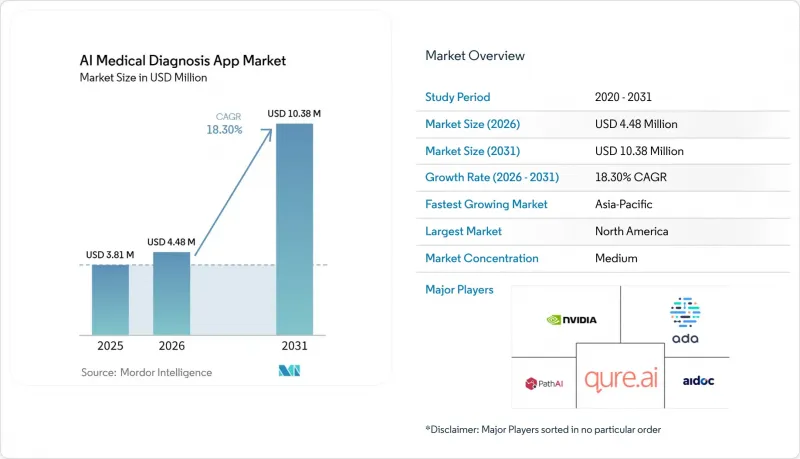
본 보고서는 구성 요소(소프트웨어, 하드웨어, 서비스), 용도(생체 내 진단, 체외 진단), 도입 형태(클라우드 기반, 하이브리드형, On-Premise형), 최종 사용자(병원, 영상진단센터, 검사 기관, 진료소, 기타 의료 제공업체), 지역(북미, 유럽, 아시아태평양, 중동 및 아프리카, 남미)별로 분류되어 있습니다.
전 세계 AI 의료 진단 앱 시장 동향과 인사이트
신속한 분류 및 질환 조기 발견에 대한 수요 증가
AI 의료 진단 앱 시장은 과부하 상태에 있는 영상 진단 워크플로우에서 보다 신속한 판독, 조기 이상 감지 및 프런트엔드에서의 우선순위 지정을 요구하는 병원 측 수요 덕분에 성장하고 있습니다. Aidoc사는 2026년 6월, 흉부 X선 사진의 예비 보고서를 자동 생성하는 도구 ‘First Read’에 대해 FDA의 획기적 의료기기(Breakthrough Device) 지정을 획득했습니다. 이는 AI 의료 진단 앱 시장 도입이 단순한 경보 알림 단계를 넘어 직접적인 보고서 작성 지원으로 전환되고 있음을 보여줍니다. 2026년 『BMC Medical Imaging』지에 게재된 연구에 따르면, 관상동맥 CT 혈관조영술을 위한 AI 통합형 구조화 보고서 작성 도구를 통해 보고서 작성 시간이 40.2% 단축되었고, 판독자 간 일치율이 45.3%에서 94.6%로 향상된 것으로 밝혀졌습니다. 이는 일관성을 해치지 않으면서도 신속한 출력이 가능함을 입증합니다. 따라서 인력 부족에 직면한 병원에서는 처리 시간을 단축하고, 임상의가 긴급한 증례에 우선적으로 대응할 수 있도록 지원하는 시스템 도입을 더욱 적극적으로 검토하고 있습니다. 이러한 추세에 따라 AI 의료 진단 앱 시장은 도입 직후 부서 차원에서 시간 절약과 업무 부담 경감을 실감할 수 있는 이용 사례로 전환되고 있습니다.
AI를 활용한 방사선과 및 병리과 워크플로우의 확대
AI 의료 진단 앱 시장은 영상 진단 분야를 기반으로 계속 발전하고 있습니다. 이는 규제 당국의 승인, 도입 실적, 데이터 세트의 가용성 측면에서 영상 진단이 여전히 가장 성숙한 임상 영역이기 때문입니다. 지멘스 헬스인어즈와 메이요 클리닉은 2026년 2월, 신경퇴행성 질환, 전립선암, 전이성 간종양의 관리를 위한 AI 지원 MRI 프로토콜을 개발하기 위해 제휴를 확대했습니다. 이는 각 벤더들이 AI를 독립된 레이어로 판매하는 것이 아니라, 영상 진단 워크플로우에 통합하고 있음을 보여줍니다. GE 헬스케어의 광자 계수 CT ‘Photonova Spectra’는 2026년 3월 FDA의 510(k) 승인을 획득했습니다. 이 장비에는 NVIDIA의 가속 컴퓨팅 기술이 통합되어 있어 기존 CT에 비해 최대 50배의 데이터를 처리할 수 있으므로, 일상적인 영상 진단 업무에서 AI 기반의 정량 분석이 강화되었습니다. 병리학 분야에서는 Paige나 Ibex와 같은 벤더들이 조직 AI를 임상 워크플로우에 도입하고 있으며, 이를 통해 AI 의료 진단 앱 시장은 방사선과를 넘어 심사 건수가 많고 자동화 수요가 명확한 진단 프로세스로 확대되고 있습니다. AI가 스캐너 프로토콜이나 진단 시스템의 일부가 됨에 따라, 구매자는 수년에 걸친 장비 수명 주기 동안 벤더에 대한 의존도가 높아지고 있으며, 그 결과 AI 의료 진단 앱 시장에서 벤더를 변경하는 데 따른 장벽이 높아지고 있습니다.
알고리즘의 설명 가능성과 책임에 대한 우려가 임상 도입을 지연시키고 있습니다.
AI 의료 진단 앱 시장은 알고리즘이 임상 판단에 영향을 미쳤을 경우 책임 소재를 결정하는 거버넌스 체계보다 더 빠르게 발전하고 있습니다. FDA 승인을 받은 AI 탑재 의료기기를 검증한 JAMA Network Open의 연구에 따르면, 조사 대상이었던 모든 이식형 AI 기기가 510(k) 절차를 통해 승인된 것으로 지적되었으며, 이로 인해 임상적 근거의 깊이와 오류 발생 시 법적 책임에 대한 의문이 제기되고 있습니다. EU의 AI 법에 따르면, 많은 의료 진단 용도이 고위험 시스템으로 분류되며, 단계적인 규정 준수 대응의 부담으로 인해 공급업체에게는 더욱 강력한 시판 후 모니터링, 인적 감독 및 투명성 확보 프로세스가 요구될 것입니다. PMC를 통해 입수 가능한 2026년 리뷰에서도, 지속 학습 모델은 도입 후 업데이트가 기존의 모니터링 체계에 잘 부합하지 않기 때문에 설명 책임의 공백을 초래한다고 지적되고 있습니다. 그 결과, 법무, 윤리, 규정 준수 각 팀이 모델의 동작, 업데이트 관리 및 장애 대응에 관한 보다 강력한 증거를 요구할 경우, AI 의료 진단 앱 시장에서 기업의 구매 주기가 장기화될 가능성이 있습니다.
부문 분석
2025년 기준, 소프트웨어는 AI 의료 진단 앱 시장의 65.2% 점유율을 차지하고 있으며, 2031년까지 연평균 성장률(CAGR) 18.8%를 나타낼 것으로 예측됩니다. 이러한 우위는 라이선싱 및 구독 모델의 경제성에 기인하며, AI 의료 진단 앱 시장에서 하드웨어 의존도가 높은 시스템에 비해 단계적 배포가 용이하기 때문입니다. 구글은 2026년에 MedGemma 1.5를 출시했고, 엔비디아는 NIM 마이크로서비스를 통해 의료 영상 지원을 확대했습니다. 이를 통해 벤더들은 모델 개발에서 상용화 가능한 제품으로의 전환 기간을 단축할 수 있게 되었습니다. 그 결과, 소프트웨어는 규제상의 재사용성, 업데이트의 유연성, 지속적인 수익 창출 가능성을 모두 갖추고 있어 AI 의료 진단 앱 업계에서 여전히 가장 확실한 성장 동력으로 자리 잡고 있습니다.
하드웨어 역시 여전히 중요한 역할을 하고 있습니다. AI 지원 스캐너와 가속화된 엣지 시스템은 일상적인 사용에서 추론의 품질과 속도를 향상시키기 때문입니다. GE 헬스케어의 'Photonova Spectra'는 이러한 역할을 명확히 보여줍니다. 이 시스템은 이미지 처리 계층에서 GPU 기반의 재구성 및 대용량 데이터 처리를 지원하기 때문입니다. 서비스는 세 번째 구성 요소이며, 제공업체는 도입 후 검증, 구현, 모니터링, 규정 준수 지원이 필요하기 때문에 AI 의료 진단 앱 시장의 이 분야는 앞으로도 그 중요성을 유지할 것입니다. 또한 중국과 유럽의 규제 요건 강화로 인해 라이프사이클 관리 및 시판 후 감시의 필요성이 높아지고 있으며, 이는 AI 의료 진단 앱 업계 전반에 걸쳐 안정적인 서비스 기회를 뒷받침하고 있습니다.
2025년 AI 의료 진단 앱 시장 규모에서 생체 내 진단이 63.8%의 점유율을 차지하고 있으며, 이에 따라 영상 진단은 현재 상업적 수요의 중심을 계속 유지하고 있습니다. 방사선과는 AI 의료 진단 앱 시장에서 보다 명확한 규제 선례, 대규모 라벨링 데이터 세트, 그리고 자동화에 적합한 강력한 워크플로우를 갖추고 있었기 때문에 다른 대부분의 전문 분야보다 빠르게 도입이 진행되었습니다. Qure.AI는 2026년 2월 기준으로 9개 제품에 걸쳐 26개의 FDA 승인 적응증을 획득했으며, 이는 영상 진단 분야의 규제 체계가 선별 검사 및 병원 환경에서의 광범위한 도입을 어떻게 뒷받침하고 있는지를 보여줍니다. 이로 인해 생체 내 진단은 도입 실적, 고객 인지도 및 단기 수익 창출 측면에서 계속해서 우위를 점하고 있습니다.
체외진단 분야는 현재 규모는 작지만, 머신러닝이 면역 분석, 분자진단, 디지털 병리학의 워크플로로 확대됨에 따라 2031년까지 연평균 성장률(CAGR) 5.2%를 나타낼 것으로 예측됩니다. 본 초안에서는 AI를 활용한 마이크로플루이딕스 플랫폼이 출력 결과를 훈련 데이터와 실시간으로 비교하는 자가 보정형 랩온칩(Lab-on-a-chip) 시스템을 지원할 수 있다고 지적하고 있으며, 이를 통해 진료 현장의 자동화가 강화될 것입니다. 로슈의 PathAI 인수 계획 또한, 주요 진단 기업들이 현재 AI 병리학 및 영상 관리를 단순한 선택적 확장 기능이 아닌 핵심 자산으로 간주하고 있음을 보여줍니다. 앞으로 검사실 자동화 및 병리학 소프트웨어가 상업적 관점에서 영상 진단에 가까워짐에 따라, AI 의료 진단 앱 시장에서는 용도 구성이 더욱 균형 잡힌 형태로 변화할 것입니다.
지역별 분석
2025년, 북미는 AI 의료 진단 앱 시장 점유율의 55.1%를 차지하며, 해당 시장에서 가장 규모가 큰 지역 블록으로서의 지위를 유지하고 있습니다. 이러한 지위는 FDA의 강력한 승인 환경, 높은 IT 도입 준비도, 그리고 엔터프라이즈급 소프트웨어 도입을 감당할 수 있는 의료 제공업체의 예산에 의해 뒷받침되고 있습니다. Aidoc사는 2026년 6월, ‘First Read’에 대해 FDA의 획기적 의료기기(Breakthrough Device) 지정을 획득했습니다. 이러한 규제 측면의 신속화는 긴급성이 높은 임상 워크플로우를 다루는 벤더들에게 더 빠른 상용화를 뒷받침해 줄 것입니다. 또한, 해당 지역에서는 민간 자본도 계속해서 활발하며, Aidoc사가 2026년 4월에 1억 5,000만 달러를 조달한 것은 AI 의료 진단 앱 시장에서 단기적인 임상 AI 수익화에 대한 투자자들의 신뢰가 지속되고 있음을 보여줍니다.
반면, 유럽의 상황은 다릅니다. AI 의료 진단 앱 시장의 성장은 규정 준수 대응 체계, 병원의 디지털화, 그리고 시스템 수준의 조달 규정과 밀접하게 연결되어 있기 때문입니다. EU AI법 및 GDPR(EU 개인정보보호규정)에 따라 의료 데이터와 고위험 소프트웨어에 대한 운영 환경이 더욱 엄격해지고 있으며, 이로 인해 정해진 신고 절차를 완료하고 문서화 능력이 뛰어난 벤더가 유리한 위치에 서는 경향이 있습니다. 또한, 영국의 NHS(국민보건서비스)에서도 AI가 유방촬영술 검진의 업무 부담을 경감시킬 수 있음이 입증되었으며, 이는 지역 내 조달 논의에서 영상 진단의 활용 사례가 계속해서 중요한 위치를 차지하는 요인이 되고 있습니다. 독일은 의료 기술의 기반과 병원 조달 규모가 크기 때문에 여전히 중요한 시장이며, 한편 프랑스, 이탈리아, 스페인에서는 디지털화 프로그램이 전자건강기록(EHR) 및 PACS의 현대화를 뒷받침하고 있어 성장 여지가 있습니다.
아시아태평양은 AI 의료 진단 앱 시장에서 2031년까지 19.2%라는 가장 높은 연평균 성장률(CAGR)을 나타낼 전망입니다. 이 지역은 정책 지원, 국내 AI 공급업체, 그리고 선진국 및 신흥국 의료 시스템 모두에서 충족되지 않은 진단 수요가 크다는 점의 혜택을 받고 있습니다. 한국에서는 2025년에 157건의 의료용 AI 승인이 보고되었으며, 2026년 4월에는 생성형 AI 의료기기로서 첫 승인이 내려졌는데, 이는 새로운 소프트웨어 카테고리에 대한 적극적인 규제 환경을 보여줍니다. 또한 일본은 SaMD(소프트웨어 의료기기)에 관한 지침을 업데이트했으며, 인도 및 동남아시아에서는 휴대용 영상 진단 장치나 공중보건 프로그램과 연계된 모델을 통해 자원이 제한된 환경에서의 도입을 확대되고 있습니다. 중동 및 아프리카는 스마트 병원에 대한 투자와 민관 파트너십을 통해 소규모 기반에서 성장을 지속하고 있으며, 남미에서는 병원 그룹의 통합과 민간 보험의 보급 확대가 이를 뒷받침하고 있습니다.
기타 혜택:
- 엑셀 형식 시장 예측(ME) 시트
- 3개월간의 애널리스트 지원
자주 묻는 질문
목차
제1장 서론
제2장 조사 방법
제3장 주요 요약
제4장 시장 구도
제5장 시장 규모 및 성장 예측(금액;주요 분석 대상 물질 출하량)
제6장 경쟁 구도
제7장 시장 기회와 향후 전망
JHS 26.08.11According to Mordor Intelligence, the AI medical diagnosis app market size is expected to grow from USD 3.81 million in 2025 to USD 4.48 million in 2026 and is forecast to reach USD 10.38 million by 2031 at 18.30% CAGR over 2026-2031.
This report is Segmented by Component (Software, Hardware, Services), Application (In Vivo Diagnostics, in Vitro Diagnostics), Deployment Mode (Cloud Based, Hybrid, On Premises), End User (Hospitals, Diagnostic Imaging Centers, Diagnostic Laboratories, Clinics and Other Healthcare Providers), and Geography (North America, Europe, Asia-Pacific, Middle East and Africa, South America).
Global AI Medical Diagnosis App Market Trends and Insights
Rising Demand for Faster Triage and Early Disease Detection
The AI medical diagnosis app market is benefiting from hospital demand for faster reading, earlier flagging, and better front-end prioritization in overloaded imaging workflows. Aidoc received FDA Breakthrough Device Designation in June 2026 for First Read, an autonomous tool that generates preliminary chest radiograph reports, which shows that AI medical diagnosis app market adoption is moving beyond alerting into direct reporting support. A 2026 study in BMC Medical Imaging found that an AI-integrated structured reporting tool for coronary CT angiography reduced reporting time by 40.2% and improved inter-reader agreement from 45.3% to 94.6%, which supports faster output without weakening consistency . Hospitals facing staffing shortages are therefore more willing to evaluate systems that shorten turnaround time and help clinicians focus on urgent cases first. This pattern is helping the AI medical diagnosis app market move toward use cases where time savings and operational relief are visible at the department level soon after deployment.
Expansion of AI-Enabled Radiology and Pathology Workflow
The AI medical diagnosis app market continues to build on radiology because imaging remains the most mature clinical area for regulatory clearances, deployment experience, and dataset availability. Siemens Healthineers and Mayo Clinic expanded their collaboration in February 2026 to develop AI-enabled MRI protocols for neurodegenerative disease, prostate cancer, and metastatic liver tumor management, which shows how vendors are embedding AI inside imaging workflows rather than selling it as a separate layer. GE HealthCare's Photonova Spectra photon-counting CT received FDA 510(k) clearance in March 2026 and integrates NVIDIA accelerated computing that handles up to 50 times more data than conventional CT, which strengthens routine AI-based quantitative analysis in daily imaging practice. In pathology, vendors such as Paige and Ibex are pushing tissue AI into clinical workflows, which is expanding the AI medical diagnosis app market beyond radiology and into diagnostic processes with high review volume and clear automation needs. As AI becomes part of scanner protocols and diagnostic systems, buyers face deeper vendor dependence over multiyear equipment cycles, and that raises switching barriers in the AI medical diagnosis app market.
Algorithm Explainability and Liability Concerns Slow Clinical Adoption
The AI medical diagnosis app market is advancing faster than the governance systems that decide accountability when an algorithm influences a clinical decision . A JAMA Network Open study reviewing FDA-authorized AI-enabled medical devices noted that all implantable AI devices in its sample cleared through the 510(k) pathway, which raises questions around the depth of clinical evidence and legal responsibility when errors occur. The EU AI Act classifies many medical diagnostic applications as high-risk systems, and the phased compliance burden will require stronger post-market monitoring, human oversight, and transparency processes from vendors. A 2026 review available through PMC also noted that continuous learning models create accountability gaps because post-deployment updates do not fit neatly into older surveillance structures. As a result, enterprise buying cycles in the AI medical diagnosis app market can lengthen when legal, ethics, and compliance teams want stronger proof of model behavior, update control, and failure response.
Other drivers and restraints analyzed in the detailed report include:
- Multi-Modal Clinical Data Convergence Improves Diagnostic Precision
- Provider Push Toward Workflow Automation in Overloaded Systems
For complete list of drivers and restraints, kindly check the Table Of Contents.
Segment Analysis
Software held 65.2% of AI medical diagnosis app market share in 2025, and it is also projected to grow at an 18.8% CAGR through 2031. This lead reflects the economics of licensing and subscription models, where incremental distribution is easier than for hardware-heavy systems in the AI medical diagnosis app market. Google released MedGemma 1.5 in 2026, and NVIDIA expanded medical imaging support through NIM microservices, which helps software vendors shorten the path from model development to deployable products. As a result, software remains the clearest scale engine inside the AI medical diagnosis app industry because it combines regulatory reuse, update flexibility, and recurring revenue potential.
Hardware still matters because AI-enabled scanners and accelerated edge systems raise the quality and speed of inference during routine use. GE HealthCare's Photonova Spectra shows this role clearly because the system supports GPU-based reconstruction and high-volume data handling at the imaging layer. Services form the third component block, and this part of the AI medical diagnosis app market will stay relevant as providers need validation, implementation, monitoring, and compliance support after deployment. Regulatory demands in China and Europe are also increasing the need for lifecycle management and post-market oversight, which supports a steady services opportunity across the AI medical diagnosis app industry.
In vivo diagnostics represented 63.8% share of the AI medical diagnosis app market size in 2025, which keeps imaging at the center of current commercial demand. Radiology reached adoption earlier than most specialties because it had clearer regulatory precedents, large labeled datasets, and stronger workflow fit for automation in the AI medical diagnosis app market. Qure.AI had 26 FDA-cleared indications across 9 products by February 2026, which shows how regulatory depth in imaging can support broad deployment across screening and hospital settings. This keeps in vivo diagnostics ahead on installed use, customer familiarity, and near-term revenue capture.
In vitro diagnostics is smaller today, but it is projected to grow at a 5.2% CAGR through 2031 as machine learning expands into immunoassay, molecular diagnostics, and digital pathology workflows. The draft notes that AI-enabled microfluidic platforms can support self-correcting lab-on-chip systems that compare outputs to training data in real time, which strengthens automation at the point of care. Roche's planned acquisition of PathAI also shows that large diagnostics companies now view AI pathology and image management as core assets rather than optional extensions. Over time, the AI medical diagnosis app market should see a more balanced application mix as laboratory automation and pathology software move closer to imaging in commercial relevance.
Complete Report Scope:
- By Component
- Software
- Hardware
- Services
- By Application
- In Vivo Diagnostics
- In Vitro Diagnostics
- By Deployment Mode
- Cloud Based
- Hybrid
- On Premises
- By Tend User
- Hospitals
- Diagnostic Imaging Centers
- Diagnostic Laboratories
- Clinics and Other Healthcare Providers
- By Geography
- North America
- United States
- Canada
- Mexico
- Europe
- Germany
- United Kingdom
- France
- Italy
- Spain
- North America
- United States
- Canada
- Mexico
- Europe
- Germany
- United Kingdom
- France
- Italy
- Spain
- Rest of Europe
- Asia-Pacific
- China
- India
- Japan
- South Korea
- Australia
- Rest of Asia-Pacific
- Middle East & Africa
- GCC
- South Africa
- Rest of Middle East and Africa
- South America
- Brazil
- Argentina
- Rest of South America
- North America
Geography Analysis
North America held 55.1% of AI medical diagnosis app market share in 2025, which keeps it as the largest regional block in the AI medical diagnosis app market. This position is supported by a strong FDA clearance environment, high IT readiness, and provider budgets that can absorb enterprise-scale software deployment. Aidoc received FDA Breakthrough Device Designation for First Read in June 2026, and that kind of regulatory acceleration supports faster commercialization for vendors addressing urgent clinical workflows. Private capital also remains active in the region, as Aidoc raised USD 150 million in April 2026, which signals continued investor confidence in near-term clinical AI monetization in the AI medical diagnosis app market.
Europe has a different profile because growth is tied closely to compliance readiness, hospital digitization, and system-level procurement rules in the AI medical diagnosis app market. The EU AI Act and GDPR create a stricter operating environment for health data and high-risk software, which tends to favor vendors with established filings and stronger documentation capacity. The UK's NHS has also shown that AI can reduce mammography screening workloads, and this keeps imaging use cases prominent in regional procurement discussions. Germany remains important because of its medical technology base and hospital purchasing depth, while France, Italy, and Spain offer expansion potential as digitization programs support EHR and PACS modernization.
Asia Pacific is projected to record the fastest CAGR at 19.2% through 2031 in the AI medical diagnosis app market. The region is benefiting from policy support, domestic AI vendors, and large unmet diagnostic demand across both advanced and emerging healthcare systems. South Korea reported 157 medical AI approvals in 2025 and issued the first clearance of a generative AI medical device in April 2026, which shows an active regulatory environment for newer software categories. Japan is also updating SaMD guidance, while India and Southeast Asia are expanding deployment in under-resourced settings through models tied to portable imaging and public health programs. The Middle East and Africa are growing from a smaller base through smart hospital investment and public partnerships, while South America is being supported by hospital group consolidation and broader private insurance reach.
- Alphabet Inc. (Google Health / DeepMind)
- Microsoft
- NVIDIA
- Siemens Healthineers
- GE HealthCare Technologies Inc.
- Koninklijke Philips
- Roche
- Tempus AI, Inc.
- Aidoc Medical Ltd.
- Qure.AI Technologies Private Limited
- Heartflow
- PathAI, Inc.
- Paige.AI, Inc.
- IBM
- Ada Health GmbH
- AliveCor
- Butterfly Network, Inc.
- Digital Diagnostics
- Lunit
- Ibex Medical Analytics Ltd.
Additional Benefits:
- The market estimate (ME) sheet in Excel format
- 3 months of analyst support
TABLE OF CONTENTS
1 Introduction
- 1.1 Study Assumptions & Market Definition
- 1.2 Scope of the Study
2 Research Methodology
3 Executive Summary
4 Market Landscape
- 4.1 Market Overview
- 4.2 Market Drivers
- 4.2.1 Rising Demand for Faster Triage and Early Disease Detection
- 4.2.2 Expansion of AI-Enabled Radiology and Pathology Workflows
- 4.2.3 Multi-Modal Clinical Data Convergence Improves Diagnostic Confidence
- 4.2.4 Provider Push Toward Workflow Automation in Overburdened Health Systems
- 4.2.5 Integration With Wearables and Remote Monitoring Expands Diagnostic Reach
- 4.2.6 Growing Investment in Clinical Validation and Interoperable AI Platforms
- 4.3 Market Restraints
- 4.3.1 Algorithm Explainability and Liability Concerns Slow Clinical Trust
- 4.3.2 High Integration Cost Across PACS, EHR, and Hospital IT Stacks
- 4.3.3 Data Privacy, Sovereignty, and Cross-Border Model Training Constraints
- 4.3.4 Regulatory Heterogeneity and Revalidation Burden for Model Updates
- 4.4 Value / Supply-Chain Analysis
- 4.5 Regulatory Landscape
- 4.6 Technological Outlook
- 4.7 Porters Five Forces
5 Market Size & Growth Forecasts (Value; volume for key analytes)
- 5.1 By Component
- 5.1.1 Software
- 5.1.2 Hardware
- 5.1.3 Services
- 5.2 By Application
- 5.2.1 In Vivo Diagnostics
- 5.2.2 In Vitro Diagnostics
- 5.3 By Deployment Mode
- 5.3.1 Cloud Based
- 5.3.2 Hybrid
- 5.3.3 On Premises
- 5.4 By Tend User
- 5.4.1 Hospitals
- 5.4.2 Diagnostic Imaging Centers
- 5.4.3 Diagnostic Laboratories
- 5.4.4 Clinics and Other Healthcare Providers
- 5.5 By Geography
- 5.5.1 North America
- 5.5.1.1 United States
- 5.5.1.2 Canada
- 5.5.1.3 Mexico
- 5.5.2 Europe
- 5.5.2.1 Germany
- 5.5.2.2 United Kingdom
- 5.5.2.3 France
- 5.5.2.4 Italy
- 5.5.2.5 Spain
- 5.5.4.6 Rest of Europe
- 5.5.5 Asia-Pacific
- 5.5.5.1 China
- 5.5.5.2 India
- 5.5.5.3 Japan
- 5.5.5.4 South Korea
- 5.5.5.5 Australia
- 5.5.5.6 Rest of Asia-Pacific
- 5.5.6 Middle East & Africa
- 5.5.6.1 GCC
- 5.5.6.2 South Africa
- 5.5.6.3 Rest of Middle East and Africa
- 5.5.7 South America
- 5.5.7.1 Brazil
- 5.5.7.2 Argentina
- 5.5.7.3 Rest of South America
- 5.5.1 North America
6 Competitive Landscape
- 6.1 Market Concentration
- 6.2 Market Share Analysis
- 6.3 Company Profiles
- 6.3.1 Alphabet Inc. (Google Health / DeepMind)
- 6.3.2 Microsoft Corporation
- 6.3.3 NVIDIA Corporation
- 6.3.4 Siemens Healthineers AG
- 6.3.5 GE HealthCare Technologies Inc.
- 6.3.6 Koninklijke Philips N.V.
- 6.3.7 F. Hoffmann-La Roche Ltd
- 6.3.8 Tempus AI, Inc.
- 6.3.9 Aidoc Medical Ltd.
- 6.3.10 Qure.ai Technologies Private Limited
- 6.3.11 Heartflow, Inc.
- 6.3.12 PathAI, Inc.
- 6.3.13 Paige.AI, Inc.
- 6.3.14 IBM Corporation
- 6.3.15 Ada Health GmbH
- 6.3.16 AliveCor, Inc.
- 6.3.17 Butterfly Network, Inc.
- 6.3.18 Digital Diagnostics, Inc.
- 6.3.19 Lunit Inc.
- 6.3.20 Ibex Medical Analytics Ltd.
7 Market Opportunities & Future Outlook
- 7.1 White Space and Unmet Need Assessment


