|
시장보고서
상품코드
2099429
소변 배액 주머니 : 시장 점유율 분석, 업계 동향 및 통계, 성장 예측(2026-2031년)Urinary Drainage Bags - Market Share Analysis, Industry Trends & Statistics, Growth Forecasts (2026 - 2031) |
||||||
 Mordor Intelligence
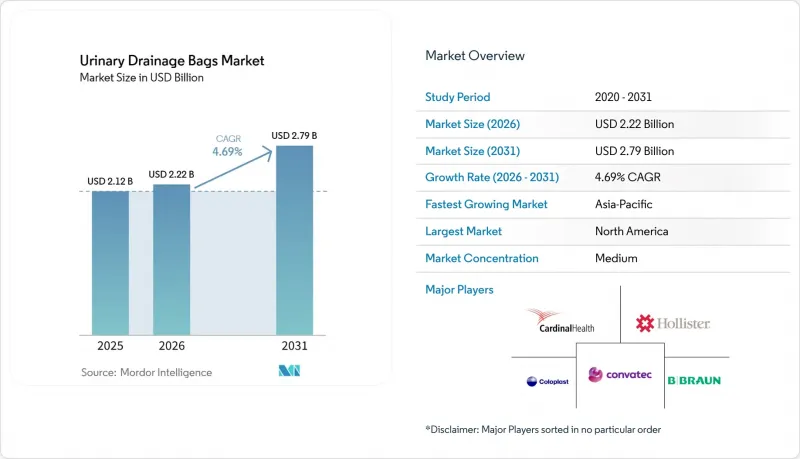
Mordor Intelligence에 의하면, 소변 배액 주머니 시장 규모는 2025년 21억 2,000만 달러로 평가되었습니다. 2026년에는 22억 2,000만 달러로 확대되어 2031년까지 27억 9,000만 달러에 이를 것으로 예상되고 2026년부터 2031년에 걸쳐 CAGR 4.69%로 성장할 전망입니다.
본 보고서는 제품 유형(대형 백 및 레그 백), 사용 형태(재사용 가능 및 일회용), 용량(0-500 ml, 500-1,000 ml, 1,000-2,000 ml), 최종 사용자(병원, 진료소, 재택치료, 외래수술센터(ASC), 기타), 지역(북미, 유럽, 아시아태평양, 중동 및 아프리카, 남미)별로 분류되어 있습니다. 시장 전망은 금액(달러) 기준으로 제시됩니다.
세계의 소변 배액 주머니 시장 동향 및 인사이트
요실금 및 요폐의 부담 증가
요실금 및 요폐는 여전히 소변 배액 주머니 시장의 주요 수요 요인으로 작용하고 있습니다. 세계보건기구(WHO)는 요실금을 허약, 운동 기능 저하, 인지 기능 저하와 함께 흔히 동반되는 주요 노인 증후군 중 하나로 규정하고 있으며, 이는 노인 돌봄 계획의 핵심 과제로 대두되고 있습니다. 유럽에서는 여성의 25%에서 45%, 그리고 일반 인구의 최대 40%가 이 증상으로 고통받고 있습니다. 이에 따른 경제적 부담은 2023년에 692억 유로(790억 8,000만 달러)로 추산되며, 2030년까지 867억 유로(990억 8,000만 달러)에 달할 것으로 예측됩니다. 80세 이상 고령층에서는 수요 증가가 특히 두드러지며, 이는 몇몇 성숙한 의료 시스템에서 가장 빠르게 증가하고 있는 집단입니다. 한편, 선별 검사 및 치료 과정의 개선으로 인해 치료를 받는 환자층은 계속해서 확대되고 있습니다.
수술 후 요로 관리 수요 증가
많은 수술 후 카테터 삽입이 여전히 일반적인 처치인 만큼, 수술 후 요폐는 계속해서 소변 배액 주머니 시장을 지탱하고 있습니다. 『Journal of the American Academy of Orthopaedic Surgeons』지에 게재된 2025년 연구에 따르면, 수술 후 요폐는 정형외과 수술 환자의 최대 43%에 영향을 미칠 수 있으며, 배액 주머니의 사용은 수술 전후 관리와 계속해서 밀접하게 연관되어 있습니다. 미국에서는 발표된 조사에 따르면, 의료 및 외과 현장에서 매년 3,000만 개에 가까운 요도 카테터가 삽입되고 있으며, 그 대부분은 병원 치료와 관련이 있습니다. 예정된 수술이 회복 및 확대됨에 따라 시장은 카테터 관련 배액 제품에 대한 안정적인 수요의 혜택을 계속 누리고 있으며, 임상 프로토콜에서도 수술 후 민감한 기간에는 역류 방지 기능과 감염 방지 기능을 갖춘 시스템이 우선적으로 채택되고 있습니다.
감염 위험, 누출에 대한 불안, 그리고 사용자의 비준수
소변 배액 주머니 시장은 감염에 대한 우려, 누출에 대한 불안, 악취 문제, 그리고 카테터 사용이 외부에서 보인다는 점으로 인한 사회적 부담과 같은 제약에 직면해 있으며, 이러한 요인들은 제품의 수용성을 저하시키고 조기 중단으로 이어질 가능성이 있습니다. 세계보건기구(WHO)의 ICOPE 지침에서는 카테터 삽입이 임상적으로 필요하지 않은 경우, 첫 번째 배뇨 관리 수단으로 흡수성 제품을 권장하고 있으며, 이로 인해 지역사회나 장기 요양 시설에서의 광범위한 사용이 제한되고 있습니다. 가정 환경에서는 주머니 배치 오류, 불규칙한 배액, 부적절한 재연결과 같은 부적절한 취급으로 인해 고품질 시스템의 이점을 충분히 체감하지 못할 가능성이 있습니다. 이러한 제약은 자원이 제한된 환경에서 더욱 두드러지며, 환자에 대한 교육 및 사후 관리 지원이 미흡한 점이 소변 배액 주머니 시장의 보급 및 가격 책정에 계속해서 영향을 미치고 있습니다.
부문 분석
레그백은 2025년에 매출의 57.60%를 차지했으며, 소변 배액 주머니 시장에서 주도적인 위치를 차지하게 될 것입니다. 이러한 점유율은 일상적인 이동이나 재택 간호에서의 사용을 더 잘 지원하는 보행에 적합한 형태로의 꾸준한 전환을 반영하고 있습니다. 환자와 간병인은 컴팩트한 디자인, 조절 가능한 고정 방식, 눈에 띄지 않는 착용감을 높이 평가하고 있으며, 이러한 특징 덕분에 레그백은 병원 밖에서도 사용하기 편리합니다. 또한, 이 형태는 기본적인 재택용 제품부터 프리미엄 실리콘 제품 및 역류 방지 기능을 갖춘 제품에 이르기까지 폭넓게 구비되어 있어, 대형 침대용 백보다 더 다양한 가격대에 대응하고 있습니다. 이러한 폭넓은 제품 라인업 덕분에 표준화된 입원용 백에 비해 소변 배액 백 시장에서 더 큰 가치 창출 기회가 생겨나고 있습니다.
일회용 소변 배액 주머니은 2026년부터 2031년까지 연평균 성장률(CAGR) 4.90%를 나타낼 것으로 예측되며, 소변 배액 주머니 시장에서 가장 빠르게 성장하는 사용 형태가 될 전망입니다. 2025년에는 일회용 백이 매출의 59.55%를 차지할 것으로 예상되는 반면, 재사용 가능한 제품은 비용 관리가 중요하고 사용자가 수동 세척을 보다 일관되게 수행할 수 있는 재택 간호 현장에서 여전히 중요한 역할을 계속할 것입니다. 두 형태의 차이를 결정짓는 것은 단순한 가격 측면이 아니라 감염 관리에 대한 기대입니다. APIC 지침에 따르면 배액 시스템은 무균 밀폐 회로를 유지해야 하며, 연결을 끊는 행위는 예방 조치 위반으로 간주되므로 급성기 의료 분야에서 일회용 제품의 보급이 촉진되고 있습니다. 그 결과, 소변 배액 주머니 시장에서 병원의 조달 동향은 꾸준히 일회용 시스템으로 전환되고 있습니다.
지역별 분석
2025년, 북미는 매출의 39.95%를 차지하며 소변 배액 주머니 시장에서 가장 규모가 큰 지역 부문이 되었습니다. 미국은 병원, 외과, 재택 간호 현장에서의 높은 카테터 사용률에 힘입어 여전히 주요 수요 거점으로 자리 잡고 있습니다. 미국에서는 내과 및 외과 의료 현장을 합쳐 매년 3,000만 개에 가까운 요도 카테터가 삽입되고 있으며, 이는 배액 제품에 대한 대규모의 지속적인 수요 기반을 형성하고 있습니다. 캐나다에서는 고령화와 광범위한 의료 보험 제도로 인해 안정적인 수요가 예상되며, 멕시코에서는 민간 병원의 수용 능력 확대와 배뇨 기능 관리에 대한 인식 제고가 호재로 작용하고 있습니다.
유럽은 소변 배액 주머니 시장에서 여전히 규모가 크고 구조적으로도 중요한 지역이며, 독일, 영국, 프랑스가 최대의 지역 수요원입니다. 유병률 부담은 여전히 크며, 노화에 따라 계속 증가하는 배뇨 기능 장애와 관련된 수요 기반이 광범위하게 존재합니다. 특히 독일은 고령화와 전문의에 대한 접근성이 양호하여 첨단 카테터 및 배액 솔루션의 지속적인 이용이 뒷받침되고 있으며, 여전히 중요한 시장으로 자리 잡고 있습니다. 서유럽 일부 지역에서는 체류 기간 연장을 목적으로 실리콘 제품으로의 전환이 진행되고 있지만, 이탈리아, 스페인 및 기타 유럽에서는 여전히 가격에 대한 민감도가 높은 경향을 보이고 있습니다.
아시아태평양은 2026년부터 2031년까지 연평균 성장률(CAGR) 5.34%를 나타낼 것으로 예측되며, 소변 배액 주머니 시장에서 가장 빠르게 성장하는 지역이 될 전망입니다. 이 지역의 급속한 고령 인구 증가와 고령자를 위한 통합 의료에 대한 관심 고조가 계속해서 수요를 뒷받침하고 있습니다. 중국에서는 병원 및 비뇨기과 의료 수용 능력이 확대되고 있으며, 일본에서는 재택치료 기반이 성숙해졌습니다. 또한, 인도와 한국에서는 의료 체계 확충과 인구 동향의 변화로 인해 수요가 증가하고 있습니다. 남미에서는 브라질과 아르헨티나를 중심으로 한 인프라 투자의 혜택을 받고 있는 반면, 중동 및 아프리카는 여전히 발전 초기 단계 시장으로, 주로 걸프 연안 국가들의 병원 확충과 남아프리카공화국에서의 재택 간병의 점진적인 보급에 의해 주도되고 있습니다.
기타 혜택 :
- 엑셀 형식 시장 예측(ME) 시트
- 3개월간의 애널리스트 지원
자주 묻는 질문
목차
제1장 서론
제2장 조사 방법
제3장 주요 요약
제4장 시장 구도
제5장 시장 규모 및 성장 예측
제6장 경쟁 구도
제7장 시장 기회 및 향후 전망
KTH 26.08.10According to Mordor Intelligence, the urinary drainage bags market size is expected to increase from USD 2.12 billion in 2025 to USD 2.22 billion in 2026 and reach USD 2.79 billion by 2031, growing at a CAGR of 4.69% over 2026-2031.
This report is Segmented by Product Type (Large Bags and Leg Bags), Usage Type (Reusable, and Disposable), Capacity (0-500 Ml, 500-1000 Ml, 1000-2000 Ml), End User (Hospitals, Clinics, Home Healthcare, Ambulatory Surgical Centers, Others), and Geography (North America, Europe, Asia-Pacific, Middle East and Africa, South America). The Market Forecasts are Provided in Terms of Value (USD).
Global Urinary Drainage Bags Market Trends and Insights
Rising Burden Of Urinary Incontinence and Retention
Urinary incontinence and urinary retention remain key demand drivers for the urinary drainage bags market. The World Health Organization identifies incontinence as a core geriatric syndrome that often occurs alongside frailty, limited mobility, and cognitive decline, keeping it central to care planning for older adults. In Europe, the condition affects 25% to 45% of women and up to 40% of the broader population. Its economic burden was estimated at EUR 69.2 billion (USD 79.08 billion) in 2023 and is projected to reach EUR 86.7 billion (USD 99.08 billion) by 2030. Demand is rising faster among people aged 80 years and older, the fastest-growing group in several mature healthcare systems, while improved screening and care pathways continue to expand the treated patient base.
Growth In Postoperative Urinary Management Needs
Postoperative urinary retention continues to support the urinary drainage bags market, as catheterization remains a common practice after many procedures. A 2025 study in the Journal of the American Academy of Orthopaedic Surgeons reports that postoperative urinary retention can affect up to 43% of orthopedic surgery patients, keeping drainage bag use closely linked to perioperative care. In the United States, published research states that nearly 30 million indwelling urethral catheters are placed each year across medical and surgical settings, with most placements tied to hospital-based care. As elective procedures recover and expand, the market continues to benefit from steady demand for catheter-associated drainage products, with clinical protocols shifting preference toward anti-reflux and infection-resistant systems for sensitive postsurgical periods.
Infection Risk, Leakage Anxiety, and User Non-Compliance
The urinary drainage bags market faces constraints from infection concerns, leakage anxiety, odor issues, and the social burden of visible catheter use, which can reduce acceptance and lead to early discontinuation. The World Health Organization's ICOPE guidance recommends absorbent products as the first containment option when catheterization is not clinically required, limiting broader use in community and long-term care settings. In home settings, poor handling practices, such as incorrect bag positioning, irregular emptying, or improper reconnection, can reduce the perceived benefits of higher-quality systems. This restraint is more evident in lower-resource settings, where limited patient education and follow-up support continue to affect adoption and pricing in the urinary drainage bags market.
Other drivers and restraints analyzed in the detailed report include:
- Expanding Home-Based Continence Care Pathways
- Infection-Control Upgrades, Latex-Free and Anti-Reflux
- Hospital Budget Compression and Tender-Driven Pricing
For complete list of drivers and restraints, kindly check the Table Of Contents.
Segment Analysis
Leg bags are expected to account for 57.60% of revenue in 2025, giving them the leading position in the urinary drainage bags market. Their share reflects a steady shift toward ambulatory-compatible formats that better support daily mobility and home care use. Patients and caregivers value their compact design, adjustable fixation, and discreet wear, which make leg bags easier to use outside hospital settings. This format also supports a wider pricing ladder than large bedside bags, as it includes basic home-use products as well as premium silicone and anti-reflux variants. This broader product mix creates a stronger value opportunity for the urinary drainage bags market than standardized inpatient bags.
Disposable urinary drainage bags are projected to register a 4.90% CAGR from 2026 to 2031, making them the faster-growing usage format in the urinary drainage bags market. Disposable bags are expected to represent 59.55% of revenue in 2025, while reusable alternatives remain relevant mainly in home care settings where cost control matters and users can manage manual cleaning more consistently. Infection-control expectations, rather than simple affordability, shape the difference between the two formats. APIC guidance states that the drainage system should remain a sterile closed circuit, and any disconnection is considered a break in prevention practice, supporting wider disposable use in acute care. As a result, hospital procurement is steadily shifting toward single-use systems in the urinary drainage bags market.
Complete Report Scope:
- By Product Type
- Large Bags
- Leg Bags
- By Usage Type
- Reusable Urinary Drainage Bags
- Disposable Urinary Drainage Bags
- By Capacity
- 0-500 Ml
- 500-1000 Ml
- 1000-2000 Ml
- By End User
- Hospitals
- Clinics
- Home Healthcare
- Ambulatory Surgical Centers
- Others
- By Geography
- North America
- United States
- Canada
- Mexico
- Europe
- Germany
- United Kingdom
- France
- Italy
- Spain
- Rest of Europe
- Asia-Pacific
- China
- India
- Japan
- Australia
- South Korea
- Rest of Asia-Pacific
- Middle East and Africa
- GCC
- South Africa
- Rest of Middle East and Africa
- South America
- Brazil
- Argentina
- Rest of South America
- North America
Geography Analysis
North America accounted for 39.95% of revenue in 2025, making it the largest regional segment in the urinary drainage bags market. The United States remains the primary demand center, supported by high catheter use across hospital, surgical, and home-based care settings. Nearly 30 million indwelling urethral catheters are placed each year in the country across medical and surgical settings, creating a large recurring base for drainage products. Canada adds stable demand through an aging population and broad healthcare coverage, while Mexico benefits from expanding private hospital capacity and rising continence care awareness.
Europe remains a large and structurally important region in the urinary drainage bags market, with Germany, the United Kingdom, and France supporting the largest regional demand pools. The prevalence burden remains substantial, with a broad base of continence-related needs that continues to increase with age. Germany remains especially important, as an aging population and strong specialist access support the continued use of advanced catheter and drainage solutions. In parts of Western Europe, preference is shifting toward silicone-based formats for longer dwell times, while Italy, Spain, and the rest of Europe remain more price sensitive.
Asia-Pacific is projected to grow at a CAGR of 5.34% from 2026 to 2031, making it the fastest-growing geography in the urinary drainage bags market. The region's rapidly expanding elderly population and growing focus on integrated care for older adults continue to support demand. China is expanding hospital and urological care capacity, Japan has a mature home care base, and India and South Korea are adding demand through healthcare expansion and demographic change. South America is benefiting from infrastructure investment, led by Brazil and Argentina, while the Middle East and Africa remain earlier-stage markets driven mainly by hospital expansion in the Gulf and gradual home care adoption in South Africa.
- Amsino International, Inc.
- B. Braun
- Beckton Dickinson
- Cardinal Health
- Coloplast
- Convatec
- Cook Group
- Flexicare Medical
- GPC Medical Ltd.
- Hollister
- Manfred Sauer GmbH
- Mckesson
- Medline Industries
- Medtronic
- Romsons Scientific and Surgical Industries Pvt. Ltd.
- Santex S.p.A.
- Sol-Millennium Medical Group, Inc.
- Teleflex
- Utah Medical Products
- Well Lead Medical Co., Ltd.
Additional Benefits:
- The market estimate (ME) sheet in Excel format
- 3 months of analyst support
TABLE OF CONTENTS
1 INTRODUCTION
- 1.1 Study Assumptions and Market Definition
- 1.2 Scope of the Study
2 RESEARCH METHODOLOGY
3 EXECUTIVE SUMMARY
4 MARKET LANDSCAPE
- 4.1 Market Overview
- 4.2 Market Drivers
- 4.2.1 Rising Burden of Urinary Incontinence and Retention
- 4.2.2 Growth In Postoperative Urinary Management Needs
- 4.2.3 Expanding Home-Based Continence Care Pathways
- 4.2.4 Infection-Control Upgrades, Latex-Free and Anti-Reflux Designs
- 4.2.5 Reimbursement Pressure Favoring Standardized Low-Cost Drainage Systems
- 4.2.6 Under-Recognized Demand from Long-Stay Mobility-Limited Patients Using Wearable Leg Bags
- 4.3 Market Restraints
- 4.3.1 Infection Risk, Leakage Anxiety, and User Non-Compliance
- 4.3.2 Hospital Budget Compression and Tender-Driven Pricing
- 4.3.3 Disposal, Odor, and Biomedical Waste Handling Burdens
- 4.3.4 Substitution Risk from Intermittent Catheterization and Alternative Bladder Management
- 4.4 Value/Supply Chain Analysis
- 4.5 Regulatory Landscape
- 4.6 Technological Outlook
- 4.7 Porter's Five Forces Analysis
- 4.7.1 Threat of New Entrants
- 4.7.2 Bargaining Power of Suppliers
- 4.7.3 Bargaining Power of Buyers
- 4.7.4 Threat of Substitutes
- 4.7.5 Intensity of Competitive Rivalry
5 MARKET SIZE AND GROWTH FORECASTS (VALUE, USD)
- 5.1 By Product Type
- 5.1.1 Large Bags
- 5.1.2 Leg Bags
- 5.2 By Usage Type
- 5.2.1 Reusable Urinary Drainage Bags
- 5.2.2 Disposable Urinary Drainage Bags
- 5.3 By Capacity
- 5.3.1 0-500 Ml
- 5.3.2 500-1000 Ml
- 5.3.3 1000-2000 Ml
- 5.4 By End User
- 5.4.1 Hospitals
- 5.4.2 Clinics
- 5.4.3 Home Healthcare
- 5.4.4 Ambulatory Surgical Centers
- 5.4.5 Others
- 5.5 By Geography
- 5.5.1 North America
- 5.5.1.1 United States
- 5.5.1.2 Canada
- 5.5.1.3 Mexico
- 5.5.2 Europe
- 5.5.2.1 Germany
- 5.5.2.2 United Kingdom
- 5.5.2.3 France
- 5.5.2.4 Italy
- 5.5.2.5 Spain
- 5.5.2.6 Rest of Europe
- 5.5.3 Asia-Pacific
- 5.5.3.1 China
- 5.5.3.2 India
- 5.5.3.3 Japan
- 5.5.3.4 Australia
- 5.5.3.5 South Korea
- 5.5.3.6 Rest of Asia-Pacific
- 5.5.4 Middle East and Africa
- 5.5.4.1 GCC
- 5.5.4.2 South Africa
- 5.5.4.3 Rest of Middle East and Africa
- 5.5.5 South America
- 5.5.5.1 Brazil
- 5.5.5.2 Argentina
- 5.5.5.3 Rest of South America
- 5.5.1 North America
6 COMPETITIVE LANDSCAPE
- 6.1 Market Concentration
- 6.2 Market Share Analysis
- 6.3 Company Profiles (includes Global Level Overview, Market Level Overview, Core Segments, Financials as available, Strategic Information, Market Rank/Share, Products and Services, Recent Developments)
- 6.3.1 Amsino International, Inc.
- 6.3.2 B. Braun SE
- 6.3.3 Becton, Dickinson and Company
- 6.3.4 Cardinal Health, Inc.
- 6.3.5 Coloplast A/S
- 6.3.6 ConvaTec Group Plc
- 6.3.7 Cook Medical LLC
- 6.3.8 Flexicare Medical Limited
- 6.3.9 GPC Medical Ltd.
- 6.3.10 Hollister Incorporated
- 6.3.11 Manfred Sauer GmbH
- 6.3.12 McKesson Corporation
- 6.3.13 Medline Industries, LP
- 6.3.14 Medtronic plc
- 6.3.15 Romsons Scientific and Surgical Industries Pvt. Ltd.
- 6.3.16 Santex S.p.A.
- 6.3.17 Sol-Millennium Medical Group, Inc.
- 6.3.18 Teleflex Incorporated
- 6.3.19 Utah Medical Products, Inc.
- 6.3.20 Well Lead Medical Co., Ltd.
7 MARKET OPPORTUNITIES AND FUTURE OUTLOOK
- 7.1 White-Space and Unmet-Need Assessment