
|
시장보고서
상품코드
2099452
백본 네트워크 서비스 : 시장 점유율 분석, 업계 동향 및 통계, 성장 예측(2026-2031년)Backbone Network Services - Market Share Analysis, Industry Trends & Statistics, Growth Forecasts (2026 - 2031) |
||||||
 Mordor Intelligence
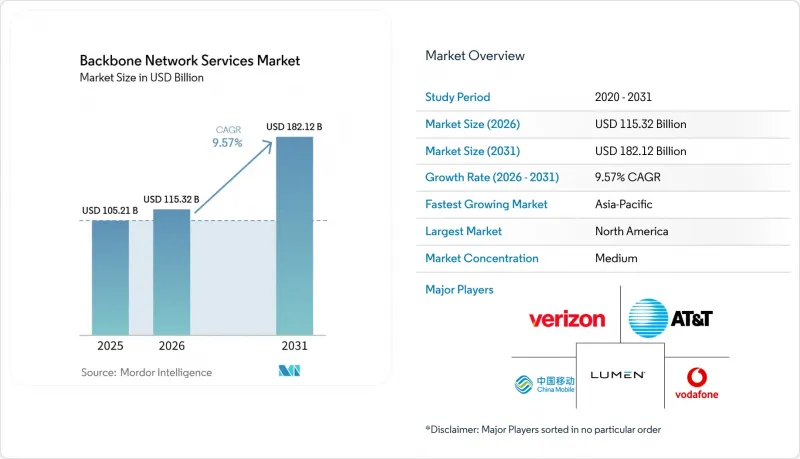
Mordor Intelligence에 의하면, 백본 네트워크 서비스 시장 규모는 2025년에 1,052억 1,000만 달러로 평가되었습니다. 2026년부터 2031년에 걸쳐 CAGR 9.57%로 확대되어 2031년에는 1,821억 2,000만 달러에 이를 것으로 예측됩니다.
본 보고서는 네트워크 유형별(유선, 무선), 서비스 유형별(인터넷 백본, 인트라넷 등), 접속 모델(P2P, 통신사 간 도매, 관리형 파장 등), 최종 용도(통신, 기업, 정부, 교육, 의료 등), 지역(북미, 남미, 유럽 등)별로 분류되어 있습니다. 시장 전망은 금액(달러) 기준으로 제시되어 있습니다.
세계의 백본 네트워크 서비스 시장 동향 및 인사이트
증가하는 크로스 클라우드 및 데이터센터 간 상호 연결 트래픽
백본 네트워크 서비스 시장에서 새로운 코어 용량의 주요 촉진요인으로 기존 엔터프라이즈 WAN 수요를 대체하여 크로스 클라우드 트래픽이 부상하고 있습니다. 2025년에는 전 세계 인터넷 대역폭이 대폭 확대되었으며, 그 트래픽의 대부분은 분산형 AI 워크로드 및 광범위한 멀티클라우드 사용과 관련된 데이터센터 간 및 클라우드 간 통신 트래픽에서 비롯되었습니다. 이러한 변화로 인해 기존 코어 레이아웃은 서로 다른 트래픽 패턴에 맞추어 구축되었기 때문에 통신 사업자들은 백본 설계의 업데이트 주기를 단축할 수밖에 없게 되었습니다. 2026년 3월, 차이나모바일은 115.2T의 스위칭 용량과 144개의 800GE 장거리 포트를 갖춘 라우터 프로토타입을 특징으로 하는 ‘GSE-DCI’ 솔루션을 발표하며, AI 전송 수요가 얼마나 신속하게 상용 백본 계획에 반영되고 있는지를 입증했습니다. 그 결과, 데이터센터 클러스터를 중심으로 한 경로를 갖춘 통신 사업자는 여전히 기존의 도시 간 허브 패턴에 의존하는 사업자보다 유리한 입장에 있습니다. 이러한 라우팅의 전환으로 인해 백본 네트워크 서비스 시장에는 용량 밀도, 저지연, 신속한 확장을 축으로 한 보다 명확한 프리미엄 계층이 형성되고 있습니다.
5G, IoT 및 저지연 백홀의 확대
백본 네트워크 서비스 시장은 5G 백홀, 사물 연결성, 그리고 보다 엄격한 지연 제어가 필요한 서비스의 보급에 힘입어 성장하고 있습니다. 새로운 5G 스몰 셀 클러스터에는 지역 또는 전국의 백본 노드로 연결되는 신뢰할 수 있는 경로가 필요하며, 이로 인해 이전에는 마이크로파에만 의존하던 지역에도 광섬유가 더욱 깊이 침투하고 있습니다. 노키아가 보다폰 아이디어(Vodafone Idea)를 대상으로 수행한 2025년 구축 사례는 통신 사업자들이 더 고밀도인 4G 및 5G 트래픽을 지원하기 위해 더욱 견고한 IP/MPLS 백본을 구축하고자 전송 네트워크를 현대화하고 있는 실태를 보여줍니다. IoT 트래픽은 또 다른 계층을 추가합니다. 산업, 농업, 스마트 시티 이용 사례에서는 일반 소비자 트래픽보다 더 엄격한 트래픽 처리가 필요한 비대칭 흐름이 발생하기 때문입니다. 이러한 운영상의 현실로 인해 통신 사업자는 특히 프라이빗 5G 요소를 포함하는 기업용 계약을 목표로 할 경우, 백본 경로 전반에 걸쳐 서비스 품질을 더욱 신중하게 설계해야 하는 상황에 직면해 있습니다. 사실상 백본 네트워크 서비스 시장은 현재 모바일 네트워크의 고밀도화와 통신 사업자들이 다음 단계로 삼고 있는 기업용 전송 서비스의 번들화라는 두 가지 요인 모두로부터 혜택을 받고 있습니다.
코어 전송 및 광섬유 자산의 높은 자본 집약도
막대한 업그레이드 투자는 여전히 백본 네트워크 서비스 시장에 있어 가장 큰 구조적 걸림돌로 작용하고 있습니다. AT&T는 2025년에 220억 달러의 설비 투자를 보고했으며, 2028년까지 연간 230억-240억 달러를 예상하고 있어, 최대 규모의 통신 사업자조차도 광섬유와 코어 전송망의 동시 확장이 얼마나 막대한 비용이 드는지를 여실히 보여주고 있습니다. 광학 부품, 라우팅 플랫폼, 긴 리드타임 등의 요인으로 인해 대규모 구매자의 입지가 점점 더 유리해지고 있어, 중소 지역 통신 사업자가 이러한 투자 수준을 따라가기란 어렵습니다. 그 결과, 경로를 신속하게 갱신할 수 있는 대형 통신 사업자와 자산의 수명을 연장하거나 업그레이드를 연기할 수밖에 없는 중소 사업자 간의 격차가 더욱 확대되고 있습니다. 일부 통신 사업자는 장비의 수명 주기를 연장하거나, 신규 도입 가격이 가장 불리한 경우에는 중고 하드웨어 조달 경로에 눈을 돌림으로써 이러한 상황에 대응하고 있습니다. 그럼에도 불구하고, 노선 확장, 광통신으로의 전환, 고객 서비스에 대한 투자가 모두 동시에 자본을 필요로 하는 상황에서 백본 네트워크 서비스 시장은 여전히 취약한 상태에 있습니다. 이러한 압박은 400G 및 800G로의 전환과 새로운 회선 구간 구축이 겹치는 상황에서 특히 두드러집니다.
부문 분석
2025년, 유선 백본 네트워크 서비스는 매출의 71.23%를 차지하며, 이 부문은 계속해서 백본 네트워크 서비스 시장의 확고한 기반으로서의 지위를 유지했습니다. 트래픽 밀도와 신호 안정성이 가장 중요한 대용량·저지연 도시 간 전송에서는 여전히 광섬유가 최적의 선택지로 자리 잡고 있습니다. 또한, 이 부문은 국내 및 국경을 넘는 경로에서 400G 및 800G 파장의 지속적인 도입으로 인해 혜택을 받고 있습니다. 노키아가 2025년에 KPN의 네덜란드 국내 백본을 216Tbps 이상으로 업그레이드한 사례는 통신 사업자가 광섬유의 핵심적인 역할을 바꾸지 않으면서도 새로운 광 시스템을 활용하여 규모를 확대하고 있는 실태를 보여줍니다. 유선 서비스 중에서는 VPN 백본, 인트라넷 백본, 전용 파장 서비스가 여전히 주요 수익원으로 자리 잡고 있지만, 경로 관리 강화를 원하는 구매자들 사이에서 다크 파이버 임대가 주목받고 있습니다.
그렇지만 무선 백본 네트워크 서비스는 2031년까지 연평균 성장률(CAGR) 11.32%를 나타낼 것으로 예측되며, 이 시장에서 가장 빠르게 성장하는 부문이 될 전망입니다. 이러한 성장세는 5G 스몰셀 백홀, 고정 무선 접속 회선, 그리고 광섬유 전면 구축이 지연되거나 경제적으로 부적합한 도시 간 2차 링크에서 비롯된 것입니다. 2025년 세라곤(Ceragon)사가 IP-50EXP를 출시한 것은 mm파 시스템이 성능 격차의 일부를 메우고 있음을 보여주며, 이전에는 E-밴드만 사용해야 했던 경로에서 2+0 구성으로 최대 20Gbps를 달성했습니다. 이로 인해, 특히 통신 사업자가 서비스 품질을 희생하지 않고 도입 비용을 절감하고자 하는 신흥 시장에서 하이브리드 백본 설계의 타당성이 더욱 높아지고 있습니다. 그 결과, 백본 네트워크 서비스 시장은 광섬유가 여전히 핵심을 이루고 있지만, 특정 경로에서는 무선 백홀이 더 강력한 공동 주요 옵션이 되는 보다 균형 잡힌 모델로 전환되고 있습니다.
2025년, 인터넷 백본 서비스의 점유율은 49.12%를 차지하며, 이 부문은 백본 네트워크 서비스 시장에서 가장 큰 서비스 계층이 되었습니다. 이러한 위상은 통신 사업자, 기업 및 디지털 플랫폼을 위한 전 세계 인터넷 트래픽을 전송하는 데 있어 Tier 1 IP 트랜짓이 계속해서 중요한 역할을 하고 있음을 반영합니다. 2025년, GTT가 Tier 1 용량 부문에서 세계 3위의 백본으로 인정받으며 네트워크 전체에서 700테라비트를 넘는 용량을 보유한 것은 비트당 가격에 압박이 가해지고 있음에도 불구하고 규모를 둘러싼 경쟁이 여전히 활발함을 보여줍니다. 인트라넷 백본 서비스는 트래픽 분리, 운영 관리, 그리고 일반 트랜짓에서는 제공할 수 없는 보다 강력한 서비스 보장을 필요로 하는 기업 및 정부 기관 고객에게 계속해서 제공되고 있습니다. 이로 인해 표준 트랜짓의 이익률이 어려운 상황에서도 프리미엄 서비스에 대한 수요는 유지되고 있습니다.
VPN 백본 서비스는 2031년까지 연평균 성장률(CAGR) 10.87%를 나타낼 것으로 예측되며, 본 조사에서 가장 빠르게 성장하는 서비스 유형이 될 것입니다. 많은 기업이 여전히 정책 계층이나 용도 계층의 하류에서 관리형 백본 전송을 필요로 하고 있기 때문에 이 부문은 소프트웨어 정의 WAN(SD-WAN) 도입의 혜택을 받고 있습니다. Lumen사는 2026년 1월, AI 기반 및 멀티 클라우드 워크로드를 위한 프로그래밍 가능한 연결성을 원동력으로 삼아 2025년 3분기 이후 자사의 ‘Network-as-a-Service’ 고객 기반이 2,000개사 이상으로 확대되었다고 발표했습니다. 이러한 변화에 따라 백본 네트워크 서비스 업계에서는 VPN 백본을 전용선의 구식 대안이라기보다는 소프트웨어로 오케스트레이션되는 전송 패브릭으로 인식하고 있습니다. 또한 VPN 서비스의 역할도 AI 훈련을 위한 상호 연결, 실시간 추론 지원, 그리고 지연 시간 및 트래픽 예측 가능성이 여전히 중요한 기타 워크로드로 확대되고 있습니다.
지역별 분석
2025년, 북미는 백본 네트워크 서비스 시장 점유율의 28.95%를 차지하며, 이 지역은 계속해서 전 세계 수요의 중심지로서의 위상을 유지했습니다. 북미 백본 네트워크 서비스 시장은 하이퍼스케일러 캠퍼스, Tier 1 통신사 네트워크 및 기업 연결성에 대한 투자가 집중되어 있어 계속해서 혜택을 받고 있습니다. AT&T는 2026년까지 5년간 2,500억 달러 규모의 인프라 투자를 발표했습니다. 여기에는 2028년까지 연간 230억-240억 달러의 설비 투자액을 예상하는 것은 물론, 2026년 말까지 연간 400만 곳의 신규 거점에 광섬유를 구축하겠다는 목표가 포함된 계획입니다. 또한, 루멘(Lumen)사도 2026년에 ‘노스라인(NorthLine)’ 노선 구축을 추진하여, AI 데이터 마이그레이션을 위해 조성된 북부 데이터센터 회랑을 따라 시애틀과 미니애폴리스를 연결할 계획입니다. 이러한 투자는 해당 지역의 성장이 단순한 표준 도매 사업의 확대를 넘어, AI와 관련된 장거리 회랑 및 전용 연결 인프라로 향하고 있음을 보여줍니다.
유럽은 막대한 기업 트래픽, 국가 차원의 인프라 우선순위, 그리고 강화되는 규정 준수 요건이 복합적으로 작용하고 있어 전략적으로 중요한 지역으로 남아 있습니다. 유럽의 백본 네트워크 서비스 시장은 경로 재편, 국내 복원력 계획 강화, 대용량 광 시스템으로의 신속한 전환을 통해 재편되고 있습니다. 노키아가 2025년에 수행한 KPN의 전송 및 코어 네트워크를 800G 지원 아키텍처로 업그레이드하여 216Tbps를 초과하는 용량을 실현한 사례는 더 고밀도화되고 자동화된 인프라로의 이러한 움직임을 반영한 것입니다. 2026년 2월에 진행된 GEANT의 800G IP 백본으로의 전환 역시 같은 방향성을 보여주는데, 이는 연구 및 교육 분야의 트래픽에 있어서도 유럽 전역에서 더 대규모의 용량 기반이 필요했기 때문입니다. 이러한 상업적 수요와 정책 주도형 내결함성의 결합이 해당 지역 전체에서 보다 계획적인 업그레이드 주기를 뒷받침하고 있습니다.
아시아태평양의 백본 네트워크 서비스 시장은 2031년까지 연평균 성장률(CAGR) 11.33%로 확대될 것으로 예측되며, 지역별 부문 중 가장 빠른 성장을 이룰 전망입니다. 이 지역의 성장 속도는 중국, 인도, 동남아시아의 대규모 네트워크 확장을 반영한 것으로, 이들 지역에서는 AI 클러스터, 클라우드 성장, 5G 확대로 인해 더욱 강력한 국내 및 지역 백본에 대한 수요가 증가하고 있습니다. 차이나모바일의 홍콩 투자 및 컴퓨팅·네트워크 통합 계획은 해당 지역에서 클라우드 연동형 라우팅에 대한 수요가 현재 어느 정도 규모로 계획되고 있는지를 시사합니다. 인도에서는 노키아가 보다폰 아이디어에 도입한 사례를 통해, 주요 통신 사업자들이 더 고밀도인 4G 및 5G 트래픽에 대응하기 위해 IP/MPLS 전송망을 강화하고 있는 실태가 드러났습니다. 중동 및 아프리카 역시 경로 다각화와 새로운 동서 케이블 프로젝트를 통해 중요성이 커지고 있는 반면, 남미에서는 AI, 클라우드, 니어쇼어링 수요에 연동된 장거리 광섬유 프로젝트가 주목받고 있습니다. 이러한 동향들이 맞물리면서 백본 네트워크 서비스 시장은 아시아태평양에서 가장 급속한 확장을 이어가고 있으며, 기타 신흥 지역에서는 내결함성과 데이터센터의 성장을 중심으로 선택적인 회랑 구축이 진행되고 있습니다.
기타 혜택 :
- 엑셀 형식 시장 예측(ME) 시트
- 3개월간의 애널리스트 지원
자주 묻는 질문
목차
제1장 서론
제2장 조사 방법
제3장 주요 요약
제4장 시장 구도
제5장 시장 규모 및 성장 예측
제6장 경쟁 구도
제7장 시장 기회 및 향후 전망
KTH 26.08.10According to Mordor Intelligence, the backbone network services market size stood at USD 105.21 billion in 2025 and is forecast to reach USD 182.12 billion by 2031 at a CAGR of 9.57% over 2026-2031.
This report is Segmented by Network Type (Wired, and Wireless), Service Type (Internet Backbone, Intranet, and More), Connectivity Model (P2P, Carrier-To-Carrier Wholesale, Managed Wavelength, and More), End Use (Telecom, Enterprise, Government, Education, Healthcare, and More), and Geography (North America, South America, Europe, and More). The Market Forecasts are Provided in Terms of Value (USD).
Global Backbone Network Services Market Trends and Insights
Rising Cross-Cloud and Data Center Interconnect Traffic
Cross-cloud traffic is replacing traditional enterprise WAN demand as the primary driver of new core capacity in the backbone network services market. Global internet bandwidth grew significantly in 2025, and a larger share of that traffic came from inter-data-center and cloud-to-cloud flows tied to distributed AI workloads and broader multi-cloud use. That shift is pushing operators to shorten refresh cycles for backbone design because older core layouts were built for different traffic patterns. In March 2026, China Mobile presented its GSE-DCI solution, featuring a router prototype with 115.2T switching capacity and 144 long-haul 800GE ports, demonstrating how quickly AI transport needs are moving into commercial backbone planning. The practical result is that carriers with routes centered on data center clusters are better placed than operators still relying on older city-to-city hub patterns. That routing shift is giving the backbone network services market a clearer premium layer built around capacity density, low latency, and faster scaling.
5G, IoT, And Low-Latency Backhaul Expansion
The backbone network services market is also being lifted by the spread of 5G backhaul, machine connectivity, and services that require tighter latency control. Each new 5G small-cell cluster needs a dependable path to regional or national backbone nodes, which is forcing fiber deeper into areas that previously relied solely on microwave. Nokia's 2025 deployment for Vodafone Idea demonstrated how operators are modernizing transport networks to build a stronger IP/MPLS backbone to support denser 4G and 5G traffic. IoT traffic adds another layer, as industrial, agricultural, and smart-city use cases generate asymmetric flows that require stricter traffic handling than ordinary consumer traffic. That operating reality is pushing carriers to engineer service quality more carefully across backbone routes, especially when they target enterprise contracts with private 5G elements. In effect, the backbone network services market is gaining from mobile densification today and from enterprise transport bundling that carriers are positioning for next.
High Capital Intensity of Core Transport and Fiber Assets
High upgrade spending remains the largest structural brake on the backbone network services market. AT&T reported USD 22 billion in capital investment in 2025 and guided to USD 23 billion to USD 24 billion annually through 2028, underscoring how expensive concurrent fiber and core transport buildouts have become, even for the biggest operators. Those spending levels are harder for smaller regional carriers to match because optical components, routing platforms, and long lead times increasingly favor buyers with scale. The result is a wider gap between large carriers that can refresh routes quickly and smaller operators that must stretch asset life or delay upgrades. Some operators are responding by extending equipment life cycles and turning to secondary hardware channels when new-build pricing is least favorable. Even so, the backbone network services market remains exposed when route expansion, optical migration, and customer service commitments all demand capital simultaneously. This pressure is especially evident where 400G and 800G migrations overlap with new corridor builds.
Other drivers and restraints analyzed in the detailed report include:
- SDN, NFV, And Automated Traffic Engineering Adoption
- Secure Inter-Regional Transport Demand, Including DDoS Resilience
- Cross-Border Regulatory Fragmentation and Data Sovereignty Constraints
For complete list of drivers and restraints, kindly check the Table Of Contents.
Segment Analysis
Wired backbone network services commanded 71.23% of revenue in 2025, which kept this segment as the clear base of the backbone network services market. Fiber still offers the best fit for high-capacity, low-latency inter-city transport where traffic density and signal stability matter most. The segment also benefits from the continued deployment of 400G and 800G wavelengths on national and cross-border routes. Nokia's 2025 upgrade of KPN's Dutch backbone to more than 216Tbps showed how operators are using new optical systems to expand scale without changing the core role of fiber. Within wired services, VPN backbone, intranet backbone, and dedicated wavelength offerings remain the main revenue pillars, while dark fiber leasing is gaining traction among buyers seeking greater route control.
That said, wireless backbone network services are forecast to grow at a 11.32% CAGR through 2031, making it the fastest-growing segment of this market. Its momentum comes from 5G small-cell backhaul, fixed wireless access corridors, and secondary inter-city links where full fiber deployment is slower or less economical. Ceragon's IP-50EXP launch in 2025 demonstrated how millimeter-wave systems are closing part of the performance gap, reaching up to 20Gbps in a 2+0 configuration over routes that previously required exclusive E-band use. That strengthens the case for a mixed backbone design, especially in emerging markets where carriers want to lower deployment costs without sacrificing service quality. As a result, the backbone network services market is moving toward a more balanced model in which fiber remains central, while wireless backhaul becomes a stronger co-primary option on selected routes.
Internet backbone services held a 49.12% share in 2025, making this segment the largest service layer in the backbone network services market. That position reflects the continuing role of Tier 1 IP transit in carrying global internet traffic for carriers, enterprises, and digital platforms. GTT's recognition in 2025 as the world's third-largest global backbone by Tier 1 capacity, with more than 700 terabits across its network, showed that scale competition remains active despite pressure on price per bit. Intranet backbone services continue to serve enterprise and government buyers that need traffic separation, managed operations, and stronger service guarantees than commodity transit can provide. That keeps premium demand present even when standard transit margins remain tight.
VPN backbone services are expected to grow at a 10.87% CAGR through 2031, making it the fastest-growing service type in this review. The segment is benefiting from software-defined WAN adoption because many enterprises still need managed backbone transport beneath their policy and application layers. Lumen said in January 2026 that its Network-as-a-Service customer base had grown to more than 2,000 businesses since the third quarter of 2025, driven by programmable connectivity for AI-driven and multi-cloud workloads. That shift is pushing the backbone network services industry to treat VPN backbone less as a legacy substitute for leased lines and more as a software-orchestrated transport fabric. It also broadens the role of VPN services into AI training interconnect, real-time inference support, and other workloads where latency and traffic predictability remain critical.
Complete Report Scope:
- By Network Type
- Wired Backbone Network Services
- Wireless Backbone Network Services
- By Service Type
- Internet Backbone Services
- Intranet Backbone Services
- VPN Backbone Services
- By Connectivity Model
- Dedicated Point-to-Point Connectivity
- Carrier-to-Carrier Wholesale Connectivity
- Managed Wavelength Services
- Other Connectivity Model
- By End Use
- Telecommunication
- Enterprise
- Government
- Education
- Healthcare
- Content and Digital Platforms
- Cloud Service Providers
- By Geography
- North America
- United States
- Canada
- Mexico
- South America
- Brazil
- Argentina
- Rest of South America
- Europe
- Germany
- United Kingdom
- France
- Italy
- Spain
- Russia
- Rest of Europe
- Asia-Pacific
- China
- India
- Japan
- South Korea
- Australia
- Rest of Asia-Pacific
- Middle East
- Saudi Arabia
- United Arab Emirates
- Israel
- Turkey
- Rest of Middle East
- Africa
- South Africa
- Nigeria
- Rest of Africa
- North America
Geography Analysis
North America held 28.95% of the backbone network services market share in 2025, which kept the region as the anchor of global demand. The backbone network services market in North America continues to benefit from a dense base of hyperscaler campuses, Tier 1 carrier networks, and enterprise connectivity spending. AT&T announced a USD 250 billion five-year infrastructure commitment in 2026, with annual capital expenditure guidance of USD 23 billion to USD 24 billion through 2028 and a fiber deployment run rate targeting 4 million new locations per year by the end of 2026. Lumen also advanced its NorthLine route in 2026 to connect Seattle and Minneapolis along northern data center corridors built for AI data movement. These investments show that regional growth is moving toward AI-linked long-haul corridors and private connectivity fabrics rather than solely toward standard wholesale expansion.
Europe remains strategically important because the region combines heavy enterprise traffic, sovereign infrastructure priorities, and rising compliance demands. The backbone network services market in Europe is being reshaped by route realignment, stronger domestic resilience planning, and faster migration toward high-capacity optical systems. Nokia's 2025 upgrade of KPN's transport and core network to an 800G-ready architecture, with more than 216Tbps of capacity, reflected this move toward denser, more automated infrastructure. GEANT's 800G IP backbone migration in February 2026 pointed in the same direction, as research and education traffic also required a much larger capacity base across Europe. This combination of commercial demand and policy-led resilience is supporting a more disciplined upgrade cycle across the region.
The Asia Pacific backbone network services market is projected to expand at a 11.33% CAGR through 2031, making it the fastest-growing geographic segment. The region's pace reflects major buildouts across China, India, and Southeast Asia, where AI clusters, cloud growth, and 5G expansion are increasing demand for stronger national and regional backbones. China Mobile's Hong Kong investment and computing-network integration plans signaled the scale at which cloud-linked routing demand is now being planned in the region. In India, Nokia's deployment for Vodafone Idea showed how large operators are strengthening IP/MPLS transport to support denser 4G and 5G traffic. The Middle East and Africa are also gaining importance through route diversification and new east-west cable projects, while South America is attracting attention from long-haul fiber projects tied to AI, cloud, and nearshoring demand. Together, these patterns keep the backbone network services market tilted toward Asia Pacific for the fastest expansion, while other emerging regions build selective corridors around resilience and data center growth.
- Verizon Communications Inc.
- AT&T Inc.
- China Mobile Limited
- Deutsche Telekom AG
- China Telecom Corporation Limited
- Bharti Airtel Limited
- British Telecommunications plc
- China Unicom (Hong Kong) Limited
- Tata Communications Limited
- Lumen Technologies, Inc.
- Cogent Communications Holdings, Inc.
- Vodafone Group Plc
- Orange S.A.
- NTT Communications Corporation
- Telstra Group Limited
- Arelion
- Equinix, Inc.
- Digital Realty Trust, Inc.
- GTT Communications, Inc.
- Colt Technology Services Group Limited
- KDDI Corporation
Additional Benefits:
- The market estimate (ME) sheet in Excel format
- 3 months of analyst support
TABLE OF CONTENTS
1 INTRODUCTION
- 1.1 Study Assumptions and Market Definition
- 1.2 Scope of the Study
2 RESEARCH METHODOLOGY
3 EXECUTIVE SUMMARY
4 MARKET LANDSCAPE
- 4.1 Market Overview
- 4.2 Market Drivers
- 4.2.1 Rising Cross-Cloud and Data Center Interconnect Traffic
- 4.2.2 5G, IoT, and Low-Latency Backhaul Expansion
- 4.2.3 SDN, NFV, and Automated Traffic Engineering Adoption
- 4.2.4 Secure Inter-Regional Transport Demand, Including DDoS Resilience
- 4.2.5 Subsea Cable Buildouts and Route Diversity Requirements
- 4.2.6 AI-Driven Network Optimization and Predictive Capacity Planning
- 4.3 Market Restraints
- 4.3.1 High Capital Intensity of Core Transport and Fiber Assets
- 4.3.2 Cross-Border Regulatory Fragmentation and Data Sovereignty Constraints
- 4.3.3 Scarcity of Specialized Optical and Routing Equipment Supply
- 4.3.4 Satellite and Alternative Path Substitution for Certain Traffic Classes
- 4.4 Supply Chain Analysis
- 4.5 Regulatory Landscape
- 4.6 Technological Outlook
- 4.7 Porter's Five Forces Analysis
- 4.7.1 Bargaining Power of Suppliers
- 4.7.2 Bargaining Power of Buyers
- 4.7.3 Threat of New Entrants
- 4.7.4 Threat of Substitutes
- 4.7.5 Industry Rivalry
5 MARKET SIZE AND GROWTH FORECASTS (VALUE)
- 5.1 By Network Type
- 5.1.1 Wired Backbone Network Services
- 5.1.2 Wireless Backbone Network Services
- 5.2 By Service Type
- 5.2.1 Internet Backbone Services
- 5.2.2 Intranet Backbone Services
- 5.2.3 VPN Backbone Services
- 5.3 By Connectivity Model
- 5.3.1 Dedicated Point-to-Point Connectivity
- 5.3.2 Carrier-to-Carrier Wholesale Connectivity
- 5.3.3 Managed Wavelength Services
- 5.3.4 Other Connectivity Model
- 5.4 By End Use
- 5.4.1 Telecommunication
- 5.4.2 Enterprise
- 5.4.3 Government
- 5.4.4 Education
- 5.4.5 Healthcare
- 5.4.6 Content and Digital Platforms
- 5.4.7 Cloud Service Providers
- 5.5 By Geography
- 5.5.1 North America
- 5.5.1.1 United States
- 5.5.1.2 Canada
- 5.5.1.3 Mexico
- 5.5.2 South America
- 5.5.2.1 Brazil
- 5.5.2.2 Argentina
- 5.5.2.3 Rest of South America
- 5.5.3 Europe
- 5.5.3.1 Germany
- 5.5.3.2 United Kingdom
- 5.5.3.3 France
- 5.5.3.4 Italy
- 5.5.3.5 Spain
- 5.5.3.6 Russia
- 5.5.3.7 Rest of Europe
- 5.5.4 Asia-Pacific
- 5.5.4.1 China
- 5.5.4.2 India
- 5.5.4.3 Japan
- 5.5.4.4 South Korea
- 5.5.4.5 Australia
- 5.5.4.6 Rest of Asia-Pacific
- 5.5.5 Middle East
- 5.5.5.1 Saudi Arabia
- 5.5.5.2 United Arab Emirates
- 5.5.5.3 Israel
- 5.5.5.4 Turkey
- 5.5.5.5 Rest of Middle East
- 5.5.6 Africa
- 5.5.6.1 South Africa
- 5.5.6.2 Nigeria
- 5.5.6.3 Rest of Africa
- 5.5.1 North America
6 COMPETITIVE LANDSCAPE
- 6.1 Market Concentration
- 6.2 Strategic Moves
- 6.3 Market Share Analysis
- 6.4 Company Profiles (includes Global Level Overview, Market Level Overview, Core Segments, Financials as available, Strategic Information, Market Rank/Share, Products and Services, Recent Developments)
- 6.4.1 Verizon Communications Inc.
- 6.4.2 AT&T Inc.
- 6.4.3 China Mobile Limited
- 6.4.4 Deutsche Telekom AG
- 6.4.5 China Telecom Corporation Limited
- 6.4.6 Bharti Airtel Limited
- 6.4.7 British Telecommunications plc
- 6.4.8 China Unicom (Hong Kong) Limited
- 6.4.9 Tata Communications Limited
- 6.4.10 Lumen Technologies, Inc.
- 6.4.11 Cogent Communications Holdings, Inc.
- 6.4.12 Vodafone Group Plc
- 6.4.13 Orange S.A.
- 6.4.14 NTT Communications Corporation
- 6.4.15 Telstra Group Limited
- 6.4.16 Arelion
- 6.4.17 Equinix, Inc.
- 6.4.18 Digital Realty Trust, Inc.
- 6.4.19 GTT Communications, Inc.
- 6.4.20 Colt Technology Services Group Limited
- 6.4.21 KDDI Corporation
7 MARKET OPPORTUNITIES AND FUTURE OUTLOOK
- 7.1 White Space and Unmet Need Assessment
- 7.1.1 Hyperscale-to-Edge Backbone Orchestration
- 7.1.2 Sovereign Regional Transport Corridors
- 7.1.3 AI-Aware Capacity Reservation and Traffic Forecasting
- 7.1.4 Carrier-Neutral Interconnect Expansion in Secondary Cities
- 7.1.5 Secure Backbone for Critical Infrastructure and Public Sector Networks