

|
시장보고서
상품코드
2099457
기반 모델 : 시장 점유율 분석, 업계 동향 및 통계, 성장 예측(2026-2031년)Foundation Model - Market Share Analysis, Industry Trends & Statistics, Growth Forecasts (2026 - 2031) |
||||||
 Mordor Intelligence
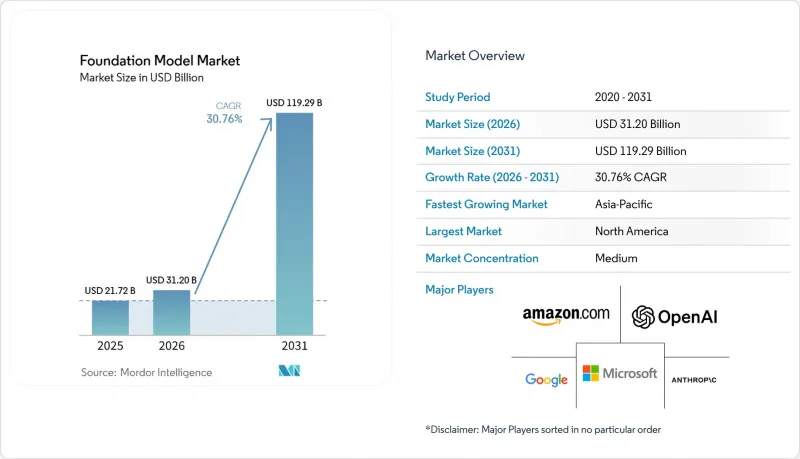
Mordor Intelligence에 의하면, 기반 모델 시장 규모는 2025년 217억 2,000만 달러로 평가되었습니다. 2026년 312억 달러에서 2031년까지 1,192억 9,000만 달러로 확대되어 2026년부터 2031년에 걸쳐 CAGR 30.76%를 나타낼 것으로 예측됩니다.
본 보고서는 모델 유형(대규모 언어 모델, 멀티모달 모델 등), 배포 방식(클라우드 기반 및 On-Premise형), 기업 규모(대기업 및 중소기업), 용도(컨텐츠 생성, 고객 지원 및 가상 비서 등), 최종 사용자(은행, 금융서비스 및 보험(BFSI), 헬스케어 등), 그리고 지역별로 분류되어 있습니다. 시장 전망은 금액(달러) 기준으로 제시되어 있습니다.
세계의 기반 모델 시장 동향 및 인사이트
멀티모달 모델 및 추론 모델에 대한 기업 수요가 아키텍처 업그레이드를 주도
기업들은 더 이상 주로 초안 생성을 목적으로 모델을 구매하지 않습니다. 현재는 동일한 워크플로우 내에서 문서, 이미지, 음성 및 구조화된 기록을 처리할 수 있는 시스템을 원하기 때문입니다. 이에 따라 기반 모델 시장 전반의 조달 기준이 변화하고 있으며, 구매자들은 모델이 다단계 추론 및 신뢰할 수 있는 작업 수행을 지원하기를 점점 더 기대하고 있습니다. 의료, 국방, 미디어 등의 분야에서는 입력 데이터가 여러 형식으로 도착하여 텍스트 전용 시스템으로는 효과적으로 처리할 수 없기 때문에 멀티모달 기능의 중요성이 더욱 높아지고 있습니다. 또한, 행동이나 권장 사항을 생성하기 전에 기록, 시각 정보, 지시를 연계하는 데 의존하는 이용 사례도 강화되고 있습니다. 애플의 3세대 기반 모델 제품군은 하드웨어 제약이 있는 환경에서 언어 및 이미지 이해를 위해 온디바이스 처리형과 서버 기반형 변형을 결합함으로써 이러한 방향성을 반영하고 있습니다. 이러한 아키텍처가 성숙해짐에 따라, 기반 모델 시장은 단순한 컨텐츠 도구가 아닌 보다 광범위한 추론 시스템으로 전환되고 있습니다.
도메인 특화 기반 모델로의 급속한 전환이 고위험 산업 분야의 구매 우선순위를 바꾸고 있습니다.
광범위한 인터넷 데이터로 학습된 범용 모델은 정확도, 추적 가능성 및 도메인 맥락이 필요한 워크플로우에서 그 유효성을 잃어가고 있습니다. 금융 분야에서는 IEEE CSCloud에서 발표된 연구에 따르면, 금융 데이터셋을 활용한 모듈식 LoRA 기반의 도메인 적응형 사후 학습을 통해 70억 파라미터 규모의 콤팩트한 모델이 특정 금융 벤치마크에서 GPT-4를 능가하는 성능을 발휘할 수 있음이 입증되었습니다. 의료 분야에서는 HL7 FHIR 표준화된 임상 데이터로 미세 조정된 EHR 기반 모델이 6가지 주요 임상 예측 과제에서 진전을 보이며, 전문화된 아키텍처가 부상하고 있는 이유를 뒷받침하고 있습니다. 이로 인해 규제가 엄격한 환경에 있는 기업들은 더 많은 감독이 필요한 광범위한 모델보다, 규모가 더 작고 목표가 명확한 시스템을 선호하는 추세입니다. 또한, 모든 작업을 유료 프론티어 API를 통해 전송하는 대신, 미세 조정된 모델을 관리된 인프라 내에서 실행할 수 있다면 총 운영 비용을 절감할 수도 있습니다. 기반 모델 시장에서 이러한 변화로 인해, 단순한 모델 접근뿐만 아니라 미세 조정, 통합, 거버넌스를 지원하는 벤더로 가치가 이동하고 있습니다.
GPU에 대한 높은 의존도와 기반 모델 훈련 비용이 경쟁 환경을 좁히고 있습니다.
기반 모델 훈련에는 여전히 막대한 자본 투자가 필요하기 때문에 GPU에 대한 높은 의존도는 기반 모델 시장에서 가장 명백한 구조적 제약 중 하나로 남아 있습니다. 현재 최신 세대의 프론티어 훈련 실행 비용은 1억 달러를 초과하는 것이 일반화되어 있으며, 2024년 단일 실행 중 최대 규모는 3억 9,000만 달러에 육박했습니다. 이 때문에 진정한 프론티어 개발은 반복되는 훈련 주기를 감당할 수 있는 자본과 인프라를 갖춘 하이퍼스케일러의 지원을 받는 극소수의 조직에 집중된 상태입니다. 그 영향은 훈련에만 그치지 않습니다. 첨단 하드웨어에 대한 접근성은 추론 규모, 출시 시기, 그리고 장기적인 서비스의 경제성에도 영향을 미치기 때문입니다. 첨단 반도체에 대한 수출 규제는 관할 구역 간 접근 격차를 더욱 확대하는 요인이 되고 있으며, 최첨단 수준에서 규모를 확장할 수 있는 기업을 좌우하고 있습니다. 기반 모델 시장에서 이러한 요인들이 복합적으로 작용하여, 장기적으로 모델 성능의 리더십을 유지할 수 있는 기업의 범위가 좁아지고 있습니다.
부문 분석
2025년 모델 유형별 기반 모델 시장 점유율에서 대규모 언어 모델은 59.11%를 차지하며, 텍스트 중심의 도입이 주를 이루는 상용 기반으로서의 지위를 유지했습니다. 구매자들이 연동된 전체 워크플로우에서 텍스트, 이미지, 음성, 구조화 데이터를 처리할 수 있는 단일 시스템을 점점 더 요구함에 따라, 멀티모달 모델은 2031년까지 연평균 성장률(CAGR) 31.34%로 확대될 것으로 예측됩니다. 비전 모델은 기반 모델 시장에서 여전히 틈새 시장이지만 중요한 카테고리이며, 특히 이미지 이해가 핵심이 되는 검사, 방사선 진단 분류, 시각 검색 환경에서 중요한 위치를 차지하고 있습니다. 음성, 오디오 및 도메인 특화 모델을 포함한 기타 모델 유형도 음성 인터페이스, 지연, 또는 전문용어 등의 이유로 범용 아키텍처가 적합하지 않은 상황에서 주목을 받고 있습니다. 부문 구성을 살펴보면, 기반 모델 시장은 단일 모달리티 도구에서 더 복잡한 기업 환경 전반에서 작동 가능한 광범위한 추론 시스템으로 전환되고 있음을 알 수 있습니다.
많은 주요 모델이 동일한 워크플로우 내에서 문서, 이미지, 코드를 지원하게 됨에 따라, 대규모 언어 모델과 멀티모달 모델의 경계는 이미 모호해지고 있습니다. 애플의 3세대 기반 모델 제품군은 하드웨어 제약이 있는 환경을 위해 언어와 이미지 이해를 결합한 온디바이스 및 서버 기반 버전을 제공하며, 이러한 추세를 반영하고 있습니다. 따라서 기반 모델 업계에서는 모델의 폭넓은 적용 범위와 더 효율적인 추론, 그리고 간편한 도입을 모두 충족시킬 수 있는 벤더가 높은 평가를 받을 가능성이 높습니다.
2025년에는 AWS, Azure, Google Cloud의 관리형 서비스가 모델 호스팅의 운영 부담을 줄여준 덕분에, 클라우드 기반 도입이 기반 모델 시장의 66.39%를 차지했습니다. On-Premise 도입은 기밀성이 높은 환경에서의 보안, 제어 및 로컬에서 관리되는 인프라에 대한 수요 증가를 반영하여, 2031년까지 연평균 성장률(CAGR) 39.90%로 확대될 것으로 예측됩니다. 이러한 추세는 기반 모델 시장이 단순히 한 가지 배포 방식을 다른 방식보다 우선시하는 것이 아님을 보여줍니다. 이는 현재 구매자의 우선순위가 데이터 기밀성, 워크로드 유형 및 내부 거버넌스 요구 사항에 따라 달라지기 때문입니다. 오픈 웨이트 생태계는 벤더에 대한 과도한 종속이나 클라우드 전용의 고정된 운영 모델에 얽매이지 않고, 기업이 모델을 배포할 수 있는 자유도를 높임으로써 이러한 변화를 뒷받침하고 있습니다. 실제로 많은 조직에게 클라우드는 여전히 기본 선택지이지만, 고부가가치 이용 사례의 비중이 증가함에 따라 On-Premise 배포는 전략적 요건이 되고 있습니다.
또한, 클라우드와 On-Premise 환경은 명확한 경계선을 따라 서로 대체되는 것도 아닙니다. 많은 대기업에서는 현재 위험이나 데이터 등급에 따라 워크로드를 분할하는 하이브리드 아키텍처를 채택하고 있기 때문입니다. 기밀성이 높은 추론 처리는 사내 인프라에서 실행되는 경우가 많은 반면, 기밀성이 낮고 처리량이 많은 작업은 계속해서 외부 API를 통해 실행되고 있습니다. 애플의 3세대 기반 모델 제품군은 기기 내 및 서버 기반 변형을 모두 아우르고 있으며, 이는 하이브리드 배포가 예외적인 사례가 아니라 실용적인 설계 선택지가 되어가고 있음을 보여줍니다. 이는 보고된 클라우드의 우위가 기반 모델 시장에서 사내 배포 능력의 중요성을 과소평가하고 있을 가능성이 있음을 의미합니다. 정부 및 국방 분야의 도입 사례도 이 점을 뒷받침합니다. 안전한 에어갭 환경에서는 하드웨어에 상주하는 모델과 이에 대한 특화된 지원이 필요한 경우가 많기 때문입니다.
지역별 분석
2025년, 북미는 기반 모델 시장의 39.37%를 차지하며 최대의 지역별 수익원이 되었습니다. 이 지역은 최첨단 AI 연구소, 하이퍼스케일러의 본사, 그리고 새로운 모델의 신속한 상용화를 뒷받침하는 견고한 기업 소프트웨어 인프라가 한곳에 집적되어 있다는 이점을 가지고 있습니다. 미국은 모델 개발 분야의 리더십과 강력한 클라우드 배포 체계, 그리고 활발한 기업 조달 활동을 모두 갖추고 있어 이 지위의 주요 버팀목으로 자리 잡고 있습니다. 캐나다는 토론토와 몬트리올의 AI 생태계와 연계된 연구 역량을 통해 시장에 깊이를 더하고 있으며, 이는 인재 공급과 학술적 영향력을 지속적으로 뒷받침하고 있습니다. 기반 모델 시장에서 남미는 도입 단계가 아직 초기 단계에 머물러 있어, 현지에서 개발된 최첨단 모델보다는 미국이나 유럽공급자가 제공하는 클라우드 API에 대한 의존도가 높은 상황이 지속되고 있습니다.
유럽은 기반 모델 시장에서 가장 엄격한 규정 준수 요건을 가진 사업 환경입니다. 이는 문서화, 투명성 및 테스트에 관한 의무가 공급업체의 모델 출시 및 유지 관리 방식을 규정하고 있기 때문입니다. 그러나 그럼에도 불구하고 수요는 줄어들지 않고 있으며, 독일, 영국, 프랑스, 이탈리아, 스페인에서는 금융 서비스 및 산업 제조 분야가 여전히 중요한 구매 거점으로 자리 잡고 있습니다. 그 결과, 도입이 진행되는 한편, 새로운 운영 규정에 대응하기 위해 거버넌스 관련 지출도 증가하는 등 양극화된 지역적 경향이 나타나고 있습니다. 중동도 중요성이 커지고 있습니다. 각국의 AI 인프라 계획과 현지 호스팅에 대한 의지가 높아짐에 따라, 지역적 전개 거점의 역할이 더욱 명확해지고 있기 때문입니다.
아시아태평양은 2031년까지 연평균 성장률(CAGR) 32.89%로 확대될 것으로 예측되며, 기반 모델 시장에서 가장 빠르게 성장하는 지역 블록이 될 전망입니다. 중국의 오픈 웨이트 생태계는 급속히 확대되고 있으며, 알리바바의 보고서에 따르면 Qwen 시리즈는 2025년 4월 기준으로 모델 버전 수 300종, 다운로드 수 3억 회, 파생 파인 튜닝 모델 수 10만 종을 돌파했습니다. 중국석유천연가스그룹(CNPC)의 기반 모델 ‘쿤룬(Kunlun)’은 2026년 5월 기준으로 152개의 도입 시나리오에 도달했으며, 이는 아시아태평양의 기반 모델 시장이 모델 개발과 대규모 산업 활용 사례를 어떻게 연계하고 있는지를 보여줍니다. 한국의 ‘인공지능 개발에 관한 기본법’은 2026년 1월에 시행되어, 한국에서 사업을 전개하는 외국 AI 기업에 대한 공식적인 규정 준수 요건이 추가되었습니다. 인도와 일본도 급속히 확대되고 있지만, 남아프리카를 중심으로 한 아프리카는 여전히 초기 단계에 있으며, 보다 광범위한 확산을 위해서는 다국어 지원 설계와 모바일 우선 제공이 중요해지고 있습니다.
기타 혜택 :
- 엑셀 형식 시장 예측(ME) 시트
- 3개월간의 애널리스트 지원
자주 묻는 질문
목차
제1장 서론
제2장 조사 방법
제3장 주요 요약
제4장 시장 구도
제5장 시장 규모 및 성장 예측
제6장 경쟁 구도
제7장 시장 기회 및 향후 전망
KTH 26.08.10According to Mordor Intelligence, the foundation model market size is projected to expand from USD 21.72 billion in 2025 and USD 31.20 billion in 2026 to USD 119.29 billion by 2031, registering a CAGR of 30.76% from 2026 to 2031.
This report is Segmented by Model Type (Large Language Models, Multimodal Models, and More), Deployment Mode (Cloud-Based and On-Premise), Enterprise Size (Large Enterprises and Small and Medium Enterprises), Application (Content Generation, Customer Support and Virtual Assistants, and More), End User (BFSI, Healthcare, and More), and Geography. The Market Forecasts are Provided in Terms of Value (USD).
Global Foundation Model Market Trends and Insights
Enterprise Demand for Multimodal and Reasoning Models Drives Architecture Upgrades
Enterprises are no longer buying models mainly for draft generation, because they now want systems that can process documents, images, audio, and structured records inside the same workflow. This is changing procurement standards across the foundation model market, where buyers increasingly expect models to support multi-step reasoning and dependable task execution. Multimodal capability matters more in sectors such as healthcare, defense, and media, where input data arrives in multiple formats and cannot be handled effectively by text-only systems. It also strengthens use cases that depend on connecting records, visuals, and instructions before producing an action or recommendation. Apple's third-generation foundation model family reflects this direction by combining on-device and server-based variants for language and image understanding in hardware-constrained environments. As these architectures mature, the foundation model market is shifting toward broader reasoning systems rather than standalone content tools.
Rapid Shift to Domain-Tuned Foundation Models Changes Buying Priorities in High-Stakes Verticals
General-purpose models trained on broad internet data are becoming less effective in workflows that need precision, traceability, and domain context. In finance, research presented through IEEE CSCloud showed that domain-adaptive post-training with modular LoRA on financial datasets enabled compact 7-billion-parameter models to outperform GPT-4 on selected financial benchmarks. In healthcare, EHR foundation models fine-tuned on HL7 FHIR-standardized clinical data have demonstrated progress across 6 major clinical forecasting tasks, underscoring why specialized architectures are gaining ground. This is pushing enterprises in regulated settings to prefer smaller, more targeted systems over broader models that require greater supervision. It also lowers total operating cost when a fine-tuned model can run inside controlled infrastructure instead of sending every task through a premium frontier API. In the foundation model market, that shift is moving value toward vendors that support fine-tuning, integration, and governance rather than only raw model access.
High GPU Dependency and Frontier Training Costs Compress the Competitive Field
High GPU dependency remains one of the clearest structural restraints on the foundation model market, as frontier model training still requires substantial capital commitments. Current-generation frontier training runs now regularly exceed USD 100 million, and the largest single run in 2024 reached nearly USD 390 million. This keeps true frontier development concentrated among a very small group of hyperscaler-backed organizations with the capital and infrastructure to absorb repeated training cycles. The effect is not limited to training, because access to advanced hardware also shapes inference scale, release timing, and long-term service economics. Export controls on advanced semiconductors add another layer of uneven access across jurisdictions, which affects who can scale at the leading edge. In the foundation model market, that combination narrows the field of firms that can sustain model-performance leadership over time.
Other drivers and restraints analyzed in the detailed report include:
- Inference Cost Compression from Open-Weight Ecosystems Reshapes Deployment Economics
- AI Agent Deployment Across Core Business Workflows Embeds Models in Revenue-Critical Systems
- Hallucination Risk Slows Adoption in Regulated Workflows Despite Wider Deployment
For complete list of drivers and restraints, kindly check the Table Of Contents.
Segment Analysis
Large language models accounted for 59.11% of the foundation model market share in 2025 by model type, maintaining text-centric deployments as the primary commercial base. Multimodal models are projected to expand at a 31.34% CAGR through 2031, as buyers increasingly seek a single system that can process text, images, audio, and structured data across connected workflows. Vision models remain a focused but important category in the foundation model market, especially in inspection, radiology triage, and visual search environments where image understanding is central. Other model types, including speech, audio, and domain-specific models, are also gaining traction where voice interfaces, latency, or technical vocabularies create a poor fit for broad architectures. The segment mix shows that the foundation model market is moving from single-modality tools toward broader reasoning systems that can operate across more complex enterprise contexts.
The boundary between large language models and multimodal models is already becoming less clear, as many leading releases now support documents, images, and code within the same workflow. Apple's third-generation foundation model family reflects this trend with on-device and server-based variants that combine language and image understanding for hardware-constrained environments. The foundation model industry is therefore likely to reward vendors that can combine model breadth with more efficient inference and simpler deployment.
Cloud-based deployment accounted for 66.39% of the foundation model market in 2025, as managed services from AWS, Azure, and Google Cloud reduce the operational burden of model hosting. On-premise deployment is projected to expand at a 39.90% CAGR through 2031, reflecting stronger demand for security, control, and locally managed infrastructure in sensitive environments. This pattern shows that the foundation model market is not simply favoring one mode over another, because buyer priorities now differ by data sensitivity, workload type, and internal governance needs. The open-weight ecosystem supports that shift by giving enterprises more freedom to deploy models without tight vendor lock-in or fixed cloud-only operating models. In practice, cloud remains the default for many organizations, but local deployment has become a strategic requirement for an increasing share of high-value use cases.
Cloud and on-premise setups are also not replacing each other in a clean line, because many large organizations now use hybrid architectures that split workloads by risk and data class. Sensitive inference often runs on internal infrastructure, while non-sensitive, high-volume tasks continue to run through external APIs. Apple's third-generation foundation model family, spanning on-device and server-based variants, shows that hybrid deployment is becoming a practical design choice rather than an edge case. This means reported cloud leadership can understate the importance of internal deployment capability in the foundation model market. Government and defense adoption reinforces that point, because secure, air-gapped environments often require hardware-resident models and tailored support for them.
Complete Report Scope:
- By Model Type
- Large Language Models
- Multimodal Models
- Vision Models
- Other Model Types (Speech and Audio Models, Domain-Specific Models, etc.)
- By Deployment Mode
- Cloud-Based
- On-Premise
- By Enterprise Size
- Large Enterprises
- Small and Medium Enterprises
- By Application
- Content Generation
- Customer Support and Virtual Assistants
- Knowledge Management
- Cybersecurity and Fraud Detection
- Business Intelligence and Analytics
- Other Applications (Software Development, Drug Discovery, etc.)
- By End User
- BFSI
- Healthcare
- IT and Telecommunications
- Manufacturing
- Government and Defense
- Other End Users (Retail and E-Commerce, Media and Entertainment, Education, etc.)
- By Geography
- North America
- United States
- Canada
- South America
- Brazil
- Argentina
- Rest of South America
- Europe
- Germany
- United Kingdom
- France
- Italy
- Spain
- Rest of Europe
- Asia-Pacific
- China
- India
- Japan
- South Korea
- Rest of Asia-Pacific
- Middle East
- Saudi Arabia
- United Arab Emirates
- Rest of the Middle East
- Africa
- South Africa
- Rest of Africa
- North America
Geography Analysis
North America accounted for 39.37% of the foundation model market in 2025, making it the largest regional revenue pool. The region benefits from the co-location of frontier AI labs, hyperscaler headquarters, and a deep enterprise software base that helps commercialize new models quickly. The United States remains the main anchor of this position because it combines model development leadership with strong cloud distribution and enterprise procurement activity. Canada adds depth through research strength linked to the Toronto and Montreal AI ecosystems, which continue to support talent supply and academic influence. In the foundation model market, South America remains earlier in adoption and more dependent on cloud APIs from U.S. and European providers than on local frontier model development.
Europe presents the most compliance-heavy operating environment in the foundation model market, because documentation, transparency, and testing obligations shape how providers launch and maintain models. That does not stop demand, as financial services and industrial manufacturing remain important buying centers across Germany, the United Kingdom, France, Italy, and Spain. The result is a two-track regional pattern in which deployment moves ahead, while governance spending also rises to meet new operating rules. The Middle East is also gaining relevance, as sovereign AI infrastructure plans and local hosting ambitions create a clearer role for regional deployment hubs.
Asia-Pacific is projected to expand at a 32.89% CAGR through 2031, making it the fastest-growing regional block in the foundation model market. China's open-weight ecosystem is scaling quickly, and Alibaba reported that the Qwen series had exceeded 300 model versions, 300 million downloads, and 100,000 derivative fine-tuned models by April 2025. China National Petroleum's Kunlun foundation model had reached 152 deployment scenarios by May 2026, which shows how the foundation model market in Asia-Pacific is linking model development with large industrial use cases. South Korea's Framework Act on Artificial Intelligence Development took effect in January 2026 and added a formal compliance layer for foreign AI companies operating in the country. India and Japan are also scaling quickly, while Africa, led by South Africa, remains at an earlier stage where multilingual design and mobile-first delivery are important for broader deployment.
- OpenAI LLC
- Microsoft Corporation
- Google LLC
- Amazon Web Services, Inc.
- Meta Platforms, Inc.
- Anthropic PBC
- NVIDIA Corporation
- IBM Corporation
- Oracle Corporation
- Salesforce, Inc.
- Hugging Face, Inc.
- Mistral AI SAS
- Cohere Inc.
- Databricks, Inc.
- Baidu, Inc.
- Alibaba Cloud (Alibaba Group Holding Limited)
- Tencent Holdings Limited
- Huawei Technologies Co., Ltd.
- AI21 Labs Ltd.
- xAI Corp.
- DeepSeek (Hangzhou DeepSeek Artificial Intelligence Co., Ltd.)
Additional Benefits:
- The market estimate (ME) sheet in Excel format
- 3 months of analyst support
TABLE OF CONTENTS
1 INTRODUCTION
- 1.1 Study Assumptions and Market Definition
- 1.2 Scope of the Study
2 RESEARCH METHODOLOGY
3 EXECUTIVE SUMMARY
4 MARKET LANDSCAPE
- 4.1 Market Overview
- 4.2 Market Drivers
- 4.2.1 Enterprise Demand for Multimodal and Reasoning Models
- 4.2.2 Rapid Shift to Domain-Tuned Foundation Models
- 4.2.3 Inference Cost Compression from Open-Weight Ecosystems
- 4.2.4 AI Agent Deployment Across Core Business Workflows
- 4.2.5 Cloud-Native Model Hosting and Managed AI Platforms
- 4.2.6 Demand for Model Fine-Tuning, Guardrails, and Governance Layers
- 4.3 Market Restraints
- 4.3.1 High GPU Dependency and Frontier Training Costs
- 4.3.2 Hallucination Risk in Regulated Workflows
- 4.3.3 Data Sovereignty and Cross-Border Model Hosting Constraints
- 4.3.4 Fragmented Compliance Burden Across Model, Data, and Deployment Layers
- 4.4 Industry Value Chain Analysis
- 4.5 Technological Outlook
- 4.6 Regulatory Landscape
- 4.7 Porter's Five Forces Analysis
- 4.7.1 Bargaining Power of Suppliers
- 4.7.2 Bargaining Power of Buyers
- 4.7.3 Threat of New Entrants
- 4.7.4 Threat of Substitutes
- 4.7.5 Competitive Rivalry
- 4.8 Pricing Analysis
- 4.9 Impact of Macroeconomic Factors on the Market
5 MARKET SIZE AND GROWTH FORECASTS (VALUE)
- 5.1 By Model Type
- 5.1.1 Large Language Models
- 5.1.2 Multimodal Models
- 5.1.3 Vision Models
- 5.1.4 Other Model Types (Speech and Audio Models, Domain-Specific Models, etc.)
- 5.2 By Deployment Mode
- 5.2.1 Cloud-Based
- 5.2.2 On-Premise
- 5.3 By Enterprise Size
- 5.3.1 Large Enterprises
- 5.3.2 Small and Medium Enterprises
- 5.4 By Application
- 5.4.1 Content Generation
- 5.4.2 Customer Support and Virtual Assistants
- 5.4.3 Knowledge Management
- 5.4.4 Cybersecurity and Fraud Detection
- 5.4.5 Business Intelligence and Analytics
- 5.4.6 Other Applications (Software Development, Drug Discovery, etc.)
- 5.5 By End User
- 5.5.1 BFSI
- 5.5.2 Healthcare
- 5.5.3 IT and Telecommunications
- 5.5.4 Manufacturing
- 5.5.5 Government and Defense
- 5.5.6 Other End Users (Retail and E-Commerce, Media and Entertainment, Education, etc.)
- 5.6 By Geography
- 5.6.1 North America
- 5.6.1.1 United States
- 5.6.1.2 Canada
- 5.6.2 South America
- 5.6.2.1 Brazil
- 5.6.2.2 Argentina
- 5.6.2.3 Rest of South America
- 5.6.3 Europe
- 5.6.3.1 Germany
- 5.6.3.2 United Kingdom
- 5.6.3.3 France
- 5.6.3.4 Italy
- 5.6.3.5 Spain
- 5.6.3.6 Rest of Europe
- 5.6.4 Asia-Pacific
- 5.6.4.1 China
- 5.6.4.2 India
- 5.6.4.3 Japan
- 5.6.4.4 South Korea
- 5.6.4.5 Rest of Asia-Pacific
- 5.6.5 Middle East
- 5.6.5.1 Saudi Arabia
- 5.6.5.2 United Arab Emirates
- 5.6.5.3 Rest of the Middle East
- 5.6.6 Africa
- 5.6.6.1 South Africa
- 5.6.6.2 Rest of Africa
- 5.6.1 North America
6 COMPETITIVE LANDSCAPE
- 6.1 Market Concentration
- 6.2 Strategic Moves (Strategic Partnerships, Model Launches, Open-Weight Releases, Cloud Distribution, and M&A)
- 6.3 Market Positioning Analysis
- 6.4 Company Profiles (includes Global Level Overview, Market Level Overview, Core Segments, Financials as available, Strategic Information, Market Rank/Share, Products and Services, Recent Developments)
- 6.4.1 OpenAI LLC
- 6.4.2 Microsoft Corporation
- 6.4.3 Google LLC
- 6.4.4 Amazon Web Services, Inc.
- 6.4.5 Meta Platforms, Inc.
- 6.4.6 Anthropic PBC
- 6.4.7 NVIDIA Corporation
- 6.4.8 IBM Corporation
- 6.4.9 Oracle Corporation
- 6.4.10 Salesforce, Inc.
- 6.4.11 Hugging Face, Inc.
- 6.4.12 Mistral AI SAS
- 6.4.13 Cohere Inc.
- 6.4.14 Databricks, Inc.
- 6.4.15 Baidu, Inc.
- 6.4.16 Alibaba Cloud (Alibaba Group Holding Limited)
- 6.4.17 Tencent Holdings Limited
- 6.4.18 Huawei Technologies Co., Ltd.
- 6.4.19 AI21 Labs Ltd.
- 6.4.20 xAI Corp.
- 6.4.21 DeepSeek (Hangzhou DeepSeek Artificial Intelligence Co., Ltd.)
7 MARKET OPPORTUNITIES AND FUTURE OUTLOOK
- 7.1 White-Space and Unmet-Need Assessment


