

|
시장보고서
상품코드
2099464
독일의 의료 물류 : 시장 점유율 분석, 업계 동향 및 통계, 성장 예측(2026-2031년)Germany Healthcare Logistics - Market Share Analysis, Industry Trends & Statistics, Growth Forecasts (2026 - 2031) |
||||||
 Mordor Intelligence
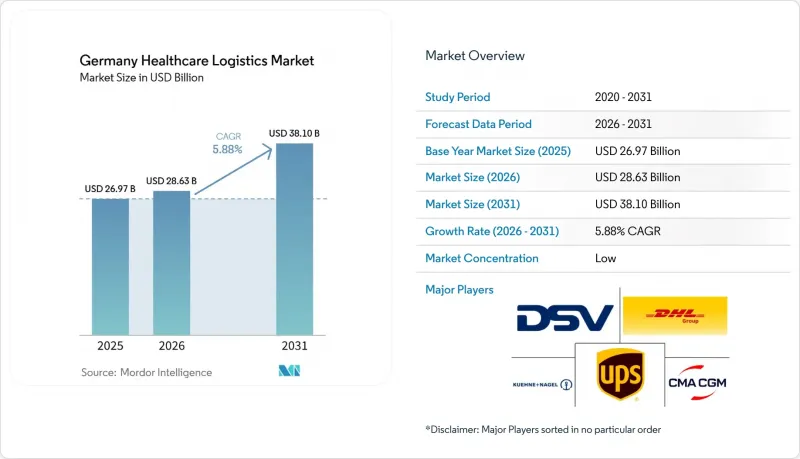
Mordor Intelligence에 의하면, 독일의 의료 물류 시장 규모는 2025년 269억 7,000만 달러로 평가되었습니다. 2026년에는 286억 3,000만 달러로 확대되어 2031년까지 381억 달러에 이를 것으로 예상되고 2026년부터 2031년에 걸쳐 CAGR 5.88%로 성장할 전망입니다.
독일의 의료 물류 시장은 독일이 중부 유럽 내 의약품 유통의 거점으로서 역할을 수행하고 있다는 점에 힘입어 성장하고 있습니다. 이 나라에서는 GDP 기준에 부합하는 창고 보관, 항공 화물 취급 및 도로망 정비를 통해 국내 공급과 유럽연합(EU) 전역에 걸친 국경을 초월한 의약품 유통이 모두 뒷받침되고 있습니다. 본 보고서는 물류 기능별(수송, 창고·유통, 기타), 온도 유형별(온도 관리, 기타), 제품 유형별(의약품, 기타), 목적지별(국내, 국제), 최종 사용자별(제약 제조업체, 기타), 지역별(노르트라인-베스트팔렌주, 바이에른주, 기타)로 분류되어 있습니다. 시장 전망은 금액(달러) 기준으로 제시되어 있습니다.
독일의 의료 물류 시장 동향과 인사이트
중부 유럽의 의약품 유통 허브로서의 독일
독일의 입지 조건과 밀집된 운송망은 중부 유럽 내 의약품 유통 플랫폼으로서 독일의 역할을 지속적으로 뒷받침하고 있습니다. 독일의 의료 물류 시장은 프랑크푸르트에 위치한 GDP(Global Distribution Center) 기준 항공 화물 인프라와 서유럽, 남유럽, 중부 유럽의 무역 경로를 연결하는 도로망의 혜택을 받고 있습니다. 프랑크푸르트 카고 허브의 'Pharma&FRA' 시설에서는 지속적인 온도 모니터링, 전용 취급 절차, 그리고 민감한 의약품에 대한 대응이 요구되며, 이를 통해 고부가가치 헬스케어 유통 분야에서 독일의 역할이 강화되고 있습니다. 의약품의 흐름이 일반적인 상온 제품에서 보다 엄격한 공정 관리가 필요한 바이오의약품 및 첨단 치료제로 전환됨에 따라, 이 운영 모델의 중요성은 더욱 커지고 있습니다. 그 결과, 신규 진입업체에 대한 규정 준수 장벽이 높아지는 한편, 이미 인증을 받은 거점, 검증된 프로세스, 통합된 운송 네트워크를 운영하고 있는 사업자에게는 더욱 견고한 입지가 확립되고 있습니다. 따라서 독일의 의료 물류 시장은 지역적 우위뿐만 아니라, 규정 준수 대응 능력이 현재 네트워크 설계의 핵심을 이루고 있다는 사실에서도 혜택을 받고 있습니다.
'환자 직접 배송' 및 '재택 배송' 모델의 부상
처방전을 통한 의약품 접근성, 재택 치료, 그리고 환자의 편의성이 의료 제공에서 더욱 중요시됨에 따라, 독일의 의약품 풀필먼트 분야에서 환자 직접 배송이 점점 더 중요한 역할을 수행하고 있습니다. 독일의 의료 물류 시장은 동일한 네트워크 내에서 의료 기관으로의 유통과 환자 수준으로의 배송을 모두 지원할 수 있는 하이브리드형 풀필먼트 모델로의 전환을 통해 이러한 변화에 대응하고 있습니다. 병원 재고 보충과 재택 배송에는 서로 다른 포장 형식, 서로 다른 관리 기준, 서로 다른 배송 증명 기준이 요구되므로, 이러한 전환은 운영 측면에서 큰 부담을 수반합니다. 의약품이 기존 도매 채널 밖에서 유통되는 경우에도 GDP(의약품 유통 적정 기준)의 취급 요건은 여전히 적용됩니다. 즉, 출하량이 적거나 소비자를 대상으로 한다고 해서 규정 준수를 소홀히 할 수는 없습니다. 로트 단위의 추적성, 위조 방지 포장, 시간 엄수 라스트 마일 배송을 결합할 수 있는 공급업체는 약국이나 전문 의료시설과의 계약을 확보하는 데 유리한 입장에 있습니다. 따라서 독일의 의료 물류 시장에서는 가정 배송을 단순한 소포 서비스가 아닌, 규제 대상 의약품 풀필먼트의 연장선상에 있는 것으로 간주하고 있습니다.
냉장 창고 및 운송 분야의 높은 에너지 비용
냉장 창고 및 운송은 에너지 소비량 증가와 지속적인 온도 관리의 필요성으로 인해 계속해서 비용 압박에 직면해 있습니다. 독일의 의료 물류 시장에서는 이 압박을 가장 크게 느끼는 분야가 냉장 창고 업무입니다. 이 분야에서는 전력 사용량이 서비스 모델에 포함되어 있어, 설비 업그레이드 없이는 비용을 절감할 수 없습니다. 소규모 전문 사업자는 자산 기반이 좁고, 대규모 냉각 설비 개보수에 투입할 자금 여유가 적기 때문에 더 큰 영향을 받기 쉬운 상황에 놓여 있습니다. 또한, 규정 준수 및 냉매 관련 규제로 인해 시설 개보수 비용이 더 높아지고 시행에도 시간이 걸리기 때문에 네트워크 일부에서 효율화 진전이 지연될 가능성이 있습니다. 이로 인해 시장은 에너지 비용 변동을 흡수하고, 장기적인 계획 기간에 걸쳐 검증된 인프라 갱신에 자금을 투입할 수 있는 대형 사업자로 이동하고 있습니다. 그 결과, 단기적으로는 이익률에 압박이 발생하고, 장기적으로는 온도 관리가 필요한 거점에서 점차 통합 압력이 높아지고 있습니다.
부문 분석
2026년 독일의 의료 물류 시장에서 운송 부문은 시장 점유율의 47.78%를 차지하며 시장 최대의 부문이 되었습니다. 병원, 도매업체, 약국은 라스트 마일 및 지역 내 보충망을 촘촘하게 커버해야 하기 때문에 이 부문 내에서는 육상 운송이 여전히 핵심 운송 수단으로 자리 잡고 있습니다. 항공 운송의 점유율은 여전히 작지만, 시간적 제약이 엄격한 생물학적 제제나 특수 화물의 운송은 보다 신속한 국제적 연결에 의존하고 있기 때문에 투자 집약도는 높은 수준을 유지하고 있습니다. 쿠네 나겔(Kuehne Nagel)은 2026년 6월, 프랑크푸르트를 ‘Inspire’ 항공기 운항 노선에 추가하고, 두 주요 생산·유통 허브 간의 민감한 의약품 물류를 대상으로 하는 시카고-프랑크푸르트 간 직항편을 개설했습니다. 해상 운송, 내륙 수로, 철도는 API(의약품 원료)의 대량 운송 및 국내 복합 일괄 운송에서 여전히 제한적인 역할을 담당했으나, 창고·유통은 독일의 의료 물류 시장에서 여전히 2위 기능 카테고리를 유지했습니다.
부가가치 서비스 등은 2026년부터 2031년에 걸쳐 연평균 성장률(CAGR) 7.64%를 나타낼 것으로 예측되며, 독일의 의료 물류 시장에서 가장 빠르게 성장하는 기능 분야가 될 전망입니다. 이러한 확대는 시리얼화, 키팅, 라벨 재부착, 임상시험 지원 및 환자별 콜드체인 포장이 전문 물류 파트너에게 더 광범위하게 아웃소싱되고 있음을 반영합니다. 함부르크 근교에 위치한 LOXXESS Pharma의 로젠가르텐-넨도르프 거점은 2026년 3분기에 가동을 시작할 예정이며, 자동화된 큐브형 보관 로봇 피킹 시스템을 갖추고 있어 독일에서 의약품 GDP 승인을 받은 최초의 시스템으로 소개되었습니다. 그 상업적 효과는 분명합니다. 검증된 자동화를 통해 처리 능력과 정확성을 향상시키는 동시에 감사 대응 체계도 강화할 수 있기 때문입니다. 독일의 의료 물류 업계의 이 분야에서는 제약 기업 고객들이 규제 대상 지원 업무를 자사 시설 외부로 위탁하는 추세이기 때문에 단순한 창고 규모보다 서비스의 깊이가 더욱 중요시되고 있습니다.
2025년, 독일의 의료 물류 시장에서 비온도 관리 물류는 88.28%의 점유율을 차지하며, 시장 내 최대 온도 관리 부문으로서의 지위를 유지했습니다. 이는 여전히 독일 헬스케어 공급망을 통해 대량의 상온 의약품, 의료기기, 진단용 제품이 유통되고 있음을 반영합니다. 하지만 제품 구성이 바이오의약품, 전문의약품 및 기타 온도에 민감한 제품으로 전환됨에 따라 이러한 우위는 점차 줄어들고 있습니다. 냉장, 표준 냉장 및 초저온 냉동 각 경로는 모두 중요하지만, 가장 두드러진 역량 격차가 나타나는 분야는 첨단 치료제를 위한 초저온 취급 분야입니다. Movianto는 2025년 5월, 노인키르헨의 의약품 냉장 시설을 2℃-8℃ 온도대에서 팔레트 수용 능력을 7,200개에서 8,000개로 확장했습니다. 이는 규제 대상인 콜드체인 역량에 대한 지속적인 투자를 보여주는 것입니다. 또한 이 회사는 바덴뷔르템베르크주 비스로흐-발도르프에 새로운 거점을 건설하고, 독일 국내에서 냉동 제품 물류를 도입함으로써 콜드체인 제공 범위를 표준 냉장 처리의 범위를 넘어 확대되고 있습니다.
온도 관리 물류 시장은 2026년부터 2031년까지 연평균 성장률(CAGR) 7.46%를 나타낼 것으로 예측되며, 독일의 의료 물류 시장 전체를 상회하는 속도로 확대되면서 전략적 중요성이 높아지고 있습니다. 의약품 GDP 지침에 더해, 운송 차량의 적합성 평가 및 온도 모니터링 요건이 이러한 역량을 실제로 어떻게 확대하고 검증할 수 있는지를 결정짓고 있습니다. 따라서 독일의 의료 물류 시장에서는 인프라 확충, 모니터링 체계의 강화, 그리고 보다 전문적인 운송 프로파일이 결합되어 온도 관리 물류가 성장을 이루고 있습니다. 또한, 이는 헬스케어 전문 업체와 일반 화물 운송업체를 프리미엄 서비스 역량을 통해 명확히 구분하는 가장 두드러진 분야 중 하나이기도 합니다.
기타 혜택 :
- 엑셀 형식 시장 예측(ME) 시트
- 3개월간의 애널리스트 지원
자주 묻는 질문
목차
제1장 서론
제2장 조사 방법
제3장 주요 요약
제4장 시장 구도
제5장 시장 규모 및 성장 예측
제6장 경쟁 구도
제7장 시장 기회 및 향후 전망
KTH 26.08.10According to Mordor Intelligence, the Germany healthcare logistics market size is expected to increase from USD 26.97 billion in 2025 to USD 28.63 billion in 2026 and reach USD 38.10 billion by 2031, growing at a CAGR of 5.88% over 2026-2031.
The Germany healthcare logistics market is supported by Germany's role as a central European pharmaceutical distribution base, where GDP-compliant warehousing, air cargo handling, and road connectivity support both domestic supply and cross-border drug flows across the European Union. This report is Segmented by Logistics Function (Transportation, Warehousing and Distribution, and More), by Temperature Type (Temperature Controlled, and More), by Product Type (Pharmaceuticals, and More), by Destination (Domestic, International), by End User (Pharma Manufacturers, and More), and by Region (NRW, Bavaria, and Rest). The Market Forecasts are Provided in Terms of Value (USD).
Germany Healthcare Logistics Market Trends and Insights
Germany As a Central European Pharmaceutical Distribution Hub
Germany's location and transport density continue to support its role as a central European pharmaceutical distribution platform. The Germany healthcare logistics market benefits from GDP-compliant air cargo infrastructure at Frankfurt and from road links that connect western, southern, and central European trade routes. Frankfurt Cargo Hub's Pharma@FRA setup requires continuous temperature monitoring, dedicated handling procedures, and support for sensitive pharmaceutical products, which strengthens Germany's role in high-value healthcare distribution. This operating model matters more as pharmaceutical flows shift from standard ambient products toward biologics and advanced therapies that need tighter process control. The result is a higher compliance threshold for new entrants and a stronger position for operators that already run certified sites, validated processes, and integrated transport links. The Germany healthcare logistics market therefore gains not only from geography, but also from the fact that compliance capability is now part of core network design.
Rising Direct-to-Patient and Home Delivery Models
Direct-to-patient delivery is becoming an increasingly important part of pharmaceutical fulfillment in Germany as prescription access, home-based treatment, and patient convenience gain greater weight in care delivery. The Germany healthcare logistics market is responding by moving closer to hybrid fulfillment models that can support both institutional distribution and patient-level dispatch in the same network. That shift is operationally demanding because hospital replenishment and home delivery require different pack formats, different controls, and different proof-of-delivery standards. GDP handling requirements still apply when medicinal products move outside classic wholesale channels, which means compliance cannot be relaxed simply because the shipment is smaller or consumer-facing. Providers that can combine batch-level traceability, tamper-evident packaging, and time-sensitive last-mile execution are better placed to secure pharmacy and specialty care contracts. The Germany healthcare logistics market is therefore seeing home delivery as an extension of regulated pharmaceutical fulfillment rather than as a simple parcel service.
High Energy Costs for Refrigerated Warehousing and Transport
Refrigerated warehousing and transport continue to face cost pressure from elevated energy use and the need for continuous temperature control. The Germany healthcare logistics market feels this pressure most strongly in cold storage operations, where power use is built into the service model and cannot be reduced without equipment upgrades. Smaller specialist operators are more exposed because they often have narrower asset bases and less room to fund large cooling retrofits. Compliance and refrigerant rules also make facility upgrades more expensive and slower to execute, which can delay efficiency gains in parts of the network. This pushes the market toward larger operators that can absorb utility volatility and finance validated infrastructure renewal over a longer planning period. The result is short-term margin pressure and, over time, gradual consolidation pressure in temperature-controlled nodes.
Other drivers and restraints analyzed in the detailed report include:
- Increasing Cell and Gene Therapy Trial Logistics
- Higher Premium Tolerance for GDP-Compliant Temperature Assurance
- Shortage of GDP-Trained Drivers and Cold Chain Labor
For complete list of drivers and restraints, kindly check the Table Of Contents.
Segment Analysis
Transportation accounted for 47.78% of the Germany healthcare logistics market share in 2026, making it the largest function in the market. Road freight remained the core mode within this segment because hospitals, wholesalers, and pharmacies need dense last-mile and regional replenishment coverage. Air freight still represented a smaller share, but investment intensity remained high because time-sensitive biologics and specialty shipments depend on faster international connections. Kuehne+Nagel added Frankfurt to its Inspire aircraft rotation in June 2026, creating a direct Chicago-Frankfurt link that targets sensitive pharmaceutical flows between 2 major production and distribution hubs. Sea, inland waterways, and rail kept more selective roles in bulk API movements and intermodal domestic distribution, while warehousing and distribution remained the second-largest functional category in the Germany healthcare logistics market.
Value-added services and others are forecast to grow at a 7.64% CAGR from 2026 to 2031, making it the fastest-growing function in the German healthcare logistics market. This expansion reflects the broader outsourcing of serialization, kitting, relabeling, clinical trial support, and patient-specific cold-chain packaging to specialized logistics partners. LOXXESS Pharma's Rosengarten-Nenndorf site near Hamburg, scheduled to start in Q3 2026, includes automated cube-storage robotic picking systems and was presented as the first such system with pharmaceutical GDP approval in Germany. The commercial effect is clear, because validated automation can raise throughput and accuracy while also strengthening audit readiness. In this part of the Germany healthcare logistics industry, service depth is becoming more valuable than simple warehouse footprint because pharmaceutical customers are shifting regulated support tasks outside their own facilities.
Non-temperature-controlled logistics held 88.28% of the Germany healthcare logistics market share in 2025, which kept it as the largest temperature segment in the market. That reflects the large volume of ambient pharmaceuticals, medical devices, and diagnostic products that still move through German healthcare supply chains. Even so, this lead is gradually narrowing as the product mix shifts toward biologics, specialty medicines, and other temperature-sensitive products. Chilled, standard refrigerated, and deep-frozen lanes each matter, but the sharpest capability gap sits in ultra-low-temperature handling for advanced therapies. Movianto expanded its Neunkirchen pharmaceutical refrigeration site from 7,200 to 8,000 pallet positions at 2 °C to 8 °C in May 2025, which shows continued investment in regulated cold chain capacity. The company is also building a new site in Wiesloch-Walldorf, Baden-Wurttemberg, to introduce frozen goods logistics in Germany, extending the cold chain offer beyond standard refrigerated handling.
Temperature-controlled logistics is forecast to grow at a 7.46% CAGR from 2026 to 2031, outpacing the overall Germany healthcare logistics market and gaining strategic weight. GDP guidelines for medicinal products, along with vehicle qualification and temperature monitoring requirements, shape how this capacity can be expanded and validated in practice. The Germany healthcare logistics market is therefore seeing temperature-controlled growth as a mix of infrastructure expansion, stricter monitoring, and more specialized shipment profiles. This is also one of the clearest areas where premium service capability is separating healthcare-focused providers from standard freight operators.
Complete Report Scope:
- By Logistics Function
- Transportation
- Road
- Air
- Sea and Inland Waterways
- Rail
- Warehousing and Distribution
- Value-added Services and Others
- Transportation
- By Temperature Type
- Temperature Controlled
- Chilled (0-5 °C)
- Frozen (-18-0 °C)
- Ambient
- Deep-Frozen / Ultra-Low (less than -20 °C)
- Non-Temperature Controlled
- Temperature Controlled
- By Product Type
- Pharmaceuticals
- Prescription and Specialty Drugs
- OTC Drugs
- Biopharmaceuticals (Biologics and Biosimilars)
- Vaccines
- Clinical Trial Materials
- Cell and Gene Therapies
- Medical Devices
- Veterinary Medicine
- Blood, Plasma and Blood Components
- Diagnostic and Laboratory Products
- Organs and Human Tissues
- Others
- Pharmaceuticals
- By Destination
- Domestics
- International
- By End User
- Pharmaceutical Manufacturers
- Biopharmaceutical Manufacturers
- Hospitals and Clinics
- Hospitals and Retail Pharmacies
- Healthcare Distributors and Wholesalers
- Others
- By Region
- North Rhine-Westphalia
- Bavaria (Bayern)
- Baden-Wurttemberg
- Rest of States
List of Companies Covered in this Report:
- DHL Group
- Kuehne+Nagel
- United Parcel Service of America, Inc. (UPS)
- DSV A/S (Including DB Schenker)
- CMA CGM Group (Including CEVA Logistics)
- GEODIS
- Movianto
- Trans-o-Flex
- DACHSER SE
- FedEx
- Rhenus Group
- FIEGE
- Hellmann Worldwide Logistics
- LOXXESS Pharma
- SK Pharma Logistics GmbH
- Frigo-Trans
- Biotech and Pharma Logistics GmbH
- PHOENIX Pharmahandel
- Alliance Healthcare Deutschland GmbH
- Noweda Logistik
- Pharmaserv Logistics GmbH
Additional Benefits:
- The market estimate (ME) sheet in Excel format
- 3 months of analyst support
TABLE OF CONTENTS
1 Introduction
- 1.1 Study Assumptions and Market Definition
- 1.2 Scope of the Study
2 Research Methodology
3 Executive Summary
4 Market Landscape
- 4.1 Market Overview and Role of Logistics in Healthcare
- 4.2 Healthcare Spending Trends
- 4.3 Market Drivers
- 4.3.1 Germany as a Central European Pharmaceutical Distribution Hub
- 4.3.2 Rising Direct-to-Patient and Home Delivery Models
- 4.3.3 Increasing Cell and Gene Therapy Trial Logistics
- 4.3.4 Higher Premium Tolerance for GDP-Compliant Temperature Assurance
- 4.3.5 Increasing Ultra-Low-Temperature Readiness for Advanced Therapies
- 4.3.6 Expansion of Biopharma Manufacturing in Southern Germany
- 4.4 Market Restraints
- 4.4.1 High Energy Costs for Refrigerated Warehousing and Transport
- 4.4.2 Shortage of GDP-Trained Drivers and Cold Chain Labor
- 4.4.3 Uneven Infrastructure Depth Across Smaller Federal States
- 4.4.4 Margin Pressure From Cross-Border and Regional Specialist Carriers
- 4.5 Regulatory Framework
- 4.6 Value Chain and Distribution Channel Architecture Analysis
- 4.7 Technology Innovations Outlook
- 4.8 Porter's Five Forces Analysis
- 4.8.1 Threat of New Entrants
- 4.8.2 Bargaining Power of Suppliers
- 4.8.3 Bargaining Power of Buyers
- 4.8.4 Threat of Substitutes
- 4.8.5 Rivalry Among Competitors
- 4.9 Evolution of Healthcare Logistics Requirements
- 4.10 Impact of Geo-Political Events on Supply Chain Shifts
5 Market Size and Growth Forecasts
- 5.1 By Logistics Function
- 5.1.1 Transportation
- 5.1.1.1 Road
- 5.1.1.2 Air
- 5.1.1.3 Sea and Inland Waterways
- 5.1.1.4 Rail
- 5.1.2 Warehousing and Distribution
- 5.1.3 Value-added Services and Others
- 5.1.1 Transportation
- 5.2 By Temperature Type
- 5.2.1 Temperature Controlled
- 5.2.1.1 Chilled (0-5 °C)
- 5.2.1.2 Frozen (-18-0 °C)
- 5.2.1.3 Ambient
- 5.2.1.4 Deep-Frozen / Ultra-Low (less than -20 °C)
- 5.2.2 Non-Temperature Controlled
- 5.2.1 Temperature Controlled
- 5.3 By Product Type
- 5.3.1 Pharmaceuticals
- 5.3.1.1 Prescription and Specialty Drugs
- 5.3.1.2 OTC Drugs
- 5.3.2 Biopharmaceuticals (Biologics and Biosimilars)
- 5.3.3 Vaccines
- 5.3.4 Clinical Trial Materials
- 5.3.5 Cell and Gene Therapies
- 5.3.6 Medical Devices
- 5.3.7 Veterinary Medicine
- 5.3.8 Blood, Plasma and Blood Components
- 5.3.9 Diagnostic and Laboratory Products
- 5.3.10 Organs and Human Tissues
- 5.3.11 Others
- 5.3.1 Pharmaceuticals
- 5.4 By Destination
- 5.4.1 Domestics
- 5.4.2 International
- 5.5 By End User
- 5.5.1 Pharmaceutical Manufacturers
- 5.5.2 Biopharmaceutical Manufacturers
- 5.5.3 Hospitals and Clinics
- 5.5.4 Hospitals and Retail Pharmacies
- 5.5.5 Healthcare Distributors and Wholesalers
- 5.5.6 Others
- 5.6 By Region
- 5.6.1 North Rhine-Westphalia
- 5.6.2 Bavaria (Bayern)
- 5.6.3 Baden-Wurttemberg
- 5.6.4 Rest of States
6 Competitive Landscape
- 6.1 Market Concentration
- 6.2 Key Strategic Moves
- 6.3 Market Share Analysis
- 6.4 Company Profiles (Includes Global Level Overview, Market Level Overview, Core Segments, Financials as Available, Strategic Information, Market Rank/Share for Key Companies, Products and Services, and Recent Developments)
- 6.4.1 DHL Group
- 6.4.2 Kuehne+Nagel
- 6.4.3 United Parcel Service of America, Inc. (UPS)
- 6.4.4 DSV A/S (Including DB Schenker)
- 6.4.5 CMA CGM Group (Including CEVA Logistics)
- 6.4.6 GEODIS
- 6.4.7 Movianto
- 6.4.8 Trans-o-Flex
- 6.4.9 DACHSER SE
- 6.4.10 FedEx
- 6.4.11 Rhenus Group
- 6.4.12 FIEGE
- 6.4.13 Hellmann Worldwide Logistics
- 6.4.14 LOXXESS Pharma
- 6.4.15 SK Pharma Logistics GmbH
- 6.4.16 Frigo-Trans
- 6.4.17 Biotech and Pharma Logistics GmbH
- 6.4.18 PHOENIX Pharmahandel
- 6.4.19 Alliance Healthcare Deutschland GmbH
- 6.4.20 Noweda Logistik
- 6.4.21 Pharmaserv Logistics GmbH
7 Market Opportunities and Future Outlook
- 7.1 White-space and Unmet-Need Assessment


