

|
시장보고서
상품코드
2099490
철도 및 지하철 인프라용 광섬유 케이블 : 시장 점유율 분석, 업계 동향 및 통계, 성장 예측(2026-2031년)Fiber Optic Cable For Railway and Metro Infrastructure - Market Share Analysis, Industry Trends & Statistics, Growth Forecasts (2026 - 2031) |
||||||
 Mordor Intelligence
Mordor Intelligence에 의하면, 철도 및 지하철 인프라용 광섬유 케이블 시장 규모는 2025년 118억 달러로 평가되었습니다. 2026년에는 125억 달러로 확대되어 2031년까지 165억 달러에 이를 것으로 예상되고 2026년부터 2031년에 걸쳐 CAGR 5.71%로 성장할 전망입니다.
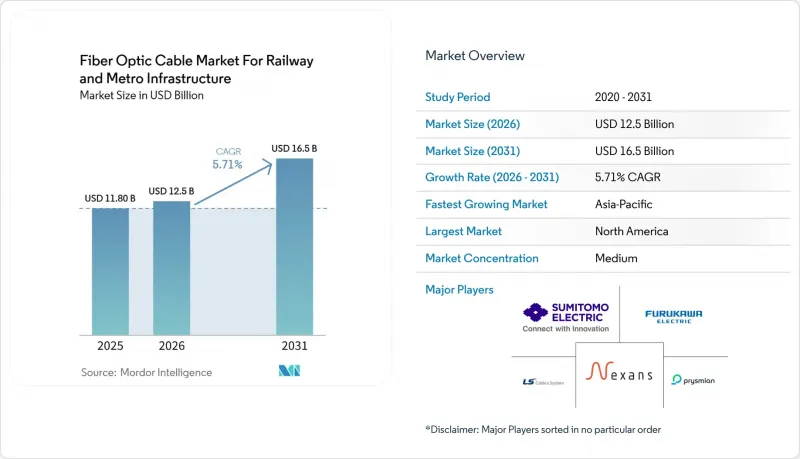
본 보고서는 케이블 유형(광섬유 케이블, 구리 통신 케이블 등), 용도(신호 시스템, 통신 네트워크 등), 설치 형태(지하 터널, 지상 및 고가 선로 등), 최종 사용자(지하철 사업자 등), 그리고 지역별로 분류되어 있습니다. 시장 전망은 금액(달러) 기준으로 제시되어 있습니다.
철도 및 지하철 인프라용 광섬유 케이블 시장 인사이트 및 동향
도시화의 진전과 지하철 네트워크의 확대
도시 교통망의 확대는 철도 및 지하철 인프라용 광섬유 케이블 시장의 최대 수요 요인으로 계속 작용하고 있습니다. 이는 현재 신규 지하철 노선에서 토목 공사에 더해 대규모 통신·제어 시스템이 도입되고 있기 때문입니다. 케이블 수요는 더 이상 노선 부설에만 국한되지 않습니다. 운영 사업자는 동일한 프로젝트 내에서 운행 관리 센터, 승강장 시스템, 차량 기지, 비상 통신 및 역 간 연결을 위해 광섬유 네트워크를 필요로 하기 때문입니다. 그 결과, 노선 1킬로미터당 매출액은 케이블 적용 범위가 좁고, 설치된 설비의 대부분이 단순한 신호 시스템이나 음성 네트워크로 한정되었던 기존 철도 프로젝트보다 더 높게 나타나고 있습니다. 이러한 영향은 신규 건설되는 지하철 시스템에서 가장 두드러집니다. 이러한 시스템에서는 설계자가 조달을 지연시키고 성능 기준을 복잡하게 만드는 레거시 시스템의 혼용을 유지하는 대신, 처음부터 ‘파이버 퍼스트(Fiber First)’ 아키텍처를 지정할 수 있기 때문입니다. 철도 및 지하철 인프라용 광섬유 케이블 시장도 그 혜택을 누리고 있습니다. 지하철 확장은 일반적으로 단계적으로 이루어지기 때문에 특정 노선 구간을 위한 초기 케이블 발주가 이후 역, 차량 기지, 환승역 및 제어실 업그레이드를 위한 발주로 이어지는 경우가 많기 때문입니다. 이로 인해 철도용 케이블 공급업체에게는 단일 선로 건설만으로는 예상되는 것보다 더 안정적인 수요 주기가 형성됩니다.
고밀도 광섬유 백본이 필요한 디지털 신호 시스템의 도입
디지털 신호 시스템으로의 전환은 철도 및 지하철 인프라용 광섬유 케이블 시장에서 가장 지속적인 수요 요인 중 하나입니다. 이는 고주파수 열차 제어가 안정성이 높고, 지연 시간이 짧으며, 간섭에 강한 통신 링크에 의존하기 때문입니다. 기존의 고정 블록 방식에서 CBTC 및 ETCS 아키텍처로 전환하는 사업자들은 단순히 신호 장비를 교체하는 것뿐만 아니라, 열차 운행 허가, 감시, 진단 및 시스템의 내결함성을 뒷받침하는 통신 백본도 재구축하고 있습니다. 이는 제어 플랫폼과 전송 계층이 일체형으로 설계되는 대규모 신호 시스템 도입 사례에서 두드러지게 나타납니다. 예를 들어, 2025년에 히타치 레일이 수주한 타이베이·지룽 도시권 MRT 프로젝트에서는 첨단 신호 시스템, 텔레메트리, 클라우드 연동 운영 기능이 통합되어 있어, 열차, 역, 감시 노드 간의 고밀도 광섬유 연결이 요구되고 있습니다. 호주에서도 유사한 경향이 나타나고 있으며, 알스톰(Alstom)이 2025년 12월 멜버른 메트로 터널에 브라운필드 CBTC를 도입해 여객 운행에 투입했을 때, 가동 중인 도시 교통 시스템의 수송 능력 향상을 위해 광섬유를 다용하는 신호 아키텍처의 역할이 더욱 강화되었습니다. 따라서 철도 및 지하철 인프라용 광섬유 케이블 시장은 신규 노선뿐만 아니라, 운행 빈도, 안전성, 실시간 제어에 대한 요구 사항이 지속적으로 증가하고 있는 기존 노선의 신호 현대화에서도 혜택을 받고 있습니다. 열차 통신에 무선 계층이 도입되는 경우에도 선로변이나 역 수준에서 대용량 광섬유 백홀의 필요성은 여전히 변함없습니다.
지하 케이블 매설에 수반되는 고액의 토목 인프라 및 굴착 비용
지하 매설은 철도 및 지하철 인프라용 광섬유 케이블의 보급을 저해하는 가장 뿌리 깊은 장벽 중 하나로 남아 있습니다. 이는 도랑 파기, 덕트 설치, 굴착, 교통 관리, 복구 작업 비용이 케이블 하드웨어 자체의 가격을 초과하는 경우가 많기 때문입니다. 이러한 부담은 공사 기간이 짧고, 공공시설의 혼잡도가 높으며, 지표면 개보수가 프로젝트 소유주에게 금전적 및 정치적 비용을 수반하는 고밀도 도시 지역에서 특히 두드러집니다. 광섬유의 장기적인 운영상의 이점이 명확한 경우에도, 케이블 네트워크 설치에 앞서 경로 설계상 복잡한 토목 공사가 필요한 경우, 단기적인 조달이 지연될 가능성이 있습니다. 이 문제는 신규 노선(그린필드)보다 기존 노선의 개량 프로그램에 더 큰 영향을 미칩니다. 이는 기존 철도 시스템의 경우, 현대적인 통신 부하를 상정하여 설계되지 않은 기존 환경에 새로운 케이블 경로를 통합해야 하기 때문입니다. 철도 및 지하철 인프라용 광섬유 케이블 시장에서 이는 프로젝트 일정이 케이블의 가용성이나 장비 사양과 마찬가지로 토목 공사의 준비 상황에 따라 크게 좌우된다는 것을 의미합니다. 따라서 하이브리드 도입 모델이나 기존 덕트, 단계적인 노선 개보수에 적합한 제품을 보유한 공급업체는 사업자가 초기 단계의 혼란을 완화할 수 있도록 지원하는 데 있어 더 유리한 입장에 있습니다.
부문 분석
2025년, 철도 및 지하철 인프라용 광섬유 케이블 시장에서 구리 통신 케이블은 52.10%의 점유율을 차지했습니다. 이는 기존 신호 환경에서 구리 케이블이 계속해서 중요한 역할을 하고 있다는 점, 미터당 비용이 저렴하다는 점, 그리고 확립된 통신 레이아웃을 여전히 채택하고 있는 철도 프로젝트 전반에 걸쳐 널리 이용 가능하다는 사실을 반영합니다. 많은 철도 시스템에서는 전체 통신 아키텍처를 한 번에 교체하지 않으며, 개보수 공사나 저대역폭 기능, 조달 예산이 엄격하게 관리되는 노선에서 구리선이 계속 사용되고 있기 때문에 이 범주는 여전히 중요한 위치를 차지하고 있습니다. 그럼에도 불구하고, 철도 및 지하철 인프라용 광섬유 케이블 시장은 성능이 극히 중요한 이용 사례, 특히 전자기 간섭이 운영상의 지속적인 우려 사항인 전차선 환경에서 꾸준히 구리선에서 광섬유로 전환되고 있습니다. 광섬유 제품은 이러한 위험에 더 효과적으로 대처할 수 있기 때문에 신규 건설되는 지하철 시스템에서는 광섬유를 단순한 선택적 업그레이드 수단으로 취급하지 않고, 백본 통신이나 제어 기능에 광섬유를 지정하는 사례가 늘고 있습니다. 철도 및 지하철 인프라용 광섬유 케이블 시장에서 외장형 철도 케이블은 여전히 보완적인 위치를 차지하고 있습니다. 이는 기계적 영향을 받는 구간에서는 신규 건설이나 노선 상황에 맞춘 보호 기능이 여전히 필요하기 때문입니다.
광섬유 케이블 시장은 2031년까지 연평균 성장률(CAGR) 6.12%로 확대될 것으로 예측되며, 신호 시스템의 전환, 모니터링 수요, 데이터 트래픽 증가로 인해 조달 우선순위가 재편되는 가운데, 철도 및 지하철 인프라용 광섬유 케이블 시장 내에서 가장 두드러진 성장을 보이는 부문이 되고 있습니다. 또한, 이 카테고리는 장기적인 통신 용량을 확보하도록 설계된 각국의 철도 프로젝트로부터도 혜택을 받고 있습니다. 그 대표적인 예가 영국의 ‘프로젝트 리치(Project Reach)’입니다. 이 프로젝트에서 네트워크 레일(Network Rail), 네오스 네트웍스(Neos Networks), 프레시웨이브(Freshwave)는 초기 단계부터 철도 운영을 아키텍처에 통합한 1,000km 규모의 초고속 광섬유 구축을 시작했습니다. 이러한 사양은 대용량 회선 구간 설계로의 전환을 시사합니다. 이곳에서 사업자들은 현재의 제어 및 통신 작업뿐만 아니라, 미래의 상업, 운영 및 디지털 서비스 계층에도 대응할 수 있도록 광섬유 네트워크의 규모를 결정하고 있습니다. 규제 준수 압박 또한 추가적인 호재로 작용하고 있습니다. 이는 밀폐된 고중요도 철도 환경에서 인증된 LSZH 광섬유 제품이 더 안전한 조달 옵션으로 자리 잡고 있기 때문입니다. 특히 철도 및 지하철 인프라용 광섬유 케이블 시장에서는 단순한 공칭 사양 준수뿐만 아니라, 실증된 성능이 더욱 중요시되고 있기 때문입니다.
통신 네트워크는 2031년까지 연평균 성장률(CAGR) 5.43%를 나타낼 것으로 예측되며, 이는 철도 및 지하철 인프라용 광섬유 케이블 시장이 역, 차량 기지, 운행 센터, 연선 자산을 실시간으로 연결하는 전용 대용량 전송 계층으로 전환되고 있음을 반영합니다. 이 부문 수요는 IP 기반 아키텍처로의 광범위한 전환과 밀접한 관련이 있습니다. 이 아키텍처에서는 음성, 데이터, 영상, 감시 트래픽이 고립된 저용량 레거시 시스템에 의존하기보다는 내결함성이 높은 백본 인프라를 공유하는 경향이 강해지고 있습니다. 또한, 승객 정보 시스템도 수요 기반을 확대되고 있습니다. 이는 실시간 표시, 차내 연결, 동적 운행 정보 표시 모두가 중앙 집중형 데이터 환경으로의 안정적이고 지연 시간이 짧은 연결에 의존하기 때문입니다. '기타' 범주는 여전히 규모는 작지만, 견인 전력 모니터링이나 산업용 이더넷 연결 등, 가동 중인 철도 환경에서 여전히 엄격한 성능 및 신뢰성 요건이 요구되는 기술적 이용 사례를 포괄하고 있습니다. 이를 종합해 보면, 철도 및 지하철 인프라용 광섬유 케이블 시장이 단순한 열차 제어의 범위를 넘어 확대되고 있으며, 철도 네트워크의 운영 기술 계층 전체와 더욱 밀접하게 연결되고 있음을 알 수 있습니다.
2025년 시점에서 철도 및 지하철 인프라용 광섬유 케이블 시장의 45.67%를 신호 시스템이 차지했으며, 이러한 선두 위상은 지하철 및 철도 인프라 전체에서 신호 시스템이 가장 중요도가 높은 용도임을 반영합니다. 이 용도에서 구매자는 케이블 단가보다 네트워크 가용성을 더 중요하게 여깁니다. 이는 신호 루프 내의 통신 장애가 여러 역이나 노선 전체에 걸친 서비스 연속성에 영향을 미칠 가능성이 있기 때문입니다. 따라서 철도 및 지하철 인프라용 광섬유 케이블 시장에서 사업자들은 듀얼 패스(dual path) 및 기타 내결함성이 뛰어난 광섬유 아키텍처를 점점 더 많이 지정하고 있습니다. 중복 경로 설계를 채택함으로써, 한쪽 경로에 장애가 발생하더라도 네트워크 가동 시간을 유지할 수 있도록 하고 있습니다. 또한, 이 분야는 원격 측정, 분석, 제어 기능을 결합한 새로운 신호 시스템 계약의 혜택도 받고 있습니다. 예를 들어, 히타치 레일이 수주한 2025년 타이베이·지룽 광역권 MRT 프로젝트에서는 기존의 신호 시스템 업데이트 프로그램보다 더 고도화되고 고밀도인 통신 요건이 요구되었습니다.
지역별 분석
2025년, 북미는 철도 및 지하철 인프라용 광섬유 케이블 시장 점유율의 33.56%를 차지했으며, 이러한 선두 위상은 해당 지역의 꾸준한 노선 현대화 주기, 통근 철도의 통신 업그레이드, 그리고 고신뢰성 운영 네트워크에 대한 제도적 지원을 반영한 것입니다. 이 지역에서는 신호, 열차 제어, 승객 정보를 위한 레거시 통신 회선을 광섬유로 교체하는 프로젝트에 따른 수요가 지속적으로 발생하고 있으며, 이로 인해 새로운 교통 인프라 공사와 더불어 기존 설비의 개보수 공사도 상업적으로 중요한 위치를 차지하고 있습니다. 이는 메트로 노스의 뉴헤이븐선에서 두드러지게 나타났습니다. 이 노선에서는 다단계에 걸친 업그레이드를 통해 총 22개 역에서 구식 구리선 회로가 광섬유로 교체되었으며, 제어 시스템 및 승객 정보 시스템의 통신 기반이 강화되었습니다. 북미의 철도 및 지하철 인프라용 광섬유 케이블 시장은 사업자들이 현대화를 여러 단계에 걸쳐 실시하는 경우가 많기 때문에 수요가 단일 조달 주기에 집중되지 않고 수요가 평준화되는 이점도 누리고 있습니다. 남미 시장은 여전히 규모는 작지만, 지하철 확장, 통근 철도 전철화, 통신 시스템 업그레이드를 통해 철도용 광섬유 솔루션 도입 기반이 서서히 확대되고 있어 이 지역의 중요성이 높아지고 있습니다.
유럽은 철도 및 지하철 인프라용 광섬유 케이블 시장에서 여전히 사양을 가장 중시하는 지역 중 하나입니다. 이는 조달이 ETCS 도입, 네트워크 신뢰성 목표, 그리고 엄격한 화재 안전 기준과 밀접하게 연결되어 있기 때문입니다. 영국의 ‘프로젝트 리치(Project Reach)’는 이러한 추세를 여실히 보여주는 대표적인 사례로, 주요 회랑을 따라 연결성을 향상시키면서 동시에 동일한 인프라 내에서 철도 이용을 위한 운영 능력을 유지하는 것을 목표로 하는 대규모 전국 철도 광섬유 구축이 진행되고 있습니다. 국경을 넘는 프로젝트도 중요한데, ‘레일 발티카(Rail Baltica)’에서는 광섬유 관련 덕트 공급 계약이 체결되었습니다. 이는 대규모 지역 철도 건설이 선로나 토목 공사 패키지에만 국한되지 않는 다층적인 수요를 창출하고 있음을 보여줍니다. 한편, 중동에서는 다른 양상이 나타나고 있으며, 신규 지하철 개발로 인해 대규모 도시 철도 시스템 전반에 걸쳐 터널용, 방탄형 및 통신용 케이블의 향후 조달 주기가 장기화되고 있습니다.
아시아태평양은 2031년까지 연평균 성장률(CAGR) 6.43%를 나타낼 것으로 예측되며, 도시 교통망 정비와 철도 디지털화가 병행되는 가운데, 철도 및 지하철 인프라용 광섬유 케이블 시장에서 지역별 가장 빠른 성장 궤도를 그리고 있습니다. 이 지역 수요 기반은 광범위하며, 고밀도 지하철 개발, 새로운 신호 시스템 도입, 철도 시스템 내 전국적인 통신 인프라 업그레이드, 그리고 주요 교통 프로젝트에서 턴키 방식 채택 경향의 강화 등이 포함됩니다. 인도에서는 철도부가 2026년 7월, 남동부 철도(South Eastern Railway)의 총 연장 1,696.2km에 걸쳐 48코어 광섬유 케이블(OFC)을 부설하는 프로젝트를 승인했습니다. 이는 해당 지역의 공공 철도 시스템이 더 높은 대역폭의 통신 백본을 구축하고 있는 규모를 뒷받침하는 것입니다. 또한, 이 지역은 히타치 레일의 타이베이·지룽 MRT 프로젝트와 같은 신호 시스템 주도형 업그레이드나, 알스톰의 멜버른 CBTC 도입과 같은 용량 중심의 운영 모델을 통해 철도 및 지하철 인프라용 광섬유 케이블 시장의 향후 사양 방향에 계속해서 영향을 미치고 있습니다.
기타 혜택 :
- 엑셀 형식 시장 예측(ME) 시트
- 3개월간의 애널리스트 지원
자주 묻는 질문
목차
제1장 서론
제2장 조사 방법
제3장 주요 요약
제4장 시장 구도
제5장 시장 규모 및 성장 예측
제6장 경쟁 구도
제7장 시장 기회 및 향후 전망
KTH 26.08.10According to Mordor Intelligence, the fiber optic cable market for railway and metro infrastructure industry size is expected to increase from USD 11.8 billion in 2025 to USD 12.50 billion in 2026 and reach USD 16.50 billion by 2031, growing at a CAGR of 5.71% over 2026-2031.
This report is Segmented by Cable Type (Fiber Optic Cable, Copper Communication Cable, and More), Application (Signaling Systems, Communication Networks, and More), Installation Type (Underground Tunnels, At-Grade and Elevated Tracks, and More), End User (Metro Operators, and More), and Geography. The Market Forecasts are Provided in Terms of Value (USD).
Insights and Trends of Fiber Optic Cable Market For Railway and Metro Infrastructure
Rising Urbanization And Metro Network Expansion
Urban transit expansion remains the largest volume driver of the fiber optic cable market for railway and metro infrastructure, as every new metro line now carries a large communication and control layer alongside civil construction. The cable requirement no longer stops at route alignment, since operators also need fiber networks for operations control centers, platform systems, depots, emergency communication, and station connectivity across the same project. That makes revenue per route kilometer higher than in older rail programs, where cable scope was narrower and much of the installed base remained tied to simpler signaling or voice networks. The effect is strongest in greenfield metro systems, where designers can specify a fiber-first architecture from the start rather than preserving mixed legacy systems that slow procurement and complicate performance standards. The fiber-optic cable market for railway and metro infrastructure also benefits, as metro expansion typically occurs in phases, meaning an initial cable order for one corridor often extends into later packages for stations, depots, interchanges, and control-room upgrades. This creates a steadier demand cycle for railway-grade cable suppliers than one-time track construction alone would suggest.
Digital Signaling Adoption Requiring Dense Fiber Backbones
The shift toward digital signaling has become one of the most durable demand supports for the fiber optic cable market for railway and metro infrastructure market because high-frequency train control depends on stable, low-latency, and interference-resistant communication links. Operators moving from conventional fixed-block systems to CBTC and ETCS architectures are not simply replacing signaling equipment; they are also rebuilding the communications backbone that supports train movement authority, supervision, diagnostics, and system resilience. This is evident in major signaling deployments where the control platform and the transmission layer are designed together, as in Hitachi Rail's Taipei-Keelung Metropolitan MRT contract in 2025, which combined advanced signaling, telemetry, and cloud-linked operational functions that require dense fiber connectivity between trains, stations, and supervision nodes. The same pattern appeared in Australia when Alstom placed the Melbourne Metro Tunnel brownfield CBTC installation into passenger service in December 2025, reinforcing the role of fiber-intensive signaling architecture in capacity upgrades on active urban systems. The fiber optic cable market for railway and metro infrastructure, therefore, gains not only from new lines but also from signal modernization on existing lines, where service frequency, safety, and real-time control requirements continue to rise. Even where wireless layers are introduced for train communication, the need for high-capacity fiber backhaul at trackside and station level remains intact.
High Civil Infrastructure And Trenching Costs For Underground Cable Installation
Underground installation remains one of the most persistent barriers to faster adoption of fiber optic cable market for railway and metro infrastructure markets because trenching, ducting, drilling, traffic management, and restoration often cost more than the cable hardware itself. This burden is particularly strong in dense urban settings where construction windows are short, utility congestion is high, and surface disruption carries both financial and political costs for project owners. Even where the long-term operating case for fiber is clear, near-term procurement can still be delayed if route design requires complex civil packages before the cable network can be installed. The issue also affects retrofit programs more than greenfield corridors, because legacy rail systems must fit new cable pathways into built environments that were never designed for modern communication loads. In the fiber optic cable market for railway and metro infrastructure, this means project timing is often shaped as much by civil readiness as by cable availability or equipment specifications. Suppliers with products suited to hybrid deployment models, existing ducts, or staged corridor upgrades are therefore better placed to help operators reduce upfront disruption.
Other drivers and restraints analyzed in the detailed report include:
- Higher Bandwidth Demands From Data-Intensive Rail Operations
- Fire Safety Standards Mandating Low-Smoke, Halogen-Free Cable Specifications
- Long Certification And Type-Testing Cycles For Railway-Grade Cable Products
For complete list of drivers and restraints, kindly check the Table Of Contents.
Segment Analysis
Copper communication cable held 52.10% of the fiber-optic cable market share for railway and metro infrastructure in 2025, reflecting its continued role in legacy signaling environments, its lower per-meter cost, and its broad availability across rail projects that still use established communication layouts. The category remains relevant because many rail systems do not replace their entire communication architecture at once, and that keeps copper in service across retrofit work, lower-bandwidth functions, and corridors where procurement budgets remain tightly controlled. Even so, the fiber-optic cable market for railway and metro infrastructure is steadily shifting away from copper in performance-critical use cases, especially in energized rail environments where electromagnetic interference is a recurring operational concern. Fiber products address that exposure more effectively, which is why new-build metro systems increasingly specify fiber for backbone communication and command functions instead of treating it as an optional upgrade path. Armored rail cable continues to hold a complementary position in the fiber optic cable for the railway and metro infrastructure industry, since mechanically exposed sections still need protection features that track closely with greenfield construction and route conditions.
Fiber optic cable is projected to expand at a 6.12% CAGR through 2031, and that makes it the fastest-moving category within the fiber optic cable market for railway and metro infrastructure industry as signaling migration, surveillance needs, and wider data traffic reshape procurement priorities. The category also benefits from the way national rail projects are being designed for long-lived communication capacity, as seen in Project Reach in the United Kingdom, where Network Rail, Neos Networks, and Freshwave launched a 1,000 km ultra-fast fiber rollout with operational rail use embedded in the architecture from the outset. That kind of specification signals a move toward higher-capacity corridor design, where operators size fiber networks not only for current control and communication tasks but also for future commercial, operational, and digital service layers. Compliance pressure adds another tailwind because certified LSZH fiber variants are becoming the safer procurement choice in enclosed and high-criticality rail settings, especially as the fiber optic cable for railway and metro infrastructure market places more weight on tested performance rather than nominal specification alignment alone.
Communication networks are projected to grow at a 5.43% CAGR through 2031, reflecting the fiber-optic cable market for railway and metro infrastructure moving toward dedicated, high-capacity transmission layers that connect stations, depots, operations centers, and route-side assets in real time. Demand in this segment is tied to a broader move toward IP-based architecture, where voice, data, video, and supervisory traffic increasingly share resilient backbone infrastructure rather than relying on isolated, lower-capacity legacy systems. Passenger information systems also form an expanding demand base because real-time displays, onboard connectivity, and dynamic operational messaging all rely on stable, low-latency links to centralized data environments. The others category remains smaller, but it covers technical use cases such as traction power monitoring and industrial Ethernet connections that can still carry strict performance and reliability requirements in active rail environments. Taken together, these shifts show how the fiber-optic cable market for railway and metro infrastructure is expanding beyond train control alone and becoming more closely linked to the full operating technology layer of rail networks.
Signaling systems accounted for 45.67% of the fiber optic cable market for railway and metro infrastructure industry size in 2025, and that lead position reflects their status as the highest-criticality application across metro and railway infrastructure. In this application, buyers focus less on cable unit price and more on network availability, because a communication failure inside a signaling loop can affect service continuity across multiple stations or an entire corridor. That is why operators increasingly specify dual-path or otherwise resilient fiber architectures in the fiber optic cable market for railway and metro infrastructure market, using redundant route design to preserve network uptime when one path is compromised. The category also benefits from new signaling contracts that combine telemetry, analytics, and control functions, such as Hitachi Rail's 2025 Taipei-Keelung Metropolitan MRT award, which pointed to a deeper and denser communications requirement than conventional signal replacement programs usually carried.
Complete Report Scope:
- By Cable Type
- Fiber Optic Cable
- Hybrid Fiber Copper Cable
- Copper Communication Cable
- Armored Rail Cable
- By Application
- Signaling Systems
- Communication Networks
- Passenger Information and Surveillance Systems
- Other Applications
- By Installation Type
- Underground Tunnels
- At-Grade and Elevated Sections
- Station and Depot Infrastructure
- Hybrid Corridor Deployments
- By End User
- Metro Operators
- Railway Infrastructure Owners
- Rolling Stock Integrators
- System Contractors and EPC Firms
- By Geography
- North America
- United States
- Canada
- Mexico
- South America
- Brazil
- Argentina
- Rest of South America
- Europe
- United Kingdom
- Germany
- France
- Italy
- Rest of Europe
- Asia-Pacific
- China
- Japan
- India
- South Korea
- Rest of Asia-Pacific
- Middle East and Africa
- Middle East
- Israel
- Saudi Arabia
- United Arab Emirates
- Turkey
- Rest of Middle East
- Africa
- South Africa
- Egypt
- Rest of Africa
- Middle East
- North America
Geography Analysis
North America held 33.56% of the fiber optic cable market for railway and metro infrastructure industry share in 2025, and that lead position reflected the region's steady corridor modernization cycle, commuter rail communication upgrades, and institutional support for high-reliability operating networks. The region continues to generate demand from projects that replace legacy communication links with fiber for signaling, train control, and passenger information, which keeps retrofit activity commercially important alongside new transit work. This was visible on Metro-North's New Haven Line, where a multi-phase upgrade replaced older copper circuits with fiber across all 22 stations and strengthened the communications base for control and passenger systems. The fiber-optic cable market for railway and metro infrastructure in North America also benefits from the fact that operators often extend modernization over several phases, which smooths demand rather than concentrating it in a single procurement cycle. South America remains smaller, but the region still adds relevance through metro expansions, commuter rail electrification, and communications upgrades that gradually expand the installed base for railway-grade fiber solutions.
Europe remains one of the most specification-driven parts of the fiber optic cable market for railway and metro infrastructure industry because procurement is closely tied to ETCS rollout, network reliability targets, and strict fire safety expectations. The United Kingdom's Project Reach is a strong example of this direction, with a large national rail fiber rollout designed to improve connectivity along major corridors while preserving operational capacity for rail use within the same infrastructure. Cross-border projects are also relevant, as Rail Baltica moved forward with fiber-related duct supply awards that show how large regional rail builds create layered demand beyond track and civil packages alone. The Middle East is following a different pattern, where greenfield metro development is setting up a longer future procurement cycle for tunnel-grade, armored, and communications cable across large urban rail systems.
Asia-Pacific is projected to grow at a 6.43% CAGR through 2031, giving it the fastest regional trajectory in the fiber optic cable market for railway and metro infrastructure as urban transit buildout and railway digitalization move in parallel. The region's demand base is broad, since it spans dense metro development, new signaling deployment, national telecom upgrades inside railway systems, and a stronger preference for turnkey execution on major transport programs. In India, the Ministry of Railways approved a July 2026 project to deploy 48-fiber OFC across 1,696.2 route km on South Eastern Railway, reinforcing the scale at which public rail systems in the region are building higher-bandwidth communication backbones. The region also continues to influence future specification direction for the fiber optic cable for railway and metro infrastructure market through signaling-led upgrades such as Hitachi Rail's Taipei-Keelung MRT program and through capacity-oriented operating models such as Alstom's CBTC activation in Melbourne.
- Prysmian Group
- Nexans S.A.
- Sumitomo Electric Industries, Ltd.
- LS Cable & System Ltd.
- Furukawa Electric Co., Ltd.
- Huber+Suhner
- NKT A/S
- Belden Inc.
- TE Connectivity Ltd.
- Leoni AG
- Southwire Company, LLC
- Tratos Group
- Eland Cables
- ACOME Group
- Hengtong Group Co., Ltd.
- KEI Industries Limited
- Riyadh Cables Group Company
- Polycab India Limited
- RR Kabel Limited
- Fujikura Ltd.
Additional Benefits:
- The market estimate (ME) sheet in Excel format
- 3 months of analyst support
TABLE OF CONTENTS
1 INTRODUCTION
- 1.1 Study Assumptions and Market Definition
- 1.2 Scope of the Study
2 RESEARCH METHODOLOGY
3 EXECUTIVE SUMMARY
4 MARKET LANDSCAPE
- 4.1 Market Overview
- 4.2 Market Drivers
- 4.2.1 Rising Urban Rail and Metro Electrification Programs
- 4.2.2 Digital Signaling and Train Control Upgrades
- 4.2.3 Higher Bandwidth Demand From Passenger Information and Surveillance Systems
- 4.2.4 Fire Safety and Low Smoke Zero Halogen Compliance Requirements
- 4.2.5 Fiber Embedded Condition Monitoring and Predictive Maintenance Cables
- 4.2.6 Hybrid Route Design, Limited Access Tunnels, and Retrofit Complexity
- 4.3 Market Restraints
- 4.3.1 High Civil Installation and Retrofitting Costs
- 4.3.2 Long Certification Cycles Across Rail Safety Standards
- 4.3.3 Copper and Polymer Price Volatility
- 4.3.4 Skilled Labor Constraints for Specialized Rail Cabling Projects
- 4.4 Value Chain Analysis
- 4.5 Raw Material Sourcing
- 4.5.1 Cable Compounding and Fiber Processing
- 4.5.2 Cable Assembly, Jacketing, and Armoring
- 4.5.3 Testing, Certification, and Quality Assurance
- 4.5.4 Distribution and Rail Project Integration
- 4.6 Regulatory Landscape
- 4.7 Technological Outlook
- 4.7.1 Smart Cables and Embedded Sensing
- 4.7.2 Low Smoke Zero Halogen and Flame Retardant Materials
- 4.7.3 Hybrid Fiber Power Architectures
- 4.8 Porter's Five Forces Analysis
- 4.8.1 Bargaining Power of Suppliers
- 4.8.2 Bargaining Power of Buyers
- 4.8.3 Threat of New Entrants
- 4.8.4 Threat of Substitutes
- 4.8.5 Industry Rivalry
5 MARKET SIZE AND GROWTH FORECASTS (VALUE)
- 5.1 By Cable Type
- 5.1.1 Fiber Optic Cable
- 5.1.2 Hybrid Fiber Copper Cable
- 5.1.3 Copper Communication Cable
- 5.1.4 Armored Rail Cable
- 5.2 By Application
- 5.2.1 Signaling Systems
- 5.2.2 Communication Networks
- 5.2.3 Passenger Information and Surveillance Systems
- 5.2.4 Other Applications
- 5.3 By Installation Type
- 5.3.1 Underground Tunnels
- 5.3.2 At-Grade and Elevated Sections
- 5.3.3 Station and Depot Infrastructure
- 5.3.4 Hybrid Corridor Deployments
- 5.4 By End User
- 5.4.1 Metro Operators
- 5.4.2 Railway Infrastructure Owners
- 5.4.3 Rolling Stock Integrators
- 5.4.4 System Contractors and EPC Firms
- 5.5 By Geography
- 5.5.1 North America
- 5.5.1.1 United States
- 5.5.1.2 Canada
- 5.5.1.3 Mexico
- 5.5.2 South America
- 5.5.2.1 Brazil
- 5.5.2.2 Argentina
- 5.5.2.3 Rest of South America
- 5.5.3 Europe
- 5.5.3.1 United Kingdom
- 5.5.3.2 Germany
- 5.5.3.3 France
- 5.5.3.4 Italy
- 5.5.3.5 Rest of Europe
- 5.5.4 Asia-Pacific
- 5.5.4.1 China
- 5.5.4.2 Japan
- 5.5.4.3 India
- 5.5.4.4 South Korea
- 5.5.4.5 Rest of Asia-Pacific
- 5.5.5 Middle East and Africa
- 5.5.5.1 Middle East
- 5.5.5.1.1 Israel
- 5.5.5.1.2 Saudi Arabia
- 5.5.5.1.3 United Arab Emirates
- 5.5.5.1.4 Turkey
- 5.5.5.1.5 Rest of Middle East
- 5.5.5.2 Africa
- 5.5.5.2.1 South Africa
- 5.5.5.2.2 Egypt
- 5.5.5.2.3 Rest of Africa
- 5.5.5.1 Middle East
- 5.5.1 North America
6 COMPETITIVE LANDSCAPE
- 6.1 Market Concentration
- 6.2 Strategic Moves
- 6.3 Market Share Analysis
- 6.4 Company Profiles (includes Global Level Overview, Market Level Overview, Core Segments, Financials as available, Strategic Information, Market Rank/Share, Products and Services, Recent Developments)
- 6.4.1 Prysmian Group
- 6.4.2 Nexans S.A.
- 6.4.3 Sumitomo Electric Industries, Ltd.
- 6.4.4 LS Cable & System Ltd.
- 6.4.5 Furukawa Electric Co., Ltd.
- 6.4.6 Huber+Suhner
- 6.4.7 NKT A/S
- 6.4.8 Belden Inc.
- 6.4.9 TE Connectivity Ltd.
- 6.4.10 Leoni AG
- 6.4.11 Southwire Company, LLC
- 6.4.12 Tratos Group
- 6.4.13 Eland Cables
- 6.4.14 ACOME Group
- 6.4.15 Hengtong Group Co., Ltd.
- 6.4.16 KEI Industries Limited
- 6.4.17 Riyadh Cables Group Company
- 6.4.18 Polycab India Limited
- 6.4.19 RR Kabel Limited
- 6.4.20 Fujikura Ltd.
7 MARKET OPPORTUNITIES AND FUTURE OUTLOOK
- 7.1 White-Space and Unmet-Need Assessment
- 7.1.1 High Density Underground Transit Retrofits
- 7.1.2 Self-Diagnostic Fiber Cabling for Asset Health Monitoring
- 7.1.3 Low-Disruption Installation Platforms for Live Rail Corridors
- 7.1.4 Cybersecure Communication Backbone for Rail Control Networks


