

|
시장보고서
상품코드
2099513
증식성 유리체 망막증 시장 : 시장 점유율 분석, 업계 동향 및 통계, 성장 예측(2026-2031년)Proliferative Vitreoretinopathy - Market Share Analysis, Industry Trends & Statistics, Growth Forecasts (2026 - 2031) |
||||||
 Mordor Intelligence
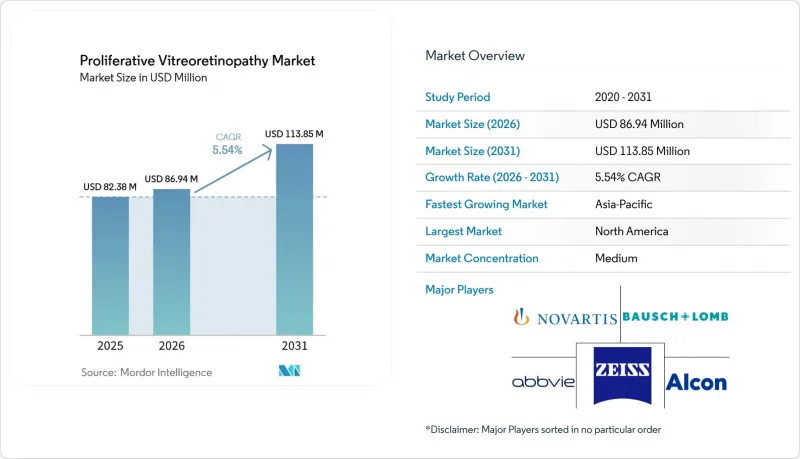
Mordor Intelligence에 의하면, 증식성 유리체 망막증 시장 규모는 2025년 8,238만 달러로 평가되었고, 2026년 8,694만 달러에서 2031년까지 1억 1,385만 달러로 확대될 것으로 예측되며, 2026-2031년 연평균 복합 성장률(CAGR)은 5.54%를 나타낼 전망입니다.
본 보고서는 치료 유형별(외과적 치료 등), 질환 단계별(등급 A PVR, 등급 B PVR, 등급 C PVR), 수술용 의료기기 유형별(유리체 절제 장치, 유리체 절제 프로브 등), 최종 사용자별(병원, 전문 안과 병원 등), 지역별(북미, 유럽, 아시아태평양 등)로 분류되어 있습니다. 시장 전망은 금액(달러) 기준으로 제시되어 있습니다.
세계의 증식성 유리체 망막증 시장 동향 및 인사이트
천공성 망막박리 발생률 상승이 PVR 수술 파이프라인을 뒷받침하고 있습니다.
독일의 전국 데이터에 따르면, 균열성 망막박리의 발생률은 2005년 10만 명당 15.6건에서 2021년에는 10만 명당 24.8건으로 상승했으며, 이는 복잡한 망막 복원술 수요 원천이 되는 사례 수가 여전히 증가하고 있음을 뒷받침합니다. 망막박리 사례 중 증식성 유리체 망막증(PVR)으로 진행되는 비율은 5%에서 10% 전후로 유지되고 있으며, 수술법이 개선된다 하더라도 망막박리 사례 수가 증가함에 따라 PVR의 절대 사례 수도 증가합니다. 이는 증식성 유리체 망막증 시장에 있어 중요한 점입니다. 왜냐하면 수요는 수술법의 개선으로도 해소되지 않는 실패 패턴과 연결되어 있기 때문입니다. 근시는 계속해서 이러한 부담의 업스트림에 위치하고 있으므로, 향후 사례 수 증가는 단순한 급성기 수술 대응 능력뿐만 아니라 장기적인 굴절 이상 동향과도 연동될 것입니다. 그 결과, 특히 고령화와 근시가 같은 방향으로 진행되고 있는 지역에서 증식성 유리체 망막증 시장에는 지속적인 수술 기반이 형성되고 있습니다. 따라서 병원이나 3차 망막 센터에서는 PVR을 감소 추세에 있는 수술 합병증이 아니라 지속적인 서비스 라인으로 계속해서 다루고 있습니다.
수술의 표준 치료를 재정의하는 첨단 유리체 망막 플랫폼
현재의 제품 사이클은 이례적으로 활발하며, 알콘(Alcon)사의 'UNITY VCS'는 'HYPERVIT 30K' 프로브와 개선된 유체 제어 아키텍처를 갖추고 시장 출시가 진행되고 있습니다. 보쉬 롬(Bosch-Lomb)사의 'Bi-Blade+' 듀얼 포트 유리체 절제 커터는 분당 2만 5,000회의 절단 능력과 커터 진동을 62% 저감했다고 보고되어, 섬세한 막 수술에서 직접적으로 중요한 역할을 하는 또 하나의 고성능 선택지가 되고 있습니다. 이러한 업그레이드를 통해 수술실에서의 제어성, 가시성 및 워크플로우 효율은 향상되지만, 중증 증식성 유리체 망막증(PVR) 수술에서 요구되는 임상적 판단이 불필요해지는 것은 아닙니다. 이러한 상황은 어려운 증례에서 재수술의 필요성을 배제하지 않으면서도 각 수술의 수익 가치를 높임으로써 증식성 유리체 망막증 시장을 지탱하고 있습니다. 또한, 이미 장비를 도입한 고객 기반 전반에 걸쳐 프리미엄 플랫폼 공급업체에 이익을 가져다주는 장비 교체 주기도 유지되고 있습니다. 통합 시스템에 투자하는 의료 기관이 늘어남에 따라, 증식성 유리체 망막증 시장은 단일 장비 구매가 아닌 번들 구매로 계속 전환되고 있습니다.
승인된 약물 요법이 없어 치료 선택지가 제한적
2026년 현재, PVR 치료제에 대해 FDA, EMA 및 기타 주요 규제 당국의 승인은 존재하지 않으며, 수술이 유일하게 확립된 치료법입니다. 27건의 무작위 대조 시험과 3,375명의 환자를 대상으로 한 체계적 문헌 고찰에 따르면, 일반적으로 검증된 약물 요법은 대규모 연구에서 재현 가능한 임상적 유효성을 보여주지 못한 것으로 밝혀졌습니다. 이러한 근거 부족으로 인해 증식성 유리체 망막증 시장은 유리체 절제술, 실리콘 오일 탐포네이드, 막 박리 등의 반복적인 외과적 개입에 계속 의존하고 있습니다. 또한, 환자 간의 이질성도 제품 개발을 복잡하게 만들고 있습니다. 수술 전 PVR 등급은 수술 후 치료 실패를 예측하는 강력한 지표로 남아 있어, 임상시험의 명확한 계층화를 어렵게 만들기 때문입니다. 이로 인해 미충족 의료 수요가 명백함에도 불구하고, 보조 요법이 될 가능성이 있는 제품 시장 진입이 지연되고 있습니다. 그 결과, 증식성 유리체 망막증 시장은 높은 임상적 수요가 있음에도 불구하고, 약물을 통한 치료 경로는 여전히 입증되지 않은 상황입니다.
부문 분석
2025년에는 외과적 치료가 매출의 72.43%를 차지했으며, 증식성 유리체 망막증 시장 규모에 있어 가장 큰 기여 요인이 되었습니다. 이러한 압도적인 점유율은 퍼스-프라나 유리체 절제술, 막 박리술 및 탐포네이드가 질병의 모든 단계에서 확립된 효능을 지닌 유일한 치료법으로 남아 있다는 사실을 반영합니다. 초소형 수술 기구와 시인성 향상으로 수술실에서의 정밀도는 높아졌지만, 핵심적인 외과적 치료법을 대체하지는 못했습니다. 따라서 증식성 유리체 망막증 시장의 수익 기반은 여전히 수술 기법, 의료기기 및 재사용 가능한 수술 소모품에 집중되어 있습니다. 증식성 유리체 망막증 업계에서 이로 인해 수술실이 가치 창출의 주요 거점이 되고 있습니다.
약물 요법 및 보조 요법은 2026-2031년 연평균 성장률(CAGR) 9.23%를 나타낼 것으로 예측되며, 이는 환자 부담형 구조에서 가장 빠르게 성장하는 치료 범주가 될 것입니다. 이러한 급속한 성장은 현재의 상업적 규모가 아닌 임상시험 활동에 기인한 것으로, 이 부문의 중요한 차이점입니다. 알데이라(Aldaira)사의 ADX-2191은 이 분야에서 여전히 가장 주목할 만한 자산 중 하나이며, 주요 임상시험 경로에 대해 이미 FDA의 특별 프로토콜 평가(SPA) 승인을 받은 바 있습니다. 학술지 보고에 따르면, 외과적 기술의 발전에도 불구하고 증식성 유리체 망막증(PVR)의 발생률은 실질적으로 감소하지 않았으며, 이는 외과적 치료의 대안이 아닌 약물 요법을 통한 보완적 치료의 필요성을 뒷받침합니다. 따라서 외과 수술이 여전히 매출을 주도하고 있음에도 불구하고, 증식성 유리체 망막증 시장에서는 보조 약물에 대한 강한 관심이 지속되고 있습니다.
2025년에는 등급 C가 증식성 유리체 망막증 시장의 53.28%를 차지한 것으로 평가되었으며, 이는 실제 임상에서 치료가 얼마나 진행 단계의 질환에 집중되어 있는지를 보여줍니다. 이러한 경향은 진료 의뢰 지연, 전문의 접근 제한, 그리고 많은 환자가 첫 번째 망막 복원술이 이미 실패한 후에야 비로소 3차 의료기관을 방문한다는 사실을 반영합니다. C등급의 경우 일반적으로 막 박리, 망막 절개, 실리콘 오일 사용 등 가장 많은 자원을 소모하는 치료법의 조합이 필요합니다. 따라서 상업적으로는 중요하지만, 임상적으로는 어려움을 수반합니다. 증식성 유리체 망막증 시장은 치료의 강도 덕분에 수익을 창출하고 있지만, 진행기 치료에서는 환자 1인당 자원 소비량이 많아지기 때문에 효율성 저하도 동반됩니다. 증식성 유리체 망막증 업계에서 등급 C는 여전히 임상적 필요와 경제적 부담이 가장 집중된 부문입니다.
등급 A는 2031년까지 연평균 성장률(CAGR) 9.79%를 나타낼 것으로 예측되며, 이 부문 내에서 가장 빠르게 성장하는 질환 단계가 될 것입니다. 이러한 변화는 진행성 흉터 형성이 고착되기 전에 망막 박리 위험이 높은 환자를 선별하는 데 대한 관심이 높아지고 있음을 시사합니다. 2026년 리뷰에서는 임상적으로 유의미한 증식성 유리체망막병증(PVR)이 발병하기 전에 고위험군 환자를 선별하기 위한 유용한 계층화 도구로, 최소 15광자/ms의 역치를 사용한 레이저 플레어 광도 측정이 확인되었습니다. 등급 B의 중요성이 높아지고 있는 배경에는 학술 기관들이 메토트렉세이트 병용 요법이나 수술 후 보다 엄격한 모니터링을 검토하기 시작하는 기준점에 근접해 있다는 점이 꼽힙니다. 앞으로 증식성 유리체 망막증(PVR) 시장은 순수하게 구제를 목적으로 하는 등급 C 치료 모델에 대한 의존도를 낮추고, 조기 발견에 대한 의존도를 높여갈 것으로 전망됩니다.
지역별 분석
2025년, 북미는 증식성 유리체 망막증 시장의 38.64%를 차지하며 지역별 최대 점유율을 기록했습니다. 미국은 망막 외과 의사의 밀도가 높고, 확립된 보험 환급 제도가 있으며, 최첨단 유리체망막 기술이 조기에 도입되고 있어 여전히 주요 수익원으로 자리 잡고 있습니다. 매사추세츠 안이병원에서는 네탈스딜 및 토포테칸의 예방 임상시험이 모두 진행되고 있어, 이로 인해 해당 지역은 다음 단계의 보조 치료 개발과 밀접하게 연계되어 있습니다. 캐나다에서는 2026년 7월 알콘(Alcon)사의 ‘UNITY VCS’가 캐나다 보건부의 승인을 획득함에 따라, 이 지역 전체에서 현행 세대의 유리체망막 플랫폼 기술에 대한 접근성이 확대되었습니다. 멕시코는 여전히 소규모 수익원이지만, 특정 병원 시스템 내에서 3차 망막 의료 인프라가 확대됨에 따라 그 기여도는 높아지고 있습니다.
유럽은 독일, 영국, 프랑스, 이탈리아, 스페인을 주축으로 하여, 증식성 유리체 망막증(PVR) 시장에서 2위 규모를 자랑하는 지역 블록입니다. 독일의 조정된 균열성 망막박리 발생률은 2021년까지 10만 명당 24.8에 달했으며, 이는 PVR 관련 수술의 안정적인 수요원이 되고 있습니다. 영국과 프랑스는 3차 의료기관으로의 환자 집중 및 임상시험 설계에 전문의가 참여함으로써 여전히 중요한 위치를 차지하고 있으며, 이를 통해 유럽은 이미 도입된 의료기기 규모를 넘어 그 중요성을 유지하고 있습니다. 또한 공급업체들은 학술 기관 및 대규모 의뢰 의료기관에서 외과의사들이 프리미엄 시각화 시스템 및 유리체 절제 시스템에 정통하다는 점에서도 혜택을 받고 있습니다. EU의 MDR(의료기기 규정) 준수는 소규모 의료기기 진출기업들에게 진입 장벽을 높이고 있으며, 이는 이미 규모와 규제 대응 능력을 갖추고 병원 입찰에서 입지를 유지할 수 있는 공급업체들에게 유리하게 작용하고 있습니다.
아시아태평양은 2031년까지 연평균 성장률(CAGR) 12.38%로 확대될 것으로 예측되며, 증식성 유리체 망막증 시장에서 가장 빠르게 성장하는 지역이 될 전망입니다. 중국에서 ZEISS사의 ‘ARTEVO 750’ 및 ‘ARTEVO 850’이 2026년에, DORC사의 ‘ILM-Blue’가 2025년에 승인된 것은 프리미엄 망막 기술이 수술 건수가 많은 의료 기관에 더욱 확산되고 있음을 보여줍니다. 일본과 한국에서는 고령화 인구와 성숙한 망막 수술 체계로 인해 추가적인 수요가 발생하고 있습니다. 또한, APVRS의 합의 지침은 회원 시장 간 수술 관행의 표준화에 기여하고 있습니다. 중동 및 아프리카 및 남미는 증식성 유리체 망막증 시장에서 여전히 규모가 작은 시장이지만, 브라질과 아르헨티나가 두드러지고 있습니다. 다만, 성장을 위해서는 의뢰 절차의 신속화, 조기 진단, 그리고 망막 전문의 수 증가가 여전히 필수적입니다.
기타 혜택 :
- 엑셀 형식 시장 예측(ME) 시트
- 3개월간의 애널리스트 지원
자주 묻는 질문
목차
제1장 서론
제2장 조사 방법
제3장 주요 요약
제4장 시장 구도
제5장 시장 규모 및 성장 예측
제6장 경쟁 구도
제7장 시장 기회 및 향후 전망
AJY 26.08.11According to Mordor Intelligence, the proliferative vitreoretinopathy market size is projected to expand from USD 82.38 million in 2025 and USD 86.94 million in 2026 to USD 113.85 million by 2031, registering a CAGR of 5.54% between 2026 to 2031.
This report is Segmented by Treatment Type (Surgical Treatment, and More), Disease Stage (Grade A PVR, Grade B PVR, and Grade C PVR), Surgical Device Type (Vitrectomy Machines, Vitrectomy Probes, and More), End User (Hospitals, Specialty Eye Hospitals, and More), and Geography (North America, Europe, Asia-Pacific, and More). The Market Forecasts are Provided in Terms of Value (USD).
Global Proliferative Vitreoretinopathy Market Trends and Insights
Rising Rhegmatogenous Incidence Anchors PVR Procedural Pipeline
Germany's nationwide data showed rhegmatogenous retinal detachment incidence rising to 24.8 per 100,000 by 2021 from 15.6 per 100,000 in 2005, which confirms that the upstream case pool for complex retinal repair is still growing. The share of detachment cases that progress to PVR has remained near 5% to 10%, so absolute PVR volumes increase as detachment volumes increase, even when surgical methods improve. This matters for the proliferative vitreoretinopathy market because demand is tied to a failure pattern that has not been eliminated by surgical refinement. Myopia continues to sit upstream of this burden, which keeps future case expansion linked to long-duration refractive disease trends rather than only to acute surgical capacity. The result is a durable procedural base for the proliferative vitreoretinopathy market, especially in regions where aging and myopia are moving in the same direction. Hospitals and tertiary retina centers, therefore, continue to treat PVR as a recurring service line rather than as a shrinking surgical complication.
Advanced Vitreoretinal Platforms Reshaping Surgical Standard of Care
The current product cycle remains unusually active, with Alcon's UNITY VCS moving through commercial rollout with the HYPERVIT 30K probe and upgraded fluidics architecture. Bausch + Lomb's Bi-Blade+ dual-port vitrectomy cutter adds another high-specification option with 25,000 cuts per minute and a reported 62% reduction in cutter vibration, which is directly relevant in delicate membrane work. These upgrades improve control, visibility, and workflow efficiency in the operating room, but they do not remove the clinical judgment required in severe PVR surgery. That dynamic supports the proliferative vitreoretinopathy market by raising the revenue value of each procedure without removing the need for repeat intervention in difficult cases. It also sustains a device replacement cycle that benefits premium platform vendors across installed base accounts. As more facilities invest in integrated systems, the proliferative vitreoretinopathy market keeps shifting toward bundled purchases rather than stand-alone instrument decisions.
Absence of Approved Pharmacological Therapy Narrows Treatment Options
No FDA, EMA, or other major regulatory approval exists for a PVR drug in 2026, which leaves surgery as the only established route of care. A systematic review covering 27 randomized controlled trials and 3,375 patients found that commonly tested pharmacological approaches did not deliver reproducible clinical benefit in large studies. That evidence gap keeps the proliferative vitreoretinopathy market dependent on repeat mechanical intervention, including vitrectomy, silicone oil tamponade, and membrane peeling. Patient heterogeneity also complicates product development, because preoperative PVR grade remains a strong predictor of post-surgical failure and makes clean trial stratification difficult. This slows commercial entry for would-be adjunct therapies even when the unmet need is obvious. As a result, the proliferative vitreoretinopathy market carries high clinical demand but a still-unproven drug pathway.
Other drivers and restraints analyzed in the detailed report include:
- Aging Population Expands PVR-Eligible Surgical Pool
- Anti-Fibrotic Pipeline Redefining Pharmacological Adjunct Strategy
- Recurrence Dynamics Create Clinical and Economic Friction
For complete list of drivers and restraints, kindly check the Table Of Contents.
Segment Analysis
Surgical treatment accounted for 72.43% of revenue in 2025, which made it the largest contributor to the proliferative vitreoretinopathy market size. This dominance reflects the fact that pars plana vitrectomy, membrane peeling, and tamponade remain the only interventions with established efficacy across the disease spectrum. Smaller-gauge surgery and better visualization have improved precision in the operating room, but they have not displaced the core surgical pathway. The revenue base of the proliferative vitreoretinopathy market, therefore, remains centered on procedures, devices, and recurring surgical consumables. Within the proliferative vitreoretinopathy industry, this makes the operating room the primary point of value capture.
Pharmacological and adjunctive treatment is projected to grow at 9.23% CAGR from 2026 to 2031, which makes it the fastest-growing treatment category in the user-supplied structure. That faster pace comes from trial activity and not from present-day commercial scale, which is an important distinction in this segment. Aldeyra's ADX-2191 remains one of the clearest named assets in this space, with FDA Special Protocol Assessment support already on record for a pivotal pathway. Journal evidence also notes that PVR incidence has not materially declined despite surgical advances, which preserves the case for a pharmacological complement rather than a surgical substitute. That is why the proliferative vitreoretinopathy market can support strong attention to adjunct drugs even while surgery continues to hold the revenue lead.
Grade C captured 53.28% of the proliferative vitreoretinopathy market share in 2025, which shows how heavily real-world treatment still concentrates in advanced disease. This pattern reflects delayed referral, limited specialist access, and the fact that many patients reach tertiary care only after the first retinal repair has already failed. Grade C cases usually require the most resource-intensive mix of membrane peeling, retinotomy, and silicone oil use, which makes them commercially important but clinically difficult. The proliferative vitreoretinopathy market gains revenue from that intensity, but it also inherits weaker efficiency because late-stage care consumes more resources per patient. Within the proliferative vitreoretinopathy industry, Grade C remains the segment where clinical need and economic burden are most concentrated.
Grade A is projected to grow at 9.79% CAGR through 2031, which makes it the fastest-growing disease stage in the segment framework. That change points to a stronger interest in identifying high-risk retinal detachment patients before aggressive scarring becomes established. A 2026 review identified laser flare photometry at a threshold of at least 15 photons/ms as a useful stratification tool for selecting patients at higher risk before clinically significant PVR develops. Grade B is also becoming more important because it sits near the point where academic centers consider adjunctive methotrexate protocols and tighter post-operative monitoring. Over time, the proliferative vitreoretinopathy market is likely to depend more on earlier identification and less on a purely rescue-oriented Grade C treatment model.
Complete Report Scope:
- By Treatment Type
- Surgical Treatment
- Pharmacological and Adjunctive Treatment
- By Disease Stage
- Grade A PVR
- Grade B PVR
- Grade C PVR
- By Surgical Device Type
- Vitrectomy Machines
- Vitrectomy Probes
- Intraocular Tamponades
- Ophthalmic Visualization Systems
- Others
- By End User
- Hospitals
- Specialty Eye Hospitals
- Ambulatory Surgery Center
- Others
- By Geography
- North America
- United States
- Canada
- Mexico
- Europe
- Germany
- United Kingdom
- France
- Italy
- Spain
- Rest of Europe
- Asia-Pacific
- China
- India
- Japan
- Australia
- South Korea
- Rest of Asia-Pacific
- Middle East and Africa
- GCC
- South Africa
- Rest of Middle East and Africa
- South America
- Brazil
- Argentina
- Rest of South America
- North America
Geography Analysis
North America commanded 38.64% of the proliferative vitreoretinopathy market share in 2025, which made it the largest regional contributor. The United States remains the primary revenue center because it combines a high density of retinal surgeons, established reimbursement pathways, and early adoption of premium vitreoretinal technology. Massachusetts Eye and Ear is running both netarsudil and topotecan prevention studies, which keep the region closely connected to the next wave of adjunct treatment development. Canada received Health Canada approval for Alcon's UNITY VCS in July 2026, which extends access to current-generation vitreoretinal platform technology across the region. Mexico remains a smaller revenue source, but its contribution improves as tertiary retinal care infrastructure expands in selected hospital systems.
Europe represents the second-largest regional block in the proliferative vitreoretinopathy market, supported by Germany, the UK, France, Italy, and Spain. Germany's adjusted rhegmatogenous retinal detachment incidence reached 24.8 per 100,000 by 2021, which creates a steady downstream pool for PVR-related surgery. The UK and France remain important through tertiary referral concentration and specialist engagement in trial design, which keeps Europe relevant beyond its installed device base. Suppliers are also benefiting from high surgeon familiarity with premium visualization and vitrectomy systems across academic and large referral centers. EU MDR compliance is raising the barrier for smaller device entrants, which favors suppliers that already have the scale and regulatory capability to stay present in hospital tenders.
Asia-Pacific is forecast to expand at 12.38% CAGR through 2031, making it the fastest-growing region in the proliferative vitreoretinopathy market. China's 2026 approvals for ZEISS ARTEVO 750 and ARTEVO 850, together with DORC's 2025 ILM-Blue approval, show that premium retinal technologies are moving deeper into high-volume centers. Japan and South Korea add further demand through older populations and mature retinal surgery capacity, while consensus guidance from APVRS is helping align surgical practice across member markets. Middle East and Africa and South America remain smaller opportunities in the proliferative vitreoretinopathy market, with Brazil and Argentina standing out, but growth still depends on faster referral, earlier diagnosis, and a larger retina specialist base.
- Abbvie
- Alcon
- Aldeyra Therapeutics
- Alimera Sciences, Inc.
- Bausch + Lomb Corporation
- BVI Medical
- Carl Zeiss
- Carl Zeiss
- DORC (Dutch Ophthalmic Research Center)
- Roche
- Genentech
- HOYA
- Johnson & Johnson
- Danaher
- Nidek
- Novartis
- Pfizer
- Regeneron Pharmaceuticals
- Tetra Bio-Pharma Inc.
- Topcon
Additional Benefits:
- The market estimate (ME) sheet in Excel format
- 3 months of analyst support
TABLE OF CONTENTS
1 Introduction
- 1.1 Study Assumptions And Market Definition
- 1.2 Scope Of The Study
2 Research Methodology
3 Executive Summary
4 Market Landscape
- 4.1 Market Overview
- 4.2 Market Drivers
- 4.2.1 Increasing Incidence of Rhegmatogenous Retinal Detachment Leading to PVR Burden
- 4.2.2 Expanding Use of Advanced Vitreoretinal Surgical Techniques
- 4.2.3 Rising Geriatric Population and Age-Associated Retinal Pathology
- 4.2.4 Greater Clinical Focus on Anti-Fibrotic Adjuncts and Combination Therapy
- 4.2.5 Improved Access to Retina Specialists and Tertiary Eye Care Referral Networks
- 4.2.6 Growing Use of Smaller-Gauge Vitrectomy and Visualization Platforms
- 4.3 Market Restraints
- 4.3.1 Limited Availability of Approved Pharmacological Treatments
- 4.3.2 High Recurrence Risk and Variable Post-Surgical Visual Outcomes
- 4.3.3 High Procedure Complexity and Dependence on Specialized Retina Surgeons
- 4.3.4 Delayed Diagnosis of Early PVR And Under-Referral in Emerging Markets
- 4.4 Value And Supply-Chain Analysis
- 4.5 Regulatory Landscape
- 4.6 Technological Outlook
- 4.7 Porter's Five Forces Analysis
- 4.7.1 Threat Of New Entrants
- 4.7.2 Bargaining Power Of Buyers
- 4.7.3 Bargaining Power Of Suppliers
- 4.7.4 Threat Of Substitutes
- 4.7.5 Competitive Rivalry
5 Market Size and Growth Forecasts
- 5.1 By Treatment Type
- 5.1.1 Surgical Treatment
- 5.1.2 Pharmacological and Adjunctive Treatment
- 5.2 By Disease Stage
- 5.2.1 Grade A PVR
- 5.2.2 Grade B PVR
- 5.2.3 Grade C PVR
- 5.3 By Surgical Device Type
- 5.3.1 Vitrectomy Machines
- 5.3.2 Vitrectomy Probes
- 5.3.3 Intraocular Tamponades
- 5.3.4 Ophthalmic Visualization Systems
- 5.3.5 Others
- 5.4 By End User
- 5.4.1 Hospitals
- 5.4.2 Specialty Eye Hospitals
- 5.4.3 Ambulatory Surgery Center
- 5.4.4 Others
- 5.5 By Geography
- 5.5.1 North America
- 5.5.1.1 United States
- 5.5.1.2 Canada
- 5.5.1.3 Mexico
- 5.5.2 Europe
- 5.5.2.1 Germany
- 5.5.2.2 United Kingdom
- 5.5.2.3 France
- 5.5.2.4 Italy
- 5.5.2.5 Spain
- 5.5.2.6 Rest of Europe
- 5.5.3 Asia-Pacific
- 5.5.3.1 China
- 5.5.3.2 India
- 5.5.3.3 Japan
- 5.5.3.4 Australia
- 5.5.3.5 South Korea
- 5.5.3.6 Rest of Asia-Pacific
- 5.5.4 Middle East and Africa
- 5.5.4.1 GCC
- 5.5.4.2 South Africa
- 5.5.4.3 Rest of Middle East and Africa
- 5.5.5 South America
- 5.5.5.1 Brazil
- 5.5.5.2 Argentina
- 5.5.5.3 Rest of South America
- 5.5.1 North America
6 Competitive Landscape
- 6.1 Market Concentration
- 6.2 Market Share Analysis
- 6.3 Company Profiles (includes Global Level Overview, Market Level Overview, Core Segments, Financials as Available, Strategic Information, Market Rank/Share, Products and Services, Recent Developments)
- 6.3.1 AbbVie Inc.
- 6.3.2 Alcon Inc.
- 6.3.3 Aldeyra Therapeutics, Inc.
- 6.3.4 Alimera Sciences, Inc.
- 6.3.5 Bausch + Lomb Corporation
- 6.3.6 BVI Medical
- 6.3.7 Carl Zeiss AG
- 6.3.8 Carl Zeiss Meditec AG
- 6.3.9 DORC (Dutch Ophthalmic Research Center)
- 6.3.10 F. Hoffmann-La Roche AG
- 6.3.11 Genentech, Inc.
- 6.3.12 Hoya Corporation
- 6.3.13 Johnson & Johnson Vision
- 6.3.14 Leica Microsystems
- 6.3.15 NIDEK CO., LTD.
- 6.3.16 Novartis AG
- 6.3.17 Pfizer Inc.
- 6.3.18 Regeneron Pharmaceuticals, Inc.
- 6.3.19 Tetra Bio-Pharma Inc.
- 6.3.20 Topcon Corporation
7 Market Opportunities and Future Outlook
- 7.1 White-space and Unmet-Need Assessment


