

|
시장보고서
상품코드
2099514
인도의 로보틱스 CNC 터닝 센터 시장 : 시장 점유율 분석, 업계 동향 및 통계, 성장 예측(2026-2031년)India Robotics CNC Turning Centers - Market Share Analysis, Industry Trends & Statistics, Growth Forecasts (2026 - 2031) |
||||||
 Mordor Intelligence
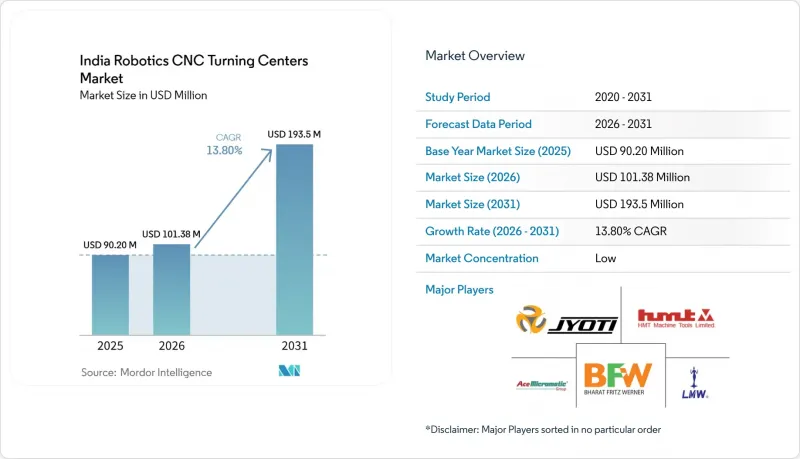
Mordor Intelligence에 의하면, 인도의 로보틱스 CNC 터닝 센터 시장 규모는 2025년 9,020만 달러로 평가되었고, 2026년에는 1억 138만 달러로 확대될 것으로 추정되고, 2026-2031년 CAGR 13.80%로 성장을 지속할 전망이며, 2031년에는 1억 9,350만 달러에 이를 것으로 예측됩니다.
본 보고서는 기계 유형별(수평형 로봇 선반, 수직형 로봇 선반 등), 로봇 유형별(다관절 로봇 등), 로봇 통합 유형별(OEM, 개조/애프터마켓 로봇 자동화), 최종 사용자 산업별(석유 및 가스·에너지, 항공우주 및 방위 등)으로 분류되어 있습니다. 시장 전망은 금액(달러) 및 수량(대)으로 제시되어 있습니다.
인도의 로보틱스 CNC 터닝 센터 시장 동향 및 인사이트
'메이크 인 인디아' 및 PLI(생산 연계형 인센티브)가 CNC 및 로봇 제조를 뒷받침하고 있습니다.
정책 지원에 힘입어, 인도의 로보틱스 CNC 선반 센터 시장에서 자동화 투자의 비용 구조는 적극적으로 변화하고 있습니다. '인도 자본재 부문 경쟁력 강화 계획(2단계)'의 총 예산은 1,207카롤 루피(1억 3,430만 달러)이며, 이 중 975카롤 루피(1억 850만 달러)가 예산 지원으로 책정되었습니다. 2024년 8월 현재, 33건의 프로젝트가 승인되었습니다. 이러한 프로젝트는 공작기계·로보틱스 분야의 우수 센터, 인더스트리 4.0 테스트베드, 기술 양성 시설 등에 이르기까지, CNC 및 로보틱스의 보다 광범위한 도입에 필요한 운영 기반 구축에 기여하고 있습니다. 또한, 1단계의 ‘기술 확보 기금 프로그램’을 통해 터닝-밀링 센터 및 4가이드웨이 CNC 선반의 국내 조달도 완료되었으며, 이는 멀티태스크 선반 플랫폼의 현지 개발을 지원하고 있습니다. 아울러 PLI(생산 연계형 인센티브)와 연계된 전자, 자동차, 의료기기 분야에 대한 투자도 정밀 제조 수요를 견인하고 있으며, 2025-26 회계연도에 자동차 및 자동차 부품 분야에 대한 배분이 확대됨에 따라 자동 선반 수요에 대한 이러한 견인력은 더욱 강화되고 있습니다. 'SAMARTH Udyog Bharat 4.0'도 이와 같은 방향성을 뒷받침하고 있습니다. 그 실증 모델을 통해 인도 제조업체들에게 스마트 제조의 통합이 가시화되어 실용적인 것으로 자리 잡았기 때문입니다.
로봇 도입을 주도하는 자동차 부문
자동차 부문은 인도 로보틱스 CNC 터닝 센터 시장에서 여전히 가장 확실한 수요의 주축으로 자리 잡고 있습니다. 2024년 자동차 분야 도입 대수는 총 4,070대에 달했으며, 이는 인도 내 산업용 로봇 도입 총수의 45%를 차지했습니다. 자동차 부품 공급업체만 해도 2,100대가 추가되어 40%의 성장률을 기록했으며, 샤프트, 허브, 플랜지, 변속기 부품에 사용되는 선반 시스템의 조달 채널은 활발한 상태를 유지하고 있습니다. 전기차(EV) 생산으로의 전환도 공작기계에 대한 요구 사항을 변화시키고 있습니다. 이는 전기차 부품에 더 엄격한 공차와 단일 세팅 내 공정 통합의 고도화가 요구되기 때문입니다. Jyoti CNC Automation사는 전기차 부품 가공을 위해 ‘VST 160 수직 샤프트 선반’을 개발했습니다. 이 회사는 자동 적재·하역 시스템을 통합하여, 공급업체들이 이러한 수요에 맞추어 제품을 조정하고 있음을 보여주는 실례를 제시하고 있습니다. 수요는 푸네, 첸나이, 구르가온, 사난드에 집중되어 있으므로, 이러한 클러스터에서 강력한 서비스 네트워크를 갖춘 공급업체는 인도의 로봇 호환 CNC 선반 시장에서 뚜렷한 경영상의 우위를 점하고 있습니다.
로봇 핵심 부품에 대한 높은 수입 의존도
인도의 로봇용 CNC 선반 시장은 로봇의 핵심 부품이 주로 수입에 의존하고 있어 여전히 구조적인 비용 문제에 직면해 있습니다. 인도는 중요한 전자 부품 및 서브시스템의 순수입국으로 남아 있으며, NITI Aayog의 2025-26 회계연도 2분기 ‘Trade Watch’ 보고서에 따르면 수출 구성은 여전히 최종 조립 제품에 집중되어 있는 것으로 확인되었습니다. 이와 유사한 의존 관계는 CNC 및 로봇 용도로 사용되는 반도체, 집적 회로, 컨트롤러, 모션 시스템에도 영향을 미치고 있습니다. 이로 인해 시스템 가격은 환율 변동의 영향을 받기 쉬워지며, 주요 서브시스템이 현지화되지 않은 경우 현지 기계 제조업체가 비용 변동을 흡수할 수 있는 범위가 제한됩니다. 중공업부는 터닝 밀링 센터 및 4가이드웨이 CNC 선반의 현지 기술 확보를 지원했으나, 서보 모터와 하모닉 드라이브의 현지화는 여전히 미흡한 상태입니다.
부문 분석
2025년, 인도의 로봇 연동 CNC 선반 시장에서 수평형 로봇 선반 센터는 46.7%의 점유율을 차지하며, 주요 기계 유형으로 자리 잡았습니다. 이 기계들은 자동차, 일반 기계, 석유 및 가스 분야의 대량 생산 원통형 부품 제조에서 여전히 표준적인 선택지로 남아 있습니다. 넓은 공작물 고정 범위와 표준 갠트리 로봇 및 관절식 로봇 로더와의 호환성을 통해 신규 도입 및 개조 프로젝트 모두를 지원합니다. 따라서 생산 라인의 안정성, 익숙한 공구, 그리고 폭넓은 서비스 지원을 여전히 중시하는 구매자에게 가장 실용적인 선택지가 되고 있습니다.
수직형 로봇 선반은 에너지 장비, 대구경 피팅 및 자동차용 대형 주조품의 대구경·중량 공작물 가공에 계속해서 활용되고 있습니다. 멀티태스크형 로봇 선반은 가장 빠르게 성장하는 기계 유형으로, 인도 로보틱스 CNC 터닝 센터 시장에서 이 부문의 규모는 2031년까지 연평균 성장률(CAGR) 14.1%로 확대될 것으로 예측됩니다. 공정 통합을 통해 단일 세팅 내에서 2차 밀링, 드릴링, 태핑 공정이 줄어들기 때문에 구매자들은 이러한 시스템으로 전환하고 있습니다. 이러한 변화는 여러 번의 세팅으로 인해 바람직하지 않은 치수 편차가 발생할 수 있는 항공우주, 의료기기, 전기차(EV) 파워트레인 분야에서 특히 중요합니다. '기타' 범주에는 역방향 및 스위스형 선반 센터가 포함되어 있으며, 초정밀 가공 분야에서도 주목을 받고 있습니다. 또한, Jyoti CNC Automation 및 AceMicromatic의 최근 제품 출시는 국내 OEM 업체들이 복잡한 가공 공정을 처리하는 선반 제품 라인업을 확대하고 있음을 보여줍니다.
2025년 인도 로봇 연동 CNC 선반 시장 규모 중 관절식 로봇이 56.2%를 차지하며, 로봇 유형 중 최대 점유율을 기록했습니다. 6축 동작을 통해 자동차 및 중공업 현장에서 복잡한 로딩 경로, 공작물 반전, 셀 내 검사가 가능해집니다. 따라서 요구 사항이 까다로운 생산 라인에서 고속 부품 이송 및 정밀한 배치를 위해서는 관절식 로봇이 최적의 구성입니다. 또한, 공장 내 다른 장소에서 기존 산업용 로봇을 이미 운용하고 있는 대형 제조업체들 사이에서 관절식 로봇에 대한 호환성이 높기 때문에 그 도입 대수도 증가하고 있습니다.
갠트리형 또는 데카르트형 로봇은 직선축을 통해 단순한 픽 앤 플레이스 작업에서 재현성과 저비용을 실현하므로, 단일 부품 계열의 대량 생산에서 여전히 안정적인 역할을 수행하고 있습니다. 협동 로봇은 인도의 로보틱스 CNC 터닝 센터 시장에서 2031년까지 연평균 성장률(CAGR)이 15.8%에 달할 것으로 예측되며, 가장 빠른 성장이 전망되는 로봇 유형입니다. 고정식 안전 가드의 필요성을 줄이고, 다품종 생산을 위한 보다 유연한 레이아웃을 가능하게 하기 때문에 중소·영세 기업(MSME)의 위탁 가공 업체에서 그 매력이 가장 크게 발휘되고 있습니다. 인도 일반 산업 분야에서의 로봇 활용이 광범위하게 확대되고 있는 것이 이러한 추세를 뒷받침하고 있으며, 국제로봇연맹(IFR)의 전 세계 데이터 역시 협동 로봇 도입 추세가 강화되고 있음을 보여주고 있습니다. 푸네에서 개최된 IMTMA(인도 공작기계 제조업체 협회) 자동화 심포지엄에서는 스마트 팩토리 내 협업 로봇에 특히 초점이 맞추어졌으며, CNC 환경에서 협업 로봇 도입을 위한 업계의 준비가 점차 갖춰지고 있음이 밝혀졌습니다.
기타 혜택 :
- 엑셀 형식 시장 예측(ME) 시트
- 3개월간의 애널리스트 지원
자주 묻는 질문
목차
제1장 서론
제2장 조사 방법
제3장 주요 요약
제4장 시장 구도
제5장 시장 규모 및 성장 예측
제6장 경쟁 구도
제7장 시장 기회 및 향후 전망
AJY 26.08.11According to Mordor Intelligence, the India robotics CNC turning centers market size is expected to grow from USD 90.20 million in 2025 to USD 101.38 million in 2026 and is forecast to reach USD 193.5 million by 2031 at 13.80% CAGR over 2026-2031.
This report is Segmented by Machine Type (Horizontal Robotic Turning Centers, Vertical Robotic Turning Centers, and More), by Robot Type (Articulated Robots, and More), by Robot Integration Type (OEM, Retrofit/Aftermarket Robotic Automation), and by End-User Industry (Oil, Gas, & Energy, Aerospace & Defense, and More), The Market Forecasts are Provided in Terms of Value (USD) and Volume (Units).
India Robotics CNC Turning Centers Market Trends and Insights
Make in India and PLI (Production-Linked Incentive) Incentivizing CNC and Robotics Manufacturing
Policy support is actively changing the cost structure of automation investment in the India robotics CNC turning centers market. The Scheme for Enhancement of Competitiveness in the Indian Capital Goods Sector Phase II has a total outlay of INR 1,207 crore (USD 134.3 million), of which INR 975 crore (USD 108.5 million) is budgetary support. As of August 2024, 33 projects have been sanctioned. These projects span centers of excellence in machine tool robotics, Industry 4.0 testbeds, and skilling facilities, helping build the operating base needed for broader adoption of CNC and robotics. The Technology Acquisition Fund Program under Phase I also completed domestic acquisitions of a Turn Mill Center and a Four-Guideway CNC Lathe, which support local development of multi-tasking turning platforms. PLI-linked investment in electronics, automotive, and medical devices is also driving demand for precision manufacturing, and the larger 2025-26 allocation for automobiles and auto components further strengthens this pull on automated turning demand. SAMARTH Udyog Bharat 4.0 reinforces the same direction because its demonstration model keeps smart manufacturing integration visible and practical for Indian manufacturers.
Automotive Sector Driving Robot Adoption
The automotive sector remains the clearest demand anchor for the India robotics CNC turning centers market. Automotive installations totaled 4,070 units in 2024, representing 45% of all industrial robot deployments in India. Automotive parts suppliers alone added 2,100 units and grew by 40%, keeping the procurement channel active for turning systems used in shafts, hubs, flanges, and transmission elements. The shift toward electric vehicle production is also changing machine requirements, as EV components require tighter tolerances and greater process consolidation within a single setup. Jyoti CNC Automation developed its VST 160 Vertical Shaft Turning Center for EV component machining. It integrated an automated loading and unloading system, demonstrating how suppliers are aligning their products with this demand. Demand is concentrated in Pune, Chennai, Gurugram, and Sanand, so vendors with stronger service networks in these clusters hold a clear operating advantage in the India robotics CNC turning centers market.
High Import Dependency for Core Robotics Components
The India robotics CNC turning centers market still faces a structural cost problem because core robotics components are largely imported. India remains a net importer of critical electronic components and subsystems, and NITI Aayog's Trade Watch for Q2 FY 2025-26 confirmed that the export profile remains concentrated in final-assembly products. The same dependency affects semiconductors, integrated circuits, controllers, and motion systems used in CNC and robotic applications. This keeps system pricing exposed to currency movements and limits how far local machine builders can absorb cost swings when key subsystems are not localized. The Ministry of Heavy Industries supported local technology acquisition for a Turn Mill Center and a Four-Guideway CNC Lathe, but localization of servo motors and harmonic drives remains incomplete.
Other drivers and restraints analyzed in the detailed report include:
- Rapid Robot Installation Growth
- MSME Automation Subsidies Expanding Robot Adoption
- High Upfront Cost of Robot-Integrated CNC Turning Cells
For complete list of drivers and restraints, kindly check the Table Of Contents.
Segment Analysis
Horizontal robotic turning centers held 46.7% of the India robotics CNC turning centers market share in 2025, making them the leading machine type. They remain the default choice for high-volume cylindrical part production across automotive, general engineering, and oil and gas applications. Their wide workholding range and compatibility with standard gantry and articulated robot loaders support both new installations and retrofit projects. This makes them the most practical choice for buyers who still prioritize line stability, familiar tooling, and broad service support.
Vertical robotic turning centers continue to serve large-diameter and heavy-workpiece jobs in energy equipment, large-bore fittings, and heavy automotive castings. Multi-tasking robotic turning centers are the fastest-growing machine type, and the India robotics CNC turning centers market size for this segment is projected to expand at a 14.1% CAGR through 2031. Buyers are shifting toward these systems because process consolidation reduces secondary milling, drilling, and tapping steps within a single setup. That change is especially relevant in aerospace, medical devices, and EV powertrains, where multiple setups can introduce unwanted dimensional variation. The others category, which includes inverted and Swiss-type turning centers, is also gaining traction in miniature precision applications, and recent product moves from Jyoti CNC Automation and AceMicromatic show that domestic OEMs are broadening their complex-process turning portfolios.
Articulated robots accounted for 56.2% of the India robotics CNC turning centers market size in 2025, giving them the largest share among robot types. Their six-axis motion supports complex loading paths, workpiece flipping, and in-cell inspection in automotive and heavy engineering settings. This makes them the preferred setup for high-speed part transfer and precision placement in demanding production lines. Their installed base also benefits from stronger familiarity among large manufacturers that already operate conventional industrial robots elsewhere on the shop floor.
Gantry or cartesian robots still hold a steady role in high-volume single-part-family production because their linear axes offer repeatability and lower cost for simple pick-and-place tasks. Collaborative robots are the fastest-growing robot type with a 15.8% CAGR through 2031 in the India robotics CNC turning centers market. Their appeal is strongest in MSME job shops because they reduce the need for fixed safety guarding and allow more flexible layouts for high-mix production. The broader rise of general industry robot use in India supports this pattern, and global IFR data also points to stronger cobot adoption trends. IMTMA's (India Machine Tool Manufacturers' Association) automation symposium in Pune devoted dedicated attention to collaborative robotics in smart factories, which shows rising industry readiness for cobot use in CNC environments.
Complete Report Scope:
- By Machine Type
- Horizontal Robotic Turning Centers
- Vertical Robotic Turning Centers
- Multi-Tasking Robotic Turning Centers
- Others
- By Robot Type
- Articulated Robots
- Collaborative Robots (Cobots)
- Gantry/Cartesian Robots
- By Robot Integration Type
- OEM-Integrated Robotic Turning Cells
- Retrofit/Aftermarket Robotic Automation
- By End-User Industry
- Automotive & Commercial Vehicles
- Aerospace & Defense
- Medical Devices & Surgical Instruments
- Oil, Gas, & Energy
- Electrical, Electronics & Semiconductor Equipment
- General Industrial Machinery
- Others
List of Companies Covered in this Report:
- Jyoti CNC Automation Limited
- Ace Micromatic Group
- Bharat Fritz Werner Ltd. (BFW)
- HMT Machine Tools Limited
- LMW Limited (Lakshmi Machine Works)
- Macpower CNC Machines Limited
- DMG MORI Co., Ltd.
- Yamazaki Mazak Corporation
- Okuma Corporation
- DN Solutions Co., Ltd.
- Hyundai WIA Corporation
- EMAG GmbH & Co. KG
- Nakamura-Tome Precision Industry Co., Ltd.
- Murata Machinery, Ltd. (Muratec)
- FANUC Corporation
- ABB Ltd
- KUKA AG
- Yaskawa Electric Corporation
- Kawasaki Heavy Industries, Ltd.
- Mitsubishi Electric Corporation
Additional Benefits:
- The market estimate (ME) sheet in Excel format
- 3 months of analyst support
TABLE OF CONTENTS
1 Introduction
- 1.1 Study Assumptions & Market Definition
- 1.2 Scope of the Study
2 Research Methodology
3 Executive Summary
4 Market Landscape
- 4.1 Market Overview
- 4.2 Market Drivers
- 4.2.1 Make in India and PLI Incentivizing CNC and Robotics Manufacturing
- 4.2.2 Automotive Sector Driving Robot Adoption
- 4.2.3 Rapid Robot Installation Growth
- 4.2.4 MSME Automation Subsidies Expanding Robot Adoption
- 4.2.5 Industry-Led Initiatives Promoting Advanced Manufacturing Technologies
- 4.2.6 Domestic CNC Turning OEMs Adding Automation Readiness
- 4.3 Market Restraints
- 4.3.1 High Import Dependency for Core Robotics Components
- 4.3.2 High Upfront Cost of Robot-Integrated CNC Turning Cells
- 4.3.3 Shortage of Skilled Manpower for CNC and Robotics-Integrated Systems
- 4.3.4 Low Robot Density Compared to Peer Manufacturing Economies
- 4.4 Value / Supply-Chain Analysis
- 4.4.1 Component & Raw Material Supply
- 4.4.2 Manufacturing & System Integration
- 4.4.3 Distribution & End-User Delivery
- 4.4.4 Aftermarket Services & Lifecycle Support
- 4.5 Regulatory Landscape
- 4.6 Technological Outlook
- 4.6.1 AI-Enabled Vision Guidance
- 4.6.2 Predictive Maintenance Integration
- 4.6.3 Digital Twin and Simulation Technologies
- 4.7 Automation Maturity Assessment by Industry
- 4.8 Digitalization Trends in CNC Machining
- 4.9 Investment and Procurement Models for Robotic CNC Turning Cells
- 4.10 Pricing Analysis
- 4.10.1 Average Selling Price (ASP) Benchmarking of Key Market Participants
- 4.10.2 Average Selling Price (ASP) Benchmarking by Automation Level
- 4.10.3 Average Selling Price (ASP) Benchmarking by Geography
- 4.11 Porter's Five Forces - Industry Attractiveness Scoring
- 4.11.1 Threat of New Entrants
- 4.11.2 Bargaining Power of Suppliers
- 4.11.3 Bargaining Power of Buyers
- 4.11.4 Threat of Substitutes
- 4.11.5 Industry Rivalry
- 4.12 Industry Case Studies
- 4.13 Impact of Geopolitical Events on the Market
5 Market Size & Growth Forecasts
- 5.1 By Machine Type
- 5.1.1 Horizontal Robotic Turning Centers
- 5.1.2 Vertical Robotic Turning Centers
- 5.1.3 Multi-Tasking Robotic Turning Centers
- 5.1.4 Others
- 5.2 By Robot Type
- 5.2.1 Articulated Robots
- 5.2.2 Collaborative Robots (Cobots)
- 5.2.3 Gantry/Cartesian Robots
- 5.3 By Robot Integration Type
- 5.3.1 OEM-Integrated Robotic Turning Cells
- 5.3.2 Retrofit/Aftermarket Robotic Automation
- 5.4 By End-User Industry
- 5.4.1 Automotive & Commercial Vehicles
- 5.4.2 Aerospace & Defense
- 5.4.3 Medical Devices & Surgical Instruments
- 5.4.4 Oil, Gas, & Energy
- 5.4.5 Electrical, Electronics & Semiconductor Equipment
- 5.4.6 General Industrial Machinery
- 5.4.7 Others
6 Competitive Landscape
- 6.1 Market Concentration
- 6.2 Strategic Moves
- 6.3 Market Share Analysis
- 6.4 Competitive Technology Benchmarking
- 6.5 Company Profiles (Includes Global Level Overview, Market Level Overview, Core Segments, Financials as Available, Strategic Information, Products & Services, and Recent Developments)
- 6.5.1 Jyoti CNC Automation Limited
- 6.5.2 Ace Micromatic Group
- 6.5.3 Bharat Fritz Werner Ltd. (BFW)
- 6.5.4 HMT Machine Tools Limited
- 6.5.5 LMW Limited (Lakshmi Machine Works)
- 6.5.6 Macpower CNC Machines Limited
- 6.5.7 DMG MORI Co., Ltd.
- 6.5.8 Yamazaki Mazak Corporation
- 6.5.9 Okuma Corporation
- 6.5.10 DN Solutions Co., Ltd.
- 6.5.11 Hyundai WIA Corporation
- 6.5.12 EMAG GmbH & Co. KG
- 6.5.13 Nakamura-Tome Precision Industry Co., Ltd.
- 6.5.14 Murata Machinery, Ltd. (Muratec)
- 6.5.15 FANUC Corporation
- 6.5.16 ABB Ltd
- 6.5.17 KUKA AG
- 6.5.18 Yaskawa Electric Corporation
- 6.5.19 Kawasaki Heavy Industries, Ltd.
- 6.5.20 Mitsubishi Electric Corporation
7 Market Opportunities & Future Outlook
- 7.1 White-Space & Unmet-Need Assessment


