

|
시장보고서
상품코드
2099523
중심 정맥 카테터 시장 : 시장 점유율 분석, 업계 동향 통계, 성장 예측(2026-2031년)Central Venous Catheter - Market Share Analysis, Industry Trends & Statistics, Growth Forecasts (2026 - 2031) |
||||||
 Mordor Intelligence
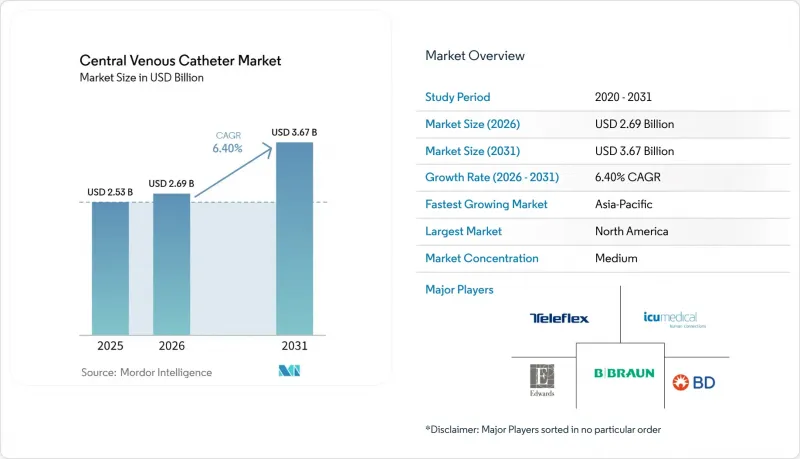
Mordor Intelligence에 의하면, 중심 정맥 카테터 시장 규모는 2025년 25억 3,000만 달러로 평가되었고, 2026년에는 26억 9,000만 달러로 확대될 것으로 추정되고, 2026-2031년 CAGR 6.40%로 성장을 지속할 전망이며, 2031년에는 36억 7,000만 달러에 이를 것으로 예측됩니다.
본 보고서는 제품 유형별(비터널형, 터널형 중심정맥카테터, PICC, 이식형 포트), 루멘별(싱글, 더블, 트리플, 멀티루멘), 재질별(폴리우레탄, 실리콘, 기타), 용도별(약물 투여, 수액·영양 공급, 수혈, 진단), 최종 사용자별(병원, 외래수술센터(ASC), 진료소, 재택치료), 지역별(북미, 유럽, 아시아태평양, 중동 및 아프리카, 남미)로 분류되어 있습니다. 예측치는 달러 기준입니다.
세계의 중심 정맥 카테터 시장 동향 및 인사이트
암, 투석 및 중환자 치료 분야 수요 증가
중심 정맥 카테터 시장은 반복적인 접근, 안정적인 수액 공급, 그리고 장기간 치료 기간 동안의 관리된 투여가 필요한 암, 투석 및 중환자 치료 사례로부터 계속해서 혜택을 받고 있습니다. 의료진은 인공루가 사용 가능해질 때까지 터널형 카테터를 임시 접근 수단으로 사용하기 때문에 투석은 여전히 주요 수요 견인 요인으로 작용하고 있습니다. 중환자 치료 분야도 시장 성장을 뒷받침하고 있습니다. 중환자실 환자들은 대개 단일 접근 경로를 통해 혈관 작용제, 혈액 제제, 모니터링, 영양 지원이 필요하기 때문입니다. 또한, 암 치료와 신장 질환이 중복되는 경우, 환자가 화학요법과 투석 모두에 대한 지원이 필요하기 때문에 환자 1인당 카테터 사용량이 증가합니다. 인도 등 여러 국가에서 공공 의료 프로그램이 확대됨에 따라, 서비스 제공 역량의 향상이 실제 의료 현장에서 카테터 삽입 건수를 얼마나 증가시키는지를 보여주고 있습니다.
고압 주입 대응 중심 정맥 카테터에 대한 수요 증가
암 진단, 병기 분류 및 경과 관찰에서 조영제를 이용한 영상 진단이 일상화됨에 따라, 병원에서는 고압 주입 대응 시스템의 도입이 점점 더 확대되고 있습니다. 카테터가 고압 조영제 주입을 지원하지 못하는 경우, 임상의는 추가적인 접근 절차가 필요한 경우가 많으며, 이로 인해 업무 부담이 증가하고 환자에게도 부담이 가중됩니다. 프로토콜을 중시하는 병원에서는 현재 고압 주입이 가능한 말초 삽입형 중심 정맥 카테터(PICC)나 포트를 선택적인 프리미엄 업그레이드가 아닌 표준 사양으로 취급하고 있습니다. 이러한 변화는 카테터의 성능, 삽입 시 안전성, 그리고 간소화된 워크플로우 설계를 단일 플랫폼에 통합한 공급업체에게 유리하게 작용합니다. BD사의 ‘CentroVena One’ 출시는 이러한 방향성을 반영하고 있으며, 통합된 삽입, 절차 간소화, 그리고 응급 상황이 많은 환경에서의 사용에 중점을 두고 있습니다.
카테터 관련 혈류 감염 위험
예방 프로토콜이 강화되었음에도 불구하고, 감염 위험은 여전히 중심정맥 접근에 대한 신뢰를 훼손하고 있습니다. WHO의 2024년 지침에 따르면, 혈관 내 카테터와 관련된 혈류 감염에는 엄격한 처치 규율과 지속적인 모니터링이 필요하다고 명시되어 있습니다. 또한, 중심 정맥 카테터 관련 혈류 감염(CLABSI)이 발생할 경우, 병원은 보고 의무, 보험 급여에 미치는 영향, 내부 조사 등의 압박에 직면하게 되며, 그 부담은 임상적 피해에만 그치지 않습니다. 혈전증은 치료를 중단시키거나 카테터 제거를 필요로 하거나, 이미 허약한 환자의 치료비를 증가시킬 가능성이 있어 추가적인 우려 사항이 되고 있습니다. 2026년 『BMC Surgery』지에 발표된 후향적 코호트 연구에 따르면, 종양학 환자에게 사용되는 터널형 비커프 중심 정맥 카테터는 삽입 프로토콜이 최적화되어 있음에도 불구하고 여전히 유의미한 혈전증 위험을 수반하는 것으로 확인되었습니다. 특정 사례에서 구매자가 중심정맥 접근법을 침습성이 낮은 대안과 비교할 때, 안전성 우려가 도입을 지연시킬 가능성이 있으므로, 이러한 우려는 중심 정맥 카테터 시장에 있어 여전히 중요한 과제로 남아 있습니다.
부문 분석
말초 삽입형 중심 정맥 카테터(PICC)는 2025년에 제품 유형별 부문의 38.12%를 차지한 것으로 평가되었으며, 중기 치료에서 계속해서 주도적인 위치를 유지할 전망입니다. 항생제 정맥 주입, 화학요법 주기, 그리고 즉각적인 외과적 삽입이 필요하지 않으면서도 신뢰할 수 있는 접근이 요구되는 치료 분야에서 그 사용은 계속해서 견조한 추세를 보일 것입니다. 비터널형 카테터는 급성기 병원 수요를 충족시키는 한편, 터널형 장치는 투석 및 만성 암 치료에서 여전히 중요한 역할을 수행하고 있습니다. 이러한 구성 덕분에 중심 정맥 카테터 시장은 대량으로 사용되는 급성기 용도와 내구성이 뛰어난 장기 접근 방식 사이에서 균형을 유지하고 있습니다.
이식형 포트는 암 치료 및 소아 의료 분야 수요 증가를 배경으로, 2026-2031년 연평균 성장률(CAGR) 9.53%를 기록하며 가장 빠르게 성장하는 제품 카테고리가 될 것으로 예측됩니다. 완전 피하 이식형 설계 덕분에 환자의 편의성이 향상되고, 외관상 눈에 덜 띄며, 장기적인 치료 요구를 충족시킬 수 있습니다. PICC-PORT 설계와 같은 하이브리드 개념은 해부학적 조건이 까다로운 사례에 대한 유연한 접근 수단으로의 전환을 보여줍니다. 공급업체들이 고부가가치 및 장기 삽입 용도에서 차별화를 꾀함에 따라 이 카테고리의 중요성은 더욱 커지고 있습니다.
2025년에는 더블 루멘 카테터가 42.45%의 점유율을 차지한 것으로 평가되었으며, 투석 및 병원 내 다제 투여 프로토콜에서 주요 루멘 유형이 될 전망입니다. 투석에서는 채혈과 환류를 동시에 수행해야 하지만, 종양학이나 중환자 치료 요법에서는 채널이 분리되어 있는 것이 유리합니다. 싱글 루멘 장치는 보다 단순한 치료에 대응하며, 트리플 루멘 구성은 중증 환자 치료에서 여전히 중요한 역할을 하고 있습니다. 중심 정맥 카테터 시장에서 루멘 선택은 여전히 치료의 복잡성과 밀접한 관련이 있습니다.
치료 경로에서 삽입 부위를 최소화하면서 동시에 수액을 투여할 수 있는 수요가 증가함에 따라, 멀티루멘 카테터는 가장 빠르게 성장하는 루멘 카테고리가 될 것이며, 2031년까지 연평균 성장률(CAGR) 8.67%를 나타낼 것으로 예측됩니다. 삽입 부위를 줄임으로써 환자의 접근 부담을 경감하고, 복잡한 병원 프로토콜을 간소화할 수 있습니다. 또한, 혈전 형성을 억제하고 장기 사용을 가능하게 하는 표면 처리 등 루멘 수준의 성능 향상을 위한 기술 혁신도 진행되고 있습니다. 삽입의 복잡성을 증가시키지 않으면서 채널의 기능성을 향상시키는 공급업체는 계속해서 유리한 입지를 유지할 전망입니다.
지역별 분석
북미는 2025년에 41.56%의 점유율을 차지한 것으로 평가되었으며, 중심 정맥 카테터 시장에서 가장 규모가 큰 지역 블록으로서의 지위를 유지할 전망입니다. 엄격한 감염 관리 기준, 확립된 병원 인증 요건, 그리고 고품질 항균 기기 및 고압 주입 대응 기기의 광범위한 채택이 이 지역의 선도적 지위를 뒷받침하고 있습니다. 특히 미국은 여전히 중요한 시장이며, 임상 프로토콜, 성숙한 계약 채널, 그리고 워크플로우 개선 기술에 대한 강력한 수요가 프리미엄 기기의 채택을 뒷받침하고 있습니다. 캐나다와 멕시코는 꾸준한 성장에 기여하고 있으며, 제품 차별화는 단순한 기본 카테터 접근을 넘어 삽입 시스템, 고정 및 통합 워크플로우 설계로 전환되고 있습니다.
유럽은 독일, 프랑스, 영국의 대규모 암 치료 프로그램과 확립된 투석 네트워크에 힘입어, 중심 정맥 카테터 시장에서 여전히 2위 지역 블록을 차지하고 있습니다. 이탈리아와 스페인에서는 고령화가 진행되는 인구 동향과 외래 정맥 주사 치료 역량의 확장으로 인해 수요가 서서히 증가하고 있습니다. 유럽연합(EU)의 의료기기 규정에 따른 규제 요건은 신규 진출기업들의 부담을 가중시키고 있으며, 특히 코팅 제품이나 항균 제품과 같은 카테고리에서는 시판 후 지속적인 임상 추적 관찰이 여전히 중요합니다. 2026년에 발표될 것으로 예상되는 B. Braun사의 2025년도 결산에서는 연구개발비가 전년 대비 11% 증가한 5억 8,400만 유로가 될 전망이며, 이는 커넥티드 수액 및 혈관 접근 기능에 대한 지속적인 투자를 뒷받침하는 것입니다.
아시아태평양은 중심 정맥 카테터 시장에서 가장 빠르게 성장하고 있는 지역으로, 2026-2031년 연평균 성장률(CAGR) 10.56%가 예상됩니다. 병원 수용 능력 확대, 만성 질환 부담 증가, 그리고 투석 및 암 치료 인프라에 대한 공공 투자 강화가 이 지역의 성장을 견인하고 있습니다. 인도에서는 투석 프로그램 확대가 호재로 작용하고 있으며, 이는 인공 투석용 션트를 통한 접근이 아직 이용 불가능한 상황에서 터널형 카테터 삽입을 촉진하고 있습니다. 중국에서는 두 가지 흐름이 관찰됩니다. 다국적 제조업체들이 최상위급 병원을 대상으로 우수한 성능을 무기로 경쟁을 펼치는 한편, 국내 제조업체들은 비용 중심의 조달 채널에서 계속해서 활발히 활동하고 있습니다.
기타 혜택 :
- 엑셀 형식 시장 예측(ME) 시트
- 3개월간의 애널리스트 지원
자주 묻는 질문
목차
제1장 서론
제2장 조사 방법
제3장 주요 요약
제4장 시장 구도
제5장 시장 규모 및 성장 예측
제6장 경쟁 구도
제7장 시장 기회 및 향후 전망
AJY 26.08.11According to Mordor Intelligence, the central venous catheter market size is expected to grow from USD 2.53 billion in 2025 to USD 2.69 billion in 2026 and is forecast to reach USD 3.67 billion by 2031 at 6.40% CAGR over 2026-2031.
This report is Segmented by Product Type (Non-Tunneled, Tunneled CVCs, Piccs, Implanted Ports), Lumen (Single, Double, Triple, Multi-Lumen), Material (Polyurethane, Silicone, Others), Application (Drug Admin., Fluid/Nutrition, Blood Transfusion, Diagnostics), End User (Hospitals, Ascs, Clinics, Home Healthcare), and Geography (North America, Europe, Asia-Pacific, MEA, South America). Forecasts in USD Value.
Global Central Venous Catheter Market Trends and Insights
Rising Cancer, Dialysis, and Critical-Care Demand
The central venous catheter market continues to gain from cancer, dialysis, and critical care cases that require repeated access, reliable infusion, and controlled administration over extended treatment periods. Dialysis remains a key demand driver, as healthcare providers use tunneled catheters as bridging access when fistulas are not ready. Critical care also supports market growth, as patients in intensive care settings often need vasoactive drugs, blood products, monitoring, and nutritional support through a single access route. The overlap between oncology and kidney disease increases catheter use per patient when individuals require both chemotherapy and dialysis support. Public program expansion in countries such as India shows how higher service capacity can increase catheter placements in real care settings.
Increasing Preference for Power-Injectable Central Venous Catheters
Hospitals are increasingly adopting power-injectable systems as contrast-enhanced imaging becomes routine in cancer diagnosis, staging, and follow-up care. When catheters cannot support high-pressure contrast injection, clinicians often need an additional access step, which increases workload and patient inconvenience. Protocol-driven hospitals now treat power-injectable peripherally inserted central catheters (PICCs) and ports as standard specifications rather than optional premium upgrades. This shift benefits suppliers that combine catheter performance, insertion safety, and simplified workflow design in a single platform. BD's CentroVena One launch reflects this direction, with a focus on integrated insertion, fewer procedural steps, and use in high-acuity environments.
Catheter-Related Bloodstream Infection Risk
Infection risk continues to affect confidence in central access, despite stronger prevention protocols. The WHO's 2024 guidance states that bloodstream infections associated with intravascular catheters require strict procedural discipline and continuous oversight. Hospitals also face reporting pressure, reimbursement consequences, and internal reviews when central line-associated bloodstream infection (CLABSI) events occur, extending the burden beyond clinical harm. Thrombosis adds further concern, as it can interrupt therapy, require catheter removal, and increase treatment costs for already fragile patients. A 2026 retrospective cohort study in BMC Surgery confirmed that tunneled non-cuffed centrally inserted catheters in oncology patients still carry meaningful thrombosis risk despite optimized placement protocols. This restraint remains important for the central venous catheter market because safety concerns can slow adoption when buyers compare central access with less invasive options in selected cases.
Other drivers and restraints analyzed in the detailed report include:
- Infection-Prevention Bundling and Chlorhexidine Adoption
- Longer Dwell-Time Use in Home Infusion and Ambulatory Settings
- Pricing Pressure from Value-Based Procurement and Tenders
For complete list of drivers and restraints, kindly check the Table Of Contents.
Segment Analysis
Peripherally inserted central catheters (PICCs) are expected to account for 38.12% of the product type segment in 2025, maintaining the leading position across intermediate-duration therapies. Their use remains strong in antibiotic infusion, chemotherapy cycles, and treatments that require reliable access without immediate surgical implantation. Non-tunneled catheters support acute hospital needs, while tunneled devices remain important in dialysis and chronic oncology care. This mix keeps the central venous catheter market balanced between high-volume acute use and durable long-term access.
Implanted ports are projected to be the fastest-growing product category, registering a 9.53% compound annual growth rate (CAGR) from 2026 to 2031, driven by stronger demand in oncology and pediatric care. Their fully subcutaneous design improves patient comfort, lowers visibility, and supports extended treatment needs. Hybrid concepts, such as PICC-PORT designs, indicate a shift toward flexible access options for difficult anatomies. This category is gaining importance as suppliers pursue differentiation in high-value and long-dwell applications.
Double lumen catheters are expected to hold a 42.45% share in 2025, making them the leading lumen type across dialysis and multi-drug hospital protocols. Dialysis requires simultaneous withdrawal and return, while oncology and intensive care regimens benefit from separated channels. Single lumen devices support simpler therapies, and triple lumen configurations remain relevant in high-acuity care. Lumen selection in the central venous catheter market remains closely linked to treatment complexity.
Multi-lumen catheters are projected to be the fastest-growing lumen category, registering an 8.67% CAGR through 2031, as care pathways require more simultaneous infusions through fewer insertion sites. Fewer insertion points can reduce patient access burden and simplify complex hospital protocols. Innovation is also advancing lumen-level performance, including surfaces designed to reduce clot formation and support longer use. Suppliers that improve channel functionality without complicating insertion are likely to stay well positioned.
Complete Report Scope:
- By Product Type
- Non-Tunneled Central Venous Catheters
- Tunneled Central Venous Catheters
- Peripherally Inserted Central Catheters
- Implanted Ports
- By Lumen Type
- Single Lumen
- Double Lumen
- Triple Lumen
- Multi-Lumen
- By Material
- Polyurethane
- Silicone
- Other Materials
- By Application
- Drug Administration
- Fluid and Nutrition Administration
- Blood Transfusion
- Diagnostics and Testing
- By End User
- Hospitals
- Ambulatory Surgery Centers
- Specialty Clinics
- Home Healthcare Settings
- By Geography
- North America
- United States
- Canada
- Mexico
- Europe
- Germany
- United Kingdom
- France
- Italy
- Spain
- Rest of Europe
- Asia-Pacific
- China
- India
- Japan
- Australia
- South Korea
- Rest of Asia-Pacific
- Middle East and Africa
- GCC
- South Africa
- Rest of Middle East and Africa
- South America
- Brazil
- Argentina
- Rest of South America
- North America
Geography Analysis
North America is expected to hold a 41.56% share in 2025, maintaining its position as the largest regional block in the central venous catheter market. Strong infection-control standards, established hospital accreditation requirements, and broad adoption of premium antimicrobial and power-injectable device types support the region's leadership. The United States remains especially important, as clinical protocols, mature contracting channels, and strong demand for workflow-improving technologies support premium device adoption. Canada and Mexico contribute steady growth, while product differentiation is shifting toward insertion systems, securement, and integrated workflow design rather than basic catheter access alone.
Europe remains the second-largest geographic block in the central venous catheter market, supported by large oncology treatment programs and established dialysis networks in Germany, France, and the United Kingdom. Italy and Spain add incremental demand through aging demographics and expanding outpatient infusion capabilities. Regulatory expectations under the European Union Medical Device Regulation increase the burden for newer entrants, especially in coated and antimicrobial categories where sustained post-market clinical follow-up remains important. B. Braun's 2025 results, expected to be published in 2026, are expected to show EUR 584 million in research and development spending, with an 11% year-on-year increase, underlining continued investment in connected infusion and vascular access capabilities.
Asia-Pacific is the fastest-growing region in the central venous catheter market, with a projected compound annual growth rate of 10.56% from 2026 to 2031. Hospital capacity expansion, a rising chronic disease burden, and stronger public investment in dialysis and cancer care infrastructure drive regional growth. India benefits from dialysis program expansion, which supports tunneled catheter placement where fistula-based access is not yet available. China is developing along two tracks, with multinational suppliers competing on premium performance in top-tier hospitals while domestic manufacturers remain active in cost-sensitive procurement channels.
- AngioDynamics
- Argon Medical Devices
- B. Braun
- Beckton Dickinson
- Cardinal Health
- Cook Group
- Delta Med S.p.A.
- Edward Lifesciences
- Fresenius Medical Care AG and Co. KGaA
- Halyard Health, Inc.
- ICU Medical
- Lepu Medical Technology (Beijing) Co., Ltd.
- Medtronic
- Merit Medical Systems
- Nipro
- Poly Medicure
- Smiths Group
- Teleflex
- Terumo
- Vygon
Additional Benefits:
- The market estimate (ME) sheet in Excel format
- 3 months of analyst support
TABLE OF CONTENTS
1 INTRODUCTION
- 1.1 Study Assumptions and Market Definition
- 1.2 Scope of the Study
2 RESEARCH METHODOLOGY
3 EXECUTIVE SUMMARY
4 MARKET LANDSCAPE
- 4.1 Market Overview
- 4.2 Market Drivers
- 4.2.1 Rising Cancer, Dialysis, and Critical-Care Demand
- 4.2.2 Increasing Preference for Power-Injectable Central Venous Catheters
- 4.2.3 Infection-Prevention Bundling and Chlorhexidine Adoption
- 4.2.4 Expansion of Interventional and ICU Procedure Volumes
- 4.2.5 Longer Dwell-Time Use in Home Infusion and Ambulatory Care
- 4.2.6 Smarter Insertion, Securement, and Tip-Verification Workflows
- 4.3 Market Restraints
- 4.3.1 Catheter-Related Bloodstream Infection Risk
- 4.3.2 Clinical Preference Shift Toward PICCs in Select Settings
- 4.3.3 Pricing Pressure from Value-Based Procurement and Tendering
- 4.3.4 Regulatory Burden for Antimicrobial, Coated, and Novel Catheters
- 4.4 Supply/Value Chain Analysis
- 4.5 Regulatory Landscape
- 4.6 Technological Outlook
- 4.7 Porter's Five Forces Analysis
- 4.7.1 Bargaining Power of Suppliers
- 4.7.2 Bargaining Power of Buyers
- 4.7.3 Threat of New Entrants
- 4.7.4 Threat of Substitutes
- 4.7.5 Intensity of Competitive Rivalry
5 MARKET SIZE AND GROWTH FORECASTS (VALUE, USD)
- 5.1 By Product Type
- 5.1.1 Non-Tunneled Central Venous Catheters
- 5.1.2 Tunneled Central Venous Catheters
- 5.1.3 Peripherally Inserted Central Catheters
- 5.1.4 Implanted Ports
- 5.2 By Lumen Type
- 5.2.1 Single Lumen
- 5.2.2 Double Lumen
- 5.2.3 Triple Lumen
- 5.2.4 Multi-Lumen
- 5.3 By Material
- 5.3.1 Polyurethane
- 5.3.2 Silicone
- 5.3.3 Other Materials
- 5.4 By Application
- 5.4.1 Drug Administration
- 5.4.2 Fluid and Nutrition Administration
- 5.4.3 Blood Transfusion
- 5.4.4 Diagnostics and Testing
- 5.5 By End User
- 5.5.1 Hospitals
- 5.5.2 Ambulatory Surgery Centers
- 5.5.3 Specialty Clinics
- 5.5.4 Home Healthcare Settings
- 5.6 By Geography
- 5.6.1 North America
- 5.6.1.1 United States
- 5.6.1.2 Canada
- 5.6.1.3 Mexico
- 5.6.2 Europe
- 5.6.2.1 Germany
- 5.6.2.2 United Kingdom
- 5.6.2.3 France
- 5.6.2.4 Italy
- 5.6.2.5 Spain
- 5.6.2.6 Rest of Europe
- 5.6.3 Asia-Pacific
- 5.6.3.1 China
- 5.6.3.2 India
- 5.6.3.3 Japan
- 5.6.3.4 Australia
- 5.6.3.5 South Korea
- 5.6.3.6 Rest of Asia-Pacific
- 5.6.4 Middle East and Africa
- 5.6.4.1 GCC
- 5.6.4.2 South Africa
- 5.6.4.3 Rest of Middle East and Africa
- 5.6.5 South America
- 5.6.5.1 Brazil
- 5.6.5.2 Argentina
- 5.6.5.3 Rest of South America
- 5.6.1 North America
6 COMPETITIVE LANDSCAPE
- 6.1 Market Concentration
- 6.2 Market Share Analysis
- 6.3 Company Profiles (includes Global Level Overview, Market Level Overview, Core Segments, Financials as available, Strategic Information, Market Rank/Share, Products and Services, Recent Developments)
- 6.3.1 AngioDynamics, Inc.
- 6.3.2 Argon Medical Devices, Inc.
- 6.3.3 B. Braun SE
- 6.3.4 Becton, Dickinson and Company
- 6.3.5 Cardinal Health, Inc.
- 6.3.6 Cook Medical LLC
- 6.3.7 Delta Med S.p.A.
- 6.3.8 Edwards Lifesciences Corporation
- 6.3.9 Fresenius Medical Care AG and Co. KGaA
- 6.3.10 Halyard Health, Inc.
- 6.3.11 ICU Medical, Inc.
- 6.3.12 Lepu Medical Technology (Beijing) Co., Ltd.
- 6.3.13 Medtronic plc
- 6.3.14 Merit Medical Systems, Inc.
- 6.3.15 Nipro Corporation
- 6.3.16 Poly Medicure Limited
- 6.3.17 Smiths Group plc
- 6.3.18 Teleflex Incorporated
- 6.3.19 Terumo Corporation
- 6.3.20 Vygon SA
7 MARKET OPPORTUNITIES AND FUTURE OUTLOOK
- 7.1 White-Space and Unmet-Need Assessment


