

|
시장보고서
상품코드
2099762
네트워크 스위칭 및 패킷 처리용 HBM : 시장 점유율 분석, 업계 동향 및 통계, 성장 예측(2026-2031년)HBM For Network Switching and Packet Processing - Market Share Analysis, Industry Trends & Statistics, Growth Forecasts (2026 - 2031) |
||||||
 Mordor Intelligence
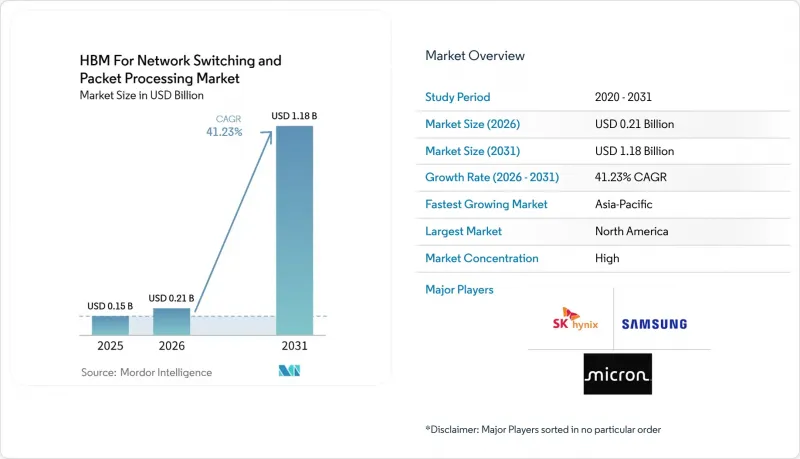
Mordor Intelligence에 의하면, 네트워크 스위칭 및 패킷 처리용 HBM 시장은 2025년 1억 5,000만 달러로 평가되었습니다. 2026년에는 2억 1,000만 달러로 확대되어 2031년까지 11억 8,000만 달러에 이를 것으로 예상되고 2026년부터 2031년에 걸쳐 CAGR 41.23%로 성장할 전망입니다.
본 보고서는 용도별(이더넷 스위치 ASIC, 데이터 처리 유닛, 스마트닉스 등), HBM 세대별(HBM3E, HBM4 등), 스택당 메모리 용량별(16GB, 24GB 등), 최종 사용자 산업(클라우드 데이터센터, 엔터프라이즈 네트워킹 등), 지역별(북미, 아시아태평양 등)로 분류되어 있습니다. 시장 예측은 금액(달러) 기준으로 제시되어 있습니다.
네트워크 스위칭 및 패킷 처리용 HBM의 세계 동향 및 인사이트
AI 최적화 스위치 ASIC 및 패킷 버퍼의 대역폭 요구 사항 증가
AI 훈련 클러스터가 10만 개의 가속기를 초과하는 규모에 도달함에 따라, 네트워크 스위칭 및 패킷 처리용 HBM 시장은 기존의 온다이 SRAM만으로는 감당할 수 없는 명확한 메모리 대역폭 한계에 의해 주도되었습니다. 2026년 1월에 발표된 HBM-NS 아키텍처에 관한 IEEE 논문에서는 스위치리스 HBM 구성과 비교하여 에너지 소비량이 32.1% 감소하고 지연 시간이 55% 단축되었다고 보고되어, 실용적인 네트워크 설계 옵션으로서 니어 메모리 스위칭의 유효성이 입증되었습니다. NSDI 2026에서 발표된 Themis에 관한 논문에서는 HBM 기반 하이브리드 버퍼 관리를 통해 400 Gbps 포트 속도에서 엔드투엔드 네트워크 성능이 최대 2.8배 향상되는 것으로 밝혀졌으며, 이는 단순한 대역폭 주장에 그치지 않는 HBM 네트워크 스위칭 및 패킷 처리 시장에서 강력한 성능적 근거가 제시되었습니다. 또한, 네트워크가 400G에서 800G, 나아가 1.6T로 전환됨에 따라 대규모 AI 클러스터로 인해 더 장기간에 걸친 혼잡과 고밀도 트래픽 버스트가 발생하여, 포트 속도 향상만으로는 설명할 수 없을 정도로 부하가 급격히 증가하고 있습니다. 이러한 추세로 인해 더 대용량의 버퍼 풀에 대한 수요가 증가하고 있으며, 네트워크 스위칭 및 패킷 처리용 HBM 시장 전반에서 대용량 HBM 구성의 보급이 확대되고 있습니다.
테라비트급 네트워크 스위칭 플랫폼에서의 코패키지형 HBM 채택
네트워크 스위칭 및 패킷 처리용 HBM 시장은 2024년 3월 Broadcom이 HBM, 실리콘 포토닉스, 스위치 로직을 하나의 패키지에 집적시킨 세계 최초의 51.2 Tbps 코패키지형 광 이더넷 스위치 플랫폼을 발표함으로써 초기 패키징 청사진을 확보했습니다. Broadcom은 2025년 10월, 102.4 Tbps의 'Tomahawk 6 Davisson'을 발표하며 이 모델을 확장했습니다. 이를 통해 기존 코패키지형 스위치 설계의 대역폭을 2배로 확대하면서도 시스템 아키텍처의 중심에 HBM을 유지했습니다. Marvell은 2026년 6월, AI 및 클라우드 데이터센터 네트워크를 위해 여러 패키징 옵션을 갖춘 102.4 Tbps의 'Teralynx T100'을 출시하며 이러한 방향성을 더욱 강화했습니다. 이러한 코패키징 접근 방식에 따라 네트워크 스위칭 및 패킷 처리 시장에서 HBM의 구매 단위가 변화하고 있습니다. 하이퍼스케일러 기업들은 메모리와 스위치 부품을 개별적으로 평가하기보다는 HBM과 ASIC을 결합한 패키지를 평가하는 경향이 강해지고 있기 때문입니다. 따라서 메모리 로드맵, 패키징 접근성, 스위치용 실리콘 일정을 조기에 조율할 수 있는 벤더는 대규모 도입 주기를 선점하는 데 유리한 입장에 있습니다.
대량 생산용 HBM 통합에 필요한 첨단 패키징 역량 부족
네트워크 스위칭 및 패킷 처리용 HBM 시장은 여전히 첨단 패키징 생산 능력에 의존하고 있으며, 특히 HBM과 스위칭 로직을 단일 패키지에 통합하는 설계의 경우, 그 생산 능력이 최종 수요를 초과하는 속도로 부족해지고 있습니다. 브로드컴(Broadcom)의 최신 플랫폼인 ‘Tomahawk’ 및 ‘Jericho’, 그리고 마블(Marvell)의 ‘Teralynx T100’은 모두 독립적인 메모리 연결이 아닌, 첨단 패키징에 의존하는 설계 방향성을 보이고 있습니다. 이로 인해 네트워크용 실리콘과 AI 가속기 사이에서 패키징 접근권을 둘러싼 직접적인 경쟁이 발생하며, 네트워크 스위칭 및 패킷 처리용 HBM 시장에서 최대 규모의 구매자나 조기에 예약한 기업이 뚜렷한 우위를 점하게 될 것입니다. 따라서 소규모 네트워크 벤더는 기술 로드맵이 탄탄하고 고객 수요가 있더라도 규모를 확대해 나가는 과정이 더욱 험난해질 것입니다. 그 결과, 최상위 하이퍼스케일러는 신속하게 움직일 수 있는 반면, 2차 OEM 및 엔터프라이즈용 벤더는 양산 시작 시기가 늦어지는 등 양극화된 공급 환경이 조성되고 있습니다.
부문 분석
2025년, 이더넷 스위치 ASIC은 네트워크 스위칭 및 패킷 처리용 HBM 시장 점유율의 43.13%를 차지했으나, AI 네트워크 패브릭 스위치는 2026년부터 2031년에 걸쳐 연평균 성장률(CAGR) 42.03%를 나타낼 것으로 예측됩니다. 이러한 매출 우위는 하이퍼스케일 리프·스파인 이더넷 환경에서 수년에 걸친 도입 실적을 반영한 것입니다. 해당 환경에서는 대규모 동서 방향 트래픽 부하에 대응하기 위해 딥 버퍼 스위칭이 이미 실질적인 필수 요건이 되어 있었습니다. Broadcom에 따르면, Jericho4는 표준 온칩 메모리의 160배에 달하는 패킷 버퍼 용량을 실현하고 있으며, 이것이 2025년 및 2026년에도 딥 버퍼 이더넷 플랫폼이 고성능 AI 네트워크 설계의 핵심으로 남아 있는 이유를 설명해 줍니다. 동시에, 네트워크 스위칭 및 패킷 처리용 HBM 시장은 맞춤형 AI 패브릭으로 이동하고 있습니다. 또한, 2026년 3월 NVIDIA가 Marvell과 체결한 20억 달러 규모의 투자를 바탕으로 한 제휴를 통해, 고급 패킷 관리 및 스케일업 네트워킹이 HBM 지원 설계와 더욱 긴밀하게 연계되었습니다.
다음 수요층은 서버, 네트워크 에지, 또는 통신 제어 플레인에 더 가까운 위치에 배치되는 인터페이스 및 패킷 처리 장치에서 발생하고 있습니다. Broadcom의 BCM88690 데이터시트에 따르면, 네트워크 처리 하드웨어에는 이미 듀얼 HBM Gen2 큐브가 채택되어 총 8GB의 패킷 버퍼를 갖추고 있으며, 최대 12만 8,000개의 프로그래밍 가능한 큐를 지원하며, 이를 통해 NPU는 최대 규모의 AI 패브릭을 넘어선 영역에서도 결정론적 트래픽 처리에서 여전히 중요한 역할을 계속 수행하고 있습니다. 이는 네트워크 스위칭 및 패킷 처리 업계에서 HBM에 있어 중요한 의미를 지닙니다. 왜냐하면 이 기술이 최상위 스위치 ASIC에만 국한되는 것이 아니라, 큐 부하가 높고 지연 시간에 민감한 패킷 처리 워크로드에도 대응할 수 있음을 보여주기 때문입니다. 앞으로 메모리 수율이 향상되고 비트당 비용이 낮아지며, HBM을 활용한 트래픽 관리가 더 많은 네트워크 기능에 도입될 정당성이 확보됨에 따라, 용도 수요는 최고 성능의 스위칭 계층에서 인접한 디바이스로 더욱 확대될 것으로 예측됩니다.
HBM3는 2025년에 55.92%의 점유율을 차지하며, HBM 세대별 네트워크 스위칭 및 패킷 처리 시장 규모에서 가장 큰 점유율을 기록했습니다. 한편, HBM4는 2031년까지 연평균 성장률(CAGR) 42.21%로 확대될 것으로 예측됩니다. HBM3가 이러한 선두 위치를 확보한 배경에는 Broadcom의 StrataDNX Jericho 제품군 및 Tomahawk급 시스템이 2024년부터 2025년에 걸쳐 양산 단계로 진입한 것이 있으며, 이를 통해 이 세대는 이미 도입된 스위칭 플랫폼에서 가장 견고한 상업적 기반을 확립했습니다. HBM2 및 HBM2E는 기존의 딥 버퍼 플랫폼에 남아 있었으나, 네트워크가 400G 이상의 스위칭으로 더욱 전환됨에 따라 이들 제품의 핀당 대역폭 프로파일은 적합하지 않게 되고 있습니다. Broadcom의 BCM88480 문서에 따르면, 초기 HBM Gen2 설계는 패키지 내에 4GB의 버퍼 메모리를 탑재한 기존 라우터 시스템에서 여전히 사용되고 있으며, 이는 신세대가 시장 점유율을 확대하고 있음에도 불구하고 구세대가 당장 사라지지 않은 이유를 보여줍니다.
네트워크 스위칭 및 패킷 처리용 HBM 시장은 현재 HBM3E 및 HBM4로 전환되고 있습니다. 이는 차세대 스위치용 실리콘이 더 넓은 인터페이스와 스택당 더 큰 대역폭을 필요로 하기 때문입니다. 테크니온, 캘리포니아 대학교 버클리 캠퍼스, 캘리포니아 대학교 샌디에이고 캠퍼스가 수행한 연구에 따르면, 4개의 HBM4 스택을 사용한 ‘라우터 인 어 패키지(Router-in-a-Package)’ 설계를 통해 총 81.92 Tbps의 스위칭 대역폭을 실현할 수 있음이 밝혀졌으며, 차세대 메모리 아키텍처의 여력이 부각되었습니다. 삼성은 2026년 2월에 HBM4 양산을 시작했으며, 엔비디아와 SK하이닉스는 2026년 6월, AI 팩토리를 위한 차세대 메모리 개발을 추진하기 위해 다년간의 기술 제휴를 공식적으로 체결했습니다. 이 모든 것은 미래공급 기반에 대한 전망을 명확히 하는 것이었습니다. 이러한 움직임은 차세대 스위칭 기술이 양산 단계에 도달함에 따라, 네트워크 스위칭 및 패킷 처리용 HBM 시장이 더 넓은 대역폭을 가진 2,048비트 인터페이스와 스택당 더 높은 대역폭으로 계속 전환될 것이라는 전망을 뒷받침합니다.
지역별 분석
2025년, 네트워크 스위칭 및 패킷 처리용 HBM 시장에서 북미는 44.68%의 점유율을 차지했습니다. 이 지역이 1위를 차지한 이유는 미국이 첨단 스위치용 실리콘의 최대 규모 하이퍼스케일 구매처이며, 하이엔드 HBM 탑재 네트워크 플랫폼을 대규모로 도입한 최초의 지역이었기 때문입니다. 구글은 2026년, 자사의 Virgo 네트워크가 13만 4,000개의 TPU 칩을 플랫하고 논블로킹 설계로 연결하여 최대 47 페타비트/초의 바이섹션 대역폭을 실현했다고 밝혔습니다. 이는 북미 통신 사업자들이 이미 계획하고 구축해 온 인프라의 규모를 반영한 것입니다. 이러한 구축에는 기존 설계로는 제공할 수 없는 훨씬 더 높은 메모리 대역폭과 패킷 버퍼링 능력을 갖춘 스위치가 필요합니다. 따라서 네트워크 스위칭 및 패킷 처리용 HBM 시장은 해당 지역의 하이퍼스케일 투자 주기와 밀접하게 연동되어 있습니다. 또한, NNSA가 국가 계산 프로그램을 위해 Cornelis Networks와의 차세대 네트워크 개발을 지원함에 따라, 정부 차원 수요도 해당 지역 시장 기반을 뒷받침했습니다.
2025년에는 유럽도 상당한 시장 점유율을 차지했으며, 독일, 영국, 프랑스 및 북유럽 국가에서는 대규모 클라우드 캠퍼스 및 대용량 네트워크 구축이 진행되었습니다. 또한, 이 지역은 5G 독립형(SA) 코어 업그레이드의 혜택을 받고 있으며, 이를 통해 보다 정교한 메모리 서브시스템을 갖춘 패킷 프로세서 및 라우팅 시스템에 대한 지속적인 관심이 뒷받침되었습니다. 영국과 독일의 국가 AI 프로그램은 향후 데이터센터 투자를 유지하는 데 기여하고 있으며, 이는 예측 기간 동안 첨단 스위칭용 반도체의 점진적인 보급을 촉진할 것으로 예측됩니다. 또한 유럽은 반도체 및 패키징 역량에 대한 장기적인 의존도를 낮추는 데에도 전략적인 관심을 가지고 있습니다. 하지만 현재로서는 네트워크 스위칭 및 패킷 처리 시장에서 HBM의 주요 패키징 거점은 여전히 대만이 차지하고 있습니다.
아시아태평양은 2031년까지 연평균 성장률(CAGR) 42.23%를 나타낼 것으로 예측되며, 네트워크 스위칭 및 패킷 처리용 HBM 시장에서 가장 빠르게 성장하는 지역이 될 전망입니다. 한국은 공급의 중심에 위치해 있습니다. 이는 SK하이닉스가 2025 회계연도에 사상 최대 실적을 기록한 데 더해, 엔비디아가 2026년 6월 AI 인프라에 사용되는 차세대 메모리와 관련해 SK하이닉스와 다년간의 기술 제휴를 체결했기 때문입니다. 대만은 여전히 없어서는 안 될 존재입니다. 브로드컴(Broadcom)과 마블(Marvel)의 최첨단 AI용 스위치 플랫폼은 대만의 반도체 생태계와 깊이 연계된 패키지 집약형 조립 공정에 의존하고 있기 때문입니다. 인도와 동남아시아에서는 도입이 아직 초기 단계이지만, 국내 클라우드 투자로 인해 HBM 통합형 스위칭 플랫폼에 대한 미래 수요가 발생하기 시작하고 있습니다. 남미, 중동 및 아프리카는 여전히 장기적인 기회이며, 이 지역에서는 대규모 AI 패브릭 도입보다는 기업의 현대화 및 정부의 네트워크 업그레이드가 단기적인 주요 촉진요인으로 작용하고 있습니다.
기타 혜택 :
- 엑셀 형식 시장 예측(ME) 시트
- 3개월간의 애널리스트 지원
자주 묻는 질문
목차
제1장 서론
제2장 조사 방법
제3장 주요 요약
제4장 시장 구도
제5장 시장 규모 및 성장 예측
제6장 경쟁 구도
제7장 시장 기회 및 향후 전망
KTH 26.08.10According to Mordor Intelligence, the HBM for network switching and packet processing market is expected to increase from USD 0.15 billion in 2025 to USD 0.21 billion in 2026, and reach USD 1.18 billion by 2031, growing at a CAGR of 41.23% over 2026-2031.
This report is Segmented by Application (Ethernet Switch ASICs, Data Processing Units, Smartnics, and More), HBM Generation ( HBM3E, HBM4, and More), Memory Capacity Per Stack (16 GB, 24 GB, and More), End-User Industry (Cloud Data Centers, Enterprise Networking, and More), and Geography (North America, Asia-Pacific, and More). The Market Forecasts are Provided in Terms of Value (USD).
Global HBM For Network Switching and Packet Processing Market Trends and Insights
Rising AI-Optimized Switch ASIC and Packet-Buffer Bandwidth Requirements
As AI training clusters moved past 100,000 accelerators, the HBM market for network switching and packet processing was pushed by a clear memory bandwidth limit that conventional on-die SRAM could not address on its own. A January 2026 IEEE paper on the HBM-NS architecture reported 32.1% lower energy use and 55% lower latency than switchless HBM configurations, supporting the case for near-memory switching as a practical network design option. The Themis paper presented at NSDI 2026 found that HBM-based hybrid buffer management improved end-to-end network performance by up to 2.8 times at 400 Gbps port speeds, providing a strong performance case for the HBM network-switching and packet-processing market beyond simple bandwidth claims. The pressure also rises faster than port speed alone suggests, because larger AI clusters create longer congestion events and denser traffic bursts as networks move from 400G to 800G and then toward 1.6T. That pattern is increasing demand for deeper buffer pools and helping higher-capacity HBM configurations gain ground across the HBM market for network switching and packet processing.
Co-Packaged HBM Adoption in Terabit-Class Network Switching Platforms
The HBM for network switching and packet processing market gained an early packaging blueprint when Broadcom introduced the first 51.2 Tbps co-packaged optics Ethernet switch platform in March 2024 with HBM, silicon photonics, and switch logic assembled in one package. Broadcom extended that model in October 2025 with the Tomahawk 6 Davisson at 102.4 Tbps, which doubled the bandwidth of earlier co-packaged switch designs while keeping HBM at the center of the system architecture. Marvell reinforced this direction in June 2026, when it launched the 102.4 Tbps Teralynx T100 with multiple packaging options for AI and cloud data center networking. This co-packaged approach changes the buying unit within the HBM for the network switching and packet processing market, as hyperscalers increasingly evaluate a combined HBM-ASIC package rather than separate memory and switch components. Vendors that can align memory roadmaps, packaging access, and switch silicon schedules earlier are therefore in a better position to capture the largest deployment cycles.
Limited Advanced Packaging Capacity for High-Volume HBM Integration
The HBM market for network switching and packet processing still depends on advanced packaging capacity that remains tighter than end demand, especially for designs that place HBM and switching logic in a single package. Broadcom's latest Tomahawk and Jericho platforms, along with Marvell's Teralynx T100, all point to a design direction that relies on sophisticated packaging rather than stand-alone memory attachment. That creates direct competition for packaging access between networking silicon and AI accelerators, giving the largest buyers and earliest reservers an obvious advantage in the HBM for network switching and packet processing market. Smaller networking vendors, therefore, face a harder path to scale, even when their technical roadmaps are sound and customer demand is present. The result is a two-speed supply environment in which top hyperscalers can move faster, while second-tier OEMs and enterprise-oriented vendors face slower ramp timing.
Other drivers and restraints analyzed in the detailed report include:
- Hyperscale Data Center Migration Toward Memory-Bound Network Architectures
- 800G and 1.6T Ethernet Rollouts Increasing Buffer Depth and Latency Sensitivity
- Export Controls and Qualification Constraints on Advanced DRAM Nodes
For complete list of drivers and restraints, kindly check the Table Of Contents.
Segment Analysis
Ethernet switch ASICs held 43.13% of the HBM market share for network switching and packet processing in 2025, while AI networking fabric switches are projected to grow at a 42.03% CAGR from 2026 to 2031. That revenue lead reflected years of deployment in hyperscale leaf-spine Ethernet environments, where deep-buffer switching had already become a practical requirement for large east-west traffic loads. Broadcom said Jericho4 delivered 160 times the packet buffer capacity of standard on-chip memory, which explains why deep-buffer Ethernet platforms remained central to high-performance AI network design in 2025 and 2026. At the same time, the HBM for network switching and packet processing market is being pulled toward custom AI fabrics, and NVIDIA's March 2026 partnership with Marvell, backed by a USD 2 billion investment, has more tightly linked advanced packet management and scale-up networking to HBM-aware designs.
The next layer of demand comes from interface and packet-processing devices that sit closer to the server, the network edge, or the telecom control plane. Broadcom's BCM88690 datasheet showed that network processing hardware already used dual HBM Gen2 cubes for a total of 8 GB of packet buffer and supported up to 128,000 programmable queues, which kept NPUs relevant for deterministic traffic handling beyond the largest AI fabrics. That matters for the HBM in the network switching and packet processing industry because it shows that the technology is not limited to top-end switch ASICs and can also support queue-heavy, latency-sensitive packet processing workloads. Over time, application demand is likely to keep widening from the highest-performance switching tier into adjacent devices as memory yields improve, per-bit economics ease, and HBM-backed traffic management becomes easier to justify across more networking functions.
HBM3 commanded a 55.92% share in 2025, giving it the largest position in the HBM for network switching and packet processing market size by HBM generation, while HBM4 is projected to expand at a 42.21% CAGR through 2031. HBM3 built that lead because Broadcom's StrataDNX Jericho family and Tomahawk-class systems moved into production across 2024 and 2025, which gave this generation the strongest commercial footing in deployed switching platforms. HBM2 and HBM2E remained in legacy deep-buffer platforms, but their bandwidth-per-pin profile is becoming less suitable as networks move deeper into 400G-and-above switching. Broadcom's BCM88480 documentation illustrated that earlier HBM Gen2 designs still served installed router systems with 4 GB of in-package buffer memory, which shows why older generations did not disappear immediately, even as newer ones gained share.
The HBM market for network switching and packet processing is now moving toward HBM3E and HBM4, as next-generation switch silicon requires wider interfaces and greater bandwidth per stack. Research from Technion, UC Berkeley, and UC San Diego showed that a router-in-a-package design using 4 HBM4 stacks could deliver 81.92 Tbps of combined switching bandwidth, which highlighted the architectural headroom of the next memory generation. Samsung began HBM4 mass production in February 2026, and NVIDIA and SK Hynix formalized a multiyear technology partnership in June 2026 to advance next-generation memory for AI factories, both of which improved visibility around the future supply base. Those moves support the view that the HBM market for network switching and packet processing will continue shifting toward wider 2,048-bit interfaces and higher per-stack bandwidth as the next switching wave reaches production.
Complete Report Scope:
- By Application
- Ethernet Switch ASICs
- Data Processing Units (DPUs)
- SmartNICs
- Network Processing Units (NPUs)
- AI Networking Fabric Switches
- By HBM Generation
- HBM2
- HBM2E
- HBM3
- HBM3E
- HBM4
- By Memory Capacity Per Stack
- 4 GB
- 8 GB
- 16 GB
- 24 GB
- 32 GB and Above
- By End-User Industry
- Cloud Data Centers
- Telecommunications
- Enterprise Networking
- Government and Defense
- High-Performance Computing Networks
- By Geography
- North America
- United States
- Canada
- Mexico
- Europe
- Germany
- United Kingdom
- France
- Italy
- Rest of Europe
- Asia-Pacific
- China
- Japan
- South Korea
- Taiwan
- India
- Rest of Asia-Pacific
- South America
- Middle East and Africa
- North America
Geography Analysis
North America held 44.68% of the HBM for the network switching and packet processing market share in 2025. The region led because the United States was home to the largest hyperscale buyers of advanced switch silicon and was the first to adopt high-end HBM-backed networking platforms at scale. Google disclosed in 2026 that its Virgo network linked 134,000 TPU chips in a flat, non-blocking design and delivered up to 47 petabits per second of bisectional bandwidth, reflecting the scale of infrastructure that North American operators were already planning and deploying. That kind of deployment favors switches with far deeper memory bandwidth and packet buffering than conventional designs can provide, which keeps the HBM for network switching and packet processing market closely aligned with the region's hyperscale spending cycle. Government demand also supported the regional base after the NNSA backed next-generation networking work with Cornelis Networks for national computing programs.
Europe contributed a meaningful share in 2025, with Germany, the United Kingdom, France, and the Nordic countries hosting major cloud campuses and high-capacity network deployments. The region also benefited from 5G standalone core upgrades, which supported ongoing interest in packet processors and routing systems with richer memory subsystems. National AI programs in the United Kingdom and Germany are helping sustain future data center investment, which should support the gradual uptake of advanced switching silicon over the forecast period. Europe also has a strategic interest in reducing long-term dependence on semiconductor and packaging capabilities, even though Taiwan remains the central packaging hub for HBM in the network switching and packet processing market today.
Asia-Pacific is projected to grow at a 42.23% CAGR through 2031, making it the fastest-growing region in the HBM for network switching and packet processing market. South Korea sits at the center of supply because SK hynix posted record FY25 results, and NVIDIA entered a multiyear technology partnership with SK hynix in June 2026 for next-generation memory used in AI infrastructure. Taiwan remains indispensable because the most advanced AI-focused switch platforms from Broadcom and Marvell rely on package-intensive assembly paths that are deeply linked to the island's semiconductor ecosystem. India and Southeast Asia are earlier in adoption, but domestic cloud investment is beginning to create future demand for HBM-integrated switching platforms. South America,d the Middle East,t and Africa remain longer-horizon opportunities, where enterprise modernization and government network upgrades are more important near-term drivers than large AI fabric deployments.
- SK hynix Inc.
- Samsung Electronics Co., Ltd.
- Micron Technology, Inc.
Additional Benefits:
- The market estimate (ME) sheet in Excel format
- 3 months of analyst support
TABLE OF CONTENTS
1 INTRODUCTION
- 1.1 Study Assumptions and Market Definition
- 1.2 Scope of the Study
2 RESEARCH METHODOLOGY
3 EXECUTIVE SUMMARY
4 MARKET LANDSCAPE
- 4.1 Market Overview
- 4.2 Market Drivers
- 4.2.1 Rising AI-Optimized Switch ASIC and Packet-Buffer Bandwidth Requirements
- 4.2.2 Co-Packaged HBM Adoption in Terabit-Class Network Switching Platforms
- 4.2.3 Hyperscale Data Center Migration Toward Memory-Bound Network Architectures
- 4.2.4 800G and 1.6T Ethernet Rollouts Increasing Buffer Depth and Latency Sensitivity
- 4.2.5 Thermal and Power-Efficiency Gains From Near-Compute Memory Integration
- 4.2.6 HBM-Rich Edge Networking for Deterministic Packet Processing in Telecom Equipment
- 4.3 Market Restraints
- 4.3.1 Limited Advanced Packaging Capacity for High-Volume HBM Integration
- 4.3.2 Export Controls and Qualification Constraints on Advanced DRAM Nodes
- 4.3.3 Yield Risk Increases Rapidly With Higher-Stack HBM Architectures
- 4.3.4 Tight Coupling to Custom ASIC Roadmaps Slows Broader Networking Adoption
- 4.4 Industry Value Chain Analysis
- 4.5 Impact of Macroeconomic Factors on the Market
- 4.6 Regulatory Landscape
- 4.7 Technological Outlook
- 4.8 Porter's Five Forces Analysis
- 4.8.1 Bargaining Power of Suppliers
- 4.8.2 Bargaining Power of Buyers
- 4.8.3 Threat of New Entrants
- 4.8.4 Threat of Substitutes
- 4.8.5 Intensity of Competitive Rivalry
5 MARKET SIZE AND GROWTH FORECASTS (VALUE)
- 5.1 By Application
- 5.1.1 Ethernet Switch ASICs
- 5.1.2 Data Processing Units (DPUs)
- 5.1.3 SmartNICs
- 5.1.4 Network Processing Units (NPUs)
- 5.1.5 AI Networking Fabric Switches
- 5.2 By HBM Generation
- 5.2.1 HBM2
- 5.2.2 HBM2E
- 5.2.3 HBM3
- 5.2.4 HBM3E
- 5.2.5 HBM4
- 5.3 By Memory Capacity Per Stack
- 5.3.1 4 GB
- 5.3.2 8 GB
- 5.3.3 16 GB
- 5.3.4 24 GB
- 5.3.5 32 GB and Above
- 5.4 By End-User Industry
- 5.4.1 Cloud Data Centers
- 5.4.2 Telecommunications
- 5.4.3 Enterprise Networking
- 5.4.4 Government and Defense
- 5.4.5 High-Performance Computing Networks
- 5.5 By Geography
- 5.5.1 North America
- 5.5.1.1 United States
- 5.5.1.2 Canada
- 5.5.1.3 Mexico
- 5.5.2 Europe
- 5.5.2.1 Germany
- 5.5.2.2 United Kingdom
- 5.5.2.3 France
- 5.5.2.4 Italy
- 5.5.2.5 Rest of Europe
- 5.5.3 Asia-Pacific
- 5.5.3.1 China
- 5.5.3.2 Japan
- 5.5.3.3 South Korea
- 5.5.3.4 Taiwan
- 5.5.3.5 India
- 5.5.3.6 Rest of Asia-Pacific
- 5.5.4 South America
- 5.5.5 Middle East and Africa
- 5.5.1 North America
6 COMPETITIVE LANDSCAPE
- 6.1 Market Concentration
- 6.2 Strategic Moves
- 6.3 Market Share Analysis
- 6.4 Company Profiles (includes Global Level Overview, Market Level Overview, Core Segments, Financials as available, Strategic Information, Products and Services, Recent Developments)
- 6.4.1 SK hynix Inc.
- 6.4.2 Samsung Electronics Co., Ltd.
- 6.4.3 Micron Technology, Inc.
- 6.5 Other Ecosystem Players
- 6.5.1 NVIDIA Corporation
- 6.5.2 Advanced Micro Devices, Inc.
- 6.5.3 Intel Corporation
- 6.5.4 Broadcom Inc.
- 6.5.5 Marvell Technology, Inc.
- 6.5.6 Taiwan Semiconductor Manufacturing Company Limited
- 6.5.7 ASE Technology Holding Co., Ltd.
- 6.5.8 Amkor Technology, Inc.
- 6.5.9 Powertech Technology Inc.
- 6.5.10 United Microelectronics Corporation
- 6.5.11 Rambus Inc.
- 6.5.12 Cadence Design Systems, Inc.
- 6.5.13 Synopsys, Inc.
- 6.5.14 Applied Materials, Inc.
- 6.5.15 Qualcomm Incorporated
- 6.5.16 Fujitsu Limited
- 6.5.17 Texas Instruments Incorporated
7 MARKET OPPORTUNITIES AND FUTURE OUTLOOK
- 7.1 White-Space and Unmet-Need Assessment


