

|
시장보고서
상품코드
2099763
FPGA 가속화용 HBM 시장 : 시장 점유율 분석, 업계 동향 및 통계, 성장 예측(2026-2031년)HBM For FPGA Acceleration - Market Share Analysis, Industry Trends & Statistics, Growth Forecasts (2026 - 2031) |
||||||
 Mordor Intelligence
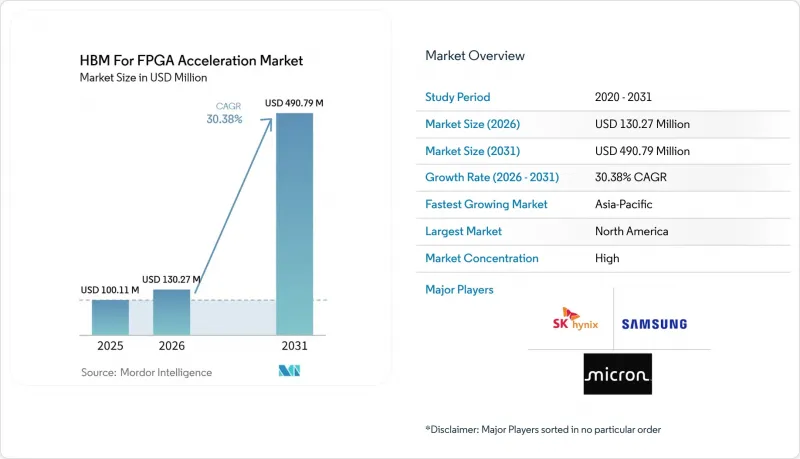
Mordor Intelligence에 의하면, FPGA 가속화용 HBM 시장 규모는 2025년 1억 11만 달러로 평가되었고, 2026년에는 1억 3,027만 달러로 확대될 것으로 추정되고, 2031년까지 4억 9,079만 달러에 이를 것으로 예상되며, 2026-2031년 CAGR 30.38%로 성장할 전망입니다.
본 보고서는 메모리 유형별(HBM2E, HBM3, HBM3E, HBM4), 통합 유형별(HBM을 통합한 FPGA SoC 등), 용도별(AI 추론 가속화, 고성능 컴퓨팅 등), 최종 사용자별(하이퍼스케일러 및 클라우드 서비스 제공업체 등), 지역별(북미, 아시아태평양, 중동 및 아프리카)로 분류되어 있습니다. 시장 전망은 금액(달러) 기준으로 제시되어 있습니다.
FPGA 가속화용 HBM의 세계 동향 및 인사이트
클라우드 및 엣지 가속기에서 HBM 탑재 FPGA 카드 도입 확대
클라우드 및 엣지 시스템은 더욱 고밀도 데이터 경로로 전환되고 있으며, 이러한 변화로 인해 대역폭을 가장 많이 소비하는 환경에서 DDR 기반 FPGA 설계의 매력은 점차 줄어들고 있습니다. DYNANIC사와 Silicom사는 2025년 9월, AI 패브릭에서 저지연 패킷 처리를 실현하기 위해 Altera사의 Agilex 7 M 시리즈 실리콘과 HBM2e를 결합한 400G FPGA 기반 AI 네트워킹 구성을 시연했습니다. Silicom사의 ThunderFjord 카드는 HBM을 탑재한 보드가 고속 데이터센터 네트워킹용으로 설계된 폼 팩터에서 최대 32GB의 HBM2e와 2×2.6Tbps의 대역폭을 지원할 수 있음을 입증했습니다. 또한, 알테라(Altera)사는 프로그래머블 로직, 높은 메모리 처리량, 그리고 클라우드 인프라 전반에 걸친 도입 유연성이 필요한 데이터센터 가속화 이용 사례를 위해 Agilex 제품군을 포지셔닝하고 있습니다. 이에 따라 FPGA 가속화용 HBM 시장은 단순히 칩을 공급하는 것뿐만 아니라, 완전한 솔루션을 패키징할 수 있는 카드 및 모듈 공급업체에 대한 의존도가 높아지고 있습니다. 또한 이는 네트워킹 및 추론 분야의 설계 채택 실적이, 유사한 대역폭 특성을 필요로 하는 인접한 엣지 용도으로도 파급될 수 있음을 의미합니다.
실시간 워크로드에서 결정론적이고 저지연 메모리 액세스에 대한 수요 증가
FPGA 가속화용 HBM 시장은 처리량과 마찬가지로 타이밍 일관성을 중시하는 워크로드의 혜택을 받고 있습니다. FPGA 기반 설계에서는 메모리 채널을 하드웨어로 할당할 수 있으므로, 공유 컴퓨팅 환경에 비해 응답 거동을 더 예측 가능하게 유지할 수 있습니다. AMD는 자사의 Alveo UL3422 가속기가 전자 거래 워크로드에서 3ns 미만의 레이턴시를 달성했다고 발표했으며, 이는 FPGA 기반 가속화가 극히 낮은 레이턴시 환경에서도 여전히 중요한 역할을 하고 있음을 입증합니다. 또한, RoCE BALBOA 스택에 관한 2025년 arXiv 논문에서는 데이터센터용 FPGA에서 HBM 채널을 페이로드 스테이징에 직접 활용하여 상용 NIC에 필적하는 100G의 처리량을 달성했다고 보고하고 있습니다. 따라서 대상 수요 기반은 기존의 트랜잭션 용도를 넘어 AI 패브릭 제어, 패킷 검사, 그리고 지터가 시스템 성능에 악영향을 미칠 가능성이 있는 기타 서비스로 확대되고 있습니다. 이러한 이용 사례가 확대됨에 따라, FPGA 가속화용 HBM 시장은 일관된 타이밍 동작을 위해 더 높은 비용을 지불할 의향이 있는 구매자들로부터 지지를 얻고 있습니다.
FPGA-HBM 통합에 있어 첨단 패키징 역량의 제약
FPGA 가속화용 HBM 시장은 여전히 표준 보드 레벨 메모리 설계보다 확장이 어려운 첨단 패키징 공정에 의존하고 있습니다. HBM 통합에는 연산 다이, 메모리 스택 및 상호 연결 구조 간의 긴밀한 협력이 필요하기 때문에 로직 수요가 왕성하더라도 패키징 공급 상황에 따라 제품의 타이밍에 영향을 미칠 가능성이 있습니다. AMD는 2026년 5월, AI 인프라를 위한 첨단 패키징 제조를 확대하기 위해 대만의 생태계에 100억 달러 이상을 투자하겠다고 발표했습니다. 이는 가속기 공급망 전반에서 패키징 생산 능력이 얼마나 중요해지고 있는지를 여실히 보여줍니다. 또한, 삼성의 HBM4 양산화 진전과 마이크론의 HBM4 생산 진행 상황을 통해, 메모리와 패키징의 준비 상황이 더 이상 별개의 조달 단계가 아니라 연동되어 진행되고 있음을 알 수 있습니다. FPGA 벤더 입장에서는 이로 인해 조기 계획의 중요성이 높아지고, 단기간 내 생산량 확대의 여지가 좁아집니다. 그 결과, 인증된 공급량이 최종 사용자 수요를 상회하는 상태가 더 오랜 기간 지속되는 시장이 형성될 것입니다.
부문 분석
2025년, FPGA 가속화용 HBM 시장에서 HBM2E는 65.83%의 점유율을 차지했습니다. 이는 현재 도입된 플랫폼의 강점과 인증된 가속기 설계의 교체 주기가 비교적 느린 점을 반영한 것입니다. 알테라(Altera)의 Agilex 7 M 시리즈는 단일 디바이스에 최대 32GB의 HBM2E를 통합하고 최대 820GB/s의 피크 대역폭을 제공함으로써, HBM2E를 출하 제품에서의 실질적인 기준으로 자리매김하는 데 기여하고 있습니다. 이러한 도입 기반이 중요한 이유는 네트워크, 통신, 인프라 분야의 구매자들이 하이퍼스케일 컴퓨팅 구매자들에 비해 동일한 세대의 하드웨어를 장기간에 걸쳐 계속 운영하는 경향이 있기 때문입니다. HBM3는 공급 및 플랫폼 계획이 메모리 로드맵의 다음 단계로 빠르게 진행됨에 따라, 이 부문에서는 여전히 ‘과도기적 계층’에 머물러 있습니다. HBM3E는 공급업체의 집중도 강화, 데이터 전송 속도 향상, 차세대 가속기 요구 사항과의 높은 호환성을 반영하여 2031년까지 연평균 성장률(CAGR) 31.18%를 나타낼 것으로 예측됩니다.
JEDEC의 JESD235 표준 제품군은 HBM의 각 세대에 걸친 상호 운용성을 지속적으로 지원하며, 공급업체가 공통 설계 규칙 내에서 메모리 공급처를 전환할 때 인증 절차를 단축하는 데 기여하고 있습니다. 지멘스는 HBM3E가 AI 가속기 생태계 전반에서 양산 단계에 접어들었습니다고 밝혔으며, 향후 제품 차별화 분야로 맞춤형 HBM4 베이스 다이 접근 방식을 제시했습니다. 삼성의 HBM4 출하 마일스톤과 마이크론의 HBM4 생산 진척 상황은 메모리 로드맵이 많은 FPGA 제품 주기보다 빠른 속도로 진행되고 있음을 보여주며, 이로 인해 전환 계획의 가치가 보다 견실한 벤더 쪽으로 이동할 가능성이 있습니다. FPGA 가속화용 HBM의 단기 시장은 여전히 HBM2E 출하가 중심이지만, 향후 플랫폼 로드맵은 HBM3E 지원 현황과 최초의 HBM4 설계 경로에 따라 점점 더 구체화되고 있습니다.
HBM을 탑재한 독립형 FPGA 가속기 카드는 2025년 FPGA 가속화용 HBM 시장 점유율의 53.18%를 차지하고 있으며, 이는 엔터프라이즈 및 코로케이션 환경에서 PCIe 기반 도입이 성숙 단계에 접어들었음을 반영합니다. 카드 기반 설계는 인증 획득이 용이하고, 기존 서버로의 교체도 간편하며, 보드 파트너가 특정 워크로드에 맞추어 쉽게 맞춤화할 수 있다는 장점이 있습니다. Silicom사의 'ThunderFjord' 제품은 현재의 카드 설계에서 HBM2e, 높은 포트 처리량 및 데이터센터 네트워킹 기능을 친숙한 가속기 형식에 통합할 수 있음을 보여줍니다. 이것이 새로운 모듈 형식이 주목을 받는 와중에도 독립형 카드가 여전히 FPGA 가속화용 HBM 시장의 상업적 기반을 지탱하고 있는 이유입니다. 또한 PCIe 카드의 도입은 랙 전체를 재설계하는 대신 단계적인 업그레이드가 필요한 시스템 통합사업자의 조달 방식에도 부합합니다.
하이퍼스케일러 환경이 공유 섀시나 보다 유연한 가속기 풀로 전환됨에 따라, OCP/OAM FPGA 가속기 모듈 시장은 2031년까지 연평균 성장률(CAGR) 31.08%로 확대될 것으로 예측됩니다. 알테라(Altera)의 데이터센터 전략은 프로그래머블 가속을 랙 스케일 AI 시스템 및 개방형 모듈 도입 모델과 조화시킴으로써 이러한 방향성을 뒷받침하고 있습니다. 2026년 3월 알테라와 Arm의 제휴 역시 CPU, FPGA, 메모리 리소스가 초기 단계부터 통합적으로 계획되는 긴밀하게 통합된 시스템으로의 전환을 시사합니다. HBM을 통합한 FPGA SoC나 소형 PCIe 모듈은 특정 설계에서 여전히 중요하지만, FPGA 가속화 시장에서의 HBM의 장기적인 방향성은 더 대규모의 AI 및 네트워크 패브릭에서의 모듈 기반 도입으로 향하고 있습니다.
지역별 분석
2025년, 북미는 FPGA 가속화용 HBM 시장 점유율의 44.94%를 차지했으며, 현재 매출 측면에서 가장 큰 기여를 하는 지역입니다. 이 지역은 FPGA 설계 팀의 밀집도, AI 인프라에 대한 투자, 그리고 시스템 수준의 통합 능력이라는 이점을 누리고 있습니다. 알테라(Altera)의 데이터센터 분야 내 입지와 Arm과의 제휴는 모두 AI 서버 환경에서 프로그래머블 가속화의 거점으로서 북미의 역할을 강화하는 요소입니다. 또한, AMD가 2026년 5월 대만의 전체 생태계에 100억 달러 이상을 투자하겠다고 약속한 것은 북미의 가속기 수요가 아시아의 업스트림 공정에서 이루어지는 패키징 및 메모리 생산 능력과 직접적으로 연결되어 있음을 반영합니다. 금융 서비스 및 저지연 인프라의 도입은 미국에서 프리미엄 수요층을 창출하며, 특수한 워크로드에 대한 FPGA 기반 가속화의 지속적인 활용을 뒷받침하고 있습니다.
아시아태평양은 2031년까지 연평균 성장률(CAGR) 31.36%로 확대될 것으로 예상되며, FPGA 가속화용 HBM 시장에서 가장 빠르게 성장하는 지역이 될 것입니다. 이 지역은 메모리 제조, 딥 패키징, 전자기기 생산, 그리고 증가하는 AI 데이터센터 수요를 단일하고 광범위한 공급 생태계 내에 통합하고 있습니다. SK하이닉스는 2026년 HBM 총 출하량의 3분의 2 가까이를 HBM3E가 차지할 것으로 전망하고 있으며, 삼성은 2026년 2월 HBM4의 양산 출하를 시작했다고 보고했습니다. 이 모든 것은 공급 측면에서 한국의 중요성을 부각시키고 있습니다. 마이크론의 HBM4 생산 진전 또한, 첨단 가속기 플랫폼을 위한 메모리 공급의 다음 단계에서 아시아태평양의 역할을 강화하고 있습니다. 대만은 이 지역의 첨단 패키징 역량이 HBM 탑재 시스템의 설계부터 상용 출하까지의 속도에 직접적인 영향을 미치기 때문에 여전히 매우 중요한 위치를 차지하고 있습니다. 일본이 반도체 생산 능력 확충에 주력하고 있다는 점과 메모리 확대에서 일본이 차지하는 역할은 FPGA 가속화용 HBM 시장에서 이 지역의 장기적인 중요성을 더욱 뒷받침하고 있습니다.
유럽, 남미, 중동 및 아프리카는 현재 매출에서 차지하는 비중은 작지만, 각각 특정 도입 경로에서 여전히 중요한 위치를 차지하고 있습니다. 유럽은 프로그래밍 가능성과 보안 처리가 여전히 중요시되는 국방, 통신, 산업용 전자기기 용도 분야에서 가장 중요한 역할을 수행하고 있습니다. EU의 ‘칩 법’에 따른 2030년까지 430억 유로(486억 달러) 규모의 투자는 현재 첨단 패키징에 대한 의존도가 높은 상황이지만, 장기적으로는 해당 지역의 반도체 역량을 향상시킬 가능성이 있습니다. 남미, 중동 및 아프리카는 여전히 초기 단계 시장이며, 이들 지역의 성장은 당장의 HBM 플랫폼 판매량보다는 보다 광범위한 클라우드 투자 및 각국이 주도하는 AI 인프라 구축과 밀접하게 관련되어 있습니다. 따라서 이 지역들은 현재 매출 기여도는 낮지만, FPGA 가속화 시장에서 HBM의 미래 비즈니스 기회를 확대할 것입니다.
기타 혜택 :
- 엑셀 형식 시장 예측(ME) 시트
- 3개월간의 애널리스트 지원
자주 묻는 질문
목차
제1장 서론
제2장 조사 방법
제3장 주요 요약
제4장 시장 구도
제5장 시장 규모 및 성장 예측
제6장 경쟁 구도
제7장 시장 기회 및 향후 전망
AJY 26.08.07According to Mordor Intelligence, the HBM for FPGA acceleration market size is expected to increase from USD 100.11 million in 2025 to USD 130.27 million in 2026 and reach USD 490.79 million by 2031, growing at a CAGR of 30.38% over 2026-2031.
This report is Segmented by Memory Type (HBM2E, HBM3, HBM3E, and HBM4), Integration Type (FPGA SoCs With Integrated HBM, and More), Application (AI Inference Acceleration, High-Performance Computing, and More), End User (Hyperscalers and Cloud Service Providers, and More), and Geography (North America, Asia-Pacific, and Middle East and Africa). The Market Forecasts are Provided in Terms of Value (USD).
Global HBM For FPGA Acceleration Market Trends and Insights
Rising Deployment of HBM-Enabled FPGA Cards in Cloud and Edge Accelerators
Cloud and edge systems are moving toward denser data paths, and that shift is making DDR-based FPGA designs less attractive in the most bandwidth-heavy environments. DYNANIC and Silicom demonstrated a 400G FPGA-based AI networking setup in September 2025 that paired Altera Agilex 7 M-Series silicon with HBM2e for low-latency packet handling in AI fabrics. Silicom's ThunderFjord card demonstrated how an HBM-equipped board can support up to 32GB of HBM2e and 2 X 2.6Tbps of bandwidth in a form factor designed for high-speed data center networking. Altera also positions the Agilex family for data center acceleration use cases that need programmable logic, high memory throughput, and deployment flexibility across cloud infrastructure. This makes the HBM for FPGA acceleration market more dependent on card and module vendors that can package complete solutions rather than only supply chips. It also means that design wins in networking and inference can carry over into adjacent edge applications that require similar bandwidth behavior.
Growing Need for Deterministic, Low-Latency Memory Access in Real-Time Workloads
The HBM for FPGA acceleration market is benefiting from workloads that value timing consistency as much as throughput. In FPGA-based designs, memory channels can be assigned in hardware, which helps keep response behavior more predictable than in shared compute environments. AMD stated that its Alveo UL3422 accelerator achieved latency below 3 ns for electronic trading workloads, demonstrating that FPGA-based acceleration still plays a strong role in extremely low-latency settings. A 2025 arXiv paper on the RoCE BALBOA stack also showed direct HBM channel use for payload staging on data center FPGAs, achieving 100G throughput comparable to commercial NICs. The addressable demand base is therefore widening beyond classic trading applications into AI fabric control, packet inspection, and other services where jitter can hurt system performance. As these use cases expand, the HBM for FPGA acceleration market gains support from buyers willing to pay more for consistent timing behavior.
Limited Advanced Packaging Capacity for FPGA-HBM Integration
The HBM for FPGA acceleration market still depends on advanced packaging flows that are harder to scale than standard board-level memory designs. HBM integration requires close coupling between the compute die, the memory stack, and the interconnect structure, so product timing can be affected by packaging availability even when logic demand is strong. AMD announced more than USD 10 billion in investments in Taiwan's ecosystem in May 2026 to expand advanced packaging manufacturing for AI infrastructure, underscoring how central packaging capacity has become across accelerator supply chains. Samsung's HBM4 ramp and Micron's HBM4 production progress also show that memory and packaging readiness now move together rather than as separate procurement steps. For FPGA vendors, this raises the importance of early planning and narrows the room for short-cycle volume expansion. The result is a market where qualified supply can remain tighter than end-user interest for longer periods.
Other drivers and restraints analyzed in the detailed report include:
- Hyperscaler Shift Toward FPGA-Based Custom Acceleration for Select Workloads
- Wider Availability of HBM3 and HBM3E in High-End FPGA Platforms
- High Bill-of-Materials Cost Compared With GDDR- and DDR-Based FPGA Designs
For complete list of drivers and restraints, kindly check the Table Of Contents.
Segment Analysis
HBM2E held 65.83% of the HBM for FPGA acceleration market share in 2025, reflecting the strength of current installed platforms and the slower replacement cycle for qualified accelerator designs. Altera's Agilex 7 M-Series integrates up to 32GB of HBM2e in a single device and provides up to 820GB/s of peak bandwidth, helping make HBM2E the practical baseline for shipping products. That installed base matters because buyers in network, telecom, and infrastructure roles often keep the same hardware generation in service longer than hyperscale compute buyers. HBM3 remained a bridge tier in the segment because supply and platform planning moved quickly toward the next step in the memory roadmap. HBM3E is projected to grow at a 31.18% CAGR through 2031, reflecting stronger supplier focus, higher data rates, and better alignment with next-wave accelerator requirements.
JEDEC's JESD235 standard family continues to support interoperability across HBM generations and helps shorten qualification work when vendors move between memory sources within shared design rules. Siemens said HBM3E has entered high-volume production across the AI accelerator ecosystem, and it also pointed to custom HBM4 base-die approaches as a future area of product differentiation. Samsung's HBM4 shipment milestone and Micron's HBM4 production progress show that the memory roadmap is moving faster than many FPGA product cycles, potentially shifting value toward vendors with stronger transition planning. The near-term HBM for FPGA acceleration market still centers on HBM2E shipments, but future platform roadmaps are increasingly being shaped by HBM3E readiness and the first HBM4 design paths.
Standalone FPGA Accelerator Cards with HBM held 53.18% of the HBM for FPGA acceleration market share in 2025, reflecting the maturity of PCIe-based deployment in enterprise and colocation environments. Card-based designs remain easier to qualify, easier to swap into existing servers, and easier for board partners to tailor around specific workloads. Silicom's ThunderFjord product shows how current card designs can package HBM2e, high port throughput, and data center networking features into a familiar accelerator format. This is why standalone cards still anchor the commercial base of the HBM for FPGA acceleration market, even as newer module formats gather attention. PCIe card deployments also fit the procurement style of system integrators that need incremental upgrades rather than full rack redesigns.
OCP/OAM FPGA Accelerator Modules are projected to expand at 31.08% CAGR through 2031 as hyperscaler environments shift toward shared chassis and more flexible accelerator pools. Altera's data center positioning supports this path by aligning programmable acceleration with rack-scale AI systems and open module deployment models. The March 2026 Altera and Arm collaboration also points to tightly integrated systems in which CPU, FPGA, and memory resources are planned together from the start. FPGA SoCs with integrated HBM and smaller PCIe modules will remain important in select designs, but the long-term direction for HBM in the FPGA acceleration market is toward module-based deployment in larger AI and networking fabrics.
Complete Report Scope:
- By Memory Type
- HBM2E
- HBM3
- HBM3E
- HBM4
- By FPGA Integration Type
- Standalone FPGA Accelerator Cards with HBM
- FPGA SoCs with Integrated HBM
- PCIe FPGA Accelerator Modules
- OCP/OAM FPGA Accelerator Modules
- By Application
- AI Inference Acceleration
- High-Performance Computing
- Network Acceleration
- Financial Services and Low-Latency Trading
- Defense, Aerospace, and Secure Systems
- Scientific and Industrial Simulation
- By End User
- Hyperscalers and Cloud Service Providers
- Enterprise OEMs and System Integrators
- Telecom and Networking Operators
- Defense and Government Organizations
- Financial Institutions
- Research Institutes and Laboratories
- By Geography
- North America
- United States
- Canada
- Mexico
- Europe
- Germany
- United Kingdom
- France
- Italy
- Rest of Europe
- Asia-Pacific
- China
- Japan
- South Korea
- Taiwan
- India
- Rest of Asia-Pacific
- South America
- Middle East and Africa
- North America
Geography Analysis
North America held 44.94% of the HBM for FPGA acceleration market share in 2025, making it the largest regional contributor to current revenue. The region benefits from a dense concentration of FPGA design teams, AI infrastructure spending, and system-level integration capabilities. Altera's data center positioning and its collaboration with Arm both reinforce North America's role as a base for programmable acceleration in AI server environments. AMD's May 2026 commitment of more than USD 10 billion across the Taiwan ecosystem also reflected how North American accelerator demand is directly linked to upstream packaging and memory capacity in Asia. Financial services and low-latency infrastructure deployments add a premium demand layer in the United States, supporting continued use of FPGA-based acceleration for specialized workloads.
Asia-Pacific is projected to expand at a 31.36% CAGR through 2031, making it the fastest-growing geography in the HBM for FPGA acceleration market. The region combines memory manufacturing, deep packaging, electronics production, and rising AI data center demand within a single broad supply ecosystem. SK hynix said HBM3E was expected to account for nearly two-thirds of total HBM shipments in 2026, and Samsung reported HBM4 mass production shipment in February 2026, both of which underline South Korea's importance in supply availability. Micron's progress in HBM4 production also strengthens Asia-Pacific's role in the next stage of memory supply for advanced accelerator platforms. Taiwan remains critical because advanced packaging capacity there affects how quickly HBM-enabled systems can move from design to commercial shipment. Japan's focus on semiconductor capacity and its role in memory expansion further support the region's long-term weight in the HBM for FPGA acceleration market.
Europe, South America, and Middle East and Africa together account for a smaller share of current revenue, but each remains relevant for selected deployment paths. Europe matters most for defense, telecom, and industrial electronics applications, where programmability and secure processing remain important. The EU Chips Act commitment of EUR 43 billion (USD 48.6 billion) through 2030 could improve regional semiconductor capabilities over time, even though dependence on advanced packaging remains high today. South America, the Middle East, and Africa are still early-stage opportunities, and growth there is more closely tied to broader cloud investment and sovereign AI buildouts than to immediate HBM platform volume. These regions, therefore, contribute less to current sales, but they still expand the future opportunity set for HBM in the FPGA acceleration market.
- SK hynix Inc.
- Samsung Electronics Co., Ltd.
- Micron Technology, Inc.
Additional Benefits:
- The market estimate (ME) sheet in Excel format
- 3 months of analyst support
TABLE OF CONTENTS
1 INTRODUCTION
- 1.1 Study Assumptions and Market Definition
- 1.2 Scope of the Study
2 RESEARCH METHODOLOGY
3 EXECUTIVE SUMMARY
4 MARKET LANDSCAPE
- 4.1 Market Overview
- 4.2 Market Drivers
- 4.2.1 Rising Deployment of HBM-Enabled FPGA Cards In Cloud And Edge Accelerators
- 4.2.2 Growing Need For Deterministic, Low-Latency Memory Access In Real-Time Workloads
- 4.2.3 Hyperscaler Shift Toward FPGA-Based Custom Acceleration For Select Workloads
- 4.2.4 Wider Availability Of HBM3 And HBM3E In High-End FPGA Platforms
- 4.2.5 Increasing Importance Of Power-Efficient Bandwidth Scaling Versus Pure Compute Scaling
- 4.2.6 Co-Optimization Of FPGA And HBM In Heterogeneous AI Inference Pipelines
- 4.3 Market Restraints
- 4.3.1 Limited Advanced Packaging Capacity For FPGA-HBM Integration
- 4.3.2 High Bill-Of-Materials Cost Compared With GDDR- And DDR-Based FPGA Designs
- 4.3.3 Thermal And Board-Level Design Complexity In HBM-Enabled Accelerator Systems
- 4.3.4 Supply Concentration In HBM Manufacturing And Interposer Ecosystems
- 4.4 Industry Value Chain Analysis
- 4.5 Impact Of Macroeconomic Factors On The Market
- 4.6 Regulatory Landscape
- 4.7 Technological Outlook
- 4.8 Porter's Five Forces Analysis
- 4.8.1 Bargaining Power Of Suppliers
- 4.8.2 Bargaining Power Of Buyers
- 4.8.3 Threat Of New Entrants
- 4.8.4 Threat Of Substitutes
- 4.8.5 Intensity of Competitive Rivalry
5 MARKET SIZE AND GROWTH FORECASTS (VALUE)
- 5.1 By Memory Type
- 5.1.1 HBM2E
- 5.1.2 HBM3
- 5.1.3 HBM3E
- 5.1.4 HBM4
- 5.2 By FPGA Integration Type
- 5.2.1 Standalone FPGA Accelerator Cards with HBM
- 5.2.2 FPGA SoCs with Integrated HBM
- 5.2.3 PCIe FPGA Accelerator Modules
- 5.2.4 OCP/OAM FPGA Accelerator Modules
- 5.3 By Application
- 5.3.1 AI Inference Acceleration
- 5.3.2 High-Performance Computing
- 5.3.3 Network Acceleration
- 5.3.4 Financial Services and Low-Latency Trading
- 5.3.5 Defense, Aerospace, and Secure Systems
- 5.3.6 Scientific and Industrial Simulation
- 5.4 By End User
- 5.4.1 Hyperscalers and Cloud Service Providers
- 5.4.2 Enterprise OEMs and System Integrators
- 5.4.3 Telecom and Networking Operators
- 5.4.4 Defense and Government Organizations
- 5.4.5 Financial Institutions
- 5.4.6 Research Institutes and Laboratories
- 5.5 By Geography
- 5.5.1 North America
- 5.5.1.1 United States
- 5.5.1.2 Canada
- 5.5.1.3 Mexico
- 5.5.2 Europe
- 5.5.2.1 Germany
- 5.5.2.2 United Kingdom
- 5.5.2.3 France
- 5.5.2.4 Italy
- 5.5.2.5 Rest of Europe
- 5.5.3 Asia-Pacific
- 5.5.3.1 China
- 5.5.3.2 Japan
- 5.5.3.3 South Korea
- 5.5.3.4 Taiwan
- 5.5.3.5 India
- 5.5.3.6 Rest of Asia-Pacific
- 5.5.4 South America
- 5.5.5 Middle East and Africa
- 5.5.1 North America
6 COMPETITIVE LANDSCAPE
- 6.1 Market Concentration
- 6.2 Strategic Moves
- 6.3 Market Share Analysis
- 6.4 Company Profiles (includes Global Level Overview, Market Level Overview, Core Segments, Financials as available, Strategic Information, Products and Services, Recent Developments)
- 6.4.1 SK hynix Inc.
- 6.4.2 Samsung Electronics Co., Ltd.
- 6.4.3 Micron Technology, Inc.
- 6.5 Other Ecosystem Players
- 6.5.1 Advanced Micro Devices, Inc.
- 6.5.2 Intel Corporation
- 6.5.3 Lattice Semiconductor Corporation
- 6.5.4 Microchip Technology Incorporated
- 6.5.5 Achronix Semiconductor Corporation
- 6.5.6 QuickLogic Corporation
- 6.5.7 Efinix, Inc.
- 6.5.8 GOWIN Semiconductor Corporation
- 6.5.9 Flex Logix Technologies, Inc.
- 6.5.10 NVIDIA Corporation
- 6.5.11 Xilinx, Inc.
- 6.5.12 TSMC
- 6.5.13 Amkor Technology, Inc.
- 6.5.14 ASE Technology Holding Co., Ltd.
- 6.5.15 Cadence Design Systems, Inc.
- 6.5.16 Synopsys, Inc.
- 6.5.17 Broadcom Inc.
7 MARKET OPPORTUNITIES AND FUTURE OUTLOOK
- 7.1 White-Space and Unmet-Need Assessment


