

|
시장보고서
상품코드
2099816
네오펜틸글리콜 시장 : 시장 점유율 분석, 업계 동향 및 통계, 성장 예측(2026-2031년)Neopentyl Glycol - Market Share Analysis, Industry Trends & Statistics, Growth Forecasts (2026 - 2031) |
||||||
 Mordor Intelligence
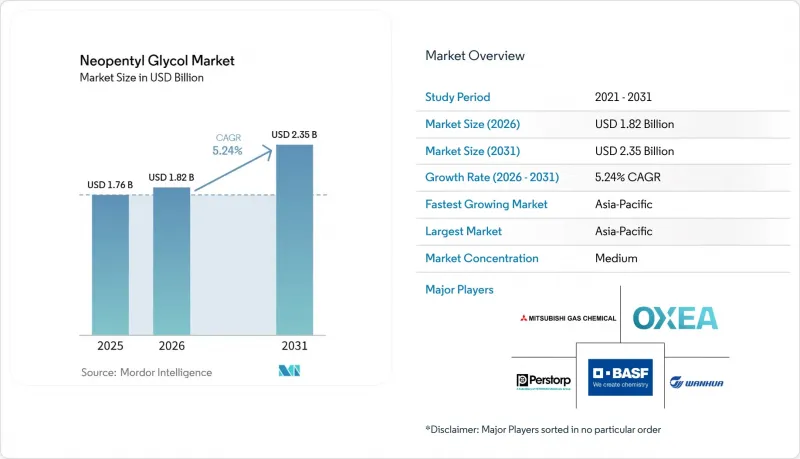
Mordor Intelligence에 의하면, 네오펜틸글리콜 시장 규모는 2025년 17억 6,000만 달러로 평가되었고, 2026년에는 18억 2,000만 달러로 확대될 것으로 추정되고, 2026-2031년 CAGR 5.24%로 성장을 지속할 전망이며, 2031년에는 23억 5,000만 달러에 이를 것으로 예측됩니다.
본 보고서는 형태별(플레이크, 용융, 슬러리), 용도별(윤활제, 가소제 등), 지역별(아시아태평양, 북미, 유럽, 남미, 중동 및 아프리카)로 분류되어 있습니다. 시장 예측은 금액(달러) 기준으로 제시되어 있습니다.
세계의 네오펜틸글리콜 시장 동향 및 인사이트
도료 및 수지 제조 분야의 높은 수요
네오펜틸글리콜(NPG) 시장에서 가장 큰 수요원으로 자리 잡고 있는 분야는 도료 및 수지 제조 분야입니다. 이 분야에서 NPG는 내구성이 뛰어난 표면 마감에 사용되는 포화 폴리에스터 및 알키드계 수지에 필수적인 성분으로 계속해서 활용되고 있습니다. 그 화학 구조 덕분에 수지 배합자는 내후성, 광택 유지성 및 내가수분해성을 향상시킬 수 있으며, NPG 시장은 도막의 조기 열화가 허용되지 않는 용도와 밀접하게 연결되어 있습니다. 2026년 중국에서 도료 규제가 강화됨에 따라, 배합 개발자들은 저VOC 시스템으로의 전환을 더욱 서둘러야 했으며, 중국의 대규모 건설 및 산업 용도료 시장에서 분체 수지 및 수성 수지에 대한 수요가 촉진되고 있습니다. BASF는 분체 도료 수지 시스템이 액체 도료에 비해 VOC 배출량을 최대 50%까지 줄일 수 있다고 밝혔으며, 규제 준수를 중시하는 배합에서 NPG 기반 폴리에스테르 시스템의 중요성이 더욱 높아지고 있습니다. 이 분야에서는 가격과 마찬가지로 안정적인 공급 및 공정 적합성이 중요하기 때문에 도료 수지 집적지 인근에서 운영되는 제조업체가 우위를 점하고 있습니다. 이러한 입지 덕분에, 하류 구매자들이 비용과 탄소 강도를 더욱 엄격하게 모니터링하고 있는 상황에서도 도료 및 수지는 NPG 시장의 중심적인 위치를 계속 차지하고 있습니다.
자동차 경량화 및 고성능 윤활유
NPG 시장은 자동차 및 산업용 윤활유 수요에 의해서도 뒷받침되고 있습니다. NPG 유래 에스테르는 열 안정성, 낮은 휘발성, 그리고 뛰어난 저온 성능을 제공합니다. Sinochem은 NPG 기반 합성 에스테르 윤활유가 전기차용 기어박스 오일, 배터리 열관리액, 고속 모터용 윤활유 등의 고성능 용도에 최적이라고 지적하고 있습니다. 이는 NPG 시장이 단순히 자동차 생산량의 전반적인 증가뿐만 아니라 윤활유 사양의 변화로부터도 혜택을 받고 있다는 점에서 중요합니다. 도료 분야에서도 유사한 차량 플랫폼의 전환이, 장기간의 사용 주기 동안 안정적인 수지 화학적 특성과 우수한 표면 성능을 필요로 하는 내구성이 높은 OEM 및 리피니시 시스템을 지속적으로 뒷받침하고 있습니다. 따라서 NPG 시장은 자동차 분야의 두 가지 관련 요구 사항, 즉 더 가볍고 내구성이 뛰어난 도장 부품과 더 고성능인 합성 윤활유라는 양쪽 모두로부터 혜택을 받고 있습니다. 이러한 이중 혜택 덕분에 NPG 시장은 단일 운송 용도에 의존하는 특수 화학 물질에 비해 더 균형 잡힌 수요 구성을 실현하고 있습니다.
원료 가격 변동
네오펜틸글리콜(NPG) 시장은 여전히 원료 가격 변동의 영향을 받기 쉬운 상황에 있습니다. 이는 NPG 생산이 이소부틸알데히드와 포름알데히드에 의존하고 있으며, 이 두 물질 모두 변동이 심한 업스트림 석유화학 체인에서 유래하기 때문입니다. ChemNet 보고서에 따르면, 2025년 3월 한 주 동안 중국의 이소부틸알데히드 가격은 17.1% 상승했으며, 공급이 부족하고 하류 수요가 개선됨에 따라 국내 가격은 톤당 6,433위안에서 7,533위안으로 상승했습니다. 원료 비용이 이처럼 급격하게 변동할 경우, 생산자는 이익률 하락을 감수하거나 가격 인상분을 고객에게 전가하는 것 중 하나를 선택할 수밖에 없습니다. 이로 인해 가격에 민감한 용도의 구매자에게는 리스크가 발생하며, 조달 팀은 구매를 연기하거나 재고를 줄이거나 배합의 수익성을 재평가할 가능성이 있습니다. 네오펜틸글리콜 시장은 원가 변동에 따라 구매 행태가 더 급격하게 변화하는 하류 분야에 비해, 성능이 중요한 코팅 및 윤활유 분야에서는 더 안정적입니다. 이러한 동향으로 인해 수요가 사라지는 것은 아니지만, 원료 공급이逼迫하는 기간 동안에는 발주 시기가 지연되거나 수익성이 저하될 가능성이 있습니다.
부문 분석
2025년, 네오펜틸글리콜 시장 점유율의 52.78%를 용융 형태가 차지했습니다. 이는 하루에 대량의 NPG를 소비하는 연속 수지 생산 라인과의 적합성을 반영한 것입니다. 대규모 공장에서는 플레이크 형태일 때 필요한 재용해 공정을 생략하고 제품을 직접 가열 시스템으로 보낼 수 있기 때문에 용융 형태의 납품을 선호합니다. 이러한 공정상의 이점은 높은 처리량을 요구하는 중축합 공정에서의 에너지 손실을 줄여주며, 도료 수지 제조업체의 생산 일정 안정화에 기여합니다. 또한 용융 형태는 공급망이 가열 탱크, 파이프라인을 통한 이송, 통합 화학 플랜트에서의 신속한 하역에 대응하고 있는 지역에도 적합합니다. 이러한 운영상의 이점으로 인해 아시아 전역 및 유럽 일부의 대규모 생산 거점에서는 네오펜틸글리콜 시장에서 용융 형태가 계속해서 선호되고 있습니다.
플레이크는 배치식 가동, 소규모 수지 공장, 또는 수출 물류에서 포장 및 보관이 용이한 점이 중시되는 네오펜틸글리콜 시장에서 여전히 중요한 위치를 차지하고 있습니다. 인도 및 동남아시아의 소규모 구매자들은 가열 운송 네트워크가 충분히 정비되어 있지 않고, 공장 구조가 연속적인 용융 형태 투입에 대응하지 못하는 지역에서 여전히 플레이크를 사용하고 있습니다. 그러나 하류 사용자가 취급 시스템을 현대화하고 수지 제조에 따른 전환 비용 절감을 추구함에 따라 플레이크 형태는 점차 압박을 받고 있습니다. 슬러리(Slurry)는 네오펜틸글리콜 시장에서 가장 빠르게 성장하는 형태이며, 2031년까지 연평균 성장률(CAGR) 5.82%로 확대될 것으로 예측됩니다. 상온에서 운송이 가능하기 때문에 온도 관리에 따른 물류 부담을 줄일 수 있습니다. 또한, 이 형태는 구매 가격이나 순도뿐만 아니라, 탄소 발자국 및 안전성 측면에서 납품 형태를 평가하는 구매자에게도 매력적입니다.
지역별 분석
아시아태평양은 2025년에 세계 수요의 44.83%를 차지한 것으로 평가되었으며, 2031년까지 연평균 성장률(CAGR) 5.93%로 확대될 것으로 전망되어 네오펜틸글리콜 시장의 주요 지역 성장 동력이 되고 있습니다. 이 지역은 대규모 생산 거점과 막대한 하류 소비를 모두 갖추고 있어, 이를 통해 물류가 효율화되고 업스트림의 NPG 플랜트와 코팅 수지 사용자 간의 견고한 연계가 뒷받침되고 있습니다. 중국은 NPG 관련 수지 및 코팅의 최대 생산국이자 소비국으로서, 네오펜틸글리콜 시장에서 여전히 지배적인 위치를 차지하고 있습니다. 2026년 중국에서 코팅 기준이 강화됨에 따라, NPG와 호환되는 수지 화학 기술을 활용한 분체 도료 및 수성 시스템이 더욱 활성화될 전망입니다. 한국, 일본, 인도 및 동남아시아 역시 전자기기용 코팅, 자동차 공급망, 인프라 자재, 특수 수지 수요를 통해 네오펜틸글리콜 시장에 기여하고 있습니다.
북미는 네오펜틸글리콜 시장에서 고부가가치 부문을 차지했으며, 이 지역의 구매자들은 비용뿐만 아니라 등급의 일관성, 기술 서비스, 공급의 신뢰성을 우선시하는 경향이 있습니다. 이스트만(Eastman)과 바스프(BASF)는 해당 지역 공급 구조에서 여전히 중심적인 역할을 수행하고 있으며, 2026년 3월 북미 및 라틴아메리카 전역에서 실시된 가격 인상은 사양을 중시하는 고객 기반에서 시장의 규율이 견고하게 유지되고 있음을 시사합니다. 또한, 이 지역에서는 저탄소 등급 및 재활용·순환형 원료 공급 경로에 대한 관심이 높아지고 있다는 점도 주목할 만합니다. 이는 코팅 및 첨단 소재 분야에서 조달 투명성으로의 광범위한 전환과 맥을 같이하는 것입니다. 캐나다와 멕시코는 독자적인 성장 패턴이라기보다는 주로 국경을 초월한 자동차 및 산업 제조 협력을 통해 네오펜틸글리콜 시장에 기여하고 있습니다.
유럽에서는 네오펜틸글리콜 시장에서 추적 가능성과 규정 준수를 중시하는 공급 방식이 계속해서 선호되고 있습니다. 특히 독일, 영국, 프랑스, 이탈리아에서는 자동차용 및 건축용 도료 분야 수요가 여전히 집중되어 있습니다. BASF가 2026년 3월에 실시한 1메트르톤당 350유로(1메트르톤당 406달러)의 가격 인상은 유럽의 구매자들이 기술적으로 적합한 공급에 대한 가격 책정을 뒷받침하는 시장 환경 속에서 계속해서 사업을 전개하고 있음을 보여줍니다. 저탄소 등급 및 탄소 발자국 인증은 다른 대부분의 지역에 비해 유럽에서 더 중요하게 여겨지고 있으며, 이는 네오펜틸글리콜 시장에서 프리미엄 공급업체의 입지를 강화하고 있습니다. 남미, 중동 및 아프리카는 여전히 소규모 시장이지만, 내구성이 높은 수지 시스템이 필요한 산업용, 건축용, 인프라용 도료 분야에서 장기적인 비즈니스 기회를 제공합니다.
기타 혜택 :
- 엑셀 형식 시장 예측(ME) 시트
- 3개월간의 애널리스트 지원
자주 묻는 질문
목차
제1장 서론
제2장 조사 방법
제3장 주요 요약
제4장 시장 구도
제5장 시장 규모 및 성장 예측
제6장 경쟁 구도
제7장 시장 기회 및 향후 전망
AJY 26.08.11According to Mordor Intelligence, the neopentyl glycol market size is expected to grow from USD 1.76 billion in 2025 to USD 1.82 billion in 2026 and is forecast to reach USD 2.35 billion by 2031 at 5.24% CAGR over 2026-2031.
This report is Segmented by Form (Flakes, Molten, and Slurry), Application (Lubricants, Plasticizers, and More), and Geography (Asia-Pacific, North America, Europe, South America, and Middle-East and Africa). The Market Forecasts are Provided in Terms of Value (USD).
Global Neopentyl Glycol Market Trends and Insights
High Demand from Coatings and Resins Manufacturing
The neopentyl glycol (NPG) market continues to draw its largest demand from coatings and resins manufacturing, where NPG remains integral to saturated polyester and alkyd systems used in durable surface finishes. Its chemical structure enables resin formulators to improve weatherability, gloss retention, and hydrolytic resistance, keeping the NPG market closely tied to applications where early coating breakdown is not acceptable. China's tighter coating regulations in 2026 added further pressure on formulators to shift toward low-VOC systems, supporting demand for powder and waterborne resins in the country's large construction and industrial coatings base. BASF stated that powder coating resin systems can reduce VOC emissions by up to 50% compared with liquid coating alternatives, reinforcing the relevance of NPG-based polyester systems in compliance-driven formulations. Producers operating close to coating resin clusters hold an advantage, as reliable supply and process compatibility are as important as price in this segment. This positioning keeps coatings and resins at the center of the NPG market, even as downstream buyers continue to monitor costs and carbon intensity more closely.
Automotive Lightweighting and High-Performance Lubricants
The NPG market is also supported by automotive and industrial lubricant demand, where NPG-derived esters offer thermal stability, low volatility, and strong low-temperature performance. Sinochem noted that NPG-based synthetic ester lubricants are well-suited to high-performance applications such as electric vehicle gearbox oils, battery thermal management fluids, and high-speed motor lubricants. This is relevant because the NPG market is benefiting from a shift in lubricant specifications, not just from broader automotive output growth. In coatings, the same vehicle platform transition continues to support durable OEM and refinish systems that require stable resin chemistry and strong surface performance over long operating cycles. The NPG market therefore benefits from two linked automotive needs: lighter and more durable coated parts on one side, and higher-performance synthetic lubricants on the other. This dual exposure gives the NPG market a more balanced demand mix compared with specialty chemicals that depend on a single transportation end use.
Feedstock Price Volatility
The neopentyl glycol market remains exposed to feedstock price swings because NPG production depends on isobutyraldehyde and formaldehyde, both derived from volatile upstream petrochemical chains. ChemNet reported that isobutyraldehyde prices in China rose 17.1% over one week in March 2025, with domestic prices increasing to CNY 7,533 per ton from CNY 6,433 per ton, as supply tightened and downstream demand improved. When feedstock costs move this quickly, producers must either accept lower margins or pass the increase on to customers. This creates risk for buyers in price-sensitive applications, where procurement teams may delay purchases, reduce inventory, or reassess formulation economics. The neopentyl glycol market is more stable in performance-critical coatings and lubricants than in downstream categories where cost swings can alter buying behavior more rapidly. This dynamic does not eliminate demand, but it can slow order timing and weaken profitability during periods of tight feedstock supply.
Other drivers and restraints analyzed in the detailed report include:
- Shift Toward Low-VOC and Sustainable Formulations
- Growth in Bio-Based Neopentyl Glycol (NPG) Production
- Substitution Risk from Alternative Glycols
For complete list of drivers and restraints, kindly check the Table Of Contents.
Segment Analysis
Molten accounted for 52.78% of the neopentyl glycol market share in 2025, reflecting its compatibility with continuous resin production lines that consume large daily volumes of NPG. Large plants prefer molten deliveries because the product moves directly into heated systems without the additional re-melting step required for flakes. This process advantage reduces energy loss in high-throughput polycondensation operations and helps stabilize production scheduling for coatings resin manufacturers. Molten form also suits regions where supply networks support heated tanks, pipeline handling, and rapid unloading at integrated chemical sites. These operational benefits explain why the neopentyl glycol market continues to favor molten form in large-scale production centers across Asia and parts of Europe.
Flakes remain relevant in the neopentyl glycol market where batch operations, smaller resin plants, or export logistics favor easier packaging and storage. Smaller buyers in India and Southeast Asia continue to use flakes where heated transport networks are less developed and plant configurations are not built around continuous molten input. However, flakes face gradual pressure as downstream users modernize handling systems and seek lower conversion costs in resin manufacturing. Slurry is the fastest-growing form in the neopentyl glycol market and is expected to expand at a 5.82% CAGR through 2031. It can be transported at ambient temperature, reducing the logistics burden associated with thermal maintenance. This form also appeals to buyers that evaluate delivery formats on the basis of carbon footprint and safety considerations, not only purchase price and purity.
Complete Report Scope:
- By Form
- Flakes
- Molten
- Slurry
- By Application
- Coatings and Resins
- Lubricants
- Plasticizers
- Adhesives and Sealants
- Polyurethane Foams and Insulation
- Other Applications
- By Geography
- Asia-Pacific
- China
- India
- Japan
- South Korea
- Rest of Asia-Pacific
- North America
- United States
- Canada
- Mexico
- Europe
- Germany
- United Kingdom
- France
- Italy
- Russia
- Rest of Europe
- South America
- Brazil
- Argentina
- Rest of South America
- Middle-East and Africa
- Saudi Arabia
- South Africa
- Rest of Middle-East and Africa
- Asia-Pacific
Geography Analysis
Asia-Pacific accounted for 44.83% of global demand in 2025 and is projected to expand at a 5.93% CAGR through 2031, making it the primary regional growth engine of the neopentyl glycol market. The region combines large production clusters with substantial downstream consumption, which tightens logistics and supports strong integration between upstream NPG plants and coating resin users. China remains the dominant force in the neopentyl glycol market, as both the largest producer and consumer of NPG-linked resins and coatings. Tighter Chinese coating standards in 2026 provide additional support for powder and waterborne systems that use NPG-compatible resin chemistry. South Korea, Japan, India, and Southeast Asia also contribute to the neopentyl glycol market through electronics coatings, automotive supply chains, infrastructure materials, and specialty resin demand.
North America represents a high-value segment of the neopentyl glycol market, where buyers often prioritize grade consistency, technical service, and supply reliability over cost alone. Eastman and BASF remain central to the regional supply landscape, and the March 2026 price increase across North and Latin America indicated that market discipline held firm within a specification-driven customer base. The region is also notable for growing interest in lower-carbon grades and documented recycled or circular feedstock pathways, which align with the broader shift toward procurement transparency in coatings and advanced materials. Canada and Mexico contribute to the neopentyl glycol market primarily through cross-border automotive and industrial manufacturing links rather than independent growth patterns.
Europe continues to favor traceable, compliance-oriented supply in the neopentyl glycol market, particularly in Germany, the UK, France, and Italy, where demand from automotive and architectural coatings remains concentrated. BASF's March 2026 price increase of EUR 350 per metric ton (USD 406 per metric ton) indicates that European buyers continue to operate in a market that supports pricing for technically qualified supply. Lower-carbon grades and carbon footprint documentation carry greater weight in Europe than in most other regions, which strengthens the position of premium suppliers in the neopentyl glycol market. South America, the Middle East, and Africa remain smaller markets, but offer longer-cycle opportunities in industrial, architectural, and infrastructure coatings that require durable resin systems.
- BASF
- Dongsung Chemical
- Eastman Chemical Company
- Hubei Longxin Chemical Industry Co., Ltd.
- LG Chem
- MITSUBISHI GAS CHEMICAL COMPANY, INC.
- OXEA GmbH
- Perstorp
- Shandong Dongchen New Technology Co., Ltd.
- Wanhua
- Zhejiang Guanghua Technology Co., Ltd.
- Zibo Ruibao Chemical Co., Ltd.
Additional Benefits:
- The market estimate (ME) sheet in Excel format
- 3 months of analyst support
TABLE OF CONTENTS
1 Introduction
- 1.1 Study Assumptions and Market Definition
- 1.2 Scope of the Study
2 Research Methodology
3 Executive Summary
4 Market Landscape
- 4.1 Market Overview
- 4.2 Market Drivers
- 4.2.1 High Demand for Coatings and Resins in Industrial Applications
- 4.2.2 Automotive Light Weighting and Durable Coating Demand
- 4.2.3 Shift Toward Low-VOC and Eco-Friendly Formulations
- 4.2.4 Growth in Bio-Balanced and Circular Chemistry Offerings
- 4.3 Market Restraints
- 4.3.1 Feedstock Price Volatility in Petrochemical Chains
- 4.3.2 Substitution Risk from Alternative Polyols and Ester Chemistries
- 4.3.3 High Handling and Storage Complexity for Certain Grades
- 4.4 Value Chain Analysis
- 4.5 Porter's Five Forces Analysis
- 4.5.1 Threat of New Entrants
- 4.5.2 Bargaining Power of Suppliers
- 4.5.3 Bargaining Power of Buyers
- 4.5.4 Threat of Substitutes
- 4.5.5 Competitive Rivalry
5 Market Size and Growth Forecasts (Value)
- 5.1 By Form
- 5.1.1 Flakes
- 5.1.2 Molten
- 5.1.3 Slurry
- 5.2 By Application
- 5.2.1 Coatings and Resins
- 5.2.2 Lubricants
- 5.2.3 Plasticizers
- 5.2.4 Adhesives and Sealants
- 5.2.5 Polyurethane Foams and Insulation
- 5.2.6 Other Applications
- 5.3 By Geography
- 5.3.1 Asia-Pacific
- 5.3.1.1 China
- 5.3.1.2 India
- 5.3.1.3 Japan
- 5.3.1.4 South Korea
- 5.3.1.5 Rest of Asia-Pacific
- 5.3.2 North America
- 5.3.2.1 United States
- 5.3.2.2 Canada
- 5.3.2.3 Mexico
- 5.3.3 Europe
- 5.3.3.1 Germany
- 5.3.3.2 United Kingdom
- 5.3.3.3 France
- 5.3.3.4 Italy
- 5.3.3.5 Russia
- 5.3.3.6 Rest of Europe
- 5.3.4 South America
- 5.3.4.1 Brazil
- 5.3.4.2 Argentina
- 5.3.4.3 Rest of South America
- 5.3.5 Middle-East and Africa
- 5.3.5.1 Saudi Arabia
- 5.3.5.2 South Africa
- 5.3.5.3 Rest of Middle-East and Africa
- 5.3.1 Asia-Pacific
6 Competitive Landscape
- 6.1 Market Concentration
- 6.2 Strategic Moves
- 6.3 Market Share (%)/Ranking Analysis
- 6.4 Company Profiles (includes Global Overview, Market Overview, Core Segments, Financials as available, Strategic Information, Products and Services, and Recent Developments)
- 6.4.1 BASF
- 6.4.2 Dongsung Chemical
- 6.4.3 Eastman Chemical Company
- 6.4.4 Hubei Longxin Chemical Industry Co., Ltd.
- 6.4.5 LG Chem
- 6.4.6 MITSUBISHI GAS CHEMICAL COMPANY, INC.
- 6.4.7 OXEA GmbH
- 6.4.8 Perstorp
- 6.4.9 Shandong Dongchen New Technology Co., Ltd.
- 6.4.10 Wanhua
- 6.4.11 Zhejiang Guanghua Technology Co., Ltd.
- 6.4.12 Zibo Ruibao Chemical Co., Ltd.
7 Market Opportunities and Future Outlook
- 7.1 White-Space and Unmet-Need Assessment
- 7.2 Commercialization Pathways for Bio-Based NPG


