

|
시장보고서
상품코드
2099836
AI 추론 GPU용 GDDR7 시장 : 시장 점유율 분석, 업계 동향 및 통계, 성장 예측(2026-2031년)GDDR7 For AI Inference GPU - Market Share Analysis, Industry Trends & Statistics, Growth Forecasts (2026 - 2031) |
||||||
 Mordor Intelligence
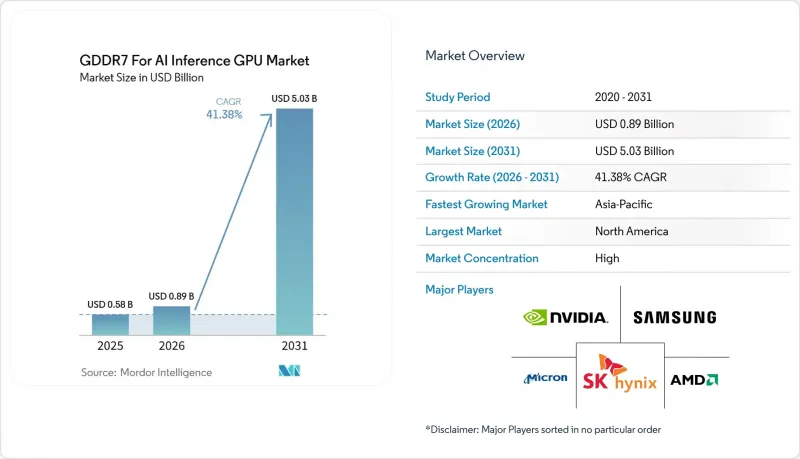
Mordor Intelligence에 의하면, AI 추론 GPU용 GDDR7 시장 규모는 2025년 5억 8,000만 달러로 평가되었고, 2026년에는 8억 9,000만 달러로 확대될 것으로 추정되고, 2031년까지 50억 3,000만 달러에 이를 것으로 예상되며, 2026-2031년 CAGR 41.4%로 성장할 전망입니다.
본 보고서는 메모리 밀도별(16Gb, 24Gb, 32Gb 이상), 메모리 데이터 전송률별(최대 32Gbps, 32Gbps 이상), 용도별(데이터센터 AI 추론, 엣지 AI 추론, 워크스테이션 AI 등), 최종 사용자 산업별(클라우드 및 하이퍼스케일 데이터센터, OEM 워크스테이션, 정부·국방 등), 그리고 지역별로 분류되어 있습니다. 시장 전망은 금액(달러) 기준으로 제시되어 있습니다.
세계의 AI 추론 GPU용 GDDR7 동향 및 인사이트
GDDR7 플랫폼에서의 AI 추론 처리량 향상
AI 추론 GPU용 GDDR7 시장은 확대 추세를 보이고 있습니다. 이는 실제 운영 환경에서의 추론 과정에서 메모리 대역폭이 토큰 생성 및 응답 속도의 직접적인 제약 요인이 되고 있기 때문입니다. JEDEC의 GDDR7 규격에서는 초기 데이터 전송 속도를 최대 32 Gbps로 설정하고, 48 Gbps를 목표로 하는 로드맵을 정의하고 있어, 이를 통해 이전 세대에 비해 데이터 처리량이 대폭 향상됩니다. 또한 램버스(Lambus)사는 GDDR7이 디바이스당 최대 192 GB/s의 처리량을 실현할 수 있는 반면, GDDR6은 96GB/s에 그칩니다고 지적하고 있습니다. 이를 통해 더 고가의 메모리 아키텍처로의 전면적인 전환을 강요하지 않고도 처리량을 향상시킬 수 있습니다. 이는 추론 서버에서 중요한 점입니다. 대역폭이 높아지면 목표 성능 수준을 달성하는 데 필요한 메모리 디바이스의 수를 줄일 수 있어, 기판의 복잡성을 낮추고 비용 관리 개선에 기여하기 때문입니다. 이러한 이점은 대규모 훈련 클러스터에 비해 전력, 열 제한, 기판 공간 제약이 엄격한 워크스테이션이나 어플라이언스 형태에서도 중요합니다. 연구 환경이 아닌 상용 시스템으로 추론 작업이 전환됨에 따라, AI 추론 GPU용 GDDR7 시장은 속도, 비용, 시스템 단순성이라는 실용적인 균형에서 혜택을 받고 있습니다.
PAM3 신호 전송을 통한 전력 효율이 높은 대역폭 확장
AI 추론 GPU용 GDDR7 시장은 에너지 효율 향상으로도 뒷받침되고 있습니다. 이는 데이터센터 및 엣지 시스템 전반에 걸쳐 전력 밀도 제한이 엄격해지는 상황에서 중요한 요소입니다. 램버스(Lambus)는 PAM3 신호 방식이 기존 신호 방식에 비해 클럭 사이클당 데이터 전송량을 50% 증가시켜, 클럭 주파수를 그만큼 높이지 않고도 유효 데이터 전송 속도를 향상시킨다고 설명했습니다. Samsung Electronics는 자사의 24GB GDDR7이 클럭 제어 관리 및 듀얼 VDD 구조를 채택하여, 이전 세대 제품에 비해 전력 소비를 30% 이상 줄였습니다고 밝혔습니다. 마이크론 역시 GDDR7을 하이브리드 CPU, GPU, NPU 시스템 전반에 걸친 저지연 및 고전력 효율의 AI 워크플로우를 위한 플랫폼으로 자리매김하고 있습니다. 이러한 효율성 덕분에 AI 추론 GPU용 GDDR7 시장의 적용 범위는 주류 클라우드 하드웨어에 그치지 않고 산업용 장비, 통신 엣지 시스템, 그리고 디바이스 내 AI 플랫폼으로 확대되고 있습니다. 또한 구매자가 피크 시의 훈련 성능뿐만 아니라 추론의 경제성도 비교할 때, 공급업체에게는 더욱 강력한 어필 요소가 됩니다.
대규모 AI 훈련에서의 HBM 선호
AI 추론 GPU용 GDDR7 시장의 가장 큰 제약은 대규모 AI 훈련 시스템에서 여전히 HBM이 선호되고 있다는 점입니다. 훈련 클러스터에서는 가속기당 대역폭을 가능한 한 극대화하는 것이 여전히 우선시되고 있으며, 그로 인해 예산이 가장 넉넉한 컴퓨팅 환경에서는 HBM3e나 HBM4가 더 매력적으로 여겨지고 있습니다. 이 때문에 GDDR7이 AI 추론에 최적임에도 불구하고, AI 추론용 GPU 시장이 하이퍼스케일 분야의 최상위 계층에 침투할 수 있는 범위는 제한될 수밖에 없습니다. 구매 담당자의 관행 또한 또 다른 장벽이 되고 있습니다. 조달 팀은 추론용 하드웨어에 대해서도 훈련 시대의 벤치마크나 인증 요건을 적용하는 경우가 많기 때문입니다. 이로 인해 이미 HBM 탑재 플랫폼이나 벤더의 스택을 표준화한 고객들의 도입이 주춤하고 있습니다. 그 결과, 수요가 붕괴되는 것은 아니지만, AI 하드웨어 사이클 중 훈련 중심의 최상위 부문으로의 진입에는 한계가 생기고 있습니다.
부문 분석
2025년, AI 추론용 GPU용 GDDR7 시장 규모의 63.8%를 16GB 부문이 차지했습니다. 이는 Blackwell 기반 도입의 첫 물결과 초기 제품 출시 시점에 16GB 제품이 널리 구할 수 있었던 점을 반영한 것입니다. 기업 및 클라우드의 교체 주기가 1년 만에 완료되는 것이 아니기 때문에 이러한 도입 기반을 바탕으로 16GB는 지속적인 역할을 수행하게 될 것입니다. 많은 구매자는 현재 플랫폼에서 처리량, 비용, 가용성 간의 균형이 실용적이라는 이유로 여전히 이 용량대를 선택하고 있습니다. 32GB 이상 부문은 2031년까지 연평균 성장률(CAGR) 44.6%를 나타낼 것으로 예측되며, AI 추론용 GPU GDDR7 시장에서 가장 빠르게 확대될 용량대가 될 전망입니다. 이러한 성장은 추론 작업이 더 긴 컨텍스트 윈도우, 멀티모달 입력, 그리고 더 많은 로컬 모델 호스팅을 처리하게 됨에 따라 더 큰 VRAM 풀에 대한 수요가 증가하고 있음을 반영합니다.
24GB 부문은 중간 위치에 있으며, 메모리 서브시스템의 전면적인 재설계가 필요 없이 채널당 용량을 향상시킨다는 점에서 중요한 역할을 하고 있습니다. Samsung Electronics는 2024년, 자사의 24Gb GDDR7이 차세대 AI 컴퓨팅을 위해 설계되었으며, 고밀도화와 전력 효율 향상을 동시에 달성했다고 발표했습니다. 이로 인해 16GB로는 부족한 메모리 여유 공간을 필요로 하면서도, 초고밀도 구성만큼 비용이 급증하지 않는 점진적인 비용 증가를 원하는 벤더에게 24GB는 유용한 선택지가 됩니다. 앞으로 AI 추론용 GPU용 GDDR7 시장에서는 16Gb가 대량 출하 측면에서 계속해서 중요한 위치를 차지하는 한편, 24Gb 및 32Gb 이상이 프리미엄급 추론 하드웨어의 상한선을 점점 더 정의해 나갈 것으로 보입니다. 실용적인 관점에서 보면, 밀도는 더 이상 사양의 한 요소라기보다는 데이터를 저속 시스템 메모리로 밀어내지 않고 모델을 로컬 VRAM 내에 상주시킬 수 있는지 여부에 중점이 옮겨가고 있습니다.
2025년 AI 추론용 GPU GDDR7 시장에서 ‘최대 32 Gbps’ 부문이 81.1%를 차지할 것으로 예상되며, 이는 초기 시장에서 성숙 단계에 접어들어 구하기 쉬운 속도 대역이 선호되었음을 보여줍니다. 이 부문은 공급업체의 지원 범위가 넓고, 현재의 기판 설계와의 호환성이 높아 GPU 제조업체에게 인증 절차의 부담을 덜어줍니다. 또한, 높은 처리량을 필요로 하되 가장 까다로운 성능 프로파일까지는 요구하지 않는 주류 추론 이용 사례에도 대응하고 있습니다. '32 Gbps 초과' 부문은 2031년까지 연평균 성장률(CAGR) 43.9%로 확대될 것으로 예측되며, 이는 대규모 컨텍스트 처리, 실시간 멀티모달 처리 및 더 높은 부하를 요구하는 시각 AI 워크로드에 대한 수요 증가를 반영합니다. 시스템 설계자들이 보드당 성능 향상을 추구함에 따라, AI 추론용 GPU용 GDDR7 시장에서 속도는 더욱 강력한 차별화 요소로 부상하고 있습니다.
고속 등급으로의 전환은 단순히 메모리 실리콘의 문제만은 아닙니다. 속도가 높아짐에 따라 기판 소재, 배선 정밀도, 열 설계에 대한 요구 사항도 더욱 까다로워지기 때문입니다. JEDEC은 2024년 3월에 GDDR7 상호운용성 프레임워크를 최종 확정했습니다. 이를 통해 벤더들은 공통된 표준 구조 내에서 속도 등급을 넘나들며 확장할 수 있게 됩니다. 이러한 표준화를 통해 단일 공급업체에 대한 의존도가 낮아지고, 향후 제품을 위한 보다 명확한 로드맵이 구축될 것입니다. 하지만 AI 추론용 GPU 업계의 GDDR7에 대해서는 단기적인 출하량의 대부분이 ‘최대 32 Gbps’ 대에 머물 것으로 예상되며, 더 고속의 등급은 계속해서 프리미엄 기기나 하이엔드 가속기 설계에 집중될 것입니다. 그 결과, 성숙한 속도 등급이 양산 확대를 뒷받침하고, 더 빠른 등급이 미래 성능 면에서의 주도권을 형성하는 양극화된 구조가 생겨나게 될 것입니다.
지역별 분석
2025년 AI 추론용 GPU GDDR7 시장 점유율 중 북미가 45.9%를 차지했으며, 지역별로는 가장 큰 기여도를 보였습니다. 이 지역은 미국에 하이퍼스케일 클라우드 사업자, AI 칩 설계 회사, 그리고 엔터프라이즈용 하드웨어 구매자가 집중되어 있다는 이점을 누리고 있습니다. 또한, 새로운 추론 인프라를 신속하게 상용화할 수 있는 플랫폼 사업자들의 강력한 견인력도 작용하고 있습니다. AWS는 2026년 1월, EC2 G7e 출시를 통해 GDDR7 기반의 추론 능력을 광범위한 엔터프라이즈용 클라우드 서비스에 도입했음을 보여주었습니다. 또한, GPU 아키텍트, 클라우드 기업 및 기업 소프트웨어 스택에 의한 많은 시스템 수준의 결정이 북미에서 이루어지기 때문에 이 지역은 제품 로드맵 수립에도 큰 영향을 미치고 있습니다.
유럽은 AI 추론용 GDDR7 탑재 GPU 시장에서 규모는 작지만 안정적인 비중을 차지했으며, 기업의 AI 도입, 산업 자동화, 그리고 보다 통제된 컴퓨팅 환경을 추구하는 공공 부문의 관심에 힘입고 있습니다. 이 지역은 개인정보 보호, 데이터 처리 및 로컬 제어가 중요한 워크스테이션이나 어플라이언스 도입에 최적입니다. 국방 분야 수요도, 특히 견고화 및 임베디드형 컴퓨팅 형태에서 더욱 두드러지고 있습니다. 콘트론(Contron)사가 2026년 7월 방위 및 항공우주 분야용 AI 추론용 'VX33211'을 출시한 것은 임무 수행이 가능한 엣지 플랫폼으로의 전환을 반영합니다. 이러한 요인들로 인해 유럽에서는 급격한 출하량 증가보다는 꾸준한 성장 궤도가 예상됩니다.
아시아태평양은 2031년까지 연평균 성장률(CAGR)이 43%로 가장 빠르게 성장하는 지역이며, 생산 측면에서의 주도적 지위와 증가하는 최종 사용자 수요가 맞물려 두드러지고 있습니다. Samsung Electronics와 SK하이닉스가 이 지역공급 측면에서 큰 비중을 차지하는 한편, 중국, 일본, 한국, 대만은 중요한 수요 및 통합 역할을 담당하고 있습니다. 로이터 통신 보도에 따르면, 엔비디아의 중국용 제품 ‘Blackwell’은 HBM 대신 GDDR7을 채택할 예정이라고 합니다. 이는 정책 및 지역별 접근 조건이 아시아의 하드웨어 설계를 어떻게 재구성하고 있는지를 보여줍니다. 또한 마이크론도 일본에서 AI PC 및 하이브리드 컴퓨팅 워크플로우를 위해 GDDR7을 포지셔닝하고 있으며, 이는 클라우드 인프라에만 국한되지 않는 기업 수요의 확대를 시사합니다. '세계 기타 지역'은 현재로서는 규모가 작지만, 각국 정부의 AI 투자 및 클라우드 인프라 확장에 힘입어 예측 기간 후반에는 그 역할이 확대될 가능성이 있습니다.
기타 혜택 :
- 엑셀 형식 시장 예측(ME) 시트
- 3개월간의 애널리스트 지원
자주 묻는 질문
목차
제1장 서론
제2장 조사 방법
제3장 주요 요약
제4장 시장 구도
제5장 시장 규모 및 성장 예측
제6장 경쟁 구도
제7장 시장 기회 및 향후 전망
AJY 26.08.11According to Mordor Intelligence, the GDDR7 for AI inference GPU market size is expected to increase from USD 0.58 billion in 2025 to USD 0.89 billion in 2026 and reach USD 5.03 billion by 2031, growing at a CAGR of 41.4% over 2026-2031.
This report is Segmented by Memory Density (16 Gb, 24 Gb, and 32 Gb and Above), Memory Data Rate (Up To 32 Gbps, and Above 32 Gbps), Application (Data Center AI Inference, Edge AI Inference, Workstation AI, and More), End-User Industry (Cloud and Hyperscale Data Centers, OEM Workstations, Government and Defense, and More), and Geography. The Market Forecasts are Provided in Terms of Value (USD).
Global GDDR7 For AI Inference GPU Market Trends and Insights
AI Inference Throughput Gains on GDDR7 Platforms
The GDDR7 for AI inference GPU market is moving higher because memory bandwidth has become a direct limiter for token generation and response speed in production inference. The JEDEC GDDR7 standard sets initial data rates up to 32 Gbps and defines a roadmap to 48 Gbps, which materially increases data throughput compared to the prior generation. Rambus also noted that GDDR7 can deliver up to 192 GB/s per device, compared with 96 GB/s for GDDR6, which improves throughput without forcing a full shift to more expensive memory architectures. This matters in inference servers because higher bandwidth can reduce the number of memory devices needed to achieve a target performance level, helping lower board complexity and improve cost discipline. The same advantage matters in workstation and appliance formats, where power, thermal limits, and board space are tighter than in large training clusters. As more inference tasks move into commercial systems rather than research environments, the GDDR7 for AI inference GPU market is gaining from this practical balance between speed, cost, and system simplicity.
Power-Efficient Bandwidth Scaling With PAM3 Signaling
The GDDR7 for AI inference GPU market is also being supported by better energy efficiency, which matters as power density limits tighten across data centers and edge systems. Rambus explained that PAM3 signaling carries 50% more data per clock cycle than prior signaling methods, thereby raising effective data rates without an equal increase in clock frequency. Samsung stated that its 24 GB GDDR7 used clock control management and a dual-VDD structure, cutting power draw by more than 30% compared to its predecessor. Micron has also positioned GDDR7 as a platform for lower-latency and more power-efficient AI workflows across hybrid CPU, GPU, and NPU systems. This efficiency profile helps the GDDR7 for AI inference GPU market extend beyond mainstream cloud hardware into industrial appliances, telecom edge systems, and on-device AI platforms. It also gives suppliers a stronger case when buyers compare inference economics rather than peak training performance alone.
HBM Preference in Large-Scale AI Training
The largest restraint on the GDDR7 for the AI inference GPU market is the continued preference for HBM in large-scale AI training systems. Training clusters still prioritize the highest possible bandwidth per accelerator, and that makes HBM3e and HBM4 more attractive for the most expensive compute budgets. This limits how far the GDDR7 for AI inference GPU market can penetrate the top tier of hyperscale spending, even when it is well-suited for inference. Buyer familiarity adds another barrier, because procurement teams often apply training-era benchmarks and qualification expectations to inference hardware. That slows adoption in accounts that already standardized around HBM-equipped platforms and vendor stacks. The result is not a collapse in demand, but a ceiling on participation in the most premium training-led portions of the AI hardware cycle.
Other drivers and restraints analyzed in the detailed report include:
- Rapid Adoption in AI Workstations and Enterprise Appliances
- GDDR7 Design Wins in Premium AI GPU Segments
- Limited Leading-Edge DRAM Capacity Amid HBM Competition
For complete list of drivers and restraints, kindly check the Table Of Contents.
Segment Analysis
The 16 GB segment held 63.8% of the GDDR7 for AI inference GPU market size in 2025, which reflected the first wave of Blackwell-based deployments and the wide availability of 16 GB parts across early product launches. This installed base gives 16 GB a durable role because enterprise and cloud refresh cycles do not turn over in a single year. Many buyers are still choosing this tier because it offers a practical balance between throughput, cost, and availability in current platforms. The 32 GB and Above segment is projected to grow at a 44.6% CAGR through 2031, making it the fastest-expanding density band in the GDDR7 for AI inference GPU market. That growth reflects rising demand for larger VRAM pools as inference jobs handle longer context windows, multimodal inputs, and more local model hosting.
The 24 GB segment sits in the middle and plays an important role, raising capacity per channel without requiring a full redesign of the memory subsystem. Samsung said in 2024 that its 24 Gb GDDR7 was built for next-generation AI computing and delivered both higher density and improved power efficiency. That makes 24 GB useful for vendors that need more memory headroom than 16 GB can offer but want a more measured cost step than very high-density configurations. Over time, the GDDR7 for AI inference GPU market is likely to see 16 Gb remain important for volume shipments while 24 Gb and 32 Gb and Above increasingly define the ceiling for premium inference hardware. In practical terms, density is becoming less about specification positioning and more about whether a model can stay resident in local VRAM without pushing data into slower system memory.
The Up to 32 Gbps segment captured 81.1% of the GDDR7 for AI inference GPU market in 2025, showing that the early market favored mature, more readily available speed bins. This tier benefits from broader supplier readiness and a better fit with current board designs, which lowers qualification friction for GPU makers. It also supports mainstream inference use cases that need strong throughput but do not require the most aggressive performance profile. The Above 32 Gbps segment is forecast to expand at a 43.9% CAGR through 2031, reflecting rising demand for larger context handling, real-time multimodal processing, and more demanding visual AI workloads. As system designers push for more performance per board, speed is becoming a stronger point of differentiation inside the GDDR7 for the AI inference GPU market.
The shift to faster tiers is not only a matter of memory silicon, because board materials, routing precision, and thermal design also become more demanding as speeds rise. JEDEC finalized the interoperability framework for GDDR7 in March 2024, which helps vendors scale across speed grades within a common standards structure. That standardization reduces single-supplier dependence and supports a clearer roadmap for future products. Even so, the GDDR7 for AI inference GPU industry will likely keep most near-term shipment volume in the Up to 32 Gbps band while faster bins remain concentrated in premium appliances and high-end accelerator designs. The result is a split structure where mature speed grades support volume growth and higher speed grades shape future performance leadership.
Complete Report Scope:
- By Memory Density
- 16 Gb
- 24 Gb
- 32 Gb and Above
- By Memory Data Rate
- Up To 32 Gbps
- Above 32 Gbps
- By Application
- Data Center AI Inference
- Edge AI Inference
- Workstation AI
- Consumer AI Acceleration
- By End-User Industry
- Cloud and Hyperscale Data Centers
- Enterprise IT
- OEM Workstations
- Government and Defense
- Other End-user Industries
- By Geography
- North America
- Europe
- Asia-Pacific
- China
- Japan
- South Korea
- Taiwan
- Rest of Asia-Pacific
- Rest of the World
Geography Analysis
North America accounted for 45.9% of the GDDR7 market share for the AI inference GPU market in 2025, making it the largest regional contributor. The region benefits from the concentration of hyperscale cloud operators, AI chip designers, and enterprise hardware buyers in the United States. It also has strong pull-through from platform operators that can quickly commercialize new inference infrastructure. AWS showed that in January 2026, with its EC2 G7e launch, which brought GDDR7-based inference capacity into a broad enterprise cloud offering. North America also shapes the product roadmap because many system-level decisions by GPU architects, cloud companies, and enterprise software stacks begin there.
Europe represents a smaller but stable part of the GDDR7 for AI inference GPU market, supported by enterprise AI adoption, industrial automation, and public sector interest in more controlled compute environments. The region is well-suited to workstation and appliance deployments where privacy, data handling, and local control matter. Defense demand is also becoming more visible, especially in ruggedized and embedded compute formats. Kontron's July 2026 launch of the VX33211 for defense and aerospace AI inference reflects that shift toward mission-ready edge platforms. These factors give Europe a measured growth path rather than a sudden volume surge.
Asia-Pacific is the fastest-growing region, with a 43% CAGR through 2031, and it stands out because it combines production leadership with rising end-user demand. Samsung and SK hynix give the region major supply-side weight, while China, Japan, South Korea, and Taiwan add important demand and integration roles. Reuters reported that NVIDIA's China-focused Blackwell product would use GDDR7 instead of HBM, which shows how policy and regional access conditions are reshaping hardware design in Asia. Micron also positioned GDDR7 for AI PC and hybrid compute workflows in Japan, which points to widening enterprise demand beyond cloud infrastructure alone. Rest of the World remains smaller today, but sovereign AI investment and expanding cloud infrastructure could lift its role later in the forecast period.
- Samsung Electronics Co., Ltd.
- SK hynix Inc.
- Micron Technology, Inc.
- NVIDIA Corporation
- Advanced Micro Devices, Inc.
- Rambus Inc.
- TSMC
- Intel Corporation
- Synopsys, Inc.
- Cadence Design Systems, Inc.
Additional Benefits:
- The market estimate (ME) sheet in Excel format
- 3 months of analyst support
TABLE OF CONTENTS
1 INTRODUCTION
- 1.1 Study Assumptions and Market Definition
- 1.2 Scope of The Study
2 RESEARCH METHODOLOGY
3 EXECUTIVE SUMMARY
4 MARKET LANDSCAPE
- 4.1 Market Overview
- 4.2 Market Drivers
- 4.2.1 AI Inference Throughput Gains over HBM in Cost-Sensitive Deployments
- 4.2.2 Power-Efficient Bandwidth Scaling with PAM3 Signaling
- 4.2.3 Rapid Adoption in AI Workstations and Edge Servers
- 4.2.4 GDDR7 Design Wins in Premium GPU Launch Cycles
- 4.2.5 Supplier Qualification Progress for 24 Gb and 32 Gb Dies
- 4.2.6 Localized Inference Demand from Enterprise and Sovereign AI Programs
- 4.3 Market Restraints
- 4.3.1 HBM Preference in Large-Scale Training and Bandwidth-Hungry Inference
- 4.3.2 Limited Leading-Edge DRAM Capacity and Allocation Discipline
- 4.3.3 Thermal and Board-Level Integration Limits in Compact Accelerators
- 4.3.4 Qualification Friction Across GPU, Memory Controller, and Board Designs
- 4.4 Industry Value Chain Analysis
- 4.5 Regulatory Landscape
- 4.6 Technological Outlook
- 4.7 Porter's Five Forces Analysis
- 4.7.1 Bargaining Power of Suppliers
- 4.7.2 Bargaining Power of Buyers
- 4.7.3 Threat of New Entrants
- 4.7.4 Threat of Substitutes
- 4.7.5 Intensity of Competitive Rivalry
- 4.8 Impact of Macroeconomic Factors on the Market
5 MARKET SIZE AND GROWTH FORECASTS (VALUE)
- 5.1 By Memory Density
- 5.1.1 16 Gb
- 5.1.2 24 Gb
- 5.1.3 32 Gb and Above
- 5.2 By Memory Data Rate
- 5.2.1 Up To 32 Gbps
- 5.2.2 Above 32 Gbps
- 5.3 By Application
- 5.3.1 Data Center AI Inference
- 5.3.2 Edge AI Inference
- 5.3.3 Workstation AI
- 5.3.4 Consumer AI Acceleration
- 5.4 By End-User Industry
- 5.4.1 Cloud and Hyperscale Data Centers
- 5.4.2 Enterprise IT
- 5.4.3 OEM Workstations
- 5.4.4 Government and Defense
- 5.4.5 Other End-user Industries
- 5.5 By Geography
- 5.5.1 North America
- 5.5.2 Europe
- 5.5.3 Asia-Pacific
- 5.5.3.1 China
- 5.5.3.2 Japan
- 5.5.3.3 South Korea
- 5.5.3.4 Taiwan
- 5.5.3.5 Rest of Asia-Pacific
- 5.5.4 Rest of the World
6 COMPETITIVE LANDSCAPE
- 6.1 Market Concentration
- 6.2 Strategic Moves
- 6.3 Market Share Analysis
- 6.4 Company Profiles (includes Global Level Overview, Market Level Overview, Core Segments, Financials as available, Strategic Information, Market Rank/Share, Products and Services, Recent Developments)
- 6.4.1 Samsung Electronics Co., Ltd.
- 6.4.2 SK hynix Inc.
- 6.4.3 Micron Technology, Inc.
- 6.4.4 NVIDIA Corporation
- 6.4.5 Advanced Micro Devices, Inc.
- 6.4.6 Rambus Inc.
- 6.4.7 TSMC
- 6.4.8 Intel Corporation
- 6.4.9 Synopsys, Inc.
- 6.4.10 Cadence Design Systems, Inc.
7 MARKET OPPORTUNITIES AND FUTURE OUTLOOK
- 7.1 White-Space And Unmet-Need Assessment


