

|
시장보고서
상품코드
2099878
AI 데이터센터용 분산형 메모리 아키텍처 시장 : 시장 점유율 분석, 업계 동향 및 통계, 성장 예측(2026-2031년)Disaggregated Memory Architecture For AI Data Centers - Market Share Analysis, Industry Trends & Statistics, Growth Forecasts (2026 - 2031) |
||||||
 Mordor Intelligence
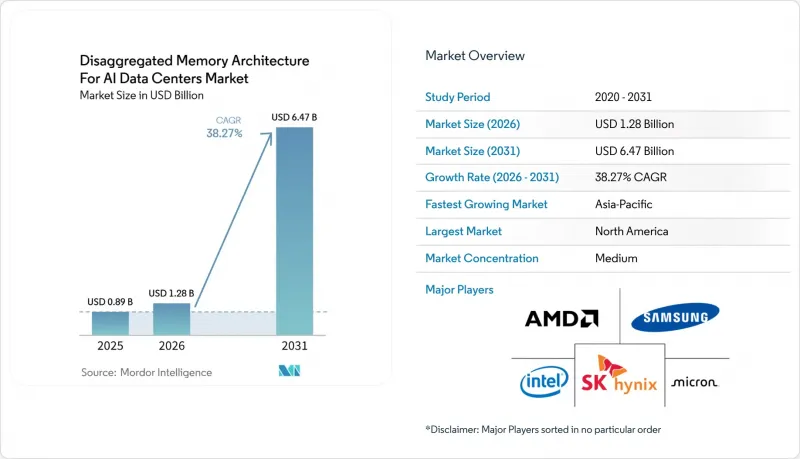
Mordor Intelligence에 의하면, AI 데이터센터용 분산형 메모리 아키텍처 시장 규모는 2025년에 8억 9,000만 달러로 평가되었고, 2026년 12억 8,000만 달러에서, 2031년까지 64억 7,000만 달러에 이를 것으로 예측되며, 2026-2031년 CAGR 38.27%로 성장할 전망입니다.
본 보고서는 구성 요소별(메모리 모듈, 스위치 및 리타이머, 컨트롤러 및 어댑터 등), 메모리 기술별(DRAM 등), 아키텍처 유형별(직접 어태치드 메모리 확장 등), 용도별(AI 훈련 등), 최종 사용자별(클라우드 서비스 제공업체 등), 지역별로 분류되어 있습니다. 시장 전망은 금액(달러) 기준으로 제시됩니다.
세계의 AI 데이터센터용 분산형 메모리 아키텍처 시장 동향 및 인사이트
AI 워크로드의 급증과 ‘메모리 장벽’으로 인한 압박
대규모 언어 모델 및 에이전트형 AI 시스템의 부상으로 메모리 용량이 주목받고 있습니다. 이는 많은 프로덕션 환경에서 제약 요인이 더 이상 순수한 연산 능력만이 아니기 때문입니다. AI 데이터센터 시장을 겨냥한 디스어그리게이트드 메모리 아키텍처는 이러한 변화의 혜택을 받고 있습니다. CXL 기반의 풀링을 통해 고속 액세스 경로가 필요한 서버에서 표준적인 로드·스토어 동작을 유지하면서도, DIMM 슬롯의 제한을 넘어 사용 가능한 메모리를 확장할 수 있기 때문입니다. 각 벤더들도 메모리 부하를 시스템 수준의 문제로 인식하고 있으며, 새로운 스위치 및 컨트롤러 설계에서는 공유 가능하고 확장 가능한 메모리 풀을 활용하여 AI의 메모리 한계를 극복하는 데 특히 중점을 두고 있습니다. Meta의 Vistara 도입 사례는 하이퍼스케일 환경에서 재활용된 DDR4를 CXL 패브릭을 통해 연결한 결과, ML 추론 서버 대수가 25% 감소하고 분산 캐시의 레이턴시가 29% 감소했음을 보여줌으로써, 해당 운영 사례를 더욱 구체적으로 입증했습니다. 이 결과는 AI 데이터센터의 비집약형 메모리 아키텍처 시장이 단순한 실험실 내 가설적 이용 사례가 아니라, 실제 운영상의 병목 현상에 의해 추진되고 있음을 보여주며 중요한 의미를 지닙니다. 더 많은 AI 플릿이 파일럿 클러스터에서 광범위한 도입으로 전환됨에 따라 메모리 효율성은 인프라의 직접적인 과제가 되고 있으며, 하이퍼스케일 환경과 클라우드 환경 모두에서 풀형 설계에 대한 수요가 증가하고 있습니다.
하이퍼스케일 데이터센터에서의 컴포저블 인프라로의 전환
하이퍼스케일 사업자들은 고정된 서버 구성에서 벗어나, 기존 랙 환경보다 컴퓨팅, 메모리, 스토리지를 보다 독립적으로 확장할 수 있는 컴포저블 설계로 점차 전환하고 있습니다. 이러한 변화로 인해 운영자는 프로세서 플랫폼을 업데이트할 때마다 가동 중인 메모리 자산을 폐기할 필요가 없어지므로, AI 데이터센터의 비집약형 메모리 아키텍처 시장이 활성화될 것입니다. 2025년에 발표된 CXL 컨소시엄의 시뮬레이션에 따르면, 저비용 DIMM을 CXL 확장 메모리와 결합함으로써 메모리 비용을 16%에서 27%까지 절감할 수 있는 것으로 나타났습니다. 이를 통해 운영 사업자에게는 메모리 계획과 CPU 업데이트 주기를 분리해야 할 명확한 경제적 근거가 생깁니다. 이러한 아키텍처 전환은 퍼블릭 클라우드 도입 사례에서도 명확히 드러납니다. Microsoft Azure의 M 시리즈 가상 머신에 Astera Labs사의 'Leo CXL Smart Memory Controller'가 채택되어, 서버 컨트롤러 1대당 메모리 용량이 1.5배 이상 향상되었습니다. 2026년에 발표된 조사에서는 나아가 CXL 생태계가 이미 디바이스와 IP를 아우르며 190개 이상의 벤더로 확산되고 있다는 점이 지적되었습니다. 이는 컴포저블 도입에 필요한 공급업체 기반이 현재 프로덕션 프로그램을 지원하기에 충분한 규모를 갖추고 있음을 의미합니다. 하지만 다음 도입 물결은 하드웨어의 등장이라기보다는 운영상의 복잡성을 증가시키지 않으면서 풀링된 메모리의 배치, 재조정, 모니터링을 수행할 수 있는 소프트웨어 계층에 크게 의존하게 될 것입니다.
다중 벤더 CXL 스택에서의 상호 운용성 및 검증의 복잡성
상호 운용성은 AI 데이터센터의 분산 메모리 아키텍처 시장에 여전히 큰 걸림돌로 작용하고 있습니다. 이는 프로덕션 시스템에서 CPU, 모듈, 리타이머, 스위치, 운영 체제 및 관리 계층을 단일 스택으로 인증해야 하기 때문입니다. CXL 컨소시엄의 준수 프로그램은 유용한 기준을 제공하지만, 프로토콜 준수만으로는 여러 벤더가 혼재된 구성에서 시스템 수준의 튜닝, 워크로드 검증 및 장애 대응과 같은 장기적인 과제를 해결할 수 없습니다. 2026년 조사에서는 생태계가 190개 이상의 벤더로 확대되었음에도 불구하고, 단계적 확장을 위해서는 여전히 신중한 도입 체계와 실제 클라우드 환경에서 얻은 실무적 교훈이 필요하다는 점이 명확히 지적되었습니다. 이것이 바로 AI 데이터센터의 비집약형 메모리 아키텍처 시장이 검증 팀 인력이 부족한 중소규모 기업이나 코로케이션 사업자보다 하이퍼스케일러나 대형 클라우드 제공업체에게 여전히 접근하기 쉬운 이유 중 하나입니다. 또한, 인증에 따르는 부담은 구매 주기를 장기화시키는 요인이 되기도 합니다. 구매자는 광범위한 배포를 승인하기 전에 여러 하드웨어와 소프트웨어의 조합을 테스트할 수밖에 없는 경우가 많기 때문입니다. 멀티 벤더 간의 상호 운용성이 더욱 보편화되기 전까지는 수 분기에 걸친 검증 프로그램을 감당할 수 있는 조직이 단기간에 예측 가능한 도입 일정을 필요로 하는 구매자보다 도입 속도가 더 빠르게 진행될 것입니다.
부문 분석
2025년에는 메모리 모듈이 부품 매출의 44.13%를 차지한 것으로 평가되었으며, 이는 구매자들이 더 복잡한 스위칭 및 패브릭 설계로 전환하기 전에 여전히 대부분의 도입이 직접 메모리 확장(CMM)에서 시작되고 있음을 보여줍니다. 이러한 추세는 검증된 CXL 메모리 모듈이 이미 고객 프로그램에 도입되기 시작했다는 사실로 뒷받침됩니다. SK하이닉스는 96GB CXL 2.0 기반 CMM-DDR5 제품의 검증을 완료했으며, 128GB 버전 개발을 진행 중입니다. AI 데이터센터의 분산형 메모리 아키텍처 시장에서 이러한 도입 방식은 타당합니다. 모듈 주도형 확장은 랙 수준의 풀링보다 인증이 용이하고, 기존 서버 설계에 대한 변경도 최소화할 수 있기 때문입니다. 또한 스위치, 컨트롤러, 소프트웨어에 대한 관심이 높아지고 있음에도 불구하고, 하드웨어 매출 기준이 여전히 모듈에 치우쳐 있는 이유도 이로 설명할 수 있습니다. 스위치와 리타이머가 중요한 이유는 이들이 단순한 확장에서 공유 메모리 풀로 이어지는 경로를 만들어 내고, 그곳에서 더 큰 효율 향상이 나타나기 시작하기 때문입니다.
컨트롤러와 어댑터는 이러한 전환 과정의 핵심에 위치합니다. 이들은 서로 다른 호스트 환경 간에 메모리를 얼마나 확실하게 확장, 모니터링 및 매핑할 수 있는지를 결정하기 때문입니다. 또한 통합 및 지원 서비스도 AI 데이터센터의 비집약형 메모리 아키텍처 시장에서 점점 더 중요한 요소로 부상하고 있습니다. 이는 인증, 튜닝, 워크로드 테스트에 표준 하드웨어 공급을 넘어서는 엔지니어링 지원이 필요한 경우가 많기 때문입니다. 소프트웨어 및 관리 플랫폼 시장은 2031년까지 연평균 성장률(CAGR) 39.18%를 나타낼 것으로 예측되며, 이는 기본적인 CXL 하드웨어가 더 널리 이용 가능해짐에 따라 가치가 제어 계층으로 이동하기 시작하고 있음을 보여줍니다. Astera Labs의 COSMOS 제품군은 자사의 메모리 컨트롤러 제품군에 대한 링크 가시화, 플릿 수준 관리 및 신뢰성 텔레메트리 기능을 제공함으로써 이러한 추세를 반영하고 있습니다. AI 데이터센터의 디스어그리게이트 메모리 아키텍처 산업이 성숙해짐에 따라, 규제 대상 및 대규모 환경의 구매자들은 오케스트레이션 및 진단 도구를 교체하는 것보다 더 빠른 속도로 하드웨어 구성 요소를 교체하는 경향이 강해질 것입니다. 이에 따라 소프트웨어는 스택 내에서 더욱 확고한 위치를 차지하게 될 것입니다.
2025년, DRAM은 메모리 기술 부문의 61.76%를 차지했으며, 이러한 우위는 CPU의 로드·스토어 액세스에 적합한 지연 시간을 유지하면서 CXL 직접 어태치 확장을 지원하는 유일하고 널리 실용화 가능한 선택지로서의 역할을 반영합니다. AI 데이터센터의 비집약형 메모리 아키텍처 시장에서 DRAM은 용도를 즉시 스토리지와 같은 액세스 패턴으로 전환하지 않고도 용량을 확장할 수 있기 때문에 여전히 실용적인 최우선 선택지로 남아 있습니다. HBM은 보다 광범위한 AI 하드웨어 스택에서 중요한 위치를 차지하고 있지만, GPU에 가까운 배치와 비트당 높은 비용으로 인해 프라이빗 가속기 메모리에는 적합할 수 있으나, 공유 랙 규모의 분산화에는 그다지 적합하지 않습니다. 퍼시스턴트 메모리의 역할은 여전히 제한적이며, 주로 저널링이나 체크포인트가 많이 사용되는 워크플로우 등, DRAM급 속도보다는 바이트 단위의 주소 지정이 가능한 내구성이 중시되는 이용 사례에서 활용되고 있습니다. 즉, 현재의 부문 구조는 장기적인 아키텍처상의 선호도라기보다는 운영상의 준비 상태가 더 강하게 반영된 것이라고 할 수 있습니다.
DRAM과 NAND를 결합한 계층형 메모리는 더 대규모의 효율적인 메모리 풀을 구축할 수 있는 경제적인 수단을 제공하므로, 2031년까지 연평균 성장률(CAGR) 38.97%를 나타낼 것으로 예측됩니다. 2026년에 발표된 조사에 따르면, CXL 하이브리드 메모리 시스템은 NVMe의 레이턴시를 부분적으로 마스킹하는 DMA 기반 접근 방식을 통해 SSD 기반의 용량을 직접 액세스 확장으로 제공할 수 있는 것으로 나타났습니다. 이를 통해 올-DRAM 설계로는 경제적으로 실현할 수 없는 훨씬 더 대규모의 추론 상태 호스팅이 가능해집니다. 이는 AI 데이터센터의 비집약형 메모리 아키텍처 시장에 중요한 의미를 지닙니다. 왜냐하면 컨텍스트 길이에 민감한 많은 워크로드에서는 프로덕션 환경 규모에서 올-DRAM 구성을 정당화할 수 없기 때문입니다. 또한 계층형 메모리는 페이지 배치, 핫 데이터 처리 및 폴백 동작이 엄격하게 관리될 때만 적절하게 작동하므로, 소프트웨어 정책이 이 부문의 성장을 좌우하게 될 것입니다. 향후에는 DRAM의 중요성이 떨어지기 때문이 아니라, 운영자가 동일한 메모리 계층 내에서 여러 경제적인 계층을 필요로 하게 될 것이기 때문에 이 부문은 확대될 것으로 예측됩니다. 따라서 AI 데이터센터의 비집약형 메모리 아키텍처 시장에서는 DRAM을 핵심으로 삼으면서도, 지연 시간, 용량, 비용의 균형을 맞추는 혼합 메모리 클래스에 대한 비중을 점차 확대해 나갈 것입니다.
지역별 분석
2025년, 북미는 디스어그리게이트드 메모리 아키텍처 시장의 46.28%를 차지했습니다. 이는 해당 지역에 하이퍼스케일 캠퍼스, 반도체 설계 기업 및 첨단 인증 역량이 집중되어 있음을 반영합니다. 이 지역은 CPU 플랫폼 개발사, 메모리 컨트롤러 전문 기업, 스위치 벤더, 그리고 세계 최대 규모의 AI 인프라 운영사가 인접해 있다는 이점이 있어, 이를 통해 도입에 대한 피드백 루프가 단축되고 있습니다. Astera Labs는 2026년 6월, 대만에서 사업을 확장하고 클라우드 규모의 상호 운용성 연구소를 설립함으로써 생태계의 범위를 넓혔으며, 아시아의 시스템 제조업체 및 AI 플랫폼 제공업체와의 협력을 강화했습니다. 북미 운영업체들에게 있어 CXL 컨소시엄이 모델링한 16%에서 27%의 메모리 비용 절감은 특히 중요한 의미를 지닙니다. 이는 전력 비용 상승과 데이터센터 회랑의 성숙화로 인해 단순한 하드웨어 확장보다 효율성 향상이 더욱 중시되고 있기 때문입니다. 또한, 캐나다도 AI 중심의 데이터센터 투자를 통해 제2의 거점으로 부상하고 있지만, 멕시코는 본격적인 풀형 메모리 도입보다는 엣지 및 이를 뒷받침하는 인프라와의 연계가 여전히 강한 상황입니다.
유럽은 현재 매출 규모 면에서는 여전히 소규모이지만, 이 지역은 북미와는 다른 논리에 따라 발전하고 있습니다. 데이터 상주 요건 및 규정 준수 기대감으로 인해 소프트웨어 정의 인프라의 매력이 높아지고 있습니다. 이는 구매자가 리소스 할당 및 관리 현황을 가시화하기를 원하기 때문입니다. 독일과 영국은 하이퍼스케일 기업의 진출과 금융, 제조, 시뮬레이션을 많이 활용하는 워크로드에 대한 기업 수요가 맞물려 도입을 주도하고 있습니다. 프랑스와 이탈리아는 아직 도입 주기의 초기 단계에 있지만, 국가 차원의 AI 및 연구 인프라 프로그램이 보다 진보된 메모리 토폴로지를 채택하는 초기 구매자 기반을 형성하는 데 힘을 실어주고 있습니다. 기타 유럽에서는 재생에너지의 이용 가능성과 북유럽 및 동유럽으로의 하이퍼스케일 기업의 지속적인 확장이 도입 후기 단계에 필요한 조건을 뒷받침하고 있습니다.
아시아태평양은 2031년까지 연평균 성장률(CAGR) 39.09%로 확대될 것으로 예측되며, AI 데이터센터의 분산형 메모리 아키텍처 시장에서 가장 빠르게 성장하는 지역이 될 전망입니다. 대만은 주요 CXL 컨트롤러 및 스위치용 실리콘 파운드리 거점으로서 공급망의 핵심 역할을 계속 수행하고 있으며, 이를 통해 해당 지역은 생산 역량과 수요 잠재력을 모두 갖추고 있습니다. 중국은 국가가 관여하는 AI 인프라에 공급할 수 있는 국내 메모리 역량을 구축하고 있는 반면, 인도는 여전히 초기 역량 구축 단계에 있으며, 하이퍼스케일러 및 클라우드에 대한 투자가 향후 도입을 위한 기반을 마련하고 있습니다. 남미, 중동 및 아프리카는 하이퍼스케일러의 밀도가 낮고 통합 비용이 높아 랙 규모의 CXL 도입을 조기에 정당화하기 어렵기 때문에 당분간은 세계 최첨단 지역에 뒤처질 가능성이 높다고 볼 수 있습니다.
기타 혜택 :
- 엑셀 형식 시장 예측(ME) 시트
- 3개월간의 애널리스트 지원
자주 묻는 질문
목차
제1장 서론
제2장 조사 방법
제3장 주요 요약
제4장 시장 구도
제5장 시장 규모 및 성장 예측
제6장 경쟁 구도
제7장 시장 기회 및 향후 전망
AJY 26.08.11According to Mordor Intelligence, the disaggregated memory architecture market size for AI data centers is projected to be USD 0.89 billion in 2025, USD 1.28 billion in 2026, and reach USD 6.47 billion by 2031, growing at a CAGR of 38.27% from 2026 to 2031.
This report is Segmented by Component (Memory Modules, Switches and Retimers, Controllers and Adapters, and More), Memory Technology (DRAM, and More), Architecture Type (Direct Attached Memory Expansion, and More), Application (AI Training, and More), End User (Cloud Service Providers, and More), and Geography. The Market Forecasts are Provided in Terms of Value (USD).
Global Disaggregated Memory Architecture For AI Data Centers Market Trends and Insights
AI Workload Proliferation and Memory Wall Pressure
Large language models and agentic AI systems have pushed memory capacity into the foreground because the limiting factor in many production environments is no longer raw compute alone. The disaggregated memory architecture for the AI data centers market benefits from this shift, since CXL-based pooling extends usable memory beyond DIMM slot limits while preserving standard load-store behavior for servers that need fast access paths. Vendors have also framed memory pressure as a system-level issue, with newer switch and controller designs positioned specifically to break the AI memory wall through shared and expandable memory pools. Meta's Vistara deployment made the operating case more concrete by showing a 25% reduction in ML inference server counts and a 29% reduction in distributed cache latency when recycled DDR4 was attached over a CXL fabric at hyperscale. That result matters because it shows that the disaggregated memory architecture for the AI data center market is being driven by real production bottlenecks, not by a speculative lab-only use case. As more AI fleets move from pilot clusters to broad deployment, memory efficiency becomes a direct infrastructure issue, which strengthens demand for pooled designs across both hyperscale and cloud environments.
Hyperscale Data Center Transition to Composable Infrastructure
Hyperscalers are gradually shifting from fixed server configurations toward composable designs, where compute, memory, and storage can be scaled with more independence than in traditional racks. That change supports the disaggregated memory architecture for the AI data center market by allowing operators to avoid retiring working memory assets each time a processor platform is refreshed. CXL Consortium modeling presented in 2025 showed that memory costs can fall by 16% to 27% when lower-cost DIMMs are paired with CXL expansion memory, which gives operators a clear financial reason to separate memory planning from CPU refresh cycles. The architectural shift is also evident in public cloud deployments, where Astera Labs' Leo CXL Smart Memory Controllers were used on Microsoft Azure M-series virtual machines to enable more than 1.5 times the memory capacity per server controller. Research published in 2026 further noted that the CXL ecosystem already spans more than 190 vendors across devices and IP, which means the supplier base needed for composable deployment is now broad enough to support production programs. Even so, the next wave of adoption will depend less on hardware discovery and more on software layers that can place, rebalance, and monitor pooled memory without adding heavy operating complexity.
Interoperability and Validation Complexity Across Multi-Vendor CXL Stacks
Interoperability remains a real brake on the disaggregated memory architecture for AI data centers market, because production systems must qualify CPUs, modules, retimers, switches, operating systems, and management layers as one stack. The CXL Consortium's compliance programs provide a useful baseline, but protocol conformance does not eliminate the longer-term work of system-level tuning, workload validation, and failure handling across mixed-vendor combinations. Research from 2026 clearly made this point by showing that, even as the ecosystem expanded to more than 190 vendors, incremental scaling still required careful deployment discipline and practical lessons from real cloud environments. This is one reason the disaggregated memory architecture for AI data centers market remains more accessible to hyperscalers and large cloud providers than to smaller enterprises or colocation operators with thinner validation teams. The qualification burden also stretches purchasing cycles, because buyers are often forced to test several hardware and software combinations before approving a broader rollout. Until multi-vendor interoperability becomes more routine, adoption will continue to move faster in organizations that can absorb multi-quarter validation programs than in buyers that need short and predictable deployment timelines.
Other drivers and restraints analyzed in the detailed report include:
- Tight Coupling of CXL Ecosystem Support Across CPUs, Memory, and Switches
- Rising Demand for Memory Utilization Optimization and Lower TCO
- Immature Software Orchestration and Memory Tiering Tooling
For complete list of drivers and restraints, kindly check the Table Of Contents.
Segment Analysis
Memory Modules accounted for 44.13% of component revenue in 2025, indicating that most deployments still begin with direct memory expansion before buyers move into more complex switching and fabric designs. That position was supported by the fact that validated CXL memory modules were already moving into customer programs, with SK hynix completing validation of a 96GB CXL 2.0-based CMM-DDR5 product and progressing work on a 128GB version. In the disaggregated memory architecture for the AI data centers market, this entry point makes sense because module-led expansion is easier to qualify than rack-level pooling and requires fewer changes to the current server design. It also helps explain why the hardware revenue base still skews toward modules, even though switches, controllers, and software are attracting growing attention. Switches and retimers matter because they create the path from simple expansion to shared memory pools, where larger efficiency gains begin to emerge.
Controllers and adapters sit in the middle of that transition because they determine how reliably memory can be expanded, monitored, and mapped across different host environments. Integration and Support Services are also becoming a more visible part of the disaggregated memory architecture for AI data centers market, since qualification, tuning, and workload testing often require engineering support beyond standard hardware fulfillment. Software and Management Platforms is projected to grow at a 39.18% CAGR through 2031, which shows that value is beginning to migrate toward the control layer as basic CXL hardware becomes more widely available. Astera Labs' COSMOS suite reflects that direction by offering link visibility, fleet-level management, and reliability telemetry around its memory controller portfolio. As the disaggregated memory architecture for AI data centers industry matures, buyers in regulated and large-scale environments are likely to switch hardware components faster than they switch orchestration and diagnostic tools, which makes software the stickier layer of the stack.
DRAM held 61.76% of the memory technology segment in 2025, and that dominance reflects its role as the only broad production-ready option for CXL direct-attached expansion with latency that still fits CPU load-store access. In the disaggregated memory architecture for the AI data centers market, DRAM remains the practical first choice because it can expand capacity without forcing applications to shift immediately toward storage-like access patterns. HBM remains important in the wider AI hardware stack, but its near-GPU placement and high cost per bit make it less suited to shared rack-scale disaggregation than to private accelerator memory. Persistent Memory still has a narrower role, mainly in use cases where byte-addressable durability matters more than DRAM-class speed, such as journaling and checkpoint-heavy workflows. That means the segment structure today still reflects operational readiness more than long-run architectural preference.
Tiered Memory, which combines DRAM and NAND, is projected to grow at a 38.97% CAGR through 2031, as it offers a more affordable path to larger, more effective memory pools. Research published in 2026 showed that CXL-hybrid memory systems can expose SSD-backed capacity as direct-access expansion through a DMA-based approach that masks part of NVMe latency, which supports much larger inference state hosting than all-DRAM designs can economically deliver. That matters for the disaggregated memory architecture for AI data centers market because many context-length-sensitive workloads cannot justify an all-DRAM footprint at production scale. It also means software policy will determine segment growth, since tiered memory only works well when page placement, hot data handling, and fallback behavior are managed with discipline. Over time, the segment is likely to broaden not because DRAM loses relevance, but because operators need more than one economic tier inside the same memory hierarchy. The disaggregated memory architecture for AI data centers market therefore keeps DRAM at the core while gradually opening more room for mixed memory classes that balance latency, capacity, and cost.
Complete Report Scope:
- By Component
- Memory Modules
- Switches and Retimers
- Controllers and Adapters
- Software and Management Platforms
- Integration and Support Services
- By Memory Technology
- DRAM
- HBM
- Persistent Memory
- Tiered Memory (DRAM + NAND)
- By Architecture Type
- Direct Attached Memory Expansion
- Switched Memory Pooling
- Rack-Scale Memory Disaggregation
- Fabric Attached Memory
- By Application
- AI Training
- AI Inference
- High Performance Computing
- In-Memory Databases And Analytics
- Large Language Model Serving
- Enterprise Virtualization
- By End User
- Hyperscalers
- Cloud Service Providers
- Enterprise Data Centers
- Colocation Providers
- Research and Supercomputing Institutions
- By Geography
- North America
- United States
- Canada
- Mexico
- Europe
- Germany
- United Kingdom
- France
- Italy
- Rest of Europe
- Asia-Pacific
- China
- Japan
- South Korea
- Taiwan
- India
- Rest of Asia-Pacific
- South America
- Middle East and Africa
- North America
Geography Analysis
North America accounted for 46.28% of the disaggregated memory architecture market share in 2025, reflecting the region's concentration of hyperscale campuses, semiconductor design firms, and advanced qualification capacity. The region benefits from close proximity among CPU platform developers, memory controller specialists, switch vendors, and some of the world's largest AI infrastructure operators, which shortens deployment feedback loops. Astera Labs expanded its ecosystem reach in June 2026 by expanding its Taiwan operations and establishing a cloud-scale interoperability laboratory to strengthen its work with Asian system manufacturers and AI platform providers. For North American operators, the 16% to 27% memory cost savings modeled by the CXL Consortium remain especially relevant because rising power costs and mature data center corridors place greater emphasis on efficiency gains than on simple hardware scale. Canada is also emerging as a secondary node through AI-oriented data center investment, while Mexico remains more closely tied to edge and supporting infrastructure than to full-scale pooled memory deployment.
Europe remains smaller in current revenue, but the region is moving forward on a different logic than North America. Data residency requirements and compliance expectations make software-definable infrastructure more attractive, because buyers want visibility into how resources are assigned and governed. Germany and the United Kingdom are leading adoption through a mix of hyperscale presence and enterprise demand from finance, manufacturing, and simulation-heavy workloads. France and Italy are still earlier in the cycle, but national AI and research infrastructure programs are helping create an initial buyer base for more advanced memory topologies. Across the rest of Europe, renewable power availability and continued hyperscaler expansion into Nordic and Eastern European locations are supporting the conditions needed for later-stage adoption.
Asia-Pacific is projected to expand at a 39.09% CAGR through 2031, making it the fastest-growing regional part of the disaggregated memory architecture for AI data centers market. Taiwan continues to anchor the supply chain as the foundry base for leading CXL controllers and switch silicon, which gives the region production depth as well as demand potential. China is building domestic memory capability that can feed state-linked AI infrastructure, while India is still in an earlier capacity-building phase where hyperscaler and cloud investment lay the groundwork for future adoption. South America and the Middle East and Africa are likely to remain behind the global frontier in the near term because lower hyperscale density and higher integration costs make rack-scale CXL deployments harder to justify early.
- Samsung Electronics Co., Ltd.
- SK hynix Inc.
- Micron Technology, Inc.
- Intel Corporation
- Advanced Micro Devices, Inc.
- Broadcom Inc.
- Marvell Technology, Inc.
- Astera Labs, Inc.
- Rambus Inc.
- Montage Technology Co., Ltd.
- Super Micro Computer, Inc.
- Dell Technologies Inc.
- Hewlett Packard Enterprise Company
- Lenovo Group Limited
- GigaIO, Inc.
- MemVerge, Inc.
- Liqid, Inc.
- Quanta Computer Inc.
Additional Benefits:
- The market estimate (ME) sheet in Excel format
- 3 months of analyst support
TABLE OF CONTENTS
1 INTRODUCTION
- 1.1 Study Assumptions and Market Definition
- 1.2 Scope of the Study
2 RESEARCH METHODOLOGY
3 EXECUTIVE SUMMARY
4 MARKET LANDSCAPE
- 4.1 Market Overview
- 4.2 Market Drivers
- 4.2.1 AI Workload Proliferation and Memory Wall Pressure
- 4.2.2 Hyperscale Data Center Transition to Composable Infrastructure
- 4.2.3 Tight Coupling of CXL Ecosystem Support Across CPUs, Memory, and Switches
- 4.2.4 Rising Demand for Memory Utilization Optimization and Lower TCO
- 4.2.5 Emerging Need for Rack-Scale Resource Pooling In Multi-Tenant AI Clusters
- 4.2.6 Faster Qualification of CXL 3.x Platforms for Production Deployment
- 4.3 Market Restraints
- 4.3.1 Interoperability and Validation Complexity Across Multi-Vendor CXL Stacks
- 4.3.2 Immature Software Orchestration and Memory Tiering Tooling
- 4.3.3 High Integration Cost for Rack-Scale Fabric, Switch, and Memory Pooling Hardware
- 4.3.4 Risk of Delayed Adoption Where HBM and DDR Roadmaps Still Meet Near-Term Needs
- 4.4 Industry Value Chain Analysis
- 4.5 Regulatory Landscape
- 4.6 Technological Outlook
- 4.7 Porter's Five Forces Analysis
- 4.7.1 Bargaining Power of Buyers
- 4.7.2 Bargaining Power of Suppliers
- 4.7.3 Threat of New Entrants
- 4.7.4 Threat of Substitutes
- 4.7.5 Intensity of Competitive Rivalry
- 4.8 Impact of Macroeconomic Factors on the Market
5 MARKET SIZE AND GROWTH FORECASTS (VALUE)
- 5.1 By Component
- 5.1.1 Memory Modules
- 5.1.2 Switches and Retimers
- 5.1.3 Controllers and Adapters
- 5.1.4 Software and Management Platforms
- 5.1.5 Integration and Support Services
- 5.2 By Memory Technology
- 5.2.1 DRAM
- 5.2.2 HBM
- 5.2.3 Persistent Memory
- 5.2.4 Tiered Memory (DRAM + NAND)
- 5.3 By Architecture Type
- 5.3.1 Direct Attached Memory Expansion
- 5.3.2 Switched Memory Pooling
- 5.3.3 Rack-Scale Memory Disaggregation
- 5.3.4 Fabric Attached Memory
- 5.4 By Application
- 5.4.1 AI Training
- 5.4.2 AI Inference
- 5.4.3 High Performance Computing
- 5.4.4 In-Memory Databases And Analytics
- 5.4.5 Large Language Model Serving
- 5.4.6 Enterprise Virtualization
- 5.5 By End User
- 5.5.1 Hyperscalers
- 5.5.2 Cloud Service Providers
- 5.5.3 Enterprise Data Centers
- 5.5.4 Colocation Providers
- 5.5.5 Research and Supercomputing Institutions
- 5.6 By Geography
- 5.6.1 North America
- 5.6.1.1 United States
- 5.6.1.2 Canada
- 5.6.1.3 Mexico
- 5.6.2 Europe
- 5.6.2.1 Germany
- 5.6.2.2 United Kingdom
- 5.6.2.3 France
- 5.6.2.4 Italy
- 5.6.2.5 Rest of Europe
- 5.6.3 Asia-Pacific
- 5.6.3.1 China
- 5.6.3.2 Japan
- 5.6.3.3 South Korea
- 5.6.3.4 Taiwan
- 5.6.3.5 India
- 5.6.3.6 Rest of Asia-Pacific
- 5.6.4 South America
- 5.6.5 Middle East and Africa
- 5.6.1 North America
6 COMPETITIVE LANDSCAPE
- 6.1 Market Concentration
- 6.2 Strategic Moves
- 6.3 Market Share Analysis
- 6.4 Company Profiles (includes Global Level Overview, Market Level Overview, Core Segments, Financials as available, Strategic Information, Market Rank/Share, Products and Services, Recent Developments)
- 6.4.1 Samsung Electronics Co., Ltd.
- 6.4.2 SK hynix Inc.
- 6.4.3 Micron Technology, Inc.
- 6.4.4 Intel Corporation
- 6.4.5 Advanced Micro Devices, Inc.
- 6.4.6 Broadcom Inc.
- 6.4.7 Marvell Technology, Inc.
- 6.4.8 Astera Labs, Inc.
- 6.4.9 Rambus Inc.
- 6.4.10 Montage Technology Co., Ltd.
- 6.4.11 Super Micro Computer, Inc.
- 6.4.12 Dell Technologies Inc.
- 6.4.13 Hewlett Packard Enterprise Company
- 6.4.14 Lenovo Group Limited
- 6.4.15 GigaIO, Inc.
- 6.4.16 MemVerge, Inc.
- 6.4.17 Liqid, Inc.
- 6.4.18 Quanta Computer Inc.
7 MARKET OPPORTUNITIES AND FUTURE OUTLOOK
- 7.1 White Space and Unmet Need Assessment


