

|
시장보고서
상품코드
2099905
과민성 폐렴 시장 : 시장 점유율 분석, 업계 동향 및 통계, 성장 예측(2026-2031년)Hypersensitivity Pneumonitis - Market Share Analysis, Industry Trends & Statistics, Growth Forecasts (2026 - 2031) |
||||||
 Mordor Intelligence
Mordor Intelligence에 의하면, 과민성 폐렴 시장 규모는 2025년에 13억 2,000만 달러로 평가되었고, 2026년 13억 9,000만 달러에서 2031년까지 17억 9,000만 달러에 이를 것으로 예측되며, 예측 기간(2026-2031년) CAGR은 5.25%를 나타낼 전망입니다.
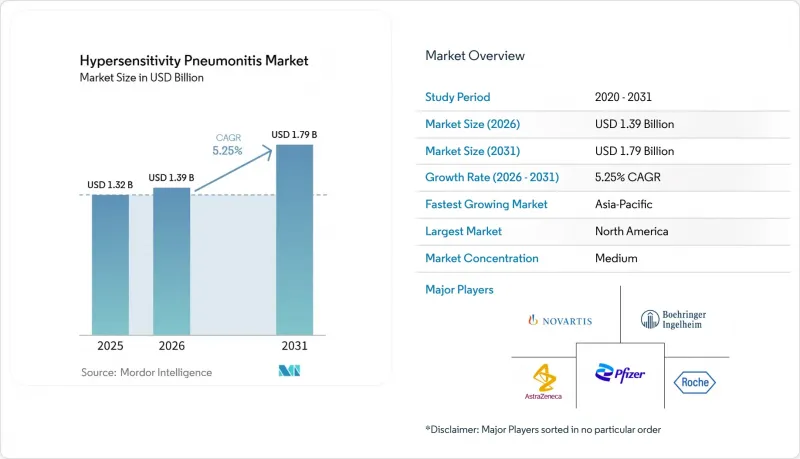
본 보고서는 질환 유형별(급성, 아급성, 만성), 진단법별(영상 진단, 임상 검사, 기관지경 검사/BAL, 생검), 치료법별(코르티코스테로이드, 면역억제제, 항섬유화제, 지지 요법), 투여 경로별(경구, 주사, 흡입), 최종 사용자별(병원, 전문 클리닉, 진단 검사 기관, 학술 기관), 지역별(북미, 유럽, 아시아태평양, 중동 및 아프리카, 남미)로 분류되어 있습니다. 시장 규모 예측은 달러(USD) 기준입니다.
세계의 과민성 폐렴 시장 동향 및 인사이트
섬유화형 과민성 폐렴으로 인해 장기 치료 수요 증가
섬유화형 과민성 폐렴은 과민성 폐렴 시장에서 장기 치료 수요를 확대시키고 있습니다. 이는 임상의들이 현재 이 질환을 예후와 치료 경로가 다른 독자적인 병태로 관리하고 있기 때문입니다. 과민성 폐렴은 진행성 섬유화성 간질성 폐질환(PF-ILD)을 대상으로 한 INBUILD 코호트의 26%를 차지하고 있으며, 이는 보다 광범위한 의료 현장에서 이 질환의 치료에 막대한 자원이 필요함을 여실히 보여주고 있습니다. 일본에서 실시된 닌테다니브의 2년간 시판 후 조사에서는 과민성 폐렴이 PF-ILD 코호트의 10.05%를 차지했으며, 이들 환자의 73.17%가 약물 이상반응을 경험한 것으로 나타나, 이 치료군이 적극적으로 관리되고 면밀히 모니터링되고 있음을 보여줍니다. 독일의 2025년판 S2k 가이드라인에서는 진행성 섬유화형 과민성 폐렴에 대한 항섬유화 요법이 권장되었으며, 직장에서의 노출에 대한 체계적인 감시가 추가되었습니다. 이에 따라 해당 시장의 처방 기준이 상향 조정되어 인근 유럽 국가들에도 영향을 미칠 가능성이 있습니다.
진행성 섬유화성 간질성 폐질환(PF-ILD) 치료의 확산으로 과민성 폐렴 시장 확대
과민성 폐렴 시장은 확대되고 있습니다. 이는 당초 특발성 폐섬유증을 위해 개발된 약제가 현재는 더 광범위한 ‘진행성 폐섬유증’이라는 적응증 하에서 사용되고 있으며, 그 안에서 과민성 폐렴이 명확한 기저 질환으로 자리매김하고 있기 때문입니다. 베링거 인겔하임의 네랑고미라스트는 2025년 12월 진행성 폐섬유증에 대해 FDA 승인을 획득하여, 이 치료 영역의 항섬유화 요법에 있어 큰 진전을 이루었습니다. FIBRONEER-ILD 임상시험에서 네랑고미라스트 9mg 투여군은 52주 시점에서 위약군에 비해 FVC(1초량) 유지 측면에서 83mL의 우위를 보였으며, 과민성 폐렴 하위군에서도 일관된 치료 효과가 확인되었습니다. 이 제품은 2026년 5월 유럽의약품청(CHMP)으로부터 긍정적인 의견을 받았으며, 2026년 7월에는 영국 의약품규제청(MHRA)의 승인을 획득하여 1년 이내에 여러 지역에서 승인 절차를 완료했습니다. 과민성 폐렴을 하위 그룹으로 포함하는 진행성 폐섬유증에 관한 새로운 임상시험이 실시될 때마다 보험사에 대한 설득력이 높아지며, 과민성 폐렴 시장 전체에서 더 가치 있는 치료법의 도입이 촉진됩니다.
단일한 진단 골드 스탠다드가 존재하지 않아 치료 시작이 지연되고 있습니다.
널리 인정받는 진단상의 골드 스탠다드가 존재하지 않기 때문에 과민성 폐렴 시장에서 치료 시작이 지연되고 있습니다. 이는 임상의가 치료 계획을 확정하기 전에 서로 다른 진단 체계에 따라 환자를 재분류하는 경우가 많기 때문입니다. 2020년 ATS, JRS, ALAT 기준, ACCP 프레임워크 및 2025년 한국 지침은 민감도와 특이도에 차이가 있어, 특히 의료 자원이 제한된 환경에서 의료 기관 간에 편차가 발생하고 있습니다. 임상의는 확신도 높은 진단을 위해 기관지경 검사나 기관지폐포 세척을 필요로 하는 경우가 많지만, 이러한 침습적 검사는 3차 의료기관인 간질성 폐질환 전문센터 외에서는 일관되게 이용하기 어려울 수 있습니다. 표준화되지 않은 ELISA법이나 화학발광법, 지역 고유의 항원 패널로 인한 혈청학적 검사의 불일치는 의뢰까지의 기간을 더욱 연장시키고, 전문의에게 의뢰하는 것을 지연시키며, 가이드라인에 따른 치료로의 전환을 늦추고 있습니다.
부문 분석
2025년, 만성 과민성 폐렴은 질환 유형 부문의 48.65%를 차지했으며, 과민성 폐렴 시장에서 1위를 기록했습니다. 이러한 우위는 치료 기간이 길고, 영상 진단, 경과 관찰, 항원 회피 지도, 코르티코스테로이드, 면역억제제, 항섬유화제 사용 빈도가 높기 때문이었습니다. 급성 및 아급성 사례도 여전히 중요하며, 만성 섬유화 사례에 비해 회복 가능성이 높음에도 불구하고 진단 업무와 경과 관찰을 지속적으로 발생시키고 있습니다. 2025년 『PLOS ONE』지에 게재된 연구에 따르면, 일본 이외의 지역에서는 가정 내 곰팡이 노출이 간과되는 경우가 많으며, 일부 아급성 및 만성 사례는 임상의가 환경 이력을 더 상세하게 확인할 때까지 특정되지 않았던 것으로 나타났습니다.
급성 과민성 폐렴은 2031년까지 연평균 성장률(CAGR) 6.93%로 확대될 것으로 예측되며, 과민성 폐렴 시장에서 가장 빠르게 성장하는 질환 하위 유형이 될 전망입니다. 보다 체계적인 직업 건강 검진의 실시로 인해, 이전에는 바이러스성 질환이나 단기적인 호흡기 자극으로 취급되던 경증 및 중등도의 급성 사례가 식별되고 있습니다. 일본 전역을 대상으로 한 연구에 따르면, 주로 급성 및 아급성 임상 양상을 보이는 가습기 폐는 2011년부터 2021년에 걸쳐 증가 추세를 보였으며, 특히 코로나19 유행 기간 중에는 실내 체류 시간과 가습기 사용이 증가함에 따라 현저한 증가가 관찰되었습니다. 또한, 섬유화형 및 비섬유화형 과민성 폐렴에 관한 일본 최초의 전국적 유병률 추산치가 발표됨에 따라, 해당 지역의 사례 수 및 치료 수요를 계획하기 위한 과민성 폐렴 시장의 보다 견고한 기반이 마련되었습니다.
2025년 시점에서 영상 진단은 과민성 폐렴 시장의 진단 분야 시장 규모 중 57.23%를 차지했으며, 가장 큰 진단 부문이 되었습니다. HRCT는 섬유성 패턴과 비섬유성 패턴을 구별하고 감별 진단의 범위를 좁히는 데 중심적인 역할을 했기 때문에 주요 지침에서 계속해서 1순위 검사법으로 자리매김했습니다. 2025년 『Diagnostics』지에 게재된 연구에 따르면, 호기 시 HRCT, 특히 공기 저류 평가는 과민성 폐렴의 다학제적 진단을 뒷받침하는 가장 유력한 단일 방사선학적 소견 중 하나임이 밝혀졌습니다. 영상 검사 결과가 확정적이지 않은 경우에는 기관지경 검사 및 기관지폐포 세척이 여전히 중요하며, 반면 폐생검은 육아종 확인이 필요한 특정 증례로 제한되었습니다.
임상 검사 시장은 2031년까지 연평균 성장률(CAGR) 8.67%로 확대될 것으로 예측되며, 과민성 폐렴 시장에서 가장 빠르게 성장하는 진단 하위 부문이 될 전망입니다. 이러한 성장은 혈청 특이적 IgG 패널, KL-6 검사, 그리고 비침습적 진단을 지원하는 광범위한 단백질체학 접근법에 의해 주도되고 있습니다. 2025년 『Respiratory Research』 저널에 발표된 연구에 따르면, 엑소좀 유래 KL-6, CAPN2 및 SP-B를 조합한 모델은 간질성 폐질환의 아형 분류에서 AUC 0.987을 달성하여, 향후 과민성 폐렴에 특화된 검사법에 대한 강력한 벤치마크를 확립했습니다. 또한, 2026년 프리프린트에서는 섬유화를 동반한 과민성 폐렴에서 임상 경과가 서로 다른 두 가지 혈액 기반 면역 대사 엔도유형이 확인되었습니다. 이는 과민성 폐렴 시장에서 검사 도구가 광범위한 선별 검사에서 보다 정밀한 질환 페노타이핑으로 전환되어 갈 것임을 시사합니다.
지역별 분석
2025년, 북미는 41.56%의 점유율을 차지하며 과민성 폐렴 시장에서 가장 규모가 큰 지역 블록이 되었습니다. 이 지역은 간질성 폐질환에 관한 탄탄한 인프라, 전문의에 대한 접근 용이성, 그리고 많은 공적 의료 제도보다 효과적으로 첨단 치료를 지원하는 보험 환급 제도의 혜택을 누리고 있었습니다. 미국은 계속해서 이 지역 최대의 국내 시장으로, 보고된 유병률은 연간 10만 명당 1.28-1.94건의 신규 사례입니다. 또한, 미국 사례의 50%에서는 여전히 항원이 확인되지 않아, 이는 재진료, 영상 진단 및 전문의에 의한 재평가를 촉진하고 있습니다. 2025년 12월 네란디미라스트가 미국에서 승인된 점과 맞물려, 북미는 과민성 폐렴 시장에서 항섬유화 요법으로의 전환을 주도하는 최전선에 위치하게 되었습니다.
유럽은 독일, 영국, 프랑스를 필두로 과민성 폐렴 시장에서 두 번째로 큰 규모를 자랑하는 지역 클러스터를 형성했습니다. 2025년 1월 독일에서 제정된 S2k 지침은 진행성 섬유화를 동반한 과민성 폐렴에 대한 항섬유화 요법의 사용을 공식적으로 인정하고, 직장에서의 노출 감시를 강화했습니다. 이는 인접 국가들의 처방 기준에 영향을 미칠 가능성이 있습니다. 영국에서는 2026년 7월 MHRA가 네란미라스트를 승인함에 따라, 특발성 폐섬유증 및 진행성 폐섬유증(과민성 폐렴 관련 섬유증 포함)에 대한 공식적인 치료 경로가 확립되었습니다. 또한, 스페인의 REGINHA 레지스트리도 현지 치료 성과를 밝히는 데 기여하여 처방 실무 및 후속 보험 적용 협상을 뒷받침했습니다.
아시아태평양은 2031년까지 연평균 성장률(CAGR) 9.56%를 나타낼 것으로 예측되며, 과민성 폐렴 시장에서 가장 빠르게 성장하는 지역이 될 전망입니다. 일본은 계속해서 주요 성장 동력으로 작용하고 있습니다. 일본에서 최초로 실시된 전국 역학 조사에 따르면, 섬유화형 과민성 폐렴의 유병률은 10만 명당 6.3명, 비섬유화형의 유병률은 10만 명당 3.6명으로 추정되며, 곰팡이 및 조류에 대한 노출과 관련된 남부 지역에서 현저한 집중 현상이 관찰되었습니다. 또한, 일본의 2026년 시판 후 조사 결과에서도 과민성 폐렴을 포함한 진행성 섬유화 질환의 치료 프로그램에서 닌테다니브가 실제 임상 현장에서 사용되고 있음이 확인되었습니다. 한국에서는 2011년부터 2020년까지의 발병률이 인구 10만 명당 1.14-2.16명으로 보고되었으며, 2025년 지침에서는 섬유화성 질환에 대한 항섬유화제 사용이 조건부로 권장되게 되었습니다. 중동 및 아프리카 및 남미는 많은 국가에서 전문의 접근성, 보험 급여 범위, 그리고 직업적 모니터링이 여전히 불균일하기 때문에 장기적인 기회로 남아 있을 것으로 보입니다.
기타 혜택 :
- 엑셀 형식 시장 예측(ME) 시트
- 3개월간의 애널리스트 지원
자주 묻는 질문
목차
제1장 서론
제2장 조사 방법
제3장 주요 요약
제4장 시장 구도
제5장 시장 규모 및 성장 예측
제6장 경쟁 구도
제7장 시장 기회 및 향후 전망
AJY 26.08.11According to Mordor Intelligence, the hypersensitivity pneumonitis market size was valued at USD 1.32 billion in 2025 and is estimated to grow from USD 1.39 billion in 2026 to reach USD 1.79 billion by 2031, at a CAGR of 5.25% during the forecast period (2026-2031).
This report is Segmented by Disease Type (Acute, Subacute, Chronic), Diagnosis (Imaging, Lab Testing, Bronchoscopy/BAL, Biopsy), Therapy (Corticosteroids, Immunosuppressants, Antifibrotics, Supportive Care), Route (Oral, Injectable, Inhaled), End User (Hospitals, Specialty Clinics, Diag. Labs, Academic Institutes), and Geography (N. America, Europe, APAC, MEA, S. America). Forecasts in Value (USD).
Global Hypersensitivity Pneumonitis Market Trends and Insights
Fibrotic Hypersensitivity Pneumonitis Expands Long-Term Treatment Need
Fibrotic hypersensitivity pneumonitis is expanding long-term treatment need in the hypersensitivity pneumonitis market, as clinicians now manage it as a distinct disease course with a different prognosis and treatment pathway. Hypersensitivity pneumonitis represented 26% of the INBUILD population for progressive fibrosing interstitial lung disease, highlighting its significant treatment resource requirement within the broader care setting. In Japan's two-year nintedanib post-marketing surveillance, hypersensitivity pneumonitis accounted for 10.05% of the PF-ILD cohort, and 73.17% of these patients experienced adverse drug reactions, indicating an active and closely monitored treatment group. Germany's 2025 S2k guideline endorsed antifibrotic therapy for progressive fibrotic hypersensitivity pneumonitis and added structured workplace exposure surveillance, raising prescribing standards in that market and potentially influencing nearby European countries.
Progressive Fibrosing ILD Treatment Spillover Broadens the Hypersensitivity Pneumonitis Market
The hypersensitivity pneumonitis market is widening because drugs initially developed for idiopathic pulmonary fibrosis are now used under the broader progressive pulmonary fibrosis label, where hypersensitivity pneumonitis is an explicit underlying diagnosis. Boehringer Ingelheim's nerandomilast received FDA approval in December 2025 for progressive pulmonary fibrosis, marking a major step for antifibrotic therapy in this treatment space. The FIBRONEER-ILD trial showed that nerandomilast 9 mg delivered an 83 mL advantage over placebo in FVC preservation at week 52, with a consistent treatment effect in the hypersensitivity pneumonitis subgroup. The same product received a positive CHMP opinion in May 2026 and UK MHRA approval in July 2026, creating a multi-region regulatory pathway within a single year. Each new progressive pulmonary fibrosis trial that includes hypersensitivity pneumonitis as a subgroup strengthens payer arguments and supports higher-value therapy adoption across the hypersensitivity pneumonitis market.
No Single Diagnostic Gold Standard Slows Treatment Initiation
The absence of a widely accepted diagnostic gold standard slows treatment initiation in the hypersensitivity pneumonitis market, as clinicians often reclassify patients across different diagnostic systems before finalizing care plans. The 2020 ATS, JRS, and ALAT criteria, the ACCP framework, and the 2025 Korean guideline differ in sensitivity and specificity, creating variation across centers, particularly in lower-resource settings. Clinicians often require bronchoscopy and bronchoalveolar lavage for high-confidence diagnosis, but these invasive procedures are not consistently available outside tertiary interstitial lung disease centers. Inconsistent serological testing, driven by non-standardized ELISA and chemiluminescence methods and geography-specific antigen panels, further extends referral timelines, delays specialist engagement, and slows movement into guideline-based treatment.
Other drivers and restraints analyzed in the detailed report include:
- High Diagnostic Uncertainty Sustains Multidisciplinary Decision-Making
- Occupational Surveillance in Farming and Bird-Related Settings
- Reimbursement Pressure Favors Low-Cost Steroid Regimens
For complete list of drivers and restraints, kindly check the Table Of Contents.
Segment Analysis
Chronic hypersensitivity pneumonitis held 48.65% of the disease-type segment in 2025, giving it the leading position in the hypersensitivity pneumonitis market. Its lead came from longer care episodes and higher use of imaging, follow-up, antigen avoidance counseling, corticosteroids, immunosuppressants, and antifibrotics. Acute and subacute disease also remained important, as they continued to generate diagnostic work and monitored follow-up despite better reversibility than chronic fibrotic cases. A 2025 PLOS ONE study showed that home mold exposure was often missed outside Japan, indicating that some subacute and chronic cases were not identified until clinicians reviewed environmental history in more detail.
Acute hypersensitivity pneumonitis is projected to grow at a 6.93% CAGR through 2031, making it the fastest-expanding disease subtype in the hypersensitivity pneumonitis market. More structured occupational screening is identifying mild and moderate acute cases that were previously treated as viral illness or short-term respiratory irritation. A nationwide Japanese study found that humidifier lung, mainly acute and subacute in phenotype, showed a rising trend during 2011-2021, with a notable increase during the COVID-19 period as indoor time and humidifier use increased. Japan's first national prevalence estimates for fibrotic and non-fibrotic hypersensitivity pneumonitis also gave the hypersensitivity pneumonitis market a stronger base for planning case volume and treatment demand in the region.
Imaging accounted for 57.23% of the hypersensitivity pneumonitis market size within diagnosis in 2025, making it the largest diagnostic segment. HRCT remained the first-line tool across major guidelines because it was central to separating fibrotic from non-fibrotic patterns and narrowing the differential diagnosis. A 2025 study in Diagnostics found that expiratory HRCT, especially air trapping assessment, was one of the strongest single radiologic signals supporting a multidisciplinary diagnosis of hypersensitivity pneumonitis. Bronchoscopy and bronchoalveolar lavage remained important when imaging was inconclusive, while lung biopsy remained limited to selected cases requiring granuloma identification.
Laboratory testing is forecast to grow at an 8.67% CAGR through 2031, making it the fastest-growing diagnostic sub-segment in the hypersensitivity pneumonitis market. Growth is being driven by serum-specific IgG panels, KL-6 testing, and broader proteomic approaches that support less invasive diagnosis. A 2025 Respiratory Research study reported that a combined exosomal KL-6, CAPN2, and SP-B model achieved an AUC of 0.987 in interstitial lung disease subtyping, setting a strong benchmark for future hypersensitivity pneumonitis-focused assays. A 2026 preprint also identified two blood-based immune-metabolic endotypes in fibrotic hypersensitivity pneumonitis with different clinical trajectories, suggesting that laboratory tools will move from broad screening toward more precise disease phenotyping in the hypersensitivity pneumonitis market.
Complete Report Scope:
- By Disease Type
- Acute Hypersensitivity Pneumonitis
- Subacute Hypersensitivity Pneumonitis
- Chronic Hypersensitivity Pneumonitis
- By Diagnosis
- Imaging
- Laboratory Testing
- Bronchoscopy and Bronchoalveolar Lavage
- Lung Biopsy
- By Therapy
- Corticosteroids
- Immunosuppressants
- Antifibrotics
- Supportive Care
- By Route of Administration
- Oral
- Injectable
- Inhaled
- By End User
- Hospitals
- Specialty Clinics
- Diagnostic Laboratories
- Academic and Research Institutes
- By Geography
- North America
- United States
- Canada
- Mexico
- Europe
- Germany
- United Kingdom
- France
- Italy
- Spain
- Rest of Europe
- Asia-Pacific
- China
- India
- Japan
- Australia
- South Korea
- Rest of Asia-Pacific
- Middle East and Africa
- GCC
- South Africa
- Rest of Middle East and Africa
- South America
- Brazil
- Argentina
- Rest of South America
- North America
Geography Analysis
North America held a 41.56% share in 2025, making it the largest regional block in the hypersensitivity pneumonitis market. The region benefited from strong interstitial lung disease infrastructure, high specialist access, and reimbursement pathways that supported advanced therapies more effectively than many public systems. The United States remained the largest national market in the region, with reported incidence ranging from 1.28 to 1.94 new cases per 100,000 persons annually. In addition, 50% of U.S. cases still had an unidentified antigen, supporting repeat referrals, imaging, and specialist reviews. Nerandomilast's U.S. approval in December 2025 also positioned North America at the forefront of the antifibrotic shift in the hypersensitivity pneumonitis market.
Europe formed the second-largest regional cluster in the hypersensitivity pneumonitis market, led by Germany, the United Kingdom, and France. Germany's S2k guideline in January 2025 formalized antifibrotic use in progressive fibrotic hypersensitivity pneumonitis and reinforced workplace exposure surveillance, which may influence prescribing standards across nearby countries. In the United Kingdom, MHRA approval for nerandomilast in July 2026 created a formal treatment path for idiopathic pulmonary fibrosis and progressive pulmonary fibrosis, including hypersensitivity pneumonitis-related fibrosis. Spain's REGINHA registry also helped define local outcomes, supporting prescribing practice and later formulary negotiations.
Asia-Pacific is forecast to grow at a 9.56% CAGR through 2031, making it the fastest-growing geography in the hypersensitivity pneumonitis market. Japan remains a key driver, as its first national epidemiological survey estimated fibrotic hypersensitivity pneumonitis prevalence at 6.3 per 100,000 and non-fibrotic prevalence at 3.6 per 100,000, with notable southern clustering linked to mold and bird exposure. Japan's 2026 post-marketing surveillance results also confirmed real-world nintedanib use in progressive fibrosing disease programs that included hypersensitivity pneumonitis. South Korea reported incidence rates of 1.14 to 2.16 per 100,000 persons between 2011 and 2020, and its 2025 guideline added conditional support for antifibrotics in fibrotic disease. The Middle East and Africa and South America will remain longer-term opportunities, as specialist access, reimbursement depth, and occupational monitoring remain uneven across many countries.
- Abbott Laboratories
- Abbvie
- Amgen
- AstraZeneca
- aTyr Pharma, Inc.
- Boehringer Ingelheim
- Bristol-Myers Squibb
- Eli Lilly and Company
- Roche
- Gilead Sciences
- Johnson & Johnson
- Merck
- Novartis
- Pfizer
- Sandoz Group AG
- Sanofi
- Siemens Healthineers
- Sun Pharmaceuticals Industries
- Sysmex
- Thermo Fisher Scientific
Additional Benefits:
- The market estimate (ME) sheet in Excel format
- 3 months of analyst support
TABLE OF CONTENTS
1 INTRODUCTION
- 1.1 Study Assumptions and Market Definition
- 1.2 Scope of the Study
2 RESEARCH METHODOLOGY
3 EXECUTIVE SUMMARY
4 MARKET LANDSCAPE
- 4.1 Market Overview
- 4.2 Market Drivers
- 4.2.1 High Diagnostic Uncertainty Sustains Multidisciplinary Referral Volumes
- 4.2.2 Fibrotic Hypersensitivity Pneumonitis Expands Long-Term Disease Management Need
- 4.2.3 Progressive Fibrosing ILD Treatment Spillover Broadens Pharmacologic Demand
- 4.2.4 Occupational Surveillance in Farming and Bird-Related Workforces Improves Case Detection
- 4.2.5 Indoor Mold, Humidifier, and HVAC Exposure Screening Raises Environmental Case Finding
- 4.3 Market Restraints
- 4.3.1 No Single Diagnostic Gold Standard Slows Treatment Initiation
- 4.3.2 Antigen Identification Failure Limits Etiology-Directed Therapy
- 4.3.3 Weak Prospective Evidence Base Constrains Therapy Standardization
- 4.3.4 Reimbursement Pressure Favors Low-Cost Steroid Regimens and Generic Substitution
- 4.4 Value/Supply Chain Analysis
- 4.5 Regulatory Landscape
- 4.6 Technological Outlook
- 4.7 Porter's Five Forces Analysis
- 4.7.1 Threat of New Entrants
- 4.7.2 Bargaining Power of Suppliers
- 4.7.3 Bargaining Power of Buyers
- 4.7.4 Threat of Substitutes
- 4.7.5 Industry Rivalry
5 MARKET SIZE AND GROWTH FORECASTS (VALUE, USD)
- 5.1 By Disease Type
- 5.1.1 Acute Hypersensitivity Pneumonitis
- 5.1.2 Subacute Hypersensitivity Pneumonitis
- 5.1.3 Chronic Hypersensitivity Pneumonitis
- 5.2 By Diagnosis
- 5.2.1 Imaging
- 5.2.2 Laboratory Testing
- 5.2.3 Bronchoscopy and Bronchoalveolar Lavage
- 5.2.4 Lung Biopsy
- 5.3 By Therapy
- 5.3.1 Corticosteroids
- 5.3.2 Immunosuppressants
- 5.3.3 Antifibrotics
- 5.3.4 Supportive Care
- 5.4 By Route of Administration
- 5.4.1 Oral
- 5.4.2 Injectable
- 5.4.3 Inhaled
- 5.5 By End User
- 5.5.1 Hospitals
- 5.5.2 Specialty Clinics
- 5.5.3 Diagnostic Laboratories
- 5.5.4 Academic and Research Institutes
- 5.6 By Geography
- 5.6.1 North America
- 5.6.1.1 United States
- 5.6.1.2 Canada
- 5.6.1.3 Mexico
- 5.6.2 Europe
- 5.6.2.1 Germany
- 5.6.2.2 United Kingdom
- 5.6.2.3 France
- 5.6.2.4 Italy
- 5.6.2.5 Spain
- 5.6.2.6 Rest of Europe
- 5.6.3 Asia-Pacific
- 5.6.3.1 China
- 5.6.3.2 India
- 5.6.3.3 Japan
- 5.6.3.4 Australia
- 5.6.3.5 South Korea
- 5.6.3.6 Rest of Asia-Pacific
- 5.6.4 Middle East and Africa
- 5.6.4.1 GCC
- 5.6.4.2 South Africa
- 5.6.4.3 Rest of Middle East and Africa
- 5.6.5 South America
- 5.6.5.1 Brazil
- 5.6.5.2 Argentina
- 5.6.5.3 Rest of South America
- 5.6.1 North America
6 COMPETITIVE LANDSCAPE
- 6.1 Market Concentration
- 6.2 Market Share Analysis
- 6.3 Company Profiles (includes Global Level Overview, Market Level Overview, Core Segments, Financials as available, Strategic Information, Market Rank/Share, Products and Services, Recent Developments)
- 6.3.1 Abbott Laboratories
- 6.3.2 AbbVie Inc.
- 6.3.3 Amgen Inc.
- 6.3.4 AstraZeneca plc
- 6.3.5 aTyr Pharma, Inc.
- 6.3.6 Boehringer Ingelheim International GmbH
- 6.3.7 Bristol-Myers Squibb Company
- 6.3.8 Eli Lilly and Company
- 6.3.9 F. Hoffmann-La Roche Ltd.
- 6.3.10 Gilead Sciences, Inc.
- 6.3.11 Johnson and Johnson
- 6.3.12 Merck & Co., Inc.
- 6.3.13 Novartis AG
- 6.3.14 Pfizer Inc.
- 6.3.15 Sandoz Group AG
- 6.3.16 Sanofi S.A.
- 6.3.17 Siemens Healthineers AG
- 6.3.18 Sun Pharmaceutical Industries Limited
- 6.3.19 Sysmex Corporation
- 6.3.20 Thermo Fisher Scientific Inc.
7 MARKET OPPORTUNITIES AND FUTURE OUTLOOK
- 7.1 White-space and Unmet-Need Assessment


