|
시장보고서
상품코드
2099930
네트워킹 및 통신 장비용 DRAM 시장 : 점유율 분석, 업계 동향 및 통계, 성장 예측(2026-2031년)DRAM For Networking and Telecom Equipment - Market Share Analysis, Industry Trends & Statistics, Growth Forecasts (2026 - 2031) |
||||||
 Mordor Intelligence
Mordor Intelligence에 의하면, 네트워킹 및 통신 장비용 DRAM 시장 규모는 2025년에 32억 달러, 2026년에 35억 달러가 되어, 2031년까지 56억 달러에 이를 것으로 예측되며, 2026년부터 2031년까지 CAGR 10.1%로 성장할 전망입니다.
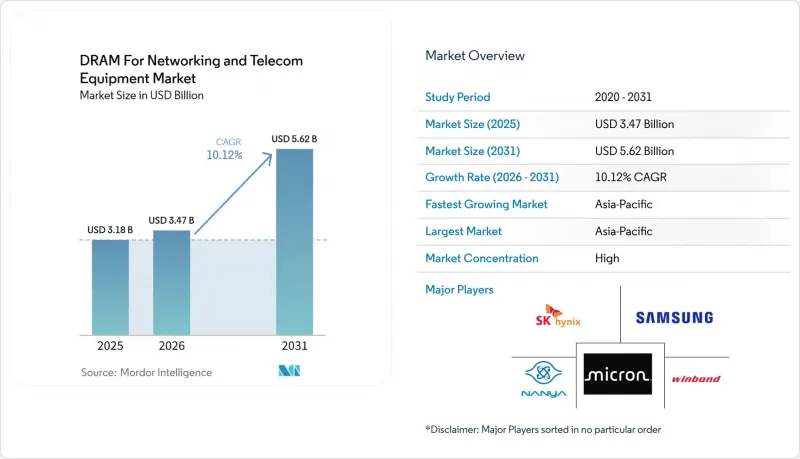
본 보고서는 유형별(SDRAM, DDR, DDR2, DDR3, DDR4, DDR5), 제품 형태별(DRAM IC, DRAM 모듈(UDIMM, RDIMM/LRDIMM)), 폼 팩터별(임베디드형 DRAM, 메모리 모듈), 기능별(표준 DRAM, 저전력 DRAM), 지역별(북미, 유럽, 아시아태평양, 기타 지역)로 분류되어 있습니다. 시장 전망은 금액(달러) 기준으로 제시되어 있습니다.
네트워킹 및 통신 장비용 DRAM의 세계 동향 및 인사이트
5G 및 첨단 네트워크의 확대 전개
5G 및 첨단 네트워크의 확대 전개에 따라, 네트워크·통신 장비용 DRAM 시장에서 라우터, 스위치, 베이스밴드 유닛, 엣지 컴퓨팅 노드 전반에 걸쳐 메모리 수요가 증가하고 있습니다. 이러한 변화는 이전 모바일 세대보다 더욱 두드러집니다. 그 이유는 Open RAN 및 가상화된 기능이 서버형 아키텍처에 크게 의존하고 있어, 통신 인프라에 DRAM 고밀도화가 진행되고 있기 때문입니다. 이러한 변화로 인해 소프트웨어 워크로드와 전송 기능을 동시에 지원해야 하는 상용 플랫폼에 메모리 도입이 확대되고 있으며, 출하 대수가 본격적으로 증가하기 전부터 컨텐츠 가치를 높이고 있습니다. KDDI는 2025년 2월 분산형 디스어그리게이트 백본 라우터 클러스터에 대한 기술 검증을 완료하고, 2026년에 대규모 상용화를 시작했습니다. 이는 통신 사업자의 백본 업그레이드가 노드당 메모리 수요를 어떻게 증가시키고 있는지를 보여줍니다. 3GPP 및 ETSI와 같은 표준화 기구는 계속해서 플랫폼 요구 사항을 수립하고 있으며, 이에 따라 네트워킹 및 통신 장비용 DRAM 시장에서 공급업체의 인증은 장기적인 네트워크 투자 주기와 밀접하게 연계된 상태가 지속되고 있습니다. 통신 사업자들이 5G 커버리지 확대와 네트워크 지능화를 추진함에 따라, 통신 업계용 DDR4 및 DDR5 제품 포트폴리오를 보유한 공급업체는 예측 기간 동안 보다 안정적인 설계 채택을 확보할 수 있는 입장에 있습니다.
라우터 및 스위치의 메모리 밀도 요구 사항 증가
라우터 및 스위치의 메모리 밀도 요구 사항이 증가함에 따라, 네트워킹 및 통신 장비용 DRAM 시장에서 대용량 구성의 가치가 높아지고 있습니다. 네트워크 장비는 현재 여전히 엄격한 신뢰성 및 열적 제약에 직면한 하드웨어 플랫폼 내에서 더 대규모의 라우팅 테이블, 더 많은 소프트웨어 제어 기능, 그리고 AI를 활용한 트래픽 관리에 대응해야 합니다. 이러한 압박으로 인해 벤더들은 여러 세대의 DRAM을 동시에 지원해야 하는 상황에 놓여 있습니다. 이는 새로운 플랫폼이 대역폭이나 용량 측면에서 진화하더라도, 고객이 이미 도입한 시스템에서 여전히 연속성을 필요로 하기 때문입니다. 브로드컴은 2026년 6월, DDR4, DDR5, LPDDR4 및 LPDDR5를 지원하는 BCM677x 제품군을 출시했습니다. 이는 차세대 라우터 및 5G 고정 무선 액세스 장비에서 유연한 메모리 선택의 필요성을 반영한 것입니다. 따라서 네트워킹 및 통신 장비용 DRAM 시장은 출하량 증가뿐만 아니라 용량 확대와 아키텍처 유연성이라는 두 가지 측면에서 혜택을 받고 있습니다. 현장 신뢰성을 저해하지 않으면서 고밀도 모듈 및 임베디드 설계 인증을 획득할 수 있는 공급업체는 단순한 최고 속도보다 가동 시간이나 호환성이 여전히 중시되는 리프레시 주기에서 계속해서 지지를 받을 가능성이 높습니다.
HBM 및 AI 서버에 대한 공급 우선
HBM 및 AI 서버에 대한 공급 우선으로 인해, 수요의 펀더멘털은 견조함에도 불구하고 네트워킹 및 통신 장비용 DRAM 시장에 대한 공급 속도가 제한되고 있습니다. 문제는 네트워크 관련 지출이 부진한 것이 아니라, 더 높은 가격 책정과 단기적인 성장이 예상되는 AI 메모리 제품으로 첨단 제조 자원이 재분배되고 있다는 점에 있습니다. 삼성은 2026년 2월 HBM4 양산을 시작했으며, 통신 장비 구매자들이 여전히 기존 DRAM 제품 라인을 필요로 하던 시기에 업계의 관심이 고대역폭 메모리 프로그램으로 더욱 집중되는 결과를 낳았습니다. 최첨단 생산 능력이 그 방향으로 더욱 이동함에 따라, 통신 장비 구매자들은 네트워킹 및 통신 장비용 DRAM 시장 전체에서 기존 DDR4 및 DDR5 제품군의 가용성이 더욱 부족해지는 상황에 직면하고 있습니다. 그 결과, 계획 주기가 장기화되고 조기 공급 확보에 대한 압박이 커지면서, 폭넓은 제품 로드맵과 강력한 할당 관리 능력을 갖춘 주요 공급업체에 대한 의존도가 높아지고 있습니다. 이러한 제약은 여러 플랫폼 세대에 걸쳐 안정적인 조달이 필요한 장비 제조업체에게 가장 중요한 문제가 됩니다. 메모리 공급이 부족해질 때마다 인증된 시스템을 쉽게 재설계할 수 없기 때문입니다.
부문 분석
2025년, DDR4는 네트워킹 및 통신 장비용 DRAM 시장 점유율의 58.2%를 차지했습니다. 이는 DDR4공급 상황과 비용 관리를 바탕으로 인증된 라우터, 스위치, 기지국 플랫폼에 걸친 도입 기반의 규모를 반영한 것입니다. 이러한 우위는 생태계의 성숙도, 전환 위험이 낮다는 점, 그리고 많은 통신 사업자의 플랫폼이 여전히 적극적인 아키텍처 변경보다 지속성을 우선시하고 있다는 사실에서 기인합니다. SDRAM, DDR, DDR2, DDR3 등 구세대 제품은 유지보수 프로그램이나 수명 주기 연장에 국한되어 있었으며, 2026년 플랫폼 계획에 포함된 신규 설계 프로젝트와는 거의 관련이 없었습니다. DDR5는 2031년까지 연평균 성장률(CAGR) 11.3%로 확대될 것으로 예측되며, 이는 벤더들이 보다 광범위한 소프트웨어 워크로드, 고속 버퍼링 및 고급 제어 기능을 준비하는 가운데 신제품 개발이 어떤 방향으로 나아가고 있는지를 보여줍니다. 그 결과, 네트워킹 및 통신 장비용 DRAM 시장에서는 향후 설계 동향이 더욱 고도화된 방향으로 전환되고 있음에도 불구하고, 여전히 DDR4 출하량에서 가치의 대부분을 창출하고 있는 구조입니다.
마이크론은 2026년 5월, 9,200 MT/s의 256GB DDR5 RDIMM 샘플 공급을 시작했습니다. 이번 출시로 장비 설계자들에게 차세대 제어 플레인 및 서버 기반 통신 워크로드를 위한 명확한 지침이 제공되었습니다. 2025년 12월 SK하이닉스의 인증 획득 역시, 긴 인증 절차와 고밀도 확장이 필요한 통신 관련 플랫폼에서 엔터프라이즈급 DDR5 도입 준비에 대한 폭넓은 신뢰를 뒷받침했습니다. 그러나 통신 사업자들은 장비의 수명을 길게 설정하고 플랫폼 전환이 승인되기 전에 철저한 테스트를 수행하기 때문에 이 분야의 전환은 하이퍼스케일 서버보다 더디게 진행되고 있습니다. 그 결과, DDR4와 DDR5를 모두 지원할 수 있는 공급업체가 네트워킹 및 통신 장비용 DRAM 시장에서 계속해서 유리한 입지를 유지하는 긴 중복 기간이 발생하게 됩니다. 또한, 이미 도입된 하드웨어 및 조달 정책의 관점에서 볼 때, 급격한 교체보다는 질서 있는 전환이 여전히 우선시되므로, 설계 활동의 동향이 시사하는 것보다 시장 점유율의 주도권 이동은 완만할 것으로 보입니다.
2025년에는 DRAM IC가 74.2%의 점유율을 차지하고 있으며, 이는 네트워킹 및 통신 장비용 DRAM 시장에서 직접 칩 통합이 여전히 대부분의 하드웨어 설계의 기반이 되고 있음을 보여줍니다. 이러한 디스크리트 칩은 기판 레이아웃, 레이턴시 제어, 열 특성 및 장기간에 걸친 검증 주기가 엄격하게 관리되는 라우팅 ASIC, 스위칭 SoC 및 라인 카드에 최적입니다. DRAM 모듈은 점유율은 작지만, 통신 기능이 완전한 맞춤형 캐리어 플랫폼이 아닌 상용 서버 하드웨어로 전환되는 분야에서 그 중요성이 커지고 있습니다. RDIMM/LRDIMM은 2031년까지 연평균 성장률(CAGR) 10.5%를 나타낼 것으로 예측되며, 네트워킹 및 통신 장비용 DRAM 시장 규모의 이 부분은 Open RAN, NFV 및 가상 라우터의 도입과 밀접한 관련이 있습니다. 따라서 제품 형태의 구성은 기존 장비의 고정형 임베디드 설계와 새로운 소프트웨어 주도 아키텍처의 모듈형 서버 메모리 사이에서 뚜렷한 양극화가 나타나고 있습니다.
Innodisk는 COMPUTEX 2026에서 DDR5 8000 RDIMM, CUDIMM, CSODIMM 및 MRDIMM 12800을 전시하며, 유연한 용량 옵션이 필요한 엣지 AI 및 통신 분야 도입을 위한 보다 광범위한 모듈 로드맵을 제시했습니다. 또한, 2026년 2월에 발표된 이 회사의 CXL 애드인 카드는 모듈 주도 성장이 표준 DIMM 슬롯을 넘어, 플랫폼 재설계 요구 사항이 적고 업그레이드가 용이한 엣지 포맷으로 확대되고 있음을 보여주었습니다. 이를 통해 전문 공급업체들은 웨이퍼 규모뿐만 아니라 인증, 수명 주기 지원 및 관리된 구성 측면에서도 차별화를 꾀할 여지가 더욱 넓어집니다. 서버 기반 통신 아키텍처가 보급됨에 따라, 네트워킹 및 통신 장비 시장에서 DRAM 제품 형태에 대한 수요는 고정 기판 통합에서 보다 유연한 메모리 구성으로 계속 전환될 것입니다. 이러한 변화는 점진적으로 이루어지겠지만, 산업용 모듈 설계와 통신 사업자의 조달 규칙을 모두 이해하고 있는 공급업체에게는 분명히 유리하게 작용할 것입니다.
지역별 분석
아시아태평양은 2025년 네트워킹 및 통신 장비용 DRAM 시장 점유율의 48.2%를 차지할 것으로 예상되며, 2031년까지 연평균 성장률(CAGR) 11.3%로 가장 높은 성장률을 나타낼 것으로 전망됩니다. 이 지역은 견고한 제조거점과 대규모 통신 네트워크 구축을 모두 갖추고 있어, 네트워킹 및 통신 장비용 DRAM 시장에서 수급이 밀접하게 연결되어 있습니다. 한국은 삼성과 SK하이닉스가 폭넓은 제품 포트폴리오와 적극적인 기술 로드맵을 무기로, 통신 사업자용 및 엣지 하드웨어용 지역 메모리 공급의 핵심 역할을 계속 수행하고 있어 여전히 중심적인 위치를 차지하고 있습니다. 일본도 수요가 증가하고 있으며, KDDI가 2026년에 구축할 예정인 분산형·디스어그리게이트형 백본 라우터는 통신 사업자의 고도화된 업그레이드로 인해 백본 인프라 전체에서 노드당 메모리 요구 사항이 증가하고 있음을 보여줍니다. 이러한 현지 생산 역량의 강점과 적극적인 네트워크 현대화가 결합됨에 따라, 예측 기간 전반에 걸쳐 아시아태평양은 네트워킹 및 통신 장비용 DRAM 시장의 중심적인 위치를 계속 차지할 것입니다.
북미는 AI 지원 네트워크에 대한 투자와, 더 높은 밀도와 고속 메모리 구성을 필요로 하는 소프트웨어 주도형 통신 아키텍처에 대한 지속적인 관심에 힘입어 여전히 2위 지역 시장으로서의 지위를 유지하고 있습니다. 또한, 메모리 할당 리스크로 인해 네트워크 구축이 지연되는 것을 원치 않는 통신 사업자 및 장비 제조업체에게 공급 탄력성이 전략적 과제로 대두되고 있다는 점에서도 이 지역은 중요한 위치를 차지하고 있습니다. 마이크론(Micron)사의 2026년 DDR5 RDIMM 샘플 제공 및 LPDRAM SOCAMM2 출시는 네트워킹 및 엣지 플랫폼용 인프라 메모리 제품 개발에서 북미가 여전히 중요한 위치를 차지하고 있음을 보여줍니다. 또한, 수출 규제에 대한 논의와 공급 지속성에 대한 우려로 인해 지역별 조달 계획이 더욱 신중해지고 있으며, 이로 인해 네트워킹 및 통신 장비용 DRAM 시장에서 장기적인 공급업체와의 관계 가치가 높아지고 있습니다.
2025년에도 유럽 및 기타 지역은 시장 점유율이 비교적 낮았으나, 5G 보급 범위 확대와 기업 네트워크 업그레이드가 진행됨에 따라 네트워킹 및 통신 장비용 DRAM 시장에서 여전히 중요한 위치를 차지하고 있습니다. 유럽 수요는 통신 사업자의 현대화뿐만 아니라, 단기 주기의 일반 상품 공급이 아닌 수명이 길고 인증을 받은 메모리 부품을 필요로 하는 대규모 통신 장비 생태계에 의해 뒷받침되고 있습니다. 전 세계 기타 지역에서는 도입이 주기의 초기 단계에 있기 때문에 수요는 당장의 수량 규모보다는 비용, 공급 시기, 프로젝트 순서와 밀접하게 연관되어 있습니다. 따라서 이러한 지역은 네트워킹 및 통신 장비용 DRAM 시장에 있어 중기적인 기회가 될 것입니다. 특히 분산형 네트워크 환경에서 모듈식 및 저전력 구성의 인증 및 도입이 용이해지고 있는 점이 그 요인입니다.
기타 혜택:
- 엑셀 형식 시장 예측(ME) 시트
- 3개월간의 애널리스트 지원
자주 묻는 질문
목차
제1장 서론
제2장 조사 방법
제3장 주요 요약
제4장 시장 구도
제5장 시장 규모와 성장 예측
제6장 경쟁 구도
제7장 시장 기회와 향후 전망
JHS 26.08.11According to Mordor Intelligence, the DRAM for networking and telecom equipment market size is projected to be USD 3.2 billion in 2025, USD 3.5 billion in 2026, and reach USD 5.6 billion by 2031, growing at a CAGR of 10.1% from 2026 to 2031.
This report is Segmented by Type (SDRAM, DDR, DDR2, DDR3, DDR4, and DDR5), Product Form (DRAM IC, and DARM Modules (UDIMM, RDIMM/LRDIMM)), Form Factor (Embedded DRAM, and Memory Modules), Functionality (Standard DRAM, and Low-Power DRAM), and Geography (North America, Europe, Asia-Pacific, Rest of the World). The Market Forecasts are Provided in Terms of Value (USD).
Global DRAM For Networking and Telecom Equipment Market Trends and Insights
Growing 5G And Advanced Network Rollouts
Growing 5G and advanced network rollouts are increasing memory demand across routers, switches, baseband units, and edge compute nodes in the DRAM for networking and telecom equipment market. The change is greater than in earlier mobile generations because Open RAN and virtualized functions rely more heavily on server-style architectures, bringing higher DRAM density into telecom deployments. That shift moves more memory into commercial platforms that must support both software workloads and transport functions simultaneously, which lifts content value even before unit volume fully scales. KDDI completed technical validation of its distributed disaggregated backbone router cluster in February 2025 and began large-scale commercial deployment in 2026, showing how carrier backbone upgrades are increasing memory needs per node. Standards bodies such as 3GPP and ETSI continue to shape platform requirements, and that keeps supplier qualification closely tied to long network investment cycles across the DRAM for networking and telecom equipment market. As operators push wider 5G coverage and more network intelligence, suppliers with telecom-ready DDR4 and DDR5 portfolios are positioned to capture steadier design wins over the forecast period.
Rising Memory Density Requirements In Routers And Switches
Rising memory density requirements in routers and switches are increasing the value of higher-capacity configurations in the DRAM for networking and telecom equipment market. Network equipment now has to handle larger routing tables, more software control functions, and more AI-assisted traffic management inside hardware platforms that still face strict reliability and thermal limits. That pressure is pushing vendors to support multiple DRAM generations simultaneously, because customers still need continuity in fielded systems even as newer platforms move higher in bandwidth and capacity. Broadcom launched its BCM677x family in June 2026, supporting DDR4, DDR5, LPDDR4, and LPDDR5, reflecting the need for flexible memory choices in next-generation routers and 5G fixed wireless access equipment. The DRAM for networking and telecom equipment market is therefore benefiting from both capacity growth and architectural flexibility, rather than from shipment growth alone. Vendors that can qualify denser modules or embedded designs without disrupting field reliability are likely to remain favored in refresh cycles where uptime and compatibility still matter more than headline speed alone.
Supply Prioritization Toward HBM And AI Servers
Supply prioritization toward HBM and AI servers is limiting the pace at which the DRAM for networking and telecom equipment market can be served, even though demand fundamentals remain firm. The issue is not weak network spending, but the reallocation of advanced manufacturing attention toward AI memory products that offer stronger pricing and faster near-term growth. Samsung began mass production of HBM4 in February 2026, reinforcing the industry's focus on high-bandwidth memory programs at a time when telecom buyers still needed conventional DRAM lines. As more leading-edge capacity shifts in that direction, telecom buyers face tighter availability of conventional DDR4 and DDR5 families across the DRAM for networking and telecom equipment market. The result is longer planning cycles, more pressure to secure supply early, and greater dependence on large vendors with broad product roadmaps and stronger allocation control. This restraint matters most for equipment makers that need stable sourcing across several platform generations, because they cannot easily redesign qualified systems every time memory availability tightens.
Other drivers and restraints analyzed in the detailed report include:
- DDR5 Transition In Telecom Infrastructure Platforms
- AI-Driven Edge And Micro Data Center Expansion
- Long Qualification Cycles For Carrier-Grade Memory
For complete list of drivers and restraints, kindly check the Table Of Contents.
Segment Analysis
DDR4 held 58.2% of the DRAM for networking and telecom equipment market share in 2025, reflecting the size of the installed base across routers, switches, and base station platforms that were qualified based on DDR4 availability and cost discipline. Its lead remained tied to ecosystem maturity, lower transition risk, and the fact that many carrier platforms still prioritize continuity over aggressive architecture change. Older generations, such as SDRAM, DDR, DDR2, and DDR3, stayed limited to maintenance programs and lifecycle extensions, with little relevance to fresh design wins in 2026 platform planning. DDR5 is forecast to expand at a 11.3% CAGR through 2031, indicating where new product development is heading as vendors prepare for broader software workloads, faster buffering, and richer control functions. The result is a structure where the DRAM for networking and telecom equipment market still earns much of its value from DDR4 volume, even while future design momentum shifts higher.
Micron sampled its 256 GB DDR5 RDIMM at 9,200 MT/s in May 2026, and that release provided equipment designers with a clear reference point for next-generation control-plane and server-based telecom workloads. SK Hynix's certification milestone in December 2025 also supported broader confidence around enterprise-grade DDR5 readiness for telecom-adjacent platforms that need long qualification paths and high-density scaling. Even so, the transition is slower here than in hyperscale servers because operators keep equipment in the field longer and test more extensively before a platform shift is approved. That creates a long overlap period in which suppliers that can serve both DDR4 and DDR5 remain best placed in the DRAM for networking and telecom equipment market. It also means type leadership will change more gradually than design activity suggests, because installed hardware and procurement discipline still favor orderly migration over rapid replacement.
DRAM IC commanded a 74.2% share in 2025, indicating that direct chip integration still anchors most hardware designs in the DRAM for networking and telecom equipment market. Those discrete chips fit well in routing ASICs, switching SoCs, and line cards where board layout, latency control, thermal behavior, and long validation cycles remain tightly managed. DRAM Modules held the smaller position, but they became more relevant where telecom functions moved onto commercial server hardware rather than fully custom carrier platforms. RDIMM/LRDIMM is forecast to grow at a 10.5% CAGR through 2031, and that part of the DRAM for networking and telecom equipment market size is tied to Open RAN, NFV, and virtual router deployments. The product-form mix, therefore, shows a clear split between fixed-embedded designs in traditional equipment and modular server memory in newer software-led architectures.
Innodisk showcased DDR5 8000 RDIMM, CUDIMM, CSODIMM, and MRDIMM 12800 at COMPUTEX 2026, signaling a broader module roadmap for edge AI and telecom deployments that require flexible capacity options. Its February 2026 CXL Add-In Card also showed that module-led growth is expanding beyond standard DIMM slots into upgrade-friendly edge formats with fewer platform redesign demands. This gives specialist suppliers more room to differentiate on qualification, lifecycle support, and controlled configurations rather than on wafer scale alone. As server-based telecom architecture spreads, product-form demand should keep shifting from fixed board integration toward more flexible memory arrangements within the DRAM for networking and telecom equipment market. That change should be gradual, but it clearly favors vendors that understand both industrial module design and carrier procurement discipline.
Complete Report Scope:
- By Type
- SDRAM
- DDR
- DDR2
- DDR3
- DDR4
- DDR5
- By Product Form
- DRAM IC (Discrete Chips)
- DRAM Modules
- UDIMM
- RDIMM/LRDIMM
- By Form Factor
- Embedded DRAM
- Memory Modules
- By Functionality
- Standard DRAM
- Low-Power DRAM
- By Geography
- North America
- Europe
- Asia-Pacific
- China
- Japan
- South Korea
- Taiwan
- Rest of Asia-Pacific
- Rest of the World
Geography Analysis
Asia-Pacific held 48.2% of the DRAM for networking and telecom equipment market share in 2025, and it is also expected to post the fastest 11.3% CAGR through 2031. The region combines a strong manufacturing base with large-scale telecom network rollouts, which keeps supply and demand closely linked inside the DRAM for networking and telecom equipment market. South Korea remains central because Samsung and SK Hynix continue to anchor regional memory supply for carrier and edge hardware with broad product portfolios and active technology roadmaps. Japan also adds demand depth, and KDDI's 2026 rollout of distributed, disaggregated backbone routers shows how advanced carrier upgrades are increasing per-node memory requirements across backbone infrastructure. This combination of local production strength and active network modernization keeps Asia-Pacific at the center of the DRAM for networking and telecom equipment market over the full forecast period.
North America remained the second-largest regional market, supported by AI-ready network investments and ongoing interest in software-driven telecom architecture that requires denser, faster memory configurations. The region also matters because supply resilience has become a strategic issue for operators and equipment makers that do not want memory allocation risk to delay network rollouts. Micron's 2026 DDR5 RDIMM sampling and LPDRAM SOCAMM2 launch show that North America remains important in product development for infrastructure memory serving networking and edge platforms. Export control discussions and supply continuity concerns are also making regional procurement planning more cautious, which increases the value of long-term supplier relationships in the DRAM for networking and telecom equipment market.
Europe and the rest of the world remained smaller positions in 2025, but both still matter to the DRAM for networking and telecom equipment market as 5G coverage and enterprise network upgrades continue. European demand is supported by carrier modernization and by large telecom equipment ecosystems that need long-life, qualified memory components rather than short-cycle commodity supply. In the rest of the world, deployments are earlier in the cycle, so demand is more closely tied to cost, supply timing, and project sequencing than to immediate volume scale. That leaves these regions as medium-term opportunities for the DRAM for networking and telecom equipment market, especially as modular and lower-power configurations become easier to qualify and deploy in distributed network settings.
- Samsung Electronics Co., Ltd.
- SK Hynix Inc.
- Micron Technology, Inc.
- Nanya Technology Corporation
- Winbond Electronics Corporation
- Etron Technology, Inc.
- Kingston Technology Company, Inc.
- Transcend Information, Inc.
- Kingston Technology Corporation
- Integrated Silicon Solution Inc.
- Powerchip Technology Corporation
- ATP Electronics, Inc.
- AP Memory Technology Corporation
- GigaDevice Semiconductor Inc.
- Elite Semiconductor Microelectronics Technology Inc.
- ProMOS Technologies Inc.
- Adata Technology Co., Ltd.
- Team Group Inc.
- Apacer Technology Inc.
- Innodisk Corporation
- Smart Modular Technologies, Inc.
Additional Benefits:
- The market estimate (ME) sheet in Excel format
- 3 months of analyst support
TABLE OF CONTENTS
1 INTRODUCTION
- 1.1 Study Assumptions and Market Definition
- 1.2 Scope of the Study
2 RESEARCH METHODOLOGY
3 EXECUTIVE SUMMARY
4 MARKET LANDSCAPE
- 4.1 Market Overview
- 4.2 Market Drivers
- 4.2.1 Growing 5G and Advanced Network Rollouts
- 4.2.2 Rising Memory Density Requirements in Routers and Switches
- 4.2.3 DDR5 Transition in Telecom Infrastructure Platforms
- 4.2.4 AI-Driven Edge and Micro Data Center Expansion
- 4.2.5 Power Efficiency Pressure in Network Equipment Design
- 4.2.6 CXL and Memory Pooling for Telecom Edge Architectures
- 4.3 Market Restraints
- 4.3.1 Supply Prioritization Toward HBM and AI Servers
- 4.3.2 Long Qualification Cycles for Carrier-Grade Memory
- 4.3.3 Legacy DDR4 Installed Base Delaying Migration Cycles
- 4.3.4 Export Controls and Supply Chain Concentration Risk
- 4.4 Industry Supply Chain Analysis
- 4.5 Regulatory Landscape
- 4.6 Technological Outlook
- 4.7 Impact of Macroeconomic Factors on the Market
- 4.8 Porter's Five Forces Analysis
- 4.8.1 Bargaining Power of Suppliers
- 4.8.2 Bargaining Power of Buyers
- 4.8.3 Threat of New Entrants
- 4.8.4 Threat of Substitutes
- 4.8.5 Intensity of Competitive Rivalry
5 MARKET SIZE AND GROWTH FORECASTS (VALUE)
- 5.1 By Type
- 5.1.1 SDRAM
- 5.1.2 DDR
- 5.1.3 DDR2
- 5.1.4 DDR3
- 5.1.5 DDR4
- 5.1.6 DDR5
- 5.2 By Product Form
- 5.2.1 DRAM IC (Discrete Chips)
- 5.2.2 DRAM Modules
- 5.2.2.1 UDIMM
- 5.2.2.2 RDIMM/LRDIMM
- 5.3 By Form Factor
- 5.3.1 Embedded DRAM
- 5.3.2 Memory Modules
- 5.4 By Functionality
- 5.4.1 Standard DRAM
- 5.4.2 Low-Power DRAM
- 5.5 By Geography
- 5.5.1 North America
- 5.5.2 Europe
- 5.5.3 Asia-Pacific
- 5.5.3.1 China
- 5.5.3.2 Japan
- 5.5.3.3 South Korea
- 5.5.3.4 Taiwan
- 5.5.3.5 Rest of Asia-Pacific
- 5.5.4 Rest of the World
6 COMPETITIVE LANDSCAPE
- 6.1 Market Concentration
- 6.2 Strategic Moves
- 6.3 Market Share Analysis
- 6.4 Company Profiles (includes Global Level Overview, Market Level Overview, Core Segments, Financials as available, Strategic Information, Products and Services, Recent Developments)
- 6.4.1 Samsung Electronics Co., Ltd.
- 6.4.2 SK Hynix Inc.
- 6.4.3 Micron Technology, Inc.
- 6.4.4 Nanya Technology Corporation
- 6.4.5 Winbond Electronics Corporation
- 6.4.6 Etron Technology, Inc.
- 6.4.7 Kingston Technology Company, Inc.
- 6.4.8 Transcend Information, Inc.
- 6.4.9 Kingston Technology Corporation
- 6.4.10 Integrated Silicon Solution Inc.
- 6.4.11 Powerchip Technology Corporation
- 6.4.12 ATP Electronics, Inc.
- 6.4.13 AP Memory Technology Corporation
- 6.4.14 GigaDevice Semiconductor Inc.
- 6.4.15 Elite Semiconductor Microelectronics Technology Inc.
- 6.4.16 ProMOS Technologies Inc.
- 6.4.17 Adata Technology Co., Ltd.
- 6.4.18 Team Group Inc.
- 6.4.19 Apacer Technology Inc.
- 6.4.20 Innodisk Corporation
- 6.4.21 Smart Modular Technologies, Inc.
7 MARKET OPPORTUNITIES AND FUTURE OUTLOOK
- 7.1 White-space and Unmet-Need Assessment