

|
시장보고서
상품코드
2099989
T3P 시장 : 시장 점유율 분석, 업계 동향 및 통계, 성장 예측(2026-2031년)T3P - Market Share Analysis, Industry Trends & Statistics, Growth Forecasts (2026 - 2031) |
||||||
 Mordor Intelligence
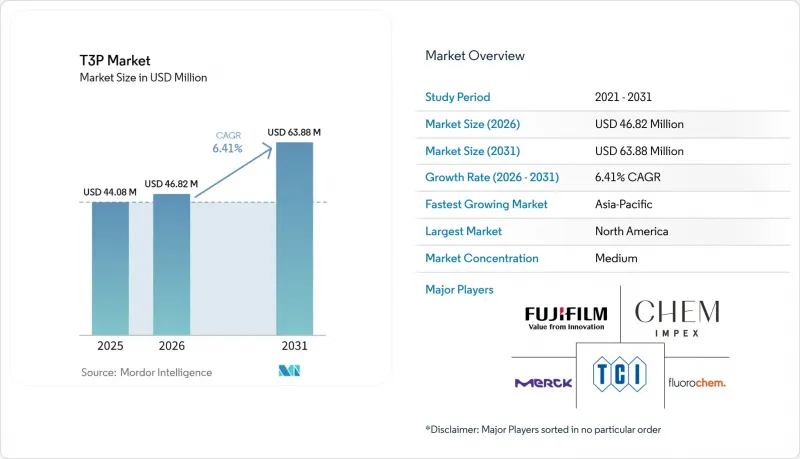
Mordor Intelligence에 의하면, T3P 시장 규모는 2025년 4,408만 달러로 평가되었고, 2026년 4,682만 달러에서 2031년까지 6,388만 달러로 확대될 것으로 예측되며, 2026-2031년 CAGR 6.41%를 나타낼 전망입니다.
본 보고서는 농도별(50% 용액, 70% 용액, 기타 농도), 용매 유형별(에틸아세테이트, 아세토니트릴 등), 용도별(펩타이드 합성, 의약품 원료(API) 합성 등), 지역별(아시아태평양, 북미, 유럽, 기타 지역)로 분류되어 있습니다. 시장 전망은 금액(달러) 기준으로 제시되어 있습니다.
세계의 T3P 시장 동향 및 인사이트
원료의약품(API) 및 펩타이드계 의약품 제조에 대한 수요 증가
T3P 시장은 펩타이드계 치료제가 전문적인 개발 단계에서 대량 생산 단계로 전환되고 있는 데서 혜택을 받고 있습니다. 이 변화는 매우 중요한데, 제조업체들이 더 이상 연구용 배치만을 위해 커플링 시약을 구매하는 것이 아니라, 더 광범위하고 예측 가능한 산업 생산 프로그램을 위해 이를 필요로 하고 있기 때문입니다. T3P는 아미드 결합 형성을 가능하게 하는 동시에, 경쟁 시스템에서 발생하는 잔류물보다 제거하기 쉬운 수용성 부산물을 생성함으로써 이러한 요구 사항을 충족합니다. 이러한 운영상의 이점은 제조업체들이 상업용 API 라인 전반에 걸쳐 정제 시간 단축, 용매 사용량 감소, 배치 처리 능력의 제약 해소를 위해 노력함에 따라 점점 더 중요해지고 있습니다. 그 결과, T3P 시장은 몇년전과 비교하여 대사성 질환, 종양학 및 심혈관계 의약품 제조에서 더욱 중요한 위치를 차지하게 되었습니다. 더 많은 펩타이드 프로그램이 개발 단계를 거쳐 규모 확대 단계로 나아감에 따라, T3P 시장 수요는 주요 제약사와 그 수탁 제조 파트너의 생산 능력 결정과 계속해서 밀접한 관련을 가질 것으로 예측됩니다.
그린 케미컬 프레임워크 및 대규모 GMP(우수 제조 기준) 합성에서 T3P의 채택 확대
T3P 시장은 규제 대상 제조 분야에서 보다 친환경적이고 안전한 공정 화학으로의 광범위한 전환으로부터도 지지를 받고 있습니다. 조달 팀과 플랜트 운영자들은 대규모 사용을 위한 커플링 시약을 선정할 때, 폐기물 발생량, 위험성 프로파일, 그리고 제거 용이성을 점점 더 중요하게 여기고 있습니다. 『Organic Letters』지에 게재될 예정인 2026년 연구에 따르면, T3P를 이용한 Cyclover 보조형 액상 펩타이드 합성을 통해, 모델 펩타이드인 Leu-엔케팔린의 경우 공정 질량 강도가 2.7배 감소하고 분리 수율이 93%에 달했다고 보고될 전망이며, 이는 T3P 시장에서 지속가능성에 관한 논의를 위한 기술적 참고 기준이 될 것입니다. 이 결과는 T3P의 실용성을 뒷받침하는 것입니다. 왜냐하면 환경 부하 저감이 수율 향상이나 공정 부담 경감으로 이어질 때, 그 환경 성능에는 상업적인 의의가 있기 때문입니다. 또한, T3P는 용액 형태로 구할 수 있다는 장점도 있어, 고체 시약이 노출 및 안전상의 우려를 야기할 가능성이 있는 우수 제조 기준(GMP) 환경에서의 취급을 개선합니다. T3P 시장에서 그린 케미스트리는 적합성 평가, 플랜트 워크플로우 및 공급업체 선정에 영향을 미치는 운영상의 선별 기준으로 기능하고 있습니다.
대체 커플링 시약에 비해 높은 비용
T3P 시장은 구매자가 시약 가격을 기존 대체품과 직접 비교하는 경우가 많기 때문에 여전히 비용 측면의 과제에 직면해 있습니다. 이러한 과제는 제네릭 의약품 제조, 연구 규모 용도 및 농약 생산 분야에서 특히 두드러지며, 이러한 분야에서는 다운스트림 공정의 운영 효율보다 투입 비용 관리가 시약 선정에 더 큰 영향을 미치는 경우가 많습니다. T3P는 정제 요건, 용매 폐기 부담 및 사이클 타임을 줄일 수 있습니다. 그러나 초기 구매 결정을 내리는 조달 팀은 반드시 이러한 비용 절감 효과를 고려하는 것은 아닙니다. 공정상의 가치와 구매 가격 사이에 발생하는 이러한 격차는 장기적으로 볼 때 총 소유 비용 측면에서 T3P가 유리하더라도 도입을 저해하는 요인이 되고 있습니다. 가격에 민감한 최종 용도의 경우, 제조업체는 검증된 워크플로우나 예산 계획에 부합하는 저비용 시스템을 계속 사용하는 경우가 많습니다. 그 결과, T3P 시장은 순도, 속도, 규정 준수가 중요한 요건인 용도에서는 급속히 성장하고 있는 반면, 부가가치가 낮은 용도에서는 도입 속도가 둔화되고 있습니다.
부문 분석
2025년에는 ‘50% 용액’이 T3P 시장 점유율의 58.72%를 차지한 것으로 평가되었으며, 이는 처리 요건 및 반응 성능에서 이 용액이 수행하는 역할을 반영한 것입니다. 이 형태는 안정적인 유동 특성을 제공하고 용적식 분주를 지원하기 때문에 자동 합성 플랫폼, GMP 반응기 및 일상적인 실험실 작업에서 여전히 실용적인 표준으로 자리 잡고 있습니다. 또한 사용자는 활성 시약의 강도와 조작 편의성 사이의 균형을 맞추어야 할 때에도 이 형태를 선호합니다. 많은 생산 현장에서는 농도의 소폭 향상만큼이나 투여 제어 및 취급의 용이성이 중시되고 있습니다. 이러한 운영 논리에 따라 새로운 펩타이드 프로그램에서 더 높은 효율이 요구되더라도, 50% 용액은 T3P 시장에서 여전히 중심적인 위치를 차지하고 있습니다.
70% 용액의 T3P 시장 규모는 2026-2031년 연평균 성장률(CAGR) 6.93%로 확대될 것으로 예측되며, 예측 기간 동안 가장 두드러진 성장을 보일 농도 포맷이 될 전망입니다. 산업 규모의 펩타이드 제조에서 이 농도의 채택이 가장 활발한데, 시약 농도를 높임으로써 배치당 총 용매량을 줄이고 공정 질량 효율 목표 달성을 지원할 수 있기 때문입니다. 이러한 요인은 소규모 실험실 처리보다 대규모 생산 캠페인에서 더욱 중요해집니다. 이는 규모가 커질수록 용매 부하와 반응기의 처리 용량이 중요한 비용 요인이 되기 때문입니다. 2026년 『Organic Letters』 저널에 실린 연구는 최적화된 조건 하에서 T3P 기반 펩타이드 워크플로가 공정 질량 강도를 대폭 감소시킨다는 것을 보여주며, 이러한 효율화 추세를 뒷받침하고 있습니다. 그 밖의 농도 형태는 여전히 틈새 시장으로 남아 있으며, 광범위한 산업 수요라기보다는 수탁 합성 수요나 전문적인 연구 프로그램에 대응하는 것입니다. T3P 업계 전체적으로는 고농도 제형으로의 전환이 완만하게 진행되고 있지만, 공정 효율이 비용 및 지속가능성 측면에서 이점을 제공하는 용도에서는 이러한 추세가 뚜렷하게 나타납니다.
50% 용액은 GMP 문서 및 재현성 요건을 충족한다는 점에서도 장점이 있습니다. 일관된 분주를 통해 피할 수 있는 배치 간 편차 위험을 줄일 수 있기 때문입니다. 고속 생산(High-throughput) 환경에서 기업이 이미 공정을 최적화한 경우, 이러한 신뢰성은 더 높은 농도의 형식이 가진 이론상의 효율적 이점을 능가할 가능성이 있습니다. T3P 시장의 구매자들은 50% 용액을 적합성 평가나 스케일업 과정에서 ‘마찰이 적은 선택지’로 간주하는 경우가 많습니다. 이러한 인식으로 인해, 특히 제약사가 상용화 단계에서 운영상의 변화를 최소화하고자 할 때 50% 용액의 도입 실적은 견조하게 유지되고 있습니다. 대조적으로, 70% 용액은 대규모 펩타이드 프로그램의 다음 단계 최적화 노력과 더 밀접하게 연관되어 있습니다. 이러한 동향으로 인해 T3P 시장에서는 농도에 따른 양극화가 발생하고 있으며, 한쪽 제형 형태는 기존의 관행에 의해 뒷받침되는 반면, 다른 한쪽 제형 형태는 규모 확대를 통한 효율화 목표에 의해 지지받고 있습니다.
지역별 분석
북미는 2025년에 T3P 시장 점유율의 36.82%를 차지한 것으로 평가되었으며, 금액 기준으로 가장 큰 기여를 할 것으로 전망됩니다. 이 지역에는 제약사, 대형 CDMO 및 첨단 펩타이드 생산 프로그램이 집중되어 있습니다. 규제 대상 제조를 수행하는 고객들은 공급업체의 품질 시스템, 종합적인 문서화 및 신뢰할 수 있는 납품을 우선시하기 때문에 이러한 집중 현상이 시약에 대한 안정적인 수요를 뒷받침하고 있습니다. 2025년 3월로 예정된 Curia사의 앨버커키 거점 확장은 향후 의약품 생산 수요를 충족하기 위해 해당 지역공급 기반을 강화할 것으로 전망됩니다. 그 결과, T3P 시장 내 북미 수요는 최종 사용자 수뿐만 아니라 인증의 엄격성과 제조의 집중도에 의해서도 형성되고 있습니다.
유럽은 여전히 T3P 시장의 중요한 부분을 차지했으며, 독일, 영국, 프랑스, 이탈리아가 의약품 및 특수 화학 물질 관련 활동을 통해 수요를 뒷받침하고 있습니다. 이 지역의 공정 화학 기반과 엄격하게 관리되는 제조 기준을 충족하는 소재에 대한 선호도가 이러한 위상을 뒷받침하고 있습니다. 또한, 유럽의 구매자들은 용매 선정, 추적성, 그리고 공급업체의 감사 대응 체계를 중시하고 있으며, 이러한 요소들은 GMP 등급 제제를 뒷받침하는 요소가 되고 있습니다. 따라서 T3P 시장의 지역적 특성상, 저비용의 카탈로그 제품과의 경쟁보다는 고순도이며 문서화가 철저한 공급이 선호되고 있습니다.
아시아태평양은 가장 빠르게 성장하는 지역 부문이며, T3P 시장은 2031년까지 연평균 성장률(CAGR) 7.13%를 나타낼 것으로 예측됩니다. 중국은 광범위한 화학 제조거점과 의약품 및 산업용 합성 분야에서의 중요성 증대로 인해, 지역 전체 판매량에서 계속해서 핵심 시장으로서의 지위를 유지하고 있습니다. 인도는 수출 지향적인 API(원료의약품) 부문과 보다 복잡한 공정 화학의 활용 확대를 통해 시장의 성장세를 뒷받침하고 있습니다. 일본은 후지필름 와코 순약 주식회사의 2024년 5월 의약품 원료 생산 능력 확대를 포함하여, 확립된 GMP 시약 기반에 힘입고 있습니다. 한국은 바이오의약품 개발 활동을 통해 기여하고 있으며, 세계 기타 지역은 규모가 비교적 작고 개발 초기 단계에 머물러 있습니다. 이러한 추세를 종합해 보면, T3P 시장은 현재 북미에 집중되어 있으며, 유럽에서는 품질을 중시하는 수요가 나타나고, 아시아태평양에서 가장 급속한 확장을 이루고 있음을 알 수 있습니다.
기타 혜택 :
- 엑셀 형식 시장 예측(ME) 시트
- 3개월간의 애널리스트 지원
자주 묻는 질문
목차
제1장 서론
제2장 조사 방법
제3장 주요 요약
제4장 시장 구도
제5장 시장 규모 및 성장 예측
제6장 경쟁 구도
제7장 시장 기회 및 향후 전망
AJY 26.08.07According to Mordor Intelligence, the T3P market size is projected to expand from USD 44.08 million in 2025 and USD 46.82 million in 2026 to USD 63.88 million by 2031, and is expected to register a CAGR of 6.41% between 2026 and 2031.
This report is Segmented by Concentration (50% Solution, 70% Solution, and Other Concentrations), Solvent Type (Ethyl Acetate, Acetonitrile, and More), Application (Peptide Synthesis, Pharmaceutical API Synthesis, and More), and Geography (Asia-Pacific, North America, Europe, Rest of the World). The Market Forecasts are Provided in Terms of Value (USD).
Global T3P Market Trends and Insights
Growing Demand for Pharmaceutical Active Pharmaceutical Ingredient (API) and Peptide-Based Drug Manufacturing
The T3P market is benefiting from the transition of peptide-based therapies from specialized development to large-volume commercial manufacturing. This shift is significant because manufacturers no longer purchase coupling reagents only for research batches; they now require them for broader and more predictable industrial programs. T3P supports this requirement by enabling amide bond formation while producing a water-soluble byproduct that is easier to remove than residues associated with several competing systems. This operational advantage becomes more relevant as manufacturers work to reduce purification time, solvent use, and batch throughput constraints across commercial API lines. As a result, the T3P market now has greater relevance in the production of metabolic disease, oncology, and cardiovascular drugs than it did a few years ago. As more peptide programs move through development and into scale-up, demand in the T3P market is likely to remain linked to capacity decisions by large pharmaceutical manufacturers and their contract partners.
Increasing Adoption of T3P in Green Chemistry Frameworks and Large-Scale Good Manufacturing Practice (GMP) Synthesis
The T3P market is also gaining support from the broader shift toward greener and safer process chemistry in regulated manufacturing. Procurement teams and plant operators increasingly assess waste generation, hazard profiles, and ease of removal when selecting coupling reagents for large-scale use. A 2026 study in Organic Letters is expected to report that Cyclover-assisted liquid-phase peptide synthesis using T3P achieved a 2.7-fold reduction in process mass intensity and a 93% isolated yield for the model peptide Leu-enkephalin, providing the T3P market with a technical reference point for sustainability discussions. This result supports the practical case for T3P because greener performance has commercial relevance when it links to better yield and a lower process burden. T3P also benefits from its availability in solution form, which improves handling in Good Manufacturing Practice (GMP) settings where solid reagents can create exposure and safety concerns. In the T3P market, green chemistry serves as an operational filter that influences qualification, plant workflows, and supplier preferences.
High Cost Compared to Alternative Coupling Reagents
The T3P market continues to face cost challenges, as buyers often compare reagent prices directly with established alternatives. This challenge is most pronounced in generics manufacturing, research-scale applications, and agrochemical production, where input cost control often influences reagent selection more than downstream operating efficiency. T3P can reduce purification requirements, solvent disposal burdens, and cycle times. However, procurement teams making initial purchasing decisions do not always account for these savings. This gap between process value and purchase price slows adoption, even when the total cost of ownership may favor T3P over time. In price-sensitive end uses, manufacturers often continue to use lower-cost systems that align with their validated workflows and budget assumptions. Therefore, the T3P market grows faster in applications where purity, speed, and compliance are key requirements, while lower-value applications show slower adoption.
Other drivers and restraints analyzed in the detailed report include:
- Rising Outsourcing of Pharmaceutical Manufacturing and Supply Chain Realignment
- Expanding Use of T3P in Agrochemical and Fine & Specialty Chemical Synthesis
- Availability of Alternative Coupling Reagents
For complete list of drivers and restraints, kindly check the Table Of Contents.
Segment Analysis
The 50% solution is expected to hold 58.72% of the T3P market share in 2025, reflecting its role in handling requirements and reaction performance. This format remains the practical standard across automated synthesis platforms, GMP reactors, and routine laboratory work because it provides stable flow properties and supports volumetric dispensing. Users also prefer it when they need to balance active reagent strength with operating convenience. In many production settings, dosing control and lower handling complexity matter as much as marginal gains in concentration. This operating logic keeps the 50% solution central to the T3P market, even as newer peptide programs require higher efficiency.
The T3P market size for the 70% solution is projected to expand at a CAGR of 6.93% between 2026 and 2031, making it the fastest-growing concentration format during the forecast period. Industrial peptide manufacturing shows the strongest adoption, as higher reagent density can reduce total solvent volume per batch and support process mass efficiency targets. This factor matters more in large production campaigns than in small laboratory runs because solvent load and reactor throughput become significant cost drivers at scale. The 2026 Organic Letters study supports this efficiency trend by linking T3P-based peptide workflows with materially lower process mass intensity under optimized conditions. Other concentration formats remain niche and serve custom synthesis needs and specialized research programs rather than broad industrial demand. Across the T3P industry, the shift toward higher-concentration formats remains gradual but is visible in applications where process efficiency delivers cost and sustainability benefits.
The 50% solution also benefits from its alignment with GMP documentation and repeatability requirements, as consistent dispensing reduces the risk of avoidable batch variation. In high-throughput manufacturing, this reliability can outweigh the theoretical efficiency benefits of a more concentrated format when companies have already optimized their processes. Buyers in the T3P market often view the 50% solution as the low-friction option for qualification and scale transfer. This position keeps its installed base strong, especially when pharmaceutical producers aim to limit operational changes during commercial execution. By contrast, the 70% solution is more closely associated with next-stage optimization efforts in large peptide programs. This dynamic creates a concentration split in the T3P market, with one format anchored by installed practice and the other supported by scale-driven efficiency goals.
Complete Report Scope:
- By Concentration
- 50% Solution
- 70% Solution
- Other Concentrations
- By Solvent Type
- Ethyl Acetate
- Dimethylformamide (DMF)
- Acetonitrile
- Other Solvents
- By Application
- Peptide Synthesis
- Pharmaceutical API Synthesis
- Organic Synthesis
- Fine & Specialty Chemical Synthesis
- Agrochemical Synthesis
- Process Chemistry
- Other Applications
- By Geography
- Asia-Pacific
- China
- India
- Japan
- South Korea
- Rest of Asia-Pacific
- North America
- United States
- Canada
- Europe
- Germany
- United Kingdom
- France
- Italy
- Russia
- Rest of Europe
- Rest of the World
- South America
- Middle-East and Africa
- Asia-Pacific
Geography Analysis
North America is expected to hold 36.82% of the T3P market share in 2025, making it the largest regional contributor by value. The region has a high concentration of pharmaceutical manufacturers, large CDMOs, and advanced peptide production programs. This concentration supports steady reagent demand, as customers in regulated manufacturing prioritize supplier quality systems, comprehensive documentation, and reliable delivery. Curia's March 2025 Albuquerque expansion is expected to strengthen the regional supply base to meet future pharmaceutical production needs. As a result, qualification rigor and manufacturing intensity shape North American demand in the T3P market as much as the end-user count.
Europe remains an important part of the T3P market, with Germany, the United Kingdom, France, and Italy supporting demand through pharmaceutical and specialty chemical activity. The region's process-chemistry base and preference for materials that meet tightly controlled manufacturing standards support its position. European buyers also value solvent choice, traceability, and supplier audit readiness, which support GMP-grade formulations. Therefore, the regional profile of the T3P market favors higher-purity, well-documented supply over lower-cost catalog competition.
Asia-Pacific is the fastest-growing regional segment, with the T3P market projected to register a 7.13% CAGR through 2031. China remains the anchor market in regional volume terms due to its broad chemical manufacturing base and growing relevance in pharmaceutical and industrial synthesis. India adds momentum through its export-oriented API sector and increasing use of more complex process chemistry. Japan is supported by an established GMP reagent base, including FUJIFILM Wako Pure Chemical Corporation's May 2024 capacity expansion for pharmaceutical raw materials . South Korea contributes through biopharmaceutical development activity, while the rest of the world remains smaller and at an earlier stage of development. Together, these patterns indicate that the T3P market has a current concentration in North America, quality-led demand in Europe, and the fastest expansion in Asia-Pacific.
- AAPPTec
- BLD Pharmatech Ltd.
- Carl Roth
- Chem-Impex
- Curia Global, Inc.
- Fluorochem Limited
- FUJIFILM Wako Pure Chemical Corporation
- Infinia Sciences Pvt. Ltd.,
- Iris Biotech GmbH
- Merck KGaA
- Santa Cruz Biotechnology, Inc.
- TargetMol Chemicals Inc.
- Tokyo Chemical Industry Co., Ltd.
Additional Benefits:
- The market estimate (ME) sheet in Excel format
- 3 months of analyst support
TABLE OF CONTENTS
1 Introduction
- 1.1 Study Assumptions and Market Definition
- 1.2 Scope of the Study
2 Research Methodology
3 Executive Summary
4 Market Landscape
- 4.1 Market Overview
- 4.2 Market Drivers
- 4.2.1 Growing Demand for Peptide Therapeutics and Advanced Pharmaceutical Manufacturing
- 4.2.2 Increasing Adoption of T3P in Pharmaceutical API and Organic Synthesis
- 4.2.3 Rising Outsourcing of Drug Development and Manufacturing to CDMOs
- 4.2.4 Expanding Use of T3P as a High-Efficiency and Low-Byproduct Coupling Reagent
- 4.2.5 Increasing R&D Investments in Medicinal Chemistry and Specialty Chemical Synthesis
- 4.3 Market Restraints
- 4.3.1 High Cost Compared with Conventional Coupling Reagents
- 4.3.2 Availability of Alternative Coupling Reagents such as HATU, HBTU, COMU, and EDC
- 4.3.3 Stringent Regulatory and Quality Requirements for Pharmaceutical-Grade Reagents
- 4.4 Value Chain Analysis
- 4.5 Porter's Five Forces Analysis
- 4.5.1 Threat of New Entrants
- 4.5.2 Bargaining Power of Suppliers
- 4.5.3 Bargaining Power of Buyers
- 4.5.4 Threat of Substitutes
- 4.5.5 Competitive Rivalry
- 4.6 Pricing Analaysis
5 Market Size and Growth Forecasts (Value)
- 5.1 By Concentration
- 5.1.1 50% Solution
- 5.1.2 70% Solution
- 5.1.3 Other Concentrations
- 5.2 By Solvent Type
- 5.2.1 Ethyl Acetate
- 5.2.2 Dimethylformamide (DMF)
- 5.2.3 Acetonitrile
- 5.2.4 Other Solvents
- 5.3 By Application
- 5.3.1 Peptide Synthesis
- 5.3.2 Pharmaceutical API Synthesis
- 5.3.3 Organic Synthesis
- 5.3.4 Fine & Specialty Chemical Synthesis
- 5.3.5 Agrochemical Synthesis
- 5.3.6 Process Chemistry
- 5.3.7 Other Applications
- 5.4 By Geography
- 5.4.1 Asia-Pacific
- 5.4.1.1 China
- 5.4.1.2 India
- 5.4.1.3 Japan
- 5.4.1.4 South Korea
- 5.4.1.5 Rest of Asia-Pacific
- 5.4.2 North America
- 5.4.2.1 United States
- 5.4.2.2 Canada
- 5.4.3 Europe
- 5.4.3.1 Germany
- 5.4.3.2 United Kingdom
- 5.4.3.3 France
- 5.4.3.4 Italy
- 5.4.3.5 Russia
- 5.4.3.6 Rest of Europe
- 5.4.4 Rest of the World
- 5.4.4.1 South America
- 5.4.4.2 Middle-East and Africa
- 5.4.1 Asia-Pacific
6 Competitive Landscape
- 6.1 Market Concentration
- 6.2 Strategic Moves
- 6.3 Market Share (%)/Ranking Analysis
- 6.4 Company Profiles (includes Global Overview, Market Overview, Core Segments, Financials as available, Strategic Information, Products and Services, and Recent Developments)
- 6.4.1 AAPPTec
- 6.4.2 BLD Pharmatech Ltd.
- 6.4.3 Carl Roth
- 6.4.4 Chem-Impex
- 6.4.5 Curia Global, Inc.
- 6.4.6 Fluorochem Limited
- 6.4.7 FUJIFILM Wako Pure Chemical Corporation
- 6.4.8 Infinia Sciences Pvt. Ltd.,
- 6.4.9 Iris Biotech GmbH
- 6.4.10 Merck KGaA
- 6.4.11 Santa Cruz Biotechnology, Inc.
- 6.4.12 TargetMol Chemicals Inc.
- 6.4.13 Tokyo Chemical Industry Co., Ltd.
7 Market Opportunities and Future Outlook
- 7.1 White-Space and Unmet-Need Assessment


