

|
시장보고서
상품코드
2100007
만성 요통(CLBP) 시장 : 시장 점유율 분석, 업계 동향 및 통계, 성장 예측(2026-2031년)Chronic Lower Back Pain (CLBP) - Market Share Analysis, Industry Trends & Statistics, Growth Forecasts (2026 - 2031) |
||||||
 Mordor Intelligence
Mordor Intelligence에 의하면, 2026년 만성 요통 시장 규모는 25억 7,000만 달러로 추정되고, 2025년 23억 8,000만 달러에서 확대해, 2031년에는 37억 6,000만 달러에 이를 것으로 예측됩니다.
2026-2031년 연평균 성장률(CAGR) 7.93%로 성장할 것으로 전망됩니다.
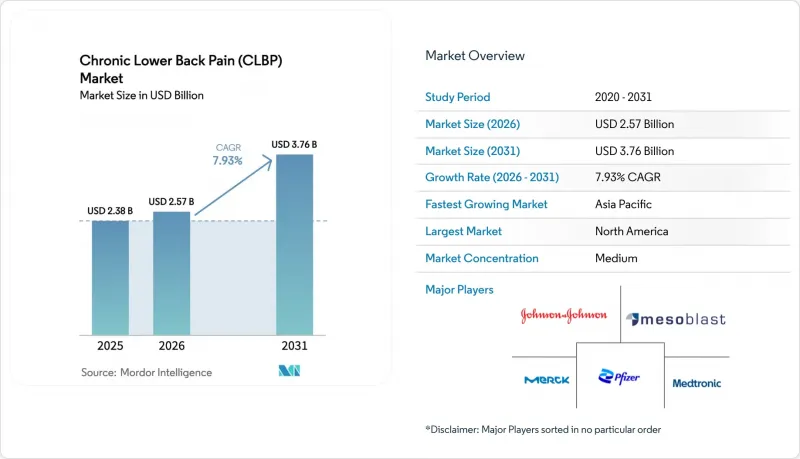
본 보고서는 통증 유형별(급성 통증, 아급성 요통, 만성 요통, 기타 통증 유형), 진단별(통증 점수 평가, 병력 등), 치료법별(약물 요법 등), 최종 사용자별(병원 등), 지역별(북미, 유럽, 아시아태평양, 중동 및 아프리카, 남미)로 분류되어 있습니다. 시장 전망은 금액(달러) 기준으로 제시되어 있습니다.
세계의 만성 요통(CLBP) 시장 동향 및 인사이트
신경 조절 및 SCS 임플란트의 급속한 보급
폐루프 방식의 척수 자극(SCS)은 생리학적 피드백에 따라 신호를 자동으로 조정하고, 임상의의 개입 없이 과도한 자극을 억제함으로써 치료 패러다임을 혁신했습니다. 메드트로닉(Medtronic)의 Inceptiv 시스템의 경우, 시술을 받은 환자의 82%가 12개월 시점에서 최소 50%의 통증 감소를 경험한 것으로 나타났습니다. 네브로(Nebro)사의 HFX AdaptivAI 플랫폼은 머신러닝 알고리즘을 활용하여 유효성을 유지하면서 자극 빈도를 최적화합니다. 이러한 발전들이 결합되어 장기적인 치료 성과가 향상되고, 건강 관련 삶의 질(QOL) 지표가 개선되며, 예정에 없던 병원 방문이 감소하고 있습니다. 보험 환급은 실제 세계 데이터(REW)와의 연계가 점점 더 강화되고 있으며, 미국의 보험사들은 오피오이드 사용량을 줄이는 효과가 입증된 폐쇄 루프형 자극 장치에 대해 추가 지급을 도입하기 시작했습니다. 또한, 각 제조업체는 펄스 발생기의 소형화를 추진하고 있어, 당일 퇴원이 가능한 외래 이식 수술이 현실화되고 있습니다. 의료기기 제조업체와 원격의료 플랫폼 간의 적극적인 협력을 통해, 치료 매개변수 및 환자 보고 결과가 클라우드 대시보드에 집약되는 생태계가 구축되어, 다학제 팀에 의한 선제적인 조정이 가능해졌습니다.
비만과 앉아 있는 생활 습관 증가
비만은 생체역학적 스트레스를 유발하고 추간판 변성을 가속화하기 때문에 모든 연령대에서 만성 요통이 증가하고 있습니다. 2020년 이후 재택근무의 보급으로 인해 앉아 있는 생활이 더욱 정착되면서, 근골격계 문제가 의사 진료를 받는 주요 이유 중 하나가 되고 있습니다. 경제적 측면에서는 미국에서 2024년에 만성 통증과 관련된 비용이 7,250억 달러에 달했고, 의료비와 생산성 저하로 인한 타격을 입고 있습니다. 세포 노화학 연구에 따르면, 지방 조직에서 기인한 염증이 척추 추간판 내의 노화된 ‘좀비’ 세포와 관련이 있는 것으로 밝혀졌으며, 이러한 노화된 세포를 표적으로 하는 초기 단계의 병용 약물은 전임상 모델에서 추간판의 높이를 유지하는 것으로 나타났습니다. 이러한 연구 결과를 바탕으로, 대사 경로와 정형외과적 경로가 교차하는 재생 약리학 분야에 대한 투자가 확대되고 있습니다.
첨단 신경 자극 장치의 고액 초기 비용
폐루프형 SCS 시스템 이식 수술에는 35,000-7만 달러의 비용이 소요되며, 자원이 부족한 환경에서는 보험 환급의 장벽이 되고 있습니다. 이식 수술을 받은 환자의 9.82%에서 재수술이 이루어지고 있으며, 그 대부분은 리드 이동이나 불충분한 통증 관리가 원인이어서 평생 총 비용을 더욱 높이고 있습니다. 그러나 비용 대비 효과 연구에 따르면, 충전식 장치는 배터리 교체를 최소화함으로써 비충전식 발전기에 비해 평생 104,000-168,833달러의 비용 절감을 가져온다는 것이 입증되었습니다. 각 제조업체는 수술 시간과 입원 기간을 단축하는 간소화된 전극 어레이를 개발함으로써 이에 대응하고 있으며, 의료경제적 관점에서 자사 제품에 유리한 상황을 조성하고 있습니다.
부문 분석
2025년에는 만성 증상이 만성 요통 시장의 47.35%를 차지했으며, 장기간에 걸친 다학제적 협력을 통한 치료의 필요성이 부각되고 있습니다. 급성 통증은 규모는 작지만, 수술 건수 증가와 병원 내 조기 회복 프로토콜의 표준화에 따라 2031년까지 연평균 성장률(CAGR) 9.02%로 확대될 것으로 전망됩니다. 급성기 관리 측면에서는 수십년만에 승인된 최초의 신규 비오피오이드 분자인 수제트리긴의 FDA 승인이 호재로 작용하고 있으며, 이를 통해 마약 사용을 제한하는 다각적인 진통이 가능해졌습니다. 조기적이고 단호한 약물 요법 및 디지털 개입을 통해 만성화로의 전환을 미연에 방지하고, 향후 의료비를 절감할 수 있습니다. AI 기반 지도를 접목한 원격 재활 도입으로, 지역 병원에서 진행된 시범 사업에서 수술 후 재입원율이 18% 감소했습니다.
대조적으로, 직장 내 부상으로 인해 발생하는 경우가 많은 아급성 요통의 경우, 인체공학에 기반한 프로그램을 도입하는 고용주에게 예방의 좋은 기회가 되고 있습니다. 머신러닝 대시보드에 데이터를 연동하는 웨어러블 자세 센서는 위험한 동작 패턴에 대해 사용자나 인사 부서에 경고를 발령하여 발생률을 억제합니다. 신경병성 통증이나 신경근성 통증과 같은 다른 통증 범주에서는 신경 조절 요법에 대한 의존도가 높아지고 있습니다. 보험사들은 기존의 척수 자극 요법(SCS)이 효과를 보이지 않는 경우, 후근 신경절 자극 요법의 승인을 점진적으로 추진하고 있어 대상 환자층이 확대되고 있습니다.
영상 진단은 2025년 매출의 33.40%를 차지했으며, 고액 치료를 시행하기 전에 객관적인 검증이 프로토콜에 의무화되어 있어 연간 8.3%의 속도로 성장하고 있습니다. MRI는 추간판 탈출증이나 모딕 변화를 검출하기 위한 골드 스탠다드로 자리 잡고 있는 반면, 저선량 CT는 외상 진료 분야에서 트리아지 역할을 수행하고 있습니다. AI를 활용한 후처리로 진단 속도가 향상되고 있으며, NEC의 골격 자세 인식 엔진은 척추 전방 전위증의 검출 정확도를 94%까지 높이고 있습니다.
병력 청취와 신체 검사가 입문 단계인 반면, 보험사 측에서는 보험 급여를 위해 영상 진단을 통한 근거를 요구하는 목소리가 점점 더 커지고 있습니다. 통증 점수 설문지는 경과 관찰에 필수적이지만, 현재는 모바일 앱에 통합되어 임상 의사에게 통증 강도에 대한 실시간 정보를 제공합니다. 의사결정 지원 도구는 영상 진단 데이터와 주관적 지표를 통합하여 저침습적 절제술의 적격 후보자를 특정하고, 불필요한 외과 상담을 줄이고 있습니다.
지역별 분석
북미는 23만 대 이상의 가동 중인 척수 자극기 도입 실적과 클로즈드 루프 업그레이드에 대한 유리한 코딩에 힘입어, 2025년에는 전 세계 매출의 39.70%를 차지했으며, 계속해서 주도적인 위치를 유지했습니다. 획기적인 의료기기를 대상으로 한 FDA의 패스트트랙 프로그램을 통해 혁신 기술이 신속하게 시장에 도입되면서, 국내 제조업체의 선구자적 우위가 강화되고 있습니다. 그 뒤를 이어 유럽이 자리 잡고 있으며, 의료기기 규정(MDR)이 임상적 근거를 중시하는 점이 뒷받침되어 오피오이드 사용량을 줄이는 효과가 입증된 기술의 보급이 가속화되고 있습니다.
아시아태평양의 만성 요통 시장은 일본 성인의 통증 유병률이 22.5%에 달하고, 의료 제도의 근본적인 개혁이 시급한 상황인 만큼, 2031년까지 연평균 8.53%의 성장률을 보일 것으로 전망됩니다. 중국에서는 이온 채널 조절제가 국가 보험 약품 목록에 추가됨에 따라 신규 약물에 대한 접근성이 확대되고 있습니다. 한편, 호주는 신경 조절 지침의 조기 도입에 적극적인 자세를 보이고 있으며, 해당 지역의 기준이 되는 거점으로서의 위상을 확립하고 있습니다. 인도 및 동남아시아 전역에서는 외래수술센터(ASC)와 의사 연수에 대한 투자로 인해 수술 대기 건수가 감소하고 있습니다.
남미, 중동 및 아프리카은 현재 매출에서 차지하는 비중이 합쳐서 10% 미만이지만, 비만율 상승과 민간 보험 적용 범위 확대에 따라 장기적인 성장 여지가 예상됩니다. 걸프 지역 국가들의 병원과 미국 학술 기관간의 제휴에는 현재 저침습적 절제술에 관한 원격 지도가 포함되어 있어, 해외로 출장하지 않고도 기술 이전이 이루어지고 있습니다. 브라질에서는 민관 협력의 일환으로 농촌 지역에 영상 진단 서비스를 제공하는 이동식 MRI 밴의 실증 실험이 진행되고 있으며, 진단 지연을 단축하는 데 있어 초기 단계임에도 유망한 성과를 보이고 있습니다.
기타 혜택 :
- 엑셀 형식 시장 예측(ME) 시트
- 3개월간의 애널리스트 지원
자주 묻는 질문
목차
제1장 서론
제2장 조사 방법
제3장 주요 요약
제4장 시장 구도
제5장 시장 규모 및 성장 예측
제6장 경쟁 구도
제7장 시장 기회 및 향후 전망
AJY 26.08.07According to Mordor Intelligence, the chronic lower back pain market size in 2026 is estimated at USD 2.57 billion, growing from 2025 value of USD 2.38 billion with 2031 projections showing USD 3.76 billion, growing at 7.93% CAGR over 2026-2031.
This report is Segmented by Pain Type (Acute Pain, Sub-Acute Low Back Pain, Chronic Back Pain, Other Pain Types), Diagnosis (Assessment of Pain Scores, Clinical History, and More), Therapy Modality (Pharmacologic, and More), End User (Hospitals, and More), and Geography (North America, Europe, Asia-Pacific, Middle East & Africa, South America). The Market Forecasts are Provided in Terms of Value (USD).
Global Chronic Lower Back Pain (CLBP) Market Trends and Insights
Rapid Uptake of Neuromodulation & SCS Implants
Closed-loop spinal cord stimulation (SCS) has shifted the therapeutic paradigm by automatically adjusting signals in response to physiologic feedback, curbing overstimulation without clinician input. Medtronic's Inceptiv system showed 82% of recipients experienced at least 50% pain reduction at 12 months. Nevro's HFX AdaptivAI platform uses machine-learning algorithms to trim charging frequency while preserving efficacy. Together, these advances elevate long-term outcomes, improve health-related quality of life metrics, and reduce unplanned clinical visits. Reimbursement is increasingly tied to real-world evidence, and payers in the United States have begun adding supplemental payments for closed-loop stimulators that demonstrate opioid-sparing benefits. Manufacturers are also miniaturizing pulse generators, making same-day ambulatory implantation viable. Forward integration between device makers and telehealth platforms is creating an ecosystem where therapy parameters and patient-reported outcomes flow into cloud dashboards, enabling proactive adjustments by multidisciplinary teams.
Rising Prevalence of Obesity & Sedentary Lifestyles
Obesity induces biomechanical stress that accelerates intervertebral disc degeneration, heightening chronic lower back pain across demographics. Remote work adoption since 2020 has deepened sedentary behavior, with musculoskeletal complaints ranking among the top reasons for physician visits. Economically, the United States registered USD 725 billion in chronic pain-related costs during 2024, hammered by health expenditures and lost productivity. Cellular gerontology studies now link adipose-driven inflammation to senescent "zombie" cells in spinal discs, and early-stage combination drugs that target these senescent cells have shown disc-height preservation in preclinical models. Such findings are steering investment toward regenerative pharmacology that intersects metabolic and orthopedic pathways.
High Upfront Cost of Advanced Neurostimulators
Implantation of closed-loop SCS systems carries procedure costs between USD 35,000 and USD 70,000, posing reimbursement hurdles in low-resource settings. Revision surgeries occur in 9.82% of implanted patients, often for lead migration or inadequate pain control, compounding total lifetime expense. Cost-utility studies, however, prove rechargeable units deliver USD 104,000-168,833 in lifetime savings relative to non-rechargeable generators by minimizing battery replacements. Manufacturers are responding with simplified electrode arrays that shorten operating-room time and hospital stays, nudging health-economic equations in their favor.
Other drivers and restraints analyzed in the detailed report include:
- Growing Geriatric Population Susceptible to CLBP
- Expansion of Stem-Cell & Orthobiologic Trials
- Strict Opioid Prescribing & Reimbursement Clamp-Downs
For complete list of drivers and restraints, kindly check the Table Of Contents.
Segment Analysis
Chronic manifestations held 47.35% of the chronic lower back pain market share in 2025, underscoring the need for long-term multidisciplinary care. Acute pain, though smaller, will expand at a 9.02% CAGR by 2031 as surgical volumes climb and hospitals standardize enhanced-recovery protocols. Acute management is benefiting from the FDA approval of suzetrigine, the first new non-opioid molecule in decades, enabling multimodal analgesia that limits narcotic use. Early, decisive pharmacologic and digital intervention forestalls transition to chronic states, lowering future care costs. Telerehabilitation applications integrating AI-guided exercise have cut postoperative readmissions by 18% in community hospital pilots.
In contrast, sub-acute back pain-often tied to workplace injury-presents a preventative opportunity for employers deploying ergonomics programs. Wearable posture sensors that feed into machine-learning dashboards alert users and human-resources departments about risky movement patterns, curbing incidence rates. Other pain categories, such as neuropathic and radicular pain, rely heavily on neuromodulation; insurers are beginning to approve dorsal-root ganglion stimulation when conventional SCS fails, widening the total addressable population.
Imaging captured 33.40% of 2025 revenue and is climbing 8.3% per year as protocols mandate objective verification before high-cost interventions. MRI remains the gold standard to detect disc herniation and Modic changes, while low-dose CT fills triage roles in trauma units. AI-aided post-processing improves diagnostic speed; NEC's skeletal-pose engine raises detection accuracy for spondylolisthesis to 94%.
While clinical history and physical examination are entry points, payers increasingly demand imaging substantiation for reimbursement. Pain-score questionnaires, though essential for tracking, are now embedded in mobile apps, delivering real-time pain-intensity feeds to clinicians. Decision-support tools synthesize imaging and subjective metrics to flag candidates for minimally invasive ablation, trimming unnecessary surgical consults
Complete Report Scope:
- By Pain Type
- Acute Pain
- Sub-acute Low Back Pain
- Chronic Back Pain
- Other Pain Types
- By Diagnosis
- Assessment of Pain Scores
- Clinical History
- Physical Examination
- Imaging Guidelines
- By Therapy Modality
- Pharmacologic
- Neuromodulation
- Regenerative
- Minimally-Invasive Ablation
- By End User
- Hospitals
- Orthopaedic & Pain Clinics
- Ambulatory Surgical Centres
- Home-care Settings
- By Geography
- North America
- United States
- Canada
- Mexico
- Europe
- Germany
- United Kingdom
- France
- Italy
- Spain
- Rest of Europe
- Asia-Pacific
- China
- Japan
- India
- Australia
- South Korea
- Rest of Asia-Pacific
- Middle East & Africa
- GCC
- South Africa
- Rest of Middle East & Africa
- South America
- Brazil
- Argentina
- Rest of South America
- North America
Geography Analysis
North America retained leadership with 39.70% of global revenue in 2025, helped by an installed base of more than 230,000 active spinal cord stimulators and favorable coding for closed-loop upgrades. FDA fast-track programs for breakthrough devices funnel innovations to market quickly, bolstering first-mover advantages for domestic manufacturers. Europe follows, aided by the Medical Device Regulation's emphasis on clinical evidence, which accelerates uptake of technologies demonstrating opioid-sparing benefits.
The Asia Pacific chronic lower back pain market will grow 8.53% yearly through 2031 as Japan's 22.5% adult pain prevalence forces systemic healthcare reforms. China's inclusion of ion-channel modulators in the National Reimbursement Drug List widens access to novel pharmacology, while Australia's early-adopter stance on neuromodulation guidelines positions it as a regional reference site. Investments in ambulatory surgery centers and physician training are lowering procedural backlogs across India and Southeast Asia.
South America and the Middle East & Africa collectively represent under 10% of current revenue but offer long-run upside given rising obesity rates and expanding private insurance coverage. Partnerships between Gulf-state hospitals and U.S. academic centers now include tele-mentoring for minimally invasive ablation, transferring skills without travel. Public-private initiatives in Brazil are piloting mobile MRI vans to deliver rural imaging services, showing early promise in shortening diagnostic delays.
- Medtronic
- Boston Scientific
- Johnson & Johnson
- Pfizer
- Eli Lilly and Company
- Abbott Laboratories
- Nevro
- Stryker
- Merck
- Vertebral Technologies, Inc.
- Mesoblast Limited
- SpineThera, Inc.
- Stayble Therapeutics AB
- Persica Pharmaceuticals
- Pacira BioSciences
- Kyphon (BD)
- Grunenthal GmbH
- Nektar Therapeutics
- DePuy Synthes Spine
- Teva Pharmaceutical Industries
Additional Benefits:
- The market estimate (ME) sheet in Excel format
- 3 months of analyst support
TABLE OF CONTENTS
1 Introduction
- 1.1 Study Assumptions & Market Definition
- 1.2 Scope of the Study
2 Research Methodology
3 Executive Summary
4 Market Landscape
- 4.1 Market Overview
- 4.2 Market Drivers
- 4.2.1 Rapid Uptake of Neuromodulation & SCS Implants
- 4.2.2 Rising Prevalence of Obesity & Sedentary Lifestyles
- 4.2.3 Growing Geriatric Population Susceptible to CLBP
- 4.2.4 Expansion of Stem-Cell & Orthobiologic Trials
- 4.2.5 AI-Driven Digital-Twin Models for Personalised Pain Therapy
- 4.2.6 Value-Based Reimbursement Favouring Non-Opioid Solutions
- 4.3 Market Restraints
- 4.3.1 High Upfront Cost of Advanced Neurostimulators
- 4.3.2 Strict Opioid Prescribing & Reimbursement Clamp-Downs
- 4.3.3 Data-Privacy Risks in Cloud-Programmed Stimulators
- 4.3.4 Semiconductor Shortages Delaying Closed-Loop SCs Launches
- 4.4 Regulatory Landscape
- 4.5 Porter's Five Forces Analysis
- 4.5.1 Threat of New Entrants
- 4.5.2 Bargaining Power of Buyers
- 4.5.3 Bargaining Power of Suppliers
- 4.5.4 Threat of Substitutes
- 4.5.5 Intensity of Competitive Rivalry
5 Market Size & Growth Forecasts (Value in USD)
- 5.1 By Pain Type
- 5.1.1 Acute Pain
- 5.1.2 Sub-acute Low Back Pain
- 5.1.3 Chronic Back Pain
- 5.1.4 Other Pain Types
- 5.2 By Diagnosis
- 5.2.1 Assessment of Pain Scores
- 5.2.2 Clinical History
- 5.2.3 Physical Examination
- 5.2.4 Imaging Guidelines
- 5.3 By Therapy Modality
- 5.3.1 Pharmacologic
- 5.3.2 Neuromodulation
- 5.3.3 Regenerative
- 5.3.4 Minimally-Invasive Ablation
- 5.4 By End User
- 5.4.1 Hospitals
- 5.4.2 Orthopaedic & Pain Clinics
- 5.4.3 Ambulatory Surgical Centres
- 5.4.4 Home-care Settings
- 5.5 By Geography
- 5.5.1 North America
- 5.5.1.1 United States
- 5.5.1.2 Canada
- 5.5.1.3 Mexico
- 5.5.2 Europe
- 5.5.2.1 Germany
- 5.5.2.2 United Kingdom
- 5.5.2.3 France
- 5.5.2.4 Italy
- 5.5.2.5 Spain
- 5.5.2.6 Rest of Europe
- 5.5.3 Asia-Pacific
- 5.5.3.1 China
- 5.5.3.2 Japan
- 5.5.3.3 India
- 5.5.3.4 Australia
- 5.5.3.5 South Korea
- 5.5.3.6 Rest of Asia-Pacific
- 5.5.4 Middle East & Africa
- 5.5.4.1 GCC
- 5.5.4.2 South Africa
- 5.5.4.3 Rest of Middle East & Africa
- 5.5.5 South America
- 5.5.5.1 Brazil
- 5.5.5.2 Argentina
- 5.5.5.3 Rest of South America
- 5.5.1 North America
6 Competitive Landscape
- 6.1 Market Concentration
- 6.2 Market Share Analysis
- 6.3 Company Profiles (includes Global level Overview, Market-level Overview, Core Segments, Financials, Strategic Information, Market Rank/Share, Products & Services, Recent Developments)
- 6.3.1 Medtronic
- 6.3.2 Boston Scientific Corporation
- 6.3.3 Johnson & Johnson (DePuy Synthes)
- 6.3.4 Pfizer Inc.
- 6.3.5 Eli Lilly and Company
- 6.3.6 Abbott Laboratories
- 6.3.7 Nevro Corporation
- 6.3.8 Stryker Corporation
- 6.3.9 Merck & Co., Inc.
- 6.3.10 Vertebral Technologies, Inc.
- 6.3.11 Mesoblast Limited
- 6.3.12 SpineThera, Inc.
- 6.3.13 Stayble Therapeutics AB
- 6.3.14 Persica Pharmaceuticals
- 6.3.15 Pacira BioSciences, Inc.
- 6.3.16 Kyphon (BD)
- 6.3.17 Grunenthal GmbH
- 6.3.18 Nektar Therapeutics
- 6.3.19 DePuy Synthes Spine
- 6.3.20 Teva Pharmaceutical Industries
7 Market Opportunities & Future Outlook
- 7.1 White-space & Unmet-need Assessment


