

|
시장보고서
상품코드
2100260
디지털 교육 시장 : 시장 점유율 분석, 업계 동향 및 통계, 성장 예측(2026-2031년)Digital Education - Market Share Analysis, Industry Trends & Statistics, Growth Forecasts (2026 - 2031) |
||||||
 Mordor Intelligence
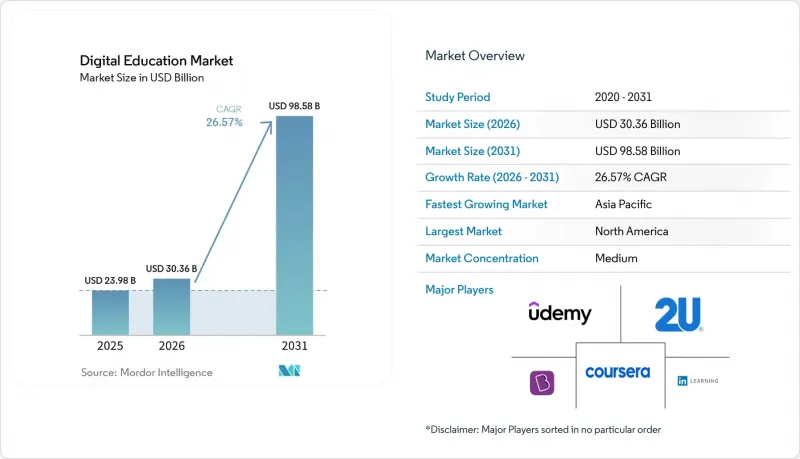
Mordor Intelligence에 의하면, 2026년 디지털 교육 시장 규모는 303억 6,000만 달러로 추정되고, 2025년 239억 8,000만 달러에서 확대해, 2031년에는 985억 8,000만 달러에 이를 것으로 예측됩니다.
2026-2031년 연평균 성장률(CAGR) 26.57%로 성장할 것으로 전망됩니다.
본 보고서는 유형별(자기 주도형 온라인 교육, 강사 주도형 온라인 교육 등), 과정 유형별(STEM, 경영 관리 등), 최종 사용자별(교육 기관·개인, 기업 등), 기술별(학습 관리 시스템, 모바일 학습 앱 등), 수익 모델별(구독형, 코스별 과금 등), 지역별로 분류되어 있습니다.
세계의 디지털 교육 시장 동향 및 인사이트
유연한 학습에 대한 수요 증가
하이브리드 근무 방식의 확산으로 인해, 동기식 대면 교육은 더 이상 현실적이지 않게 되었으며, 기업들은 시간대나 기기를 초월하여 일관된 교육을 제공할 수 있는 플랫폼을 찾고 있습니다. 2025년에는 미국 공립학교의 72%가 일정이 차질을 빚을 때에도 교육의 연속성을 유지하기 위해 혼합형 접근 방식을 도입했습니다. 적응형 엔진은 실시간 성과 데이터를 기반으로 학습 경로를 최적화하므로, 전문가들은 일상 업무를 중단하지 않고도 역량을 강화할 수 있습니다. 금융 및 소프트웨어 개발과 같은 지식 집약형 산업에서는 기술의 급속한 노후화를 완화하기 위해 현재 유연한 학습을 우선시하고 있습니다. 그 결과로 발생하는 규모의 경제 덕분에 다국적 기업들은 교육의 질을 일정하게 유지하면서 전 세계적으로 연수를 전개할 수 있게 되었습니다.
디지털 리터러시 향상을 위한 정부의 이니셔티브와 자금 지원
에 집중된 공공 투자를 통해 인프라 구축 및 플랫폼 도입이 가속화되고 있습니다. 아시아개발은행은 교원 연수, 단말기 조달, 지역 맞춤형 컨텐츠 제공 등을 포함한 지역 교육 환경 정비를 위해 150억 달러를 배정했습니다. 미국에서는 2024년 'Stepping-up Technology Implementation' 보조금을 통해 종합적인 디지털 프로그램을 추진하기 위해 40만 달러가 지급되었습니다. 현재 분석 대시보드를 통해 학습 성과를 시각화할 수 있는 공급업체가 선호되는 추세이며, 이로 인해 기존 공급업체들이 우위를 점하고 있습니다. 또한 인도나 인도네시아 등 시장에서 시행되는 ‘국내 우선 조달’ 정책도 지역별 특례를 만들어내며 경쟁 환경의 구도를 변화시키고 있습니다.
높은 도입 비용과 디지털 격차
엔터프라이즈급 도입의 경우, 통합, 맞춤화 및 사용자 온보딩에 5만-20만 달러의 비용이 소요될 수 있습니다. 라틴아메리카나 아프리카의 중소기업들은 예산이 빠듯한 상황에서 기대되는 수익이 불투명하기 때문에 도입을 미루는 경우가 많습니다. 연결 환경의 격차도 효과를 더욱 저해하고 있습니다. 광대역 신뢰성이 낮은 지역에서는 대화형 모듈에서 버퍼링이 발생하거나 작동이 중단되어 학습자의 신뢰를 떨어뜨리고 있습니다. 이러한 비용 장벽으로 인해 자금력이 풍부한 대기업과 중소기업 간의 성과 격차가 확대되고 있습니다.
부문 분석
2025년 디지털 교육 시장 규모 중 자기 주도형 모듈이 40.15%의 점유율을 유지하며, 언제든지 접근할 수 있는 형식에 대한 꾸준한 지지를 보여주었습니다. 기업들이 실무 기술을 연마하기 위해 디지털 교재와 대면 프로젝트를 결합함에 따라, 블렌디드 모델은 연평균 성장률(CAGR) 16.10%라는 가장 빠른 속도로 확대되고 있습니다. 강사 주도형 비디오 세션은 자기주도 학습을 보완하며, 이동 비용 없이 학습자에게 예정된 접촉 지점의 틀을 제공합니다. 시뮬레이션 랩이 이론을 보완하는 엔지니어링 및 헬스케어 분야에서는 하이브리드형 도입이 특히 두드러집니다. 이 구성은 비용 효율성과 그룹 학습을 통한 사회적 강화의 균형을 맞추고 있으므로, 두 형태를 모두 지원하는 제공업체는 고객 유지율과 평생 가치를 높일 수 있습니다.
학습자들은 비동기형 모듈과 실시간 워크숍 간의 원활한 연동을 기대합니다. 현재 플랫폼에는 두 맥락을 아우르는 일정 관리 도구, 분석 기능, 자격 대시보드가 통합되어 있습니다. 5G 및 클라우드 인프라가 성숙해짐에 따라 VR 및 AR을 활용한 몰입형 실습실이 하이브리드 프로그램의 일부가 되어, 원격지에 있는 수강생에게도 실전적인 문제 해결 경험을 제공합니다.
기업들이 데이터 사이언스, AI, 사이버 보안 역량을 지속적으로 우선시함에 따라, 2025년에는 STEM 분야가 디지털 교육 시장 점유율의 37.42%를 차지했습니다. 세계화와 분산형 인력의 확대로 인해 다국적 프로젝트에서 다국어 협업이 요구됨에 따라, 어학 과정 시장은 연평균 성장률(CAGR) 15.92%로 확대되고 있습니다. 경영 관리 컨텐츠는 리더십 인재 양성의 원천으로서 안정적인 수요를 유지하는 한편, 예술·인문학 분야는 틈새 시장의 창의적인 전문가들을 끌어모으고 있습니다. 클라우드 컴퓨팅 및 DevOps 분야의 마이크로 크레덴셜 과정은 학위 취득에 대한 완전한 헌신을 요구하지 않으면서도 신속한 역량 향상을 가능하게 합니다.
어학 플랫폼에서는 음성 인식 및 적응형 문법 연습을 통합하여 습득 기간을 단축하고 있습니다. 일부 공급업체는 기술 학습과 언어 학습을 결합하여 소프트웨어 개발자가 단일 학습 경로를 통해 코딩과 영어 두 가지 기술을 모두 습득할 수 있도록 하고 있으며, 이는 다중 기술을 갖춘 전문가에 대한 수요를 반영하고 있습니다.
지역별 분석
북미는 2025년 매출의 31.28%를 차지했으며, 이는 기업의 교육 예산이 성숙 단계에 접어들었으며 AI 개인화 엔진의 조기 도입이 반영된 결과입니다. 또한, 이 지역에서는 세계 모범 사례를 형성하는 규제 프레임워크가 시범적으로 도입되고 있어, 규정 준수 관련 전문 지식이 공급업체에게 상업적 우위를 제공합니다.
아시아태평양은 18억 명의 모바일 가입자와 정부 주도의 디지털 리터러시 목표에 힘입어 2031년까지 연평균 성장률(CAGR) 14.74%를 나타낼 것으로 예측됩니다. 중국의 ‘교육 현대화 계획’과 인도의 ‘디지털 인디아’ 이니셔티브는 모두 e-러닝 인프라에 막대한 자금을 할당하고 있습니다. 스마트폰을 주축으로 하는 시장에서는 데스크톱 중심 모델을 뛰어넘을 수 있으며, 플랫폼은 추가 비용을 낮게 유지하면서 지방의 학습자들에게도 도달할 가능성이 있습니다.
유럽에서는 기업들이 ESG 규정 준수 및 인력 전환 계획에 교육을 통합함에 따라 꾸준한 성장이 예상됩니다. 데이터 현지화 및 다국어 컨텐츠 요구 사항은 복잡성을 가중시키지만, 한편으로는 국내 공급업체를 보호하는 역할도 수행하고 있습니다. 라틴아메리카, 중동 및 아프리카는 여전히 초기 단계에 있지만, 광대역 보급률이 향상되고 단말기 비용이 낮아지면 성장 여지가 있습니다.
기타 혜택 :
- 엑셀 형식 시장 예측(ME) 시트
- 3개월간의 애널리스트 지원
자주 묻는 질문
목차
제1장 서론
제2장 조사 방법
제3장 주요 요약
제4장 시장 구도
제5장 시장 규모 및 성장 예측
제6장 경쟁 구도
제7장 시장 기회 및 향후 동향
AJY 26.08.07According to Mordor Intelligence, digital education market size in 2026 is estimated at USD 30.36 billion, growing from 2025 value of USD 23.98 billion with 2031 projections showing USD 98.58 billion, growing at 26.57% CAGR over 2026-2031.
This report is Segmented by Type (Self-Paced Online Education, Instructor-Led Online Education, and More), Course Type (STEM, Business Management, and More), End-User (Academic Institutions and Individuals, Enterprises, and More), Technology (Learning Management Systems, Mobile Learning Apps, and More), Revenue Model (Subscription-Based, Pay-Per-Course, and More) and Geography.
Global Digital Education Market Trends and Insights
Rising Demand for Flexible Learning
Hybrid work models make synchronous classroom training impractical, so enterprises seek platforms that deliver consistent instruction across time zones and devices. In 2025, 72% of United States public schools integrated blended approaches to maintain continuity during schedule disruptions . Adaptive engines tailor pathways to real-time performance data, letting professionals reskill without halting day-to-day operations. Knowledge-intensive industries such as finance and software development now prioritize flexible learning to mitigate rapid skill obsolescence. The resulting scale efficiencies help multinational firms roll out global training while holding instructional quality steady.
Government Initiatives and Funding for Digital Literacy
Targeted public investment accelerates infrastructure rollouts and platform adoption. The Asian Development Bank earmarked USD 15 billion for regional education upgrades that include teacher training, device procurement, and localized content delivery . In the United States, the Stepping-up Technology Implementation grant disbursed USD 400,000 to advance inclusive digital programs in 2024. Preference now leans toward providers that can document learning outcomes through analytics dashboards, giving established vendors an edge. Domestic-first procurement in markets such as India and Indonesia also creates regional carve-outs that alter the competitive map.
High Implementation Costs and Digital Divide
Enterprise-grade rollouts can cost between USD 50,000 and USD 200,000 for integration, customization, and user onboarding. Smaller businesses in Latin America and Africa often delay adoption because expected returns are uncertain when budgets are tight. Connectivity gaps further hamper efficacy: where broadband reliability is low, interactive modules buffer or fail, undermining learner trust. The cost hurdle widens the performance gap between well-funded corporations and SMEs.
Other drivers and restraints analyzed in the detailed report include:
- Growing Mobile-Internet Penetration
- AI-Driven Personalised Learning Outcomes
- Rising Data-Privacy Scrutiny on Ed-Tech Platforms
For complete list of drivers and restraints, kindly check the Table Of Contents.
Segment Analysis
Self-paced modules retained 40.15% share of the digital education market size in 2025, demonstrating enduring preference for anytime access. The blended model is scaling fastest at 16.10% CAGR as enterprises combine digital coursework with in-person projects to sharpen applied skills. Instructor-led video sessions complement self-paced reading, giving learners the structure of scheduled touchpoints without travel costs. Hybrid adoption is particularly strong in engineering and healthcare where simulation labs augment theory. This configuration balances cost efficiency with the social reinforcement of cohort learning, so providers that support both modalities increase stickiness and lifetime value.
Learners expect a seamless handoff between asynchronous modules and live workshops. Platforms now embed scheduling tools, analytics, and credential dashboards that span both contexts. As 5G and cloud infrastructure mature, immersive labs using VR or AR become part of hybrid programs, bringing tactile problem solving to remote audiences.
STEM disciplines represented 37.42% of the digital education market share in 2025 because firms continue to prioritize data science, AI, and cybersecurity competencies. Globalization and distributed workforces fuel a 15.92% CAGR in language offerings as multinational projects require multilingual collaboration. Business management content remains steady, supplying leadership pipelines, while arts and humanities attract niche creative professionals. Micro-credential tracks in cloud computing and DevOps enable rapid upskilling without full degree commitments.
Language platforms integrate speech recognition and adaptive grammar exercises to compress mastery timelines. Some vendors combine technical and language learning so software developers can gain both coding and English proficiency in a single pathway, reflecting demand for multi-skill professionals.
Complete Report Scope:
- By Learning Mode
- Self-paced Online Education
- Instructor-led Online Education
- Blended / Hybrid Learning
- By Course Type
- STEM
- Business Management
- Arts and Humanities
- Language Learning
- Other Courses
- By End-user
- Academic Institutions and Individuals
- Enterprise
- Government and Non-profits
- Vocational Training Centres
- By Technology
- Learning Management Systems (LMS)
- Mobile Learning Apps
- Virtual and Augmented Reality (XR)
- Artificial Intelligence and Adaptive Learning
- Others
- By Revenue Model
- Subscription-based
- Pay-Per-Course
- Freemium and Ad-supported
- Corporate Licensing
- By Geography
- North America
- United States
- Canada
- Mexico
- South America
- Brazil
- Argentina
- Rest of South America
- Europe
- Germany
- United Kingdom
- France
- Italy
- Spain
- Russia
- Rest of Europe
- Asia-Pacific
- China
- Japan
- India
- South Korea
- Australia and New Zealand
- Rest of Asia-Pacific
- Middle East and Africa
- Middle East
- Saudi Arabia
- UAE
- Turkey
- Rest of Middle East
- Africa
- South Africa
- Nigeria
- Kenya
- Rest of Africa
- Middle East
- North America
Geography Analysis
North America retained 31.28% of 2025 revenue, reflecting mature enterprise training budgets and early adoption of AI personalisation engines. The region also pilots regulatory frameworks that shape global best practice, making compliance expertise a commercial advantage for vendors.
Asia-Pacific is projected to post a 14.74% CAGR through 2031, fueled by 1.8 billion mobile subscribers and state-led digital-literacy targets. China's Education Modernisation Plan and India's Digital India initiative both earmark significant funding for e-learning infrastructure. Smartphone-first markets enable leapfrogging of desktop-centric models, letting platforms reach rural learners at low incremental cost.
Europe shows steady growth as enterprises embed training within ESG compliance and workforce-transition agendas. Data-localization and multilingual content requirements add complexity but also insulate domestic vendors. Latin America, the Middle East, and Africa remain early-stage yet present upside once broadband density improves and device costs fall.
- Coursera, Inc.
- 2U, Inc.
- Udemy, Inc.
- LinkedIn Learning (Microsoft Corporation)
- BYJU'S (Think and Learn Pvt Ltd)
- Udacity, Inc.
- Khan Academy, Inc.
- DataCamp, Inc.
- Intellipaat Software Solutions Pvt Ltd
- FutureLearn Limited
- Pluralsight, Inc.
- edX LLC
- Chegg, Inc.
- Skillshare Inc.
- Teachable, Inc.
- Simplilearn Solutions Pvt Ltd
- Codecademy (Skillsoft Corp.)
- Skillsoft Corp.
- Alison
- OpenSesame Inc.
- Moodle Pty Ltd
- Blackboard Inc.
- Docebo Inc.
- SAP Litmos
- Instructure Inc.
Additional Benefits:
- The market estimate (ME) sheet in Excel format
- 3 months of analyst support
TABLE OF CONTENTS
1 INTRODUCTION
- 1.1 Market Definition and Study Assumptions
- 1.2 Scope of the Study
2 RESEARCH METHODOLOGY
3 EXECUTIVE SUMMARY
4 MARKET LANDSCAPE
- 4.1 Market Overview
- 4.2 Market Drivers
- 4.2.1 Rising demand for flexible learning
- 4.2.2 Government initiatives and funding for digital literacy
- 4.2.3 Growing mobile?internet penetration
- 4.2.4 Micro-credentialing acceptance
- 4.2.5 Corporate ESG-driven workforce up-skilling
- 4.2.6 AI-driven personalised learning outcomes
- 4.3 Market Restraints
- 4.3.1 High implementation costs and digital divide
- 4.3.2 Content localisation and language barriers
- 4.3.3 Rising data-privacy scrutiny on ed-tech platforms
- 4.3.4 Credential inflation diluting perceived value
- 4.4 Value / Supply-Chain Analysis
- 4.5 Evaluation of Critical Regulatory Framework
- 4.6 Technological Outlook
- 4.7 Porter's Five Forces Analysis
- 4.7.1 Bargaining Power of Suppliers
- 4.7.2 Bargaining Power of Consumers
- 4.7.3 Threat of New Entrants
- 4.7.4 Threat of Substitutes
- 4.7.5 Intensity of Competitive Rivalry
- 4.8 Impact of Macro-economic Factors
- 4.9 Impact Assessment of Key Stakeholders
5 MARKET SIZE AND GROWTH FORECASTS (VALUE)
- 5.1 By Learning Mode
- 5.1.1 Self-paced Online Education
- 5.1.2 Instructor-led Online Education
- 5.1.3 Blended / Hybrid Learning
- 5.2 By Course Type
- 5.2.1 STEM
- 5.2.2 Business Management
- 5.2.3 Arts and Humanities
- 5.2.4 Language Learning
- 5.2.5 Other Courses
- 5.3 By End-user
- 5.3.1 Academic Institutions and Individuals
- 5.3.2 Enterprise
- 5.3.3 Government and Non-profits
- 5.3.4 Vocational Training Centres
- 5.4 By Technology
- 5.4.1 Learning Management Systems (LMS)
- 5.4.2 Mobile Learning Apps
- 5.4.3 Virtual and Augmented Reality (XR)
- 5.4.4 Artificial Intelligence and Adaptive Learning
- 5.4.5 Others
- 5.5 By Revenue Model
- 5.5.1 Subscription-based
- 5.5.2 Pay-Per-Course
- 5.5.3 Freemium and Ad-supported
- 5.5.4 Corporate Licensing
- 5.6 By Geography
- 5.6.1 North America
- 5.6.1.1 United States
- 5.6.1.2 Canada
- 5.6.1.3 Mexico
- 5.6.2 South America
- 5.6.2.1 Brazil
- 5.6.2.2 Argentina
- 5.6.2.3 Rest of South America
- 5.6.3 Europe
- 5.6.3.1 Germany
- 5.6.3.2 United Kingdom
- 5.6.3.3 France
- 5.6.3.4 Italy
- 5.6.3.5 Spain
- 5.6.3.6 Russia
- 5.6.3.7 Rest of Europe
- 5.6.4 Asia-Pacific
- 5.6.4.1 China
- 5.6.4.2 Japan
- 5.6.4.3 India
- 5.6.4.4 South Korea
- 5.6.4.5 Australia and New Zealand
- 5.6.4.6 Rest of Asia-Pacific
- 5.6.5 Middle East and Africa
- 5.6.5.1 Middle East
- 5.6.5.1.1 Saudi Arabia
- 5.6.5.1.2 UAE
- 5.6.5.1.3 Turkey
- 5.6.5.1.4 Rest of Middle East
- 5.6.5.2 Africa
- 5.6.5.2.1 South Africa
- 5.6.5.2.2 Nigeria
- 5.6.5.2.3 Kenya
- 5.6.5.2.4 Rest of Africa
- 5.6.5.1 Middle East
- 5.6.1 North America
6 COMPETITIVE LANDSCAPE
- 6.1 Market Concentration
- 6.2 Strategic Moves
- 6.3 Market Share Analysis
- 6.4 Company Profiles (includes Global level Overview, Market level overview, Core Segments, Financials as available, Strategic Information, Market Rank/Share for key companies, Products and Services, and Recent Developments)
- 6.4.1 Coursera, Inc.
- 6.4.2 2U, Inc.
- 6.4.3 Udemy, Inc.
- 6.4.4 LinkedIn Learning (Microsoft Corporation)
- 6.4.5 BYJU'S (Think and Learn Pvt Ltd)
- 6.4.6 Udacity, Inc.
- 6.4.7 Khan Academy, Inc.
- 6.4.8 DataCamp, Inc.
- 6.4.9 Intellipaat Software Solutions Pvt Ltd
- 6.4.10 FutureLearn Limited
- 6.4.11 Pluralsight, Inc.
- 6.4.12 edX LLC
- 6.4.13 Chegg, Inc.
- 6.4.14 Skillshare Inc.
- 6.4.15 Teachable, Inc.
- 6.4.16 Simplilearn Solutions Pvt Ltd
- 6.4.17 Codecademy (Skillsoft Corp.)
- 6.4.18 Skillsoft Corp.
- 6.4.19 Alison
- 6.4.20 OpenSesame Inc.
- 6.4.21 Moodle Pty Ltd
- 6.4.22 Blackboard Inc.
- 6.4.23 Docebo Inc.
- 6.4.24 SAP Litmos
- 6.4.25 Instructure Inc.
7 MARKET OPPORTUNITIES AND FUTURE TRENDS
- 7.1 White-space and Unmet-need Assessment


