

|
시장보고서
상품코드
2100493
안과용 의약품 시장 : 시장 점유율 분석, 업계 동향 및 통계, 성장 예측(2026-2031년)Ophthalmic Drugs - Market Share Analysis, Industry Trends & Statistics, Growth Forecasts (2026 - 2031) |
||||||
 Mordor Intelligence
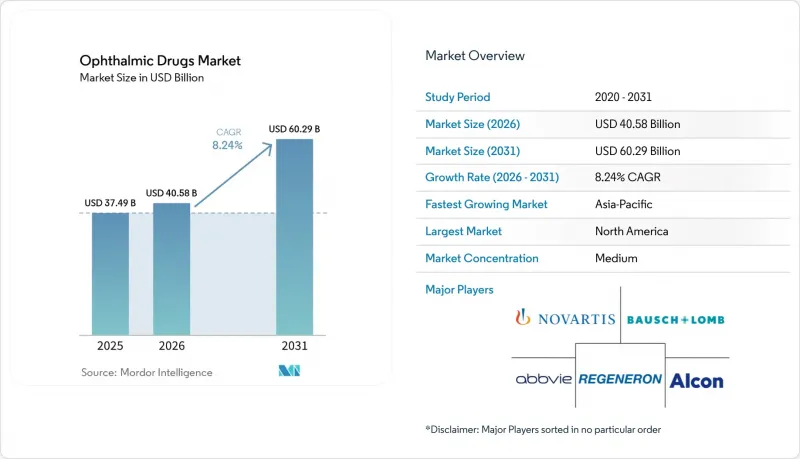
Mordor Intelligence에 의하면, 안과용 의약품 시장 규모는 2025년에 374억 9,000만 달러로 평가되었고, 2026년 405억 8,000만 달러에서 2031년까지 602억 9,000만 달러에 이를 것으로 추정되며, 예측 기간(2026-2031년) CAGR은 8.24%를 나타낼 전망입니다.
본 보고서는 약물 분류별(녹내장 치료, 안구건조증 치료, 기타), 적응증별(녹내장, 안구건조증, 기타), 제형별(점안액, 연고·젤, 기타), 제품 유형별(처방약, 일반의약품), 유통 채널별(병원 약국, 기타), 지역별(북미, 유럽, 기타)로 분류되어 있습니다. 시장 전망은 금액(달러) 기준으로 제시되어 있습니다.
세계의 안과용 의약품 시장 동향 및 인사이트
고령화와 만성 안과 질환 유병률의 급증
세계 평균 수명의 연장에 따라 60세 이상 인구가 증가하고 있으며, 유엔의 예측에 따르면 2050년까지 그 수는 21억 명으로 두 배로 늘어날 것으로 전망됩니다. 고령화는 녹내장, 노인성 황반변성, 백내장 진단과 강한 상관관계가 있으며, 이에 따라 보험사들은 예방적 선별검사를 우선시하고 있습니다. 일본은 이러한 과제를 여실히 보여주고 있습니다. 2026년에는 고령자 비율이 29%에 달할 전망이지만, 이와 병행하여 2020년 이후 녹내장 진단 건수가 12% 증가하면서 클리닉의 수용 능력에 부담이 가중되고, 재택 모니터링 및 분기별 임플란트에 대한 수요를 부추기고 있습니다. 현재 의료 제도에서는 치료 비용을 억제하기 위해 자가 투약이나 외래 치료가 권장되고 있으며, 제약사는 내원 빈도를 줄여주는 지속형 임플란트 개발을 서두르고 있습니다. 이러한 동향은 안과용 의약품 시장, 특히 서방형 제제의 성장 여지를 더욱 확대시키고 있습니다. 또한 벤처 자금도 진료 현장 밖에서 치료 관리를 가능하게 하는 디지털 복약 관리 앱과 연동되는 의료기기에 집중되고 있어, 안과용 의약품 시장 전체에 새로운 기회를 창출하고 있습니다.
당뇨병 유병률 상승이 망막 질환 치료를 견인
당뇨병성 망막병증과 황반부종은 당뇨병의 확산과 밀접한 관련이 있습니다. 국제당뇨병연맹(IDF)의 예측에 따르면, 2045년까지 성인 당뇨병 환자 수는 7억 8,300만 명에 달할 것으로 전망됩니다. 미국 식품의약국(FDA)은 2023년에 'EYLEA HD'를 승인하여 유리체 내 투여 간격을 16주로 연장함으로써, 유효성을 유지하면서도 의료기관의 부담을 줄였습니다. 제넨텍(Genentech)의 포트 투여 시스템 ‘Susvimo’는 2024년에 승인되어, 수익원이 일회용 주사기에서 리필용 카트리지로 전환되었습니다. 이러한 혁신은 연금형 현금 흐름을 창출하며, 안과 의약품 시장의 망막 질환 부문에서 경쟁을 심화시키고 있습니다. 지급 기관들은 수술 비용 절감 효과를 인식하고, 주사 빈도를 줄여주는 기술에 대해 환급 정책의 유연성을 보이고 있습니다. 그 결과, 자본 배분은 높은 가격 책정과 고객 충성도를 확보할 수 있는 의료기기 지원형 투여 방식으로 전환되고 있으며, 이는 안과 의약품 시장 전체에 대한 투자를 더욱 강화하고 있습니다.
특허 만료와 제네릭 의약품의 부상으로 인한 이익률 압박
루센티스의 바이오시밀러는 2022년 유럽에서, 2024년에는 30% 할인된 가격으로 판매가 시작되어 기존 제품의 매출 성장세를 둔화시켰습니다. 또한, 미국 시장에서 방부제 무첨가 티모롤 제네릭이 기존 브랜드 제품보다 40% 저렴한 가격으로 출시되면서 가격은 더욱 하락했습니다. 선발 제약사는 서방형 제제나 고용량 제제로 대응하고 있지만, 메디케어의 가격 협상 조항으로 인해 압박은 더욱 가중되고 있습니다. 그 결과, 대체 제품이 시장에 정착할 때까지 단기적인 매출 감소로 인해 안과용 의약품 시장의 확대가 둔화될 것입니다.
부문 분석
망막 치료는 2025년에 가장 큰 매출 증가를 기록했으며, 연평균 성장률(CAGR) 16.25%로 확대되고 있습니다. 한편, 2025년 안과용 의약품 시장 점유율의 27.56%를 차지한 녹내장 치료는 다소 완만한 속도로 확대되고 있습니다. 고용량 항-VEGF 생물학적 제제 및 유전자 치료제가 상업 유통 경로에 진입함에 따라, 망막 치료 시장 규모는 더욱 확대될 전망입니다. 아펠리스(Apellis)사의 ‘Syfovre’는 지리적 위축에 대한 최초의 병변 진행 억제 치료제로 출시되어, 100만 명 이상의 미국 환자층을 확보했습니다. 바우슈앤롬(Bausch & Lomb)의 지질계 제제 ‘미보(Mevo)’가 주도하는 안구건조증 치료 시장은 직장인 성인층의 디지털 화면 사용으로 인한 눈의 피로를 배경으로 계속해서 두 자릿수 성장을 기록하고 있습니다. 항감염제 부문에서는 항생제 내성에 대한 우려가 과제로 대두되고 있지만, 2024년에 승인된 4세대 플루오로퀴놀론계 항생제는 더 광범위한 적응증을 표기하고 있습니다. '록라탄'과 같은 병용 요법은 투여 일정을 간소화하여 고가 책정의 정당성을 뒷받침하고 있지만, 가격에 대한 민감도가 높아 여전히 틈새 시장 영역에 머물러 있습니다.
2026-2031년 투자는 위험이 완화된 환급 채널을 갖춘 망막 및 안구건조증 치료 기전에 집중될 전망입니다. 녹내장 치료 분야의 혁신은 획기적인 변화라기보다는 점진적인 변화를 반영하며, 방부제가 포함되지 않거나 주 1회 점안하는 안약에 초점이 맞추어져 있습니다. 자본 흐름도 이러한 분화를 반영하고 있으며, 벤처 자금은 망막 유전자 치료 플랫폼에 집중되는 반면, 사모펀드는 제네릭 녹내장 제제의 생산 규모 확대를 지원하고 있습니다.
망막 질환 적응증은 2025년 매출의 35.53%를 차지했으며, 1회 주사당 2,000달러를 초과하는 치료법이 많아 가격 결정력을 유지하고 있습니다. 백내장 수술 증가에 힘입은 안구 감염 및 염증 시장은 연평균 성장률(CAGR) 12.85%를 나타낼 것으로 전망됩니다. 안구건조증 치료는 Tyrvaya 비강 스프레이와 같은 대체 투여 경로에 힘입어 성장하고 있으며, 콘택트렌즈 착용자나 장시간 화면을 사용하는 직업군에 대한 접근성이 확대되고 있습니다. 녹내장 처방량은 여전히 높은 수준을 유지하고 있으나, 제네릭 의약품의 부상으로 매출 성장세는 둔화되고 있습니다. 알레르기성 결막염은 안정적이지만, OTC(일반의약품)로의 전환이 진행되면서 처방 건수는 감소 추세를 보이고 있습니다. 노안 치료 시장은 부상하고 있으며, Vuity의 2023년 출시는 약리학적 조절 기능 조절의 유효성을 입증하는 계기가 되었습니다.
부문별 차이는 앞으로도 지속될 전망입니다. 망막 치료는 생물학적 제제 및 유전자 치료의 발전으로 가장 큰 혜택을 받는 반면, 감염증 치료는 신규 항생제를 활용하여 약물 내성에 대응하는 데 우위를 점하고 있습니다. 녹내장 시장을 노리는 제약사는 성장을 재활성화하기 위해 신경 보호 관점이나 의료기기를 활용한 복약 순응도 솔루션을 추구해야 합니다.
지역별 분석
북미는 항-VEGF 주사제에 대한 메디케어 파트 B 적용 및 프리미엄 인공수정체의 조기 도입에 힘입어 2025년 매출의 42.13%를 차지했습니다. 이 지역은 높은 의사 밀도와 높은 진단률의 혜택을 받아 1인당 지출 수준을 높게 유지하고 있습니다. 캐나다와 멕시코는 시장 규모는 작지만, 제네릭 의약품의 도입이 진행되면서 단가는 억제되는 반면 접근성은 확대되고 있습니다. EYLEA HD와 같은 경쟁 신제품의 출시로 바이오의약품의 입지가 공고해졌으며, 지불자 측의 체계에서도 내원 횟수를 줄이는 혁신적인 치료법에 대한 보험 급여가 지속되고 있습니다.
유럽은 성숙한 시장이지만 규제가 엄격한 시장 환경입니다. 유럽의약품청(EMA)의 일원화된 승인으로 인해 여러 국가에서의 출시가 효율화되고 있지만, 각국의 의료기술 평가에서는 실세계 데이터가 요구되어 이익률이 압박받고 있습니다. 독일, 프랑스, 영국은 여전히 출시 우선 지역이지만, 참조 가격 제도에 따라 가격 상승은 억제되고 있습니다. 유럽의 안과용 의약품 시장 규모는 수술 자원 사용에 대한 비용 상쇄 효과를 입증한 서방형 제제의 승인으로 인해 꾸준히 확대되고 있습니다. 기후 변화를 배경으로 한 방부제 규제는 이 지역에서 더욱 엄격하여, 조기 제제 개량에 대한 투자가 불가피합니다.
아시아태평양은 2031년 연평균 성장률(CAGR)이 12.21%로 가장 빠르게 성장하고 있는 지역이며, 중국의 보험 적용 품목 목록 확대와 인도의 원료의약품(API) 자급자족 노력이 성장을 주도하고 있습니다. 도시화와 근시의 확산으로 인해 녹내장 및 망막 질환 치료에 대한 수요가 증가하고 있습니다. 일본에서는 고령 인구로 인해 처방량이 계속해서 높은 수준을 유지하고 있는 반면, 호주와 한국은 디지털 복약 준수 플랫폼의 조기 도입 거점으로 부상하고 있습니다. 현지 제약 기업들은 생산 연계형 인센티브를 활용해 지역 시장 점유율을 확보하고 있으며, 경쟁은 치열해지고 있지만 환자에 대한 접근성도 확대되고 있습니다. 동남아시아 국가들은 전문의 부족을 보완하기 위해 원격 안과 의료에 투자하고 있으며, 온라인 약국 채널을 통해 처방전을 유도하고 있습니다.
라틴아메리카, 중동 및 아프리카는 전체적으로 여전히 기여도가 미미하지만, 낮은 기저 수준에서 두 자릿수 성장을 기록하고 있습니다. 브라질의 제네릭 의약품 제조업체들은 안약 생산을 확대하고 있으며, 걸프협력회의(GCC) 회원국들은 시력 관리 인프라 구축에 투자하고 있습니다. 환율 변동과 관세 장벽으로 인해 고가 바이오의약품의 보급은 둔화되고 있지만, 실명을 줄이기 위한 공중보건 캠페인 덕분에 기초 치료에 대한 수요는 확보되고 있습니다.
기타 혜택
- 엑셀 형식 시장 예측(ME) 시트
- 3개월간의 애널리스트 지원
자주 묻는 질문
목차
제1장 서론
제2장 조사 방법
제3장 주요 요약
제4장 시장 구도
제5장 시장 규모 및 성장 예측
제6장 경쟁 구도
제7장 시장 기회 및 향후 전망
AJY 26.08.11According to Mordor Intelligence, the ophthalmic drugs market size was valued at USD 37.49 billion in 2025 and is estimated to grow from USD 40.58 billion in 2026 to reach USD 60.29 billion by 2031, at a CAGR of 8.24% during the forecast period (2026-2031).
This report is Segmented by Drug Class (Anti-Glaucoma Drugs, Dry Eye Drugs, and More), Indication (Glaucoma, Dry Eye Syndrome, and More), Dosage Form (Eye Drops, Ointments & Gels, and More), Product Type (OTC Drugs and Prescription Drugs), Distribution Channel (Hospital Pharmacies, and More), and Geography (North America, Europe, and More). The Market Forecasts are Provided in Terms of Value (USD).
Global Ophthalmic Drugs Market Trends and Insights
Aging Population And Chronic Ocular Disease Prevalence Surge
Global life expectancy gains are swelling the population aged 60 and above, which the United Nations forecasts will double to 2.1 billion by 2050. Higher age correlates strongly with glaucoma, macular degeneration, and cataract diagnoses, prompting payers to prioritize preventative screening. Japan illustrates the pressure point: a 29% senior-citizen share in 2026 coincides with a 12% rise in glaucoma diagnoses since 2020, taxing clinic capacity and propelling demand for at-home monitoring and quarterly implants. Health systems now encourage self-administered or outpatient therapies to contain procedure costs, pushing manufacturers toward long-acting inserts that reduce visit frequency. These dynamics amplify the ophthalmic drugs market's growth runway, especially for sustained-release formats. Venture funding also gravitates toward devices that pair with digital adherence apps to manage therapy outside clinical settings, creating new opportunities across the ophthalmic drugs market.
Rising Diabetes Incidence Driving Retinal Disorder Therapies
Diabetic retinopathy and macular edema track the diabetes epidemic, which the International Diabetes Federation expects to swell to 783 million adults by 2045. The U.S. FDA cleared EYLEA HD in 2023, extending intravitreal dosing intervals to 16 weeks, lessening clinic loads while preserving efficacy. Genentech's Susvimo port-delivery system earned approval in 2024, shifting revenue toward refill cartridges rather than episodic injections. These innovations create annuity-style cash flows and intensify competition in the retinal segment of the ophthalmic drugs market. Payers, recognizing avoided procedure costs, have demonstrated reimbursement flexibility for technologies that cut injection frequency. Consequently, capital allocation is tilting toward device-assisted delivery that can secure premium pricing and loyalty, further strengthening investment across the ophthalmic drugs market.
Patent Expiries And Generic Erosion Compressing Margins
Lucentis biosimilars entered Europe in 2022 and the United States in 2024 at 30% discounts, slicing incumbents' revenue trajectories. Generic timolol prices fell further when preservative-free versions debuted in the U.S. market at 40% below legacy brands. Innovators respond with extended-release or high-dose variants, yet Medicare price-negotiation clauses amplify pressure. Net effect: short-term revenue declines that temper ophthalmic drugs market expansion until replacement products scale.
Other drivers and restraints analyzed in the detailed report include:
- Rx-to-OTC Switches Expanding Consumer Access
- Gene And Cell-Therapy Pipeline Attracting New Capital
- High Formulation Complexity And Stringent Sterility Regulations
For complete list of drivers and restraints, kindly check the Table Of Contents.
Segment Analysis
Retinal therapeutics generated the largest revenue increment in 2025 and are advancing at a 16.25% CAGR, while anti-glaucoma drugs, which held 27.56% of the ophthalmic drugs market share in 2025, are expanding more slowly. The ophthalmic drugs market size for retinal therapies will expand further as high-dose anti-VEGF biologics and gene therapies move into commercial channels. Apellis's Syfovre launched the first lesion-slowing treatment for geographic atrophy, unlocking a U.S. patient pool exceeding 1 million. Dry eye therapeutics, led by Bausch + Lomb's lipid-based Miebo, continue to post double-digit growth owing to digital-screen fatigue in working adults. Anti-infective lines suffer from antimicrobial-resistance concerns; however, fourth-generation fluoroquinolones approved in 2024 offer broader coverage. Combination therapies like Rocklatan simplify regimens and justify premiums but remain niche because of price sensitivity.
During 2026-2031, investment gravitates toward retinal and dry eye mechanisms with de-risked reimbursement pathways. Anti-glaucoma innovation focuses on preservative-free or once-weekly drops, reflecting incremental rather than breakthrough change. Capital flows mirror this divergence: venture funding chases retinal gene therapy platforms, while private equity backs manufacturing scale-ups for generic glaucoma formulations.
Retinal indications secured 35.53% of 2025 sales and maintain pricing power because therapies often cost more than USD 2,000 per injection. Ocular infections and inflammation, buoyed by rising cataract surgeries, are predicted to post a 12.85% CAGR. Dry eye therapies receive a lift from alternative delivery modes like Tyrvaya's nasal spray, widening access for contact-lens wearers and screen-heavy professionals. Glaucoma volumes remain high but revenue growth lags due to generics. Allergic conjunctivitis is steady yet migratory toward OTC, thinning prescription tallies. Presbyopia treatments are emerging, with Vuity's 2023 launch validating pharmacologic accommodation modulation.
Segment differentials will persist: retinal care benefits most from biologic and gene therapy advances, while infections leverage novel antibiotics to stay ahead of resistance. Manufacturers aiming at glaucoma need neuroprotective angles or device-based adherence solutions to reignite growth.
Complete Report Scope:
- By Drug Class
- Anti-glaucoma Drugs
- Dry Eye Drugs
- Anti-inflammatory Drugs
- Anti-infective Drugs
- Retinal Disorder Drugs
- Anti-allergy Drugs
- Combination Therapies
- By Indication
- Glaucoma
- Dry Eye Syndrome
- Retinal Disorders
- Allergic Conjunctivitis
- Ocular Infections & Inflammation
- Others (Presbyopia, Post-surgical, Rare Diseases)
- By Dosage Form
- Eye Drops
- Ointments & Gels
- Capsules & Tablets
- Implants & Inserts
- Sprays & Nasal Delivery
- By Product Type
- Prescription Drugs
- OTC Drugs
- By Distribution Channel
- Hospital Pharmacies
- Retail Pharmacies & Drug Stores
- Online Pharmacies
- Geography
- North America
- United States
- Canada
- Mexico
- Europe
- Germany
- United Kingdom
- France
- Italy
- Spain
- Rest of Europe
- Asia-Pacific
- China
- Japan
- India
- South Korea
- Australia
- Rest of Asia-Pacific
- Middle East & Africa
- GCC
- South Africa
- Rest of Middle East & Africa
- South America
- Brazil
- Argentina
- Rest of South America
- North America
Geography Analysis
North America generated 42.13% of 2025 revenue, supported by Medicare Part B coverage of anti-VEGF injections and early uptake of premium implants. The region benefits from robust clinician density and high diagnostic rates, sustaining elevated per-capita spending levels. Canada and Mexico, while smaller, exhibit generic adoption that tempers unit prices but broadens access. Competitive launches like EYLEA HD cement biologics' hold, and payer frameworks continue to reimburse innovations that reduce clinic visits.
Europe represents a mature yet regulation-intensive landscape. Centralized EMA approvals streamline multi-nation launches, but national health technology assessments demand real-world evidence, compressing margins. Germany, France, and the United Kingdom remain launch priorities, though reference pricing keeps price escalation in check. The ophthalmic drugs market size in Europe grows steadily from sustained-release approvals that demonstrate cost offset against surgical resource use. Climate-driven preservative restrictions are steeper here, compelling earlier reformulation investment.
Asia-Pacific is the fastest-growing territory at a 12.21% CAGR through 2031, propelled by China's expanded reimbursement list and India's API self-sufficiency pushes. Urbanization and myopia epidemics add demand for glaucoma and retinal therapies. Japan's senior population maintains high prescription volumes, while Australia and South Korea serve as early-adopter hubs for digital adherence platforms. Local manufacturers leverage production-linked incentives to capture regional share, sharpening price competition but also enlarging patient reach. Southeast Asian nations invest in tele-ophthalmology to bridge specialist shortages, funneling prescriptions through online pharmacy channels.
Latin America and the Middle East & Africa collectively remain modest contributors but register double-digit growth off low bases. Brazilian generic houses are scaling topical formulations, and Gulf Cooperation Council nations invest in vision-care infrastructure. Currency volatility and tariff barriers temper premium biologic uptake, yet public-health campaigns to reduce blindness ensure baseline therapy demand.
- Abbvie
- Aerie Pharmaceutical
- Alcon
- Alimera Sciences Inc.
- Apellis Pharmaceuticals Inc.
- Bausch & Lomb Corporation
- Bayer
- EyePoint Pharmaceuticals Inc.
- Roche
- Glaukos
- Johnson & Johnson
- Nicox
- Novaliq
- Novartis
- Ocular Therapeutix Inc.
- Otsuka
- Regeneron Pharmaceuticals
- Santen Pharmaceuticals
- Sun Pharmaceuticals Industries
- Teva Pharmaceutical Industries
- Viatris
Additional Benefits:
- The market estimate (ME) sheet in Excel format
- 3 months of analyst support
TABLE OF CONTENTS
1 Introduction
- 1.1 Study Assumptions & Market Definition
- 1.2 Scope of the Study
2 Research Methodology
3 Executive Summary
4 Market Landscape
- 4.1 Market Overview
- 4.2 Market Drivers
- 4.2.1 Aging population & chronic ocular disease prevalence surge
- 4.2.2 Rising diabetes incidence driving retinal disorder therapies
- 4.2.3 Rx-to-OTC switches expanding consumer access
- 4.2.4 Gene & cell-therapy pipeline attracting new capital
- 4.2.5 AI-assisted drug discovery shortening development cycles
- 4.2.6 Localized API manufacturing triggered by tariff & supply-chain risk
- 4.3 Market Restraints
- 4.3.1 Patent expiries & generic erosion compressing margins
- 4.3.2 High formulation complexity and stringent sterility regulations
- 4.3.3 Patient non-adherence to multi-dose regimens limiting efficacy
- 4.3.4 Climate-driven preservative bans raising reformulation costs
- 4.4 Supply-Chain Analysis
- 4.5 Regulatory Landscape
- 4.6 Technological Outlook
- 4.7 Porter's Five Forces Analysis
- 4.7.1 Threat of New Entrants
- 4.7.2 Bargaining Power of Buyers/Consumers
- 4.7.3 Bargaining Power of Suppliers
- 4.7.4 Threat of Substitute Products
- 4.7.5 Intensity of Competitive Rivalry
5 Market Size & Growth Forecasts (Value, USD)
- 5.1 By Drug Class
- 5.1.1 Anti-glaucoma Drugs
- 5.1.2 Dry Eye Drugs
- 5.1.3 Anti-inflammatory Drugs
- 5.1.4 Anti-infective Drugs
- 5.1.5 Retinal Disorder Drugs
- 5.1.6 Anti-allergy Drugs
- 5.1.7 Combination Therapies
- 5.2 By Indication
- 5.2.1 Glaucoma
- 5.2.2 Dry Eye Syndrome
- 5.2.3 Retinal Disorders
- 5.2.4 Allergic Conjunctivitis
- 5.2.5 Ocular Infections & Inflammation
- 5.2.6 Others (Presbyopia, Post-surgical, Rare Diseases)
- 5.3 By Dosage Form
- 5.3.1 Eye Drops
- 5.3.2 Ointments & Gels
- 5.3.3 Capsules & Tablets
- 5.3.4 Implants & Inserts
- 5.3.5 Sprays & Nasal Delivery
- 5.4 By Product Type
- 5.4.1 Prescription Drugs
- 5.4.2 OTC Drugs
- 5.5 By Distribution Channel
- 5.5.1 Hospital Pharmacies
- 5.5.2 Retail Pharmacies & Drug Stores
- 5.5.3 Online Pharmacies
- 5.6 Geography
- 5.6.1 North America
- 5.6.1.1 United States
- 5.6.1.2 Canada
- 5.6.1.3 Mexico
- 5.6.2 Europe
- 5.6.2.1 Germany
- 5.6.2.2 United Kingdom
- 5.6.2.3 France
- 5.6.2.4 Italy
- 5.6.2.5 Spain
- 5.6.2.6 Rest of Europe
- 5.6.3 Asia-Pacific
- 5.6.3.1 China
- 5.6.3.2 Japan
- 5.6.3.3 India
- 5.6.3.4 South Korea
- 5.6.3.5 Australia
- 5.6.3.6 Rest of Asia-Pacific
- 5.6.4 Middle East & Africa
- 5.6.4.1 GCC
- 5.6.4.2 South Africa
- 5.6.4.3 Rest of Middle East & Africa
- 5.6.5 South America
- 5.6.5.1 Brazil
- 5.6.5.2 Argentina
- 5.6.5.3 Rest of South America
- 5.6.1 North America
6 Competitive Landscape
- 6.1 Market Concentration
- 6.2 Market Share Analysis
- 6.3 Company Profiles (includes Global level Overview, Market level overview, Core Segments, Financials as available, Strategic Information, Market Rank/Share for key companies, Products & Services, and Recent Developments)
- 6.3.1 AbbVie (Allergan)
- 6.3.2 Aerie Pharmaceuticals Inc.
- 6.3.3 Alcon Inc.
- 6.3.4 Alimera Sciences Inc.
- 6.3.5 Apellis Pharmaceuticals Inc.
- 6.3.6 Bausch & Lomb Corporation
- 6.3.7 Bayer AG
- 6.3.8 EyePoint Pharmaceuticals Inc.
- 6.3.9 F. Hoffmann-La Roche Ltd
- 6.3.10 Glaukos Corporation
- 6.3.11 Johnson & Johnson Vision
- 6.3.12 Nicox SA
- 6.3.13 Novaliq GmbH
- 6.3.14 Novartis AG
- 6.3.15 Ocular Therapeutix Inc.
- 6.3.16 Otsuka Pharmaceutical Co. Ltd
- 6.3.17 Regeneron Pharmaceuticals Inc.
- 6.3.18 Santen Pharmaceutical Co. Ltd
- 6.3.19 Sun Pharmaceutical Industries Ltd.
- 6.3.20 Teva Pharmaceutical Industries Ltd.
- 6.3.21 Viatris Inc.
7 Market Opportunities & Future Outlook
- 7.1 White-space & Unmet-need Assessment


