|
시장보고서
상품코드
2100495
항공교통 관리 시장 : 시장 점유율 분석, 업계 동향 및 통계, 성장 예측(2026-2031년)Air Traffic Management - Market Share Analysis, Industry Trends & Statistics, Growth Forecasts (2026 - 2031) |
||||||
 Mordor Intelligence
Mordor Intelligence에 의하면, 항공교통 관리 시장 규모는 2025년 115억 5,000만 달러로 평가되었고, 2026년에는 125억 1,000만 달러로 확대될 것으로 추정되고, 2026-2031년 CAGR 8.28%로 성장을 지속할 전망이며, 2031년에는 186억 2,000만 달러에 이를 것으로 예측됩니다.
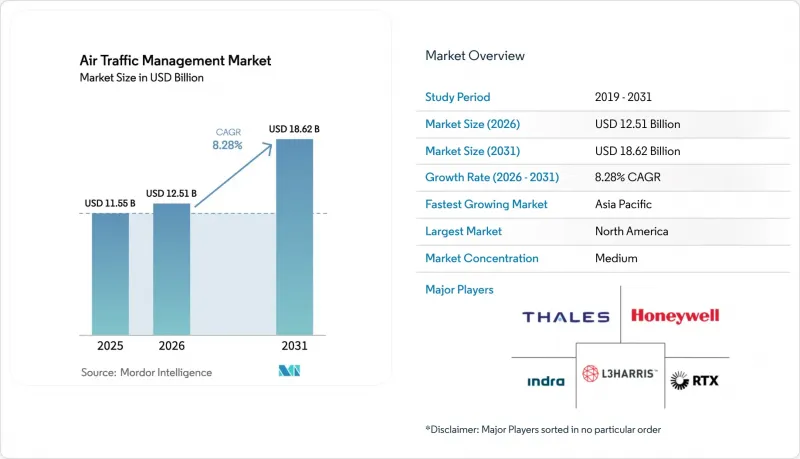
본 보고서는 분야별(항공교통관제, 항공교통량 및 용량 관리, 항공정보 관리 등), 컴포넌트별(하드웨어, 소프트웨어, 서비스), 용도별(통신, 항법, 감시 등), 최종 용도별(민간 항공 등), 지역별(북미, 유럽 등)로 분류되어 있습니다. 시장 전망은 금액(달러) 기준으로 제시되어 있습니다.
세계의 항공 교통 관리 시장 동향 및 인사이트
증가하는 항공 교통을 뒷받침하는 공항 인프라 확충
아시아태평양 및 중동에서의 공항 확장이 첨단 지상 이동 관리 시스템(A-SMGCS) 및 다점 측위 시스템의 수주를 촉진하고 있습니다. 베이징 다싱 공항의 위성 터미널은 연간 4,500만 명의 여객 수용 능력을 증강하기 위해 지상 레이더, ADS-B, 카메라 분석을 실시간으로 융합하는 차세대 A-SMGCS가 필요했습니다. 인도는 37개 공항을 디지털 관제탑 및 다점 측위 시스템으로 현대화하기 위해 12억 달러를 투자하여, 안전 여유를 유지하면서 관제사의 업무 부담을 줄이고 있습니다. 사우디아라비아는 2030년까지 여객 처리 능력을 두 배로 늘리는 것을 목표로, 위성 기반 보강 시스템을 활용해 2개의 허브 공항을 업그레이드하기 위해 8억 달러를 투자하기로 결정했습니다. 각 프로젝트에서는 활주로 시설, 항로 관제 센터, 조종실의 항공 전자 장비를 연결하는 통합된 디지털 기반이 구축되어, 더 이상 기존의 레이더에만 의존할 수 없는 지속적인 교통량 증가에 대비하여 이 지역을 자리매김하고 있습니다. IATA의 예측에 따르면, 2030년까지 아시아태평양은 전 세계 항공 교통량의 50%를 차지할 것으로 예상되며, 이러한 현대화는 단순한 선택적 업그레이드가 아닌 필수적인 과제가 되었습니다.
ADS-B 및 성능 기반 항법(PBN)에 관한 규제 요건
ADS-B 및 PBN(성능 기반 항법)에 관한 규제로 인해 항공 교통 관리 시장의 하드웨어 및 소프트웨어 업그레이드 주기가 단축되고 있습니다. FAA(미국 연방항공청) 규정에서는 이미 ADS-B Out이 의무화되어 있으며, 2024년에 발행된 권고 문서에서는 교통 상황 파악을 위해 ADS-B In을 활용하는 조종실 디스플레이 도입이 권장되고 있습니다. 유럽에서는 2025년까지 140개 공항으로 PBN 요건을 확대하고, 연료 효율이 더 높은 항로를 실현함으로써 편당 평균 연료 소비량을 5-8% 절감하고 있습니다. 일본에서는 FL 290 이상의 고도에서 적용되는 ADS-B 규제로 인해 레이더의 퇴역 및 위성 지상국 도입이 진행되었습니다. 규제 준수는 즉각적인 하드웨어 수요를 유발하는 동시에 지속적인 소프트웨어 비즈니스 기회도 창출하고 있습니다. 이는 원시 ADS-B 데이터 스트림을 처리할 때 관제사의 과부하를 방지하기 위해 고도의 필터링이 필요하기 때문입니다. ICAO 보고서에 따르면, 2025년까지 전 세계 ADS-B 커버리지는 85%에 달할 전망이지만, 상호 운용성 문제는 여전히 남아 있습니다.
가상화 및 네트워크 중심 시스템의 사이버 보안 위험
IP 기반 클라우드 아키텍처로의 전환으로 인해 새로운 공격 표면이 드러나고 있습니다. GAO의 감사 결과, 데이터 통신의 인증 취약점이 밝혀졌으며, 이에 따라 2025년까지 다단계 인증을 통한 로그인이 의무화될 예정입니다. EUROCONTROL의 기록에 따르면, 2025년에는 항공교통관제기관(ANSP)에 대한 침입 시도가 34% 증가했으며, 이러한 공격은 위성 링크와 ADS-B 데이터 스트림을 표적으로 삼았습니다. ICAO 부속서 17의 개정안에서는 사이버 보안 관리가 의무화되었으며, 준수 기한은 2030년까지로 정해져 있어 단기적인 위험에 노출되고 있습니다. 유럽의 ANSP는 2028년까지 사이버 보안 강화에 5억 유로(5억 8,662만 달러)를 투자할 계획이며, 이로 인해 용량 증강 프로젝트에서 자금이 재배정되면서 단기적인 지출 증가세가 둔화되고 있습니다.
부문 분석
2025년 매출 중 ATC(항공교통관제)가 47.80%를 차지했으며, 드론 도입 및 eVTOL 네트워크의 보급에 따라 UTM(무인기 교통관리)은 연평균 성장률(CAGR) 11.00%로 성장을 지속하고 있습니다. 전 세계 여객편의 90%가 여전히 관제사와 조종사 간의 음성 통신에 의존하고 있기 때문에 ATC 용도를 위한 항공 교통 관리 시장 규모는 여전히 큰 임베디드니다. 미국 내 89개 지역에서 진행된 STARS 업그레이드를 통해 충돌 감지 능력이 향상되었으며, 기존 체계 내에서도 점진적인 효율성이 개선되고 있음이 확인되었습니다. EUROCONTROL의 AI 지원 슬롯 할당기는 2025년에 하루 3만 건 이상의 비행 계획을 처리하고 있으며, 기존 ATC를 전면적으로 대체하지 않고도 머신러닝 계층을 통합할 수 있음을 보여주고 있습니다. 한편, UTM의 ‘디지털 퍼스트’ 설계는 자동 충돌 회피, 전자 ID 및 클라우드 오케스트레이션을 지원합니다. 유럽의 28개 U-space 구역과 중국에서 승인된 드론 비행 경로는 상업적 실현 가능성을 입증하고 있습니다.
이에 따라 병행 인프라가 부상하고 있습니다. 탈레스(Thales)와 플렉켄티스(Frequentis)의 하이브리드 플랫폼은 이미 공유된 상황 인식 계층을 통해 기존 항공 교통 관제와 저고도 드론 관리를 연결하고 있습니다. 전 세계 드론 비행 횟수가 2030년까지 하루 1,000만 편에 달할 것이라는 ICAO의 예측을 넘어섬에 따라, 통합된 API를 풍부하게 갖춘 솔루션에 대한 수요는 더욱 높아질 것입니다. 하드웨어 제조보다 소프트웨어를 통한 오케스트레이션에 주력하는 신규 진출기업들은 시장에서 호의적으로 받아들여지고 있으며, 기존 레이더의 업그레이드를 넘어서는 새로운 가치의 원천을 창출하고 있습니다.
레이더, ADS-B 안테나, VHF 무전기의 조달 주기가 장기간에 걸칩니다는 점을 감안할 때, 하드웨어 시장 점유율은 여전히 64.10%를 차지하고 있지만, 소프트웨어는 연평균 성장률(CAGR) 8.65%로 확대되고 있습니다. 항공 교통 관리 시장에서 하드웨어 점유율은 스페인의 1억 2,000만 유로(1억 3,050만 달러) 규모의 Mode S 도입과 같은 다년 계약에 의해 뒷받침되고 있습니다. L3Harris사의 9,500만 미 달러 규모의 군사 관제탑 업그레이드 프로젝트는 솔리드 스테이트 레이더에 대한 방위 분야 수요를 보여줍니다. 그러나 가상화된 비행 데이터 프로세서 및 구독형 의사결정 지원 제품군도 성장세를 보이고 있습니다. NAV CANADA는 클라우드 기반 비행 데이터 시스템으로 전환한 후 On-Premise 서버를 60% 감축하며 비용 면에서의 우위를 입증했습니다.
관제사가 감시 데이터, 기상 데이터, 항공사의 선호도를 반영한 예측 분석에 점점 더 의존함에 따라 소프트웨어의 가치는 높아지고 있습니다. SESAR는 2027년까지 AI 기반 비행 경로 예측 및 관제사 워크스테이션을 클라우드 클러스터로 이전하는 가상 관제 센터에 6억 유로(6억 2,354만 달러)를 배정했습니다. Airspace Intelligence가 AI 비행 최적화 플랫폼을 위해 3,400만 달러의 자금 조달에 성공한 것에서도 알 수 있듯이, 스타트업 기업들은 현재 경량 API 모듈을 제공함으로써 경쟁력을 발휘할 수 있게 되었습니다. 지속적인 라이선싱 수익은 벤더의 수익 구조를 혁신적으로 변화시켜, 협상력의 균형을 민첩한 개발자 측으로 기울게 하고 있습니다.
지역별 분석
북미는 2025년 매출의 32.65%를 차지했으며, 성숙한 NextGen 자산과 세계 최초의 우주 기반 ADS-B 네트워크를 활용했습니다. FAA의 데이터 통신을 통한 텍스트 클리어런스는 수백만 건의 메시지를 처리하여 피크 시간대의 관제사 업무 부담을 줄이는 동시에 활주로 처리 능력을 향상시키고 있습니다. NAV CANADA의 극지 감시 시스템은 15해리 간격의 운항을 실현하여 항공사의 연간 연료비를 3억 달러 절감하는 동시에, 해당 지역의 혁신 리더십을 강화했습니다. 인력 부족은 여전히 지속되고 있으며, 시설의 14%가 최적 인원 수 미만으로 운영되고 있어 초과 근무가 불가피하고 피로 위험이 높아지고 있습니다.
아시아태평양은 연평균 성장률(CAGR) 8.80%로 가장 빠른 성장세를 기록하고 있으며, 중국은 위성 보완 시스템에 17억 달러를 투자하고, 인도는 12억 달러를 투입해 37개 공항의 현대화 계획을 시행하고 있습니다. 일본의 ADS-B 의무화로 인해 레이더 퇴역이 가속화되고 있으며, 싱가포르의 SAF 최적화 하강 시험은 지속가능성 측면에서 이 지역의 리더십을 입증하고 있습니다. 많은 국가들이 기존 레이더 단계를 건너뛰고 위성 CNS/ATM으로 전환함으로써 도입 기간을 단축하고 장기적인 유지 관리 비용을 절감하고 있습니다. 그러나 동남아시아와 오세아니아의 일부 지역에서는 자금 조달 격차로 인해 여전히 전 지역 커버리지가 지연되고 있으며, 하위 지역 전체적으로 준비 상황에 편차가 발생하고 있습니다.
유럽은 ‘단일 유럽 영공(Single European Sky)’ 정책 및 ‘SESAR 디지털 스카이’ 이니셔티브에 따라 진전을 보이고 있으며, 16억 유로(18억 8,000만 달러)를 클라우드 서비스 및 가상 관제 센터에 투자하고 있습니다. U-space를 28개 구역으로 확대함으로써, 이 지역은 드론 교통의 선구자로서의 위상을 확립하는 한편, 침입 건수가 34% 급증함에 따라 사이버 보안 강화에도 주력하고 있습니다. 중동에서는 대규모 투자가 이루어지고 있습니다. 사우디아라비아는 8억 달러를 투입해 SBAS 업그레이드를 실시하고, 2030년까지 여객 수를 두 배로 늘리는 것을 목표로 하고 있습니다. UAE는 원격 관제탑을 도입해 관제를 일원화하며, 기술의 비약적인 발전에 대한 의지를 보이고 있습니다. 남미와 아프리카는 자금 면의 제약으로 인해 뒤처져 있으며, 아프리카 국가 중 ADS-B 인프라를 보유한 곳은 불과 18개국에 그치고, 다점 측위에 의한 커버리지도 여전히 불균일한 상황입니다. 브라질에서는 세계은행의 대출이 현대화 노력을 뒷받침하고 있지만, 전반적인 도입 상황은 고소득국의 수준에는 미치지 못하고 있습니다.
기타 혜택 :
- 엑셀 형식 시장 예측(ME) 시트
- 3개월간의 애널리스트 지원
자주 묻는 질문
목차
제1장 서론
제2장 조사 방법
제3장 주요 요약
제4장 시장 구도
제5장 시장 규모 및 성장 예측
제6장 경쟁 구도
제7장 시장 기회 및 향후 전망
AJY 26.08.07According to Mordor Intelligence, the air traffic management market size is expected to grow from USD 11.55 billion in 2025 to USD 12.51 billion in 2026 and is forecast to reach USD 18.62 billion by 2031, at an 8.28% CAGR over 2026-2031.
This report is Segmented by Domain (Air Traffic Control, Air Traffic Flow and Capacity Management, Aeronautical Information Management, and More), Component (Hardware, Software, and Services), Application (Communication, Navigation, Surveillance, and More), End-Use (Commercial Aviation, and More), and Geography (North America, Europe, and More). The Market Forecasts are Provided in Terms of Value (USD).
Global Air Traffic Management Market Trends and Insights
Expansion Of Airport Infrastructure To Support Increasing Air Traffic
Asia-Pacific and Middle Eastern airport expansions are catalyzing orders for advanced surface-movement and multilateration systems. Beijing Daxing's satellite terminal added capacity for 45 million annual passengers and required a next-generation A-SMGCS that fuses ground radar, ADS-B, and camera analytics in real time. India awarded USD 1.2 billion to modernize 37 airports with digital towers and multilateration, compressing controller workload while preserving safety margins. Saudi Arabia has committed USD 800 million to upgrade two hubs with satellite-based augmentation, aiming to double passenger throughput by 2030. Each project establishes an integrated digital backbone that links runway assets, en-route centers, and cockpit avionics, positioning the region for sustained traffic growth that can no longer rely solely on legacy radar. IATA forecasts that the Asia-Pacific region will host 50% of global traffic by 2030, making modernization a necessity rather than a discretionary upgrade.
Regulatory Mandates For ADS-B And Performance-Based Navigation
ADS-B and PBN rules are compressing upgrade cycles in both hardware and software in the Air Traffic Management Market. FAA mandates already require ADS-B Out, and advisory texts issued in 2024 incentivize cockpit displays that leverage ADS-B In for traffic situational awareness. Europe extended PBN requirements to 140 airports by 2025, enabling more fuel-efficient routings and reducing average consumption by 5-8% per flight. Japan's ADS-B rule above FL 290 drove radar retirements and satellite ground-station deployments. Compliance flows stimulate immediate hardware demand while creating sustained software opportunities, as raw ADS-B data streams require sophisticated filtering to avoid controller overload. ICAO reports 85% global ADS-B coverage by 2025, though interoperability gaps remain.
Cybersecurity Risks In Virtualized And Network-Centric Systems
Migration to IP-based, cloud architectures exposes fresh attack surfaces. A GAO audit revealed authentication weaknesses in Data Comm, prompting the implementation of mandatory multi-factor logins by 2025. EUROCONTROL logged a 34% rise in ANSP intrusion attempts in 2025, with probes targeting satellite links and ADS-B streams. ICAO's Annex 17 amendment mandates cybersecurity management yet allows compliance deadlines up to 2030, creating near-term risk exposure. European ANSPs plan to spend EUR 500 million (USD 586.62 million) on cyber hardening through 2028, redirecting funds from capacity projects and tempering short-term spending momentum.
Other drivers and restraints analyzed in the detailed report include:
- Rising Commercial Drone Operations Necessitating U-Space/UTM Integration
- Major Investments In NextGen And SESAR Digital-Sky Programs
- High Capital Requirements For Satellite CNS/ATM
For complete list of drivers and restraints, kindly check the Table Of Contents.
Segment Analysis
ATC controlled 47.80% of 2025 revenue, UTM shows 11.00% CAGR as drone deliveries and eVTOL networks proliferate. The air traffic management market size for ATC applications remains large because 90% of global passenger flights still depend on controller-pilot voice channels. STARS upgrades at 89 US sites improved conflict detection, illustrating incremental efficiency gains inside legacy paradigms. EUROCONTROL's AI-assisted slot allocator processed over 30,000 daily flight plans in 2025, signaling that machine-learning layers can be grafted on existing ATC without wholesale replacement. Conversely, UTM's digital-first design supports automated de-confliction, electronic IDs, and cloud orchestration. Europe's 28 U-space zones and China's licensed drone corridors prove commercial viability.
Parallel infrastructure is therefore emerging. Hybrid platforms from Thales and Frequentis already bridge classical air traffic control with low-altitude drone management through shared situational-awareness layers. As global drone flights exceed ICAO's projection of 10 million daily by 2030, demand for unified, API-rich solutions will intensify. Entrants focusing on software orchestration rather than hardware fabrication find a receptive market, creating new sources of value beyond traditional radar upgrades.
Hardware still holds a 64.10% share, given the long procurement cycles for radars, ADS-B antennas, and VHF radios; however, software is advancing at an 8.65% CAGR. The air traffic management market share for hardware remains anchored by multi-year contracts, such as Spain's EUR 120 million (USD 130.50 million) Mode S rollout. L3Harris' USD 95 million military tower upgrade shows defense demand for solid-state radars. However, virtualized flight-data processors and subscription-based decision-support suites are gaining traction. NAV CANADA cut on-premise servers by 60% after moving to a cloud flight-data system, proving cost advantages.
Software's value increases as controllers rely on predictive analytics that ingest data from surveillance, weather, and airline preferences. SESAR allocated EUR 600 million (USD 623.54 million) through 2027 for AI trajectory prediction and virtual centers that relocate controller workstations into cloud clusters. Startups can now compete by offering lightweight API modules, as evidenced by Airspace Intelligence's USD 34 million raise for its AI flight-optimization platform. Recurring licensing revenue reshapes vendor economics, tilting the balance of bargaining power toward agile developers.
Complete Report Scope:
- By Domain
- Air Traffic Control (ATC)
- Air Traffic Flow and Capacity Management (ATFCM)
- Aeronautical Information Management (AIM)
- Unmanned Traffic Management (UTM)
- By Component
- Hardware
- Software
- Services
- By Application
- Communication
- Navigation
- Surveillance
- Automation and Decision-Support
- By End-use
- Commercial Aviation
- Military and Government
- Urban Air Mobility (UAM) and Drone Operators
- By Geography
- North America
- United States
- Canada
- Mexico
- Europe
- United Kingdom
- France
- Germany
- Italy
- Rest of Europe
- Asia-Pacific
- China
- India
- Japan
- South Korea
- Australia
- Rest of Asia-Pacific
- South America
- Brazil
- Rest of South America
- Middle East and Africa
- Middle East
- United Arab Emirates
- Saudi Arabia
- Qatar
- Rest of Middle East
- Africa
- South Africa
- Rest of Africa
- Middle East
- North America
Geography Analysis
North America commanded 32.65% revenue in 2025, leveraging mature NextGen assets and the world's first space-based ADS-B network. FAA Data Comm text clearances handle millions of messages, reducing controller workload and increasing runway throughput during peak periods. NAV CANADA's polar surveillance unlocked 15-nautical-mile spacing, generating USD 300 million annual airline fuel savings and reinforcing the region's innovation leadership. Staffing shortages persist; 14% of facilities operate below optimal headcount, which compels overtime and raises the risk of fatigue.
The Asia-Pacific region records the fastest growth at 8.80% CAGR, as China invests USD 1.7 billion in satellite augmentation and India executes a USD 1.2 billion, 37-airport modernization plan. Japan's ADS-B mandate accelerates the retirement of radar, and Singapore's SAF-optimized descent trials demonstrate regional leadership in sustainability. Many states leapfrog legacy radar toward satellite CNS/ATM, compressing deployment timelines and lowering long-term maintenance costs. However, financing gaps in parts of Southeast Asia and Oceania still delay full coverage, creating mixed readiness levels across the sub-region.
Europe progresses under the Single European Sky policy and the SESAR Digital Sky initiative, channeling EUR 1.6 billion (USD 1.88 billion) into cloud services and virtual centers. U-space expansion to 28 zones positions the bloc as a drone-traffic pioneer, while also emphasizing cybersecurity following a 34% surge in intrusions. The Middle East invests heavily: Saudi Arabia's USD 800 million SBAS upgrade aims to double passenger counts by 2030. UAE deploys remote towers to centralize control, demonstrating appetite for technology leapfrogs. South America and Africa lag due to capital constraints; only 18 African states possess ADS-B infrastructure, and multilateration coverage remains patchy. World Bank loans underpin modernization efforts in Brazil, but overall uptake lags behind that of high-income peers.
- Thales Group
- RTX Corporation
- L3Harris Technologies, Inc.
- Indra Sistemas. S.A.
- Honeywell International Inc.
- Leonardo S.p.A
- Frequentis AG
- Saab AB
- Adacel Technologies Limited
- Advanced Navigation and Positioning Corporation
- SITA N.V.
- Northrop Grumman Corporation
- NATS
- NAV CANADA
- Aena, S.M.E.
- Kongsberg Gruppen ASA
Additional Benefits:
- The market estimate (ME) sheet in Excel format
- 3 months of analyst support
TABLE OF CONTENTS
1 INTRODUCTION
- 1.1 Study Assumptions and Market Definition
- 1.2 Scope of the Study
2 RESEARCH METHODOLOGY
3 EXECUTIVE SUMMARY
4 MARKET LANDSCAPE
- 4.1 Market Overview
- 4.2 Market Drivers
- 4.2.1 Expansion of airport infrastructure to support increasing air traffic
- 4.2.2 Regulatory mandates for ADS-B and performance-based navigation (PBN)
- 4.2.3 Rising commercial drone operations necessitating U-space/UTM integration
- 4.2.4 Major investments in NextGen and SESAR digital sky programs
- 4.2.5 Adoption of AI-based air traffic flow management solutions
- 4.2.6 Incentives for sustainable flight paths and SAF-compatible ATM systems
- 4.3 Market Restraints
- 4.3.1 Cybersecurity risks in virtualized and network-centric ATM systems
- 4.3.2 High capital requirements for transitioning from radar to satellite-based CNS/ATM
- 4.3.3 Air navigation service provider (ANSP) workforce gaps and controller fatigue
- 4.3.4 Lack of regulatory alignment for cross-border UTM implementation
- 4.4 Value Chain Analysis
- 4.5 Regulatory Landscape
- 4.6 Technological Outlook
- 4.7 Porter's Five Forces Analysis
- 4.7.1 Bargaining Power of Suppliers
- 4.7.2 Bargaining Power of Buyers/Consumers
- 4.7.3 Threat of New Entrants
- 4.7.4 Threat of Substitute Products
- 4.7.5 Intensity of Competitive Rivalry
5 MARKET SIZE AND GROWTH FORECASTS (VALUE)
- 5.1 By Domain
- 5.1.1 Air Traffic Control (ATC)
- 5.1.2 Air Traffic Flow and Capacity Management (ATFCM)
- 5.1.3 Aeronautical Information Management (AIM)
- 5.1.4 Unmanned Traffic Management (UTM)
- 5.2 By Component
- 5.2.1 Hardware
- 5.2.2 Software
- 5.2.3 Services
- 5.3 By Application
- 5.3.1 Communication
- 5.3.2 Navigation
- 5.3.3 Surveillance
- 5.3.4 Automation and Decision-Support
- 5.4 By End-use
- 5.4.1 Commercial Aviation
- 5.4.2 Military and Government
- 5.4.3 Urban Air Mobility (UAM) and Drone Operators
- 5.5 By Geography
- 5.5.1 North America
- 5.5.1.1 United States
- 5.5.1.2 Canada
- 5.5.1.3 Mexico
- 5.5.2 Europe
- 5.5.2.1 United Kingdom
- 5.5.2.2 France
- 5.5.2.3 Germany
- 5.5.2.4 Italy
- 5.5.2.5 Rest of Europe
- 5.5.3 Asia-Pacific
- 5.5.3.1 China
- 5.5.3.2 India
- 5.5.3.3 Japan
- 5.5.3.4 South Korea
- 5.5.3.5 Australia
- 5.5.3.6 Rest of Asia-Pacific
- 5.5.4 South America
- 5.5.4.1 Brazil
- 5.5.4.2 Rest of South America
- 5.5.5 Middle East and Africa
- 5.5.5.1 Middle East
- 5.5.5.1.1 United Arab Emirates
- 5.5.5.1.2 Saudi Arabia
- 5.5.5.1.3 Qatar
- 5.5.5.1.4 Rest of Middle East
- 5.5.5.2 Africa
- 5.5.5.2.1 South Africa
- 5.5.5.2.2 Rest of Africa
- 5.5.5.1 Middle East
- 5.5.1 North America
6 COMPETITIVE LANDSCAPE
- 6.1 Market Concentration
- 6.2 Strategic Moves
- 6.3 Market Share Analysis
- 6.4 Company Profiles (includes Global-level Overview, Market-level Overview, Core Segments, Financials, Strategic Info, Market Rank/Share, Products and Services, and Recent Developments)
- 6.4.1 Thales Group
- 6.4.2 RTX Corporation
- 6.4.3 L3Harris Technologies, Inc.
- 6.4.4 Indra Sistemas. S.A.
- 6.4.5 Honeywell International Inc.
- 6.4.6 Leonardo S.p.A
- 6.4.7 Frequentis AG
- 6.4.8 Saab AB
- 6.4.9 Adacel Technologies Limited
- 6.4.10 Advanced Navigation and Positioning Corporation
- 6.4.11 SITA N.V.
- 6.4.12 Northrop Grumman Corporation
- 6.4.13 NATS
- 6.4.14 NAV CANADA
- 6.4.15 Aena, S.M.E.
- 6.4.16 Kongsberg Gruppen ASA
7 MARKET OPPORTUNITIES AND FUTURE OUTLOOK
- 7.1 White-space and Unmet-Need Assessment