

|
시장보고서
상품코드
2100501
방탄복 시장 : 시장 점유율 분석, 업계 동향 및 통계, 성장 예측(2026-2031년)Body Armor - Market Share Analysis, Industry Trends & Statistics, Growth Forecasts (2026 - 2031) |
||||||
 Mordor Intelligence
Mordor Intelligence에 의하면, 방탄복 시장 규모는 2025년 30억 1,000만 달러로 평가되었고, 2026년에는 31억 5,000만 달러로 확대될 것으로 추정되고, 2026-2031년 CAGR 4.47%로 성장을 지속할 전망이며, 2031년에는 39억 2,000만 달러에 이를 것으로 예측됩니다.
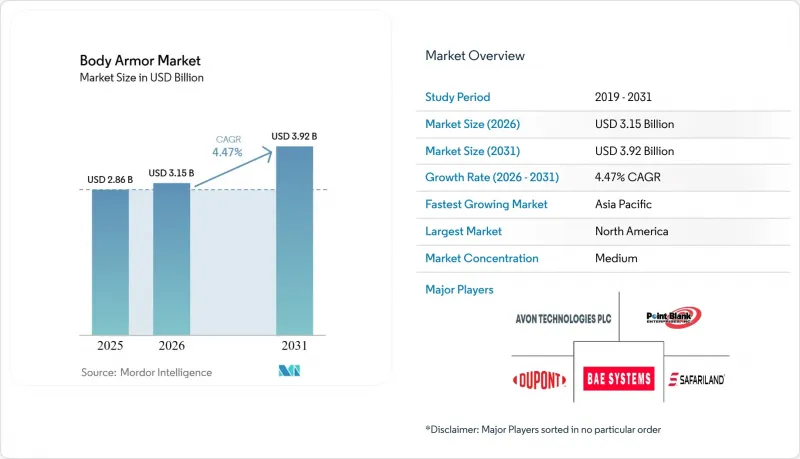
본 보고서는 방호 장비 유형별(소프트 아머, 하드 아머, 헬멧, 방패, 기타), 보호 등급별(레벨 IIA, 레벨 II, 레벨 IIIA, 레벨 III, 레벨 III+, 레벨 IV), 최종 사용자별(국방, 법 집행 기관, 민간 및 민간 경비), 지역별(북미, 유럽, 아시아태평양, 남미, 중동 및 아프리카)로 분류되어 있습니다. 시장 전망은 금액(달러) 기준으로 제시되어 있습니다.
세계의 방탄복 시장 동향 및 인사이트
국방 예산 증가 및 병사 현대화 프로그램
2024년 전 세계 군사 지출은 2조 4,400억 달러에 달할 전망이며, 이에 따른 조달 계획으로 인해 방탄복에 대한 다년간의 자금 공급이 확보되고 있습니다. 미 육군의 통합 시각 증강 시스템(IVAS), 차세대 분대용 무기(NGSW), 병사 보호 시스템(SPS)에는 2030년까지 220억 달러 이상이 배정될 전망이며, 플레이트 캐리어에 열화상 조준경 및 디지털 네트워크 모듈이 결합될 예정입니다. 인도의 ‘미래 보병 병사 시스템(Future Infantry Soldier as a System)’ 프로그램에서는 국내 생산 목표가 의무화되어 있어, 이를 통해 MKU Limited를 비롯한 현지 기업들의 공장 확장이 촉진되고 있습니다. 한국의 ‘워리어 플랫폼’에는 2027년까지 배치될 예정인 외골격 대응 캐리어가 포함되어 있어, 방탄복 선정에 있어 인체공학이 미치는 영향을 보여주고 있습니다. 방탄복 시장 전망은 장기적으로 밝지만, 고정 가격 계약으로 인해 공급업체는 원자재 가격 급등이라는 위험에 노출되어 있습니다.
격화되는 지정학적 분쟁과 테러 위협
우크라, 이스라엘, 대만에서의 대규모 소비로 인해 NATO 회원국들은 재고 보충 주문을 가속화할 수밖에 없게 되었으며, 이는 공급망 전체에 급격한 수요 급증을 초래하고 있습니다. 서유럽의 경찰 특수부대는 2024년 파리와 브뤼셀에서 발생한 테러 사건을 계기로 외관상 뚜렷하게 드러나는 플레이트 캐리어를 채택했으며, 이로 인해 외관상 뚜렷하게 드러나는 방탄복의 매출이 높은 수준을 기록했습니다. 이러한 수요 급증은 일시적이긴 하지만 규모가 커서, 전장에서의 소모율에 비해 재고 완충 여력이 여전히 부족한 이유를 여실히 드러내고 있습니다. 제조업체는 긴급한 수요를 활용하는 한편, 분쟁 종결 후 수요 감소라는 위험을 관리해야 합니다. 따라서 방탄복 시장은 완만하지만 지속적인 현대화의 물결 위에, 단기적인 수익 급증을 경험하고 있습니다.
고성능 방탄판의 높은 비용
레벨 IV 세라믹 방탄판의 소매 가격은 500-900달러로, 이 가격대는 소규모 법 집행 기관의 장비 예산을 압박하고 많은 민간인의 구매 의욕을 꺾고 있습니다. 제조 과정에는 2,200°C에서의 소결과 엄격한 균열 검사가 필요하며, 이로 인해 높은 에너지 비용과 높은 불량률이 발생하고 있습니다. 새롭게 등장한 3D 프린팅 제작 플레이트는 25%의 비용 절감이 예상되지만, 널리 보급되기 위해서는 내구성 데이터가 확립되어야 합니다. 이러한 비용 차이로 인해 소총 위협에 대한 방어 성능은 소프트 아머보다 우수함에도 불구하고, 소프트 아머가 여전히 인기를 유지하고 있습니다. 그 결과, 특히 민간 시장에서 가격은 방탄복 시장의 성장을 제한하는 요인이 되고 있습니다.
부문 분석
2025년 매출에서 소프트 아머가 차지하는 비중은 46.21%였으나, 연평균 성장률(CAGR) 5.54%로 예측되는 하드 아머는 방탄 장갑 시장의 주요 성장 동력으로서의 입지를 확고히 했습니다. 군사 분야에서는 7.62×51 mm 관통탄을 차단하는 세라믹·폴리에틸렌 재질의 인서트가 실전에 배치되어 있으며, 플레이트 대응 캐리어는 미 육군 보병의 표준 장비로 자리 잡았습니다. 헬멧과 방패는 비교적 소규모의 틈새 시장을 형성하고 있지만, 이들 역시 유사한 소재 기술의 발전으로 인한 혜택을 받고 있습니다.
소프트 아머는 가볍고 제복 아래에 숨겨 착용할 수 있기 때문에 일상적인 경찰 활동에서 여전히 필수적입니다. Point Blank의 퀵 릴리스 방식 조끼와 흡습발산성이 뛰어난 라이너는 일상적인 착용감을 향상시키고 있습니다. 이러한 차이는 방탄 장갑 시장에서 사용자의 임무가 구매 결정을 좌우하고 있음을 여실히 보여줍니다.
지역별 분석
2025년 매출액 중 북미가 44.31%를 차지했습니다. 이는 주로 군인용 시스템에 123억 달러를 배정하고 있는 8,420억 달러 규모의 미국 국방 예산에 힘입은 결과입니다. 연방 정부의 방탄복 지원금 및 주 정부 보조금으로 인해 교체 주기가 단축되고 있는 한편, 캐나다의 19억 캐나다 달러(13억 7,000만 달러) 규모의 ‘통합 병사 시스템 프로젝트’가 해당 지역의 수주를 뒷받침하고 있습니다.
아시아태평양은 5.84%라는 가장 높은 연평균 성장률(CAGR)을 보이고 있는데, 이는 중국이 200만 명의 병사를 위해 차세대 방호 플레이트를 조달하고 있으며, 인도가 ' 아트마니르바르 바라트(Atmanirbhar Bharat)’ 정책 하에 국산 부품 채택을 강력히 요구하고 있는 것이 원동력이 되고 있습니다. 또한, 한국에서 향후 도입될 외골격 대응 캐리어는 인체공학적 혁신을 한층 더 촉진할 것입니다.
유럽에서는 NATO 회원국들이 우크라이나에 보낸 비축 물자를 보충하는 과정에서 지출이 가속화되고 있으며, 독일은 2만 5,000벌의 방호복을 발주했고, 폴란드는 2억 3,000만 달러를 투자해 장비를 업그레이드하고 있습니다. 중동에서는 분쟁이 지속되는 가운데, 사우디아라비아 군사산업(SAMI)이 현지에서 레벨 IV 방탄 플레이트를 공동 생산하고 있어, 해당 지역은 계속해서 견조한 수요를 유지하고 있습니다. 남미와 아프리카는 국방 예산 제약으로 인해 뒤처지고 있지만, 브라질 국가경찰이 2024년에 레벨 IIIA 방탄복 8,000벌을 조달한 것은 점진적인 진전이 나타나고 있음을 보여줍니다.
기타 혜택
- 엑셀 형식 시장 예측(ME) 시트
- 3개월간의 애널리스트 지원
자주 묻는 질문
목차
제1장 서론
제2장 조사 방법
제3장 주요 요약
제4장 시장 구도
제5장 시장 규모 및 성장 예측
제6장 경쟁 구도
제7장 시장 기회 및 향후 전망
AJY 26.08.11According to Mordor Intelligence, the body armor market size is expected to grow from USD 3.01 billion in 2025 to USD 3.15 billion in 2026 and is forecast to reach USD 3.92 billion by 2031 at a 4.47% CAGR over 2026-2031.
This report is Segmented by Armor Type (Soft Armor, Hard Armor, Helmets, Shields, and Others), Protection Level (Level IIA, Level II, Level IIIA, Level III, Level III+, and Level IV), End User (Defense, Law Enforcement, and Civilian and Private Security), and Geography (North America, Europe, Asia-Pacific, South America, and Middle East and Africa). The Market Forecasts are Provided in Terms of Value (USD).
Global Body Armor Market Trends and Insights
Rise in Defense Budgets and Soldier Modernization Programs
Global military expenditure reached USD 2.44 trillion in 2024, and the resulting procurement pipelines guarantee multi-year funding for ballistic protection. The US Army's Integrated Visual Augmentation System (IVAS), Next Generation Squad Weapon (NGSW), and Soldier Protection System (SPS) are expected to allocate more than USD 22 billion through 2030, bundling plate carriers with thermal sights and digital networking modules. India's Future Infantry Soldier as a System program mandates domestic production targets that spur factory expansions by MKU Limited and other local firms. South Korea's Warrior Platform includes exoskeleton-ready carriers, slated for fielding by 2027, demonstrating the influence of ergonomics on armor decisions. Long-term visibility is positive for the body armor market, although fixed price contracts expose suppliers to the risk of raw material inflation.
Escalating Geopolitical Conflicts and Terrorism Threats
Large-scale consumption in Ukraine, Israel, and Taiwan forces NATO states to accelerate replenishment orders, creating abrupt spikes that roll through supply chains. Police tactical units in Western Europe adopted overt plate carriers following the 2024 Paris and Brussels attacks, driving overt-wear sales to higher levels. Such surges are temporary yet sizable, underscoring why inventory buffers remain small relative to battlefield burn rates. Manufacturers capitalize on urgent requirements but must manage the risk of post-conflict demand drops. The body armor market thus experiences short-term revenue bursts atop a slower but durable modernization wave.
High Cost of Advanced Hard-Armor Plates
Level IV ceramic plates retail between USD 500 and USD 900, a price range that exhausts equipment budgets at smaller law enforcement agencies and deters many civilians from purchasing them. Production relies on 2,200°C sintering and rigorous crack inspection, driving high energy bills and scrap rates. Emerging 3D-printed tiles promise a 25% cost cut but require durability data before widespread adoption. The expense gap keeps soft armor popular even though rifle-threat protection is superior. As a result, price acts as a ceiling on the body armor market, especially in civilian channels.
Other drivers and restraints analyzed in the detailed report include:
- Increasing Demand for Ballistic Protection Among Law-Enforcement Agencies
- Advancements in Lightweight Composite Materials
- Stringent NIJ Certification and Testing Timelines
For complete list of drivers and restraints, kindly check the Table Of Contents.
Segment Analysis
Soft armor accounted for 46.21% of 2025 revenue, while hard armor, with a forecasted 5.54% CAGR, positioned itself as a principal growth engine for the body armor market. Military forces field ceramic-polyethylene inserts that stop 7.62X51 mm armor-piercing rounds, and plate-ready carriers are the baseline issue for US infantry. Helmets and shields form smaller niches, but they benefit from the same material advances.
Soft armor remains essential for routine policing because it is lightweight and can be concealed under uniforms. Quick-release vest designs and moisture-wicking liners from Point Blank improve daily wearability. The divergence highlights how the user's mission drives purchase decisions within the body armor market.
Complete Report Scope:
- By Armor Type
- Soft Armor
- Hard Armor
- Helmets
- Shields
- Others
- By Protection Level
- Level IIA
- Level II
- Level IIIA
- Level III
- Level III+
- Level IV
- By End User
- Defense
- Law Enforcement
- Civilian and Private Security
- By Geography
- North America
- United States
- Canada
- Mexico
- Europe
- United Kingdom
- France
- Germany
- Italy
- Russia
- Rest of Europe
- Asia-Pacific
- China
- India
- Japan
- South Korea
- Australia
- Rest of Asia-Pacific
- South America
- Brazil
- Argentina
- Rest of South America
- Middle East and Africa
- Middle East
- Saudi Arabia
- United Arab Emirates
- Israel
- Rest of Middle East
- Africa
- South Africa
- Rest of Africa
- Middle East
- North America
Geography Analysis
North America accounted for 44.31% of 2025 revenue, primarily driven by the USD 842 billion US defense budget, which allocates USD 12.3 billion to soldier systems. Federal vest grants and state subsidies shorten replacement cycles, while Canada's CAD 1.90 billion (USD 1.37 billion) Integrated Soldier System Project sustains regional orders.
Asia-Pacific offers the swiftest 5.84% CAGR, propelled by China's next-generation plate purchases for 2 million troops and India's insistence on indigenous content under the Atmanirbhar Bharat policy. South Korea's upcoming exoskeleton-compatible carriers further advance ergonomic innovation.
Europe accelerates spending as NATO states replenish stocks sent to Ukraine, with Germany ordering 25,000 carriers and Poland investing USD 230 million in upgrades. The Middle East remains an enduring customer amid ongoing conflicts, where Saudi Arabian Military Industries co-produces Level IV plates locally. South America and Africa trail behind due to constrained defense budgets, although Brazil's national police procured 8,000 Level IIIA vests in 2024, signaling gradual progress.
- BAE Systems plc
- Point Blank Enterprises, Inc.
- Safariland, LLC
- Avon Technologies plc
- DuPont de Nemours, Inc.
- Honeywell International Inc.
- ArmorSource, LLC
- MKU Limited
- Rheinmetall AG
- Saab AB
- Revision Inc.
- Hesco Bastion Group
- United Shield International LLC
- Australian Defence Apparel Pty. Ltd.
- NFM Group AS
- Hardwire, LLC
- Spartan Armor Systems
- BulletSafe (Sellmark Corporation)
Additional Benefits:
- The market estimate (ME) sheet in Excel format
- 3 months of analyst support
TABLE OF CONTENTS
1 INTRODUCTION
- 1.1 Study Assumptions and Market Definition
- 1.2 Scope of the Study
2 RESEARCH METHODOLOGY
3 EXECUTIVE SUMMARY
4 MARKET LANDSCAPE
- 4.1 Market Overview
- 4.2 Market Drivers
- 4.2.1 Rise in defense budgets and soldier modernization programs
- 4.2.2 Escalating geopolitical conflicts and terrorism threats
- 4.2.3 Increasing demand for ballistic protection among law-enforcement agencies
- 4.2.4 Advancements in lightweight composite materials
- 4.2.5 Integration of IoT-enabled health-monitoring sensors in smart armor
- 4.2.6 Surge in civilian concealed-carry license holders
- 4.3 Market Restraints
- 4.3.1 High cost of advanced hard-armor plates
- 4.3.2 Stringent NIJ certification and testing timelines
- 4.3.3 Supply-chain volatility for high-grade polyethylene fibers
- 4.3.4 Environmental regulations on PFAS-based fabric treatments
- 4.4 Value Chain Analysis
- 4.5 Regulatory Landscape
- 4.6 Technological Outlook
- 4.7 Porter's Five Forces Analysis
- 4.7.1 Bargaining Power of Buyers
- 4.7.2 Bargaining Power of Suppliers
- 4.7.3 Threat of New Entrants
- 4.7.4 Threat of Substitutes
- 4.7.5 Competitive Rivalry
5 MARKET SIZE AND GROWTH FORECASTS (VALUE)
- 5.1 By Armor Type
- 5.1.1 Soft Armor
- 5.1.2 Hard Armor
- 5.1.3 Helmets
- 5.1.4 Shields
- 5.1.5 Others
- 5.2 By Protection Level
- 5.2.1 Level IIA
- 5.2.2 Level II
- 5.2.3 Level IIIA
- 5.2.4 Level III
- 5.2.5 Level III+
- 5.2.6 Level IV
- 5.3 By End User
- 5.3.1 Defense
- 5.3.2 Law Enforcement
- 5.3.3 Civilian and Private Security
- 5.4 By Geography
- 5.4.1 North America
- 5.4.1.1 United States
- 5.4.1.2 Canada
- 5.4.1.3 Mexico
- 5.4.2 Europe
- 5.4.2.1 United Kingdom
- 5.4.2.2 France
- 5.4.2.3 Germany
- 5.4.2.4 Italy
- 5.4.2.5 Russia
- 5.4.2.6 Rest of Europe
- 5.4.3 Asia-Pacific
- 5.4.3.1 China
- 5.4.3.2 India
- 5.4.3.3 Japan
- 5.4.3.4 South Korea
- 5.4.3.5 Australia
- 5.4.3.6 Rest of Asia-Pacific
- 5.4.4 South America
- 5.4.4.1 Brazil
- 5.4.4.2 Argentina
- 5.4.4.3 Rest of South America
- 5.4.5 Middle East and Africa
- 5.4.5.1 Middle East
- 5.4.5.1.1 Saudi Arabia
- 5.4.5.1.2 United Arab Emirates
- 5.4.5.1.3 Israel
- 5.4.5.1.4 Rest of Middle East
- 5.4.5.2 Africa
- 5.4.5.2.1 South Africa
- 5.4.5.2.2 Rest of Africa
- 5.4.5.1 Middle East
- 5.4.1 North America
6 COMPETITIVE LANDSCAPE
- 6.1 Market Concentration
- 6.2 Strategic Moves
- 6.3 Market Share Analysis
- 6.4 Company Profiles (includes Global level Overview, Market level overview, Core Segments, Financials as available, Strategic Information, Market Rank/Share for key companies, Products and Services, and Recent Developments)
- 6.4.1 BAE Systems plc
- 6.4.2 Point Blank Enterprises, Inc.
- 6.4.3 Safariland, LLC
- 6.4.4 Avon Technologies plc
- 6.4.5 DuPont de Nemours, Inc.
- 6.4.6 Honeywell International Inc.
- 6.4.7 ArmorSource, LLC
- 6.4.8 MKU Limited
- 6.4.9 Rheinmetall AG
- 6.4.10 Saab AB
- 6.4.11 Revision Inc.
- 6.4.12 Hesco Bastion Group
- 6.4.13 United Shield International LLC
- 6.4.14 Australian Defence Apparel Pty. Ltd.
- 6.4.15 NFM Group AS
- 6.4.16 Hardwire, LLC
- 6.4.17 Spartan Armor Systems
- 6.4.18 BulletSafe (Sellmark Corporation)
7 MARKET OPPORTUNITIES AND FUTURE OUTLOOK
- 7.1 White-space and Unmet-Need Assessment


