

|
시장보고서
상품코드
2100533
유럽의 자동차용 에어 필터 시장 : 시장 점유율 분석, 업계 동향 및 통계, 성장 예측(2026-2031년)Europe Automotive Air Filters - Market Share Analysis, Industry Trends & Statistics, Growth Forecasts (2026 - 2031) |
||||||
 Mordor Intelligence
Mordor Intelligence에 의하면, 유럽의 자동차용 에어 필터 시장 규모는 2025년에 36억 2,000만 달러로 평가되었고, 2026년 38억 4,000만 달러에서 2031년까지 51억 4,000만 달러에 이를 것으로 예측되며, 예측 기간(2026-2031년) CAGR은 6.02%를 나타낼 전망입니다.
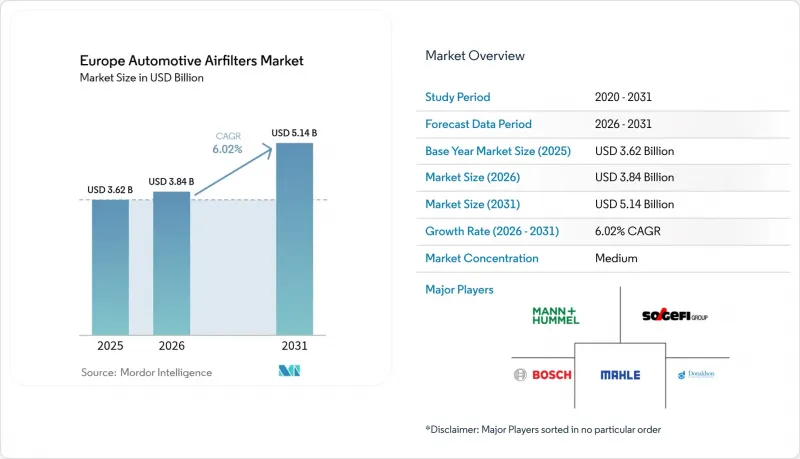
본 보고서는 소재 유형별(종이, 거즈 등), 필터 유형별(흡기 필터, 실내 공기 필터), 차량 유형별(승용차, 소형 상용차 등), 판매 채널별(OEM, 애프터마켓), 국가별로 분류되어 있습니다. 시장 전망은 금액(달러) 기준으로 제시되어 있습니다.
유럽의 자동차용 에어 필터 시장 동향 및 인사이트
차량의 노후화로 인해 독립 애프터마켓 수요 증가
서유럽 차량의 평균 연식은 2025년에 12년에 달했으나, 동유럽 차량은 15-20년에 이릅니다. 구형 내연기관(ICE) 모델의 경우 흡기 필터 및 캐빈 필터를 빈번하게 교체해야 하므로, 독립 정비 업체들은 경쟁력 있는 가격 책정과 폭넓은 SKU 취급을 통해 해당 지역의 애프터마켓에서 상당한 점유율을 확보하고 있습니다. BEV(배터리식 전기차)의 보급으로 인해 향후 흡기 필터 수요는 감소할 전망이지만, 남아 있는 ICE 차량이 장기적인 판매량을 보장하고 있어 적어도 한 번의 완전한 교체 주기를 거치는 동안 유럽 자동차용 에어 필터 시장은 견조한 모습을 유지할 것으로 보입니다. 애프터마켓 전문 기업들은 구형 플랫폼용 SKU 라인업을 확충하고, 자사 브랜드의 활성탄 캐빈 필터를 도입하는 한편, 분산된 지방의 차량 소유자들에게 다가서기 위해 전자상거래 마켓플레이스를 활용함으로써 이러한 동향에 대응하고 있습니다.
유로 7·유로 VI-D 배기가스 규제가 필터 교체 주기를 가속화
유럽연합 집행위원회는 2024년 5월 유로 7 규제를 발표하며, 가솔린 차량에 대해 10나노미터의 입자상 물질 기준치를 도입하는 한편, 배기관에서 배출되는 입자와 비배기 입자 모두에 대해 차량 수명 기간 동안의 적합성을 의무화했습니다. 차량 진단 시스템(OBD)을 통해 필터의 열화가 모니터링되게 됨에 따라, 흡기 필터와 캐빈 필터는 기존 제품보다 훨씬 더 오랜 기간 동안 성능을 유지해야 하며, 주행 거리가 많은 차량군의 경우 실제 사용 환경에서 교체 주기를 가능한 한 단축해야 합니다. 따라서 OEM 등급 공급업체들은 규제 인증을 취득하고, RFID 태그가 내장된 고수익률의 다층 엘리먼트를 세트로 판매함으로써 단위당 수익을 향상시키고, 유럽의 자동차용 에어필터 시장을 단순한 선택적 정비 부품이 아닌 규정 준수를 달성하기 위한 중요한 수단으로 자리매김하고 있습니다.
BEV의 보급으로 엔진 흡기용 에어필터 수요 감소
배터리식 전기차(BEV)는 연소용 에어필터가 필요하지 않기 때문에 신차 수요에서 흡기 필터의 전체 부품 목록이 제외됩니다. 독일에서는 2024년에 135만 대의 EV가 조립되었으며, 차량군 평균 CO₂ 배출 규제에 따라 2025년에는 167만 대를 목표로 하고 있습니다. 한편, 노르웨이의 신차 시장에서는 BEV의 점유율이 과반수를 차지하게 되었습니다. 따라서 유럽의 자동차용 에어필터 시장은 특히 전동화가 가장 빠르게 진행되고 있는 프리미엄 부문에서 구조적인 판매량 감소라는 역풍에 직면해 있습니다. 반면, 캐빈 필터, 배터리 팩 냉각용 마이크로 필터, 에어 드라이어 카트리지 분야에서는 성장이 나타나고 있으나, 차량 1대당 평균 탑재 수는 감소 추세를 보이고 있습니다. 중기적인 매출에 미치는 영향은 기존에 그 이익률로 연구개발(R&D) 예산을 충당해 온 고부가가치 흡기 필터에 집중되어 있으며, 공급업체들은 복합 소재를 활용한 캐빈 필터나 열 관리 관련 틈새 시장으로의 사업 전환을 강요받고 있습니다.
부문 분석
2025년, 종이 필터는 유럽 자동차용 에어 필터 시장 점유율의 55.62%를 차지하며, 대량 생산되는 승용차 라인 전반에 걸쳐 신뢰성 높은 통기 저항과 비용 효율성을 실현했습니다. 이 전통적인 기질은 성숙한 공급망과 지역적인 펄프 가공 능력의 혜택을 받아 수십 년에 걸쳐 유럽 자동차용 에어필터 시장 규모를 지탱해 왔습니다. 그러나 소비자들이 제한된 차량 실내 공간에서 휘발성 유기 화합물(VOC)의 흡착 및 알레르겐 중화를 요구하는 가운데, 활성탄 및 신흥 복합 소재 필터는 2031년까지 연평균 성장률(CAGR) 6.32%로 시장을 주도하고 있습니다.
각 OEM 업체들은 셀룰로오스 골격 위에 나노섬유를 적층하여 10나노미터 크기의 입자를 포집하면서도 압력 손실을 15 Pa 미만으로 억제하는 하이브리드 시트를 개발하고 있습니다. 거즈와 폼은 각각 성능 최적화나 비도로용 장비 분야의 틈새 시장 옵션으로 남아 있으며, 오일을 함침시킨 층이나 큰 기공이 먼지가 많은 환경에 적합합니다. 유로 7 규제가 정착됨에 따라 종이 필터의 점유율은 서서히 감소하고 있지만, 재활용 가능한 구성과 낮은 제조 에너지 소비량 덕분에 그 중요성은 유지되고 있으며, 유럽 자동차용 에어 필터 시장에서 완전히 대체되기보다는 공존이 보장될 전망입니다.
2025년 기준, 캐빈 필터는 유럽 자동차용 에어 필터 시장 규모의 60.78%를 차지했으며, 이러한 입지는 팬데믹 이후의 건강에 대한 우려, 도시 지역의 스모그 발생, 알레르기 인증의 마케팅적 매력으로 인해 더욱 공고해지고 있습니다. 이 부문은 2031년까지 연평균 성장률(CAGR) 6.18%로 성장하여 흡기 필터를 앞지르는 속도를 보일 전망입니다. 이는 대기 오염이 심한 대도시권에서는 교체 빈도가 연 2회에 달할 가능성이 있기 때문입니다. 각 OEM 업체들은 글러브 박스 뒤쪽에 필터 카트리지에 접근할 수 있는 경로를 마련해 두었으며, 이를 통해 사용자가 직접 교체하는 과정이 간소화되고, 독립 부품 소매업체들의 전자상거래 판매가 촉진되고 있습니다.
나머지 시장 점유율을 차지하는 흡기 필터는 BEV로의 전환이라는 과제에 직면해 있지만, 여전히 유럽의 방대한 기존 내연기관(ICE) 차량 군에 서비스를 제공합니다. 수요 변동에 따라 공급업체들은 실내용 및 HVAC용 미립자 필터와 같은 이중 기능 제품으로의 다각화를 모색하고 있습니다. 전기차(EV)의 경우, 실내 필터 선정이 HVAC의 에너지 소비량에 영향을 미치기 때문에 첨단 저압손실 설계 제품이 수익성이 높은 공장 출고 시 장착품으로 채택되고 있습니다. 커넥티드카의 대시보드는 미세 입자 축적이 급증할 경우 운전자에게 경고를 보내며, 이를 통해 적시에 필터를 교체하도록 유도함으로써 유럽 자동차용 에어 필터 시장 전체에서 프리미엄 제품의 가치가 유지되고 있습니다.
기타 혜택 :
- 엑셀 형식 시장 예측(ME) 시트
- 3개월간의 애널리스트 지원
자주 묻는 질문
목차
제1장 서론
제2장 조사 방법
제3장 주요 요약
제4장 시장 구도
제5장 시장 규모 및 성장 예측
제6장 경쟁 구도
제7장 시장 기회 및 향후 전망
AJY 26.08.11According to Mordor Intelligence, the Europe automotive air filters market size was valued at USD 3.62 billion in 2025 and estimated to grow from USD 3.84 billion in 2026 to reach USD 5.14 billion by 2031, at a CAGR of 6.02% during the forecast period (2026-2031).
This report is Segmented by Material Type (Paper, Gauze, and More), Filter (Intake Filters and Cabin Filters), Vehicle Type (Passenger Cars, Light Commercial Vehicles, and More), Sales Channel (OEM and Aftermarket), and Country. The Market Forecasts are Provided in Terms of Value (USD).
Europe Automotive Air Filters Market Trends and Insights
Ageing Car-Parc Expanding Independent Aftermarket Demand
Western Europe's average vehicle age reached 12 years in 2025, while Eastern European fleets stretch to 15-20 years. Older internal-combustion-engine (ICE) models require frequent intake and cabin filter swaps, and independent garages capture a considerable share of the regional aftermarket by offering competitive pricing and broad SKU coverage. Even as BEV penetration removes future intake filter demand, the residual ICE fleet guarantees long-dated volume, keeping the Europe automotive air filters market robust through at least one more full replacement cycle. Aftermarket specialists respond by widening SKU assortments for legacy platforms, introducing private-label activated-carbon cabin elements, and adopting e-commerce marketplaces to reach dispersed rural owners.
Euro 7 and Euro VI-D Emission Norms Accelerating Filter Replacement Cycles
The European Commission published Euro 7 rules in May 2024, introducing 10-nanometer particulate thresholds for gasoline vehicles and lifetime compliance for both tailpipe and non-exhaust particles. Because on-board diagnostics now monitor filter degradation, intake and cabin elements must sustain efficiency far longer than legacy, compressing real-world replacement to as low as possible in high-mileage fleets. OEM-grade suppliers therefore bundle higher-margin, multilayer elements that carry regulatory certificates and embedded RFID tags, lifting revenue per unit and reinforcing the Europe automotive air filters market as a critical compliance lever rather than a discretionary maintenance part.
BEV Adoption Shrinking Demand for Intake Engine Air-Filters
Battery-electric vehicles do not require combustion air filtration, removing entire intake filter bill-of-materials from new-vehicle demand. Germany assembled 1.35 million EVs in 2024 and is targeting 1.67 million units in 2025 under fleet-average CO2 rules, while Norway's new-car market reached majority of BEV share. The Europe automotive air filters market therefore confronts a structural volume headwind, chiefly in premium segments where electrification advances fastest. Counterbalancing growth arises in cabin filters, battery-pack cooling micro-filters, and air-drier cartridges-yet unit counts per vehicle fall on average. Medium-term revenue impact centers on high-value intake elements whose margins historically funded R&D budgets, compelling suppliers to pivot toward composite cabin and thermal-management niches.
Other drivers and restraints analyzed in the detailed report include:
- Heightened Consumer Focus on In-Cabin Air Quality and Allergies
- OEM Drive for Ultra-Low Pressure-Drop Media to Maximize EV Range
- Vehicle Downsizing Reducing Number/Size of Filter Elements
For complete list of drivers and restraints, kindly check the Table Of Contents.
Segment Analysis
Paper-based filters captured 55.62% of Europe automotive air filters market share in 2025, producing dependable airflow resistance and cost efficiency across high-volume passenger car lines. This traditional substrate underpinned Europe automotive air filters market size for decades, benefitting from mature supply chains and regional pulp processing capacity. Activated-carbon and emerging composite variants, however, are outpacing at 6.32% CAGR to 2031 as consumers demand volatile-organic-compound (VOC) adsorption and allergen neutralization within constrained cabin spaces.
OEMs are layering nanofibers atop cellulose backbones, creating hybrid sheets that trap 10-nanometer particles while holding pressure drops below 15 Pa. Gauze and foam remain niche options in performance tuning and off-highway equipment, respectively, where oil-impregnated layers or oversized pores suit dusty environments. As Euro 7 matures, paper's share erodes gradually but retains relevance due to recyclable composition and low embodied energy, ensuring coexistence rather than outright displacement inside the Europe automotive air filters market.
Cabin filters held 60.78% of the Europe automotive air filters market size in 2025, a position fortified by post-pandemic health concerns, urban smog episodes, and the marketing appeal of allergy certification. The segment grows at a 6.18% CAGR through 2031, outpacing intake filters, because replacement frequency can reach twice per year in polluted metropolitan zones. OEMs integrate filtration cartridge access behind glove boxes, simplifying do-it-yourself swaps and stimulating e-commerce sales by independent parts retailers.
Intake filters, covering the residual share, confront BEV substitution but still service Europe's large legacy ICE fleet. Turbulence in unit demand pushes suppliers to diversify toward dual-function cabin and HVAC micro-particle elements. Within EVs, cabin filter selection affects HVAC energy draw; thus, advanced low-pressure-drop designs win high-margin factory installs. Connected vehicle dashboards now alert drivers when particulate accumulation spikes, triggering timely replacements and preserving premium unit values across the Europe automotive air filters market.
Complete Report Scope:
- By Material Type
- Paper
- Gauze
- Foam
- Activated-carbon / Composite
- By Filter Type
- Intake Filters
- Cabin Filters
- By Vehicle Type
- Passenger Cars
- Light Commercial Vehicles
- Heavy Commercial Vehicles & Buses
- By Sales Channel
- OEM
- Aftermarket
- By Country
- Germany
- United Kingdom
- France
- Italy
- Spain
- Rest of Europe
List of Companies Covered in this Report:
- MANN+HUMMEL
- MAHLE
- Sogefi
- Robert Bosch GmbH
- Donaldson
- Hengst SE
- Freudenberg Filtration Tech.
- Ahlstrom
- Cummins Inc.
- DENSO
- K&N Engineering
- Purolator Filters LLC
- Advanced Flow Engineering
- AIRAID
- S&B Filters
- AL Filters
- JS Automobiles
- Allena Group
- Wsmridhi Manufacturing
- UFI Filters
Additional Benefits:
- The market estimate (ME) sheet in Excel format
- 3 months of analyst support
TABLE OF CONTENTS
1 Introduction
- 1.1 Study Assumptions & Market Definition
- 1.2 Scope of the Study
2 Research Methodology
3 Executive Summary
4 Market Landscape
- 4.1 Market Overview
- 4.2 Market Drivers
- 4.2.1 Ageing car-parc expanding independent aftermarket (IAM) demand
- 4.2.2 Euro 7 & Euro VI-D emission norms accelerating filter replacement cycles
- 4.2.3 Heightened consumer focus on in-cabin air quality & allergies
- 4.2.4 OEM drive for ultra-low pressure-drop media to maximise EV range
- 4.2.5 Expansion of city-level Low-Emission Zones (LEZs) across Europe
- 4.2.6 Subscription-based OTA cabin-air-quality services creating recurring filter revenue
- 4.3 Market Restraints
- 4.3.1 BEV adoption shrinking demand for intake engine air-filters
- 4.3.2 Vehicle downsizing reducing number/size of filter elements
- 4.3.3 Supply bottlenecks for specialty non-woven & activated-carbon media
- 4.3.4 Rising adoption of washable performance filters in premium segment
- 4.4 Value / Supply-Chain Analysis
- 4.5 Regulatory Landscape
- 4.6 Technological Outlook
- 4.7 Porter's Five Forces
- 4.7.1 Threat of New Entrants
- 4.7.2 Bargaining Power of Buyers/Consumers
- 4.7.3 Bargaining Power of Suppliers
- 4.7.4 Threat of Substitute Products
- 4.7.5 Intensity of Competitive Rivalry
5 Market Size & Growth Forecasts (Value (USD))
- 5.1 By Material Type
- 5.1.1 Paper
- 5.1.2 Gauze
- 5.1.3 Foam
- 5.1.4 Activated-carbon / Composite
- 5.2 By Filter Type
- 5.2.1 Intake Filters
- 5.2.2 Cabin Filters
- 5.3 By Vehicle Type
- 5.3.1 Passenger Cars
- 5.3.2 Light Commercial Vehicles
- 5.3.3 Heavy Commercial Vehicles & Buses
- 5.4 By Sales Channel
- 5.4.1 OEM
- 5.4.2 Aftermarket
- 5.5 By Country
- 5.5.1 Germany
- 5.5.2 United Kingdom
- 5.5.3 France
- 5.5.4 Italy
- 5.5.5 Spain
- 5.5.6 Rest of Europe
6 Competitive Landscape
- 6.1 Market Concentration
- 6.2 Strategic Moves
- 6.3 Market Share Analysis
- 6.4 Company Profiles (includes Global Level Overview, Market Level Overview, Core Segments, Financials as Available, Strategic Information, Market Rank/Share for Key Companies, Products and Services, SWOT Analysis, and Recent Developments)
- 6.4.1 MANN+HUMMEL
- 6.4.2 MAHLE
- 6.4.3 Sogefi
- 6.4.4 Robert Bosch GmbH
- 6.4.5 Donaldson
- 6.4.6 Hengst SE
- 6.4.7 Freudenberg Filtration Tech.
- 6.4.8 Ahlstrom
- 6.4.9 Cummins Inc.
- 6.4.10 DENSO
- 6.4.11 K&N Engineering
- 6.4.12 Purolator Filters LLC
- 6.4.13 Advanced Flow Engineering
- 6.4.14 AIRAID
- 6.4.15 S&B Filters
- 6.4.16 AL Filters
- 6.4.17 JS Automobiles
- 6.4.18 Allena Group
- 6.4.19 Wsmridhi Manufacturing
- 6.4.20 UFI Filters
7 Market Opportunities & Future Outlook
- 7.1 White-space & Unmet-need Assessment


