

|
시장보고서
상품코드
2100537
무인 전투 항공기 시장 : 점유율 분석, 업계 동향 및 통계, 성장 예측(2026-2031년)Unmanned Combat Aerial Vehicle - Market Share Analysis, Industry Trends & Statistics, Growth Forecasts (2026 - 2031) |
||||||
 Mordor Intelligence
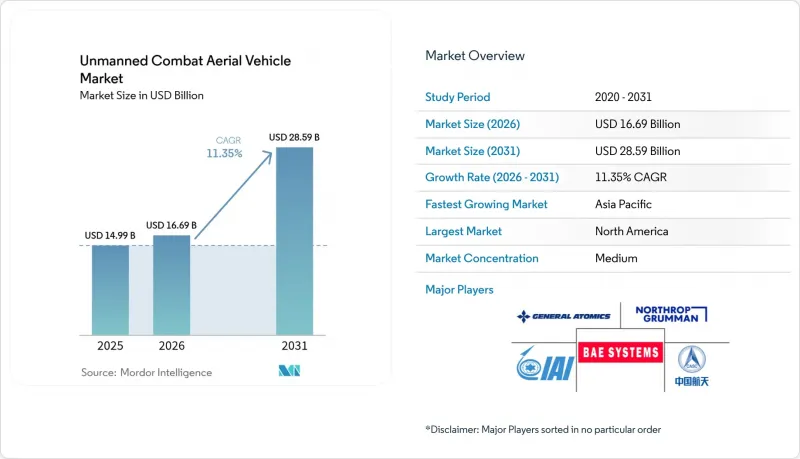
무인 전투 항공기(UCAV) 시장 규모는 2026년에 166억 9,000만 달러로 추정되고 있어 2025년 149억 9,000만 달러에서 확대해, 2031년에는 285억 9,000만 달러에 이를 것으로 예측됩니다.
2026년부터 2031년까지의 연평균 성장률(CAGR)은 11.35%가 될 것으로 전망됩니다.
본 보고서는 운용 고도(30,000피트 미만 및 그 이상), 항속 거리(단거리(200km 미만) 및 그 이상), 항속 시간(최대 6시간 및 그 이상), 기종(고정익 및 회전익(VTOL)), 엔진 유형(터보프롭 및 기타), 최종 사용자(공군 등), 지역(북미, 유럽 등)별로 분류되어 있습니다. 시장 전망은 금액(달러) 기준으로 제시되어 있습니다.
전 세계 무인 전투 항공기 시장 동향 및 인사이트
유인·무인 팀 전투(MUM-T) 교리의 제도화
공식적인 유인·무인 팀 편성(MUM-T)으로의 운영상 전환은 더 이상 개념적인 단계에 머무르지 않고, 조달 계약이나 훈련 커리큘럼, 나아가 최전선 비행대의 기체 번호 명명 규칙에도 명시되고 있습니다. 미국은 ‘협동 전투기(CCA)’ 프로그램을 통해 이 분야의 선구자가 되었으며, 2024년 4월 앤드릴(Anduril)사와 제너럴 아토믹스(General Atomics)사에 병행하여 계약을 수여하고, 2028년까지 1,000대 이상의 자율형 윙맨을 배치할 것을 요구하고 있습니다. 새로 할당된 기종 번호 ‘YFQ-42A 『갬빗』’ 및 ‘YFQ-44A 『퓨리』’는 이러한 드론을 기존의 ‘F 시리즈’ 분류 체계에 포함시키는 것으로, 과거에는 유인 전투기에만 국한되었던 역할을 수행하게 될 것임을 시사합니다.
대서양 건너편에서는 2024년 4월, 영국이 자국의 접근 방식의 유효성을 입증했습니다. 키네틱(Kinetic)사, 국방과학기술연구소(DSTI), 그리고 영국 해군이 제트 훈련기와 자율형 ‘반시 제트 80(Banshee Jet 80)’을 시속 350노트의 속도로 편대 비행시켰습니다. 이 비행 시험에서 얻은 인사이트은 현재, 목표 기반의 자율성과 전자 공격의 유연성을 중시하는 ‘자율 협력 플랫폼(ACP)’ 구상에 직접 활용되고 있습니다. 유럽 대륙에서는 프랑스·독일·스페인이 주도하는 ‘미래 전투 항공 시스템(FCAS)’을 통해 유사한 교리적 전환이 진행되고 있습니다. 또한 인도-태평양 지역에서도 호주의 MQ-28 고스트 배트가 실증기에서 실전 배치 자산으로 진화하고 있습니다. 이러한 프로그램들은 전반적으로 MUM-T가 Tier 1 항공 전력 계획의 핵심 요소가 되었음을 뒷받침하고 있습니다.
AI를 활용한 군집 행동 능력의 통합
2025년 초에 실시된 실증 실험에서는 UCAV(무인 전투기) 군집이 정찰, 전자 공격, 그리고 물리적 공격의 역할을 자율적으로 조정하는 모습이 공개되었으며, 분산형 알고리즘이 비례적인 비용을 증가시키지 않으면서도 어떻게 전투력을 창출할 수 있는지를 보여주었습니다. 블루베어(Blue Bear)사의 오픈 아키텍처 미션 시스템을 활용해 비행 중 알고리즘을 ‘핫 스왑’한 사브(Saab)사의 AUKUS 프로젝트 ‘컨버전스(Convergence)’ 시험은 조달 기관이 맞춤형 기체보다 소프트웨어의 재사용성을 우선시할 가능성이 있음을 암시했습니다. 미국 공군이 파이어스톰 랩(Firestorm Labs)사에 ‘템페스트 50(Tempest 50)’ 스웜 드론 개발 계약으로 1억 달러를 수주한 것은 알고리즘에 의한 행동이 엄격한 교전 규칙을 충족할 수 있다는 조직적인 확신을 뒷받침하는 것입니다. 이와 관련하여, 향후 수출 입찰에서는 초기 기체 사양보다 소프트웨어 업데이트 빈도를 더욱 중시하게 될 것이며, 민간용 전자기기에서 볼 수 있는 것과 같은 업데이트 논리가 방위 조달에도 도입될 가능성이 있다고 볼 수 있습니다.
시야 외(BLOS) 임무에서의 사이버 내성 과제
2025년 3월 DARPA가 발표한 계약 공고에 따르면, 해당 기관은 2025년 3월 ‘임베디드 추론을 위한 보안 및 개인정보 보호 보증(SABER)’ 프로그램을 출범시켜 자율 제어 루프 내 데이터 포이즌링 및 적대적 입력에 대한 취약점을 밝혀냈습니다. 이를 통해 사이버상의 타당성이 운용 개시의 전제조건이 되고 있음이 확인되었습니다. 이러한 노력은 근본적인 딜레마를 부각시키고 있습니다. 즉, 임무 설계자가 더 풍부한 데이터를 갈망하는 반면, 센서나 통신 채널이 하나 늘어날 때마다 공격 표면이 확대된다는 점입니다. 그 결과, 주요 제조업체들은 제로 트러스트 아키텍처와 실시간 이상 감지에 대한 투자를 늘리고 있습니다. 이로 인해 비반복적 엔지니어링 비용은 증가하지만, 수출 대상 고객이 검증된 사이버 보증을 요구할 때 경쟁력을 강화하는 데 기여합니다.
부문 분석
2025년에는 30,000피트 미만으로 순항하는 플랫폼이 매출의 63.92%를 차지했습니다. 이는 이러한 플랫폼들이 지속 가능한 연료 소비율로 ISR(정보·감시·정찰) 및 근접 항공 지원 역할을 수행하고 있기 때문입니다. Bayraktar TB2나 MQ-9의 파생형과 같은 합리적인 가격의 기체는 27시간의 항속 시간을 확보하면서도, 동적인 임무 변경에 대응할 수 있는 충분한 기동성을 유지하고 있습니다. 그러나 30,000피트를 초과하는 고고도 설계 기체는 각국이 접근 거부(A2/AD) 구역 상공에서의 지속적인 감시를 요구하고 있기 때문에 11.12%라는 가장 높은 연평균 성장률(CAGR)을 기록하고 있습니다.
스텔스 형상과 터보제트 추진을 통해, 이러한 항공기들은 대부분의 지대공 방어망 상공에서 체공할 수 있게 되어, 대등한 세력과의 분쟁에서 생존성을 높이고 있습니다. 이 두 가지 수요 동향에 따라 각 제조업체들은 탑재량을 희생하지 않으면서 비행 고도를 높이기 위해 가압 동체와 높은 종횡비 날개에 대한 투자를 지속하고 있습니다. 위성을 활용한 지휘통제 루프에 힘입어, 고고도용 UCAV 시장 규모는 2030년까지 2배로 성장할 가능성이 있습니다.
200-1,000km의 항속 거리를 가진 UCAV가 53.10%의 점유율을 차지하며 주류를 이루고 있으며, 관리 가능한 후방 지원 비용으로 국경을 넘는 임무나 해상 초계를 지원하고 있습니다. 전구 사령관들은 분산된 전방 기지 간에 신속하게 재배치할 수 있는 유연성을 높이 평가했습니다. 그러나 스탠드오프 공격 및 인도-태평양 지역 도달 범위에 대한 요구 사항으로 인해, 1,000km 초과급 시장은 연평균 12.34%의 성장이 예상됩니다. 이러한 급증의 배경에는 멀티밴드 위성통신(SATCOM)과 고효율 터빈 하이브리드 엔진의 통합은 물론, 통합 방공망에 대한 심층 침투를 우선시하는 전술 지침이 있습니다. 그 결과, UCAV 시장에서는 고속 이동 능력과 광대역 연결성을 겸비한, 연료 효율이 뛰어난 설계로의 전환이 예상됩니다.
지역별 분석
북미는 2025년에 매출의 42.10%를 차지할 것으로 예상되며, 항공 시스템에 대한 612억 달러 규모의 미국 국방 예산과 플랫폼 제조, 보안 통신, 추진 시스템, AI 소프트웨어를 결합한 산업 기반에 힘입었습니다. 제너럴 아토믹스(General Atomics)사에 대한 XQ-67A 및 보잉(Boeing)사에 대한 MQ-25A 계약 수주는 유인·무인 부대의 상호 보완적인 패키지를 향한 지속적인 자금 유입을 보여줍니다. 장기 리드타임이 필요한 부품 공급업체들은 수요 예측을 안정화시키는 다년간의 생산 로트 혜택을 누리고 있습니다.
아시아태평양은 중국, 인도, 한국이 국산 무인 공격 능력 구축에 현대화 자금을 투입하고 있어 12.03%라는 가장 높은 연평균 성장률(CAGR)을 기록하고 있습니다. 중국의 항공 엔진 개발 계획은 자급자족을 추구하며, 외국산 핫 섹션에 대한 의존도를 낮추는 동시에 FH-97 ‘로얄 윙맨’ 실증기를 구동하고 있습니다. 일본의 틸트로터 및 VTOL에 관한 연구 개발을 통해 해상 초계 장비에 양력 능력을 갖춘 무인 시스템이 추가되고 있습니다. 이 지역의 조달 활동은 쟁점이 되고 있는 해상 항로 및 열도의 요충지에 대한 대응책을 목적으로 하고 있으며, UCAV 시장을 수량 면과 기술적 정교도 양면에서 확대시키고 있습니다.
유럽에서는 위험을 분담하고 UCAV를 차세대 유인 전투기에 통합하는 다자간 협력을 통해 착실한 도입이 진행되고 있습니다. 레오나르도사와 바이칼사 간에 체결된 키지렐마의 데이터를 ‘세계 전투 항공 프로그램’에 통합한다는 합의는 동맹국들의 항공 부대 전체에 걸쳐 센서, 데이터 링크, 무기를 통합하려는 보다 광범위한 노력의 기반이 되고 있습니다. 민간 항공 교통과의 통합에 관한 규제 조화는 여전히 장벽으로 남아 있지만, EU의 방위 준비에 관한 권고안에서는 집단적 억지력을 강화하기 위해 UCAV 시장의 확산을 가속화할 것을 요구하고 있습니다.
기타 혜택:
- 엑셀 형식 시장 예측(ME) 시트
- 3개월간의 애널리스트 지원
자주 묻는 질문
목차
제1장 서론
제2장 조사 방법
제3장 주요 요약
제4장 시장 구도
제5장 시장 규모와 성장 예측
제6장 경쟁 구도
제7장 시장 기회와 향후 전망
JHS 26.08.11According to Mordor Intelligence, the unmanned combat aerial vehicle (UCAV) market size in 2026 is estimated at USD 16.69 billion, growing from 2025 value of USD 14.99 billion with 2031 projections showing USD 28.59 billion, growing at 11.35% CAGR over 2026-2031.
This report is Segmented by Altitude of Operation (Below 30, 000 Ft, and More), Range (Short-Range (Less Than 200km), and More), Endurance (Up To 6 Hours, and More), Type (Fixed-Wing and Rotary-Wing (VTOL)), Engine Type (Turboprop, and More), End-User (Air Force, and More), & Geography (North America, Europe, and More). The Market Forecasts are Provided in Terms of Value (USD).
Global Unmanned Combat Aerial Vehicle Market Trends and Insights
Institutionalization of Manned-Unmanned Teaming Doctrines
The operational shift toward formal manned-unmanned teaming (MUM-T) is no longer conceptual; it is being written into acquisition contracts, training syllabi, and even the tail-number nomenclature of front-line squadrons. The US has set the initial pace through its Collaborative Combat Aircraft (CCA) program, awarding parallel April 2024 contracts to Anduril and General Atomics that call for more than 1,000 autonomous wingmen by 2028. The newly assigned designations-YFQ-42A "Gambit" and YFQ-44A "Fury"-place these drones inside the traditional "F-series" taxonomy, signaling that they will occupy roles once reserved only for crewed fighters.
Across the Atlantic, the UK validated its approach in April 2024 when QinetiQ, the Defense Science and Technology Laboratory, and the Royal Navy flew a jet trainer in formation with an autonomous Banshee Jet 80 at 350 knots. Lessons from that sortie now feed directly into the Autonomous Collaborative Platform (ACP) concept, which stresses goal-based autonomy and electronic-attack flexibility. Similar doctrinal pivots are underway on the European continent through the Franco-German Spanish Future Combat Air System (FCAS) and in the Indo-Pacific, where Australia's MQ-28 Ghost Bat is evolving from demonstrator to operational asset. Collectively, these programs confirm that MUM-T has become a core element of Tier-1 air-power planning.
Integration of AI-Enabled Swarm Capabilities
Demonstrations in early 2025 showcased UCAV swarms autonomously coordinating reconnaissance, electronic attack, and kinetic strike roles, illustrating how distributed algorithms can generate combat mass without increasing proportional costs. Saab's AUKUS Project Convergence trial, which used BlueBear's open architecture mission system to "hot swap" algorithms in flight, implicitly revealed that procurement agencies may prioritize software reusability over bespoke airframes. The US Air Force's USD 100 million award to Firestorm Labs for Tempest 50 swarm drones confirms institutional confidence that algorithmic behaviors can meet stringent rules of engagement. The associated inference is that future export tenders may weigh software-update cadence more heavily than initial airframe specifications, bringing consumer electronics to refresh logic into defense procurement.
Cyber-hardening Challenges for Beyond-Line-of-Sight Missions
As per the contracting notice issued by DARPA in March 2025, it launched the Security and Privacy Assurance for Embedded Reasoning (SABER) program in March 2025 to expose data-poisoning and adversarial-input vulnerabilities in autonomous control loops, confirming that cyber validity is now a prerequisite for operational release. The initiative highlights a core tension: every additional sensor and communications channel widens the attack surface even as mission designers crave richer data. Consequently, primes are spending more on zero-trust architecture and real-time anomaly detection investments that heighten non-recurring engineering costs but strengthen competitiveness when export customers demand verified cyber assurance.
Other drivers and restraints analyzed in the detailed report include:
- Global Rollout of High-Throughput SATCOM
- Miniaturization of Precision-Guided Munitions
- MTCR and Wassenaar Regime Export Restrictions
For complete list of drivers and restraints, kindly check the Table Of Contents.
Segment Analysis
Platforms cruising under 30,000 ft generated 63.92% revenue in 2025 because they fill ISR and close-air-support roles at sustainable fuel burn rates. Affordable airframes such as Bayraktar TB2 and MQ-9 variants offer 27-hour endurance yet remain agile enough for dynamic retasking. However, high-altitude designs above 30,000 ft post the fastest 11.12% CAGR as nations seek surveillance persistence over anti-access zones.
Stealth shaping and turbojet propulsion let these aircraft loiter above most surface-to-air coverage, adding resilience in peer conflicts. This dual-track demand keeps manufacturers investing in pressurized fuselages and high-aspect wings to elevate ceilings without sacrificing payload. The UCAV market size for high-altitude craft could double by 2030, supported by satellite-enabled command loops.
UCAVs capable of 200-1,000 km dominate with a 53.10% share, supporting cross-border missions and maritime patrols at manageable logistics cost. Theater commanders value their flexibility to redeploy quickly among dispersed forward bases. Yet, requirements for stand-off strikes and Indo-Pacific reach spur the growth of the greater than 1,000 km class by 12.34% annually. Integrating multi-band SATCOM and efficient turbine-hybrid engines underpins this surge, as does doctrine prioritizing deep penetration against integrated air defenses. Consequently, the UCAV market anticipates a portfolio tilt toward fuel-efficient designs that pair high transit speed with broadband connectivity.
Complete Report Scope:
- By Altitude of Operation
- Below 30,000 ft
- Above 30,000 ft
- By Range
- Short-Range (Less than 200 km)
- Medium-Range (Between 200 and 1,000 km)
- Long-Range (Greater than 1,000 km)
- By Endurance
- Up to 6 hours
- 6 to 24 hours
- More than 24 hours
- By Type
- Fixed-Wing
- Rotary-Wing (VTOL)
- By Engine Type
- Turboprop
- Turbojet/Turbofan
- Hybrid-Electric/Hydrogen
- By End-User
- Air Force
- Army (Ground Forces)
- Navy/Marine Corps
- Joint Special Operations Commands
- By Geography
- North America
- United States
- Canada
- Mexico
- Europe
- United Kingdom
- France
- Germany
- Russia
- Rest of Europe
- Asia-Pacific
- China
- India
- Japan
- South Korea
- Rest of Asia-Pacific
- South America
- Brazil
- Rest of South America
- Middle East and Africa
- Middle East
- Saudi Arabia
- United Arab Emirates
- Israel
- Rest of Middle East
- Africa
- South Africa
- Nigeria
- Rest of Africa
- Middle East
- North America
Geography Analysis
North America generated 42.10% revenue in 2025, propelled by a USD 61.2 billion US defense appropriation for aviation systems and an industrial base that couples platform manufacture with secure communications, propulsion, and AI software. Contract awards to General Atomics for the XQ-67A and Boeing for the MQ-25A indicate sustained capital flow toward complementary crewed-uncrewed force packages. Long-lead component suppliers benefit from multiyear production lots that stabilize demand forecasts.
Asia-Pacific posts the quickest 12.03% CAGR as China, India, and South Korea channel modernization funds toward indigenous unmanned strike capabilities. China's aero-engine initiatives seek self-reliance, reducing reliance on foreign hot sections while powering FH-97 loyal-wingman demonstrators. Japan's tilt-rotor and VTOL explorations add lift-capable unmanned systems to maritime patrol arsenals. Regional procurement aims to counterbalance contested sea lanes and archipelagic chokepoints, enlarging the UCAV market in quantity and technological sophistication.
Europe sustains steady adoption through multinational collaborations that share risk and integrate UCAVs into next-generation manned fighters. The Leonardo-Baykar accord to feed Kizilelma data into the Global Combat Air Programme underpins broaderer drive to converge sensors, datalinks, and weapons across alliance fleets. Regulatory alignment on civilian air-traffic integration remains a hurdle, yet EU defense-preparedness recommendations urge acceleration of UCAV market uptake to strengthen collective deterrence.
- General Atomics
- Northrop Grumman Corporation
- Israel Aerospace Industries Ltd.
- BAE Systems plc
- China Aerospace Science and Technology Corporation
- Lockheed Martin Corporation
- BAYKAR A.S.
- The Boeing Company
- Elbit Systems Ltd.
- Kratos Defense & Security Solutions, Inc.
- BlueBird Aero Systems Ltd.
- Aviation Industry Corporation of China (AVIC)
- Turkish Aerospace Industries, Inc.
- AeroVironment, Inc.
- Saab AB
- Griffon Aerospace, Inc.
- Teledyne Technologies Incorporated
- Korean Aerospace Industries (KAI)
- Airbus SE
- L3Harris Technologies, Inc.
- QinetiQ Group
- Rheinmetall AG
- Hindustan Aeronautics Limited
Additional Benefits:
- The market estimate (ME) sheet in Excel format
- 3 months of analyst support
TABLE OF CONTENTS
1 INTRODUCTION
- 1.1 Study Assumptions and Market Definition
- 1.2 Scope of the Study
2 RESEARCH METHODOLOGY
3 EXECUTIVE SUMMARY
4 MARKET LANDSCAPE
- 4.1 Market Overview
- 4.2 Market Drivers
- 4.2.1 Institutionalization of manned-unmanned teaming (MUM-T) doctrines by Tier-1 air forces
- 4.2.2 Integration of Artificial Intelligence-enabled swarm and Loyal-Wingman capabilities
- 4.2.3 Global rollout of high-throughput Ka/Ku/LEO SATCOM for Beyond-Line-of-Sight (BLOS) control
- 4.2.4 Miniaturization of precision-guided munitions for Class-III UCAVs
- 4.2.5 Increasing defense budgets and military modernization programs globally
- 4.2.6 Rising geopolitical tensions and regional conflicts driving demand for autonomous systems
- 4.3 Market Restraints
- 4.3.1 Cyber-hardening challenges for Beyond-Line-of-Sight missions
- 4.3.2 MTCR and Wassenaar Regime export restrictions on Category-I UCAVs
- 4.3.3 Dependence on limited-volume aero-turbine supply chain for high-thrust small engines
- 4.3.4 Civilian air-traffic integration hurdles in Europe and the Caribbean FIRs
- 4.4 Value Chain Analysis
- 4.5 Regulatory and Technological Outlook
- 4.6 Porter's Five Forces Analysis
- 4.6.1 Bargaining Power of Buyers/Consumers
- 4.6.2 Bargaining Power of Suppliers
- 4.6.3 Threat of New Entrants
- 4.6.4 Threat of Substitute Products
- 4.6.5 Intensity of Competitive Rivalry
5 MARKET SIZE AND GROWTH FORECASTS (VALUE)
- 5.1 By Altitude of Operation
- 5.1.1 Below 30,000 ft
- 5.1.2 Above 30,000 ft
- 5.2 By Range
- 5.2.1 Short-Range (Less than 200 km)
- 5.2.2 Medium-Range (Between 200 and 1,000 km)
- 5.2.3 Long-Range (Greater than 1,000 km)
- 5.3 By Endurance
- 5.3.1 Up to 6 hours
- 5.3.2 6 to 24 hours
- 5.3.3 More than 24 hours
- 5.4 By Type
- 5.4.1 Fixed-Wing
- 5.4.2 Rotary-Wing (VTOL)
- 5.5 By Engine Type
- 5.5.1 Turboprop
- 5.5.2 Turbojet/Turbofan
- 5.5.3 Hybrid-Electric/Hydrogen
- 5.6 By End-User
- 5.6.1 Air Force
- 5.6.2 Army (Ground Forces)
- 5.6.3 Navy/Marine Corps
- 5.6.4 Joint Special Operations Commands
- 5.7 By Geography
- 5.7.1 North America
- 5.7.1.1 United States
- 5.7.1.2 Canada
- 5.7.1.3 Mexico
- 5.7.2 Europe
- 5.7.2.1 United Kingdom
- 5.7.2.2 France
- 5.7.2.3 Germany
- 5.7.2.4 Russia
- 5.7.2.5 Rest of Europe
- 5.7.3 Asia-Pacific
- 5.7.3.1 China
- 5.7.3.2 India
- 5.7.3.3 Japan
- 5.7.3.4 South Korea
- 5.7.3.5 Rest of Asia-Pacific
- 5.7.4 South America
- 5.7.4.1 Brazil
- 5.7.4.2 Rest of South America
- 5.7.5 Middle East and Africa
- 5.7.5.1 Middle East
- 5.7.5.1.1 Saudi Arabia
- 5.7.5.1.2 United Arab Emirates
- 5.7.5.1.3 Israel
- 5.7.5.1.4 Rest of Middle East
- 5.7.5.2 Africa
- 5.7.5.2.1 South Africa
- 5.7.5.2.2 Nigeria
- 5.7.5.2.3 Rest of Africa
- 5.7.5.1 Middle East
- 5.7.1 North America
6 COMPETITIVE LANDSCAPE
- 6.1 Market Concentration
- 6.2 Strategic Moves
- 6.3 Market Share Analysis
- 6.4 Company Profiles (includes Global level Overview, Market level overview, Core Segments, Financials as available, Strategic Information, Market Rank/Share for key companies, Products and Services, and Recent Developments)
- 6.4.1 General Atomics
- 6.4.2 Northrop Grumman Corporation
- 6.4.3 Israel Aerospace Industries Ltd.
- 6.4.4 BAE Systems plc
- 6.4.5 China Aerospace Science and Technology Corporation
- 6.4.6 Lockheed Martin Corporation
- 6.4.7 BAYKAR A.S.
- 6.4.8 The Boeing Company
- 6.4.9 Elbit Systems Ltd.
- 6.4.10 Kratos Defense & Security Solutions, Inc.
- 6.4.11 BlueBird Aero Systems Ltd.
- 6.4.12 Aviation Industry Corporation of China (AVIC)
- 6.4.13 Turkish Aerospace Industries, Inc.
- 6.4.14 AeroVironment, Inc.
- 6.4.15 Saab AB
- 6.4.16 Griffon Aerospace, Inc.
- 6.4.17 Teledyne Technologies Incorporated
- 6.4.18 Korean Aerospace Industries (KAI)
- 6.4.19 Airbus SE
- 6.4.20 L3Harris Technologies, Inc.
- 6.4.21 QinetiQ Group
- 6.4.22 Rheinmetall AG
- 6.4.23 Hindustan Aeronautics Limited
7 Market Opportunities and Future Outlook
- 7.1 White-space and Unmet-Need Assessment


