

|
시장보고서
상품코드
2100585
UV LED 시장 : 점유율 분석, 업계 동향 및 통계, 성장 예측(2026-2031년)UV LED - Market Share Analysis, Industry Trends & Statistics, Growth Forecasts (2026 - 2031) |
||||||
 Mordor Intelligence
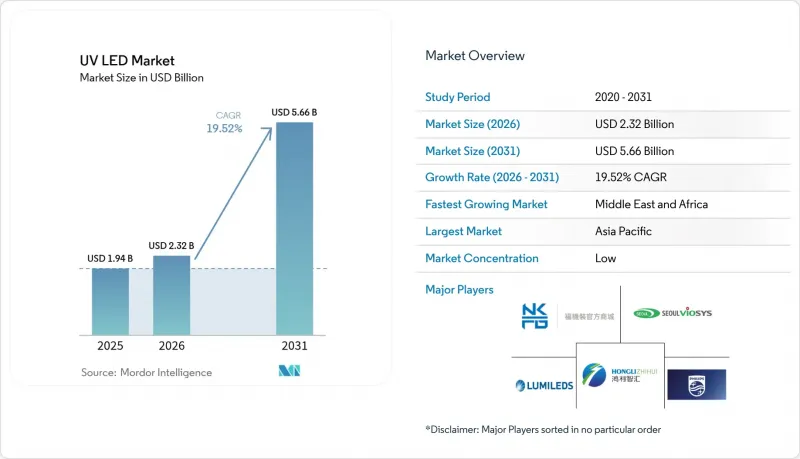
Mordor Intelligence에 의하면, 2026년 UV LED 시장 규모는 23억 2,000만 달러로 추정되고 있어 2025년 19억 4,000만 달러에서 확대해, 2031년에는 56억 6,000만 달러에 이를 것으로 예측됩니다.
2026년부터 2031년까지 연평균 성장률(CAGR) 19.52%로 성장할 것으로 전망됩니다.
본 보고서는 기술(파장)(UV-A, UV-B, UV-C), 제품/폼 팩터(램프, 모듈 등), 출력(저출력, 중출력 등), 용도(경화, 소독·살균 등), 최종 사용자 산업(헬스케어 및 생명과학, 인쇄·포장, 자동차 및 항공우주 등), 지역별로 분류되어 있습니다. 시장 전망은 금액(달러) 기준으로 제시되어 있습니다.
세계 UV LED 시장 동향 및 인사이트
수은 램프의 단계적 폐지에 관한 엄격한 정책이 UV LED 채택을 가속화
세계적인 규제 조치로 인해 조명 분야의 수은 광원이 점차 배제되고 있습니다. '미나마타 협약'에서는 147개 서명국이 2027년까지 형광등을 단계적으로 폐지하기로 합의했습니다. EU의 RoHS 지침에서는 이미 수은 함유량을 램프 1개당 5mg으로 제한하고 있으며, 2027년 이후에는 전면 금지될 전망입니다. 캐나다의 2025년 규정도 이러한 방향성을 따르고 있습니다. 사용자들이 전환을 추진하는 가운데, 인쇄 라인에서는 수은 램프를 고체 LED 어레이로 교체한 후 에너지 소비량이 85% 감소했다고 보고되고 있습니다. 그 결과, UV LED 장비에 대한 사전 인증을 획득한 공급업체들은 장기적인 개조 계약을 확보하고 있습니다.
아시아 전역에서 ‘사용 지점(PoU)’에서의 물 소독 수요가 급증
급속한 도시화로 인해 인도, 인도네시아, 중국 연안 지역에서는 중앙 상수도망에 부담이 가중되고 있습니다. 노르웨이에서 실시된 현장 시험에서는 LED 리액터를 사용함으로써 하루 545m³의 물에서 대장균군을 3로그 제거할 수 있음이 입증되어, 이 기술이 도시 지역의 수류에도 적용 가능하다는 사실이 확인되었습니다. 컴팩트한 형태로 인해 UV-C 방출체를 가정용 정수기, 소규모 공장, 지방 진료소에 통합할 수 있게 되었습니다. 아시아의 여러 장비 제조업체들은 태양광 발전에 의한 마이크로그리드로 가동되는 통합 모듈의 규모를 확대하고 있으며, Off-grid 환경에서의 안전한 물 공급 보급을 가속화하고 있습니다.
고출력 용도를 제한하는 양자 효율의 상한선
280 nm 미만의 심자외선 LED는 일반적으로 벽면 플러그 효율이 5% 미만으로, 저압 수은 램프의 20-30%보다 훨씬 낮습니다. kW급 출력이 필요한 상수도 유틸리티자는 대규모 LED 어레이를 도입해야 하므로, 그 결과 설비 투자 비용이 크게 증가하게 됩니다. 현재 연구에서는 정공 주입과 광 추출을 개선하기 위해 양자점, 슈퍼래티스, 투명 기판에 주목하고 있습니다. AlGaN 슈퍼래티스 설계를 통해 35 mW에서 양자 효율(EQE)이 8.6%로 향상되었으나, 이러한 성능으로 양산화되기까지는 아직 수년이 소요될 것으로 예측됩니다.
부문 분석
2025년에는 UV-A 시스템이 매출 점유율의 71.45%를 차지하며, 그래픽 아트 분야의 경화 처리 및 위조품 감지 분야에서 우위를 유지했습니다. 한편, UV-C는 의료 및 지자체 사용자들의 무수은 살균 솔루션 도입에 힘입어 연평균 성장률(CAGR) 21.62%를 나타낼 것으로 전망됩니다. ams OSRAM의 'OSLON™ UV 3535'는 265 nm에서 115 mW의 출력을 제공하며 20,000시간의 수명을 실현하여, 신뢰성이 높은 물·공기 반응 장치에 있어 중요한 이정표가 되고 있습니다. UV-B의 틈새 시장은 광선 요법 및 농업 분야의 광형성 분야에 대응하며, 특수한 수요 시장을 개척하고 있습니다.
도입 동향은 지역에 따라 다릅니다. 유럽에서는 식품 가공 라인을 위해 255-275 nm 방출체의 표준화가 진행되고 있는 반면, 일본에서는 피부과 의료용으로 308 nm UV-B가 검토되고 있습니다. 양자 효율이 지속적으로 향상되는 가운데, 의료용 공기 살균을 목적으로 하는 UV-C 모듈의 UV LED 시장 규모는 2030년까지 업계 평균의 2배 속도로 성장할 것으로 예측됩니다. 원자외선(UVC) 222 nm 엑시머 발광 소자의 기술적 돌파구로 인해, 사람이 머무는 공간에서 인체에 안전한 연속 소독이 가능해져 이용 사례의 영역이 더욱 확대될 것으로 기대됩니다.
모듈은 탑재 용이성 덕분에 2025년 매출에서 41.35%라는 최대 점유율을 유지했습니다. 한편, 칩은 소비자용 기기 및 실험용 기기에서 맞춤형 광학 엔진에 대한 수요를 반영하여 연평균 성장률(CAGR) 22.85%를 기록할 전망입니다. GaN-on-SiC 기판은 열 저항을 저감하여, 2025년 프로토타입에서 칩 수준에서 100 mW의 출력을 실현하고 있습니다. 램프 하위 부문은 기존 소켓에 후속 장착을 목적으로 하고 있으나, 어레이형이 보급됨에 따라 판매량은 점차 감소할 전망입니다.
초소형 칩은 신흥 바이오센서 및 랩-온-어-칩(LoC) 디바이스의 기반이 되고 있습니다. 연구진은 90 nm 크기로 20%의 EQE(양자 효율)를 달성하는 나노 스케일의 페로브스카이트 LED를 실증했습니다. 패키징이 세라믹에서 성형 복합 소재로 전환됨에 따라 1밀리와트당 비용의 중앙값이 하락하고 있으며, 이는 휴대용 살균 기기로의 채택을 촉진하고 있습니다. 그 결과, 칩 수준 매출에서 UV LED가 차지하는 시장 점유율은 2031년까지 34.20%로 상승할 것으로 예측됩니다.
지역별 분석
2025년, 아시아태평양은 UV LED 시장 매출의 54.30%라는 압도적인 점유율을 차지했습니다. 중국의 자급자족 추진에 따라 현지 에피택시 공급업체와 사내 디바이스 패키징 라인이 잇달아 등장하고 있습니다. 일본과 한국은 고정밀 제조 노하우를 제공하고 있으며, 대만은 심자외선(DUV) 칩용 질화갈륨 기판을 전문으로 하고 있습니다. 공중보건 예산 증가에 따라 대도시권에서 UV를 이용한 물·공기 정화 수요가 높아지고 있어, 이 지역의 우위를 공고히 하고 있습니다.
북미는 2위를 차지하고 있습니다. 캘리포니아주에서 수은 램프의 단계적 폐지 속도가 빨라지고, 국내 칩 생산 능력 확대를 위한 연방 정부의 자금 지원이 맞물려 의료 및 첨단 제조 분야에서의 도입을 뒷받침하고 있습니다. 그러나 복잡한 특허 장벽과 높은 인건비가 확대 속도를 둔화시키고 있습니다. 유럽은 에너지 효율화 의무화에 힘입어 북미에 근소한 차이로 뒤를 잇고 있습니다. 에코디자인 규제로 인해 2030년까지 설치되는 램프의 96%가 LED가 될 것으로 예측되어, UV 솔루션에 유리한 환경이 조성되고 있습니다.
중동 및 아프리카는 가장 빠르게 성장하는 지역으로, 해수 담수화 플랜트와 신축 병원에 LED 리액터가 도입됨에 따라 연평균 성장률(CAGR)은 20.05%로 성장을 지속하고, 있습니다. 걸프 연안 국가들은 수은이 포함되지 않은 조명을 규정하는 스마트 시티 프로그램에 자금을 지원하고 있습니다. 남미에서는 음료 병입 및 수산 양식 분야에서 성장세가 두드러지지만, 인증 절차로 인해 지자체 상수도 프로젝트의 진전은 완만합니다. 모든 지역에서 규제 정비와 기술 성숙이 동시에 진행됨에 따라 UV LED 시장은 수렴적인 성장 궤도를 타고 있습니다.
기타 혜택:
- 엑셀 형식 시장 예측(ME) 시트
- 3개월간의 애널리스트 지원
자주 묻는 질문
목차
제1장 서론
제2장 조사 방법
제3장 주요 요약
제4장 시장 구도
제5장 시장 규모와 성장 예측
제6장 경쟁 구도
제7장 시장 기회와 향후 전망
JHS 26.08.11According to Mordor Intelligence, UV LED market size in 2026 is estimated at USD 2.32 billion, growing from 2025 value of USD 1.94 billion with 2031 projections showing USD 5.66 billion, growing at 19.52% CAGR over 2026-2031.
This report is Segmented by Technology (Wavelength) (UV-A, UV-B, and UV-C), Product/Form Factor (Lamps, Modules, and More), Power Output (Low Power, Medium Power, and More), Application (Curing, Disinfection and Sterilization, and More), End-User Industry (Healthcare and Life Sciences, Printing and Packaging, Automotive and Aerospace, and More), and Geography. The Market Forecasts are Provided in Terms of Value (USD).
Global UV LED Market Trends and Insights
Stringent Mercury-Lamp Phase-Out Policies Accelerating UV LED Adoption
Global regulation is eliminating mercury sources in lighting. The Minamata Convention aligned 147 signatories on a 2027 fluorescent exit. The EU RoHS Directive already caps mercury content at 5 mg per lamp, with full bans expected after 2027. Canada's 2025 rules mirror this direction. As users transition, printing lines report 85% lower energy use after swapping mercury lamps for solid-state arrays. Vendors that pre-qualified UV LED equipment are therefore securing long-term retrofit contracts.
Surge in Point-of-Use Water Disinfection Demand Across Asia
Rapid urbanisation stresses central water grids in India, Indonesia, and coastal China. Field trials in Norway demonstrated 3-log coliform removal at 545 m3/day using LED reactors, validating the technology's viability for municipal flows. Compact form factors allow embedding UV-C emitters in home dispensers, small factories, and rural clinics. Asian equipment makers are scaling integrated modules that operate on solar micro-grids, accelerating off-grid water-safety rollouts.
Quantum Efficiency Ceiling Limiting High-Power Applications
Deep-UV LEDs below 280 nm typically deliver <5% wall-plug efficiency, far below the 20-30% of low-pressure mercury lamps.Water utilities needing kilowatt-scale output must deploy large LED arrays, inflating capital costs. Research now focuses on quantum dots, super-lattices, and transparent substrates to improve hole injection and light extraction. AlGaN super-lattice designs boosted EQE to 8.6% at 35 mW, yet mass manufacturing at such performance remains years away.
Other drivers and restraints analyzed in the detailed report include:
- Rapid Shift to Low-Migration UV LED Inks in Flexible Packaging
- Energy Price Inflation Favouring Low-Power UV LED Curing Lines
- Royalty-Heavy IP Landscape Raising Cost Barriers
For complete list of drivers and restraints, kindly check the Table Of Contents.
Segment Analysis
UV-A systems held 71.45% revenue share in 2025, retaining dominance in graphic-arts curing and counterfeit detection. UV-C, however, is set for a 21.62% CAGR as healthcare and municipal users deploy mercury-free germicidal solutions. ams OSRAM's OSLON(TM) UV 3535 delivers 115 mW at 265 nm with 20,000-hour life, a key milestone for reliable water and air reactors. The UV-B niche addresses phototherapy and agricultural photomorphogenesis, carving specialised demand pockets.
Adoption dynamics vary by region. Europe is standardising 255-275 nm emitters in food-processing pipelines, while Japan explores 308 nm UV-B for dermatology. As quantum-efficiency gains continue, the UV LED market size for UV-C modules targeting medical air sterilisation is projected to grow at double the sector average through 2030. Breakthroughs in far-UVC 222 nm excimer emitters promise human-safe continuous disinfection of occupied spaces, further widening the use-case frontier.
Modules retained the largest 41.35% slice of 2025 revenue due to integration ease. Chips, though, will post a 22.85% CAGR, reflecting demand for custom optical engines in consumer devices and lab instruments. GaN-on-SiC substrates cut thermal resistance, enabling chip-level powers of 100 mW in 2025 prototypes. The lamps sub-segment serves retrofit sockets but faces gradual volume decline as arrays gain traction.
Ultra-miniaturised chips underpin emerging biosensors and lab-on-a-chip devices. Researchers have demonstrated nano-scale perovskite LEDs with 20% EQE at 90 nm dimensions. As packaging shifts from ceramic to moulded composites, median cost per milliwatt is falling, stimulating design-in across portable sterilisation gadgets. Consequently, the UV LED market share of chip-level sales is forecast to rise to 34.20% by 2031.
Complete Report Scope:
- By Technology (Wavelength)
- UV-A
- UV-B
- UV-C
- By Product/Form Factor
- Lamps
- Modules
- Arrays
- Chips
- By Power Output
- Low Power (<10 mW)
- Medium Power (10-100 mW)
- High Power (>100 mW)
- By Application
- Curing (Inks, Coatings and Adhesives)
- Disinfection and Sterilization
- Sensing and Instrumentation
- Medical and Phototherapy
- Counterfeit Detection and Security
- Horticulture and Indoor Farming
- Other Niche Applications (3-D Printing, Lithography)
- By End-user Industry
- Healthcare and Life Sciences
- Printing and Packaging
- Electronics and Semiconductors
- Water and Wastewater Utilities
- Food and Beverage Processing
- Automotive and Aerospace
- Residential and Commercial Buildings
- Industrial Manufacturing
- By Geography
- North America
- United States
- Canada
- Mexico
- Europe
- Germany
- United Kingdom
- France
- Italy
- Spain
- Rest of Europe
- Asia-Pacific
- China
- Japan
- South Korea
- India
- South East Asia
- Rest of Asia-Pacific
- South America
- Brazil
- Rest of South America
- Middle East and Africa
- Middle East
- United Arab Emirates
- Saudi Arabia
- Rest of Middle East
- Africa
- South Africa
- Rest of Africa
- Middle East
- North America
Geography Analysis
Asia Pacific held a commanding 54.30% share of UV LED market revenue in 2025. China's self-reliance push is spawning local epitaxy suppliers and captive device packaging lines. Japan and South Korea add high-precision fabrication know-how, while Taiwan specialises in gallium-nitride substrates for deep-UV chips. Rising public-health budgets channel demand for UV-based water and air purification across megacities, cementing regional dominance.
North America ranks second. California's accelerated mercury-lamp phase-out, coupled with federal funding for domestic chip capacity, drives adoption in healthcare and advanced manufacturing. However, a dense patent thicket and higher labour costs temper the expansion pace. Europe follows closely, powered by energy-efficiency mandates. Ecodesign rules forecast that 96% of installed lamps will be LEDs by 2030, creating a receptive environment for UV solutions.
The Middle East & Africa is the fastest-growing area, showing a 20.05% CAGR as desalination plants and new hospitals incorporate LED reactors. Gulf states fund smart-city programmes that specify mercury-free lighting. South America sees momentum in beverage bottling and aquaculture, though municipal water projects move slowly due to certification cycles. Across all geographies, simultaneous regulation and technology maturation keep the UV LED market on a convergent uplift path.
- ams OSRAM AG
- Signify N.V.
- Nichia Corporation
- Seoul Viosys Co., Ltd.
- Crystal IS Inc. (Asahi Kasei)
- Lumileds Holding B.V.
- Nikkiso Co., Ltd. (UV Business)
- LG Innotek Co., Ltd.
- LITE-ON Technology Corp.
- Honlitronics (Hongli Zhihui Group)
- Stanley Electric Co., Ltd.
- SemiLEDs Corporation
- Violumas Inc.
- DOWA Electronics Materials Co., Ltd.
- Nordson Corporation
- Luminus Devices, Inc.
- Heraeus Holding GmbH (Noblelight)
- Phoseon Technology (Excelitas)
- Sensor Electronic Technology Inc. (SETi)
- Bolb Inc.
Additional Benefits:
- The market estimate (ME) sheet in Excel format
- 3 months of analyst support
TABLE OF CONTENTS
1 INTRODUCTION
- 1.1 Study Assumptions and Market Definition
- 1.2 Scope of the Study
2 RESEARCH METHODOLOGY
3 EXECUTIVE SUMMARY
4 MARKET LANDSCAPE
- 4.1 Market Overview
- 4.2 Market Drivers
- 4.2.1 Stringent Mercury Lamp Phase-Out Policies in EU and California Accelerating UV-LED Adoption
- 4.2.2 Surge in Point-of-Use Water Disinfection Demand Post-COVID-19 Across Asia
- 4.2.3 Rapid Shift to Low-Migration UV LED Inks in Flexible Packaging for Food Safety Compliance
- 4.2.4 Energy Price Inflation in Europe Favouring Low-Power UV-LED Curing Lines
- 4.2.5 Mini-LED Backlighting Roadmaps Driving Deep-UV Inspection Tools Adoption in Semiconductor Fabs
- 4.2.6 Growing Acceptance of Far-UVC (222 nm) for Occupied-Space Air Sanitisation in Airports and Hospitals
- 4.3 Market Restraints
- 4.3.1 Quantum Efficiency Ceiling (<5 %) of AlGaN-Based UVC Chips Limits High-Power Applications
- 4.3.2 Royalty-Heavy IP Landscape Raising Cost Barriers for New Entrants in North America
- 4.3.3 Thermal Management Challenges in High-Density UV LED Arrays for Industrial Curing Lines
- 4.3.4 Slow Certification Cycles (NSF/ANSI 55-2022) Delaying Municipal Water Projects in Emerging Economies
- 4.4 Industry Ecosystem Analysis
- 4.5 Technological Outlook
- 4.6 Porter's Five Forces Analysis
- 4.6.1 Bargaining Power of Suppliers
- 4.6.2 Bargaining Power of Buyers
- 4.6.3 Threat of New Entrants
- 4.6.4 Threat of Substitutes
- 4.6.5 Intensity of Competitive Rivalry
5 MARKET SIZE AND GROWTH FORECASTS (VALUES)
- 5.1 By Technology (Wavelength)
- 5.1.1 UV-A
- 5.1.2 UV-B
- 5.1.3 UV-C
- 5.2 By Product/Form Factor
- 5.2.1 Lamps
- 5.2.2 Modules
- 5.2.3 Arrays
- 5.2.4 Chips
- 5.3 By Power Output
- 5.3.1 Low Power (<10 mW)
- 5.3.2 Medium Power (10-100 mW)
- 5.3.3 High Power (>100 mW)
- 5.4 By Application
- 5.4.1 Curing (Inks, Coatings and Adhesives)
- 5.4.2 Disinfection and Sterilization
- 5.4.3 Sensing and Instrumentation
- 5.4.4 Medical and Phototherapy
- 5.4.5 Counterfeit Detection and Security
- 5.4.6 Horticulture and Indoor Farming
- 5.4.7 Other Niche Applications (3-D Printing, Lithography)
- 5.5 By End-user Industry
- 5.5.1 Healthcare and Life Sciences
- 5.5.2 Printing and Packaging
- 5.5.3 Electronics and Semiconductors
- 5.5.4 Water and Wastewater Utilities
- 5.5.5 Food and Beverage Processing
- 5.5.6 Automotive and Aerospace
- 5.5.7 Residential and Commercial Buildings
- 5.5.8 Industrial Manufacturing
- 5.6 By Geography
- 5.6.1 North America
- 5.6.1.1 United States
- 5.6.1.2 Canada
- 5.6.1.3 Mexico
- 5.6.2 Europe
- 5.6.2.1 Germany
- 5.6.2.2 United Kingdom
- 5.6.2.3 France
- 5.6.2.4 Italy
- 5.6.2.5 Spain
- 5.6.2.6 Rest of Europe
- 5.6.3 Asia-Pacific
- 5.6.3.1 China
- 5.6.3.2 Japan
- 5.6.3.3 South Korea
- 5.6.3.4 India
- 5.6.3.5 South East Asia
- 5.6.3.6 Rest of Asia-Pacific
- 5.6.4 South America
- 5.6.4.1 Brazil
- 5.6.4.2 Rest of South America
- 5.6.5 Middle East and Africa
- 5.6.5.1 Middle East
- 5.6.5.1.1 United Arab Emirates
- 5.6.5.1.2 Saudi Arabia
- 5.6.5.1.3 Rest of Middle East
- 5.6.5.2 Africa
- 5.6.5.2.1 South Africa
- 5.6.5.2.2 Rest of Africa
- 5.6.5.1 Middle East
- 5.6.1 North America
6 COMPETITIVE LANDSCAPE
- 6.1 Market Concentration
- 6.2 Strategic Moves
- 6.3 Market Share Analysis
- 6.4 Company Profiles (includes Global level Overview, Market level overview, Core Segments, Financials as available, Strategic Information, Market Rank/Share, Products and Services, Recent Developments)
- 6.4.1 ams OSRAM AG
- 6.4.2 Signify N.V.
- 6.4.3 Nichia Corporation
- 6.4.4 Seoul Viosys Co., Ltd.
- 6.4.5 Crystal IS Inc. (Asahi Kasei)
- 6.4.6 Lumileds Holding B.V.
- 6.4.7 Nikkiso Co., Ltd. (UV Business)
- 6.4.8 LG Innotek Co., Ltd.
- 6.4.9 LITE-ON Technology Corp.
- 6.4.10 Honlitronics (Hongli Zhihui Group)
- 6.4.11 Stanley Electric Co., Ltd.
- 6.4.12 SemiLEDs Corporation
- 6.4.13 Violumas Inc.
- 6.4.14 DOWA Electronics Materials Co., Ltd.
- 6.4.15 Nordson Corporation
- 6.4.16 Luminus Devices, Inc.
- 6.4.17 Heraeus Holding GmbH (Noblelight)
- 6.4.18 Phoseon Technology (Excelitas)
- 6.4.19 Sensor Electronic Technology Inc. (SETi)
- 6.4.20 Bolb Inc.
7 MARKET OPPORTUNITIES AND FUTURE OUTLOOK
- 7.1 White-space and Unmet-Need Assessment


