

|
시장보고서
상품코드
2100604
항공 사이버 보안 시장 : 시장 점유율 분석, 업계 동향 및 통계, 성장 예측(2026-2031년)Aviation Cybersecurity - Market Share Analysis, Industry Trends & Statistics, Growth Forecasts (2026 - 2031) |
||||||
 Mordor Intelligence
Mordor Intelligence에 의하면, 2026년 항공 사이버 보안 시장 규모는 129억 9,000만 달러로 추정되고, 2025년 115억 1,000만 달러에서 확대해, 2031년에는 238억 달러에 이를 것으로 예측됩니다.
2026-2031년 연평균 성장률(CAGR) 12.88%로 성장할 것으로 전망됩니다.
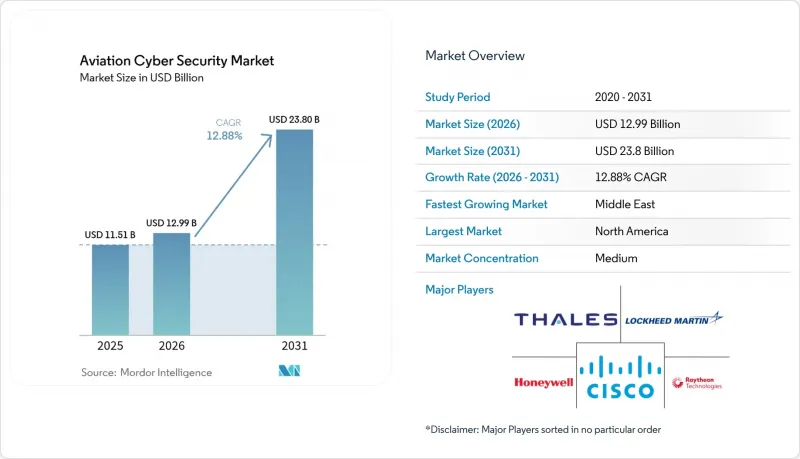
본 보고서는 솔루션별(위협 인텔리전스 및 대응, ID 및 액세스 관리, 데이터 유출 방지 등), 보안 유형별(네트워크 보안, 엔드포인트 보안, 애플리케이션 보안 등), 도입 형태별(온프레미스, 클라우드 도입), 용도별(항공사 관리, 항공 화물 관리 등), 지역별로 분류되어 있습니다. 시장 예측은 금액(달러)으로 표시되어 있습니다.
세계의 항공 사이버 보안 시장 동향 및 인사이트
통합된 디지털 항공 생태계의 급속한 확산이 사이버 공격 표면 확대
여객 서비스, 공항 OT(운영 기술), 항공기 데이터 링크 및 제3자 물류(3PL)의 융합이 항공 사이버 보안 시장을 재정의하고 있습니다. 2024년 8월, 시애틀 항구에서 발생한 보안 침해로 인해 주변 시스템이 다운되었으며, 비행 안전성이 유지되고 있는 상황에서도 횡방향 이동(라테럴 무브먼트)이 업무에 혼란을 초래할 수 있음이 밝혀졌습니다. 미국 교통안전청(TSA)은 2025 회계연도에 항공 분야에 특화된 사이버 방어에 1억 3,617만 달러를 배정하고 있으며, 이는 경계 방어 중심의 전략만으로는 더 이상 충분하지 않음을 시사합니다. 현재 이해관계자들은 항공 사이버 보안 시장 전반에 걸친 상호 의존 관계를 가시화하고 보호하는 종합적인 아키텍처를 우선시하고 있습니다.
항공기 기단 내 오픈 아키텍처 기반 항공전자 장비 및 IoT 센서의 급속한 도입
오픈 표준은 수명 주기 비용을 절감하고 플러그 앤 플레이 방식의 업그레이드를 가능하게 하지만, 반면 기단 전체에 동일한 취약점을 확산시키게 됩니다. FAA(연방항공청)가 2024년 8월에 제안한 내용에 따르면, 정비용 노트북, 공항 Wi-Fi 및 블루투스 센서가 비행에 필수적인 영역으로 침투하는 경로가 될 위험이 강조되고 있습니다. 충돌 회피용 트랜스폰더의 결함을 지적한 CISA(사이버보안·인프라보안청)의 권고도 이 문제의 시급성을 높이고 있습니다. 따라서 항공사 및 OEM 각사는 항공 사이버보안 시장 내 체계적인 위험을 완화하기 위해 보안 코딩 실천과 실행 시 모니터링을 결합해야 합니다.
통합된 보안 거버넌스를 저해하는 파편화된 레거시 시스템
방위 산업 기반에 대한 조사에 따르면, 항공 관련 조직의 98%가 사이버 사고의 영향을 받은 공급망 파트너십을 유지하고 있으며, 이로 인해 수십년전부터 운영되어 온 항공 교통 관제(ATC) 및 수하물 관리 네트워크 전반에 위험이 파급되고 있습니다. 많은 레거시 노드에서는 암호화, 다중 요소 인증, 중앙 집중식 로그 기록이 여전히 도입되지 않아, 항공사는 비용을 증가시키는 한편 중대한 보안 허점을 남기는 중복된 대책을 병행하여 시행할 수밖에 없는 상황에 처해 있습니다.
부문 분석
위협 인텔리전스 및 대응 솔루션은 2025년 항공 사이버 보안 시장 매출의 27.60%를 차지했으며, 해당 부문이 예방적 모니터링으로 무게 중심을 옮기고 있음을 보여줍니다. 관리형 보안 서비스는 2031년까지 연평균 성장률(CAGR) 13.4%를 기록할 전망입니다. 이러한 성장세는 항공 분야에 정통한 분석가 인재 풀이 제한적이라는 점과, 사내 인력을 증원하지 않고도 연중무휴 24시간 규제 기반의 로그 기록 요건을 충족해야 할 필요성에서 비롯됩니다.
OEM 및 항공사는 SIEM, OT(운영 기술) 이상 감지, 규정 준수 대시보드를 통합한 매니지드 서비스에 주목하고 있습니다. 항공 사이버 보안 시장의 매니지드 서비스 규모는 사고 보고 의무화 및 제로 트러스트 도입이 진행됨에 따라 확대될 것으로 예측됩니다. 벤더 간의 차별화 요인은 범용적인 SOC(보안 운영 센터) 인력 배치 모델이 아니라, 항공 전자 장비 및 ATC(항공 교통 관제) 워크플로우와 통합할 수 있는 비행 인증을 받은 엔지니어를 보유하고 있는지 여부에 달려 있습니다.
네트워크 보안은 2025년 지출의 31.60%를 차지했으며, 경계 방화벽에 대한 의존도가 여전히 남아 있음을 보여줍니다. 한편, 멀티 클라우드 및 컨테이너화된 워크로드로 인해 승객 체크인, 승무원 근무표 작성, 예측 유지보수 등이 온프레미스 외부로 이전됨에 따라 클라우드 보안은 연평균 성장률(CAGR) 14.7%로 성장을 주도하고 있습니다. 클라우드 제어와 관련된 항공 사이버 보안 시장 규모는 책임 분담에 대한 인식 제고 캠페인과 규제 대상 부문에 최적화된 주권 클라우드 리전의 확장에 힘입어 성장하고 있습니다.
엔드포인트 보호의 대상은 승무원의 태블릿부터 엔진 상태 모니터링 센서에 이르기까지 다양하며, 각 벤더는 서로 다른 하드웨어 간에 정책 엔진을 통합해야 할 필요가 있습니다. 또한, SaaS형 비행 계획 도구는 항공 사이버 보안 시장에 출시되기 전에 사이버 보안 및 안전성 두 가지 감사를 모두 통과해야 하기 때문에 용도 수준 방화벽, API 게이트웨이, 런타임 코드 스캔도 빠르게 보급되고 있습니다.
지역별 분석
북미는 2025년에 매출의 39.40%를 차지했으며, 항공 사이버 보안 시장을 주도하고 있습니다. 이는 FAA(연방항공청)가 2026 회계연도에 3,500만 달러의 사이버 보안 예산을 편성하고, TSA(교통안전청)가 공항 보안 강화를 위해 1억 3,617만 달러를 배정한 데 기인합니다. 현재 미국의 주요 항공사들은 모두 AI를 활용한 위협 감지 기능을 탑재하고 있으며, 캐나다의 항공교통관제기관(ANSP)인 NAV CANADA는 연방 정부의 모범 사례에 부합하는 제로 트러스트 청사진을 채택하고 있습니다. 또한, 이 지역의 벤더 생태계는 방위 분야 주요 기업들이 강화된 솔루션을 민간 항공기용으로 교차 판매하고 있다는 점에서도 혜택을 보고 있습니다.
유럽에서는 EASA의 Part-IS 및 EUROCONTROL CERT를 통한 조정을 통해 견실한 도입이 진행되고 있습니다. EU 전역에 걸친 조화를 통해 중복이 줄어들고 정보 공유의 효율성이 제고되고 있습니다. 탈레스(Thales)가 CEA와 체결한, 국방 용도의 신뢰성 높은 생성형 AI(GenAI) 개발을 위한 3년간의 AI 파트너십은 감지 및 대응의 신속화를 목표로 하는 해당 지역의 혁신을 잘 보여주고 있습니다. GDPR(EU 개인정보보호규정)은 규정 준수에 새로운 측면을 더하며, 항공 사이버 보안 시장에서 ‘프라이버시 바이 디자인(Privacy by Design)’에 기반한 암호화 및 토큰화 노력을 촉진하고 있습니다.
중동에서는 걸프 지역 허브 공항의 확장과 2024년 1분기에 기록된 183%의 DDoS 공격 급증에 힘입어, 연평균 성장률(CAGR) 13.05%로 성장을 지속하고, 있으며, 이에 따라 항공사들은 여러 공항을 보유한 포트폴리오의 보안 대책을 신속히 추진해야 할 필요에 직면해 있습니다. 이 지역의 국적 항공사들은 현재 지상 시스템에 대한 관리형 SOC(보안 운영 센터) 도입을 의무화하고 있으며, 스푸핑 공격에 대응하기 위해 위성 경로의 다각화를 추진하고 있습니다. 중국, 일본, 인도가 주도하는 아시아태평양은 대규모 항공기 도입, 정부의 스마트 공항에 대한 보조금 지원, 그리고 2024년 9월 델리에서 개최된 이 지역 최초의 항공 사이버 보안 장관급 정상회담 등을 배경으로 그 성장세가 가속화되고 있습니다. 다양한 규제 기준에 따라 국제적인 벤더와 지역 전문 기업 모두 다양한 인증 제도에 맞추어 제품 및 서비스를 현지화하도록 촉진되고 있습니다.
기타 혜택 :
- 엑셀 형식 시장 예측(ME) 시트
- 3개월간의 애널리스트 지원
자주 묻는 질문
목차
제1장 서론
제2장 조사 방법
제3장 주요 요약
제4장 시장 구도
제5장 시장 규모 및 성장 예측
제6장 경쟁 구도
제7장 시장 기회 및 향후 전망
AJY 26.08.07According to Mordor Intelligence, aviation cybersecurity market size in 2026 is estimated at USD 12.99 billion, growing from 2025 value of USD 11.51 billion with 2031 projections showing USD 23.8 billion, growing at 12.88% CAGR over 2026-2031.
This report is Segmented by Solution (Threat Intelligence and Response, Identity and Access Management, Data Loss Prevention, and More), Security Type (Network Security, Endpoint Security, Application Security, and More), Deployment Mode (On-Premise, Cloud-Deployed), Application (Airline Management, Air Cargo Management, and More), and Geography. The Market Forecasts are Provided in Terms of Value (USD).
Global Aviation Cybersecurity Market Trends and Insights
Surge in Integrated Digital Aviation Ecosystems Expanding Cyber-Attack Surface
The convergence of passenger services, airport OT, aircraft data links, and third-party logistics is redefining the Aviation Cybersecurity Market. In August 2024 a Port of Seattle breach brought down peripheral systems, demonstrating how lateral movement can disrupt operations even when flight safety is maintained. US Transportation Security Administration allocated USD 136.17 million toward aviation-focused cyber defenses for FY 2025, signaling that perimeter-centric strategies are no longer sufficient. Stakeholders now prioritize holistic architectures that map and secure interdependencies across the entire Aviation Cybersecurity Market.
Rapid Adoption of Open-Architecture Avionics & IoT Sensors in Aircraft Fleets
Open standards cut lifecycle costs and enable plug-and-play upgrades, yet they propagate identical vulnerabilities across fleets. The FAA's August 2024 proposal underscores risks from maintenance laptops, airport Wi-Fi, and Bluetooth sensors that can pivot to flight-critical domains. CISA advisories exposing flaws in collision-avoidance transponders add urgency. Airlines and OEMs thus must blend secure-coding practices with runtime monitoring to mitigate systemic exposure within the Aviation Cybersecurity Market.
Fragmented Legacy Systems Hindering Unified Security Governance
Defense Industrial Base studies find that 98% of aviation organizations sustain supply-chain partnerships hit by cyber incidents, propagating risk across decades-old ATC and baggage networks. Encryption, multifactor authentication, and centralized logging remain absent from many legacy nodes, forcing airlines to juggle redundant controls that inflate cost while leaving material gaps.
Other drivers and restraints analyzed in the detailed report include:
- Growth in Cloud-Based Airport Operations Platforms & SaaS Flight Applications
- Integration of 5G & Satellite Connectivity in ATC Networks Requiring Zero-Trust Security
- High Certification & Air-Worthiness Validation Costs Delaying Deployments
For complete list of drivers and restraints, kindly check the Table Of Contents.
Segment Analysis
Threat Intelligence & Response solutions captured 27.60% of 2025 revenue within the Aviation Cybersecurity Market share, evidencing the sector's pivot to proactive monitoring. Managed Security Services exhibit a 13.4% CAGR through 2031. This momentum stems from a limited pool of aviation-literate analysts and the need to meet 24X7 regulatory logging mandates without inflating internal headcount.
OEMs and airlines turn to managed offerings that bundle SIEM, OT anomaly detection, and compliance dashboards. The Aviation Cybersecurity Market size for managed services is forecast to increase in tandem with mandatory incident-reporting timelines and zero-trust rollouts. Vendor differentiation now centers on possessing flight-certified engineers able to integrate with avionics and ATC workflows rather than generic SOC staffing models.
Network Security retained 31.60% of 2025 spend, underlining residual reliance on perimeter firewalls. Yet Cloud Security leads growth at a 14.7% CAGR as multi-cloud, containerized workloads move passenger check-in, crew rostering, and predictive maintenance off-premise. The Aviation Cybersecurity Market size for cloud controls benefits from shared-responsibility education campaigns and the rollout of sovereign-cloud regions tailored for regulated sectors.
Endpoint protection stretches from crew tablets to engine-health sensors, compelling vendors to unify policy engines across distinct hardware. Application-level firewalls, API gateways, and runtime code-scanning also accelerate because SaaS flight-planning tools must pass both cyber and safety audits before release in the Aviation Cybersecurity Market.
Complete Report Scope:
- By Solution
- Threat Intelligence and Response
- Identity and Access Management
- Data Loss Prevention
- Security and Vulnerability Management
- Managed Security
- By Security Type
- Network Security
- Endpoint Security
- Application Security
- Cloud Security
- Wireless and Satellite Link Security
- By Deployment Mode
- On-Premise
- Cloud-Deployed
- By Application
- Airline Management
- Air Cargo Management
- Airport Management
- Air Traffic Control Management
- By Geography
- North America
- United States
- Canada
- Mexico
- Europe
- United Kingdom
- Germany
- France
- Nordics
- Rest of Europe
- Asia-Pacific
- China
- Japan
- India
- South Korea
- Rest of Asia-Pacific
- South America
- Brazil
- Argentina
- Rest of South America
- Middle East
- Saudi Arabia
- United Arab Emirates
- Turkey
- Rest of Middle East
- Africa
- South Africa
- Nigeria
- Kenya
- Rest of Africa
- North America
Geography Analysis
North America leads the Aviation Cybersecurity Market with 39.40% revenue in 2025, underpinned by the FAA's USD 35 million cybersecurity line item for FY 2026 and TSA's USD 136.17 million allocation to harden airports. All major U.S. carriers now embed AI-driven threat detection, and Canadian ANSP NAV CANADA adopts zero-trust blueprints mirroring federal best practices. The region's vendor ecosystem also benefits from defense primes cross-selling hardened solutions into commercial fleets.
Europe maintains robust adoption through EASA Part-IS and EUROCONTROL CERT coordination. Pan-EU harmonization reduces duplication and increases pooled intelligence sharing. Thales' three-year AI partnership with CEA to develop trusted GenAI for defense highlights regional innovation targeted at detection-and-response acceleration. GDPR adds another compliance dimension, prompting privacy-by-design encryption and tokenization efforts inside the Aviation Cybersecurity Market.
The Middle East posts a 13.05% CAGR driven by Gulf hub expansion and a documented 183% DDoS spike during Q1 2024, pushing operators to secure multi-airport portfolios rapidly. Flag carriers in the region now mandate managed SOC coverage for ground systems and deploy satellite-route diversity to counter spoofing attempts. Asia-Pacific, led by China, Japan, and India, follows close behind through large-scale fleet additions, government smart-airport grants, and the region's first ministerial aviation-cyber summit hosted in Delhi in September 2024. Diverse regulatory baselines encourage both international vendors and regional specialists to localize offerings for different certification regimes.
- Honeywell International Inc.
- Cisco Systems Inc.
- Thales Group
- Raytheon Technologies Corporation
- BAE Systems plc
- Lockheed Martin Corporation
- Northrop Grumman Corporation
- Collins Aerospace
- Unisys Corporation
- Palo Alto Networks Inc.
- SITA SC
- Leidos Holdings Inc.
- IBM Corporation
- Airbus CyberSecurity
- The Boeing Company
- Darktrace plc
- Fortinet Inc.
- Trend Micro Inc.
- Telespazio S.p.A.
- Rohde and Schwarz GmbH and Co KG
- Cyberbit Ltd.
Additional Benefits:
- The market estimate (ME) sheet in Excel format
- 3 months of analyst support
TABLE OF CONTENTS
1 INTRODUCTION
- 1.1 Study Assumptions and Market Definition
- 1.2 Scope of the Study
2 RESEARCH METHODOLOGY
3 EXECUTIVE SUMMARY
4 MARKET LANDSCAPE
- 4.1 Market Overview
- 4.2 Market Drivers
- 4.2.1 Surge in Integrated Digital Aviation Ecosystems Expanding Cyber-Attack Surface
- 4.2.2 Rapid Adoption of Open Architecture Avionics and IoT Sensors in Aircraft Fleets
- 4.2.3 Growth in Cloud-Based Airport Operations Platforms and SaaS Flight Applications
- 4.2.4 Integration of 5G and Satellite Connectivity in ATC Networks Requiring Zero-Trust Security
- 4.2.5 Rise of eVTOL and Urban Air Mobility Operators Implementing Security-by-Design
- 4.3 Market Restraints
- 4.3.1 Fragmented Legacy Systems Hindering Unified Security Governance
- 4.3.2 Shortage of Aviation-Domain Cyber-Security Specialists in Emerging Markets
- 4.3.3 High Certification and Air-Worthiness Validation Costs Delaying Deployments
- 4.3.4 Limited Budget Allocation Among Regional and General Aviation Airports
- 4.4 Industry Value-Chain Analysis
- 4.5 Regulatory and Compliance Outlook
- 4.6 Technology Snapshot (Emerging Tools, AI/ML, Quantum-Resistant Crypto)
- 4.7 Porter's Five Forces Analysis
- 4.7.1 Threat of New Entrants
- 4.7.2 Bargaining Power of Buyers/Consumers
- 4.7.3 Bargaining Power of Suppliers
- 4.7.4 Threat of Substitute Products
- 4.7.5 Intensity of Competitive Rivalry
- 4.8 Assessment of Macro Economic Trends on the Market
5 MARKET SIZE AND GROWTH FORECASTS (VALUES)
- 5.1 By Solution
- 5.1.1 Threat Intelligence and Response
- 5.1.2 Identity and Access Management
- 5.1.3 Data Loss Prevention
- 5.1.4 Security and Vulnerability Management
- 5.1.5 Managed Security
- 5.2 By Security Type
- 5.2.1 Network Security
- 5.2.2 Endpoint Security
- 5.2.3 Application Security
- 5.2.4 Cloud Security
- 5.2.5 Wireless and Satellite Link Security
- 5.3 By Deployment Mode
- 5.3.1 On-Premise
- 5.3.2 Cloud-Deployed
- 5.4 By Application
- 5.4.1 Airline Management
- 5.4.2 Air Cargo Management
- 5.4.3 Airport Management
- 5.4.4 Air Traffic Control Management
- 5.5 By Geography
- 5.5.1 North America
- 5.5.1.1 United States
- 5.5.1.2 Canada
- 5.5.1.3 Mexico
- 5.5.2 Europe
- 5.5.2.1 United Kingdom
- 5.5.2.2 Germany
- 5.5.2.3 France
- 5.5.2.4 Nordics
- 5.5.2.5 Rest of Europe
- 5.5.3 Asia-Pacific
- 5.5.3.1 China
- 5.5.3.2 Japan
- 5.5.3.3 India
- 5.5.3.4 South Korea
- 5.5.3.5 Rest of Asia-Pacific
- 5.5.4 South America
- 5.5.4.1 Brazil
- 5.5.4.2 Argentina
- 5.5.4.3 Rest of South America
- 5.5.5 Middle East
- 5.5.5.1 Saudi Arabia
- 5.5.5.2 United Arab Emirates
- 5.5.5.3 Turkey
- 5.5.5.4 Rest of Middle East
- 5.5.6 Africa
- 5.5.6.1 South Africa
- 5.5.6.2 Nigeria
- 5.5.6.3 Kenya
- 5.5.6.4 Rest of Africa
- 5.5.1 North America
6 COMPETITIVE LANDSCAPE
- 6.1 Market Concentration
- 6.2 Strategic Moves (MandA, JV, Product Launches)
- 6.3 Market Share Analysis
- 6.4 Company Profiles {(includes Global level Overview, Market level overview, Core Segments, Financials as available, Strategic Information, Market Rank/Share, Products and Services, Recent Developments)}
- 6.4.1 Honeywell International Inc.
- 6.4.2 Cisco Systems Inc.
- 6.4.3 Thales Group
- 6.4.4 Raytheon Technologies Corporation
- 6.4.5 BAE Systems plc
- 6.4.6 Lockheed Martin Corporation
- 6.4.7 Northrop Grumman Corporation
- 6.4.8 Collins Aerospace
- 6.4.9 Unisys Corporation
- 6.4.10 Palo Alto Networks Inc.
- 6.4.11 SITA SC
- 6.4.12 Leidos Holdings Inc.
- 6.4.13 IBM Corporation
- 6.4.14 Airbus CyberSecurity
- 6.4.15 The Boeing Company
- 6.4.16 Darktrace plc
- 6.4.17 Fortinet Inc.
- 6.4.18 Trend Micro Inc.
- 6.4.19 Telespazio S.p.A.
- 6.4.20 Rohde and Schwarz GmbH and Co KG
- 6.4.21 Cyberbit Ltd.
7 MARKET OPPORTUNITIES AND FUTURE OUTLOOK
- 7.1 White-Space and Unmet-Need Assessment


