

|
시장보고서
상품코드
2100617
방공 시스템 시장 : 점유율 분석, 업계 동향 및 통계, 성장 예측(2026-2031년)Air Defense Systems - Market Share Analysis, Industry Trends & Statistics, Growth Forecasts (2026 - 2031) |
||||||
 Mordor Intelligence
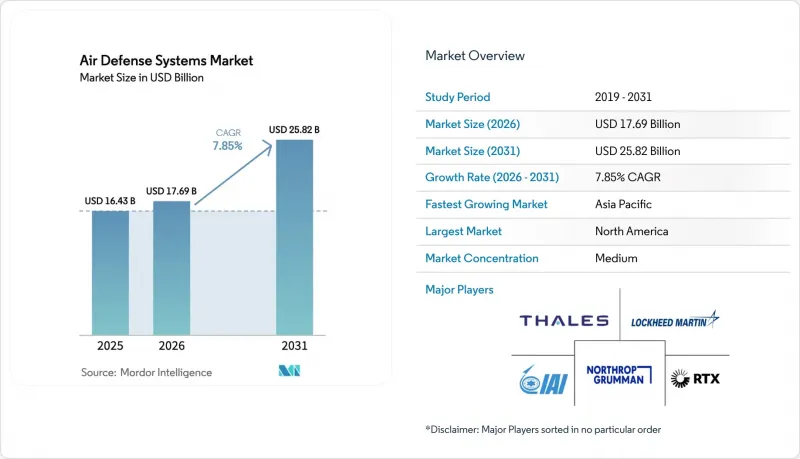
Mordor Intelligence에 의하면, 방공 시스템 시장 규모는 2025년 164억 3,000만 달러에서 2026년에는 176억 9,000만 달러로 확대되어 2026년부터 2031년까지 CAGR 7.85%로 성장을 지속하여, 2031년에는 258억 2,000만 달러에 이를 것으로 예측됩니다.
본 보고서는 시스템별(미사일 방어 시스템, 대공포 및 지대공 미사일(SAM) 시스템 등), 플랫폼별(육상, 해상 등), 사거리별(단거리, 중거리, 장거리), 하위 시스템별(무기 시스템, 사격 관제 시스템 등), 기술별(키네틱 킬 이펙터 등), 지역별(북미, 유럽 등)로 분류되어 있습니다. 시장 예측은 금액(달러) 기준으로 제시되어 있습니다.
세계 방공 시스템 시장 동향과 인사이트
통합 방공·미사일 방어 조달 가속화
미군은 과거 별도로 운영되던 레이더, 요격기 및 지휘 네트워크를 통합하여, 각 군종 및 동맹국 간에 추적 정보를 공유하는 통일된 체계로 수렴시키고 있습니다. 미 육군의 통합 전투 지휘 시스템(IBCS)은 공통 소프트웨어 기반을 통해 패트리어트, THAAD, 센티넬 및 F-35의 센서를 연계하여 교전까지 걸리는 시간을 수 분에서 수 초로 단축하고 있습니다. 유럽에서도 유사한 노력이 진행되고 있습니다. ‘유럽 스카이쉴드 이니셔티브’에는 2024년 말 기준 21개국이 참여하고 있으며, IRIS-T SLM, 패트리어트, 애로우 3의 조달을 조정함으로써 각국이 중복된 프로그램을 시행하는 것을 방지하고 있습니다. 현재 계약상 ‘플러그 앤 플레이’ 인터페이스 인증이 가능한 통합 업체에 우대 조치가 적용되고 있어, 기존 프로토콜을 보유하지 않은 신규 시장 진출기업에게는 진입 장벽이 높아지고 있습니다. 폴란드의 47억 5,000만 달러 규모 ‘비스라’ 발주는 IBCS 노드를 통합하는 것을 명확한 목적으로 설계되었습니다. 공동 표적 지정이 실시간 킬 체인으로 전환되는 가운데, 위성 군집은 목표물의 ‘탄생부터 소멸’까지의 추적 데이터를 지상 포대에 직접 제공하여 멀티도메인 루프를 완성하고 있습니다.
격화되는 공중 위협의 스펙트럼
극초음속 활공체, 저가시성 순항 미사일, 그리고 협업형 드론 스웜으로 인해 반응 시간이 수 초로 단축되면서 레이더의 현대화가 시급해지고 있습니다. 우크라이나에서 발생한 러시아의 ‘킨자르’ 공격을 계기로, 레이더 단면적이 0.01 m² 미만인 물체를 감지하는 GaN 기반의 ‘저고도 미사일 방어 센서(LTAMDS)’의 도입이 가속화되었습니다. 중국의 DF-17을 계기로 일본은 THAAD 배터리 도입을 검토하고, ‘초음속·탄도 추적 우주 센서’ 프로그램에 대한 공동 출자를 결정했습니다. 이 프로그램에서는 2025년에 시제 위성 발사가 예정되어 있습니다. 우크라이나가 1,000달러짜리 쿼드콥터를 전차 살상 무기로 활용한 사례는 저가 항공 플랫폼이 가져오는 비대칭적 효과를 여실히 보여주었으며, 이에 따라 미국의 ‘소형 UAS 대책 합동 사무국’은 2024년에 9개의 저비용 시스템을 심사하기로 했습니다.
GaN 기반 레이더 송수신 모듈공급망 병목 현상
극소수의 웨이퍼 공장에 대한 의존은 단일 고장 지점이라는 취약성을 초래하고 있습니다. Wolfspeed사의 모호크 밸리 공장은 미국 방위용 GaN 웨이퍼의 40% 이상을 공급하고 있으며, 해당 공장에서 가동 중단이 발생하면 LTAMDS, SPY-6, F-35의 각 생산 라인에 파급될 우려가 있습니다. X-밴드 MMIC의 수율률은 약 65%이므로, 각 OEM 업체들은 웨이퍼 주문량을 30% 가량 추가로 주문할 수밖에 없으며, 그 결과 재고 비용이 증가하고 있습니다. 갈륨 수출이 현재 중국의 할당제 대상에 포함되어 있어, 200mm 웨이퍼의 평균 리드타임이 16주까지 늘어났으며, 2026년에 발주된 레이더의 완전한 납품은 2028년까지 지연될 전망입니다.
부문 분석
지향성 에너지 아키텍처는 2031년까지 연평균 성장률(CAGR) 11.08%를 나타낼 것으로 예측되며, 주요 부문 중 가장 높은 성장률을 보이고 있습니다. 이는 레이저 및 고출력 마이크로파 시스템이 제공하는 저비용·고빈도 교전 능력에 대한 작전상의 요구를 반영한 것입니다. 미국 해군의 ‘프레블’호에 탑재된 60kW급 ‘다층 레이저 방어(LLD)’ 시스템은 발사체 1발당 1달러 미만의 비용으로 최대 3킬로미터 사거리 내의 아음속 순항 미사일을 무력화했습니다. 그럼에도 불구하고 미사일 방어 솔루션은 2025년에도 방공 시스템 시장 점유율의 43.91%를 유지했습니다. 이는 고체 로켓 모터 공급 부족으로 인해 2028년까지 이어질 PAC-3 MSE 및 THAAD의 미결 주문량이 뒷받침하고 있습니다.
방공 시스템 시장은 드론에 의한 포화 공격에 대응해 풍부한 탄약 비축량과 저비용을 보장하는 대-UAS(무인항공기 시스템), C-RAM(근거리 대공 방어), 그리고 고출력 마이크로파 솔루션으로 계속해서 전환되고 있습니다. 2024년 독일이 채택한 라인메탈사의 ‘스카이 레인저 30’은 30mm 공중폭발탄과 레이더 유도를 결합하여 쿼드콥터를 비용 효율적인 방식으로 격추합니다. 미국 해병대가 앤드릴(Anduril)사의 통합형 대UAS 스위트를 조달함에 따라, 하드웨어 교체 대신 코드 업데이트를 통해 방어 시스템을 업그레이드할 수 있는 소프트웨어 정의 아키텍처의 유효성이 입증되었습니다.
2025년에는 지상 배치형이 방공 시스템 시장의 59.75%를 차지하며, 각 군이 기동형 SHORAD의 가치를 재인식함에 따라 2031년까지 연평균 성장률(CAGR) 8.21%로 성장할 것으로 전망됩니다. 미 육군이 144대의 스트라이커(Striker) 탑재형 발사기로 구성된 IM-SHORAD를 도입함에 따라, 스팅어(Stinger), 헬파이어(Hellfire), 그리고 30mm 기관포를 조합하여 반경 8킬로미터 이내의 기동 부대를 보호하고 있습니다. 유럽도 이 전략을 모방하고 있으며, 복서(Boxer)에 탑재된 스카이레인저(Skyranger) 포탑은 독일 여단에 기갑 부대의 행군 속도를 따라갈 수 있는 이동식 드론 방어 능력을 제공합니다.
해상 방어 능력은 ‘이지스(Aegis)’ 시스템 업그레이드의 혜택을 받고 있습니다. 일본의 ‘마야’급 구축함은 SPY-1D(V) 레이더와 SM-3 IIA 요격 미사일을 장착하고 있어, 해상 방공 시스템 시장을 확대하는 동시에 지역 미사일 방어망이 미국의 전력과 연계되도록 보장하고 있습니다. F-35의 ‘분산 개구 시스템(DAS)’과 같은 항공기 탑재 시스템은 감지 능력을 향상시키고 있지만, 현 시점에서는 실탄을 이용한 요격 능력을 갖추고 있지 않아 사격 수단이라기보다는 전선 센서로서의 위치를 차지하고 있습니다.
지역별 분석
2025년, 미국 국방부가 현대화를 위해 80억 달러를 초과하는 지출을 단행함에 따라 북미는 방공 시스템 시장의 46.62%를 차지했습니다. RTX사가 2028년까지 납품할 예정인 28기의 레이더와 관련된 12억 달러 규모의 LTAMDS 수주는 400킬로미터 사거리에서 스텔스기를 추적하는 GaN 어레이에 대한 지속적인 투자를 뒷받침하고 있습니다. NORAD의 업그레이드에는 현재 NASAMS 배터리와 추적 레이어의 다운링크가 통합되어 있어 대륙 규모의 경계 체제가 확충되고 있습니다. 캐나다는 적극적으로 참여하고 있는 반면, 멕시코는 미국 국경 일대에서의 마약 밀수 대책용 C-UAS에 한정적으로 주력하고 있습니다.
아시아태평양은 2031년까지 연평균 성장률(CAGR) 9.76%를 나타낼 것으로 예측되며, 이는 지역별로는 가장 높은 성장 속도입니다. 일본은 2025 회계연도에 THAAD 도입 검토 및 위성 추적에 대한 투자를 포함한 탄도 미사일 방어 현대화에 23억 달러를 배정했습니다. 한국의 UAE 및 폴란드에 대한 KM-SAM 수출은 중급급 시장에서 한국의 비용 경쟁력을 보여줍니다. 인도는 러시아산 S-400에 대한 의존도를 낮추기 위해 2027년까지 QRSAM 생산 라인을 연간 200발 규모로 확대할 예정입니다. 호주의 NASAMS 발주 및 AUKUS 협정 참여는 미국과의 협력 강화를 시사하는 한편, 파키스탄에 대한 중국산 HQ-9의 불투명한 수출 상황은 연간 50개 배터리 이상의 생산량을 시사하고 있습니다.
유럽에서는 ‘유럽 스카이쉴드 이니셔티브’ 하에 조달을 가속화하고 있으며, 이 이니셔티브에는 상호 운용 가능한 방어 체계 구축에 전념하는 21개국이 참여하고 있습니다. 독일의 ‘애로우 3’ 프로젝트에서 획기적인 진전이 이루어짐에 따라, 미국 이외공급처로의 다각화가 진행되고 있습니다. 영국의 ‘드래곤파이어’ 레이저는 2027년에 해상 시험을 시작할 예정이며, 이는 해군 방어에 지향성 에너지를 통한 새로운 차원을 더하게 될 것입니다. 프랑스와 이탈리아는 NATO의 IAMD 요건에 따라 SAMP/T NG 개발을 계속하고 있으며, 2028년 초기 작전 능력(IOC) 달성을 목표로 하고 있습니다.
중동은 여전히 긴장의 초점으로 남아 있으며, 사우디아라비아의 THAAD 포대가 후시파의 미사일에 대응하고 있습니다. 아랍에미리트(UAE)는 ‘패트리어트’와 ‘NASAMS’를 도입해 방어 능력을 현대화하는 한편, 홍해에서 발생한 사건을 계기로 대 UAS(무인 항공기) 대책을 급속도로 추진하고 있습니다. 이스라엘의 ‘아이언 돔’, ‘데이비드 슬링’, ‘애로우’ 등 각 방어 체계는 90%의 요격 성공률을 유지하고 있으며, ‘아이언 빔’이 조만간 그 방어 범위를 확대하게 될 것입니다.
남미와 아프리카는 여전히 발전 중인 시장이며, 브라질은 아마존 국경 방어를 위해 NASAMS와 RBS 70 NG의 평가를 진행 중인 반면, 남아프리카공화국에서는 예산 제약 속에서 해군의 점방어 체계로 ‘움콘토-IR’이 배치되어 있습니다.
기타 혜택:
- 엑셀 형식 시장 예측(ME) 시트
- 3개월간의 애널리스트 지원
자주 묻는 질문
목차
제1장 서론
제2장 조사 방법
제3장 주요 요약
제4장 시장 구도
제5장 시장 규모와 성장 예측
제6장 경쟁 구도
제7장 시장 기회와 향후 전망
JHS 26.08.11According to Mordor Intelligence, the air defense systems market size is expected to grow from USD 16.43 billion in 2025 to USD 17.69 billion in 2026 and is forecasted to reach USD 25.82 billion by 2031 at a 7.85% CAGR over 2026-2031.
This report is Segmented by System (Missile Defense Systems, Anti-Aircraft Gun and SAM Systems, and More), Platform (Land-Based, Sea-Based, and More), Range (Short, Medium, and Long), Sub-System (Weapon System, Fire Control System, and More), Technology (Kinetic-Kill Effectors, and More ), and Geography (North America, Europe, and More). The Market Forecasts are Provided in Terms of Value (USD).
Global Air Defense Systems Market Trends and Insights
Acceleration of Integrated Air and Missile Defense Procurement
Armed forces are converging once-separate radar, interceptor, and command networks into unified frameworks that share tracks across services and allies. The US Army's Integrated Battle Command System (IBCS) links Patriot, THAAD, Sentinel, and F-35 sensors via a common software backbone, reducing engagement timelines from minutes to seconds. Europe mirrors this approach: the European Sky Shield Initiative, counting 21 members by late 2024, aligns purchases of IRIS-T SLM, Patriot, and Arrow 3 to avoid duplicative national programs. Contracts now reward integrators that can certify plug-and-play interfaces, raising entry barriers for newcomers lacking legacy protocols. Poland's USD 4.75 billion Wisla order was explicitly designed to bundle IBCS nodes. As joint targeting moves toward real-time kill chains, satellite constellations feed birth-to-death tracks directly into ground batteries, completing the multi-domain loop.
Escalating Spectrum of Airborne Threats
Hypersonic glide vehicles, low-observable cruise missiles, and cooperative drone swarms compress reaction time to seconds, forcing the modernization of radar. Russia's Kinzhal attacks in Ukraine accelerated deliveries of the GaN-based Lower Tier Air and Missile Defense Sensor (LTAMDS), which detects objects with radar cross-sections below 0.01 m2. China's DF-17 spurred Japan to consider THAAD batteries and to co-fund the Hypersonic and Ballistic Tracking Space Sensor program, with prototype satellites slated for 2025. Ukraine's adaptation of USD 1,000 quadcopters into tank killers revealed the asymmetric payoff of cheap aerial platforms, prompting the US Joint Counter-small UAS Office to vet nine low-cost systems in 2024.
Supply-Chain Bottlenecks in GaN-Based Radar T/R Modules
Reliance on a handful of wafer fabs creates single-point vulnerabilities. Wolfspeed's Mohawk Valley plant supplies over 40% of the US's defense-grade GaN wafers; any outage would ripple across the LTAMDS, SPY-6, and F-35 lines. Yield rates of roughly 65% for X-band MMICs necessitate that OEMs overbook wafers by 30%, thereby inflating inventory costs. With gallium exports now subject to Chinese quotas, average lead times for 200-mm wafers stretch to 16 weeks, delaying full radar deliveries until 2028 for orders placed in 2026.
Other drivers and restraints analyzed in the detailed report include:
- AI-Enabled Sensor Fusion for Stealth Detection
- Mobile Directed-Energy SHORAD Adoption
- Stringent ITAR and MTCR Export Controls Limiting System Sales to Emerging Nations
For complete list of drivers and restraints, kindly check the Table Of Contents.
Segment Analysis
Directed-energy architectures are projected to register an 11.08% CAGR through 2031, the fastest among major segments, reflecting the operational need for inexpensive, high-rate engagements that lasers and high-power microwave systems provide. The US Navy's 60-kilowatt Layered Laser Defense aboard USS Preble neutralized subsonic cruise missiles at ranges up to 3 kilometers at a cost of less than USD 1 per shot. Missile defense solutions nevertheless retained 43.91% of the air defense systems market share in 2025, underpinned by PAC-3 MSE and THAAD backlogs that extend into 2028 due to shortages of solid-rocket motors.
The air defense systems market continues to pivot toward counter-UAS, C-RAM, and high-power microwave options that promise deep magazines and low costs against saturating drone attacks. Rheinmetall's Skyranger 30, adopted by Germany in 2024, couples 30-mm airburst rounds with radar cueing to defeat quadcopters cost-effectively. The US Marine Corps' procurement of Anduril's integrated counter-UAS suite validated software-defined architectures that can update defenses through code updates rather than hardware swaps.
Land configurations secured 59.75% of the air defense systems market in 2025 and are expected to grow at a CAGR of 8.21% through 2031 as armies rediscover the value of mobile SHORAD. The US Army's IM-SHORAD roll-out of 144 Stryker-mounted launchers combines Stinger, Hellfire, and a 30-mm cannon to protect maneuver forces within an 8-kilometer radius. Europe is emulating this playbook; Boxer-mounted Skyranger turrets provide German brigades with movable drone defense that keeps pace with their armor columns.
Sea-based capacity benefits from Aegis upgrades; Japan's Maya-class destroyers feature SPY-1D(V) radars and SM-3 IIA interceptors, expanding the air defense systems market at sea and ensuring regional missile coverage aligns with US assets. Airborne systems, such as the F-35's Distributed Aperture System, add detection but not yet kinetic response, positioning them as forward sensors rather than shooters.
Complete Report Scope:
- By System
- Missile Defense Systems
- Anti-Aircraft Gun and SAM Systems
- Counter-Unmanned Aerial Systems (C-UAS)
- Counter-Rocket, Artillery and Mortar (C-RAM)
- Directed Energy Weapons (DEWs)
- By Platform
- Land-Based
- Sea-Based
- Air-Based
- Space-Based Early-Warning Assets
- By Range
- Short Range
- Medium Range
- Long Range
- By Sub-system
- Weapon System
- Fire Control System
- Command and Control (C2) System
- Others
- By Technology
- Kinetic-Kill Effectors
- High-Energy Laser Systems
- High-Power Microwave Systems
- Electronic Warfare (EW) Soft-Kill Solutions
- By Geography
- North America
- United States
- Canada
- Mexico
- Europe
- United Kingdom
- France
- Germany
- Russia
- Rest of Europe
- Asia-Pacific
- China
- India
- Japan
- South Korea
- Rest of Asia-Pacific
- South America
- Brazil
- Rest of South America
- Middle East and Africa
- Middle East
- Saudi Arabia
- United Arab Emirates
- Israel
- Rest of Middle East
- Africa
- South Africa
- Rest of Africa
- Middle East
- North America
Geography Analysis
North America commanded 46.62% of the air defense systems market in 2025 as the US DoD outlays exceeded USD 8 billion for modernization. RTX's USD 1.2 billion LTAMDS order for 28 radars, to be delivered by 2028, underscores its continuing investment in GaN arrays that track stealth aircraft at a range of 400 kilometers. NORAD upgrades now incorporate NASAMS batteries and Tracking Layer downlinks, expanding continental warning architecture. Canada participates actively, while Mexico's limited focus is on counter-narcotics C-UAS along the US border.
Asia-Pacific is projected to grow at a 9.76% CAGR through 2031, the highest regional pace. Japan allocated USD 2.3 billion in FY 2025 for ballistic-missile defense upgrades, including THAAD considerations and satellite tracking investments. South Korea's KM-SAM exports to the UAE and Poland illustrate Seoul's cost competitiveness in the mid-tier arena. India is scaling its QRSAM line to 200 missiles annually by 2027 to reduce reliance on Russian S-400s. Australia's NASAMS order and AUKUS collaboration indicate tighter US integration, while China's opaque HQ-9 exports to Pakistan suggest production volumes exceeding 50 batteries per year.
Europe accelerated procurement under the European Sky Shield Initiative, which enrolls 21 nations committed to interoperable layers. Germany's Arrow 3 breakthrough diversifies suppliers beyond the United States. The UK's DragonFire laser will start sea trials in 2027, adding directed-energy depth to naval defenses. France and Italy continue to develop the SAMP/T NG in line with NATO IAMD requirements, aiming to meet the 2028 IOC.
The Middle East remains a hotspot as Saudi Arabia's THAAD batteries counter Houthi missiles. The UAE modernized its defense capabilities with Patriot and NASAMS while fast-tracking counter-UAS measures following the Red Sea incidents. Israel's Iron Dome, David's Sling, and Arrow layers maintained 90% intercept success, and Iron Beam will soon extend that envelope.
South America and Africa remain embryonic segments, as Brazil evaluates NASAMS and RBS 70 NG for Amazon border defense, while South Africa's Umkhonto-IR supplies naval point defense amid budget constraints.
- RTX Corporation
- Lockheed Martin Corporation
- Israel Aerospace Industries Ltd.
- Northrop Grumman Corporation
- Thales Group
- Saab AB
- Rheinmetall AG
- Leonardo S.p.A.
- Kongsberg Gruppen ASA
- The Boeing Company
- ASELSAN Elektronik Sanayi ve Ticaret A.S.
- Hanwha Systems Co., Ltd.
- Rafael Advanced Defense Systems Ltd.
- L3Harris Technologies, Inc.
- BAE Systems plc
- MBDA
- Diehl Defence (Diehl Group)
- Elbit Systems Ltd.
- Bharat Dynamics Limited
- China Aerospace Science and Technology Corporation
- MDA Ltd.
- China North Industries Group Corporation
Additional Benefits:
- The market estimate (ME) sheet in Excel format
- 3 months of analyst support
TABLE OF CONTENTS
1 INTRODUCTION
- 1.1 Study Assumptions and Market Definition
- 1.2 Scope of the Study
2 RESEARCH METHODOLOGY
3 EXECUTIVE SUMMARY
4 MARKET LANDSCAPE
- 4.1 Market Overview
- 4.2 Market Drivers
- 4.2.1 Acceleration of integrated air and missile defense procurement
- 4.2.2 Escalating spectrum of airborne threats
- 4.2.3 AI-enabled sensor fusion for stealth detection
- 4.2.4 Mobile directed-energy SHORAD adoption
- 4.2.5 GaN-based AESA radar cost decline
- 4.2.6 Higher budgets for counter-UAS and point defense
- 4.3 Market Restraints
- 4.3.1 Supply-chain bottlenecks in GaN radar modules
- 4.3.2 Stringent ITAR and MTCR export controls limiting system sales to emerging nations
- 4.3.3 Technical and materials challenges in reliably intercepting maneuvering hypersonic targets, inflating R&D risk
- 4.3.4 Electromagnetic spectrum congestion raising inter-operability challenges
- 4.4 Value Chain Analysis
- 4.5 Regulatory and Technological Outlook
- 4.6 Porter's Five Forces Analysis
- 4.6.1 Bargaining Power of Buyers/Consumers
- 4.6.2 Bargaining Power of Suppliers
- 4.6.3 Threat of New Entrants
- 4.6.4 Threat of Substitute Products
- 4.6.5 Intensity of Competitive Rivalry
5 MARKET SIZE AND GROWTH FORECASTS (VALUE)
- 5.1 By System
- 5.1.1 Missile Defense Systems
- 5.1.2 Anti-Aircraft Gun and SAM Systems
- 5.1.3 Counter-Unmanned Aerial Systems (C-UAS)
- 5.1.4 Counter-Rocket, Artillery and Mortar (C-RAM)
- 5.1.5 Directed Energy Weapons (DEWs)
- 5.2 By Platform
- 5.2.1 Land-Based
- 5.2.2 Sea-Based
- 5.2.3 Air-Based
- 5.2.4 Space-Based Early-Warning Assets
- 5.3 By Range
- 5.3.1 Short Range
- 5.3.2 Medium Range
- 5.3.3 Long Range
- 5.4 By Sub-system
- 5.4.1 Weapon System
- 5.4.2 Fire Control System
- 5.4.3 Command and Control (C2) System
- 5.4.4 Others
- 5.5 By Technology
- 5.5.1 Kinetic-Kill Effectors
- 5.5.2 High-Energy Laser Systems
- 5.5.3 High-Power Microwave Systems
- 5.5.4 Electronic Warfare (EW) Soft-Kill Solutions
- 5.6 By Geography
- 5.6.1 North America
- 5.6.1.1 United States
- 5.6.1.2 Canada
- 5.6.1.3 Mexico
- 5.6.2 Europe
- 5.6.2.1 United Kingdom
- 5.6.2.2 France
- 5.6.2.3 Germany
- 5.6.2.4 Russia
- 5.6.2.5 Rest of Europe
- 5.6.3 Asia-Pacific
- 5.6.3.1 China
- 5.6.3.2 India
- 5.6.3.3 Japan
- 5.6.3.4 South Korea
- 5.6.3.5 Rest of Asia-Pacific
- 5.6.4 South America
- 5.6.4.1 Brazil
- 5.6.4.2 Rest of South America
- 5.6.5 Middle East and Africa
- 5.6.5.1 Middle East
- 5.6.5.1.1 Saudi Arabia
- 5.6.5.1.2 United Arab Emirates
- 5.6.5.1.3 Israel
- 5.6.5.1.4 Rest of Middle East
- 5.6.5.2 Africa
- 5.6.5.2.1 South Africa
- 5.6.5.2.2 Rest of Africa
- 5.6.5.1 Middle East
- 5.6.1 North America
6 COMPETITIVE LANDSCAPE
- 6.1 Market Concentration
- 6.2 Strategic Moves
- 6.3 Market Share Analysis
- 6.4 Company Profiles (includes Global level Overview, Market level overview, Core Segments, Financials as available, Strategic Information, Market Rank/Share for key companies, Products and Services, and Recent Developments)
- 6.4.1 RTX Corporation
- 6.4.2 Lockheed Martin Corporation
- 6.4.3 Israel Aerospace Industries Ltd.
- 6.4.4 Northrop Grumman Corporation
- 6.4.5 Thales Group
- 6.4.6 Saab AB
- 6.4.7 Rheinmetall AG
- 6.4.8 Leonardo S.p.A.
- 6.4.9 Kongsberg Gruppen ASA
- 6.4.10 The Boeing Company
- 6.4.11 ASELSAN Elektronik Sanayi ve Ticaret A.S.
- 6.4.12 Hanwha Systems Co., Ltd.
- 6.4.13 Rafael Advanced Defense Systems Ltd.
- 6.4.14 L3Harris Technologies, Inc.
- 6.4.15 BAE Systems plc
- 6.4.16 MBDA
- 6.4.17 Diehl Defence (Diehl Group)
- 6.4.18 Elbit Systems Ltd.
- 6.4.19 Bharat Dynamics Limited
- 6.4.20 China Aerospace Science and Technology Corporation
- 6.4.21 MDA Ltd.
- 6.4.22 China North Industries Group Corporation
7 MARKET OPPORTUNITIES AND FUTURE OUTLOOK
- 7.1 White-space and Unmet-Need Assessment


