

|
시장보고서
상품코드
2100621
항말라리아제 시장 : 점유율 분석, 업계 동향 및 통계, 성장 예측(2026-2031년)Anti-Malarial Drugs - Market Share Analysis, Industry Trends & Statistics, Growth Forecasts (2026 - 2031) |
||||||
 Mordor Intelligence
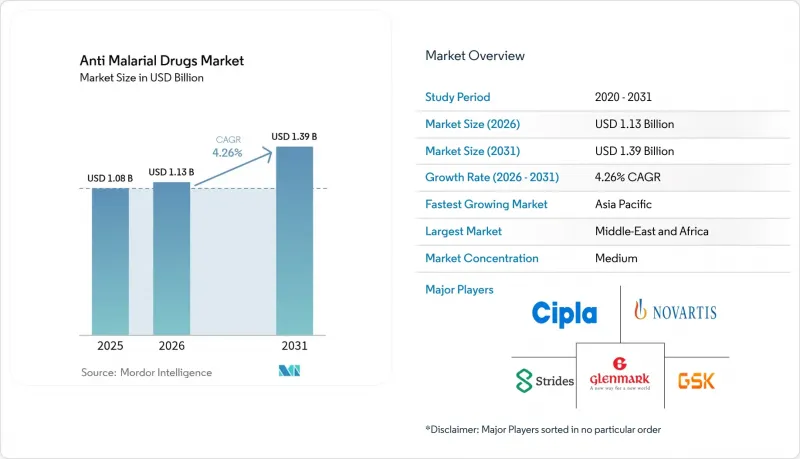
Mordor Intelligence에 의하면, 항말라리아제 시장 규모는 2025년 10억 8,000만 달러에서 2026년에는 11억 3,000만 달러로 확대되어 2026년부터 2031년까지 CAGR 4.26%로 성장을 지속하여, 2031년에는 13억 9,000만 달러에 이를 것으로 예측됩니다.
본 보고서는 약물 분류별(아리르아미노알코올 화합물 등), 말라리아 유형별(열대열 말라리아 원충 등), 작용기전별(말라리아 치료, 예방/화학적 예방, 근치), 지역별(북미, 유럽, 아시아태평양, 중동 및 아프리카, 남미)로 분류되어 있습니다. 시장 전망은 금액(달러) 기준으로 제시되어 있습니다.
전 세계 항말라리아제 시장 동향 및 인사이트
열대 지역의 풍토병으로 인한 질병 부담
열대 기후 하에서 지속적인 감염 확산으로 인해, 구매력이 낮은 경우에도 기초적인 수요가 유지되고 있습니다. 사하라 이남 아프리카에서는 2023년에 59만 7,000명의 말라리아 사망자가 기록되었으며, 이는 전 세계 전체의 94%에 해당하지만, 가격 책정이 기부자에 의한 조달에 의존하고 있기 때문에 매출에서 차지하는 비중은 작습니다. 에티오피아에서는 2024년 공급망 혼란으로 의약품 확보가 제한된 가운데, 730만 건의 확진 사례와 1,157명의 사망자가 기록되었습니다. 아노펠레스 스테펜시(Anopheles stephensi)가 도시 지역으로 침투함에 따라 감염 양상이 변화하고 있어, 농촌 지역 대상 프로그램에 그치지 않는 새로운 치료 전략이 요구되고 있습니다. 이러한 집중된 감염 부담으로 인해 유행국에서의 지속적인 소비는 보장되고 있지만, 수익 증가는 여전히 합리적인 가격 체계에 의해 제한받고 있습니다.
정부 주도의 말라리아 대책 이니셔티브 및 자금 조달
인도네시아의 ‘2030년 근절 로드맵’이나 인도의 ‘2023-27년 전략 계획’과 같은 국가 계획은 정책적 목표를 예측 가능한 의약품 입찰로 구체화하고 있습니다. 인도-부탄 및 인도-네팔 간 회랑을 따라 구축된 국경 간 감시 체제를 통해 조달 물량이 집약되면서 단가가 하락하고 있습니다. 그러나 WHO는 2025년에 예상되는 원조액 삭감이 64개 유행국의 서비스에 영향을 미치고, 공급망을 혼란에 빠뜨리며, 항말라리아제 시장을 불안정하게 만들 가능성이 있다고 경고하고 있습니다. 따라서 자금 조달의 변동은 주기적인 수요를 발생시키며, 기부자의 주기에 맞추어 생산을 유연하게 조정할 수 있는 공급업체에 이익을 가져다주고 있습니다.
유행 지역에서의 약물 내성 증가
우간다, 탄자니아, 르완다, 콩고민주공화국에서 Kelch-13 469Y 변이가 확인됨에 따라, 아르테미시닌에 대한 부분적 내성이 그 발원지인 동남아시아 이외의 지역으로도 확산되고 있음이 밝혀졌습니다. 내성 증가는 제품의 수명을 단축시키고, 비용이 많이 드는 제제 재설계를 강요하며, 연구 개발(R&D) 자금을 조달할 수 없는 소규모 생산자들을 시장에서 배제할 가능성이 있습니다. WHO가 여러 가지 1차 치료법을 권장하는 새로운 지침은 여러 가지 선택지를 동시에 비축해야 하는 의료 시스템에 물류상의 부담을 가중시키고 있습니다.
부문 분석
2025년, 아르테미시닌 유도체는 전 세계 치료 지침의 뒷받침을 받아 항말라리아제 시장 점유율의 46.02%를 차지했습니다. 노바티스의 시파르가민으로 대표되는 스피로인드론 계열 약물은 아르테미시닌 내성 균주에 대해서도 효능을 유지하고 있어 연평균 성장률(CAGR) 6.23%로 시장을 확대되고 있습니다. 항엽산제 및 아릴아미노알코올 계열 약물은 병용 요법 및 예방 분야에서 틈새 시장의 중요성을 유지하고 있습니다. 엔도퍼옥사이드 유사체는 교차 내성을 유발하지 않으면서 과산화물 기반의 활성을 모방하는 것을 목표로 하는 초기 단계의 파이프라인에 있습니다.
이러한 전환은 단일 작용기전에 의한 실패에 대비한 전략적 리스크 헤지를 보여줍니다. FIKK 키나아제 억제제나 크로마틴 리모델러와 같은 다른 유형의 약물도 연구가 진행 중이며, 기생충의 생물학적 기능을 억제하는 새로운 경로를 제공하고 있습니다(SCiencedaily.com). 규제 당국의 승인을 받기까지의 리드타임이 여전히 길기 때문에 풍부한 자본을 보유한 대기업이 이러한 자산을 승인 단계까지 이끌어내는 데 가장 적합합니다.
2025년 항말라리아제 시장 규모 중 열대열 말라리아 원충(Plasmodium falciparum)이 62.55%를 차지했습니다. PCR 진단법의 개선으로 노울시 말라리아 원충(P. knowlesi) 증가 속도가 가속화되고 있는 것으로 밝혀졌으며, 현재 연평균 성장률(CAGR) 6.62%로 확대되고 있습니다. 특히, 인간과 마카크 원숭이의 접촉이 인수공통감염병의 확산을 초래하고 있는 말레이시아와 인도네시아의 일부 지역에서 이러한 경향이 두드러집니다. Plasmodium vivax(삼일열 말라리아 원충)의 경우, 간 내의 휴면체 제거를 위해서는 근치적 치료 요법이 필요하기 때문에 여전히 높은 수요가 유지되고 있습니다.
종별로 최적화된 치료법이 점차 확산되고 있습니다. 브라질과 태국에서 비박스형 말라리아에 대한 1회 투여 근치 요법의 도입은 말라리아 치료가 정밀 의학으로 전환되고 있음을 보여줍니다. 보다 광범위한 도입은 1차 의료 현장에서의 진단 정확도에 달려 있습니다.
지역별 분석
2025년 항말라리아제 시장에서 북미가 39.12%라는 압도적인 점유율을 차지한 배경에는 여행자, 군 관계자, 연구 기관을 대상으로 한 고가의 예방약 판매가 있었습니다. 2024년 수입 사례 수는 총 1,772건에 달했으며, 비유행 지역에서도 여전히 신뢰할 수 있는 치료법이 필요하다는 사실이 확인되었습니다. FDA의 규제 측면에서의 주도적인 역할은 연구 개발(R&D) 투자를 더욱 촉진하고 있습니다. 그러나 자발적 여행에 대한 의존도가 높기 때문에 이 부문은 경기 침체의 영향을 받기 쉬우며, 약국에서 수요가 급격히 위축될 가능성이 있습니다.
아시아태평양에서는 중산층 인구 증가에 따른 의료 인프라 투자가 진행되고, 각국 정부가 사례 감지를 강화하고 있어 2031년까지 연평균 성장률(CAGR) 5.18%를 나타낼 것으로 예측됩니다. 이 지역의 항말라리아제 시장 규모는 통합적인 감시 체계와 근절 계획의 진전에 따라 확대되고 있습니다. 세계 펀드가 파악한 4억 7,800만 달러의 자금 부족은 혼합 금융에 대한 의존이 지속되고 있음을 보여줍니다. 대메콩 지역에서의 아르테미시닌 내성 문제로 인해 스피로인드론 계열 약물과 트리플 ACT에 대한 관심이 높아지고 있습니다. P. vivax가 주류를 이루고 있는 만큼, G6PD 검사의 장벽이 완화된다면 근치적 치료법의 보급이 확실시됩니다.
유럽, 중동 및 아프리카, 그리고 남미는 여전히 상황이 제각각입니다. 유럽 수요는 여행자용 예방약과 기초 조사를 중심으로 전개되고 있으며, 안정적이긴 하지만 저성장의 수익을 가져오고 있습니다. 사하라 이남 아프리카의 질병 부담은 꾸준한 조달을 확보하고 있는 반면, 가격 상한선을 끌어올리고 있습니다. 아프리카에서의 백신 도입은 돌파 감염 및 혼합 감염에 대한 치료제와 병행하여 이루어지고 있으며, 병용 요법의 활용이 증가할 가능성이 있습니다. 남미 아마존 강 유역에서는 말라리아 근절이 눈앞에 다가오고 있어, 의약품 조달은 사후 관리 및 수입 사례 관리로 전환되고 있습니다.
기타 혜택:
- 엑셀 형식 시장 예측(ME) 시트
- 3개월간의 애널리스트 지원
자주 묻는 질문
목차
제1장 서론
제2장 조사 방법
제3장 주요 요약
제4장 시장 구도
제5장 시장 규모와 성장 예측
제6장 경쟁 구도
제7장 시장 기회와 향후 전망
JHS 26.08.11According to Mordor Intelligence, the anti-malarial drugs market size is expected to grow from USD 1.08 billion in 2025 to USD 1.13 billion in 2026 and is forecast to reach USD 1.39 billion by 2031 at 4.26% CAGR over 2026-2031.
This report is Segmented by Drug Class (Aryl Amino-Alcohol Compounds, and More), Malaria Type (Plasmodium Falciparum, and More), Mechanism of Action (Treatment for Malaria, Prevention/Chemoprophylaxis, and Radical Cure), and Geography (North America, Europe, Asia-Pacific, Middle East & Africa, South America). The Market Forecasts are Provided in Terms of Value (USD).
Global Anti-Malarial Drugs Market Trends and Insights
Endemic Disease Burden In Tropical Regions
Persistent transmission in tropical climates sustains baseline demand even when purchasing power is low. Sub-Saharan Africa recorded 597,000 malaria deaths in 2023, equal to 94% of the global total, yet contributed a smaller share of revenue because pricing relies on donor procurement. Ethiopia logged 7.3 million cases and 1,157 deaths in 2024 during supply chain disruptions that limited medicine availability. Urban invasion by Anopheles stephensi is altering transmission patterns, requiring new therapeutic strategies that go beyond rural programs. This concentrated burden assures continuous consumption in endemic countries, but revenue growth remains capped by affordability frameworks.
Government-Led Malaria Control Initiatives And Funding
National plans such as Indonesia's 2030 elimination roadmap and India's 2023-27 strategic plan translate policy ambition into predictable drug tenders. Cross-border surveillance along India-Bhutan and India-Nepal corridors aggregates procurement volumes and lowers unit costs. Yet WHO cautions that projected aid reductions in 2025 could affect services across 64 endemic countries, disrupting supply chains and destabilizing the anti-malarial drugs market. Funding swings therefore create cyclic demand, benefiting suppliers able to flex production in line with donor cycles.
Increasing Drug Resistance In Endemic Areas
Kelch-13 469Y mutations now identified in Uganda, Tanzania, Rwanda, and the Democratic Republic of Congo confirm partial artemisinin resistance beyond its Southeast Asian origin. Rising resistance shortens product lifecycles, compels costly reformulation, and may sideline smaller producers unable to fund R&D. WHO's new recommendation for multiple first-line therapies raises the logistical burden on health systems that must stock several options simultaneously.
Other drivers and restraints analyzed in the detailed report include:
- Advancements In Artemisinin-Based Combination Therapies
- Expansion Of Global Health Financing Mechanisms
- Proliferation Of Counterfeit And Substandard Medications
For complete list of drivers and restraints, kindly check the Table Of Contents.
Segment Analysis
Artemisinin derivatives controlled 46.02% of anti-malarial drugs market share in 2025, anchored by global treatment guidelines. Spiroindolones, represented by Novartis's cipargamin, are advancing at a 6.23% CAGR because they retain potency against artemisinin-resistant strains. Antifolates and aryl amino-alcohols keep niche relevance in combinations and prevention. Endoperoxide analogues are in early pipelines that aim to mimic peroxide-based activity without cross-resistance.
The transition indicates strategic hedging against single-mechanism failure. Other drug types such as FIKK kinase inhibitors and chromatin remodelers are under exploration, offering new pathways to disrupt parasite biology [SCiencedaily.com]. Regulatory lead times remain long, so larger firms with deeper capital are best placed to carry these assets through approval.
Plasmodium falciparum accounted for 62.55% of the anti-malarial drugs market size in 2025. Improved PCR diagnostics are uncovering a faster rise in P. knowlesi, which now grows at a 6.62% CAGR, particularly in Malaysia and parts of Indonesia where human-macaque interface drives zoonotic spillover. Plasmodium vivax retains high demand because its liver hypnozoites necessitate radical cure regimens.
Species-tailored therapies are beginning to penetrate. Brazil's and Thailand's introduction of single-dose radical cure for vivax signals movement toward precision medicine in malaria care. Broader adoption hinges on diagnostic accuracy in primary care settings.
Complete Report Scope:
- By Drug Class
- Aryl Amino-Alcohol Compounds
- Antifolate Compounds
- Artemisinin Compounds
- Endoperoxide Analogues
- Spiroindolone Compounds
- Other Drug Types
- By Malaria Type
- Plasmodium Falciparum
- Plasmodium Vivax
- Plasmodium Malariae
- Plasmodium Ovale
- Plasmodium Knowlesi
- By Mechanism Of Action
- Treatment For Malaria
- Prevention / Chemoprophylaxis
- Radical Cure (Anti-Relapse)
- By Distribution Channel
- Public Procurement Agencies
- Hospital Pharmacies
- Retail Pharmacies
- Online Pharmacies
- Geography
- North America
- United States
- Canada
- Mexico
- Europe
- Germany
- United Kingdom
- France
- Italy
- Spain
- Rest of Europe
- Asia-Pacific
- China
- Japan
- India
- Australia
- South Korea
- Rest of Asia-Pacific
- Middle East & Africa
- GCC
- South Africa
- Rest of Middle East & Africa
- South America
- Brazil
- Argentina
- Rest of South America
- North America
Geography Analysis
North America's dominant 39.12% share of the anti-malarial drugs market in 2025 came from premium prophylaxis sales to travelers, the military, and research institutions. Imported cases totaled 1,772 in 2024, confirming that non-endemic settings still require reliable treatments. Regulatory leadership by the FDA further anchors R&D investments. Yet reliance on discretionary travel exposes the segment to economic downturns that can quickly dampen pharmacy demand.
Asia-Pacific is forecast to grow at 5.18% CAGR through 2031 as expanding middle-income populations invest in healthcare infrastructure and governments boost case detection. The anti-malarial drugs market size here rises in tandem with integrated surveillance and elimination plans. Funding shortfalls of USD 478 million identified by the Global Fund illustrate ongoing dependency on blended finance. Resistance to artemisinin in the Greater Mekong Subregion drives interest in spiroindolones and triple ACTs. P. vivax dominance ensures radical cure uptake once G6PD testing barriers ease.
Europe, Middle East & Africa, and South America remain heterogeneous. European demand orbits around traveler prophylaxis and basic research, contributing stable but low-growth revenue. Sub-Saharan Africa's disease load secures steady procurement yet caps pricing. African vaccine deployments will coexist with drugs for breakthrough and mixed infections, potentially increasing combination therapy use. South America's Amazon basin is nearing elimination, shifting drug procurement toward follow-up care and imported case management.
- GlaxoSmithKline
- Novartis
- Cipla
- Cadila Healthcare (Zydus Lifesciences)
- Bayer
- Sun Pharmaceuticals Industries
- Sanofi
- Amivas LLC
- Lupin
- Glenmark Pharmaceuticals
- Strides Pharma Science
- Ajanta Pharma
- Alvizia Healthcare
- Lincoln Pharmaceuticals
- Mylan N.V. (Viatris)
- Fosun Pharma (Artequick)
- Hetero Drugs
- Medicines For Malaria Venture (MMV)
- Sigma-Tau Arzneimittel (Eurartesim)
- Shin Poong Pharmaceutical Co., Ltd. (Pyramax)
Additional Benefits:
- The market estimate (ME) sheet in Excel format
- 3 months of analyst support
TABLE OF CONTENTS
1 Introduction
- 1.1 Study Assumptions & Market Definition
- 1.2 Scope Of The Study
2 Research Methodology
3 Executive Summary
4 Market Landscape
- 4.1 Market Overview
- 4.2 Market Drivers
- 4.2.1 Endemic Disease Burden in Tropical Regions
- 4.2.2 Government-Led Malaria Control Initiatives and Funding
- 4.2.3 Advancements in Artemisinin-Based Combination Therapies
- 4.2.4 Expansion of Global Health Financing Mechanisms
- 4.2.5 Integration of Digital Health Tools in Case Management
- 4.2.6 Growing Private-Sector Investment in Novel Antimalarials
- 4.3 Market Restraints
- 4.3.1 Increasing Drug Resistance in Endemic Areas
- 4.3.2 Proliferation of Counterfeit and Substandard Medications
- 4.3.3 Limited Commercial Incentives for Novel Chemistries
- 4.3.4 Supply Chain Vulnerability to Raw Material Shortages
- 4.4 Regulatory Landscape
- 4.5 Porter's Five Forces Analysis
- 4.5.1 Threat Of New Entrants
- 4.5.2 Bargaining Power Of Buyers / Consumers
- 4.5.3 Bargaining Power Of Suppliers
- 4.5.4 Threat Of Substitute Products
- 4.5.5 Intensity Of Competitive Rivalry
5 Market Size & Growth Forecasts (Value, USD)
- 5.1 By Drug Class
- 5.1.1 Aryl Amino-Alcohol Compounds
- 5.1.2 Antifolate Compounds
- 5.1.3 Artemisinin Compounds
- 5.1.4 Endoperoxide Analogues
- 5.1.5 Spiroindolone Compounds
- 5.1.6 Other Drug Types
- 5.2 By Malaria Type
- 5.2.1 Plasmodium Falciparum
- 5.2.2 Plasmodium Vivax
- 5.2.3 Plasmodium Malariae
- 5.2.4 Plasmodium Ovale
- 5.2.5 Plasmodium Knowlesi
- 5.3 By Mechanism Of Action
- 5.3.1 Treatment For Malaria
- 5.3.2 Prevention / Chemoprophylaxis
- 5.3.3 Radical Cure (Anti-Relapse)
- 5.4 By Distribution Channel
- 5.4.1 Public Procurement Agencies
- 5.4.2 Hospital Pharmacies
- 5.4.3 Retail Pharmacies
- 5.4.4 Online Pharmacies
- 5.5 Geography
- 5.5.1 North America
- 5.5.1.1 United States
- 5.5.1.2 Canada
- 5.5.1.3 Mexico
- 5.5.2 Europe
- 5.5.2.1 Germany
- 5.5.2.2 United Kingdom
- 5.5.2.3 France
- 5.5.2.4 Italy
- 5.5.2.5 Spain
- 5.5.2.6 Rest of Europe
- 5.5.3 Asia-Pacific
- 5.5.3.1 China
- 5.5.3.2 Japan
- 5.5.3.3 India
- 5.5.3.4 Australia
- 5.5.3.5 South Korea
- 5.5.3.6 Rest of Asia-Pacific
- 5.5.4 Middle East & Africa
- 5.5.4.1 GCC
- 5.5.4.2 South Africa
- 5.5.4.3 Rest of Middle East & Africa
- 5.5.5 South America
- 5.5.5.1 Brazil
- 5.5.5.2 Argentina
- 5.5.5.3 Rest of South America
- 5.5.1 North America
6 Competitive Landscape
- 6.1 Market Concentration
- 6.2 Market Share Analysis
- 6.3 Company Profiles (includes Global level Overview, Market level overview, Core Business Segments, Financials, Headcount, Key Information, Market Rank, Market Share, Products and Services, and analysis of Recent Developments)
- 6.3.1 GlaxoSmithKline Plc
- 6.3.2 Novartis AG
- 6.3.3 Cipla Limited
- 6.3.4 Cadila Healthcare (Zydus Lifesciences)
- 6.3.5 Bayer AG
- 6.3.6 Sun Pharmaceutical Industries
- 6.3.7 Sanofi S.A.
- 6.3.8 Amivas LLC
- 6.3.9 Lupin Limited
- 6.3.10 Glenmark Pharmaceuticals Ltd
- 6.3.11 Strides Pharma Science Limited
- 6.3.12 Ajanta Pharma
- 6.3.13 Alvizia Healthcare
- 6.3.14 Lincoln Pharmaceuticals
- 6.3.15 Mylan N.V. (Viatris)
- 6.3.16 Fosun Pharma (Artequick)
- 6.3.17 Hetero Drugs
- 6.3.18 Medicines For Malaria Venture (MMV)
- 6.3.19 Sigma-Tau Arzneimittel (Eurartesim)
- 6.3.20 Shin Poong Pharmaceutical Co., Ltd. (Pyramax)
7 Market Opportunities & Future Outlook
- 7.1 White-Space & Unmet-Need Assessment


