|
시장보고서
상품코드
2100626
세포사멸 분석 시장 : 점유율 분석, 업계 동향 및 통계, 성장 예측(2026-2031년)Apoptosis Assay - Market Share Analysis, Industry Trends & Statistics, Growth Forecasts (2026 - 2031) |
||||||
 Mordor Intelligence
Mordor Intelligence에 의하면, 세포사멸 분석 시장 규모는 2025년 65억 1,000만 달러에서 2026년에는 70억 7,000만 달러로 확대되어 2026년부터 2031년까지 CAGR 8.57%로 성장을 지속하여, 2031년에는 106억 6,000만 달러에 이를 것으로 예측됩니다.
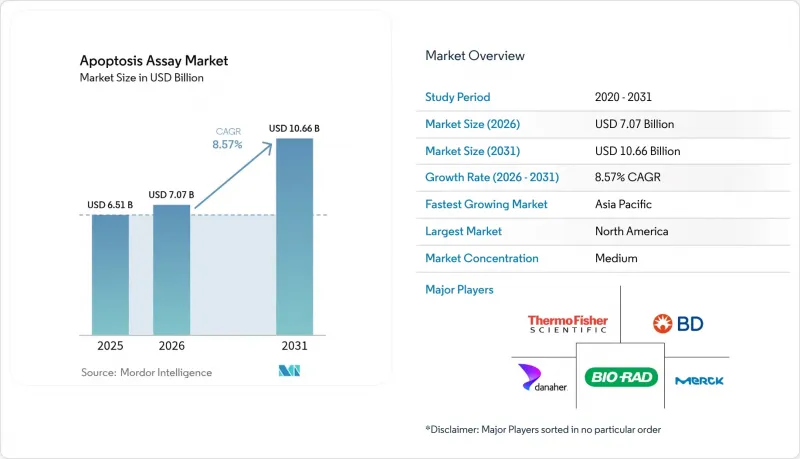
본 보고서는 제품별(분석 키트, 시약 및 소모품, 기기), 검출 기술별(유세포 분석법, 분광광도법 등), 용도별(신약·의약품 개발 등), 최종 사용자별(제약·바이오기술 기업 등), 지역별(북미, 유럽 등)로 분류되어 있습니다. 시장 전망은 금액(달러) 기준으로 제시되어 있습니다.
세계 세포사멸 분석 시장 동향과 인사이트
만성 질환 및 자가면역 질환의 발병률 상승
만성 질환 유병률 증가는 세포사멸 분석에 대한 수요 곡선을 재편하고 있습니다. 미국 국립암연구소(NCI)가 지원하는 490만 달러 규모의 ‘RNA Modifications Driving Oncogenesis’ 이니셔티브와 같은 연구 보조금은 종양 내 번역 재프로그래밍을 규명하기 위해 세포사멸 경로의 매핑을 우선적으로 지원하고 있습니다. 또한 자가면역 질환도 이러한 추세를 더욱 가속화하고 있습니다. 이는 세포사멸 조절의 이상이 염증 캐스케이드를 지속시키기 때문입니다. 세포사멸 관련 세포외 소포에 대한 연구는 암, 허혈성 손상 및 염증성 질환 전반에 걸친 면역 조절 가능성을 시사하고 있습니다. 고령화가 진행되는 가운데, 연구 기관에서는 현재 카스파제 활성, 미토콘드리아 탈분극, 포스파티딜세린 노출을 병행하여 측정하는 멀티플렉스 패널을 도입하여, 분석 워크플로우를 만성 질환의 다인자적 생물학적 특성에 맞추고 있습니다.
세포사멸 조절 치료제의 발전
BCL-2, IAP, MDM2-p53 조절 인자를 표적으로 하는 임상 개발 파이프라인에는 경로 특이적인 정밀한 분석이 요구됩니다. Ascentage Pharma사는 이 세 가지 분류 모두에서 임상시험을 적극적으로 수행하고 있으며, 정확한 세포사멸 측정이 상업적으로 얼마나 중요한지를 보여주고 있습니다. 종양학 분야를 넘어, 나비토크라크스는 항생제와 병용하여 감염 세포의 제거를 촉진하며, 결핵에서 숙주 지향적인 작용을 나타냅니다. 따라서 제약 개발 기업들은 단일 워크플로우 내에서 초기 단계의 미토콘드리아 사건, 카스파제 캐스케이드, 그리고 후기 단계의 DNA 단편화를 포착할 수 있는 분석법을 찾고 있으며, 이는 하이컨텐츠 이미징 플랫폼 및 머신러닝 분석 도구의 도입을 촉진하고 있습니다.
엄격한 다국간 규제 요건
FDA의 ‘실험실 개발 검사(LDT)’에 관한 최종 규정에는 5단계의 단계적 시행 계획이 적용되어 있으며, 이로 인해 매년 5억 6,600만 달러에서 35억 6,000만 달러의 규정 준수 비용이 발생할 것으로 예측됩니다. 유럽의 ATMP 지침에서는 세포 치료용 분석법에 대해 유사한 GMP 의무가 부과되고 있습니다. 따라서 공급업체는 서로 다른 문서 기준을 충족하는 검증 패키지를 설계해야 하며, 이는 제품 시장 출시를 지연시키고 중소규모 개발 기업들이 직접적인 상용화 대신 라이선싱을 선택하도록 유도하고 있습니다.
부문 분석
2025년, 세포사멸 분석 시장의 매출의 52.48%를 분석 키트가 차지하며, 버퍼, 컨쥬게이트, 컨트롤을 묶은 턴키 프로토콜의 매력이 부각되었습니다. 시약 및 소모품은 규모는 작지만, 고처리량 플랫폼에서는 대량의 시약이 소비되고 실험실에서 프로토콜을 맞춤 설정할 수 있기 때문에 연평균 성장률(CAGR) 9.54%로 성장할 전망입니다. 장비 분야는 AI 업그레이드 및 광학 해상도 향상에 따른 설비 투자 주기와 맞물려 완만한 성장세를 보이고 있습니다.
개별 염료, 형광 생성 기질 및 맞춤형 버퍼 세트로의 지출 전환은 공정의 성숙도를 보여줍니다. 아넥신 V-FITC 및 APC 접합체는 여전히 주력 제품이지만, 2세대 카스파제-3/7 기질은 신약 스크리닝 분야에서 주목을 받고 있습니다.
유세포분석법은 단일 세포 수준의 분해능과 다중 매개변수 측정 능력을 바탕으로 2025년 세포사멸 분석 시장에서 39.10%의 점유율을 차지했습니다. 플레이트 단위의 처리 속도가 높이 평가받는 분광광도법은 연평균 성장률(CAGR) 9.98%로 확대되고 있습니다. 하이컨텐츠 이미징 및 3D 홀로토모그래피는 오가노이드 연구 및 AI 분석에 활용되어 프리미엄 시장을 차지하고 있습니다.
유세포 분석기에서는 아넥신 V와 프로피디움 요오다이드의 이중 염색 프로토콜을 사용하여 세포사멸의 초기 단계와 후기 단계를 구분합니다. 분광광도법을 이용한 카스파제 분석에서는 384웰 플레이트를 90분 이내에 스크리닝할 수 있습니다. 첨단 이미징 시스템에는 인공지능 알고리즘이 내장되어 있어, 3D 오가노이드 모델에서 세포사멸의 분석화를 자동화함으로써 생리학적으로 관련성이 높은 시스템에서 세포사멸 분석의 복잡성을 해결하고 있습니다. 홀로토모그래피와 오가노이드 배양 시스템의 통합을 통해 형광 염색 없이도 세포사멸 과정을 실시간으로 관찰할 수 있게 되었으며, 이는 중요한 기술적 진보라고 할 수 있습니다.
지역별 분석
북미는 NIH(미국 국립보건원)의 연구비 지원과 견실한 벤처 캐피털의 지원으로 첨단 플랫폼 도입이 지속적으로 진행되고 있어, 2025년 매출의 47.42%를 차지했습니다. FDA(미국 식품의약국)의 ‘실험실 개발 검사(LDT) 규정’은 연간 35억 1,000만 달러의 이익을 창출하며, 투자를 촉진하는 통일된 품질 기준을 확립하고 있습니다. 캐나다의 바이오테크놀러지 코리도 및 멕시코의 수탁 제조 허브도 추가적인 성장에 기여하고 있습니다.
아시아태평양은 2031년까지 연평균 성장률(CAGR)이 9.91%로 가장 빠르게 성장하고 있는 지역입니다. 일본은 세포사멸 모니터링이 필요한 신약 개발 프로그램에 대한 직접 자금 지원을 통해 생명공학 부흥 전략을 확대되고 있습니다. 한국과 호주는 임상시험 인프라를 확충하고 있는 반면, 인도는 계약 연구 경험을 바탕으로 시약 및 데이터 서비스를 제공합니다.
유럽은 대형 제약 기업과 EU 전역에 걸친 연구 네트워크에 힘입어 균형 잡힌 성장을 유지하고 있습니다. 유럽의약품청(EMA)이 전이성 대장암 치료제 ‘플루자쿠라’를 승인한 것은 견고한 바이오마커 모니터링이 필요한 첨단 치료법에 대한 이 지역의 집중을 뒷받침합니다. 유럽연합 집행위원회의 생명공학 전략은 현지 생산과 중개 연구를 더욱 촉진하고 있습니다.
기타 혜택:
- 엑셀 형식 시장 예측(ME) 시트
- 3개월간의 애널리스트 지원
자주 묻는 질문
목차
제1장 서론
제2장 조사 방법
제3장 주요 요약
제4장 시장 구도
제5장 시장 규모와 성장 예측
제6장 경쟁 구도
제7장 시장 기회와 향후 전망
JHS 26.08.11According to Mordor Intelligence, the apoptosis assay market size is expected to grow from USD 6.51 billion in 2025 to USD 7.07 billion in 2026 and is forecast to reach USD 10.66 billion by 2031 at 8.57% CAGR over 2026-2031.
This report is Segmented by Product (Assay Kits, Reagents and Consumables, and Instruments), Detection Technology (Flow Cytometry, Spectrophotometry and More), Application (Drug Discovery and Development, and More), End User (Pharmaceutical and Biotechnology Companies, and More) and Geography (North America, Europe and More). The Market Forecasts are Provided in Terms of Value (USD).
Global Apoptosis Assay Market Trends and Insights
Rising Incidence of Chronic & Autoimmune Diseases
Chronic-disease prevalence reshapes demand curves for apoptosis quantification. National Cancer Institute grants such as the USD 4.9 million RNA Modifications Driving Oncogenesis initiative prioritize apoptosis pathway mapping to decode translational reprogramming in tumors. Autoimmune disorders add further momentum because dysregulated cell death sustains inflammatory cascades. Research into apoptotic extracellular vesicles shows potential for immune modulation across cancer, ischemic injury and inflammatory diseases. With aging populations, laboratories now deploy multiplex panels that read caspase activity, mitochondrial depolarization and phosphatidylserine exposure in parallel, aligning assay workflows with the multifactorial biology of chronic illness.
Advancements in Apoptosis-Modulating Therapeutics
Clinical pipelines that target BCL-2, IAP and MDM2-p53 regulators require precise, pathway-specific analytics. Ascentage Pharma runs active trials across all three classes, illustrating the commercial stake in accurate apoptosis measurement. Beyond oncology, navitoclax demonstrates host-directed action in tuberculosis by accelerating infected-cell clearance when paired with antibiotics. Drug developers therefore seek assays that capture early-stage mitochondrial events, caspase cascades and late DNA fragmentation within a single workflow, driving purchases of high-content imaging platforms and machine-learning analytics.
Stringent Multi-Jurisdictional Regulatory Requirements
The FDA's final rule for laboratory-developed tests applies a five-stage phased-enforcement plan, adding compliance costs between USD 566 million and USD 3.56 billion each year. European ATMP guidelines impose parallel GMP obligations for cell-therapy analytics. Vendors must therefore design validation packages that meet divergent documentary standards, slowing product launches and nudging smaller developers toward licensing rather than direct commercialization.
Other drivers and restraints analyzed in the detailed report include:
- Expanding Funding for Cell-Based R&D & Precision Medicine
- Mainstream Adoption of High-Throughput Screening Platforms
- High Capital & Operating Cost of Advanced Detection Instruments
For complete list of drivers and restraints, kindly check the Table Of Contents.
Segment Analysis
Assay kits generated 52.48% of apoptosis assay market revenue in 2025, underscoring the appeal of turnkey protocols that bundle buffers, conjugates and controls. Reagents and consumables, though smaller, are on track for a 9.54% CAGR because high-throughput platforms consume large reagent volumes and allow laboratories to tailor protocols. Instruments post moderate growth as capital cycles align with AI upgrades and optical-resolution gains.
Spending shifts toward individual dyes, fluorogenic substrates and customized buffer sets indicate process maturity. Annexin V-FITC and APC conjugates remain mainstays, while second-generation caspase-3/7 substrates gain drug-screening traction.
Flow cytometry captured 39.10% apoptosis assay market share in 2025 through its single-cell clarity and multi-parameter capability. Spectrophotometry, valued for plate-level speed, is advancing at a 9.98% CAGR. High-content imaging and 3D holotomography occupy the premium end, serving organoid research and AI analytics.
Flow cytometers apply dual-stain Annexin V/propidium-iodide protocols to resolve early versus late apoptosis. Spectrophotometric caspase assays can screen 384-well plates within 90 minutes. Advanced imaging systems are incorporating artificial intelligence algorithms to automate apoptosis quantification in 3D organoid models, addressing the complexity of analyzing cell death in physiologically relevant systems. The integration of holotomography with organoid culture systems enables real-time observation of apoptotic processes without fluorescent staining, representing a significant technological advancement.
Complete Report Scope:
- By Product
- Assay Kits
- Annexin V-based Assays
- Caspase activity Assays
- Mitochondrial membrane potential Assays
- DNA fragmentation Assays
- Reagents and Consumables
- Instruments
- Assay Kits
- By Detection Technology
- Flow Cytometry
- Spectrophotometry
- High-Content / 3-D Cell Imaging Systems
- Other Technologies
- By Application
- Drug Discovery and Development
- Clinical and Diagnostic Use
- Stem-cell and Regenerative Medicine Research
- Other Applications
- By End User
- Pharmaceutical and Biotechnology Companies
- Academic and Research Institutes
- Hospitals and Clinical Laboratories
- Other End Users
- By Geography
- North America
- United States
- Canada
- Mexico
- Europe
- Germany
- United Kingdom
- France
- Italy
- Spain
- Russia
- Rest of Europe
- Asia Pacific
- China
- Japan
- India
- South Korea
- Australia & New Zealand
- Rest of Asia Pacific
- Middle East and Africa
- GCC
- South Africa
- Rest of Middle East and Africa
- South America
- Brazil
- Argentina
- Rest of South America
- North America
Geography Analysis
North America held 47.42% of 2025 revenue as NIH grants and robust venture capital support continuous adoption of advanced platforms. The FDA's laboratory-developed-test rule, offering USD 3.51 billion in annualized benefits, fosters uniform quality expectations that incentivize investment. Canada's biotech corridor and Mexico's contract-manufacturing hubs add incremental growth.
Asia Pacific is the fastest growing region at 9.91% CAGR through 2031. Japan scales its biotech revival strategy with direct funding for drug discovery programs that require apoptosis monitoring. South Korea and Australia expand clinical-trial infrastructure, while India leverages contract research depth to supply reagents and data services.
Europe maintains balanced growth, driven by pharmaceutical heavyweights and pan-EU research networks. The EMA's approval of Fruzaqla for metastatic colorectal cancer underscores the region's focus on advanced therapeutics that demand robust biomarker surveillance. The European Commission's biotechnology strategy further supports local production and translational research.
- Thermo Fisher Scientific
- Merck KGaA (MilliporeSigma)
- Beckton Dickinson
- Danaher Corp. (Beckman Coulter, Molecular Devices)
- Bio-Rad Laboratories
- PerkinElmer
- Sartorius AG (Essen BioScience)
- Bio-Techne Corp. (R&D Systems)
- Promega
- Agilent Technologies
- Enzo Life Sciences
- Abcam
- Tecan Group
- Miltenyi Biotec
- BioTek Instruments (Agilent)
Additional Benefits:
- The market estimate (ME) sheet in Excel format
- 3 months of analyst support
TABLE OF CONTENTS
1 Introduction
- 1.1 Study Assumptions & Market Definition
- 1.2 Scope of the Study
2 Research Methodology
3 Executive Summary
4 Market Landscape
- 4.1 Market Overview
- 4.2 Market Drivers
- 4.2.1 Rising incidence of chronic & autoimmune diseases
- 4.2.2 Advancements in apoptosis-modulating therapeutics
- 4.2.3 Expanding funding for cell-based R&D & precision medicine
- 4.2.4 Mainstream adoption of high-throughput screening platforms
- 4.2.5 Emergence of single-cell multi-omics workflows needing apoptosis quantification
- 4.2.6 Shift to 3-D organoid models requiring imaging-compatible assays
- 4.3 Market Restraints
- 4.3.1 Stringent multi-jurisdictional regulatory requirements
- 4.3.2 High capital & operating cost of advanced detection instruments
- 4.3.3 Reproducibility & standardisation challenges across assay kits
- 4.3.4 Phototoxicity artefacts in live-cell imaging limiting data reliability
- 4.4 Regulatory Landscape
- 4.5 Technological Outlook
- 4.6 Porter's Five Forces Analysis
- 4.6.1 Threat of New Entrants
- 4.6.2 Bargaining Power of Buyers
- 4.6.3 Bargaining Power of Suppliers
- 4.6.4 Threat of Substitutes
- 4.6.5 Competitive Rivalry
5 Market Size & Growth Forecasts (Value)
- 5.1 By Product
- 5.1.1 Assay Kits
- 5.1.1.1 Annexin V-based Assays
- 5.1.1.2 Caspase activity Assays
- 5.1.1.3 Mitochondrial membrane potential Assays
- 5.1.1.4 DNA fragmentation Assays
- 5.1.2 Reagents and Consumables
- 5.1.3 Instruments
- 5.1.1 Assay Kits
- 5.2 By Detection Technology
- 5.2.1 Flow Cytometry
- 5.2.2 Spectrophotometry
- 5.2.3 High-Content / 3-D Cell Imaging Systems
- 5.2.4 Other Technologies
- 5.3 By Application
- 5.3.1 Drug Discovery and Development
- 5.3.2 Clinical and Diagnostic Use
- 5.3.3 Stem-cell and Regenerative Medicine Research
- 5.3.4 Other Applications
- 5.4 By End User
- 5.4.1 Pharmaceutical and Biotechnology Companies
- 5.4.2 Academic and Research Institutes
- 5.4.3 Hospitals and Clinical Laboratories
- 5.4.4 Other End Users
- 5.5 By Geography
- 5.5.1 North America
- 5.5.1.1 United States
- 5.5.1.2 Canada
- 5.5.1.3 Mexico
- 5.5.2 Europe
- 5.5.2.1 Germany
- 5.5.2.2 United Kingdom
- 5.5.2.3 France
- 5.5.2.4 Italy
- 5.5.2.5 Spain
- 5.5.2.6 Russia
- 5.5.2.7 Rest of Europe
- 5.5.3 Asia Pacific
- 5.5.3.1 China
- 5.5.3.2 Japan
- 5.5.3.3 India
- 5.5.3.4 South Korea
- 5.5.3.5 Australia & New Zealand
- 5.5.3.6 Rest of Asia Pacific
- 5.5.4 Middle East and Africa
- 5.5.4.1 GCC
- 5.5.4.2 South Africa
- 5.5.4.3 Rest of Middle East and Africa
- 5.5.5 South America
- 5.5.5.1 Brazil
- 5.5.5.2 Argentina
- 5.5.5.3 Rest of South America
- 5.5.1 North America
6 Competitive Landscape
- 6.1 Market Concentration
- 6.2 Market Share Analysis
- 6.3 Company Profiles (includes Global level Overview, Market level overview, Core Segments, Financials as available, Strategic Information, Market Rank/Share for key companies, Products & Services, and Recent Developments)
- 6.3.1 Thermo Fisher Scientific
- 6.3.2 Merck KGaA (MilliporeSigma)
- 6.3.3 Becton, Dickinson & Co.
- 6.3.4 Danaher Corp. (Beckman Coulter, Molecular Devices)
- 6.3.5 Bio-Rad Laboratories
- 6.3.6 PerkinElmer Inc.
- 6.3.7 Sartorius AG (Essen BioScience)
- 6.3.8 Bio-Techne Corp. (R&D Systems)
- 6.3.9 Promega Corporation
- 6.3.10 Agilent Technologies
- 6.3.11 Enzo Life Sciences
- 6.3.12 Abcam plc
- 6.3.13 Tecan Group AG
- 6.3.14 Miltenyi Biotec
- 6.3.15 BioTek Instruments (Agilent)
7 Market Opportunities & Future Outlook
- 7.1 White-space & Unmet-need Assessment