|
시장보고서
상품코드
2100632
면역 종양학 어세이 : 시장 점유율 분석, 업계 동향 및 통계, 성장 예측(2026-2031년)Immuno Oncology Assays - Market Share Analysis, Industry Trends & Statistics, Growth Forecasts (2026 - 2031) |
||||||
 Mordor Intelligence
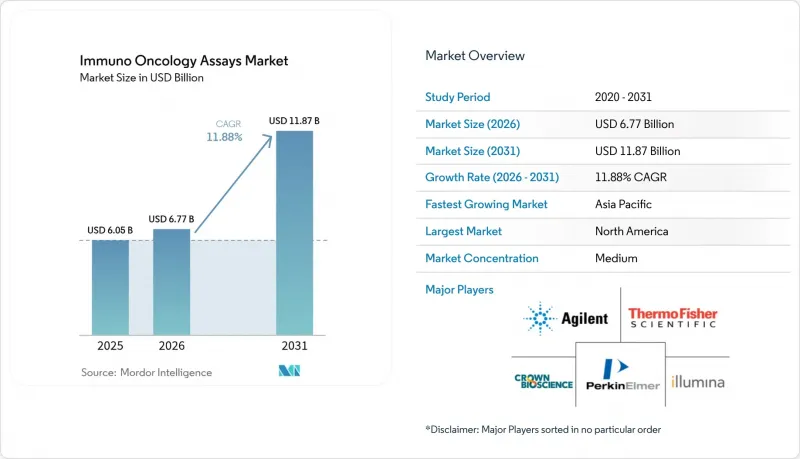
Mordor Intelligence에 의하면, 면역 종양학 어세이 시장 규모는 2025년에 60억 5,000만 달러로 평가되었습니다. 2026년 67억 7,000만 달러에서 2031년까지 118억 7,000만 달러에 이를 것으로 예상되며, 예측 기간(2026-2031년) CAGR은 11.88%를 나타낼 전망입니다.
본 보고서는 제품별(시약·항체, 기기 등), 기술별(면역측정법, PCR 등), 분석법 유형(CDx, Ldts, RUO), 적응증(폐암, 대장암, 흑색종, 유방암, 기타 암), 검체 유형(조직, 체액 생검), 지역(북미, 유럽, 아시아태평양, 중동 및 아프리카, 남미)별로 분류되어 있습니다. 시장 전망은 금액(달러) 기준으로 제시되어 있습니다.
세계의 면역 종양학 어세이 시장 동향 및 인사이트
면역관문억제제의 채택 확대
면역관문억제제는 치료 방식을 일변화시켰으며, PD-L1 상태, 종양 돌연변이 부하 및 마이크로위성 안정성을 측정하는 동반 검사의 도입 확대를 촉진하고 있습니다. 2025년에는 식도 편평상피암에 대한 티슬렐리주맙과 화학요법의 병용 요법, HER2 양성 위암에 대한 펨브롤리주맙과 트라스투주맙의 병용 요법 등 FDA의 여러 승인이 이루어질 전망이며, 이는 신뢰할 수 있는 예측 분석법의 필요성을 강조하고 있습니다. 미국 암 면역요법 학회(SITC)는 현재 일상적인 임상 판단의 지침이 되고 있는 바이오마커 패널을 정리해 놓았습니다. 공간 오믹스 플랫폼은 치료 반응 예측을 더욱 정교화하고, 검사의 특이도를 높이는 다차원적인 종양 미세환경 분석을 가능하게 합니다.
AI를 활용한 멀티플렉스 공간 프로파일링이 바이오마커 발견을 촉진
AI와 공간 생물학 기술을 결합함으로써, 기존 접근법에서는 간과되었던 세포 간 상호작용이 밝혀집니다. 가반 연구소의 'AAnet' 도구는 5가지 종양 상주 세포 유형을 구별하여 치료 전략 수립에 활용함으로써 이러한 진보를 구현하고 있습니다. 'Hyperion XTi Imaging Mass Cytometer'와 같은 상용 시스템은 자가형광 노이즈 없이 40개 이상의 마커를 동시에 시각화하여, 보다 심층적인 바이오마커 파이프라인 구축을 촉진하고 있습니다. 『Molecular Cancer』지의 조사에 따르면, 고해상도 3D 조직학이 종양의 이질성에 대한 이해를 심화시키고, 분석법의 혁신을 가속화하는 것으로 확인되었습니다.
분석법의 높은 비용과 복잡한 보험 청구 절차
2025년에 NGS 관련 메디케어 청구 거절률이 16.8%에서 27.4%로 급증한 것은 미국에서 보험사의 심사가 더욱 엄격해지고 있음을 보여줍니다. 완벽한 공간 프로파일링 환경을 구축하려면 50만 달러 이상의 설비 투자가 필요하며, 이는 지역 의료 현장에서의 보급을 더욱 제한하고 있습니다. 유럽의 의료기술평가(HTA)는 제품 출시까지의 기간을 12-18개월 연장시켜, 소규모 개발 기업의 재무적 위험을 높이고 있습니다. 그 결과, 비용에 민감한 지역에서의 보급을 유지하기 위해서는 가격대별 전략이 필수적입니다.
부문 분석
2025년, 시약·항체 분야는 면역 종양학 어세이 시장의 39.65%를 차지하여, 면역 검사 워크플로가 소모품에 의존하고 있는 실태를 뒷받침했습니다. 병원 및 검사 기관은 SITC가 권장하는 바이오마커 요건을 충족하기 위해 검증된 항체 패널을 채택하고 있습니다. 검사 기관이 40개 이상의 마커 검출이 가능한 이미징·질량세포측정 플랫폼으로 업그레이드함에 따라, 장비에 대한 수요는 견조한 추세를 보이고 있습니다.
'소프트웨어 및 분석' 분야는 2031년까지 연평균 성장률(CAGR) 12.41%를 나타낼 것으로 예측되며, 세포 표현형 매핑 및 클라우드 기반 데이터 공유를 자동화하는 AI 모듈의 혜택을 받고 있습니다. 가반 연구소의 'AAnet' 및 유사한 솔루션은 분석 시간을 단축하고, 디지털 병리학 벤더에게 새로운 수익원을 창출하고 있습니다. 이 소프트웨어 분야의 급속한 성장으로 인해 면역 종양학 어세이 시장 내 수익 구성이 다양화되고 있습니다.
차세대 시퀀싱은 2025년 면역 종양학 어세이 시장에서 37.10%의 점유율을 유지하며, 광범위한 돌연변이 스크리닝에 있어 필수적인 역할을 했습니다. 고심도 패널 시퀀싱은 종양 돌연변이 부하(TMB) 산정을 지원하며, 체크포인트 억제제 사용을 직접적으로 유도합니다.
연평균 성장률(CAGR) 12.48%를 나타낼 것으로 예측되는 멀티플렉스 공간 프로파일링은 손상되지 않은 조직 내에서 단백질 및 RNA 마커를 단일 세포 해상도로 매핑할 수 있게 해줍니다. 일루미나(Illumina)사의 전체 전사체 공간 플랫폼은 이러한 맥락이 풍부한 분석으로의 전환을 두드러지게 하고 있습니다. 면역 분석, PCR 및 유세포 분석 각 기법은 표적형 또는 고처리량 용도에서 상호 보완적인 역할을 유지하고 있으며, 이 모든 것이 종합적으로 면역 종양학 어세이 시장 내의 기술적 다양성을 뒷받침하고 있습니다.
지역별 분석
북미는 유리한 보험 환급 제도, AI의 조기 도입, 그리고 종합적인 암 센터의 밀집된 네트워크 덕분에 2025년 전 세계 매출의 41.90%를 차지했습니다. NGS 진단에 대한 메디케어 적용 범위 확대는 여전히 단기적인 보험 급여 불확실성을 야기하고 있지만, 민간 보험사의 견고한 체계 덕분에 전반적인 성장은 유지되고 있습니다.
유럽에서는 광범위한 도입에 앞서 의료기술평가(HTA)를 통해 임상적 유효성이 검증됨에 따라 균형 잡힌 발전이 지속되고 있습니다. EMA의 티슬레리주맙 등 의약품 승인은 이 지역이 면역요법 확대에 주력하고 있음을 보여줍니다. 여러 국가의 승인 절차로 인해 진단약 출시가 지연될 가능성은 있으나, EU의 IVDR을 준수한 간소화된 승인 경로를 통해 2026년 이후에는 시장 출시까지의 기간이 단축될 전망입니다.
아시아태평양은 중국이 전국적인 암 검진 프로그램을 전개하고, 일본이 유전체 검사에 보조금을 지급하고 있는 덕분에 연평균 성장률(CAGR) 12.55%로 성장을 주도하고 있습니다. 인도와 한국에서 부상하고 있는 정밀의료 거점이 수요를 더욱 자극하고 있습니다. 혁신적인 의료기기에 대한 간소화된 규제상 신속 승인 절차가 접근성을 개선하고 있어, 국제 공급업체들에게 면역 종양학 어세이 시장 내에서 상당한 규모의 잠재 고객 기반이 형성되고 있습니다.
중동 및 아프리카에서는 걸프 국가들이 암 치료 우수 센터에 대한 투자와 멀티플렉스 플랫폼 도입을 추진함에 따라 수요가 점차 확대되고 있습니다. 남미 지역에서는 브라질의 민관 협력 암 치료 파트너십과 아르헨티나가 유전체 검사를 국가 지침에 포함시킨 데 힘입어 꾸준한 진전이 나타나고 있습니다. 보험 급여 범위의 불균형이 여전히 판매량을 제한하고 있지만, 장기적인 발병률 추세가 잠재적 수요를 뒷받침하고 있습니다.
기타 혜택 :
- 엑셀 형식 시장 예측(ME) 시트
- 3개월간의 애널리스트 지원
자주 묻는 질문
목차
제1장 서론
제2장 조사 방법
제3장 주요 요약
제4장 시장 구도
제5장 시장 규모 및 성장 예측
제6장 경쟁 구도
제7장 시장 기회 및 향후 전망
KTH 26.08.07According to Mordor Intelligence, the immuno Oncology assays market size was valued at USD 6.05 billion in 2025 and estimated to grow from USD 6.77 billion in 2026 to reach USD 11.87 billion by 2031, at a CAGR of 11.88% during the forecast period (2026-2031).
This report is Segmented by Product (Reagents & Antibodies, Instruments, and More), Technology (Immunoassay, PCR, and More), Assay Type (CDx, Ldts, RUO), Indication (Lung, Colorectal, Melanoma, Breast, Other Cancers), Sample Type (Tissue, Liquid Biopsy), and Geography (North America, Europe, Asia-Pacific, MEA, South America). The Market Forecasts are Provided in Terms of Value (USD).
Global Immuno Oncology Assays Market Trends and Insights
Expanding Adoption of Immune-Checkpoint Inhibitors
Immune-checkpoint inhibitors reshape the therapeutic landscape, prompting wider deployment of companion tests that gauge PD-L1 status, tumor mutational burden, and microsatellite stability. Multiple FDA approvals in 2025, such as tislelizumab plus chemotherapy for esophageal squamous cell carcinoma and pembrolizumab-trastuzumab for HER2-positive gastric cancer, emphasise the need for robust predictive assays. The Society for Immunotherapy of Cancer lists biomarker panels that now guide routine clinical decision-making. Spatial omics platforms further refine response prediction, enabling multidimensional tumour micro-environment analysis that elevates assay specificity.
AI-Driven Multiplex Spatial Profiling Boosting Biomarker Discovery
Coupling AI with spatial biology technology uncovers cellular interactions previously hidden by conventional approaches. The Garvan Institute's AAnet tool exemplifies this progress by differentiating five tumour-resident cell types to inform therapeutic strategies. Commercial systems such as the Hyperion XTi Imaging Mass Cytometer visualise 40+ markers simultaneously without autofluorescence noise, fostering deeper biomarker pipelines. Research in Molecular Cancer confirms that high-resolution 3D histology enhances understanding of tumour heterogeneity, accelerating assay innovation.
High Assay Costs & Complex Reimbursement Pathways
Sharp increases in Medicare claim denial rates for NGS-from 16.8% to 27.4% in 2025-illustrate tightening US payer scrutiny. Capital investment exceeding USD 500,000 for full spatial-profiling setups further limits diffusion in community settings. Health technology assessments in Europe add 12-18 months to launch timelines, increasing financial risk for smaller developers. Consequently, price-tiering strategies become essential to sustain uptake in cost-sensitive regions.
Other drivers and restraints analyzed in the detailed report include:
- Regulatory Approvals of Companion Dx Assays (PD-1/PD-L1, TMB)
- Pharma-Dx Co-Development Partnerships Accelerating Test Menus
- Stringent Multi-Jurisdiction Regulatory Validation Demands
For complete list of drivers and restraints, kindly check the Table Of Contents.
Segment Analysis
Reagents & Antibodies captured 39.65% of the immuno-oncology assays market in 2025, evidencing the consumable-heavy nature of immune testing workflows. Hospital and reference laboratories turn to validated antibody panels to meet SITC-endorsed biomarker requirements. Instruments enjoy steady demand as labs upgrade to imaging-mass-cytometry platforms capable of 40-plus marker detection.
Software & Analytics, projected to post a 12.41% CAGR through 2031, benefits from AI modules that automate cell-phenotype mapping and cloud-based data sharing. The Garvan Institute's AAnet and similar solutions lower analysis times, creating new revenue streams for digital pathology vendors. This software upsurge diversifies revenue composition within the immuno-oncology assays market.
Next-Generation Sequencing retained 37.10% share of the immuno-oncology assays market in 2025, remaining indispensable for broad mutational scans. High-depth panel sequencing supports tumour mutational burden calculation, directly guiding checkpoint inhibitor use.
Multiplex Spatial Profiling, forecast to grow at 12.48% CAGR, permits single-cell resolution mapping of protein and RNA markers within intact tissues. Illumina's whole-transcriptome spatial platform highlights this shift toward context-rich analytics. Immunoassay, PCR, and flow cytometry modalities maintain complementary roles for targeted or high-throughput applications, collectively sustaining technology diversity inside the immuno-oncology assays market.
Complete Report Scope:
- By Product
- Reagents & Antibodies
- Instruments
- Software & Analytics
- Consumables & Accessories
- By Technology
- Immunoassay (ELISA, CLIA)
- Polymerase Chain Reaction (PCR/qPCR/ddPCR)
- Next-Generation Sequencing (NGS)
- Flow Cytometry
- Multiplex Spatial Profiling (mIF, IMC, DSP)
- By Assay Type
- Companion Diagnostic (CDx) Assays
- Laboratory-Developed Tests (LDTs)
- Research-Use-Only (RUO) Panels
- By Indication
- Lung Cancer
- Colorectal Cancer
- Melanoma
- Breast Cancer
- Other Cancers
- By Sample Type
- Tissue Biopsy
- Liquid Biopsy (Blood, Plasma, cfDNA)
- Geography
- North America
- United States
- Canada
- Mexico
- Europe
- Germany
- United Kingdom
- France
- Italy
- Spain
- Rest of Europe
- Asia-pacific
- China
- Japan
- India
- Australia
- South Korea
- Rest of Asia-pacific
- Middle East and Africa
- GCC
- South Africa
- Rest of Middle East and Africa
- South America
- Brazil
- Argentina
- Rest of South America
- North America
Geography Analysis
North America generated 41.90% of 2025 global revenue through favourable reimbursement, early AI adoption, and dense networks of comprehensive cancer centres. Medicare's evolving coverage for NGS diagnostics still poses short-term reimbursement uncertainty, but strong private-payer frameworks keep overall growth intact.
Europe maintains balanced progress as health technology assessments verify clinical benefit before wide rollout. EMA's approval of agents such as tislelizumab shows regional commitment to immunotherapeutic expansion. Although multiple national approval layers can delay diagnostics launches, streamlined EU IVDR-compliant pathways promise to shorten time-to-market after 2026.
Asia-Pacific leads growth at a 12.55% CAGR as China deploys national cancer screening programs and Japan subsidises genomic testing. Emerging precision-medicine hubs in India and South Korea further stimulate demand. Simplified regulatory fast-tracks for innovative devices improve access, giving international suppliers a sizeable addressable base in the immuno-oncology assays market.
Middle East & Africa witnesses incremental uptake as Gulf states invest in oncology centres of excellence and procure multiplex platforms. South America records steady progress, led by Brazil's public-private oncology partnerships and Argentina's inclusion of genomic testing in national guidelines. Varying reimbursement coverage still restricts volume but long-term incidence trends underpin latent demand.
- Agilent Technologies
- Thermo Fisher Scientific
- Illumina
- PerkinElmer
- Roche
- Merck
- HTG Molecular Diagnostics
- Crown Bioscience
- InSphero
- QIAGEN
- Bio-Rad Laboratories
- NanoString Technologies
- ArcherDx (Invitae)
- Adaptive Biotechnologies
- Sysmex
- Oxford Nanopore Tech.
- Guardant Health
- NeoGenomics
- Foundation Medicine
- Danaher (Leica-Cytiva)
Additional Benefits:
- The market estimate (ME) sheet in Excel format
- 3 months of analyst support
TABLE OF CONTENTS
1 Introduction
- 1.1 Study Assumptions & Market Definition
- 1.2 Scope of the Study
2 Research Methodology
3 Executive Summary
4 Market Landscape
- 4.1 Market Overview
- 4.2 Market Drivers
- 4.2.1 Sustained rise in Global Cancer Incidence
- 4.2.2 Expanding Adoption of Immune-checkpoint Inhibitors
- 4.2.3 Regulatory Approvals of Companion Dx Assays (PD-1/PD-L1, TMB)
- 4.2.4 Pharma-Dx Co-development Partnerships Accelerating Test Menus
- 4.2.5 AI-driven Multiplex Spatial Profiling Boosting Biomarker Discovery
- 4.2.6 Decentralised Liquid-biopsy Testing in Community Oncology
- 4.3 Market Restraints
- 4.3.1 High Assay Costs & Complex Reimbursement Pathways
- 4.3.2 Stringent Multi-jurisdiction Regulatory Validation Demands
- 4.3.3 Scarcity of Well-annotated Matched Tumour/normal Biobanks
- 4.3.4 Lack of Global Standardisation in Multiplex Assay Protocols
- 4.4 Value / Supply-Chain Analysis
- 4.5 Regulatory Landscape
- 4.6 Technological Outlook
- 4.7 Porter's Five Forces Analysis
- 4.7.1 Bargaining Power of Suppliers
- 4.7.2 Bargaining Power of Buyers
- 4.7.3 Threat of New Entrants
- 4.7.4 Threat of Substitutes
- 4.7.5 Intensity of Competitive Rivalry
5 Market Size & Growth Forecasts (Value-USD)
- 5.1 By Product
- 5.1.1 Reagents & Antibodies
- 5.1.2 Instruments
- 5.1.3 Software & Analytics
- 5.1.4 Consumables & Accessories
- 5.2 By Technology
- 5.2.1 Immunoassay (ELISA, CLIA)
- 5.2.2 Polymerase Chain Reaction (PCR/qPCR/ddPCR)
- 5.2.3 Next-Generation Sequencing (NGS)
- 5.2.4 Flow Cytometry
- 5.2.5 Multiplex Spatial Profiling (mIF, IMC, DSP)
- 5.3 By Assay Type
- 5.3.1 Companion Diagnostic (CDx) Assays
- 5.3.2 Laboratory-Developed Tests (LDTs)
- 5.3.3 Research-Use-Only (RUO) Panels
- 5.4 By Indication
- 5.4.1 Lung Cancer
- 5.4.2 Colorectal Cancer
- 5.4.3 Melanoma
- 5.4.4 Breast Cancer
- 5.4.5 Other Cancers
- 5.5 By Sample Type
- 5.5.1 Tissue Biopsy
- 5.5.2 Liquid Biopsy (Blood, Plasma, cfDNA)
- 5.6 Geography
- 5.6.1 North America
- 5.6.1.1 United States
- 5.6.1.2 Canada
- 5.6.1.3 Mexico
- 5.6.2 Europe
- 5.6.2.1 Germany
- 5.6.2.2 United Kingdom
- 5.6.2.3 France
- 5.6.2.4 Italy
- 5.6.2.5 Spain
- 5.6.2.6 Rest of Europe
- 5.6.3 Asia-pacific
- 5.6.3.1 China
- 5.6.3.2 Japan
- 5.6.3.3 India
- 5.6.3.4 Australia
- 5.6.3.5 South Korea
- 5.6.3.6 Rest of Asia-pacific
- 5.6.4 Middle East and Africa
- 5.6.4.1 GCC
- 5.6.4.2 South Africa
- 5.6.4.3 Rest of Middle East and Africa
- 5.6.5 South America
- 5.6.5.1 Brazil
- 5.6.5.2 Argentina
- 5.6.5.3 Rest of South America
- 5.6.1 North America
6 Competitive Landscape
- 6.1 Market Concentration
- 6.2 Market Share Analysis
- 6.3 Company Profiles {(includes Global level Overview, Market level overview, Core Segments, Financials as available, Strategic Information, Products & Services, and Recent Developments)}
- 6.3.1 Agilent Technologies
- 6.3.2 Thermo Fisher Scientific
- 6.3.3 Illumina
- 6.3.4 PerkinElmer
- 6.3.5 Roche
- 6.3.6 Merck KGaA
- 6.3.7 HTG Molecular Diagnostics
- 6.3.8 Crown Bioscience
- 6.3.9 InSphero
- 6.3.10 Qiagen
- 6.3.11 Bio-Rad Laboratories
- 6.3.12 NanoString Technologies
- 6.3.13 ArcherDx (Invitae)
- 6.3.14 Adaptive Biotechnologies
- 6.3.15 Sysmex
- 6.3.16 Oxford Nanopore Tech.
- 6.3.17 Guardant Health
- 6.3.18 NeoGenomics
- 6.3.19 Foundation Medicine
- 6.3.20 Danaher (Leica-Cytiva)
7 Market Opportunities & Future Outlook
- 7.1 White-space & Unmet-Need Assessment