

|
시장보고서
상품코드
2100742
인도의 원료의약품(API) 시장 : 점유율 분석, 업계 동향 및 통계, 성장 예측(2026-2031년)India Active Pharmaceutical Ingredients (API) - Market Share Analysis, Industry Trends & Statistics, Growth Forecasts (2026 - 2031) |
||||||
 Mordor Intelligence
Mordor Intelligence에 의하면, 인도 원료의약품(API) 시장 규모는 2025년 141억 8,000만 달러에서 2026년에는 152억 8,000만 달러로 확대되어 2026-2031년까지 CAGR 7.74%로 성장을 지속하여, 2031년에는 221억 8,000만 달러에 이를 것으로 예측됩니다.
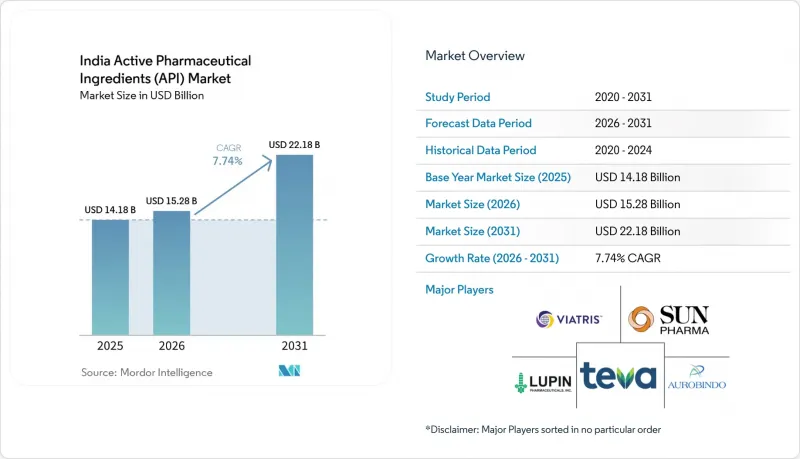
본 보고서는 비즈니스 모델(자사용 API, 판매용/수탁 API), 합성 유형(합성 API, 바이오테크 API), 제제 유형(제네릭, 브랜드 의약품, 바이오시밀러), 치료 분야(종양학, 항감염제, 심혈관·대사계, 중추신경계, 호흡기계, 기타), 최종 사용자(제약 및 바이오의약품 기업, 수출 지향형 제제 제조업체, CRDMO/CDMO), 지역별로 분류되어 있습니다. 시장 전망은 금액(달러) 기준으로 제시되어 있습니다.
인도 원료의약품 시장 동향 및 인사이트
정부의 PLI 및 벌크 의약품 단지를 통한 자급자족 추진
총액 402억 4,000만 루피 규모의 32개 PLI 프로젝트가 가동 중이며, 이는 당초 승인된 투자액을 상회할 뿐만 아니라 30년 만에 페니실린 G 등 주요 분자의 국내 합성을 가능하게 하고 있습니다. 구자라트주, 히마찰프라데시주, 안드라프라데시주에 위치한 벌크 의약품 단지에서는 용매 회수 설비, 폐수 처리 시설, 공동 유틸리티가 제공되어 운영 비용이 절감되고 있습니다. 아우로빈드 파마(Aurobind Pharma)사의 연간 생산 능력 1만 5,000톤 규모의 신규 페니실린 G 생산 단지는 자급자족으로의 전환을 상징하는 사례입니다. 신규 건설 자산이 정격 가동률에 도달하면 주요 중간체에 대한 수입 의존도가 절반으로 줄어들 것으로 예상되며, 상공부는 2021년 이후 민간 제약 부문에 대한 누적 투자액을 1조 6,100억 루피로 추정하고 있습니다. 환경 허가 절차의 신속화와 원스톱 승인 제도를 통해 프로젝트 착수 기간이 단축되어 정책의 효과가 더욱 강화되고 있습니다.
‘바이오시큐어법’ 시행 후 미국·EU의 발주가 인도로 가속화되고 있음
2024년 미국의 ‘바이오시큐어법’은 중국 바이오기술 기업과 관련이 있는 기업으로부터의 연방 정부 조달을 제한하고 있어, 선도 기업들은 공급망 다각화를 피할 수 없게 되었습니다. 이미 750곳 이상의 미국 FDA 승인 시설을 운영하고 있는 인도의 제조업체에서는 2024년 3분기 이후 견적 요청(RFQ) 및 감사 건수가 50% 급증하고 있습니다. kg당 비용 측면에서는 인도가 우위를 점하고 있으며, 동등한 품질 등급에서 인도의 도착 가격 견적은 중국의 평균 가격보다 약 20% 낮습니다. 규제상 기술 이전 주기는 여전히 18-24개월이 소요되지만, 인도의 신청 서류 작성 실적을 바탕으로 신규 진출기업에 비해 일정을 단축할 수 있습니다. 유럽과 미국의 스폰서 기업들이 중국 공급업체로부터 잇달아 철수하는 가운데, 지속적인 계약을 통해 인도의 CDMO 기업들은 향후 수년에 걸친 수익 전망이 밝습니다.
현지화가 진행되는 가운데서도 중국산 KSM의 비용은 변동이 심합니다.
국내 생산 능력이 증가하고 있음에도 불구하고, 인도는 2024 회계연도에 3,770억 루피 상당의 API를 수입했으며, 이는 총 수요의 약 35%를 차지합니다. 2025년 초 발효용 원료 가격이 15-20% 급등하면서, 애널리스트들이 12-14% 상승을 예상했던 영업이익률이 압박을 받았습니다. 대기업들은 여러 지역에 걸친 계약이나 자체 생산하는 중간체 블록을 통해 리스크를 헤지하고 있지만, 규모가 작아 중소기업 및 영세기업(MSME)은 생산을 중단하거나 생산 능력 확충을 연기하고 있어 공급망에 혼란이 발생하고 있습니다. PLI 파크의 전면 가동 지연으로 인해 2026년 내내 중국에 대한 의존이 지속될 것으로 예상되며, 투입 비용의 변동도 계속될 것으로 보입니다.
부문 분석
현재 일반 공급업체의 생산량 점유율은 39% 미만이지만, 원료의약품 제조업체들이 변동비 모델을 우선시하며 기존 합성 블록을 매각함에 따라 연평균 성장률(CAGR) 9.42%를 기록할 전망입니다. CDMO가 규제 관련 문서의 유지 관리, 검증 배치, 정기적인 현장 감사를 담당함에 따라 인도의 API 시장은 혜택을 보고 있으며, 이를 통해 스폰서 기업은 바이오의약품 및 디지털 치료제 출시에 자본을 재분배할 수 있게 됩니다. 혁신 기업들은 초기 단계의 화학, 독성학, 1상 임상시험용 공급을 엔드투엔드 역량을 갖춘 대규모 CDMO에 단일 공급업체 계약 하에 일괄 위탁하는 경향이 강해지고 있습니다. 단일 공장에서의 경제성이 거래상의 간접비를 상회하는 스타틴 계열 약물이나 메트포르민과 같은 대량 생산품의 경우, 자체 생산이 여전히 유효합니다. 환경 규제의 강화와 공공요금의 인플레이션으로 인해 총 소유 비용 측면에서는 외부 위탁 사업자가 더 유리해지고 있습니다. 피라마르 파마솔루션즈(Piramal Pharma Solutions)가 켄튀르키예주에서 실시한 8,000만 달러 규모의 무균 주사제 제조 설비 확장은 전 세계 수요에 대응하기 위한 아웃소싱 플랫폼의 확장성을 여실히 보여주고 있습니다.
부수적인 이점으로는 유연한 기술 이전 기간을 들 수 있습니다. 이를 통해 스폰서는 지역별로 출시 시기를 조정할 수 있으며, 결과적으로 외부 위탁 시설의 가동률을 균등화할 수 있습니다. 인도의 API 시장에서도 대형 CDMO 간 후방 통합이 더욱 진행되고 있습니다. 현재 반응기 단지에는 용매 회수 시설 및 폐수 소각 시설이 병설되어 있어, 환경·위생·안전(EH&S) 감사의 효율화가 도모되고 있습니다. 반면, 자사 공장에서는 제품 구성의 복잡성으로 인한 잠재적인 오염 위험에 직면해 있어, 품질 관리 인력을 증원하거나 배치당 비용을 늘릴 수밖에 없는 상황입니다.
합성 화학은 자본 집약도가 낮고 확립된 규제 선례가 있어, 2025년 매출의 72.80%를 계속 차지하고 있습니다. 그러나 바이오테크 API는 연평균 성장률(CAGR) 9.18%로 성장을 지속하고, 있으며, 단일클론 항체, 재조합 호르몬, mRNA 벡터가 후기 임상시험 단계에 도달함에 따라 부가가치가 확대될 것으로 예측됩니다. 연속 제조 스키드 및 고처리량 결정화 장치를 통해 합성 배치 주기가 단축되는 한편, 발효 반응기에는 실시간 대사 산물 센서가 도입되어 효능 향상이 도모되고 있습니다. Laurus Bio가 추가로 건설할 12억 루피 규모의 발효 블록은 바이오의약품 파이프라인에서 수요가 있는 아미노산 및 효소 중간체를 대상으로 합니다.
바이오테크용 API의 경우, 규제의 복잡성이 여전히 높기 때문에 검증된 바이러스 제거 공정과 첨단 특성 평가 플랫폼이 필요합니다. 그러나 합성 활성 물질에 비해 3-5배의 가격 프리미엄이 있기 때문에 추가 설비 투자는 상쇄됩니다. 인도의 API 시장에서는 하이브리드 제조업체들이 기존의 소분자 생산 라인을 활용하여 바이오테크 부문의 규모 확대에 따른 변동을 완화함으로써 위험 분산이 진행되고 있습니다. 한편, 합성 제조업체들은 비용 측면에서의 우위를 유지하기 위해 친환경 촉매 및 마이크로 리액터 기술 도입을 추진하고 있습니다.
기타 혜택
- 엑셀 형식 시장 예측(ME) 시트
- 3개월간의 애널리스트 지원
자주 묻는 질문
목차
제1장 서론
제2장 조사 방법
제3장 주요 요약
제4장 시장 구도
제5장 시장 규모와 성장 예측
제6장 경쟁 구도
제7장 시장 기회와 향후 전망
JHS 26.08.11According to Mordor Intelligence, the India API market size is expected to grow from USD 14.18 billion in 2025 to USD 15.28 billion in 2026 and is forecast to reach USD 22.18 billion by 2031 at 7.74% CAGR over 2026-2031.
This report is Segmented by Business Model (Captive API, Merchant/Contract API), Synthesis Type (Synthetic APIs, Biotech APIs), Drug Type (Generic, Branded, Biosimilar), Therapeutic Area (Oncology, Anti-Infectives, Cardio-Metabolic, CNS, Respiratory, Others), End-Use (Formulation Companies Domestic, Export-Oriented Formulators, CRDMOs/CDMOs), and Geography. The Market Forecasts are Provided in Terms of Value (USD).
India Active Pharmaceutical Ingredients (API) Market Trends and Insights
Government PLI & Bulk-Drug-Park Push for Self-Reliance
Thirty-two PLI projects worth Rs 4,024 crore are operational, exceeding originally sanctioned investment and enabling domestic synthesis of critical molecules such as Penicillin G for the first time in three decades. Bulk-drug parks in Gujarat, Himachal Pradesh and Andhra Pradesh provide solvent-recovery units, effluent treatment and common utilities that lower operating costs. Aurobindo Pharma's new 15,000 tpa Pen-G block exemplifies the turnaround in self-reliance. Import dependence on critical intermediates is forecast to halve once the green-field assets reach nameplate utilization, and the Ministry of Commerce & Industry pegs cumulative private pharma investment at Rs 1.61 lakh-crore since 2021. Faster environmental clearances and single-window approvals shorten project gestation, reinforcing policy impact.
Accelerated Shift of U.S./EU Orders to India Post-Biosecure Act
The 2024 U.S. Biosecure Act restricts federal procurement from firms tied to Chinese biotech entities, compelling originators to diversify supply chains. Indian producers, already running more than 750 U.S. FDA-approved sites, have seen a 50% spike in RFQs and audits since Q3 2024. Cost-per-kg parity favors India; landed quotes sit roughly 20% below Chinese averages for similar quality grades. Regulatory tech-transfer cycles still take 18-24 months, yet India's dossier experience compresses timelines relative to first-time entrants. As Western sponsors sequence departures from Chinese suppliers, rolling contracts give Indian CDMOs multi-year revenue visibility.
Volatile Cost of China-Sourced KSMs Despite Localization
Even with rising domestic capacity, India imported APIs worth Rs 377 billion in FY 2024, roughly 35% of total demand. A sudden 15-20% price surge in fermentation inputs during early 2025 compressed operating margins that analysts expected to climb to 12-14%. Larger corporates hedge via multi-region contracts and captive intermediate blocks; MSMEs, lacking scale, shutter production or defer capacity upgrades, disrupting supply chains. Delays in full PLI park commissioning mean dependence will persist through 2026, keeping input costs volatile.
Other drivers and restraints analyzed in the detailed report include:
- Scale-up in Oncology HPAPI Blocks (Visakhapatnam & Hyderabad)
- Growth of CRDMO Exports Serving Phase I/II Innovators
- Persistent Compliance Gaps at MSME API Units (WHO-GMP)
For complete list of drivers and restraints, kindly check the Table Of Contents.
Segment Analysis
Merchant suppliers currently contribute under 39% of output but will post a 9.42% CAGR as originators divest legacy synthesis blocks in favor of variable-cost models. The India API market benefits when CDMOs assume regulatory dossier maintenance, validation batches and periodic site audits, freeing sponsor capital for biologics and digital therapeutics launches. Increasingly, innovators bundle early-stage chemistry, toxicology and Phase-I supply under single-vendor contracts that reward scale CDMOs with end-to-end capabilities. Captive manufacture remains viable for high-volume statins or metformin where single-plant economies outweigh transaction overhead. Nevertheless, stricter environmental mandates and inflationary utility tariffs tilt total cost of ownership toward merchant operators. Piramal Pharma Solutions' USD 80 million sterile-injectables expansion in Kentucky underscores the scalability of outsourced platforms to serve global demand.
Second-order benefits include flexible tech-transfer windows, which help sponsors stagger launch waves across geographies, thereby smoothing utilization at merchant sites. The India API market also sees deeper backward integration among top CDMOs; reactor parks now co-locate with solvent-recovery and effluent incineration to streamline EH&S audits. Conversely, captive plants grapple with latent contamination risks tied to product-mix complexity, compelling larger quality-control staffing and higher cost per batch.
Synthetic chemistry still anchors 72.80% of 2025 revenue due to lower capital intensity and well-trodden regulatory precedent. Yet biotech APIs, logging a 9.18% CAGR, will capture incremental value as monoclonal antibodies, recombinant hormones and mRNA vectors reach late-stage trials. Continuous-manufacturing skids and high-throughput crystallizers compress synthetic batch cycles, while fermentation reactors adopt real-time metabolite sensors to boost titers. Laurus Bio's extra 120-crore fermentation block aims at amino-acid and enzyme intermediates demanded by biologics pipelines.
Regulatory complexity remains higher for biotech APIs, necessitating validated viral-clearance steps and advanced characterization platforms. However, price premiums of 3-5 X versus synthetic actives offset added capex. The India API market diversifies risk as hybrid manufacturers leverage existing small-molecule lines to cushion biotech scale-up volatility. Meanwhile, synthetic producers pursue green catalysts and micro-reactor technology to maintain cost leadership.
Complete Report Scope:
- By Business Model
- Captive API
- Merchant / Contract API
- By Synthesis Type
- Synthetic API
- Biotech API
- By Molecule Size
- Small-Molecule
- Large-Molecule / Biologic
- By Potency
- High-Potency API
- Low/Medium Potency API
- By Therapeutic Area
- Oncology
- Cardiovascular
- Infectious Diseases
- Metabolic Disorders
- CNS & Neurology
- Respiratory
- Others
- By End-User
- Pharma & Biopharma Companies
- CDMOs / CMOs
- CROs & Academia
- Export-Oriented Formulators
- CRDMOs / CDMOs
List of Companies Covered in this Report:
- Divi's Laboratories Ltd
- Aurobindo Pharma
- Laurus Labs Ltd
- Dr Reddy's Laboratories Ltd
- Sun Pharmaceuticals Industries
- Viatris India (Agila)
- Teva API India
- Lupin
- Cipla
- Zydus Group
- Intas Pharmaceuticals
- Piramal Group
- Biocon Biologics
- Samsung Biologics India JV
- Syngene International
- Torrent Pharmaceuticals
- Granules India
- Glenmark Active Pharma Ingredients
- Hetero Drugs
- Alembic Pharma
Additional Benefits:
- The market estimate (ME) sheet in Excel format
- 3 months of analyst support
TABLE OF CONTENTS
1 Introduction
- 1.1 Study Assumptions & Market Definition
- 1.2 Scope of the Study
2 Research Methodology
3 Executive Summary
4 Market Landscape
- 4.1 Market Overview
- 4.2 Market Drivers
- 4.2.1 Government PLI & Bulk-Drug-Park push for self-reliance
- 4.2.2 Accelerated shift of US/EU orders to India post-Biosecure Act
- 4.2.3 Scale-up in oncology HPAPI blocks (Visakhapatnam, Hyderabad clusters)
- 4.2.4 Growth of CRDMO exports serving Phase-I/II innovators
- 4.2.5 Green-chemistry route adoption to lower solvent import bill
- 4.2.6 AI-driven process-optimization cutting cycle-times <=20 %
- 4.3 Market Restraints
- 4.3.1 Volatile cost of China-sourced KSMs despite localization
- 4.3.2 Persistent compliance gaps at MSME API units (WHO-GMP)
- 4.3.3 Talent crunch in large-molecule downstream & containment
- 4.3.4 Rising energy tariffs eroding margins in West-coast plants
- 4.4 Value / Supply-Chain Analysis
- 4.5 Regulatory & Technological Outlook
- 4.6 Porter's Five Forces
- 4.6.1 Threat of New Entrants
- 4.6.2 Bargaining Power of Buyers
- 4.6.3 Bargaining Power of Suppliers
- 4.6.4 Threat of Substitutes
- 4.6.5 Intensity of Competitive Rivalry
5 Market Size & Growth Forecasts (Value, USD)
- 5.1 By Business Model
- 5.1.1 Captive API
- 5.1.2 Merchant / Contract API
- 5.2 By Synthesis Type
- 5.2.1 Synthetic API
- 5.2.2 Biotech API
- 5.3 By Molecule Size
- 5.3.1 Small-Molecule
- 5.3.2 Large-Molecule / Biologic
- 5.4 By Potency
- 5.4.1 High-Potency API
- 5.4.2 Low/Medium Potency API
- 5.5 By Therapeutic Area
- 5.5.1 Oncology
- 5.5.2 Cardiovascular
- 5.5.3 Infectious Diseases
- 5.5.4 Metabolic Disorders
- 5.5.5 CNS & Neurology
- 5.5.6 Respiratory
- 5.5.7 Others
- 5.6 By End-User
- 5.6.1 Pharma & Biopharma Companies
- 5.6.2 CDMOs / CMOs
- 5.6.3 CROs & Academia
- 5.6.4 Export-Oriented Formulators
- 5.6.5 CRDMOs / CDMOs
6 Competitive Landscape
- 6.1 Market Concentration
- 6.2 Market Share Analysis
- 6.3 Company Profiles (includes Global level overview, Market level overview, Core Segments, Financials, Strategic Information, Market Rank/Share, Products & Services, Recent Developments)
- 6.3.1 Divi's Laboratories Ltd
- 6.3.2 Aurobindo Pharma Ltd
- 6.3.3 Laurus Labs Ltd
- 6.3.4 Dr Reddy's Laboratories Ltd
- 6.3.5 Sun Pharmaceutical Industries Ltd
- 6.3.6 Viatris India (Agila)
- 6.3.7 Teva API India
- 6.3.8 Lupin Ltd
- 6.3.9 Cipla Ltd
- 6.3.10 Cadila Pharmaceuticals
- 6.3.11 Intas Pharmaceuticals
- 6.3.12 Piramal Pharma Solutions
- 6.3.13 Biocon Biologics
- 6.3.14 Samsung Biologics India JV
- 6.3.15 Syngene International
- 6.3.16 Torrent Pharma
- 6.3.17 Granules India
- 6.3.18 Glenmark Active Pharma Ingredients
- 6.3.19 Hetero Drugs
- 6.3.20 Alembic Pharma
7 Market Opportunities & Future Outlook
- 7.1 White-Space & Unmet-Need Assessment


