

|
시장보고서
상품코드
2100753
위성용 부품 및 컴포넌트 시장 : 점유율 분석, 업계 동향 및 통계, 성장 예측(2026-2031년)Satellite Parts and Components - Market Share Analysis, Industry Trends & Statistics, Growth Forecasts (2026 - 2031) |
||||||
 Mordor Intelligence
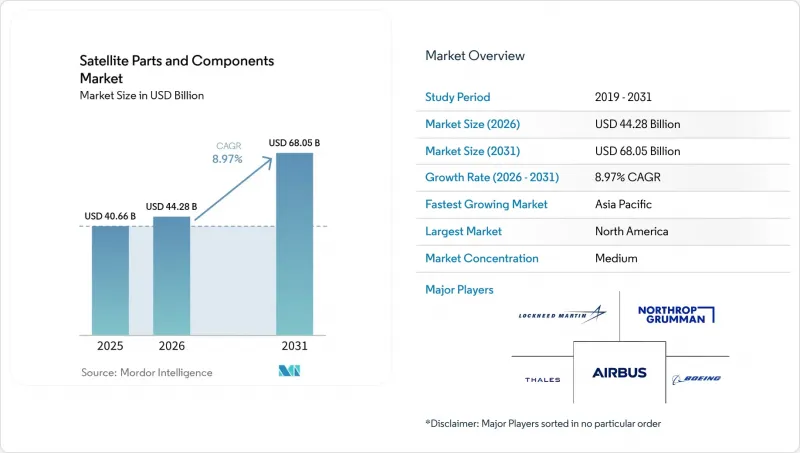
Mordor Intelligence에 의하면, 위성용 부품 및 컴포넌트 시장 규모는 2025년 406억 6,000만 달러에서 2026년에는 442억 8,000만 달러로 확대되어 2026-2031년까지 CAGR 8.97%로 성장을 지속하여, 2031년에는 680억 5,000만 달러에 이를 것으로 예측됩니다.
본 보고서는 서브시스템(태양전지 어레이 및 전력 하드웨어, 구조체, 하네스 및 기구, 추진 하드웨어 및 추진제, 기타), 구성 요소(하드웨어 및 소프트웨어), 용도(통신, 항법, 지구관측, 기타), 지역(북미, 유럽, 아시아태평양, 기타)별로 분류되어 있습니다. 시장 전망은 금액(달러) 기준으로 제시되어 있습니다.
전 세계 위성용 부품 및 컴포넌트 시장 동향과 인사이트
LEO 광대역 위성 군집의 급속한 확대
LEO 광대역의 전개로 인해, 위성용 부품 및 컴포넌트 시장 전체에서 제조 속도와 컴포넌트의 표준화가 재정의되고 있습니다. 상업 사업자들은 생산 라인을 확대하고 고처리량 크로스링크를 통합하고 있으며, 이로 인해 위상 배열, 전기 추진, 방사선 내성 컴퓨팅에 대한 수요가 증가하고 있습니다. 아마존의 '프로젝트 카이퍼'는 2026년에 초기 서비스 실증을 진행할 것이라고 보고했으며, 위성 간 광링크 기능을 갖춘 대량 조립을 확인했습니다. 이는 미션 크리티컬 부품이 양산 체제에 접어들고 있음을 나타내는 신호입니다. 에어버스는 신호 처리의 기내 처리 비율을 높이는 440기의 차세대 위성과 관련하여 22억 유로(25억 9,000만 달러) 규모의 수주를 발표했습니다. 이로 인해 우주용 인증 FPGA와 고처리량 디지털 프로세서의 잠재 시장이 확대되고 있습니다. 지역 차원의 프로그램도 이러한 추세를 가속화하고 있으며, 상하이의 G60 계획에서는 표준화된 버스 및 추진 키트에 대한 수요를 확대할 대규모 전개가 주목받고 있습니다. 이러한 시너지 효과로 인해 예측 가능한 지속적인 수요 패턴이 형성되어, 각 계층공급업체가 항공우주 부문의 공차에 적합한 자동화 및 품질 관리 시스템에 투자할 수 있게 됩니다.
위성 버스의 표준화 및 양산
각 제조업체는 모듈식 버스 템플릿과 적층 가공 기술을 활용하여 부품 수와 금형을 통합함으로써, 위성용 부품 및 컴포넌트 시장의 통합 주기를 단축하고 있습니다. 보잉(Boeing)은 복합재 제조 시간을 최대 6개월 단축하도록 설계된 3D 프린팅 태양전지 어레이 기판을 발표했으며, 자사의 항공우주 포트폴리오 전반에 걸쳐 15만 개 이상의 프린팅 부품을 납품했다고 보고했습니다. 이는 프로토타입 단계에서 양산 수준의 비행용 하드웨어로 발전했음을 보여줍니다. 일본의 우주 전략 펀드는 태양전지, 커버 글라스, 어레이 등 주요 컴포넌트의 품질·비용·납기(QCD) 향상에 자금을 배정하여, 별도 재가공 없이도 방위 규격을 충족하는 국내 표준화를 지원하고 있습니다. 버스 플랫폼이 공통 인터페이스로 통합됨에 따라, 구조체, 하네스, 파워 모듈 공급업체는 재인증 비용을 절감하는 유연한 반자동 생산 라인을 통해 생산 규모를 확대할 수 있습니다. 이러한 방식은 비행 시스템의 추적 가능성과 신뢰성이라는 기본 요건을 유지하면서, 인접 부문의 대량 생산 방식을 따르고 있습니다. 장기적으로는 표준화를 통해 호환 가능한 하위 시스템이 구현되어 수요 변동이 완화되고, 운전 자금 수요도 감소합니다.
고신뢰성(High-Rel) 구매 인증 부품의 부족과 긴 리드타임
우주용 등급의 특수 전자 기기 및 소재는 여전히 공급 제약에 직면해 있으며, 이로 인해 조립 일정이 지연되고 위성용 부품 및 컴포넌트 시장의 단기적인 성장이 둔화되고 있습니다. 고성능 메모리, 패키징, 방사선 내성 디바이스에 대한 수요는 인접 산업과의 경쟁을 유발하고 있으며, 이로 인해 파운드리 및 모듈 생산 라인의 급증에 대응할 수 있는 능력이 제한되고 있습니다. 틈새 시장인 광 단말기, 암호화 장치, 특정 추진용 컴포넌트의 경우, 인증된 공급업체가 소수에 불과하기 때문에 공급 차질이 통합 일정에 파급되고 있습니다. 이에 대응하여 각 주요 계약업체들은 통합 및 검사 공간을 확대하고 있으며, 이를 통해 병렬 작업이 가능해져 부품 도착 시 처리 능력이 향상되고 있습니다. 지상 부문 프로그램에서도 클라우드 네이티브 아키텍처와 애자일 릴리스 주기가 중시되고 있어, 비행용 하드웨어의 백로그가 해소되는 동안에도 임무 일정을 순조롭게 진행할 수 있도록 하고 있습니다. 향후에는 추가적인 표준화 및 듀얼 소싱 전략을 통해 병목 현상이 해소될 것으로 예상되지만, 고신뢰성 제품 개발 분야에서는 당분간 그 영향이 여전히 클 것으로 보입니다.
부문 분석
추진 하드웨어와 추진제는 2025년에 33.76%의 점유율을 차지하며, 2031년까지 연평균 성장률(CAGR) 10.22%로 성장할 것으로 전망되어, 위성용 부품 및 컴포넌트 시장에서 가장 빠르게 성장하고 있는 하위 시스템입니다. 홀 효과 추진기나 이온 추진기 등의 전기 추진 옵션은 지속적인 궤도 유지와 효율적인 궤도 전환이 우선시되는 저지구 궤도(LEO) 콘스텔레이션에서 점유율을 확대되고 있습니다. 수명 종료 시 폐기 일정을 충족해야 한다는 요건으로 인해, 설계는 더 많은 추진제 비축과 더 신뢰할 수 있는 자세 제어 로직으로 계속해서 나아가고 있습니다. 광 크로스링크 및 메쉬 라우팅의 확대는 궤도 상승 및 페이징에 대한 수요를 견인하고 있으며, 이는 전기 추진의 특성과 부합합니다. 화학 추진기와 전기 추진기를 모두 취급하는 공급업체들은 유연한 인터페이스에 주력하고 있으며, 이를 통해 다양한 임무 프로파일에 걸친 버스 수준의 구성 가능성을 실현하고 있습니다. 추진 시스템과 버스 항공전자 장비, 내결함성 전원 아키텍처와의 통합을 통해 생산 로트 확대 및 검사 데이터 축적에 따라 시스템 수준의 신뢰성이 향상되고 있습니다.
추진 부문의 성장 궤도는 지속가능성에 대한 요구 사항과 정밀한 수명 종료 시 제어가 필요한 아키텍처의 보급에 힘입어 가속화되고 있습니다. FCC의 2024년 5개년 궤도 이탈 기준에 따라, 추진을 통한 폐기 계획이 사업자에게 있어 양보할 수 없는 기본 요건으로 규정되었으며, 이는 화학적 방식과 전기적 방식의 추진기 모두에서 크기 설정 및 중복성에 영향을 미치고 있습니다. 또한, 위성용 부품 및 컴포넌트 산업에서는 제조성을 저해하지 않으면서 비추력을 높이기 위해 새로운 추진제 및 공급 시스템에 대한 실험도 진행되고 있습니다. 양산이 진행됨에 따라 조달 측면에서는 검증된 내방사선성, 장수명 음극, 로트 간 일관된 인증 검사 결과를 갖춘 컴포넌트가 중시되고 있습니다. 주요 시스템 통합사업자의 생산 능력 확대로 인해 서로 다른 추진기 등급을 위한 병렬 생산 라인이 구축되고, 구매 인증을 받은 부품을 사용할 수 있게 되면 사이클 타임 단축으로 이어질 것입니다. 예측 기간 동안 위성용 부품 및 컴포넌트 시장에서는 규제 준수 및 기동성이라는 두 가지 요구 사항을 모두 충족하는 확장 가능한 모듈을 중심으로 추진 시스템 공급업체의 통합이 진행될 것으로 전망됩니다.
지역별 분석
2025년에는 북미가 39.54%의 점유율로 1위를 차지했습니다. 이는 버스·아비오닉스, 추진 시스템, 전원, 통신 페이로드의 안정적인 조달을 뒷받침하는 국방 및 민간 우주 프로그램에 힘입은 결과입니다. 미국 우주개발청(SDA)의 수송·추적 계층에서는 분산형 LEO 아키텍처를 위해 여러 공급업체에 트랜치 계약이 수여되면서, 수주가 주요 제조업체 및 전문 제조업체에 분산되는 동시에 양산 체제가 강화되고 있습니다. 주요 계약업체들은 더 대규모의 병렬 작업 흐름을 처리하기 위해 통합 및 검사 역량을 확대하고 있으며, 이를 통해 개발에서 생산으로의 전환이 더욱 원활하게 이루어지고 있습니다. 지상 부문의 현대화에서는 분산형 아키텍처의 지휘통제를 강화하는 클라우드 네이티브 접근 방식이 통합되고 있습니다. 규제 환경에서는 궤도 상의 우주 쓰레기에 대한 규정 준수 및 기술 관리가 중시되고 있으며, 이는 구성품 사양을 형성하고 조달 과정에서 임무 보증의 필요성을 높이고 있습니다. 이 지역공급업체들은 예산 주기를 통해 속도를 유지하는 정부 지원 프로그램의 혜택을 받고 있습니다.
아시아태평양은 위성 군집 구축 및 국내 부품 제조 역량을 중시하는 정부 프로그램의 뒷받침을 받아, 2031년까지 연평균 성장률(CAGR) 11.73%로 가장 빠르게 성장할 것으로 예측됩니다. 중국의 대규모 저지구궤도(LEO) 계획과 지역 제조 이니셔티브로 인해 표준화된 버스 및 서브시스템 수주가 확대되고 있으며, 공공 부문 프로그램은 지속적인 생산 능력 확대를 시사하고 있습니다. 일본의 ‘우주 전략 기금’은 태양전지, 커버 글라스, 어레이, 관련 부품의 국내 생산에 주력하고 있으며, 그 품질 및 내방사선성 목표는 상업 임무와 국방 임무 모두에 부합합니다. 지역 발사 사업자와 시스템 통합사업자는 모듈식 구성 요소 생태계를 뒷받침하는 중소형 위성에 계속해서 주력하고 있습니다. 공급망의 현지화가 진행됨에 따라 지역 내 인증 및 검사 인프라가 확충되어, 국내 제조 위성의 발사까지 소요되는 기간이 단축될 전망입니다. 이러한 움직임으로 인해 규격 통합이 진행되는 가운데, 아시아태평양공급업체들은 세계 수주 경쟁에 참여할 수 있는 입지를 확보하고 있습니다.
유럽에서는 기후 모니터링, 보안 통신, 주권 위성 군(Constellation) 구상을 중심으로 한 안정적인 수요가 유지되고 있으며, 이에 따라 버스 플랫폼 및 페이로드에 대한 지속적인 투자가 뒷받침되고 있습니다. ESA의 ‘제로 데브리 헌장’과 우주 쓰레기 제거 프로그램은 부품의 크기 설정 및 수명 종료 시 처리 능력에 영향을 미치며, 추진, 유도, 구조 각 부문을 뒷받침하고 있습니다. 유럽의 주요 제조업체들은 비용 및 성능 측면에서 경쟁력을 높이기 위해 업무 효율화를 지속하는 한편, 적층 가공, 디지털 페이로드, 광 터미널 분야의 기술 업그레이드를 추진하고 있습니다. 보안 통신 및 국방 주도 프로그램은 암호화 기술, 내방사선 전자기기, 광 크로스링크 공급업체에게 비즈니스 기회를 확대되고 있습니다. 전반적으로, 지역 정책 및 정부 기관이 지원하는 임무가 부품에 대한 지속적인 수요를 창출하고 있으며, 표준화를 통해 밸류체인 전반에 걸쳐 효율성이 향상되고 있습니다.
기타 혜택
- 엑셀 형식 시장 예측(ME) 시트
- 3개월간의 애널리스트 지원
자주 묻는 질문
목차
제1장 서론
제2장 조사 방법
제3장 주요 요약
제4장 주요 산업 동향
제5장 시장 구도
제6장 시장 규모와 성장 예측
제7장 경쟁 구도
제8장 시장 기회와 향후 전망
JHS 26.08.11According to Mordor Intelligence, the satellite parts and components market size is expected to grow from USD 40.66 billion in 2025 to USD 44.28 billion in 2026, and is forecasted to reach USD 68.05 billion by 2031 at an 8.97% CAGR over 2026-2031.
This report is Segmented by Subsystem (Solar Array and Power Hardware, Structures, Harness and Mechanisms, Propulsion Hardware and Propellant, and More), Component (Hardware and Software), Application (Communication, Navigation, Earth Observation, and More), and Geography (North America, Europe, Asia-Pacific, and More). The Market Forecasts are Provided in Terms of Value (USD).
Global Satellite Parts and Components Market Trends and Insights
Rapid Proliferation of LEO Broadband Constellations
LEO broadband deployments are resetting build cadence and component standardization across the satellite parts and components market. Commercial operators are scaling production lines and embedding higher-throughput crosslinks, which lifts demand for phased arrays, electric propulsion, and radiation-tolerant compute. Amazon's Project Kuiper reported early service demonstrations in 2026 and confirmed high-volume assembly with optical inter-satellite link capability, a signal that mission-critical components are entering a repeatable manufacturing regime. Airbus disclosed a EUR 2.2 billion (USD 2.59 billion) award for 440 next-generation satellites that move more signal processing onboard, expanding the addressable market for space-qualified FPGAs and high-throughput digital processors. Regional programs add to the wave, with the G60 plan in Shanghai highlighting mass deployments that amplify demand for standardized buses and propulsion kits. The cumulative effect is a predictable, serial demand profile that enables tiered suppliers to invest in automation and quality systems suitable for aerospace tolerances.
Standardization and Mass-Manufacture of Satellite Buses
Manufacturers are consolidating part counts and tooling with modular bus templates and additive fabrication, compressing integration cycles in the satellite parts and components market. Boeing announced 3D-printed solar array substrates designed to cut composite build time by up to 6 months and reported delivering over 150,000 printed parts across its aerospace portfolio, demonstrating maturation from prototyping to production-grade flight hardware. Japan's Space Strategy Fund earmarked financing to lift Quality-Cost-Delivery (QCD) across key components such as solar cells, cover glass, and arrays, supporting domestic standardization that meets defense specifications without bespoke rework. As bus platforms converge on common interfaces, suppliers of structures, harnesses, and power modules can scale through flexible, semi-automated flow lines that reduce requalification costs. This pattern mirrors high-volume playbooks in adjacent sectors while maintaining the fundamentals of traceability and reliability for flight systems. Over time, standardization supports interchangeable subsystems, which smooths demand volatility and reduces working capital needs.
High-Rel Buy-Qualified Component Shortages and Long Lead Times
Specialized space-grade electronics and materials continue to face supply constraints, slowing assembly schedules and moderating near-term growth in the satellite parts and components market. Demand for advanced memory, packaging, and radiation-hardened devices competes with adjacent sectors, which limits surge capacity at foundries and module lines. Niche optical terminals, crypto devices, and certain propulsion components rely on a small number of qualified suppliers, so disruptions ripple through integration timelines. Prime contractors have responded by expanding integration and test space, which supports parallel workstreams and higher throughput once components arrive. Ground segment programs also emphasize cloud-native architectures and agile release cycles to keep mission schedules on track while flight hardware backlogs unwind. Over time, further standardization and dual-sourcing strategies are expected to reduce bottlenecks, but the near-term impact remains material for high-reliability builds.
Other drivers and restraints analyzed in the detailed report include:
- Defense Adoption of Commercial-Off-The-Shelf (COTS) Components
- 3-D Printing of RF and Structural Parts
- Orbital-Debris Liability Raising Insurance and Design Costs
For complete list of drivers and restraints, kindly check the Table Of Contents.
Segment Analysis
Propulsion hardware and propellant commanded a 33.76% share in 2025 and are projected to grow at a 10.22% CAGR through 2031, making it the fastest-rising subsystem within the satellite parts and components market. Electric propulsion options such as Hall-effect and ion thrusters are gaining share in LEO constellations where continuous station-keeping and efficient orbital transfers are priorities. The requirement to meet end-of-life disposal timelines continues to nudge designs toward greater propellant reserves and more reliable attitude-control logic. Growth in optical crosslinks and mesh routing drives orbit-raising and phasing needs that align with electric propulsion profiles. Suppliers with combined portfolios in chemical and electric thrusters are focusing on flexible interfaces, enabling bus-level configurability across mission profiles. Integration of propulsion with bus avionics and fault-tolerant power architectures is improving system-level reliability as production runs lengthen and test data accumulates.
The propulsion segment's trajectory is reinforced by sustainability mandates and proliferated architectures that demand precise end-of-life control. The FCC's 2024 five-year deorbit standard codified propulsive disposal planning as a non-negotiable baseline for operators, with implications for sizing and redundancy of both chemical and electric thrusters. The satellite parts and components industry is also experimenting with new propellants and feed systems to raise specific impulse without sacrificing manufacturability. As serial production advances, procurement emphasizes components with proven radiation tolerance, long-life cathodes, and consistent qualification test results across lots. Production capacity expansions at leading integrators support parallel lines for different thruster classes, which lowers cycle times once buy-qualified parts are available. Over the forecast horizon, the satellite parts and components market is expected to see propulsion suppliers consolidate around scalable modules that serve both compliance and maneuverability needs.
Complete Report Scope:
- By Subsystem
- Solar Array and Power Hardware
- Structures, Harness and Mechanisms
- Propulsion Hardware and Propellant
- Satellite Bus and Subsystems
- By Component
- Hardware
- Software
- By Application
- Communication
- Navigation
- Earth Observation
- Space Observation
- Others
- By Geography
- North America
- United States
- Canada
- Mexico
- Europe
- United Kingdom
- Germany
- France
- Russia
- Rest of Europe
- Asia-Pacific
- China
- India
- Japan
- South Korea
- Rest of Asia-Pacific
- South America
- Brazil
- Argentina
- Rest of South America
- Middle East and Africa
- Middle East
- Israel
- Saudi Arabia
- Turkey
- Rest of Middle East
- Africa
- South Africa
- Rest of Africa
- Middle East
- North America
Geography Analysis
North America led with 39.54% share in 2025, supported by defense and civil space programs that underpin consistent procurement of bus avionics, propulsion, power, and communications payloads. The US Space Development Agency's Transport and Tracking Layers have awarded multi-vendor tranches for a proliferated LEO architecture, spreading orders across primes and specialist manufacturers while reinforcing serial production behaviors. Prime contractors have expanded integration and test capacity to support larger parallel workstreams, leading to a smoother transition from development to production. Ground segment modernization is integrating cloud-native approaches that enhance command and control for proliferated architectures. The regulatory environment emphasizes orbital debris compliance and technology controls, shaping component specifications and increasing the need for mission assurance in procurement. Suppliers in the region benefit from government-backed programs that maintain cadence across budget cycles.
Asia-Pacific is forecasted to grow fastest at 11.73% CAGR through 2031, propelled by constellation build-outs and government programs that emphasize domestic component capability. China's large-scale LEO plans and regional manufacturing initiatives have increased the flow of standardized bus and subsystem orders, and public sector programs signal sustained capacity development. Japan's Space Strategy Fund commits to domestic production of solar cells, cover glass, arrays, and related components, with quality and radiation-resilience targets that align with both commercial and defense missions. Regional launch providers and integrators continue to focus on small- and medium-class satellites that support modular component ecosystems. As supply chains localize, qualification and testing infrastructure within the region will expand, enabling faster time-to-fly for domestic builds. These moves position Asia-Pacific suppliers to compete for global orders as standards converge.
Europe maintains steady demand anchored by climate monitoring, secure communications, and sovereign constellation initiatives that reinforce ongoing investment in bus platforms and payloads. ESA's Zero Debris Charter and active debris removal programs influence component sizing and end-of-life capabilities, supporting propulsion, guidance, and structural segments. European primes continue to streamline operations and pursue technology upgrades in additive manufacturing, digital payloads, and optical terminals to compete on cost and capability. Secure communications and defense-driven programs expand opportunities for suppliers of crypto, radiation-hardened electronics, and optical crosslinks. Overall, regional policy and agency-backed missions create durable demand for components while standardization pushes efficiency gains across the value chain.
- AAC Clyde Space AB
- GomSpace
- Airbus SE
- BAE Systems plc
- The Boeing Company
- General Dynamics Corporation
- Honeywell International Inc.
- Jena-Optronik GmbH
- L3Harris Technologies, Inc.
- Lockheed Martin Corporation
- Mitsubishi Electric Corporation
- Northrop Grumman Corporation
- OHB SE
- Redwire Corporation
- Sener Engineering Group
- Sierra Space Corporation
- Thales Group
Additional Benefits:
- The market estimate (ME) sheet in Excel format
- 3 months of analyst support
TABLE OF CONTENTS
1 INTRODUCTION
- 1.1 Study Assumptions and Market Definition
- 1.2 Scope of the Study
2 RESEARCH METHODOLOGY
3 EXECUTIVE SUMMARY
4 KEY INDUSTRY TRENDS
- 4.1 Satellite Miniaturization
- 4.2 Satellite Mass and Launch Statistics Analysis
- 4.3 Spending on Space Programs Analysis
5 MARKET LANDSCAPE
- 5.1 Market Overview
- 5.2 Market Drivers
- 5.2.1 Rapid proliferation of LEO broadband constellations
- 5.2.2 Standardization and mass-manufacture of satellite buses
- 5.2.3 Defense adoption of Commercial-Off-The-Shelf (COTS) components
- 5.2.4 3D printing of RF and structural parts
- 5.2.5 Optical inter-satellite link (OISL) design wins in small sats
- 5.2.6 Space-sustainability mandates driving demand for de-orbit kits
- 5.3 Market Restraints
- 5.3.1 High-rel buy-qualified component shortages and long lead times
- 5.3.2 Tariff and export-control risk on radiation-hardened semiconductors
- 5.3.3 Orbital-debris liability raising insurance and design costs
- 5.3.4 Super-heavy-lift launch delay risk for next-gen large buses
- 5.4 Value Chain Analysis
- 5.5 Regulatory Landscape
- 5.6 Technological Outlook
- 5.7 Porter's Five Forces Analysis
- 5.7.1 Threat of New Entrants
- 5.7.2 Bargaining Power of Suppliers
- 5.7.3 Bargaining Power of Buyers
- 5.7.4 Threat of Substitutes
- 5.7.5 Intensity of Competitive Rivalry
6 MARKET SIZE AND GROWTH FORECASTS (VALUE)
- 6.1 By Subsystem
- 6.1.1 Solar Array and Power Hardware
- 6.1.2 Structures, Harness and Mechanisms
- 6.1.3 Propulsion Hardware and Propellant
- 6.1.4 Satellite Bus and Subsystems
- 6.2 By Component
- 6.2.1 Hardware
- 6.2.2 Software
- 6.3 By Application
- 6.3.1 Communication
- 6.3.2 Navigation
- 6.3.3 Earth Observation
- 6.3.4 Space Observation
- 6.3.5 Others
- 6.4 By Geography
- 6.4.1 North America
- 6.4.1.1 United States
- 6.4.1.2 Canada
- 6.4.1.3 Mexico
- 6.4.2 Europe
- 6.4.2.1 United Kingdom
- 6.4.2.2 Germany
- 6.4.2.3 France
- 6.4.2.4 Russia
- 6.4.2.5 Rest of Europe
- 6.4.3 Asia-Pacific
- 6.4.3.1 China
- 6.4.3.2 India
- 6.4.3.3 Japan
- 6.4.3.4 South Korea
- 6.4.3.5 Rest of Asia-Pacific
- 6.4.4 South America
- 6.4.4.1 Brazil
- 6.4.4.2 Argentina
- 6.4.4.3 Rest of South America
- 6.4.5 Middle East and Africa
- 6.4.5.1 Middle East
- 6.4.5.1.1 Israel
- 6.4.5.1.2 Saudi Arabia
- 6.4.5.1.3 Turkey
- 6.4.5.1.4 Rest of Middle East
- 6.4.5.2 Africa
- 6.4.5.2.1 South Africa
- 6.4.5.2.2 Rest of Africa
- 6.4.5.1 Middle East
- 6.4.1 North America
7 COMPETITIVE LANDSCAPE
- 7.1 Market Concentration
- 7.2 Strategic Moves
- 7.3 Market Share Analysis
- 7.4 Company Profiles (includes Global level Overview, Market level overview, Core Segments, Financials as available, Strategic Information, Market Rank/Share for key companies, Products and Services, and Recent Developments)
- 7.4.1 AAC Clyde Space AB
- 7.4.2 GomSpace
- 7.4.3 Airbus SE
- 7.4.4 BAE Systems plc
- 7.4.5 The Boeing Company
- 7.4.6 General Dynamics Corporation
- 7.4.7 Honeywell International Inc.
- 7.4.8 Jena-Optronik GmbH
- 7.4.9 L3Harris Technologies, Inc.
- 7.4.10 Lockheed Martin Corporation
- 7.4.11 Mitsubishi Electric Corporation
- 7.4.12 Northrop Grumman Corporation
- 7.4.13 OHB SE
- 7.4.14 Redwire Corporation
- 7.4.15 Sener Engineering Group
- 7.4.16 Sierra Space Corporation
- 7.4.17 Thales Group
8 MARKET OPPORTUNITIES AND FUTURE OUTLOOK
- 8.1 White-space and Unmet-need Assessment


