|
시장보고서
상품코드
2113184
말레이시아의 농약 : 시장 점유율 분석, 업계 동향과 통계, 성장 예측(2026-2031년)Malaysia Agrochemicals - Market Share Analysis, Industry Trends & Statistics, Growth Forecasts (2026 - 2031) |
||||||
 Mordor Intelligence
Mordor Intelligence에 의하면, 말레이시아의 농약 시장 규모는 2025년 7억 1,050만 달러에서 2026년에는 7억 4,283만 달러로 확대되어 2026-2031년 CAGR 4.55%로 성장을 지속하여 2031년에는 9억 2,807만 달러에 달할 것으로 예측됩니다.
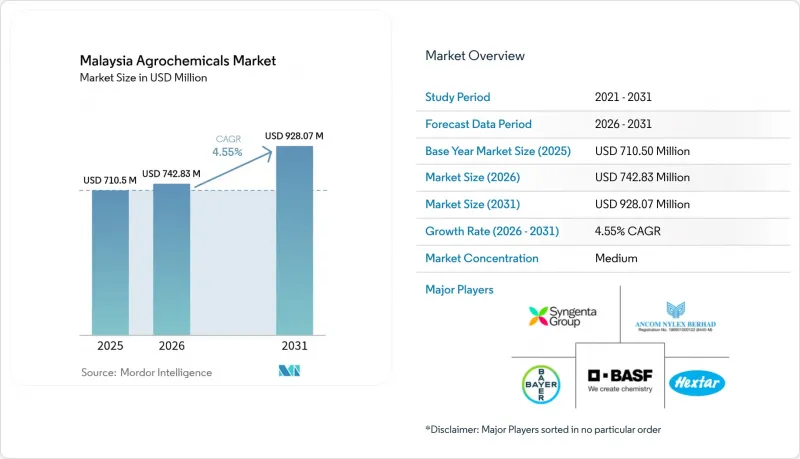
본 보고서는 제품 유형(비료, 농약, 보조제, 식물 생장 조절제) 및 작물 유형(곡물, 유지종자 및 콩류, 기타)별로 분류되어 있습니다. 시장 전망은 금액(달러)으로 표시되어 있습니다.
말레이시아의 농약 시장 동향 및 인사이트
식량 수요 증가와 작물 생산성 향상에 대한 필요성
말레이시아의 쌀 자급률은 60%에서 70% 사이에서 정체 상태를 이어가고 있으며, 이에 따라 ‘2021-2030 국가 농업식품 정책’에서는 벼의 평균 수확량을 헥타르당 3.75메트르톤에서 5메트르톤으로 끌어올리는 목표를 제시했습니다. 켈란탄주, 파한주, 트렝가누주에서 시행되고 있는 ‘5시즌 벼농사’ 이니셔티브에 따라 비료 및 농약, 특히 요소, 복합비료(NPK), 합성 피레스로이드계 농약의 사용 주기가 확대되고 있습니다. 이러한 집약화는 보호 재배 분야로도 파급되고 있으며, 그곳에서 비료 시비 및 관개, 점착 트랩을 통한 모니터링이 광범위한 살충제 살포를 대체하고 있습니다. FarmByte-Agrobank 플랫폼을 통한 신용 한도는 생산 자재 구매 비용을 충당할 뿐만 아니라, 생산자를 작물 관리 조언이 통합된 앱과 연결하여 등록된 제품의 채택을 촉진하고 있습니다. 도시 지역의 소득 증가로 인해 고급 농산물 수요가 높아지고 있으며, 수출 적합 인증을 획득한 잔류물이 없는 생산 자재의 사용이 장려되고 있습니다.
정부의 보조금 및 비료 세제 혜택
2025년도 예산에서는 신규 농업 프로젝트에 3억 링깃(7,200만 달러), 팜유 부문 지원에 26억 링깃(6억 2,400만 달러)이 편성되었습니다. 대상을 한정된 디젤 연료 보조금 제도 하에서 농약을 운송하는 물류 사업자는 1리터당 2.15링깃(0.52달러)만 지불하면 되므로 유통 비용을 35% 절감하고 있습니다. 연방토지개발청(FELDA)에 대한 1억 링깃(2,400만 달러)의 재조림 보조금은 수령이 짧은 단계의 묘목 및 농약 비용을 충당합니다. 수입 비료에 대한 매출·서비스세 면제로 인해 복합비료(NPK)의 도착 비용이 3-5% 낮아져, 적정 농업 규범(GAP) 인증을 준수하는 소규모 농가들의 부담이 경감되고 있습니다.
농장의 인력 부족이 비료 시비율을 저해
농장 현장 근로자의 80%를 차지하는 대다수는 이주 노동자이지만, 비자 발급 지연으로 인해 2024년에는 4만 2,000개의 일자리가 채워지지 않았으며, 그 결과 비료 살포가 최대 3주까지 지연되고 있습니다. 각 농장에서는 서방형 요소를 도입함으로써 영양소의 유효 기간을 90일로 연장하고, 살포 횟수를 줄이고 있습니다. 로봇 도입 프로젝트를 통해 팜유 재배 시 작업원 1인당 담당 면적을 10헥타르에서 17헥타르로 확대하고, 제초제 살포에 소요되는 노동 시간을 40% 줄이는 것을 목표로 하고 있습니다. 또한 각 기업은 열당 살포 시간을 단축할 수 있는 백팩식 정전 분무기의 도입을 추진하고 있습니다. 자동화를 통해 인력 부족은 완화되겠지만, 설비 투자(CapEx) 부담이 소규모 농원의 도입을 저해하고 있어, 업계에서는 감가상각 기간 단축과 같은 우대 조치를 요구하는 목소리가 나오고 있습니다.
부문 분석
2025년, 말레이시아의 농약 시장에서 살충제가 45.78%의 점유율을 차지했습니다. 이는 다년생 작물을 재배하는 플랜테이션에서 발생하는 열대 특유의 해충 피해가 심각함을 반영합니다. 제초제 부문은 계속해서 지배적인 위치를 유지하고 있는데, 이는 노동력 부족으로 인해 화학적 잡초 방제가 중시되는 미성숙 팜유 재배지에서 글리포세이트와 메츠설프론이 사용되고 있기 때문입니다. 살충제 수요는 메티사 플라나(Metisa plana)가 대량 발생했을 때 급증합니다. 2024년 실험에서는 드론을 이용한 바실러스 투린겐시스(Bacillus thuringiensis)의 공중 살포를 통해 유충 발생률이 72% 감소했습니다. 가노델마속(Ganoderma)에 의한 수확량 손실에 따라 살균제 사용량도 증가하고 있으며, 잔효 기간이 길기 때문에 줄기 주입에는 전신성 트리아졸계 약제가 선호되고 있습니다. 보조제 사용량은 수관에 대한 침투를 보장하기 위해 균일한 액적 분포에 의존하는 가변 살포량 기술의 보급에 따라 증가하고 있습니다. 식물 성장 조절제에는 주로 에테폰이나 사이토카이닌 배합제가 포함되어 있으며, 9.41%의 연평균 성장률(CAGR)을 기록하고 있습니다. 이는 용안과 두리안의 개화 유도, 그리고 야자나무 묘목장에서의 조직 배양을 통한 증식의 혜택을 받고 있습니다.
비료는 판매량 측면에서 가장 큰 비중을 차지하고 있으며, 논 재배에서는 질소계 제제가 주류를 이루는 반면, 과실의 품질 향상과 내병성 강화를 목표로 하는 플랜테이션 부문에서는 칼륨계 혼합 비료가 주목받고 있습니다. 조호르주에서 실시된 정밀한 토양 검사를 통해 미량 영양소의 결핍이 확인됨에 따라, 붕소와 마그네슘을 첨가한 특수 배합 비료에 대한 수요가 증가하고 있습니다. 서방형 제제는 플랜테이션의 영양 관리 프로그램에서 18%의 보급률을 기록하고 있으며, 침출에 의한 손실을 줄이는 동시에 MSPO의 환경 지표에도 부합하고 있습니다. 고부가가치 과일을 위한 특수 엽면 비료는 수출 바이어들의 품질 규격 강화에 따라 두 자릿수의 성장률을 기록하고 있습니다.
기타 혜택:
- 엑셀 형식 시장 예측(ME) 시트
- 3개월간의 애널리스트 지원
자주 묻는 질문
목차
제1장 서론
제2장 조사 방법
제3장 주요 요약
제4장 시장 구도
제5장 시장 규모와 성장 예측
제6장 경쟁 구도
제7장 시장 기회와 향후 전망
LSH 26.08.24According to Mordor Intelligence, the Malaysia agrochemicals market size is expected to grow from USD 710.50 million in 2025 to USD 742.83 million in 2026 and is forecast to reach USD 928.07 million by 2031 at 4.55% CAGR over 2026-2031.
This report is Segmented by Product Type (Fertilizers, Pesticides, Adjuvants, and Plant Growth Regulators) and Crop Type (Grains and Cereals, Oilseeds and Pulses, and More). The Market Forecasts are Provided in Terms of Value (USD).
Malaysia Agrochemicals Market Trends and Insights
Rising food demand and need for higher crop productivity
Malaysia's rice self-sufficiency rate stalled between 60% and 70%, prompting the National Agrofood Policy 2021-2030 to raise average paddy yields from 3.75 metric tons per hectare to 5.0 metric tons per hectare. The five-season paddy initiative in Kelantan, Pahang, and Terengganu magnifies fertilizer and pesticide cycles, especially urea, compound NPK, and synthetic pyrethroids. Intensification extends to protected horticulture, where fertigation and sticky-trap monitoring are displacing broad-spectrum sprays. Credit lines from the FarmByte-Agrobank platform cover input purchases and link growers to bundled crop-advice apps, fostering adoption of registered products. Rising urban incomes support premium produce, encouraging residue-free inputs with export compliance certification.
Government subsidies and fertilizer tax incentives
Budget 2025 earmarked RM300 million (USD 72 million) for new agricultural projects and RM2.6 billion (USD 624 million) for palm oil sector support. Under the targeted diesel subsidy, logistics operators hauling agrochemicals pay RM2.15 per liter (USD 0.52), trimming distribution costs by 35%. Replanting grants of RM100 million (USD 24 million) to the Federal Land Development Authority (FELDA) cover seedling and pesticide expenses during the immature phases. The Sales and Service Tax exemption on imported fertilizers lower landed costs for compound NPKs by 3-5 %, improving affordability for smallholders adhering to Good Agricultural Practices (GAP) certification.
Plantation labor shortages curbing application rates
The majority of plantation field workers, comprising 80%, are migrants, and visa delays have left 42,000 positions unfilled in 2024, which has postponed fertilizer applications by up to three weeks. Estates adopt controlled-release urea, extending nutrient availability to 90 days and reducing pass counts. Robotics projects aim to raise per-worker coverage from 10 ha to 17 ha in palm oil, trimming herbicide labor hours by 40%. Companies also push backpack-mounted electrostatic sprayers that shorten spray time per row. While automation offsets shortages, CapEx outlays curb uptake among smaller estates, provoking industry calls for accelerated depreciation incentives.
Other drivers and restraints analyzed in the detailed report include:
- Expansion of oil palm and rubber plantations
- Adoption of precision-farming services
- Proliferation of counterfeit agrochemicals
For complete list of drivers and restraints, kindly check the Table Of Contents.
Segment Analysis
Pesticides captured 45.78% of Malaysia agrochemicals market share in 2025, reflecting endemic tropical pest pressure on perennial estates. The herbicide subset continues to dominate, driven by glyphosate and metsulfuron use in immature palm circles where labor scarcity elevates chemical weed control. Insecticide demand spikes during Metisa plana outbreaks. Aerial Bacillus thuringiensis drone sprays reduced larval incidence by 72% in 2024 trials. Fungicide volumes rise alongside Ganoderma-related yield losses, with systemic triazoles favored for trunk injections due to extended residual activity. Adjuvant uptake grows in tandem with variable-rate technology that relies on uniform droplet spectra to ensure canopy penetration. Plant growth regulators largely include ethephon and cytokinin blends, posting a 9.41% CAGR, benefiting from longan and durian flowering manipulation and tissue culture propagation in oil palm nurseries.
Fertilizers represent the largest volume segment, with nitrogenous formulations dominating paddy applications while potassic blends gain traction in plantation sectors seeking enhanced fruit quality and disease resistance. Precision soil testing in Johor identifies micro-nutrient deficiencies, spurring specialty blends with boron and magnesium additives. Controlled-release formulations reach 18% penetration in estate nutrition programs, lowering leaching losses and aligning with MSPO environmental metrics. Specialty foliar fertilizers for high-value fruits register double-digit growth as export buyers tighten quality specifications.
Complete Report Scope:
- By Product Type
- Fertilizers
- Nitrogenous
- Phosphatic
- Potassic
- Other Fertilizers
- Pesticides
- Herbicides
- Insecticides
- Fungicides
- Other pesticides
- Adjuvants
- Plant Growth Regulators
- Fertilizers
- By Crop Type
- Grains and Cereals
- Oilseeds and Pulses
- Fruits and Vegetables
- Commercial Crops
- Turf and Ornamental Grass
- Other Crops
List of Companies Covered in this Report:
- Hextar Group of Companies
- Bayer AG
- Syngenta Group
- Nufarm
- Ancom Nylex Berhad
- BASF SE
- UPL Ltd
- Corteva Agriscience
- Yara International ASA
- Crop Protection (M) Sdn Bhd
- Agricultural Chemicals (M) Sdn Bhd
- Farmcochem Sdn Bhd
- PK Fertilizers Sdn Bhd
- Central Minerals and Chemicals Sdn Bhd
- Kenso Corporation Sdn Bhd
Additional Benefits:
- The market estimate (ME) sheet in Excel format
- 3 months of analyst support
TABLE OF CONTENTS
1 Introduction
- 1.1 Study Assumptions and Market Definition
- 1.2 Scope of the Study
2 Research Methodology
3 Executive Summary
4 Market Landscape
- 4.1 Market Overview
- 4.2 Market Drivers
- 4.2.1 Increasing incidence of pests and diseases
- 4.2.2 Rising food demand and need for higher crop productivity
- 4.2.3 Government subsidies and fertilizer tax incentives
- 4.2.4 Expansion of oil palm and rubber plantations
- 4.2.5 Adoption of precision-farming services
- 4.2.6 Growth of agri-fintech-enabled smallholder credit
- 4.3 Market Restraints
- 4.3.1 Stringent environmental regulations and residue limits
- 4.3.2 Adoption of gene-edited pest-resistant crop varieties
- 4.3.3 Proliferation of counterfeit agrochemicals
- 4.3.4 Plantation labor shortages curbing application rates
- 4.4 Regulatory Landscape
- 4.5 Technological Outlook
- 4.6 Porter's Five Forces Analysis
- 4.6.1 Threat of New Entrants
- 4.6.2 Bargaining Power of Buyers
- 4.6.3 Bargaining Power of Suppliers
- 4.6.4 Threat of Substitute Products
- 4.6.5 Intensity of Competitive Rivalry
5 Market Size and Growth Forecasts (Value)
- 5.1 By Product Type
- 5.1.1 Fertilizers
- 5.1.1.1 Nitrogenous
- 5.1.1.2 Phosphatic
- 5.1.1.3 Potassic
- 5.1.1.4 Other Fertilizers
- 5.1.2 Pesticides
- 5.1.2.1 Herbicides
- 5.1.2.2 Insecticides
- 5.1.2.3 Fungicides
- 5.1.2.4 Other pesticides
- 5.1.3 Adjuvants
- 5.1.4 Plant Growth Regulators
- 5.1.1 Fertilizers
- 5.2 By Crop Type
- 5.2.1 Grains and Cereals
- 5.2.2 Oilseeds and Pulses
- 5.2.3 Fruits and Vegetables
- 5.2.4 Commercial Crops
- 5.2.5 Turf and Ornamental Grass
- 5.2.6 Other Crops
6 Competitive Landscape
- 6.1 Market Concentration
- 6.2 Strategic Moves
- 6.3 Market Share Analysis
- 6.4 Company Profiles (Includes Global Level Overview, Market Level Overview, Core Segments, Financials as Available, Strategic Information, Market Rank/Share, Products and Services, and Recent Developments)
- 6.4.1 Hextar Group of Companies
- 6.4.2 Bayer AG
- 6.4.3 Syngenta Group
- 6.4.4 Nufarm
- 6.4.5 Ancom Nylex Berhad
- 6.4.6 BASF SE
- 6.4.7 UPL Ltd
- 6.4.8 Corteva Agriscience
- 6.4.9 Yara International ASA
- 6.4.10 Crop Protection (M) Sdn Bhd
- 6.4.11 Agricultural Chemicals (M) Sdn Bhd
- 6.4.12 Farmcochem Sdn Bhd
- 6.4.13 PK Fertilizers Sdn Bhd
- 6.4.14 Central Minerals and Chemicals Sdn Bhd
- 6.4.15 Kenso Corporation Sdn Bhd