

|
시장보고서
상품코드
2113190
자동차 액추에이터 : 시장 점유율 분석, 업계 동향 및 통계, 성장 예측(2026-2031년)Automotive Actuators - Market Share Analysis, Industry Trends & Statistics, Growth Forecasts (2026 - 2031) |
||||||
 Mordor Intelligence
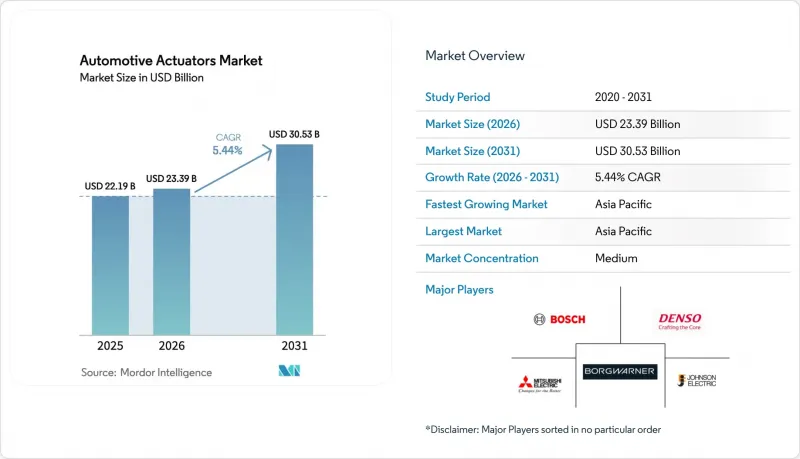
Mordor Intelligence에 의하면, 자동차 액추에이터 시장 규모는 2025년에 221억 9,000만 달러로 평가되었습니다. 2026년 233억 9,000만 달러에서 2031년까지 305억 3,000만 달러에 이를 것으로 예상되며, 예측 기간(2026-2031년) CAGR은 5.44%를 나타낼 전망입니다.
본 보고서는 구동 기술(전기식, 전기기계식 등), 작동 유형(선형·로터리),용도(스로틀, 브레이크 등), 차량 추진 방식(내연기관, 하이브리드 등), 차량 유형(승용차, 소형 상용차 등), 판매 채널(OEM·애프터마켓), 지역별로 분류되어 있습니다. 시장 전망은 금액(미 달러) 기준으로 제시되어 있습니다.
세계의 자동차 액추에이터 시장 동향 및 인사이트
고급 안전 및 편의 기능에 대한 수요 증가
세계 각국의 ADAS(첨단 운전자 보조 시스템) 규제에 따라 스티어링, 브레이크, 서스펜션 어셈블리에 액추에이터가 지속적으로 통합되고 있습니다. EU의 ‘일반 안전 규정 II’에 따르면, 2024년 7월 이후 출시되는 모든 신차에 지능형 속도 보조, 자동 긴급 제동, 차선 유지 보조 장치의 탑재가 의무화되어 있으며, 이에 따라 정밀 액추에이터에 대한 수요가 향후 수년간 확보될 전망입니다. 미국에서는 NHTSA(미국 도로교통안전국)가 ‘신차 평가 프로그램(NCAP)’을 개정하여 2033년까지 시험 기준으로 유지될 4가지 ADAS 기술을 추가했습니다. 소비자들이 오픈소스 안전 솔루션에 대해 지불 의사를 보이고 있다는 점은 첨단 액추에이션 기술에 대한 구매 여지가 있음을 시사합니다. 콘티넨탈의 카메라 생산량이 해마다 증가하고 있는 것은 주목할 만한 동향을 보여줍니다. 즉, 센서의 출력이 확대됨에 따라 액추에이터의 도입도 그에 발맞추어 증가하고 있는 것입니다. 햅틱 센서의 혁신적인 융합은 기존의 전기 기계 시스템에 새로운 활력을 불어넣으며, 자율 주행에서 종종 과제가 되는 지각의 격차를 효과적으로 메우고 있습니다. 이 획기적인 통합은 감각적 경험을 향상시키고, 차량과 주변 환경 간의 보다 직관적인 상호 작용을 만들어낼 것으로 기대됩니다.
아시아태평양의 승용차 생산 확대
2024년, 중국은 3,143만 6,000대라는 놀라운 생산 대수를 달성하며 세계 자동차 강국으로서의 위상을 확고히 했습니다. 한편, 아세안(ASEAN) 지역은 태국과 인도네시아의 매력적인 우대 조치에 힘입어 2030년대 중반까지 연간 자동차 생산 대수를 600만 대 가까이 끌어올리겠다는 확고한 로드맵을 추진 중입니다. 태국의 혁신적인 ‘EV3.5’ 프로그램이 앞장서서 부품의 현지 생산을 촉진하는 동시에, 스티어링 액추에이터의 지역 공급망 구축을 뒷받침하고 있습니다.
중국의 자동차 제조업체(OEM)들이 수직 통합을 추진하는 가운데, 비용 구조의 합리화를 도모할 뿐만 아니라 국경을 초월한 전문적인 제조 노하우의 신속한 교환도 촉진하고 있습니다. 이러한 역동적인 진화는 희토류 광물 시장에서 중국의 지배력에 의해 더욱 형성되고 있으며, 이는 전 세계의 설계 전략에 큰 영향을 미쳐 자석을 사용하지 않는 차량 아키텍처 개발로 이어지고 있습니다.
희토류 자석 공급 변동이 비용을 상승시킨다.
중국은 희토류 가공 시장에서 무려 90%의 점유율을 차지하고 있으며, 최근 도입된 더욱 엄격한 라이선스 제도가 업계 전반에 파급되기 시작했습니다. 포드와 같은 대형 제조업체들은 이미 유럽에서 ‘익스플로러 EV’ 시리즈의 생산 중단을 강요당하고 있으며, 이는 공급망의 취약성을 여실히 드러내고 있습니다.
자동차 혁신 연합(Alliance for Automotive Innovation)은 엄중한 경고를 발령했습니다. 공급 제약이 더욱 악화될 경우, 북미 사업은 대규모 가동 중단에 직면할 가능성이 있으며, 이는 자동차 부문의 미래에 어두운 그림자를 드리울 것입니다. ZF의 효율적인 분리 자화형 동기 모터는 고농도의 희토류 함유량을 배제하고 있지만, 새로운 금형과 검증이 필요합니다. 2040년까지 네오디뮴·디스프로슘 수요가 증가함에 따라 가격 상승 압력이 지속되고 개발 주기는 길어지겠지만, Sm2Fe17N3 및 Fe16N2 화합물에 대한 연구 개발이 시급합니다. 공급업체들은 이중 조달 및 재생 자석을 통해 리스크 헤지를 도모하고 있지만, 완전한 다각화에는 아직 수년이 소요될 것으로 예측됩니다.
부문별 분석
2025년, 자동차 액추에이터 시장 규모의 37.94%를 전동 액추에이터가 차지했습니다. 이는 각 OEM 업체들이 제어성과 집중형 E/E 아키텍처와의 원활한 통합을 중시했기 때문입니다. 기계적 페일세이프가 필요한 하이브리드 파워트레인에서는 전기-기계식 유닛이 여전히 표준적인 선택지로 자리 잡고 있습니다. 반면, 유압식은 무게나 유지보수상의 단점으로 인해 대형 트럭 이외의 분야에서는 감소 추세를 보이고 있습니다. SMA 액추에이터는 연평균 성장률(CAGR) 9.60%로 확대되고 있으며, 높은 힘 대 질량 비율을 활용하여 시트, 통풍구, 래치 기능에서 부피가 큰 모터를 대체함으로써 운전실 공간 절약을 실현하고 있습니다. 피에조 구동 장치는 연료 분사 장치나 햅틱 대시보드에서 마이크로초 단위의 정밀도 요구 사항을 충족하는 반면, 공압식 솔루션은 차량용 공기 시스템이 이미 구축된 틈새 상용 부문에 국한되어 있습니다.
성장 전망은 수명을 연장하고 보정 시간을 단축하는 AI 지원 자가 조정형 펌웨어에 달려 있습니다. 전기 액추에이터에는 현재 고장 모드를 예측하는 내장형 상태 모니터링 칩이 탑재되어 있어 보증 비용 절감으로 이어지고 있습니다. SMA(형상 기억 합금) 공급업체들은 Tier 1 제조업체와 제휴하여 소결 기술을 확대함으로써 단가 균등화에 한 걸음 더 다가가고 있습니다. 피에조 벤더들은 콕핏 HMI에서의 채택을 확보하기 위해 넓은 온도 범위에서 자동차 등급의 신뢰성을 추구하고 있습니다. OTA(Over-the-Air)의 보급에 따라 펌웨어의 모듈화를 통해 OEM은 하드웨어를 변경하지 않고도 새로운 작동 프로파일을 배포할 수 있게 되었으며, 자동차 액추에이터 시장에서 소프트웨어 정의 기능으로의 전환이 더욱 가속화되고 있습니다.
2025년 자동차 액추에이터 시장 규모 중 리니어 기구가 62.01%를 차지했으며, 그 배경에는 도어 클로저, 시트 레일,액티브 댐퍼가 있습니다. OEM의 지속가능성 목표에 따라, 유압식에 비해 에너지 소비량이 20% 적고 48V 전원망에 통합하기 쉬운 전동 리니어 디바이스가 선호되고 있습니다. 클라우드를 통해 수집된 스트로크 데이터를 기반으로 한 예측 유지보수 대시보드는 어댑티브 서스펜션의 예기치 못한 고장을 줄이고 승차감을 향상시킵니다.
회전식 액추에이터는 수량적으로는 적지만, 스티어 바이 와이어 시스템이나 능동 롤 제어에는 필수적입니다. 또한, 회전식 설계는 2031년까지 7.72%라는 가장 높은 연평균 성장률(CAGR)을 나타낼 전망입니다. ZF사의 sMOTION과 같은 첨단 섀시 프로그램은 0.5초 만에 80mm의 리프트를 실현하여, 고토크 회전식 모듈이 얼마나 역동적인 핸들링을 향상시키는지 입증하고 있습니다. 차세대 로터리 드라이브는 소형 자석과 희토류를 포함하지 않는 아키텍처를 채택하여 토크 밀도를 유지하면서도 공급 리스크를 회피하고 있습니다. 공급업체는 미세한 진동 패턴을 기록하는 엣지 AI 칩을 통합하여, 이를 통해 사용 기간 중 재보정이 가능해집니다. 이 기능은 자동차 액추에이터 시장에서 확대되고 있는 서비스 기반 수익 모델에 매우 적합합니다.
지역별 분석
아시아태평양은 2025년에 자동차 액추에이터 시장 규모의 41.86%를 차지했으며, 2031년까지 연평균 성장률(CAGR) 8.48%로 성장할 전망입니다. 중국의 전기차 생산 확대는 국가 보조금과 대규모 제조 체제에 힘입어 지역 전체 수요를 끌어올리고 있습니다. 아세안(ASEAN)이 향후 10년 중반에 제시한 600만 대 생산 목표는 1차 공급업체의 공장을 유치하는 2차 거점이 되어 지정학적 위험을 완화하는 역할을 하고 있습니다. 일본과 한국은 전자 분야 전문 지식을 활용해 고정밀 액추에이터를 수출하고 있는 반면, 인도는 국내 및 수출 시장을 대상으로 비용 효율적인 생산을 확대되고 있습니다.
북미에서는 규제 준수 및 리쇼어링(국내 복귀)에 대한 인센티브로 인해 꾸준한 확대가 나타나고 있습니다. EPA(미국 환경보호청)의 다중 오염 물질 규제로 인해 내연기관용 신규 액추에이터가 의무화되는 한편, ‘인플레이션 억제법’은 전기차(EV) 공급망의 현지화를 지원하고 있습니다.
유럽은 여전히 기술적으로 선진적이지만, 희토류에 대한 의존으로 인해 공급망에 제약을 받고 있습니다. ‘유로 7’ 지침 및 일반 안전 규정 II에 따라 파워트레인과 ADAS 두 분야 모두에서 액추에이터 수요가 뒷받침되고 있습니다. 콘티넨탈의 1,000만 대 카메라 생산과 ZF의 Brake-by-wire 수주는 콘티넨탈의 리더십을 보여주고 있지만, 원자재 헤지 및 에너지 비용이 수익성을 압박하고 있습니다. 중동 및 아프리카·남미는 규제 측면에서 뒤처져 있지만, 가격이 합리화되어 스마트 액추에이터의 비용 곡선에 부합하게 된다면 장기적인 성장 여지가 생길 것입니다.
기타 혜택 :
- 엑셀 형식 시장 예측(ME) 시트
- 3개월간의 애널리스트 지원
자주 묻는 질문
목차
제1장 서론
제2장 조사 방법
제3장 개요
제4장 시장 구도
제5장 시장 규모 및 성장 예측
제6장 경쟁 구도
제7장 시장 기회 및 향후 전망
KTH 26.08.31According to Mordor Intelligence, the automotive actuators market size was valued at USD 22.19 billion in 2025 and estimated to grow from USD 23.39 billion in 2026 to reach USD 30.53 billion by 2031, at a CAGR of 5.44% during the forecast period (2026-2031).
This report is Segmented by Actuation Technology (Electric, Electromechanical, and More), Motion Type (Linear and Rotary), Application Type (Throttle, Brake, and More), Propulsion Type (Internal Combustion Engine, Hybrid, and More), Vehicle Type (Passenger Cars, Light Commercial, and More), Sales Channel (OEM and Aftermarket), and Geography. The Market Forecasts are Provided in Terms of Value (USD).
Global Automotive Actuators Market Trends and Insights
Rising Demand for Advanced Safety and Comfort Features
Global ADAS mandates continue to embed actuators in steering, braking, and suspension assemblies. The EU General Safety Regulation II requires intelligent speed assistance, autonomous emergency braking, and lane-keeping support in every new model launched after July 2024, locking in multi-year volume for precision actuators. In the United States, NHTSA updated its New Car Assessment Program to include four additional ADAS technologies that will remain test criteria through 2033 . Consumers' willingness to pay for open-source safety solutions, signaling purchasing headroom for advanced actuation. The annual surge in camera production at Continental showcases a remarkable trend: as sensor output expands, the implementation of actuators rises in tandem. The innovative fusion of haptic sensors breathes new life into traditional electromechanical systems, effectively narrowing the perception gaps that often challenge autonomous driving. This exciting integration promises to enhance the sensory experience, creating a more intuitive interaction between vehicles and their surroundings.
Ramp-Up of Passenger-Car Output in Asia-Pacific
In 2024, China achieved a remarkable production milestone by rolling out an impressive 31.436 million vehicles, solidifying its position as a global automotive powerhouse. Meanwhile, the ASEAN region is on a determined path to reach an annual vehicle output of nearly 6 million units by the mid-2030s, fueled by enticing incentives from Thailand and Indonesia. Thailand's innovative EV3.5 program is at the forefront, promoting localized component production and encouraging the development of regional supply chains for steering actuators.
As Chinese original equipment manufacturers (OEMs) embrace vertical integration, they are not only streamlining their cost structures but also fostering a swift exchange of specialized manufacturing expertise across borders. This dynamic evolution is further shaped by China's dominance in the rare-earth minerals market, which significantly influences global design strategies, steering them toward the development of magnet-free vehicle architectures.
Rare-Earth Magnet Supply Volatility Inflates Costs
China dominates the rare-earth processing market with a staggering 90% share, and the recent imposition of stricter export licensing has begun to ripple across the industry. Major manufacturers, like Ford, have already been compelled to halt production of their Explorer EV line in Europe, highlighting the fragility of the supply chain.
The Alliance for Automotive Innovation has issued a stark warning: if supply constraints worsen, North American operations could face significant shutdowns, casting a shadow over the future of the automotive sector. ZF's efficient separatively excited synchronous motor eliminates heavy rare-earth content but demands new tooling and validation. Rising neodymium and dysprosium demand through 2040 sustains price pressure, compelling R&D into Sm2Fe17N3 and Fe16N2 compounds, albeit with longer development cycles. Suppliers hedge with dual-sourcing and recycled magnets, yet complete diversification remains years away.
Other drivers and restraints analyzed in the detailed report include:
- Shape-Memory-Alloy and Piezo Micro-Actuators Unlock Interior Space
- OTA-Calibrated "Software-Defined" Actuators Reduce Downtime
- High BOM Cost of Next-Gen Smart Actuators
For complete list of drivers and restraints, kindly check the Table Of Contents.
Segment Analysis
Electric actuators captured 37.94% of the automotive actuators market size in 2025 as OEMs favored their controllability and seamless integration with centralized E/E architectures. Electromechanical units remain default choices for hybrid powertrains that require a mechanical fail-safe, whereas hydraulics decline outside heavy trucks due to weight and maintenance drawbacks. SMA actuators are advancing at a 9.60% CAGR, leveraging high force-to-mass ratios to replace bulky motors in seat, vent, and latch functions, thus unlocking cabin space savings. Piezo drives address microsecond precision needs in fuel injectors and haptic dashboards, while pneumatic solutions linger in niche commercial segments where onboard air systems already exist.
Growth prospects hinge on AI-enabled self-tuning firmware that prolongs life and cuts calibration time. Electric actuators now incorporate embedded condition-monitoring chips that predict failure modes, lowering warranty costs. SMA suppliers partner with Tier-1s to scale sintering techniques that bring unit cost parity closer. Piezo vendors push automotive-grade reliability at wide temperature bands to secure cockpit HMI wins. As OTA expands, firmware modularity lets OEMs roll out new actuation profiles without hardware changes, reinforcing the automotive actuators market's shift toward software-defined functionality.
Linear mechanisms accounted for 62.01% of the automotive actuators market size in 2025, underpinned by door closers, seat rails, and active dampers. OEM sustainability goals favor electric linear devices that consume 20% less energy than hydraulic equivalents and integrate easily into 48 V power nets. Predictive-maintenance dashboards originating from cloud-captured stroke data reduce unexpected collapses in adaptive suspension, enhancing ride comfort.
While smaller in volume, rotary actuators are essential for steer-by-wire systems and active roll control. Additionally, rotary designs are projected to gain the highest CAGR at 7.72% through 2031. Advanced chassis programs such as ZF's sMOTION deliver 80 mm lift in 0.5 s, demonstrating how high-torque rotary modules enhance dynamic handling. Next-generation rotary drives employ compact magnets or rare-earth-free architectures to sidestep supply risks while sustaining torque density. Suppliers integrate edge-AI chips that log micro-vibration signatures, allowing in-life recalibration, a feature well-suited to the automotive actuators market's growing service-based revenue models
Complete Report Scope:
- By Actuation Technology
- Electric Actuators
- Electromechanical Actuators
- Hydraulic Actuators
- Pneumatic Actuators
- Piezoelectric Actuators
- Shape-Memory-Alloy Actuators
- By Motion Type
- Linear
- Rotary
- By Application Type
- Throttle
- Brake
- Transmission / Drivetrain
- Seat Adjustment
- Door / Closure
- HVAC & Thermal
- Suspension & Chassis
- Mirror & Lighting
- By Vehicle Propulsion
- Internal Combustion Engine (ICE)
- Hybrid Electric Vehicles (HEV)
- Battery-Electric (BEV)
- Plug-in Hybrid Electric Vehicles (PHEV)
- Fuel-Cell Electric (FCEV)
- By Vehicle Type
- Passenger Cars
- Light Commercial Vehicles
- Heavy Commercial Vehicles
- Off-Highway & Special-Purpose
- By Sales Channel
- Original Equipment Manufacturers (OEM)
- Aftermarket
- By Geography
- North America
- United States
- Canada
- Rest of North America
- South America
- Brazil
- Argentina
- Rest of South America
- Europe
- Germany
- France
- United Kingdom
- Italy
- Spain
- Russia
- Rest of Europe
- Asia-Pacific
- China
- Japan
- India
- South Korea
- Vietnam
- Indonesia
- Philippines
- Thailand
- Australia
- Rest of Asia-Pacific
- Middle-East and Africa
- United Arab Emirates
- Saudi Arabia
- Turkey
- Egypt
- South Africa
- Rest of Middle-East and Africa
- North America
Geography Analysis
Asia-Pacific held 41.86% of the automotive actuators market size in 2025 and will grow 8.48% CAGR through 2031. China's boost in electric vehicle production is increasing regional demand, supported by state subsidies and large-scale manufacturing. ASEAN's six million-unit production target in the mid-to-next decade offers secondary hubs that attract Tier-1 factories, buffering geopolitical risk. Japan and South Korea leverage electronics expertise to export high-precision actuators, while India ramps up cost-efficient production for domestic and export markets.
North America is expanding steadily in terms of regulatory compliance and re-shoring incentives. The EPA's multi-pollutant rule compels new combustion-engine actuators, whereas the Inflation Reduction Act supports EV supply-chain localization.
Europe remains technologically advanced but supply-chain-constrained by rare-earth exposure. The Euro 7 directive and General Safety Regulation II sustain actuator demand in both powertrain and ADAS. Continental's 10-million-camera production and ZF's brake-by-wire wins illustrate Continental's leadership, yet raw-material hedging and energy costs challenge profitability. Middle East & Africa and South America lag in regulations but present long-term whitespace once affordability matches smart-actuator cost curves.
- Robert Bosch GmbH
- Denso Corporation
- BorgWarner Inc.
- Johnson Electric Holdings Limited
- Mitsubishi Electric Corp.
- ZF Friedrichshafen AG
- Continental AG
- Valeo SA
- Aisin Corporation
- Hitachi Astemo
- Nidec Corporation
- CTS Corporation
- HELLA GmbH & Co. KGaA
- Magneti Marelli
- Mahle GmbH
- Knorr-Bremse AG
- Schaeffler AG
- Sensata Technologies Inc.
- Vitesco Technologies GmbH
Additional Benefits:
- The market estimate (ME) sheet in Excel format
- 3 months of analyst support
TABLE OF CONTENTS
1 Introduction
- 1.1 Study Assumptions & Market Definition
- 1.2 Scope of the Study
2 Research Methodology
3 Executive Summary
4 Market Landscape
- 4.1 Market Overview
- 4.2 Market Drivers
- 4.2.1 Rising Demand for Advanced Safety and Comfort Features
- 4.2.2 Surge In Vehicle Electrification and EV Production
- 4.2.3 Stricter Global Emission / Fuel-Efficiency Regulations
- 4.2.4 Ramp-Up of Passenger-Car Output in Asia-Pacific
- 4.2.5 Shape-Memory-Alloy and Piezo Micro-Actuators Unlock Interior Space
- 4.2.6 OTA-Calibrated Software-Defined" Actuators Reduce Downtime"
- 4.3 Market Restraints
- 4.3.1 High BOM Cost of Next-Gen Smart Actuators
- 4.3.2 Reliability Concerns in High-Temperature Duty Cycles
- 4.3.3 Solid-State E-Drivetrains Cutting Actuator Counts Per EV
- 4.3.4 Rare-Earth Magnet Supply Volatility Inflates Costs
- 4.4 Value / Supply-Chain Analysis
- 4.5 Regulatory Landscape
- 4.6 Technological Outlook
- 4.7 Porter's Five Forces
- 4.7.1 Threat of New Entrants
- 4.7.2 Bargaining Power of Buyers
- 4.7.3 Bargaining Power of Suppliers
- 4.7.4 Threat of Substitutes
- 4.7.5 Competitive Rivalry
5 Market Size & Growth Forecasts (Value, USD)
- 5.1 By Actuation Technology
- 5.1.1 Electric Actuators
- 5.1.2 Electromechanical Actuators
- 5.1.3 Hydraulic Actuators
- 5.1.4 Pneumatic Actuators
- 5.1.5 Piezoelectric Actuators
- 5.1.6 Shape-Memory-Alloy Actuators
- 5.2 By Motion Type
- 5.2.1 Linear
- 5.2.2 Rotary
- 5.3 By Application Type
- 5.3.1 Throttle
- 5.3.2 Brake
- 5.3.3 Transmission / Drivetrain
- 5.3.4 Seat Adjustment
- 5.3.5 Door / Closure
- 5.3.6 HVAC & Thermal
- 5.3.7 Suspension & Chassis
- 5.3.8 Mirror & Lighting
- 5.4 By Vehicle Propulsion
- 5.4.1 Internal Combustion Engine (ICE)
- 5.4.2 Hybrid Electric Vehicles (HEV)
- 5.4.3 Battery-Electric (BEV)
- 5.4.4 Plug-in Hybrid Electric Vehicles (PHEV)
- 5.4.5 Fuel-Cell Electric (FCEV)
- 5.5 By Vehicle Type
- 5.5.1 Passenger Cars
- 5.5.2 Light Commercial Vehicles
- 5.5.3 Heavy Commercial Vehicles
- 5.5.4 Off-Highway & Special-Purpose
- 5.6 By Sales Channel
- 5.6.1 Original Equipment Manufacturers (OEM)
- 5.6.2 Aftermarket
- 5.7 By Geography
- 5.7.1 North America
- 5.7.1.1 United States
- 5.7.1.2 Canada
- 5.7.1.3 Rest of North America
- 5.7.2 South America
- 5.7.2.1 Brazil
- 5.7.2.2 Argentina
- 5.7.2.3 Rest of South America
- 5.7.3 Europe
- 5.7.3.1 Germany
- 5.7.3.2 France
- 5.7.3.3 United Kingdom
- 5.7.3.4 Italy
- 5.7.3.5 Spain
- 5.7.3.6 Russia
- 5.7.3.7 Rest of Europe
- 5.7.4 Asia-Pacific
- 5.7.4.1 China
- 5.7.4.2 Japan
- 5.7.4.3 India
- 5.7.4.4 South Korea
- 5.7.4.5 Vietnam
- 5.7.4.6 Indonesia
- 5.7.4.7 Philippines
- 5.7.4.8 Thailand
- 5.7.4.9 Australia
- 5.7.4.10 Rest of Asia-Pacific
- 5.7.5 Middle-East and Africa
- 5.7.5.1 United Arab Emirates
- 5.7.5.2 Saudi Arabia
- 5.7.5.3 Turkey
- 5.7.5.4 Egypt
- 5.7.5.5 South Africa
- 5.7.5.6 Rest of Middle-East and Africa
- 5.7.1 North America
6 Competitive Landscape
- 6.1 Market Concentration
- 6.2 Strategic Moves
- 6.3 Market Share Analysis
- 6.4 Company Profiles (Includes Global level Overview, Market level overview, Core Segments, Financials as available, Strategic Information, Market Rank/Share, Products & Services, Recent Developments)
- 6.4.1 Robert Bosch GmbH
- 6.4.2 Denso Corporation
- 6.4.3 BorgWarner Inc.
- 6.4.4 Johnson Electric Holdings Limited
- 6.4.5 Mitsubishi Electric Corp.
- 6.4.6 ZF Friedrichshafen AG
- 6.4.7 Continental AG
- 6.4.8 Valeo SA
- 6.4.9 Aisin Corporation
- 6.4.10 Hitachi Astemo
- 6.4.11 Nidec Corporation
- 6.4.12 CTS Corporation
- 6.4.13 HELLA GmbH & Co. KGaA
- 6.4.14 Magneti Marelli
- 6.4.15 Mahle GmbH
- 6.4.16 Knorr-Bremse AG
- 6.4.17 Schaeffler AG
- 6.4.18 Sensata Technologies Inc.
- 6.4.19 Vitesco Technologies GmbH


