|
시장보고서
상품코드
2113219
태국 전력 : 시장 점유율 분석, 업계 동향과 통계, 성장 예측(2026-2031년)Thailand Power - Market Share Analysis, Industry Trends & Statistics, Growth Forecasts (2026 - 2031) |
||||||
 Mordor Intelligence
Mordor Intelligence에 따르면 태국 전력 시장 규모는 2025년 64.61기가와트로부터 2026년에는 65.98기가와트로 확대하며, 2026-2031년에 CAGR 2.12%로 추이하며, 2031년에는 73.29기가와트에 달할 것으로 예측됩니다.
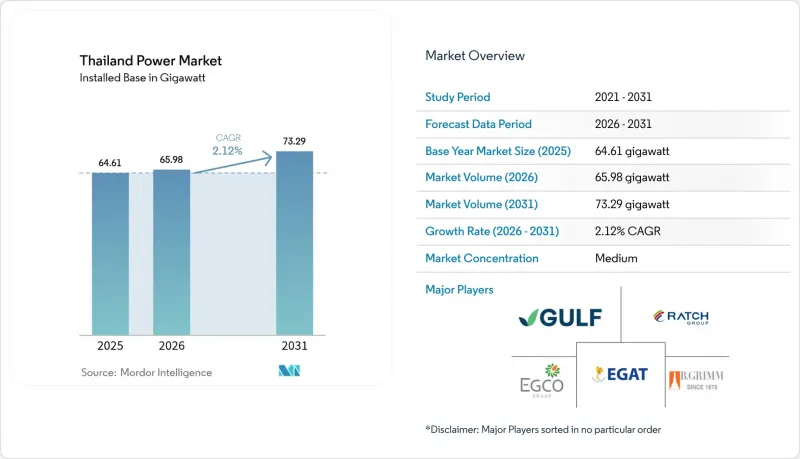
이 보고서는 발전원별(화력, 원자력, 재생에너지) 및 최종사용자별(유틸리티, 상업·산업, 주택)로 분류되어 있습니다. 시장 규모 및 예측치는 설비 용량(GW) 단위로 표시되어 있습니다.
태국 전력 시장의 동향 및 인사이트
재생 가능 에너지 신규 설치 용량의 증가
태국에서는 2024년에 약 3기가와트의 태양광발전(PV) 설비가 도입되어, 태양광발전의 누적 설비 용량은 11.875기가와트에 달하며, 증설 용량의 주요 원천이 되었습니다. EGAT의 부유식 태양광발전 로드맵은 총 2,700메가와트를 초과하는 9개의 저수지를 대상으로 하고 있으며, 이 전략을 통해 부지 확보의 제약을 피하고 기존 수력 발전 송전망 노드를 통해 계통 연계를 신속하게 진행하고 있습니다. 2022년 고정가격임베디드제도(FiT) 입찰에서는 태양광, 풍력, 배터리 프로젝트에 총 5GW가 배정되었으나, 남부 지역의 송전망 혼잡으로 인해 약 500MW의 계통 연계가 지연되면서 발전과 송전의 상호 의존 관계가 부각되고 있습니다. 바이오매스 및 폐기물 에너지화은 지원적인 임베디드 가격이 있음에도 불구하고 원료 확보의 계절적 변동에 제약을 받아 여전히 틈새 시장에 머물러 있습니다. 2025년에 제3자 접근(TPA) 규정이 확정되면, 데이터센터 및 수출 지향 제조 클러스터를 대상으로 최대 2GW 규모의 직접 전력 구매 계약(PPA)이 가능해져, 전력 회사로부터의 전력 조달 의존도가 낮아질 것으로 예상됩니다.
노후화된 송배전망의 현대화
EGAT는 2025년 1월, 발전 최적화와 재생에너지 통합을 도모하기 위해 Energy Exemplar의 PLEXOS 모델을 채택하고, 첨단 송전망 분석을 위한 디지털 전환을 시사했습니다. 반부엔 2 변전소의 17억 2,000만 바트(5,000만 달러) 규모 개보수 공사는 동부 경제 회랑에서 전압 수준이 상승함에 따라 자본 집약도가 높아지고 있음을 여실히 보여줍니다. 총 2,472MW에 달하는 3개의 양수 발전 프로젝트가 계통 유연성 강화의 핵심을 담당하고 있으며, 이는 기존 1,531MW의 발전 설비를 훨씬 능가하여 석탄 화력 발전소 폐쇄로 인해 상실된 관성력을 보완합니다. 재생에너지 예측 센터와 수요 반응 제어 센터는 현재 10% 미만에 그치고 있는 스마트 계량기 보급률이 향상되는 대로 발전 억제를 조정하게 될 것입니다. Hitachi Energy의 그리드 포밍 인버터는 동기 콘덴서에 비해 신속한 주파수 응답을 실현하기 위해 현재 시험 운영이 진행되고 있습니다.
대규모 송전망 업그레이드에 따른 막대한 설비 투자
EGAT의 900억 바트(26억 달러) 규모 양수 발전 프로그램은 토목 공사 및 환경 대책 비용을 포함하면 1MW당 100만 달러를 초과하는 비용이 될 전망입니다. 동 공사의 130억 바트(3억 8,000만 달러) 규모의 부유식 태양광발전 계획은 재무 상황을 더욱 악화시키고 있으며, 다자간 융자로 인해 이 프로젝트는 환율 변동 위험에 노출되어 있습니다. 200억 바트(5억 8,000만 달러)의 비용이 예상되는 남부 500kV 송전선 보강 공사는 부지 확보 지연에 직면해 있으며, 500MW 규모의 재생에너지 연결이 정체되고 있으며, 개발 사업자는 발전 제한 조항을 적용받을 수밖에 없는 상황입니다. EGAT의 부채비율은 규제 상한선에 근접하고 있으며, 요금 인상이나 자본 투입이 이루어지지 않는 한 추가 차입은 제한될 것입니다. 소규모 IPP(독립 발전 사업자)는 송전망 확장에 필요한 자금을 자체 자금으로 조달할 수 없기 때문에 제3자 접근을 통해 민간 주도의 송전이 가능해질 때까지 발전 설비가 유휴 상태로 남아 있게 됩니다.
부문별 분석
2025년에는 화력 발전이 발전 용량의 75.02%를 차지했으나, 태양광발전의 증가로 인해 재생에너지 발전량은 연평균 성장률(CAGR) 5.05%로 증가하여, 석탄·석유 화력 발전소의 폐로에 따라 에너지 구조의 전환이 진행되고 있음을 보여줍니다. 천연가스는 전력의 57.74%를 공급하고 있지만, LNG에 대한 의존도 증가와 탄소 중립 목표로 인해 계획 담당자들은 신규 가스 발전소 건설을 억제해야 한다는 압력을 받고 있습니다. 태양광발전은 총 2,656 MW에 달하는 부유식 태양광발전 입찰을 배경으로 11.875GW에 이르렀으며, 저수지의 수온이 비교적 낮은 덕분에 설비 이용률 18% 이상을 달성했습니다. 수력 발전은 라오스 인민민주공화국으로부터의 수입을 통해 15.63%를 차지했으며, 태국은 라오스·태국·말레이시아·싱가포르(LTMS-PIP) 회랑내 중계 거점으로서의 지위를 확립했습니다. 풍력발전은 여전히 제한적이지만, 해상 풍력 타당성 조사에 따르면 2028년 이후에는 2-3 기가와트의 잠재력이 있는 것으로 나타났습니다. 바이오매스 및 폐기물 에너지화 프로젝트는 원료의 제약으로 인해 완만한 확대에 그치고 있습니다. 원자력 및 지열 발전은 여전히 검토 단계에 있으며, 2035년까지는 태국의 전력 시장에 영향을 미칠 가능성은 낮을 것으로 보입니다.
에너지 저장은 에너지 전환의 핵심입니다. 리튬이온 배터리 가격이 1kWh당 100달러 아래로 떨어지면, 태양광발전과 축전지를 결합한 하이브리드 시스템이 피크용 가스 화력 발전보다 저렴해져, 석탄 화력 발전의 단계적 철수를 가속화하고 LNG 조달량을 줄이게 될 것입니다. 그 결과, 2026-2031년에 태국 전력 시장에서 재생에너지 하이브리드 시장 규모는 그 어떤 화력 발전 부문보다 빠르게 확대될 것으로 예측됩니다. 기존 수력 발전 설비와의 연동을 포함하는 저수지형 부유식 태양광발전은 새로운 부지 확보 없이도 단기적인 규모 확대를 실현하며, 변동하는 공급을 조정하는 데 있으며, 통합형 자산이 수행하는 역할을 부각시키고 있습니다.
기타 혜택:
- 엑셀 형식의 시장 예측(ME) 시트
- 3개월간의 애널리스트 지원
자주 묻는 질문
목차
제1장 서론
제2장 조사 방법
제3장 개요
제4장 시장 구도
제5장 시장 규모와 성장 예측
제6장 경쟁 구도
제7장 시장 기회와 향후 전망
KSA 26.08.25According to Mordor Intelligence, the Thailand power market size is expected to grow from 64.61 gigawatt in 2025 to 65.98 gigawatt in 2026 and is forecast to reach 73.29 gigawatt by 2031 at 2.12% CAGR over 2026-2031.
This report is Segmented by Power Source (Thermal, Nuclear, and Renewables) and End-User (Utilities, Commercial and Industrial, and Residential). The Market Sizes and Forecasts are Provided in Terms of Installed Capacity (GW).
Thailand Power Market Trends and Insights
Rising Renewables Capacity Additions
Thailand installed nearly 3 GW of solar photovoltaic (PV) capacity in 2024, increasing cumulative solar capacity to 11.875 GW and making solar the leading contributor to incremental capacity. EGAT's floating-solar roadmap spans nine reservoirs totaling more than 2,700 MW, a strategy that sidesteps land constraints and speeds tie-ins via existing hydro grid nodes. The 2022 feed-in-tariff (FiT) auction awarded 5 GW across solar, wind, and battery projects, but southern congestion has delayed roughly 500 MW of grid connections, exposing generation-transmission interdependencies. Biomass and waste-to-energy remain niche, constrained by seasonal variability in feedstock availability despite supportive tariffs. Finalization of Third-Party Access (TPA) codes in 2025 is expected to unlock up to 2 GW of direct PPAs for data centers and export-manufacturing clusters, reducing reliance on utility offtake.
Modernization of Ageing T&D Grid
EGAT adopted Energy Exemplar's PLEXOS model in January 2025 to optimize dispatch and renewable integration, signaling a digital pivot toward advanced grid analytics. A THB 1.72 billion (USD 50 million) upgrade at the Ban Bueng 2 substation underscores capital intensity as voltage levels rise in the Eastern Economic Corridor. Three pumped-storage projects, totaling 2,472 MW, anchor the flexibility build-out, dwarfing the existing 1,531 MW fleet and providing the inertia lost from coal retirements. The Renewable Energy Forecast Center and Demand Response Control Center will coordinate curtailment once smart meter penetration, still below 10%, improves. Hitachi Energy's grid-forming inverters are being piloted to furnish rapid frequency response compared with synchronous condensers.
High Capex for Large-Scale Grid Upgrades
EGAT's THB 90 billion (USD 2.6 billion) pumped-storage program implies costs exceeding USD 1 million per MW when civil works and environmental mitigation are included. The utility's THB 13 billion (USD 380 million) floating-solar plan further stretches the balance sheet, and multilateral financing exposes projects to exchange-rate volatility. Southern 500 kV line reinforcements, priced at THB 20 billion (USD 580 million), are facing land-acquisition delays, stalling 500 MW of renewable connections and forcing developers into curtailment clauses. EGAT's debt-to-equity ratio is near regulatory ceilings, limiting incremental borrowing unless tariffs rise or equity injections are made. Smaller IPPs cannot self-finance grid extensions, creating stranded generation until Third-Party Access enables private wheeling.
Other drivers and restraints analyzed in the detailed report include:
- Steady Electricity-Demand Growth from EV Rollout
- Rapid Cost Decline of Battery-Integrated Hybrid PV
- Exposure to Volatile Imported LNG Pricing
For complete list of drivers and restraints, kindly check the Table Of Contents.
Segment Analysis
Thermal generation supplied 75.02% of capacity in 2025, yet solar additions lifted renewable output by 5.05% CAGR, signaling a pivot as coal and oil plants retire. Natural gas produced 57.74% of electricity; however, rising LNG dependence and carbon-neutrality targets are pressuring planners to cap new gas builds. Solar reached 11.875 GW on the back of floating-PV tenders totaling 2,656 MW, achieving capacity factors above 18% owing to cooler reservoir temperatures. Hydropower contributed 15.63% via Lao PDR imports, positioning Thailand as a transit hub in the Lao-Thai-Malaysia-Singapore (LTMS-PIP) corridor. Wind remains marginal, although offshore feasibility studies suggest a potential of 2-3 GW post-2028. Biomass and waste-to-energy projects expand slowly due to feedstock constraints. Nuclear and geothermal remain exploratory and are unlikely to influence the Thai power market before 2035.
Energy storage is the fulcrum of the transition: once lithium-ion breaches USD 100 per kWh, solar-plus-battery hybrids will undercut gas peakers, accelerating coal phase-outs and trimming LNG procurement. Consequently, the Thailand power market size for renewable hybrids is projected to grow faster than any thermal category over the 2026-2031 period. Reservoir-based floating solar, bundled with existing hydro tie-ins, offers near-term scale without new rights-of-way, highlighting the role of integrative assets in balancing variable supply.
Complete Report Scope:
- By Power Source
- Thermal (Coal, Natural Gas, Oil and Diesel)
- Nuclear
- Renewables (Solar, Wind, Hydro, Geothermal, Biomass & Waste, Tidal)
- By End User
- Utilities
- Commercial and Industrial
- Residential
- By T&D Voltage Level (Qualitative Analysis only)
- High-Voltage Transmission (Above 230 kV)
- Sub-Transmission (69 to 161 kV)
- Medium-Voltage Distribution (13.2 to 34.5 kV)
- Low-Voltage Distribution (Up to 1 kV)
List of Companies Covered in this Report:
- Electricity Generating Authority of Thailand (EGAT)
- Gulf Energy Development PLC
- RATCH Group Public Co. Ltd.
- Electricity Generating Public Co. Ltd. (EGCO)
- B.Grimm Power PLC
- Glow Energy PLC (GPSC)
- Siemens Gamesa Renewable Energy SA
- Vestas Wind Systems AS
- JinkoSolar Holding Co. Ltd.
- General Electric Company
- Schneider Electric SE
- Mitsubishi Heavy Industries Ltd.
- PTT Public Co. Ltd.
- BCPG PLC
- Wind Energy Holding Co. Ltd.
- Siam Solar Development Co. Ltd.
- Sungrow Power Supply Co. Ltd.
- Huawei Digital Power Thailand
- Hitachi Energy Thailand Ltd.
- SGS SA (Inspection & Certification)
Additional Benefits:
- The market estimate (ME) sheet in Excel format
- 3 months of analyst support
TABLE OF CONTENTS
1 Introduction
- 1.1 Study Assumptions & Market Definition
- 1.2 Scope of the Study
2 Research Methodology
3 Executive Summary
4 Market Landscape
- 4.1 Market Overview
- 4.2 Market Drivers
- 4.2.1 Rising renewables capacity additions
- 4.2.2 Modernization of ageing T&D grid
- 4.2.3 Steady electricity-demand growth from EV rollout
- 4.2.4 Rapid cost decline of battery-integrated hybrid PV
- 4.2.5 Rooftop FiT 2025 spurring distributed solar boom
- 4.2.6 ASEAN LTMS-PIP cross-border power-trade corridor
- 4.3 Market Restraints
- 4.3.1 High capex for large-scale grid upgrades
- 4.3.2 Exposure to volatile imported LNG pricing
- 4.3.3 Southern corridor grid congestion delaying RE projects
- 4.3.4 PDP-2024 postponement creating investor uncertainty
- 4.4 Supply-Chain Analysis
- 4.5 Regulatory Landscape
- 4.6 Technological Outlook
- 4.7 Porter's Five Forces
- 4.7.1 Threat of New Entrants
- 4.7.2 Bargaining Power of Suppliers
- 4.7.3 Bargaining Power of Buyers
- 4.7.4 Threat of Substitutes
- 4.7.5 Competitive Rivalry
- 4.8 PESTLE Analysis
5 Market Size & Growth Forecasts
- 5.1 By Power Source
- 5.1.1 Thermal (Coal, Natural Gas, Oil and Diesel)
- 5.1.2 Nuclear
- 5.1.3 Renewables (Solar, Wind, Hydro, Geothermal, Biomass & Waste, Tidal)
- 5.2 By End User
- 5.2.1 Utilities
- 5.2.2 Commercial and Industrial
- 5.2.3 Residential
- 5.3 By T&D Voltage Level (Qualitative Analysis only)
- 5.3.1 High-Voltage Transmission (Above 230 kV)
- 5.3.2 Sub-Transmission (69 to 161 kV)
- 5.3.3 Medium-Voltage Distribution (13.2 to 34.5 kV)
- 5.3.4 Low-Voltage Distribution (Up to 1 kV)
6 Competitive Landscape
- 6.1 Market Concentration
- 6.2 Strategic Moves (M&A, Partnerships, PPAs)
- 6.3 Market Share Analysis (Market Rank/Share for key companies)
- 6.4 Company Profiles (includes Global level Overview, Market level overview, Core Segments, Financials as available, Strategic Information, Products & Services, and Recent Developments)
- 6.4.1 Electricity Generating Authority of Thailand (EGAT)
- 6.4.2 Gulf Energy Development PLC
- 6.4.3 RATCH Group Public Co. Ltd.
- 6.4.4 Electricity Generating Public Co. Ltd. (EGCO)
- 6.4.5 B.Grimm Power PLC
- 6.4.6 Glow Energy PLC (GPSC)
- 6.4.7 Siemens Gamesa Renewable Energy SA
- 6.4.8 Vestas Wind Systems AS
- 6.4.9 JinkoSolar Holding Co. Ltd.
- 6.4.10 General Electric Company
- 6.4.11 Schneider Electric SE
- 6.4.12 Mitsubishi Heavy Industries Ltd.
- 6.4.13 PTT Public Co. Ltd.
- 6.4.14 BCPG PLC
- 6.4.15 Wind Energy Holding Co. Ltd.
- 6.4.16 Siam Solar Development Co. Ltd.
- 6.4.17 Sungrow Power Supply Co. Ltd.
- 6.4.18 Huawei Digital Power Thailand
- 6.4.19 Hitachi Energy Thailand Ltd.
- 6.4.20 SGS SA (Inspection & Certification)
7 Market Opportunities & Future Outlook
- 7.1 White-space & Unmet-Need Assessment