|
시장보고서
상품코드
2113252
아프리카의 항공기 좌석 : 시장 점유율 분석, 업계 동향과 통계, 성장 예측(2026-2031년)Africa Aircraft Seating - Market Share Analysis, Industry Trends & Statistics, Growth Forecasts (2026 - 2031) |
||||||
 Mordor Intelligence
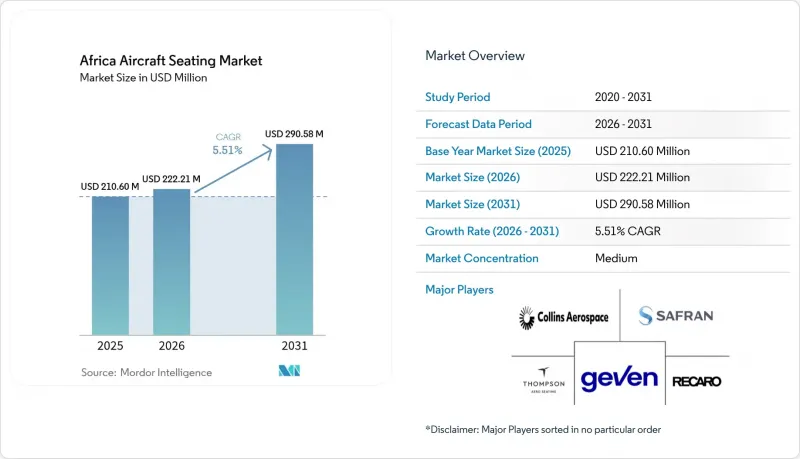
Mordor Intelligence에 의하면, 아프리카의 항공기 좌석 시장 규모는 2025년에 2억 1,060만 달러로 평가되었고 2026년 2억 2,221만 달러에서 2031년까지 2억 9,058만 달러에 달할 것으로 예측되며, 예측 기간(2026년-2031년) CAGR은 5.51%를 나타낼 전망입니다.
본 보고서는 항공기 유형(민간 항공, 일반 항공, 군용 항공), 좌석 등급(일등석, 비즈니스석, 프리미엄 이코노미석, 이코노미석), 설치 형태(라인 핏 및 개조),좌석 소재(쿠션 소재, 구조 소재 등), 국가(남아프리카, 이집트, 에티오피아 등)별로 분류되어 있습니다. 시장 예측은 금액(달러) 기준으로 제시되어 있습니다.
아프리카의 항공기 좌석 시장 동향 및 인사이트
아프리카 항공사들의 단일 통로기 기단 확대 추세
단통로 제트기는 아프리카의 항공기 좌석 시장의 주축을 이루고 있습니다. 에티오피아 항공은 140대의 항공기를 운항하고 있으며, B777-9 기종 11대에 대한 확정 주문 외에도 B737 MAX 협폭기체를 추가로 도입할 수 있는 옵션도 보유하고 있습니다. 로얄 에어 모로코는 B737-800 기종에 레카로(Recaro)사의 SL3510 좌석을 개조하여, 기체 전체 길이를 연장하지 않고도 기체당 이코노미 클래스 좌석 열을 2열 늘렸습니다. 케냐 항공은 연기된 와이드바디 항공기 주문을 대신하여 B737-800 5대를 리스했습니다. 이는 지역 노선에서 현재 운항 빈도가 수송 능력보다 우선시되고 있음을 보여줍니다. 2024년 3분기 평균 탑승률은 74%였기 때문에 각 항공사는 피치 28-29인치의 좌석 배치를 채택하고 있으며, 이를 위해서는 높은 내구성을 갖추면서도 좌석당 3,000달러 전후의 저비용 좌석이 요구되고 있습니다. 12주 리드타임 내에 슬림라인 모델을 공급할 수 있는 좌석 제조업체는 이러한 프로그램에서 경쟁 우위를 점하고 있습니다.
LCC 네트워크 확장이 고밀도 이코노미 클래스 수요를 견인
FlySafair는 28대의 B737을 운항하고 있으며, 2025년 9월에 ‘Acro Series 9’ 좌석을 도입했습니다. 이를 통해 좌석 무게를 15% 줄이고, 항공기당 좌석 수를 186석으로 늘렸습니다. 요하네스버그-케이프타운 노선의 운임은 현재 도시 간 버스 요금보다 낮기 때문에 이용 가능 좌석 킬로미터당 비용을 0.50 랜드(0.03 달러) 미만으로 유지하려면 고밀도 객실 구성이 필수적입니다. 에어 아라비아 아프리카는 카사블랑카-아가디르 노선에서 174석 사양의 A320을 운항하고 있으며, 로얄 에어 모로코보다 30-40% 저렴한 운임을 제공합니다. 이로 인해 기존 항공사들도 비슷한 좌석 수로 맞출 수밖에 없는 상황에 놓여 있습니다. 짐바브웨의 패스트젯이 운항하는 156석 규모의 A319는 좌석 지정, 수하물, 우선 탑승 등을 통해 부가 수익을 창출하여 낮은 수익률을 보완하는 데 기여하고 있습니다. LCC 시장 점유율은 여전히 아프리카 총 좌석 수의 10% 미만에 그치고 있으며, SAATM 규제가 정착됨에 따라 고밀도 이코노미 클래스 객실에는 충분한 성장 여지가 남아 있습니다.
좌석 시스템에 대한 높은 수입 관세와 물류 비용
나이지리아에서는 좌석에 대해 20%의 수입 관세에 더해 7.5%의 부가가치세(VAT)가 부과되고 있어,이로 인해 150석의 개조 비용은 45만 달러에서 약 57만 4,000달러로 증가하여, 손익분기점에 도달하기까지 5년 이상 소요됩니다. 케냐에서는 객실 내장재에 25%의 관세가 부과될 뿐만 아니라, 나이로비에서 톤당 1,200달러의 취급 수수료가 추가되어 요하네스버그에서의 항공 운임보다 2배의 비용이 듭니다. 유럽에서 라고스 또는 몸바사로의 해상 운송에는 평균 45-60일이 소요되며, 21일간의 선박 체류 기간으로 인해 체선료가 발생하여 총 도착 비용에 10-15%가 추가됩니다. 에티오피아 항공은 항공기 관련 수입품에 대해 관세 면제를 받고 있기 때문에 좌석 단가는 유럽의 벤치마크와 비슷한 수준이며, 아디스아바바를 거점으로 하는 MRO 부문은 케냐 및 나이지리아의 경쟁사 대비 15-20%의 가격 우위를 점하고 있습니다. 만성적인 병목 현상으로 인해 각 항공사는 좌석 교체를 위해 항공기를 요하네스버그나 아디스아바바로 페리 운송할 수밖에 없으며, 그 결과 추가적인 가동 중단 시간과 페리 운송 비용이 발생하고 있습니다.
부문별 분석
나이지리아, 이집트, 남아프리카공화국이 수송기 및 특수 임무용 헬리콥터를 늘림에 따라, 군사 조달은 연평균 성장률(CAGR) 7.06%로 확대될 전망이며, 이는 아프리카의 항공기 좌석 시장의 평균 성장률을 상회할 것으로 예측됩니다. 나이지리아 공군은 AW109 6대를 인수했으며, 12명의 병력을 수용할 수 있는 객실을 갖춘 AW139 12대를 발주했습니다. 한편, 이집트는 마틴 베이커(Martin Baker) 사의 이젝션 시트가 장착된 라팔(Rafale) 24대를 배치했습니다. 이젝션 시트는 1기당 15만-25만 달러가 들기 때문에 아프리카의 항공기 좌석 시장은 비록 소규모 전투기 납품이라 할지라도 그에 비례하지 않을 정도의 혜택을 보고 있습니다. 에티오피아 항공의 140대 규모 기단과 로얄 에어 모로코의 B787-9 도입으로 인해, 민간 항공은 여전히 수익의 4분의 3 가까이 차지하고 있습니다. 엠브라에르 E190이나 CRJ900과 같은 지역 제트기는 수요가 적은 노선의 운항을 가능하게 하고 있지만, 좌석의 평균 수명은 2027년까지 15년에 달할 것으로 예상되어, 이로 인해 두 부문 모두에서 개조에 대한 관심이 높아지고 있습니다.
두 번째 성장 요인은 앙골라, 나이지리아, 모잠비크의 해양 석유 개발 및 인도적 지원 임무용 헬리콥터 좌석입니다. 내충격성 병사용 벤치, 진동 흡수 쿠션, 퀵 릴리스식 시트 레일은 민간 이코노미 클래스 좌석보다 가격이 비싸기 때문에 이에 따라 방위 관련 공급업체들의 아프리카의 항공기 좌석 시장 점유율이 확대되고 있습니다. 따라서 군용 및 민간 항공 수송의 성장은 병행된 수요 패턴을 만들어내고 있습니다. 즉, 여객 항공사용 대량 생산되는 협폭기용 좌석과 공군용 고수익 특수 좌석입니다.
아디스아바바, 요하네스버그, 카이로가 장거리 허브로서의 입지를 확고히 하는 가운데, 비즈니스 클래스가 연평균 성장률(CAGR) 7.36%로 성장을 주도하고 있습니다. 에티오피아 항공은 B777-9 기종에 사프란사의 Z400 스위트를 채택했습니다. 이 좌석은 78인치의 피치와 통로로 직접 연결되는 접근성을 특징으로 하며, 걸프 지역 경쟁사들의 기준에 부합합니다. 남아프리카항공은 대서양 횡단 노선에서 프리미엄 클래스 점유율을 되찾기 위해 A350-900에 콜린스사의 슈퍼 다이아몬드를 채택했습니다. 프리미엄 객실은 1제곱미터당 수익이 이코노미 클래스의 최대 5배에 달하기 때문에 자금 면의 제약이 있음에도 불구하고 8-10년 주기의 리모델링 주기가 정당화됩니다. 한편, 2025년에도 이코노미 클래스는 여전히 총 좌석 수의 67.88%를 차지하고 있으며, 플라이사페어와 같은 항공사는 탑승률을 80% 이상 유지하기 위해 28인치 피치 구성을 선호하고 있습니다.
아프리카의 항공기 좌석 시장 규모는 신흥 프리미엄 이코노미 구역의 부상으로 인해 추가적인 성장이 예상됩니다. 에티오피아 항공의 B787-9에는 21석의 프리미엄 이코노미가 장착되어 있으며, 가격은 일반 이코노미보다 40% 높게 책정되어 있습니다. 이는 정규 요금의 비즈니스 클래스를 피하는 가격에 민감한 비즈니스 여행객을 대상으로 하고 있습니다. 퍼스트 클래스는 여전히 2% 미만의 틈새 시장에 머물러 있으며, 극소수의 B777 기종에만 한정되어 있습니다. 이는 향후 기내 구성이 풀플랫 방식의 비즈니스 클래스와 고밀도 이코노미 클래스가 주류를 이루는 3등급 구성으로 편중될 것임을 시사합니다.
기타 혜택:
- 엑셀 형식 시장 예측(ME) 시트
- 3개월간의 애널리스트 지원
자주 묻는 질문
목차
제1장 서론
제2장 조사 방법
제3장 주요 요약
제4장 시장 구도
제5장 시장 규모와 성장 예측
제6장 경쟁 구도
제7장 시장 기회와 향후 전망
LSH 26.08.24According to Mordor Intelligence, the Africa aircraft seating market size was valued at USD 210.60 million in 2025 and estimated to grow from USD 222.21 million in 2026 to reach USD 290.58 million by 2031, at a CAGR of 5.51% during the forecast period (2026-2031).
This report is Segmented by Aviation Type (Commercial Aviation, General Aviation, and Military Aviation), Seat Class (First Class, Business Class, Premium Economy Class, and Economy Class), Fitment (Linefit and Retrofit), Seat Material (Cushion Materials, Structural Materials, and More), and Country (South Africa, Egypt, Ethiopia, and More). The Market Forecasts are Provided in Terms of Value (USD).
Africa Aircraft Seating Market Trends and Insights
Rising Single-Aisle Fleet Expansion Across African Carriers
Single-aisle jets form the backbone of the Africa aircraft seating market as Ethiopian Airlines operates 140 aircraft and holds firm orders for 11 B777-9s plus options for additional B737 MAX narrowbodies. Royal Air Maroc has retrofitted its B737-800s with Recaro SL3510 seats, adding two economy rows per aircraft without extending the fuselage length. Kenya Airways leased five B737-800s to replace deferred widebody orders, proving that frequency now trumps capacity on regional routes. Load factors averaged 74% in Q3 2024, so carriers are adopting 28-29 inch pitch layouts that demand high-durability yet low-cost seats priced near USD 3,000 per unit. Seat OEMs able to supply slimline models within 12-week lead times gain a competitive edge on these programs.
Growth of Low-Cost Carrier Networks Driving High-Density Economy-Class Demand
FlySafair operates 28 B737 aircraft and chose Acro Series 9 seats in September 2025, trimming seat weight by 15% and pushing capacity to 186 seats per jet. Fares on Johannesburg-Cape Town routes now undercut intercity bus tickets, so dense cabins are critical to sustain a cost per available seat kilometer of less than ZAR 0.50 (USD 0.03). Air Arabia Africa operates 174-seat A320s from Casablanca to Agadir, offering fares 30-40% lower than those of Royal Air Maroc, which nudges incumbents toward similar seat counts. Fastjet's 156-seat A319s in Zimbabwe generate ancillary revenue through seat selection, baggage, and priority boarding, helping to offset thin yields. LCC penetration is still below 10% of African capacity, leaving ample runway for dense economy cabins as SAATM rules take hold.
High Import Duties amd Logistics Costs for Seat Systems
Nigeria levies a 20% import duty plus 7.5% VAT on seats, which increases the cost of a 150-seat retrofit from USD 450,000 to approximately USD 574,000, extending the break-even point beyond five years. Kenya's 25% tariff on cabin furnishings, coupled with USD 1,200 per ton handling fees at Nairobi, doubles the air-freight rate seen in Johannesburg. Ocean transit from Europe to Lagos or Mombasa averages 45-60 days, and vessel dwell times of 21 days invite demurrage charges that add 10-15% to total landed cost. Ethiopian Airlines enjoys a customs waiver on aviation imports, so its seat costs align with European benchmarks, giving Addis-based MRO units a 15 to 20% price advantage over rivals in Kenya and Nigeria. Persistent bottlenecks prompt carriers to ferry aircraft to Johannesburg or Addis for seat swaps, incurring extra downtime and ferry costs.
Other drivers and restraints analyzed in the detailed report include:
- Fleet Modernization Favoring Lightweight, Fuel-Efficient Seat Designs
- Increasing Passenger Traffic and Route Liberalization
- Limited Access to Aircraft Financing and FX Volatility
For complete list of drivers and restraints, kindly check the Table Of Contents.
Segment Analysis
Military procurement is slated to expand at a 7.06% CAGR, surpassing the average growth rate of the Africa aircraft seating market as Nigeria, Egypt, and South Africa add transport aircraft and special-mission helicopters. Nigeria's Air Force received six AW109s and ordered 12 AW139s with 12-troop cabins, while Egypt integrated 24 Rafales fitted with Martin-Baker ejection seats. Ejection seats can cost USD 150,000 to USD 250,000 each, so the African aircraft seating market benefits disproportionately from even modest fighter deliveries. Commercial aviation still controls almost three-quarters of revenue due to Ethiopian Airlines' 140-unit fleet and Royal Air Maroc's B787-9 acquisitions. Regional jets, such as Embraer E190s and CRJ900s, keep thin routes viable, but the median seat life is expected to reach 15 years by 2027, spurring retrofit interest across both sectors.
A second growth lever is helicopter seating for offshore oil and humanitarian missions in Angola, Nigeria, and Mozambique. Crashworthy troop benches, vibration-damped cushions, and quick-release seat tracks carry price premiums over civil economy chairs, lifting the Africa aircraft seating market share for defense suppliers. Growth in military and civil air transport, therefore, yields parallel demand profiles: high-volume, narrowbody seats for passenger carriers, and high-margin, specialty seats for air forces.
Business class leads growth at 7.36% CAGR as Addis Ababa, Johannesburg, and Cairo position themselves as long-haul hubs. Ethiopian Airlines selected Safran Z400 suites for its B777-9s, featuring a 78-inch pitch and direct aisle access, aligning with the standards of its Gulf rival. South African Airways selected Collins Super Diamond for its A350-900s to regain its premium share on trans-Atlantic routes. Premium cabins yield up to five times the revenue of economy cabins per square meter, justifying retrofit cycles every 8-10 years despite capital constraints. At the other end, economy class still occupies 67.88% of installed seats in 2025, and carriers like FlySafair favor 28-inch pitch configurations to keep load factors above 80%.
The Africa aircraft seating market size gains additional upside from emerging premium economy sections. Ethiopian's B787-9s feature 21 premium-economy seats, priced 40% above standard economy, targeting price-sensitive business travelers who avoid full-fare business class. First class remains a sub-2% niche limited to a handful of B777 fleets, indicating that the future mix will skew toward three-class layouts dominated by lie-flat business and dense economy cabins.
Complete Report Scope:
- By Aviation Type
- Commercial Aviation
- Widebody
- Narrowbody
- Regional Jets
- General Aviation
- Business Jets
- Commercial Helicopters
- Military Aviation
- Combat
- Transport
- Special Mission
- Helicopters
- Commercial Aviation
- By Seat Class
- First Class
- Business Class
- Premium Economy Class
- Economy Class
- By Fitment
- Linefit
- Retrofit
- By Seat Material
- Cushion Materials
- Structural Materials
- Upholsteries and Seat Covers
- By Country
- South Africa
- Egypt
- Ethiopia
- Nigeria
- Kenya
- Morocco
- Rest of Africa
List of Companies Covered in this Report:
- Safran SA
- Collins Aerospace (RTX Corporation)
- STELIA Aerospace (Airbus SE)
- Recaro Holding GmbH
- Geven SpA
- Thompson Aero Seating Ltd. (Aviation Industry Corporation of China)
- JAMCO Corporation
- Acro Aircraft Seating Ltd.
- Elevate Aircraft Seating LLC
- Expliseat S.A.S.
- PAC Aviation International, Inc.
Additional Benefits:
- The market estimate (ME) sheet in Excel format
- 3 months of analyst support
TABLE OF CONTENTS
1 INTRODUCTION
- 1.1 Study Assumptions and Market Definition
- 1.2 Scope of the Study
2 RESEARCH METHODOLOGY
3 EXECUTIVE SUMMARY
4 MARKET LANDSCAPE
- 4.1 Market Overview
- 4.2 Market Drivers
- 4.2.1 Rising single-aisle fleet expansion across African carriers
- 4.2.2 Growth of low-cost carrier (LCC) networks driving high-density economy-class demand
- 4.2.3 Fleet modernisation favouring lightweight, fuel-efficient seat designs
- 4.2.4 Increasing passenger traffic and route liberalization
- 4.2.5 Under-served intra-African premium-cabin demand at new hub airports
- 4.2.6 Emerging African seat-component manufacturing and MRO clusters
- 4.3 Market Restraints
- 4.3.1 High import duties and logistics costs for seat systems
- 4.3.2 Limited access to aircraft financing and FX volatility
- 4.3.3 Certification bottlenecks across fragmented CAAs
- 4.3.4 Skilled-labour shortage for cabin-retrofit programmes
- 4.4 Value Chain Analysis
- 4.5 Regulatory Landscape
- 4.6 Technological Outlook
- 4.7 Porter's Five Forces Analysis
- 4.7.1 Bargaining Power of Buyers
- 4.7.2 Bargaining Power of Suppliers
- 4.7.3 Threat of New Entrants
- 4.7.4 Threat of Substitutes
- 4.7.5 Intensity of Competitive Rivalry
5 MARKET SIZE AND GROWTH FORECASTS (VALUE)
- 5.1 By Aviation Type
- 5.1.1 Commercial Aviation
- 5.1.1.1 Widebody
- 5.1.1.2 Narrowbody
- 5.1.1.3 Regional Jets
- 5.1.2 General Aviation
- 5.1.2.1 Business Jets
- 5.1.2.2 Commercial Helicopters
- 5.1.3 Military Aviation
- 5.1.3.1 Combat
- 5.1.3.2 Transport
- 5.1.3.3 Special Mission
- 5.1.3.4 Helicopters
- 5.1.1 Commercial Aviation
- 5.2 By Seat Class
- 5.2.1 First Class
- 5.2.2 Business Class
- 5.2.3 Premium Economy Class
- 5.2.4 Economy Class
- 5.3 By Fitment
- 5.3.1 Linefit
- 5.3.2 Retrofit
- 5.4 By Seat Material
- 5.4.1 Cushion Materials
- 5.4.2 Structural Materials
- 5.4.3 Upholsteries and Seat Covers
- 5.5 By Country
- 5.5.1 South Africa
- 5.5.2 Egypt
- 5.5.3 Ethiopia
- 5.5.4 Nigeria
- 5.5.5 Kenya
- 5.5.6 Morocco
- 5.5.7 Rest of Africa
6 COMPETITIVE LANDSCAPE
- 6.1 Market Concentration
- 6.2 Strategic Moves
- 6.3 Market Share Analysis
- 6.4 Company Profiles (includes Global level Overview, Market level overview, Core Segments, Financials as available, Strategic Information, Market Rank/Share for key companies, Products and Services, and Recent Developments)
- 6.4.1 Safran SA
- 6.4.2 Collins Aerospace (RTX Corporation)
- 6.4.3 STELIA Aerospace (Airbus SE)
- 6.4.4 Recaro Holding GmbH
- 6.4.5 Geven SpA
- 6.4.6 Thompson Aero Seating Ltd. (Aviation Industry Corporation of China)
- 6.4.7 JAMCO Corporation
- 6.4.8 Acro Aircraft Seating Ltd.
- 6.4.9 Elevate Aircraft Seating LLC
- 6.4.10 Expliseat S.A.S.
- 6.4.11 PAC Aviation International, Inc.
7 MARKET OPPORTUNITIES AND FUTURE OUTLOOK
- 7.1 White-space and Unmet-Need Assessment