
|
시장보고서
상품코드
2113263
심전도 텔레메트리 기기 : 시장 점유율 분석, 업계 동향과 통계, 성장 예측(2026-2031년)ECG Telemetry Devices - Market Share Analysis, Industry Trends & Statistics, Growth Forecasts (2026 - 2031) |
||||||
 Mordor Intelligence
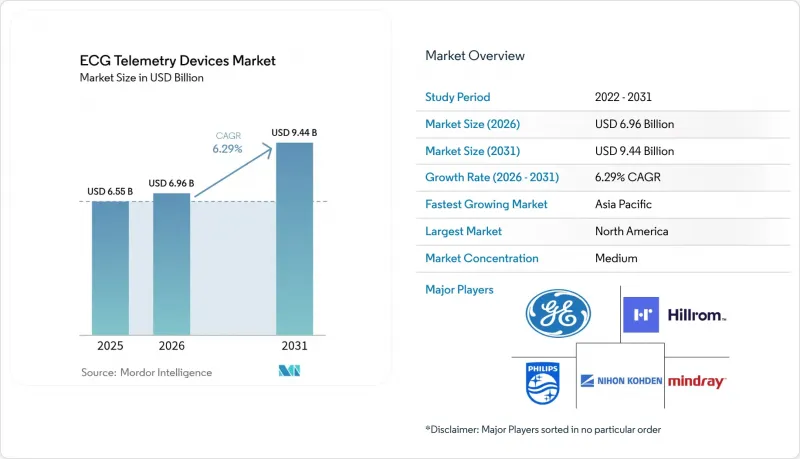
Mordor Intelligence에 따르면 심전도 텔레메트리 기기 시장 규모는 2025년에 65억 5,000만 달러로 평가되며, 2026년 69억 6,000만 달러에서 2031년까지 94억 4,000만 달러에 달할 것으로 예측되고 있으며, 예측 기간(2026-2031년)에 CAGR은 6.29%에 달할 전망입니다.
이 보고서는 제품 유형(홀터 모니터, 모바일 심장 원격 모니터링, 이식형 루프 리코더 등), 리드 유형(싱글 리드, 3-6 리드 등), 최종사용자(병원·클리닉, 진단 센터 등) 및 지역(북미, 유럽 등)별로 분류되어 있습니다. 시장 예측은 금액(달러) 기준으로 제시되어 있습니다.
전 세계 심전도 원격 모니터링 기기 시장의 동향 및 인사이트
심혈관 질환(CVD) 유병률 증가 및 고령화
전 세계에서 심혈관 질환 유병률은 계속 증가하고 있으며, 고령자들은 현재 표준적인 24-48시간 검사로는 충족할 수 없는 더 장기적인 모니터링을 요구하고 있습니다. iRhythm사의 RWD(Real World Data)가 보여주듯이, 연속 텔레메트리는 홀터법보다 우수한 부정맥 검출률을 보이며, 더 많은 부정맥을 감지할 수 있습니다. 의료 시스템은 재입원을 줄이고 조기 개입을 가능하게 함으로써 이 기술을 가치 기반 의료의 목표와 연결하고 있습니다. 메디케어와 많은 민간 보험사가 보험 적용 범위를 확대하고, 2025년에는 지방 진료소도 원격 환자 모니터링(RPM) 청구 자격을 획득함에 따라 수요는 더욱 안정화되고 있습니다.
재택 및 원격 환자 모니터링으로의 전환
2025년에 확장된 CPT 코드(99453-99458)가 시행되어 심전도 원격 모니터링 서비스에 대한 예측 가능한 보상이 제공됨에 따라 원격의료의 도입은 팬데믹으로 인한 급증기를 넘어 성숙 단계에 접어들었습니다. 임상 시험에 따르면 원격 심전도 모니터링은 진료소에서의 후속 조치에 비해 30일 이내 재입원율을 낮추고 신속한 개입으로 이어지는 것으로 나타나, 의사의 지속적이고 실시간적인 상황 파악에 대한 지지가 높아지고 있습니다. IoMT 아키텍처를 통해 암호화된 데이터가 의사결정 지원 대시보드로 직접 전송됨에 따라 관리 부담이 줄어들고, 환자 분류가 신속해졌습니다.
기기 및 데이터 서비스 비용의 고가
조달 예산은 관세로 인한 부품 가격 급등이라는 압박에 직면해 있으며, 제안된 관세는 미국으로 수입되는 심전도 하드웨어의 약 75%에 영향을 미치고 있습니다. 신흥 국가의 보상 체계가 파편화되어 있는 점도 도입을 더욱 제약하고 있으며, 보험사는 장기 모니터링 비용을 거의 보장하지 않습니다. 공급망 병목 현상과 반도체 부족으로 인해 BOM 비용이 상승하여 OEM(Original Equipment Manufacturer)와 서비스 제공업체 모두의 이익률이 압박받고 있습니다. 소규모 병원들은 장비 교체 주기를 연기하거나 재생 제품을 선택하는 경향이 있으며, 가격이 정상화되거나 현지 생산이 확대될 때까지 단기 수익을 저해하는 요인이 되고 있습니다.
부문 분석
홀터 모니터 심전도 원격 측정 기기 시장 규모는 2025년에 22억 4,000만 달러에 달하여 총매출의 34.21%를 차지했습니다. 모바일 텔레메트리는 규모는 작지만, 실시간 알림 및 환자 친화적인 웨어러블 기기에 대한 임상의의 수요를 반영하여 6.65%라는 가장 높은 연평균 성장률(CAGR)을 기록할 것으로 예측됩니다. 병원에서는 보험 적용이 가능한 진단에 여전히 홀터 모니터에 의존하고 있지만, 자동화된 클라우드 분석에 대한 선호도가 높아짐에 따라 모바일 기기의 보급이 가속화되고 있습니다. 이식형 루프 리코더는 틈새 시장인 장기 증례에 대응하는 한편, ECG 관리 플랫폼은 도입된 기기군 전체의 데이터 통합을 촉진합니다. 2024-2025년에 AliveCor, HeartBeam, Icentia가 잇달아 FDA 승인을 획득함에 따라 경쟁이 격화되고 있으며, 혁신 파이프라인이 확대되고 있음이 부각되고 있습니다.
각 제조사는 모든 제품군에 AI를 접목하여 분석 기능을 ‘차별화 요소’에서 ‘기본 요건’으로 전환하고 있습니다. 서비스 지향 비즈니스 모델에서는 하드웨어, 클라우드 대시보드, 임상적 해석을 묶음 상품으로 제공함으로써 지속적인 수입원을 공고히 하고 있습니다. 보스턴 사이언티피크의 Cortex AFib 인수와 PaceMate의 Paceart Optima 인수가 상징하는 업계 재편은 종단간 심장 치료 포트폴리오 구축을 목표로 하고 있습니다. 그 결과, 홀터 모니터 분야의 기존 사업자들은 모바일 원격 모니터링의 성장과 단순한 하드웨어를 넘어선 가치를 재정의하는 플랫폼 중심의 경쟁사라는 이중의 압박에 직면해 있습니다.
지역별 분석
북미는 RPM 서비스에 대한 메디케어 및 민간 보험의 견실한 보상을 바탕으로 2025년 전 세계 매출의 43.67%를 차지했습니다. 2025년에 개정된 CPT 코드에 따라 지방 지역의 접근성이 개선되고, 더 장기적인 모니터링이 촉진됨에 따라 의료 제공자 네트워크 전반에 걸쳐 꾸준한 업그레이드가 유지되고 있습니다. 또한 대학 병원이 AI 검증 연구를 주도하고 있으며, 고급 분석에 대한 임상적 신뢰도를 높이고 있습니다.
아시아태평양은 중국이 심장 치료 인프라와 현지 생산에 막대한 투자를 하고 있으며, 인도가 GE 헬스케어의 공장 생산 능력 확대의 혜택을 받고 있고, 일본이 iRhythm의 플랫폼을 승인함으로써규제 환경의 수용성을 보이고 있는 점 등으로 인해 2031년까지 연평균 성장률(CAGR) 7.05%로 가장 높은 성장세를 보일 전망입니다. 가처분 소득의 증가와 공중보건 캠페인의 강화로 인해 중산층에서의 도입이 더욱 확대될 것입니다.
유럽에서는 MDR(의료기기 규정) 준수를 통해 품질 기준이 통일되고, GDPR(일반 데이터 보호 규정)이 미국의 보안 요건과 조화를 이루면서 여러 지역에서의 시장 출시가 원활해져 꾸준한 성장이 예상됩니다. Cardiomatics와 Biotronik의 제휴 등은 AI 소프트웨어를 둘러싼 협업의 모멘텀을 보여주고 있습니다. 남미 및 중동 및 아프리카는 다른 지역에 비해 뒤처져 있지만, 보험 급여 및 유통과 관련된 장벽이 해소된다면 장기적인 성장 여지가 있으며, 브라질과 GCC 국가들이 조기 도입 프로그램을 주도하고 있습니다.
기타 혜택:
- 엑셀 형식의 시장 예측(ME) 시트
- 3개월간 애널리스트 지원
자주 묻는 질문
목차
제1장 서론
제2장 조사 방법
제3장 개요
제4장 시장 구도
제5장 시장 규모와 성장 예측
제6장 경쟁 구도
제7장 시장 기회와 향후 전망
KSA 26.08.25According to Mordor Intelligence, the ECG telemetry devices market size was valued at USD 6.55 billion in 2025 and estimated to grow from USD 6.96 billion in 2026 to reach USD 9.44 billion by 2031, at a CAGR of 6.29% during the forecast period (2026-2031).
This report is Segmented by Product Type (Holter Monitors, Mobile Cardiac Telemetry, Implantable Loop Recorders, and More), Lead Type (Single-Lead, 3-6 Lead, and More), End User (Hospitals & Clinics, Diagnostic Centres, and More), and Geography (North America, Europe, and More). The Market Forecasts are Provided in Terms of Value (USD).
Global ECG Telemetry Devices Market Trends and Insights
Growing CVD Prevalence & Aging Population
Global cardiovascular disease continues rising, and older adults now seek longer monitoring periods that standard 24-48 hour studies cannot fulfill. Continuous telemetry detects more arrhythmias, as evidenced by iRhythm's real-world data showing superior identification rates over Holter modalities Health systems connect the technology to value-based care goals by reducing readmissions and enabling early intervention. Medicare and many private payers broadened coverage, and Rural Health Clinics gained RPM billing eligibility in 2025, further stabilizing demand.
Shift Toward Home & Remote Patient Monitoring
Telehealth adoption matured beyond the pandemic surge once enhanced CPT codes (99453-99458) took effect in 2025, providing predictable reimbursement for ECG telemetry services. Clinical trials link remote ECG oversight to lower 30-day readmissions and faster intervention compared with in-clinic follow-up, strengthening physicians' preference for continuous, real-time insight. IoMT architectures now route encrypted data directly into decision-support dashboards, lowering administrative overhead and speeding triage.
High Device & Data-Service Costs
Procurement budgets face pressure from tariff-driven component inflation, with proposed duties affecting roughly 75% of ECG hardware imported into the United States. Fragmented reimbursement in emerging economies further constrains adoption, as payers seldom cover long monitoring durations. Supply chain bottlenecks and chip shortages elevate BOM costs, squeezing margins for both OEMs and service providers. Smaller hospitals delay replacement cycles or opt for refurbished units, dampening near-term revenue until pricing normalizes or local production scales.
Other drivers and restraints analyzed in the detailed report include:
- Miniaturization & Wearable-Patch Innovations
- AI-Enabled Arrhythmia Analytics Adoption
- Cybersecurity & Data-Privacy Compliance Burden
For complete list of drivers and restraints, kindly check the Table Of Contents.
Segment Analysis
The ECG telemetry devices market size for Holter monitors stood at USD 2.24 billion in 2025, equating to 34.21% of total revenue. Mobile telemetry, while smaller, is projected to deliver the highest 6.65% CAGR, reflecting clinician demand for real-time alerts and patient-friendly wearables. Hospitals still rely on Holters for reimbursed diagnostics, but shifting preference toward automated cloud analytics accelerates mobile uptake. Implantable loop recorders serve niche long-term cases, whereas ECG management platforms facilitate data harmonization across device fleets. Competitive intensity escalates as AliveCor, HeartBeam, and Icentia secure successive FDA clearances between 2024 and 2025, underscoring the expanding innovation pipeline .
Manufacturers embed AI across every product tier, transitioning analytics from differentiator to baseline expectation. Service-oriented models bundle hardware, cloud dashboards, and clinical interpretation, solidifying recurring revenue streams. Consolidation, evidenced by Boston Scientific's Cortex AFib buyout and PaceMate's acquisition of Paceart Optima, aims to assemble end-to-end cardiac care portfolios. Holter incumbency thus faces dual pressure from mobile telemetry's growth and platform-centric competitors re-defining value beyond raw hardware.
Complete Report Scope:
- By Product Type (Value)
- Holter Monitors
- Mobile Cardiac Telemetry
- Implantable Loop Recorders
- ECG Management Systems
- Other ECG Telemetry Devices
- By Lead Type (Value)
- Single-lead
- 3-6 lead
- 12-lead
- Other Leads
- By End User (Value)
- Hospitals & Clinics
- Diagnostic Centres
- Home Healthcare
- Ambulatory Surgical Centres
- Others
- By Geography (Value)
- North America
- United States
- Canada
- Mexico
- Europe
- Germany
- United Kingdom
- France
- Italy
- Spain
- Rest of Europe
- Asia-Pacific
- China
- India
- Japan
- South Korea
- Australia
- Rest of Asia-Pacific
- South America
- Brazil
- Argentina
- Rest of South America
- Middle East and Africa
- GCC
- South Africa
- Rest of Middle East and Africa
- North America
Geography Analysis
North America contributed 43.67% of 2025 global revenue, anchored by robust Medicare and private-insurance coverage for RPM services. Enhanced 2025 CPT codes improve rural access and incentivize longer monitoring episodes, sustaining steady upgrades across provider networks. Academic medical centers also spearhead AI validation studies, reinforcing clinical confidence in advanced analytics.
Asia-Pacific records the highest 7.05% CAGR through 2031 as China invests heavily in cardiac care infrastructure and local manufacturing; India benefits from GE Healthcare's expanded plant capacity; and Japan approves iRhythm's platform, showcasing receptive regulatory climates. Rising disposable income and heightened public health campaigns further widen adoption among middle-income groups.
Europe grows consistently as MDR compliance harmonizes quality standards and GDPR aligns with U.S. security mandates, enabling smoother multi-region launches. Partnerships such as Cardiomatics-Biotronik illustrate collaborative momentum around AI software. South America and the Middle East & Africa trail yet present long-term upside once reimbursement and distribution hurdles subside, with Brazil and GCC countries leading early procurement programs.
- AliveCor
- Baxter International Inc. (Welch Allyn)
- Biotricity Inc.
- Boston Scientific Corp. (Preventice)
- BPL
- Cardiac Insight Inc.
- CompuMed
- Fukuda Denshi Co. Ltd.
- GE HealthCare Technologies Inc.
- iRhythm Technologies
- Koninklijke Philips
- Medtronic
- Mindray Bio-Medical Electronics Co. Ltd.
- Nihon Kohden Corp.
- OSI Systems Inc. (Spacelabs Healthcare)
- Schiller
- ScottCare Corporation
- VitalConnect Inc.
- ZOLL Medical Corp.
Additional Benefits:
- The market estimate (ME) sheet in Excel format
- 3 months of analyst support
TABLE OF CONTENTS
1 Introduction
- 1.1 Study Assumptions & Market Definition
- 1.2 Scope of the Study
2 Research Methodology
3 Executive Summary
4 Market Landscape
- 4.1 Market Overview
- 4.2 Market Drivers
- 4.2.1 Growing CVD prevalence & aging population
- 4.2.2 Shift toward home & remote patient monitoring
- 4.2.3 Miniaturisation & wearable-patch innovations
- 4.2.4 Reimbursement expansions for RPM services
- 4.2.5 AI-enabled arrhythmia analytics adoption (under-reported)
- 4.2.6 Near-shoring of electronics supply chains post-tariff hikes (under-reported)
- 4.3 Market Restraints
- 4.3.1 High device & data-service costs
- 4.3.2 Fragmented global reimbursement in emerging markets
- 4.3.3 Cyber-security & data-privacy compliance burden (under-reported)
- 4.3.4 Chip-supply volatility affecting production lead-times (under-reported)
- 4.4 Value / Supply-Chain Analysis
- 4.5 Regulatory Landscape
- 4.6 Technological Outlook
- 4.7 Porter's Five Forces
- 4.7.1 Threat of New Entrants
- 4.7.2 Bargaining Power of Suppliers
- 4.7.3 Bargaining Power of Buyers
- 4.7.4 Threat of Substitutes
- 4.7.5 Competitive Rivalry
5 Market Size & Growth Forecasts
- 5.1 By Product Type (Value)
- 5.1.1 Holter Monitors
- 5.1.2 Mobile Cardiac Telemetry
- 5.1.3 Implantable Loop Recorders
- 5.1.4 ECG Management Systems
- 5.1.5 Other ECG Telemetry Devices
- 5.2 By Lead Type (Value)
- 5.2.1 Single-lead
- 5.2.2 3-6 lead
- 5.2.3 12-lead
- 5.2.4 Other Leads
- 5.3 By End User (Value)
- 5.3.1 Hospitals & Clinics
- 5.3.2 Diagnostic Centres
- 5.3.3 Home Healthcare
- 5.3.4 Ambulatory Surgical Centres
- 5.3.5 Others
- 5.4 By Geography (Value)
- 5.4.1 North America
- 5.4.1.1 United States
- 5.4.1.2 Canada
- 5.4.1.3 Mexico
- 5.4.2 Europe
- 5.4.2.1 Germany
- 5.4.2.2 United Kingdom
- 5.4.2.3 France
- 5.4.2.4 Italy
- 5.4.2.5 Spain
- 5.4.2.6 Rest of Europe
- 5.4.3 Asia-Pacific
- 5.4.3.1 China
- 5.4.3.2 India
- 5.4.3.3 Japan
- 5.4.3.4 South Korea
- 5.4.3.5 Australia
- 5.4.3.6 Rest of Asia-Pacific
- 5.4.4 South America
- 5.4.4.1 Brazil
- 5.4.4.2 Argentina
- 5.4.4.3 Rest of South America
- 5.4.5 Middle East and Africa
- 5.4.5.1 GCC
- 5.4.5.2 South Africa
- 5.4.5.3 Rest of Middle East and Africa
- 5.4.1 North America
6 Competitive Landscape
- 6.1 Market Concentration
- 6.2 Market Share Analysis
- 6.3 Company Profiles (includes Global level Overview, Market level overview, Core Segments, Financials as available, Strategic Information, Market Rank/Share for key companies, Products & Services, and Recent Developments)
- 6.3.1 AliveCor Inc.
- 6.3.2 Baxter International Inc. (Welch Allyn)
- 6.3.3 Biotricity Inc.
- 6.3.4 Boston Scientific Corp. (Preventice)
- 6.3.5 BPL Medical Technologies
- 6.3.6 Cardiac Insight Inc.
- 6.3.7 CompuMed Inc.
- 6.3.8 Fukuda Denshi Co. Ltd.
- 6.3.9 GE HealthCare Technologies Inc.
- 6.3.10 iRhythm Technologies Inc.
- 6.3.11 Koninklijke Philips N.V.
- 6.3.12 Medtronic plc
- 6.3.13 Mindray Bio-Medical Electronics Co. Ltd.
- 6.3.14 Nihon Kohden Corp.
- 6.3.15 OSI Systems Inc. (Spacelabs Healthcare)
- 6.3.16 Schiller AG
- 6.3.17 ScottCare Corporation
- 6.3.18 VitalConnect Inc.
- 6.3.19 ZOLL Medical Corp.
7 Market Opportunities & Future Outlook
- 7.1 White-space & Unmet-need Assessment