

|
시장보고서
상품코드
2113294
영구자석 모터 : 시장 점유율 분석, 업계 동향과 통계, 성장 예측(2026-2031년)Permanent Magnet Motor - Market Share Analysis, Industry Trends & Statistics, Growth Forecasts (2026 - 2031) |
||||||
 Mordor Intelligence
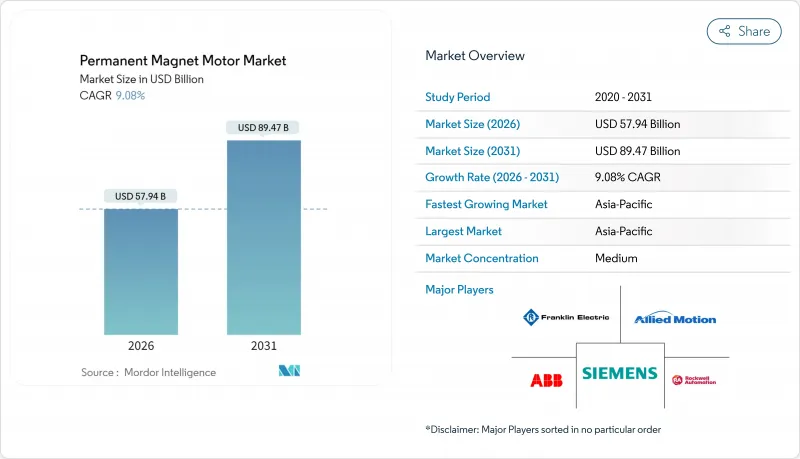
Mordor Intelligence에 따르면 영구자석 모터 시장은 2026년에 579억 4,000만 달러에 달하며, 2031년까지 894억 7,000만 달러에 달할 것으로 예측되고 있으며, 이 기간의 CAGR은 9.08%에 달합니다.
이 보고서는 모터 유형(영구자석식 교류 모터, 영구자석식 직류 모터, 기타), 자성 재료 유형(네오디뮴·철·붕소, 사마륨·코발트, 기타), 정격 출력(4kW 이하, 4-22kW, 기타), 냉각 방식(공랭식, 수랭식, 기타), 최종사용자 산업(자동차, 기타), 지역별로 분류되어 있습니다. 시장 예측은 금액(달러) 기준으로 제시되어 있습니다.
전 세계 영구자석 모터 시장의 동향 및 인사이트
영구 자석을 통한 모터 효율 향상
영구자석 동기 모터는 4-22kW급에서 94-97%의 정격 부하 효율을 실현하고 있으며, 동등한 유도 모터 설계보다 최대 5%포인트 높은 수치를 기록하고 있습니다. 이러한 차이로 인해 산업 부문에서의 투자 회수 기간은 18개월 이하로 단축됩니다. 가변 속도 운전에서는 권선 전류가 자석의 자화 작용으로 대체됨에 따라 로터의 구리 손실이 사라지므로, 비용 절감 효과가 더욱 높아집니다. 이는 낮은 부분 부하 손실을 중시하는 ISO 50001 프로그램에도 부합합니다. 유럽연합(EU)의 에코디자인 지침은 2024년에 최저 효율 기준의 적용 범위를 확대하여, 설치 공간이 제한된 냉동 및 환기 설비의 개조를 촉진했습니다. 200kW를 초과하는 범위에서는 비용 대비 효과의 차이가 줄어들지만, 재생식 크레인 등 틈새 용도의 경우 빈번한 사이클이 수명 주기 비용의 대부분을 차지하므로 자기 구동 방식의 채택은 여전히 타당합니다.
전기자동차에 대한 수요 증가
2025년 전 세계 배터리식 전기자동차 생산 대수는 1,400만 대에 달할 것으로 예상되며, 그 중 78%는 뛰어난 토크 밀도와 회생 효율을 위해 영구자석 구동 모터를 채택했습니다. 현재 중국의 자동차 제조업체들은 헤어핀형 고정자와 부문형 자석 회전을 조합하여 와전류 손실을 대폭 줄이고, 액체 냉각 없이도 150kW를 초과하는 연속 정격 출력을 실현하고 있습니다. 테슬라의 ‘릴랙턴스 보조’ 설계로 네오디뮴 사용량이 20% 감소함에 따라 경쟁사들도 디스프로슘을 포함하지 않는 소재 개발을 가속화하고 있습니다. 상용차 차량군이 수요를 더욱 확대하고 있습니다. Daimler Truck과 Volvo Group은 2027년까지 연간 5만 대 이상의 전기 대형 차량을 생산할 계획이며, 이로 인해 연간 1,200톤 이상의 NdFeB 자석이 소비될 전망입니다.
PM 발전기를 활용한 재생 가능 에너지 발전 확대
2025년 가동을 시작할 예정인 해상 풍력발전 프로젝트에서는 정격 출력 12-15MW의 다이렉트 드라이브형 영구자석 발전기가 채택되어, 기어박스가 필요 없어짐에 따라 터빈 가동률이 97% 이상으로 높아집니다. Vestas와 GE Vernova는 2028년까지 연간 최대 4,000톤의 NdFeB를 공급하는 다년 계약을 체결했습니다. 돌출극 발전기를 영구자석 동기 발전기로 교체하는 수력 발전소 개조를 통해 부분 부하시 효율이 4-6% 포인트 향상되어, 100MW 규모의 발전소에서는 연간 최대 20GWh의 발전량 증가가 예상됩니다. 발전 제한 완화에 따른 탄소 크레딧 수익화는 OECD 국가들의 전력 시장에서 프로젝트의 경제성을 더욱 향상시킵니다.
부문별 분석
2025년에는 영구자석식 교류 기계가 매출의 48.03%를 차지했습니다. 이는 3상 전력망과 성숙한 인버터 생태계 덕분에 도입이 용이한 공장 자동화 및 HVAC(냉난방·환기) 설비 분야에서 해당 제품이 확고한 입지를 차지하고 있음을 반영한 것입니다. 영구 자석 모터 시장에서는 전기자동차 및 협동 로봇의 48V 서브시스템과 자연스럽게 결합되는 브러시리스 DC 모터가 두 자릿수 성장률로 확대되고 있습니다. Continental과 같은 제조업체들은 반도체의 스위칭 손실을 최대 12%까지 줄여주는 사다리꼴 역기전력 프로파일을 입증했으며, 이러한 성능 향상으로 인해 컨트롤러의 비용 회수 주기가 단축됩니다. 소형 전자기기 부문에서는 기존 영구자석 DC 설계가 여전히 남아 있지만, 리튬이온 배터리 팩의 전압이 표준화됨에 따라 그 점유율은 축소되고 있습니다. 이는 더 긴 수명을 실현하는 센서리스 브러시리스 토폴로지가 유리하게 작용하기 때문입니다. 헤르메틱 모터는 냉동 부문의 급속한 성장과 히트펌프 개조 수요가 교차하는 지점에 위치해 있으며, 밀폐형 고정자를 통해 반복되는 열 사이클 중 냉매 누출 경로가 제거된다는 점에서 주목받고 있습니다.
브러시리스 아키텍처는 유지보수의 경제성 측면에서도 혁신을 가져오고 있습니다. 브러시가 없어 불꽃이나 분진이 발생하지 않으므로, 청정도가 최우선으로 요구되는 식품용 컨베이어나 의료용 인공호흡기에서 오버홀 주기를 연장할 수 있습니다. 자동차 전자 기기가 이미 자기장 지향 제어(FOC)를 지원하고 있으므로 차량 보조 시스템용 브러시리스 플랫폼 영구자석 모터 시장의 규모는 앞으로도 성장세를 유지할 것으로 예상됩니다. 한편, 부드러운 사인파 토크가 요구되고 전자기 호환성(EMC) 규격 준수를 용이하게 하기 위해 다소 큰 프레임을 허용할 수 있는 계통 연계 장비에서는 영구자석식 교류 모터가 여전히 선호되고 있습니다. 그 결과, 완전한 대체라기보다는 병행된 성장 경로가 나타나고 있으며, 설계 엔지니어들은 자석의 비용뿐만 아니라 듀티 사이클 및 인버터의 정교함에 따라 폼팩터를 선택하고 있습니다.
네오디뮴·철·붕소(NdFeB)는 35MGOe를 초과하는 에너지 밀도로 인해 설계자가 로터 직경을 축소하더라도 목표 토크를 달성할 수 있으므로 2025년 시점에 52.40%의 시장 점유율을 유지했습니다. 그러나 현재 영구 자석 모터 시장에서는 나노 복합 소재 NdFeB가 연평균 성장률(CAGR) 10.04%라는 급속한 성장을 보이고 있습니다. 이 나노 복합재료는 입계에 테르븀이나 디스프로슘을 침전시켜 잔류 자력을 최대 30% 향상시키는 동시에, 중희토류 함유량을 거의 절반으로 줄이는 특성을 가지고 있습니다. 이러한 합금은 2024-2025년에 60%를 넘어선 디스프로슘 가격 급등으로부터 OEM을 보호하며, 고속 스핀들에서 180°C를 초과하는 환경에서도 자성이 감소하지 않고 작동할 수 있게 합니다. 항공우주 및 방위 부문의 사용자들은 재료 비용이 NdFeB의 약 3배임에도 불구하고 200°C를 넘는 온도에서의 열 안정성을 이유로 여전히 사마륨-코발트를 지정하고 있습니다. 페라이트는 에너지 밀도가 낮지만, 전기 요금이 0.08달러/kWh 이하인 지역에서 경쟁하는 가전제품 및 관개용 펌프 제조업체들로부터 지지를 받고 있으며, 이로 인해 ROI 기준치가 고가형 자석의 경제성을 능가하는 수준까지 확대되고 있습니다.
나노 복합재료의 확산 라인에는 보다 엄격한 공정 관리와 1,000만 달러 이상의 설비 투자가 필요하지만, 선행 기업은 지적 재산권을 통한 진입 장벽을 구축하여 후발 기업의 진입을 저지하고 있습니다. 페라이트 영구자석 모터의 시장 점유율은 자석의 질량을 40-60% 줄일 수 있는 하이브리드형 릴랙턴스 보조 토폴로지의 보급으로 인해 급락하지 않고 안정될 전망입니다. 궁극적으로 성능과 비용 곡선에 따라 자석의 구성이 양극화되어, 기술적으로 높은 수준이 요구되는 자동차 및 산업용 부문에서는 나노 복합 소재가 채택되는 반면, 양산을 중시하는 가전 제조업체는 페라이트를 최적화하여 활용하게 될 것입니다.
지역별 분석
아시아태평양은 2025년 매출의 43.50%를 차지하며, 중국의 수직 통합형 공급망으로 인해 리드타임이 8주 이하로 단축됨에 따라 9.58%의 연평균 성장률(CAGR)을 유지하고 있습니다. 일본은 중국의 경쟁 영향에서 벗어나 있는 항공우주 부문 계약에서 사마륨-코발트 자석의 기술력을 활용하고 있습니다. 한편, 한국은 현대자동차와 LG의 프로젝트를 위해 헤어핀 권선 및 부문형 로터의 생산 능력 확대에 1조 8,000억 원(13억 5,000만 달러)을 투자하고 있습니다. 인도에서는 생산 연계형 인센티브에 힘입어, 페라이트 자석 대체를 통해 비용 목표를 달성한 1-5kW 브러시리스 허브 모터의 이륜차 및 오토릭샤 탑재를 가속화하고 있습니다.
북미와 유럽은 공급망의 지역화에 막대한 투자를 하고 있습니다. 미국 국방부는 2030년까지 수입 의존도를 50% 이하로 줄이는 것을 목표로, 국내 분리·자석 제조 시설에 2억 8,500만 달러를 지원했습니다. 유럽연합(EU)의 ‘중요 원자재법’은 2028년까지 희토류의 15%를 현지에서 조달할 것을 의무화하고 있으며, 스웨덴의 노라 카 광산에서 독일의 재활용 공장에 이르기까지 다양한 프로젝트를 지원하고 있습니다. ‘인플레이션 억제법’의 우대 조치에 따라 자동차 제조사들은 조달 비용이 12-18% 더 비싸지더라도 미국산 자석 사용을 추진하고 있습니다. 이는 차량이 7,500달러의 소비자 세금 공제 대상이 되기 때문입니다. 2030년까지 60GW의 해상 풍력발전을 실현하겠다는 목표에는 막대한 양의 영구자석 발전기가 필요하며, 장기 공급 계약을 통해 이미 가격과 공급량이 확보되어 있습니다.
중동 및 아프리카와 남미에서는 선택적인 도입이 진행되고 있습니다. 걸프 지역의 해수 담수화 플랜트에서는 고압 펌프를 영구자석 구동 장치로 개조하여 에너지 사용량을 최대 25% 절감하고 있습니다. 칠레와 페루의 구리 광산에서는 컨베이어 및 환기 시스템의 개조 시험이 진행되고 있으며, 1개 거점당 연간 1.2GWh 이상의 전력 절감을 실현하고 있습니다. 사하라 이남 시장에서는 여전히 가격에 대한 민감성이 나타나고 있지만, 인버터 비용을 절감할 수 있는 태양광발전식 브러시리스 DC 관개 펌프가 도입되어 전력망 공급이 불안정한 지역에서도 작물 수확량이 증가하고 있습니다.
기타 혜택
- 엑셀 형식의 시장 예측(ME) 시트
- 3개월간의 애널리스트 지원
자주 묻는 질문
목차
제1장 서론
제2장 조사 방법
제3장 개요
제4장 시장 구도
제5장 시장 규모와 성장 예측
제6장 경쟁 구도
제7장 시장 기회와 향후 전망
KSA 26.08.25According to Mordor Intelligence, the permanent magnet motor market stood at USD 57.94 billion in 2026 and is forecast to reach USD 89.47 billion by 2031, translating to a 9.08% CAGR over the period.
This report is Segmented by Motor Type (Permanent Magnet AC Motor, Permanent Magnet DC Motor, and More), Magnetic Material Type (Neodymium Iron Boron, Samarium Cobalt, and More), Power Rating (Up To 4 KW, 4-22 KW, and More), Cooling Method (Air-Cooled, Liquid-Cooled, and More), End-User Industry (Automotive, and More), and Geography. The Market Forecasts are Provided in Terms of Value (USD).
Global Permanent Magnet Motor Market Trends and Insights
Increased Motor Efficiency Due to Permanent Magnets
Permanent-magnet synchronous motors deliver 94-97% full-load efficiency in the 4-22 kW class, outpacing comparable induction designs by up to 5 percentage points, a delta that trims industrial payback periods below 18 months. Variable-speed duty cycles amplify the savings because rotor copper losses disappear when magnet excitation replaces winding current, a fit with ISO 50001 programs that prize low part-load losses. The European Union's Ecodesign Directive widened the scope of minimum efficiency rules in 2024, triggering retrofits in space-constrained refrigeration and ventilation equipment. Above 200 kW the cost-benefit narrows, yet niches such as regenerative cranes still justify magnet adoption where frequent cycling dominates lifecycle cost.
Rising Demand for Electric Vehicles
Global battery-electric output reached 14 million vehicles in 2025, and 78% used permanent-magnet traction motors for superior torque density and regeneration efficiency. Chinese automakers now combine hairpin stators with segmented-magnet rotors to slash eddy losses, enabling continuous ratings above 150 kW without liquid cooling. Tesla's reluctance-assisted design trimmed neodymium content by 20%, prompting rivals to accelerate dysprosium-free chemistries. Commercial fleets amplify demand: Daimler Truck and Volvo Group plan more than 50,000 electric heavy vehicles each year by 2027, absorbing over 1,200 metric tons of NdFeB magnets annually.
Expansion of Renewable Energy Generation Using PM Generators
Offshore wind projects commissioned in 2025 favour direct-drive permanent-magnet generators rated 12-15 MW, eliminating gearboxes and pushing turbine availability above 97%. Vestas and GE Vernova locked in multi-year supply deals covering up to 4,000 metric tons of NdFeB per year through 2028. Hydropower upgrades that replace salient-pole alternators with permanent-magnet synchronous units add 4-6 percentage points of part-load efficiency, boosting generation by up to 20 GWh annually at 100 MW stations. Carbon-credit monetization of reduced curtailment further sweetens project economics in OECD power markets.
Other drivers and restraints analyzed in the detailed report include:
- Stringent Energy-Efficiency Regulations
- Diminishing Availability of Rare-Earth Metals
- High Initial Cost of PM Motors
For complete list of drivers and restraints, kindly check the Table Of Contents.
Segment Analysis
Permanent magnet AC machines generated 48.03% of revenue in 2025, reflecting their entrenched role in factory automation and HVAC installations where three-phase grids and mature inverter ecosystems simplify deployment. The permanent magnet motor market is witnessing double-digit expansion of brushless DC alternatives that pair naturally with 48-volt subsystems in electric vehicles and collaborative robots. Manufacturers like Continental have demonstrated trapezoidal back-EMF profiles that reduce semiconductor switching losses by up to 12%, a performance gain that shortens controller cost recovery cycles. Legacy permanent magnet DC designs linger in small electronics, yet their share contracts as lithium-ion packs standardize around voltages that reward sensorless brushless topologies with longer lifespans. Hermetic motors sit at the intersection of the refrigeration boom and heat-pump retrofits, drawing interest because sealed stators eliminate refrigerant leakage paths during repeated thermal cycling.
Brushless architectures also reshape maintenance economics. Absence of brushes removes sparking and dust, extending overhaul intervals in food-grade conveyors and medical ventilators where cleanliness is paramount. The permanent magnet motor market size for brushless platforms in auxiliary vehicle systems is expected to maintain momentum because onboard electronics already support field-oriented control. Conversely, permanent magnet AC remains favoured in grid-tied equipment that demands smooth sinusoidal torque and accepts slightly larger frames to simplify compliance with electromagnetic compatibility norms. The net effect is parallel growth corridors rather than outright substitution, with design engineers selecting form factors according to duty cycle and inverter sophistication rather than magnet cost alone.
Neodymium-iron-boron retained 52.40% share in 2025, thanks to energy products above 35 MGOe that let designers trim rotor diameters and still hit torque targets. Yet the permanent magnet motor market now tracks a rapid 10.04% CAGR for nanocomposite NdFeB, a chemistry that deposits terbium or dysprosium at grain boundaries, raising coercivity by up to 30% while cutting heavy rare-earth loadings nearly in half. These alloys shield OEMs from dysprosium price spikes that exceeded 60% in 2024-2025, and they allow operation beyond 180 °C in high-speed spindles without demagnetization. Aerospace and defense users still specify samarium-cobalt for thermal stability above 200 °C despite material costs roughly triple those of NdFeB. Ferrite, though lower in energy density, draws appliance and irrigation-pump producers that compete in regions where electricity tariffs sit under USD 0.08 /kWh, extending ROI thresholds beyond premium magnet economics.
Nanocomposite diffusion lines require tighter process controls and capital outlays upward of USD 10 million, but early movers lock in intellectual property barriers that deter fast-follower entry. The permanent magnet motor market share for ferrite will likely stabilize rather than collapse, helped by hybrid reluctance-assisted topologies that allow magnet mass reductions of 40-60%. Ultimately magnet mix bifurcates along performance and cost curves, matching technologically demanding automotive and industrial segments with nanocomposites, while volume-driven appliance makers optimize around ferrite.
Complete Report Scope:
- By Motor Type
- Permanent Magnet AC Motor
- Permanent Magnet DC Motor
- Brushless DC Motor
- Hermetic Motor
- By Magnetic Material Type
- Neodymium Iron Boron
- Samarium Cobalt
- Ferrite
- Nanocomposite NdFeB
- By Power Rating
- Up to 4 kW
- 4-22 kW
- 22-75 kW
- 75 kW and Above
- By Cooling Method
- Air-Cooled
- Liquid-Cooled
- Oil-Cooled
- Hybrid Cooling
- By End-User Industry
- Automotive
- Industrial Automation
- Energy (Wind and Hydro)
- Water and Wastewater Management
- Mining, Oil and Gas
- Aerospace and Defense
- Consumer Electronics
- Healthcare Equipment
- By Geography
- North America
- United States
- Canada
- Mexico
- Europe
- United Kingdom
- Germany
- France
- Italy
- Rest of Europe
- Asia-Pacific
- China
- Japan
- India
- South Korea
- Rest of Asia
- Middle East
- Israel
- Saudi Arabia
- United Arab Emirates
- Turkey
- Rest of Middle East
- Africa
- South Africa
- Egypt
- Rest of Africa
- South America
- Brazil
- Argentina
- Rest of South America
- North America
Geography Analysis
Asia-Pacific generated 43.50% of 2025 revenue and continues at a 9.58% CAGR as China's vertically integrated chain shrinks lead times to under eight weeks. Japan leverages samarium-cobalt prowess for aerospace contracts insulated from Chinese competition, while South Korea channels KRW 1.8 trillion (USD 1.35 billion) into hairpin winding and segmented rotor capacity for Hyundai and LG projects. India, buoyed by production-linked incentives, speeds adoption of 1-5 kW brushless hub motors in two-wheelers and auto-rickshaws that meet cost targets by substituting ferrite magnets.
North America and Europe invest heavily in supply-chain regionalization. The U.S. Department of Defense awarded USD 285 million for domestic separation and magnet facilities aiming to cut import reliance below 50% by 2030. The European Union's Critical Raw Materials Act requires 15% local rare-earth sourcing by 2028, spurring projects from Sweden's Norra Karr mine to German recycling plants. Inflation Reduction Act incentives push automakers toward U.S. magnet content despite a 12-18% procurement premium, since vehicles qualify for USD 7,500 consumer tax credits. Offshore wind ambitions of 60 GW by 2030 require vast permanent-magnet generator volumes, and long-term supply agreements already lock in price and availability.
Middle East and Africa plus South America show selective adoption. Gulf desalination plants retrofit high-pressure pumps with permanent magnet drives that cut energy use by up to 25%. Chilean and Peruvian copper mines trial conveyor and ventilation conversions that save over 1.2 GWh per site per year. Sub-Saharan markets remain price-sensitive but install solar-powered brushless DC irrigation pumps that avoid inverter costs, expanding crop yields where grid service is unreliable.
- ABB Ltd.
- Siemens AG
- Nidec Corporation
- Rockwell Automation, Inc.
- Toshiba Corporation
- WEG S.A.
- Wolong Electric Group
- Mitsubishi Electric Corporation
- Hitachi, Ltd.
- Regal Rexnord Corporation
- TECO Electric and Machinery
- Johnson Electric Holdings Ltd
- Allied Motion Technologies Inc
- Ametek, Inc.
- Franklin Electric Co., Inc.
- Continental AG
Additional Benefits:
- The market estimate (ME) sheet in Excel format
- 3 months of analyst support
TABLE OF CONTENTS
1 INTRODUCTION
- 1.1 Study Assumptions and Market Definition
- 1.2 Scope of the Study
2 RESEARCH METHODOLOGY
3 EXECUTIVE SUMMARY
4 MARKET LANDSCAPE
- 4.1 Market Overview
- 4.2 Market Drivers
- 4.2.1 Increased Motor Efficiency Due to Permanent Magnets
- 4.2.2 Rising Demand for Electric Vehicles
- 4.2.3 Stringent Energy-Efficiency Regulations
- 4.2.4 Expansion of Renewable Energy Generation Using PM Generators
- 4.2.5 Advances in Additive Manufacturing of Custom PM Rotors
- 4.2.6 Regionalization of Rare-Earth Magnet Supply Chains
- 4.3 Market Restraints
- 4.3.1 Diminishing Availability of Rare-Earth Metals
- 4.3.2 High Initial Cost of PM Motors
- 4.3.3 Demagnetization Risk at Elevated Operating Temperatures
- 4.3.4 Geopolitical Supply-Chain Concentration Risk
- 4.4 Industry Value Chain Analysis
- 4.5 Impact of Macroeconomic Factors on the Market
- 4.6 Regulatory Landscape
- 4.7 Technological Outlook
- 4.8 Porter's Five Forces Analysis
- 4.8.1 Threat of New Entrants
- 4.8.2 Bargaining Power of Buyers
- 4.8.3 Bargaining Power of Suppliers
- 4.8.4 Threat of Substitute Products
- 4.8.5 Intensity of Competitive Rivalry
5 MARKET SIZE AND GROWTH FORECASTS (VALUE)
- 5.1 By Motor Type
- 5.1.1 Permanent Magnet AC Motor
- 5.1.2 Permanent Magnet DC Motor
- 5.1.3 Brushless DC Motor
- 5.1.4 Hermetic Motor
- 5.2 By Magnetic Material Type
- 5.2.1 Neodymium Iron Boron
- 5.2.2 Samarium Cobalt
- 5.2.3 Ferrite
- 5.2.4 Nanocomposite NdFeB
- 5.3 By Power Rating
- 5.3.1 Up to 4 kW
- 5.3.2 4-22 kW
- 5.3.3 22-75 kW
- 5.3.4 75 kW and Above
- 5.4 By Cooling Method
- 5.4.1 Air-Cooled
- 5.4.2 Liquid-Cooled
- 5.4.3 Oil-Cooled
- 5.4.4 Hybrid Cooling
- 5.5 By End-User Industry
- 5.5.1 Automotive
- 5.5.2 Industrial Automation
- 5.5.3 Energy (Wind and Hydro)
- 5.5.4 Water and Wastewater Management
- 5.5.5 Mining, Oil and Gas
- 5.5.6 Aerospace and Defense
- 5.5.7 Consumer Electronics
- 5.5.8 Healthcare Equipment
- 5.6 By Geography
- 5.6.1 North America
- 5.6.1.1 United States
- 5.6.1.2 Canada
- 5.6.1.3 Mexico
- 5.6.2 Europe
- 5.6.2.1 United Kingdom
- 5.6.2.2 Germany
- 5.6.2.3 France
- 5.6.2.4 Italy
- 5.6.2.5 Rest of Europe
- 5.6.3 Asia-Pacific
- 5.6.3.1 China
- 5.6.3.2 Japan
- 5.6.3.3 India
- 5.6.3.4 South Korea
- 5.6.3.5 Rest of Asia
- 5.6.4 Middle East
- 5.6.4.1 Israel
- 5.6.4.2 Saudi Arabia
- 5.6.4.3 United Arab Emirates
- 5.6.4.4 Turkey
- 5.6.4.5 Rest of Middle East
- 5.6.5 Africa
- 5.6.5.1 South Africa
- 5.6.5.2 Egypt
- 5.6.5.3 Rest of Africa
- 5.6.6 South America
- 5.6.6.1 Brazil
- 5.6.6.2 Argentina
- 5.6.6.3 Rest of South America
- 5.6.1 North America
6 COMPETITIVE LANDSCAPE
- 6.1 Market Concentration
- 6.2 Strategic Moves
- 6.3 Market Share Analysis
- 6.4 Company Profiles (includes Global Level Overview, Market Level Overview, Core Segments, Financials as Available, Strategic Information, Market Rank/Share for Key Companies, Products and Services, and Recent Developments)
- 6.4.1 ABB Ltd.
- 6.4.2 Siemens AG
- 6.4.3 Nidec Corporation
- 6.4.4 Rockwell Automation, Inc.
- 6.4.5 Toshiba Corporation
- 6.4.6 WEG S.A.
- 6.4.7 Wolong Electric Group
- 6.4.8 Mitsubishi Electric Corporation
- 6.4.9 Hitachi, Ltd.
- 6.4.10 Regal Rexnord Corporation
- 6.4.11 TECO Electric and Machinery
- 6.4.12 Johnson Electric Holdings Ltd
- 6.4.13 Allied Motion Technologies Inc
- 6.4.14 Ametek, Inc.
- 6.4.15 Franklin Electric Co., Inc.
- 6.4.16 Continental AG
7 MARKET OPPORTUNITIES AND FUTURE OUTLOOK
- 7.1 White-Space and Unmet-Need Assessment


