

|
시장보고서
상품코드
2113330
민간 항공기 기내 조명 : 시장 점유율 분석, 업계 동향과 통계, 성장 예측(2026-2031년)Commercial Aircraft Interior Lighting - Market Share Analysis, Industry Trends & Statistics, Growth Forecasts (2026 - 2031) |
||||||
 Mordor Intelligence
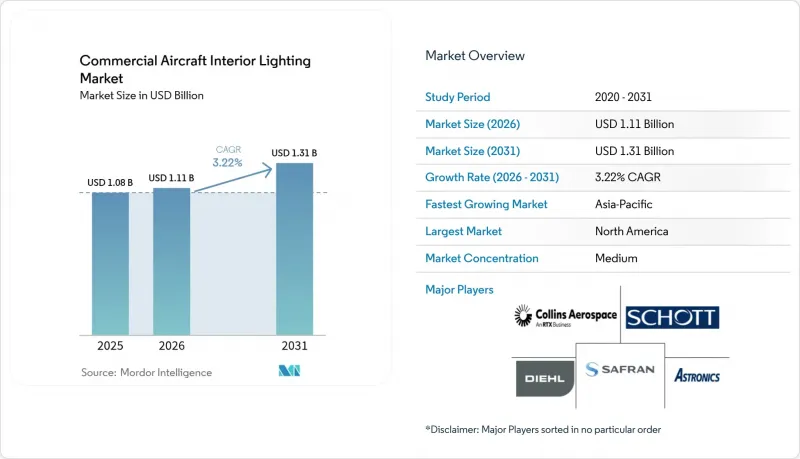
Mordor Intelligence에 따르면 민간 항공기 기내 조명 시장 규모는 2025년에 10억 8,000만 달러로 평가되며, 2026년 11억 1,000만 달러에서 2031년까지 13억 1,000만 달러에 달할 것으로 예측되며, 예측 기간(2026-2031년) 동안 CAGR은 3.22%가 될 전망입니다.
본 보고서는 항공기 유형(나로우바디기, 와이드바디기, 리저널 제트), 조명 유형(독서등, 천장·벽면 조명, 표시등 등), 객실 등급(일등석, 비즈니스석 등), 최종사용자(OEM 라인 피트 등), 및 지역(북미, 유럽, 아시아태평양 등)별로 분류되어 있습니다. 시장 예측은 금액(달러) 기준으로 제시되어 있습니다.
세계 민간 항공기 기내 조명 시장의 동향 및 인사이트
LCC에 의한 협폭체 기단의 급속한 확대
아시아태평양의 LCC 각사는 운항 효율과 탑승객 밀도 최적화를 우선시한 대규모 기단 확대 프로그램을 통해, 협폭기 기내 조명 시스템에 대한 전례 없는 수요를 주도하고 있습니다. IndiGo는 388대의 항공기를 운항하고 있으며, A320neo 260대, A321neo 390대, A350-900 30대를 발주했습니다. 이는 항공 업계에서 단일 운항사 기준 최대 규모의 수주 잔고 중 하나이며, 이 회사는 현재 단일 객실에서 2등급 구성으로의 전환을 추진 중이며, 이를 위해서는 정교한 구역별 조명 제어가 요구됩니다. 이러한 확장 추세는 인도 국내에 그치지 않고, 프라이어딜(flyadeal)도 현재 보유 중인 A320 기종 40대를 2030년까지 100대로 늘리는 것을 목표로 하고 있습니다. 이 회사의 기체는 186-240석의 고밀도 레이아웃으로 구성되어 있어, 경량이며 에너지 효율이 뛰어난 LED 시스템이 요구되고 있습니다. LCC(저비용 항공사) 모델이 중시하는 신속한 터너라운드 일정에 따라, 항공기의 가동 중단 시간을 최소화하는 ‘플러그 앤 플레이’ 방식의 개조 솔루션에 대한 수요가 발생하고 있습니다. 객실 조명의 전면적인 업그레이드라도 설치 시간은 최단 12시간입니다. 각 항공사는 유지보수의 복잡성을 줄이면서, 단일 통로 기내에서 프리미엄 이코노미 서비스를 제공할 수 있도록 지원하는 시스템을 우선시하고 있습니다. 이는 차별화된 조명 구역이 필요한 인디고의 ‘스트레치’ 제품이 보여주듯이 말입니다. 일부 LCC가 A321 기종에서 240석 배치를 실현하는 등 초고밀도 배치 추세가 강화되는 가운데, 개인 공간이 좁아져도 승객의 쾌적성을 유지할 수 있는 첨단 조명 제어 시스템이 필수적입니다.
객실 개편을 위한 LED 무드 조명 개조 붐
각 항공사는 객실 전면 개조를 대체할 비용 대비 효과가 높은 대안으로 LED 무드 조명으로의 개조를 적극적으로 도입하고 있습니다. 이를 통해 와이드바디 항공기 1대당 200만-400만 달러에 달할 수 있는 내장재 전면 교체와 같은 막대한 자본 지출 없이도 승객 경험을 즉각적으로 개선할 수 있습니다. 델타항공의 전 기종 대상 개조 프로그램에서는 다양한 기체 유형에 걸쳐 따뜻한 분위기의 탑승 조명, 촛불 같은 식사 분위기, 일주기 리듬에 맞춘 수면 전환 등 각 단계에 맞는 조명 방안을 도입하여 일관된 브랜드 경험을 창출하고 있습니다. STG Aerospace사의 ‘liTeMood’ 시스템은 이러한 추세를 상징하는 것으로, 플러그 앤 플레이 방식의 LED 교체 부품을 제공하며, 기존 형광등에 비해 항공기 1대당 30kg의 경량화를 실현함과 동시에 전력 소비를 40% 절감합니다. 이러한 개조 방식을 통해 항공사는 노후화된 기체를 비용 효율적인 방법으로 현대화할 수 있습니다. ‘Cobalt Spectrum’ 설치에는 배선 변경이 필요 없으며, 평균 고장 간격(MTBF)은 50만 시간을 자랑합니다. 항공기 개조를 전문으로 하는 기업에 따르면, 각 항공사가 기체 교체 프로그램 대신 객실 조명 업그레이드를 통해 환경적 이점과 승객 유치력을 높이고자함에 따라 수요가 급증하고 있다고 합니다. 이러한 동향은 항공사들이 기존 자산의 활용도를 극대화하면서 신형 항공기 도입에 필적하는 현대적인 승객 경험을 제공하려는 전략적 초점을 반영하고 있으며, 공급망 제약으로 인해 항공기 퇴역 일정이 연장되고 있는 상황에서 특히 중요한 의미를 지닙니다.
와이드바디 항공기 생산 잔고 및 인도 지연 지속
와이드바디 항공기의 생산 제약은 신조기 인도를 지연시키고, 항공사가 계획된 퇴역 일정을 초과하여 기존 항공기를 계속 운용하도록 강요함으로써 민간 항공기 실내 조명 시장에 큰 영향을 미치고 있으며, 시장 세분화별로 수요에 미치는 영향이 제각각입니다. B777X 프로그램은 모든 시험기에 영향을 미치는 스러스트 링크의 설계 문제로 인해 종합적인 재설계와 재시험 프로토콜이 필요하게 되어, 첫 번째 기체의 인도가 첫 비행 후 약 5년 뒤인 2026년으로 연기되는 등 지연이 계속되고 있습니다. B737 MAX 사태 이후 규제 당국의 철저한 검토와 EASA의 중복성 요건으로 인해 복잡해진 이 프로그램의 인증 일정이 장기화되면서, 에미레이트 항공,카타르항공, 루프트한자항공을 포함한 주요 항공사들의 주문 기체 500대 이상에 영향을 미치고 있으며, 조명 시스템 설치 지연으로 인한 손실은 수십억 규모에 달합니다. 생산 안정화와 관련된 과제는 보잉사에만 국한되지 않고, 에어버스사도 공급망 제약을 인정하며 A320 패밀리의 목표 생산 대수인월 50대를 달성하지 못하고 있습니다. 동시에, 조명 부품이나 와이어링 하니스 등 소형 객실 부품의 부족도 분명히 납품 지연의 한 원인이 되고 있습니다. 이에 대해 각 항공사는 대규모 정비를 실시하여 기존 기체의 운용 기간을 연장하거나, 서비스 수준을 유지하기 위한 개조 프로그램을 추진하는 방식으로 대응하고 있으며, 이로 인해 애프터마켓 수요가 증가하여 신조 기체에 대한 설치 지연으로 인한 영향을 부분적으로 상쇄하고 있습니다. 이러한 제약은 특히 프리미엄 객실 조명 분야에 큰 영향을 미치고 있는데, 이는 와이드바디 항공기가 나로우바디 항공기에 비해 단가가 높고, 더욱 고도화된 조명 시스템 사양이 요구되기 때문입니다.
부문 분석
2025년, 협폭기(narrow-body)는 50.92%의 시장 점유율을 차지하고 있으며, 이는 세계 항공 네트워크에서 협폭기가 수행하는 중심적인 역할과 포인트-투-포인트(point-to-point) 연결 모델로의 지속적인 전환을 반영한 것입니다. 이 부문의 우위는 다양한 시장 상황에서 항공사가 협폭기(narrow-body aircraft)가 제공하는 운항 유연성과 노선 최적화 능력을 중시하고 있기 때문입니다. 위즈 에어(Wizz Air)의 첫 A321XLR 인도 사례는 이러한 추세를 여실히 보여주고 있으며, 해당 기종에는 에어버스 에어스페이스(Airbus Airspace)의 객실 조명이 탑재되어 4,700해리에 달하는 장거리 노선에서 탑승, 식사,휴식, 수면 등 각 단계에 맞춰 설정할 수 있는 기능을 갖추고 있습니다.
시장 점유율 49.08%를 차지하는 와이드바디 항공기는 장거리 시장의 회복과 항공사들의 프리미엄 승객 경험에 대한 집중에 힘입어, 2031년까지 연평균 성장률(CAGR) 3.62%라는 가장 빠른 성장세를 보이고 있습니다. B777X 프로그램은 인도 시기가 2026년으로 연기된 기종으로, 시차 적응을 완화하기 위해 목적지와 동일한 시간대를 재현하도록 설계된 첨단 LED 조명 시스템을 채택하고 있습니다. 콴타스 항공의 ‘프로젝트 선라이즈’에서 A350에 도입된 사례에서는 에어버스 고객 정의 센터(Customer Definition Center)에서의 철저한 테스트를 통해 개발된 12가지 맞춤형 조명 시나리오가 채택되어, 와이드바디 항공기에서 첨단 생체리듬 조명을 구현할 수 있는 능력을 입증하고 있습니다. 와이드바디 항공기 부문은 비행 시간이 길다는 장점이 있어, 이를 통해 첨단 조명에 대한 투자가 정당화될 뿐만 아니라, 장시간 여행 중 편안함을 높여주는 기능에 대해 승객들이 추가 요금을 지불할 의향도 높아지고 있습니다.
2025년에는 천장등 및 벽등이 시장 점유율의 43.35%를 차지하며 주도적인 위치를 차지하고 있습니다. 이는 사용자 정의 가능한 색상 구성 및 조도 제어를 통해 기내 분위기를 조성하고, 항공사의 브랜딩 전략을 뒷받침하는 데 있어 이러한 조명이 수행하는 기본적인 역할을 반영한 것입니다. 이 부문에는 탑승부터 하차에 이르는 모든 비행 단계에서 승객의 경험을 결정짓는 주요 무드 조명 시스템이 포함됩니다. 독서등은 단일 조명 기구에 간접 조명과 작업용 조명의 기능을 통합하는 기술 혁신에 힘입어, 2031년까지 연평균 성장률(CAGR) 3.98%로 가장 빠르게 성장하는 부문으로 부상하고 있습니다.
샷(Shot)사의 ‘Jade Reading Light’는 이러한 융합 추세를 상징하는 제품으로, 터치 조작과 가동 부품이 없는 설계를 결합하여 기존의 ‘플렉스 앤 스테이(Flex and Stay)’ 설계에 비해 유지보수 비용을 최대 90% 절감하고 있습니다. 안내 표시용 조명은 규제 요건 및 안전 기준 준수 의무의 혜택을 받고 있는 반면, 화장실용 조명에는 재실 감지 및 자동 점등 시퀀스 등의 스마트 기능이 점점 더 많이 탑재되고 있습니다. 바닥 및 경로 조명 스트립은 전원이 필요하지 않고 비상 시 유도 기능도 제공하는 포토루미네센스 기술 덕분에 성장 잠재력이 큰 특수 부문입니다. 루프트한자 테크닉(Lufthansa Technik)의 ‘GuideU’ 시스템은 이러한 접근 방식을 입증하고 있으며, 기존 모델에 비해 60% 경량화를 실현함과 동시에 주변 빛을 통한 충전을 통해 유지보수가 필요 없는 운영을 유지하고 있습니다.
지역별 분석
북미는 2025년에 38.55%의 점유율을 유지하며 시장을 계속 선도하고 있습니다. 이는 광범위한 개조 프로그램과 모든 민간 항공기에 LED 도입을 촉진하는 규제 체계에 힘입은 결과입니다. 이 지역은 확립된 공급망, 인증에 관한 전문 지식, 그리고 첨단 조명 시스템을 통해 승객 경험의 차별화에 투자하려는 항공사들의 의지에서 혜택을 받고 있습니다. 델타항공의 종합적인 기체 갱신 프로그램은 북미 시장의 특성을 여실히 보여주며, 다양한 기종에 세련된 무드 조명을 도입함으로써 일관된 브랜드 경험을 창출하고 있습니다.
아시아태평양은 전례 없는 LCC(저비용 항공사)의 확장과 최신 조명 설비 도입을 뒷받침하는 신조 항공기 인도 일정에 힘입어, 2031년까지 연평균 성장률(CAGR) 4.69%라는 가장 빠른 성장세를 보이고 있습니다. 인디고 항공이 단일 객실 운항에서 비즈니스 클래스 ‘스트레치’ 상품을 갖춘 2등급 구성으로 전환한 것은, 세련된 조명 기능이 필요한 프리미엄 서비스 제공을 향한 해당 지역의 시장 진화를 여실히 보여줍니다. 이 지역의 성장 궤적은 더 광범위한 경제 발전 추세, 승객 수 증가, 그리고 현대적인 기체 구성을 통한 운항 효율성에 대한 항공사들의 집중을 반영하고 있습니다. 타타 그룹 산하에서 민영화된 에어 인디아의 변혁은 2023년에 이 회사가 발주한 470대의 신규 항공기를 배경으로, 신규 항공기 인도 및 개조 프로그램을 통한 객실 상품 개선에 중점을 두고 있습니다. 이러한 시장은 주요 공항을 통해 승객 수를 집중시키는 허브 앤 스포크형 네트워크 전략의 혜택을 받고 있으며, 세련된 조명 설비에 대한 투자를 정당화할 수 있는 프리미엄 기내 경험에 대한 수요를 창출하고 있습니다.
중동 및 기타 신흥 시장에서는 지역 항공사들의 적극적인 기종 현대화 및 운항 능력 확대 프로그램을 통해 강력한 성장 가능성이 보입니다. 에티하드 항공과 같은 중동 항공사들은 B777 개조 및 2030년까지 기체 수를 92대에서 170대로 확대하는 것을 목표로 한 70억 달러 규모의 투자 계획 등 적극적인 기체 현대화 프로그램을 추진하고 있습니다. 유럽 시장에서는 전통 항공사들의 기종 갱신 프로그램과 저비용 항공사(LCC)의 확장으로 꾸준한 성장이 나타나고 있으며, 에너지 효율이 높은 조명 도입을 의무화하는 규제 체계를 통해 환경 규정 준수가 뒷받침되고 있습니다. 지역 항공사들이 장거리 노선 및 프리미엄 서비스의 차별화에 주력하고 있는 만큼, 장시간 비행 시 승객의 쾌적성을 높이는 첨단 생체리듬 조명 시스템 및 분위기 제어 기술의 도입이 진행되고 있습니다.
기타 혜택:
- 엑셀 형식의 시장 예측(ME) 시트
- 3개월간의 애널리스트 지원
자주 묻는 질문
목차
제1장 소개
제2장 조사 방법
제3장 주요 요약 및 주요 조사 결과
제4장 주요 업계 동향
제5장 시장 구도
제6장 시장 규모와 성장 예측
제7장 경쟁 구도
제8장 시장 기회와 향후 전망
제9장 민간 항공기 기내 조명 분야 CEO를 향한 중요한 전략적 과제
KSM 26.08.25According to Mordor Intelligence, the commercial aircraft interior lighting market size was valued at USD 1.08 billion in 2025 and estimated to grow from USD 1.11 billion in 2026 to reach USD 1.31 billion by 2031, at a CAGR of 3.22% during the forecast period (2026-2031).
This report is Segmented by Aircraft Type (Narrowbody Aircraft, Widebody Aircraft, and Regional Jets), Light Type (Reading Lights, Ceiling and Wall Lights, Signage Lights, and More), Cabin Class (First Class, Business Class, and More), End User (OEM Linefit, and More), and Geography (North America, Europe, Asia-Pacific, and More). The Market Forecasts are Provided in Terms of Value (USD).
Global Commercial Aircraft Interior Lighting Market Trends and Insights
Accelerated narrowbody fleet expansion among LCCs
LCCs across Asia-Pacific are driving unprecedented demand for narrowbody aircraft interior lighting systems through massive fleet expansion programs that prioritize operational efficiency and passenger density optimization. IndiGo operates 388 aircraft with orders for 260 A320neos, 390 A321neos, and 30 A350-900s, representing one of aviation's largest single-operator backlogs while transitioning from single-cabin to dual-class configurations requiring sophisticated zone-based lighting control. This expansion pattern extends beyond India, with flyadeal targeting 100 aircraft by 2030 from its current 40 A320s, configured at 186-240 seats in high-density layouts that demand lightweight, energy-efficient LED systems. The LCC model's emphasis on rapid turnaround schedules creates demand for plug-and-play retrofit solutions that minimize aircraft downtime, with installation times as short as 12 hours for complete cabin lighting upgrades. Airlines prioritize systems that reduce maintenance complexity while supporting premium economy offerings within single-aisle aircraft, as demonstrated by IndiGo's "Stretch" product requiring differentiated lighting zones. The trend toward ultra-high-density configurations, with some LCCs achieving 240 seats in A321 aircraft, necessitates advanced lighting control systems that maintain passenger comfort despite reduced personal space allocations.
Retrofit wave toward LED mood-lighting for cabin refresh
Airlines embrace LED mood lighting retrofits as cost-effective alternatives to comprehensive cabin overhauls, delivering immediate passenger experience improvements without the capital intensity of full interior replacements that can cost USD 2-4 million per widebody aircraft. Delta's fleet-wide retrofit program incorporates phase-specific lighting schemes, including warm boarding illumination, candlelit dining ambiance, and circadian-aligned sleep transitions across diverse aircraft types to create consistent brand experiences. STG Aerospace's liTeMood system exemplifies this trend, offering plug-and-play LED replacements that achieve 30 kg weight savings per aircraft while reducing power consumption by 40% compared to fluorescent predecessors. The retrofit approach enables airlines to modernize aging fleets cost-effectively, with Cobalt Spectrum installations requiring no wiring modifications and delivering 500,000-hour mean time between failures. Aircraft refurbishment specialists report booming demand as airlines seek environmental benefits and passenger appeal through cabin lighting upgrades rather than fleet replacement programs. The trend reflects airlines' strategic focus on maximizing existing asset utilization while delivering contemporary passenger experiences that compete with newer aircraft deliveries, particularly important as aircraft retirement schedules extend due to supply chain constraints.
Persistent widebody production backlog and delivery delays
Widebody aircraft production constraints significantly impact the commercial aircraft interior lighting market by delaying new aircraft deliveries and forcing airlines to extend existing fleet operations beyond planned retirement schedules, creating mixed demand effects across market segments. B777X program faces continued delays with first deliveries now pushed to 2026, nearly five years after first flight, due to thrust-link design issues affecting all test aircraft and requiring comprehensive redesign and re-testing protocols. The program's extended certification timeline, complicated by post-B737 MAX regulatory scrutiny and EASA redundancy requirements, affects over 500 aircraft on order from major carriers, including Emirates, Qatar Airways, and Lufthansa, representing billions in delayed lighting system installations. Production stabilization challenges extend beyond Boeing, with Airbus acknowledging supply chain constraints that prevent achieving targeted A320-family production rates of 50 aircraft monthly. At the same time, small cabin parts shortages, including lighting components and wiring harnesses, explicitly contribute to delivery delays. Airlines respond by extending existing aircraft operations through heavy maintenance visits and pursuing retrofit programs to maintain service standards, creating increased aftermarket demand that partially offsets delayed new aircraft installations. The constraint particularly affects premium cabin lighting segments where widebody aircraft command higher per-unit values and more sophisticated lighting system specifications than narrowbody alternatives.
Other drivers and restraints analyzed in the detailed report include:
- Shift from fluorescent to energy-efficient, RoHS-compliant LEDs
- IoT-enabled smart lights enabling predictive maintenance
- Lengthy STC certification cycles for novel lighting systems
For complete list of drivers and restraints, kindly check the Table Of Contents.
Segment Analysis
Narrowbody aircraft command 50.92% market share in 2025, reflecting their central role in global aviation networks and the ongoing shift toward point-to-point connectivity models. The segment's dominance stems from airlines' preference for operational flexibility and route optimization capabilities that narrowbody platforms provide across diverse market conditions. Wizz Air's first A321XLR delivery exemplifies this trend, featuring Airbus Airspace cabin lighting with programmable settings for boarding, dining, relaxing, and sleeping phases across extended 4,700-nautical-mile routes.
While representing 49.08% of the market share, widebody aircraft demonstrate the fastest growth at 3.62% CAGR through 2031, driven by long-haul market recovery and airlines' focus on premium passenger experiences. The B777X program, despite delivery delays to 2026, incorporates sophisticated LED lighting systems designed to mimic destination time zones for jet lag mitigation. Qantas' Project Sunrise A350 installations feature 12 tailored lighting scenes developed through extensive testing at Airbus' Customer Definition Centre, demonstrating widebody platforms' capacity for advanced circadian lighting implementations. The widebody segment benefits from longer flight durations that justify sophisticated lighting investments and passengers' willingness to pay premiums for enhanced comfort features during extended travel periods.
Ceiling and wall lights dominate with 43.35% market share in 2025, reflecting their fundamental role in establishing cabin ambiance and supporting airlines' branding strategies through customizable color schemes and intensity control. This segment encompasses the primary mood lighting systems that define passenger experience across all flight phases, from boarding through disembarkation. Reading lights emerge as the fastest-growing segment at 3.98% CAGR through 2031, driven by technological innovations integrating ambient and task lighting functions within single fixtures.
Schott's Jade Reading Light exemplifies this convergence trend, combining touch operation with no moving parts to reduce maintenance costs by up to 90% compared to traditional flex-and-stay designs. Signage lights benefit from regulatory requirements and safety compliance mandates, while lavatory lights increasingly incorporate smart features like occupancy detection and automated activation sequences. Floor-path lighting strips represent a specialized segment with growth potential through photoluminescent technologies that eliminate electrical requirements while providing emergency guidance capabilities. Lufthansa Technik's GuideU system demonstrates this approach, achieving 60% weight savings versus predecessors while maintaining maintenance-free operation through ambient light charging.
Complete Report Scope:
- By Aircraft Type
- Narrowbody Aircraft
- Widebody Aircraft
- Regional jets
- By Light Type
- Reading Lights
- Ceiling and Wall Lights
- Signage Lights
- Lavatory Lights
- Floor-path Lighting Strips
- By Cabin Class
- First Class
- Business Class
- Premium Economy Class
- Economy Class
- By End User
- OEM Linefit
- Aftermarket/Retrofit
- By Geography
- North America
- United States
- Canada
- Mexico
- Europe
- United Kingdom
- France
- Germany
- Spain
- Italy
- Russia
- Rest of Europe
- Asia-Pacific
- China
- India
- Japan
- South Korea
- Indonesia
- Australia
- Rest of Asia-Pacific
- South America
- Brazil
- Rest of South America
- Middle East and Africa
- Middle East
- Saudi Arabia
- United Arab Emirates
- Qatar
- Rest of Middle East
- Africa
- South Africa
- Nigeria
- Rest of Africa
- Middle East
- North America
Geography Analysis
North America maintains market leadership with a 38.55% share in 2025, supported by extensive retrofit programs and regulatory frameworks encouraging LED adoption across commercial fleets. The region benefits from established supply chains, certification expertise, and airlines' willingness to invest in passenger experience differentiation through advanced lighting systems. Delta's comprehensive fleet refresh program exemplifies North American market characteristics, incorporating sophisticated mood lighting across diverse aircraft types to create consistent brand experiences.
Asia-Pacific demonstrates the fastest growth at 4.69% CAGR through 2031, driven by unprecedented LCC expansion and new aircraft delivery schedules that favor modern lighting installations. IndiGo's transformation from single-cabin operations to dual-class configurations with business-class "Stretch" products illustrates regional market evolution toward premium service offerings that demand sophisticated lighting capabilities. The region's growth trajectory reflects broader economic development patterns, increasing passenger traffic, and airlines' focus on operational efficiency through modern fleet configurations. Air India's post-privatization transformation under Tata ownership emphasizes cabin product improvements through new aircraft deliveries and retrofit programs, supported by the carrier's 470-aircraft order in 2023. These markets benefit from hub-and-spoke network strategies that concentrate passenger traffic through major airports, creating demand for premium cabin experiences that justify sophisticated lighting investments.
Middle East and other emerging markets demonstrate strong growth potential through aggressive fleet modernization and capacity expansion programs pursued by regional carriers. Middle East carriers like Etihad pursue aggressive fleet modernization programs, with USD 7 billion investment plans targeting B777 retrofits and capacity expansion from 92 to 170 aircraft by 2030. European markets demonstrate steady growth through established carriers' fleet renewal programs and LCC expansion, with regulatory frameworks supporting environmental compliance through energy-efficient lighting mandates. Regional carriers' focus on long-haul operations and premium service differentiation drives the adoption of advanced circadian lighting systems and mood control technologies that enhance passenger comfort during extended flights.
- Collins Aerospace (RTX Corporation)
- Safran SA
- Diehl Stiftung & Co. KG
- Astronics Corporation
- SCHOTT AG
- Honeywell International Inc.
- Luminator Technology Group
- Bruce Aerospace Inc.
- Cobalt Aerospace Group Limited
- S.E.L.A. Lighting Systems
- Soderberg Manufacturing Company, Inc.
- Prizm Aircraft Lighting
- Madelec Aero SAS
- Beadlight Limited
- Aveo Engineering Group, s.r.o.
- Heads Up Technologies, Inc.
Additional Benefits:
- The market estimate (ME) sheet in Excel format
- 3 months of analyst support
TABLE OF CONTENTS
1 INTRODUCTION
- 1.1 Study Assumptions and Market Definition
- 1.2 Scope of the Study
2 RESEARCH METHODOLOGY
3 EXECUTIVE SUMMARY AND KEY FINDINGS
4 KEY INDUSTRY TRENDS
- 4.1 Air Passenger Traffic
- 4.1.1 North America
- 4.1.2 Europe
- 4.1.3 Asia-Pacific
- 4.1.4 South America
- 4.1.5 Middle East
- 4.1.6 Africa
- 4.2 New Aircraft Deliveries
- 4.2.1 North America
- 4.2.2 Europe
- 4.2.3 Asia-Pacific
- 4.2.4 South America
- 4.2.5 Middle East
- 4.2.6 Africa
- 4.3 GDP per Capita (Value in USD)
- 4.3.1 North America
- 4.3.2 Europe
- 4.3.3 Asia-Pacific
- 4.3.4 Middle East
- 4.4 Revenue of Aircraft Manufacturers
- 4.5 Aircraft Backlog
- 4.6 Gross Orders
- 4.7 Expenditure of Airlines on Fuel
5 MARKET LANDSCAPE
- 5.1 Market Overview
- 5.2 Market Drivers
- 5.2.1 Accelerated narrowbody fleet expansion among LCCs
- 5.2.2 Retrofit wave toward LED mood-lighting for cabin refresh
- 5.2.3 Shift from fluorescent to energy-efficient, RoHS-compliant LEDs
- 5.2.4 IoT-enabled smart lights enabling predictive maintenance
- 5.2.5 Airline ESG targets favoring ultra-light photoluminescent floor paths
- 5.2.6 Government stimulus for airport infrastructure upgrades post-COVID
- 5.3 Market Restraints
- 5.3.1 Persistent widebody production backlog and delivery delays
- 5.3.2 Lengthy STC certification cycles for novel lighting systems
- 5.3.3 Supply-chain tightness for high-CRI LED chips and driver ICs
- 5.3.4 Capital reallocation toward IFEC/connectivity over lighting
- 5.4 Value Chain Analysis
- 5.5 Regulatory Landscape
- 5.6 Technological Outlook
- 5.7 Porter's Five Forces Analysis
- 5.7.1 Threat of New Entrants
- 5.7.2 Bargaining Power of Buyers
- 5.7.3 Bargaining Power of Suppliers
- 5.7.4 Threat of Substitutes
- 5.7.5 Intensity of Competitive Rivalry
6 MARKET SIZE AND GROWTH FORECASTS (VALUE)
- 6.1 By Aircraft Type
- 6.1.1 Narrowbody Aircraft
- 6.1.2 Widebody Aircraft
- 6.1.3 Regional jets
- 6.2 By Light Type
- 6.2.1 Reading Lights
- 6.2.2 Ceiling and Wall Lights
- 6.2.3 Signage Lights
- 6.2.4 Lavatory Lights
- 6.2.5 Floor-path Lighting Strips
- 6.3 By Cabin Class
- 6.3.1 First Class
- 6.3.2 Business Class
- 6.3.3 Premium Economy Class
- 6.3.4 Economy Class
- 6.4 By End User
- 6.4.1 OEM Linefit
- 6.4.2 Aftermarket/Retrofit
- 6.5 By Geography
- 6.5.1 North America
- 6.5.1.1 United States
- 6.5.1.2 Canada
- 6.5.1.3 Mexico
- 6.5.2 Europe
- 6.5.2.1 United Kingdom
- 6.5.2.2 France
- 6.5.2.3 Germany
- 6.5.2.4 Spain
- 6.5.2.5 Italy
- 6.5.2.6 Russia
- 6.5.2.7 Rest of Europe
- 6.5.3 Asia-Pacific
- 6.5.3.1 China
- 6.5.3.2 India
- 6.5.3.3 Japan
- 6.5.3.4 South Korea
- 6.5.3.5 Indonesia
- 6.5.3.6 Australia
- 6.5.3.7 Rest of Asia-Pacific
- 6.5.4 South America
- 6.5.4.1 Brazil
- 6.5.4.2 Rest of South America
- 6.5.5 Middle East and Africa
- 6.5.5.1 Middle East
- 6.5.5.1.1 Saudi Arabia
- 6.5.5.1.2 United Arab Emirates
- 6.5.5.1.3 Qatar
- 6.5.5.1.4 Rest of Middle East
- 6.5.5.2 Africa
- 6.5.5.2.1 South Africa
- 6.5.5.2.2 Nigeria
- 6.5.5.2.3 Rest of Africa
- 6.5.5.1 Middle East
- 6.5.1 North America
7 COMPETITIVE LANDSCAPE
- 7.1 Market Concentration
- 7.2 Key Strategic Moves
- 7.3 Market Share Analysis
- 7.4 Company Profiles (includes Global level Overview, Market level overview, Core Segments, Financials, Strategic Information, Market Rank/Share, Products and Services, Recent Developments)
- 7.4.1 Collins Aerospace (RTX Corporation)
- 7.4.2 Safran SA
- 7.4.3 Diehl Stiftung & Co. KG
- 7.4.4 Astronics Corporation
- 7.4.5 SCHOTT AG
- 7.4.6 Honeywell International Inc.
- 7.4.7 Luminator Technology Group
- 7.4.8 Bruce Aerospace Inc.
- 7.4.9 Cobalt Aerospace Group Limited
- 7.4.10 S.E.L.A. Lighting Systems
- 7.4.11 Soderberg Manufacturing Company, Inc.
- 7.4.12 Prizm Aircraft Lighting
- 7.4.13 Madelec Aero SAS
- 7.4.14 Beadlight Limited
- 7.4.15 Aveo Engineering Group, s.r.o.
- 7.4.16 Heads Up Technologies, Inc.
8 MARKET OPPORTUNITIES AND FUTURE OUTLOOK
- 8.1 White-space and Unmet-need Assessment


