

|
시장보고서
상품코드
2113403
고순도 테레프탈산 : 시장 점유율 분석, 업계 동향과 통계, 성장 예측(2026-2031년)Purified Terephthalic Acid - Market Share Analysis, Industry Trends & Statistics, Growth Forecasts (2026 - 2031) |
||||||
 Mordor Intelligence
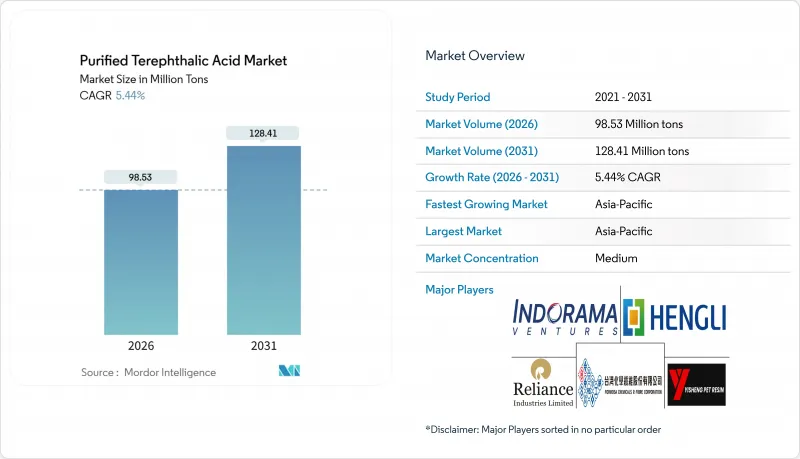
Mordor Intelligence에 따르면 고순도 테레프탈산 시장 규모는 2026년에 9,853만 톤으로 추정되며, 예측 기간(2026-2031년) 동안 CAGR 5.44%를 기록하며 2031년에는 1억 2,841만 톤에 달할 것으로 전망됩니다.
본 보고서는 유도체(폴리에틸렌 테레프탈레이트(PET), 폴리부틸렌 테레프탈레이트(PBT), 폴리트리메틸렌 테레프탈레이트(PTT), 디메틸 테레프탈레이트(DMT)), 기술(PX 산화(기존 방식), 바이오 유래 PTA, 화학 재활용 유래 PTA), 용도(포장, 섬유, 페인트·코팅 등), 및 지역(아시아태평양, 북미, 유럽 등)별로 분류되어 있습니다.
세계 고순도 테레프탈산 시장의 동향 및 인사이트
E-Commerce에 따른 PET 포장재에 대한 활발한 수요
온라인 식품 및 밀키트 배송이 꾸준히 증가함에 따라, 복잡한 풀필먼트 체인을 견딜 수 있는 가볍고 내충격성이 뛰어난 PET 용기에 대한 수요가 높아지고 있습니다. 브라질에서는 2024년에 41만 톤의 PET를 재활용한 것으로,여전히 설비 가동률이 23%라는 낮은 수준에 머물러 있으며, 2026년까지 32%, 2040년까지 50%의 회수율을 의무화하는 새로운 법규가 시행되는 상황에서도 원료 부족이 심각하다는 점을 여실히 보여주고 있습니다. 브랜드 소유주들은 회수 및 재활용 능력을 확보하기 위해 연간 약 20억 달러를 투자해야 합니다. 한편, 버진 PTA 제조업체들은 rPET 공급을 확보하기 위해 후방 통합 전략을 검토하고 있습니다.
아시아의 폴리에스터 섬유 생산능력 확대
중국과 인도의 제조사들은 2024년부터 2025년까지 420만 톤 규모의 신규 폴리에스터 섬유 생산능력을 가동했습니다. 릴라이언스 인더스트리즈(Reliance Industries)만 해도 2024-25 회계연도에 259만 톤의 PTA를 생산하여 자사의 전용 원사 생산 라인에 공급했습니다. 공급 과잉은 정저우 PTA 선물 시세를 하락시키고 있지만, 파라자일렌의 우위를 활용하여 일반 거래업체보다 가격 하락을 더 잘 견딜 수 있는 대규모 수직 통합 기업들에게는 유리하게 작용하고 있습니다.
PTA 분진 노출에 대한 독성학적 우려
OSHA(미국 직업안전보건청)는 테레프탈산 분진에 대해 5 mg/m³의 TWA(시간 평균 농도) 기준을 유지하고 있으며, 이로 인해 구형 50만 톤 규모 플랜트에서는 1,000만-1,500만 달러의 개보수 투자가 불가피합니다. INEOS는 2023년 규제 준수 비용을 이유로 벨기에 공장을 폐쇄했으며, 미쓰비시 화학도 인도네시아 자산을 매각했습니다. 이는 소규모 생산자들에게 규제 대응에 따른 경제적 부담이 가중되고 있음을 보여줍니다.
부문별 분석
폴리에틸렌 테레프탈레이트(PET)는 2025년에 고순도 테레프탈산 시장 점유율의 64.35%를 차지했으며, 2031년까지 연평균 성장률(CAGR) 6.51%로 성장할 것으로 전망되어, 포장 및 섬유 분야에서 중심적인 역할을 더욱 공고히 하고 있습니다. PBT는 시장 점유율이 비교적 낮은 편이지만 고온 환경의 자동차용 커넥터에 사용되고 있으며, PTT는 카펫 및 특수 섬유 분야에서 틈새 시장으로 자리 잡고 있습니다. 직접 에스테르화가 주류를 이루면서 DMT의 역할은 축소되고 있지만, 코흐 테크놀러지 솔루션즈(Koch Technology Solutions)의 ‘PolyVolve’ 공정은 재활용 원료를 통합하고 에너지 소비를 9% 절감함으로써 다시 주목받고 있습니다.
E-Commerce 주문 증가와 rPET(재생 PET) 의무화가 진행됨에 따라, 향후 전망에서 파생 제품의 구성은 PET 쪽으로 더욱 치우칠 것으로 보입니다. 그러나 재활용 함유율 목표 달성은 소비 후 충분한 공급량에 달려 있으며, 이러한 변동 요인이 PET의 성장 우위를 둔화시킬 가능성이 있습니다. 생산자들은 탈중합된 단량체에 대응하는 연속 중합 라인을 점점 더 많이 도입하고 있으며, 이를 통해 고순도 테레프탈산 시장이 순환 경제에 기여하는 정도가 높아지고 있습니다.
지역별 분석
아시아태평양은 2025년 소비량의 53.75%를 차지하며 연평균 성장률(CAGR) 7.12%를 기록하고 있으며, 이는 고순도 테레프탈산 시장에서 가장 높은 지역 성장률입니다. 중국 구장 및 인도 마하라슈트라 주에 신설되는 PTA 생산 라인을 통해 2027년까지 800만 톤 이상이 추가되어 수직 통합형 폴리에스터 생산 체인을 뒷받침할 것입니다. 인도의 릴라이언스(Reliance)는 2027년까지 다헤지(Daheji)에 300만 톤 규모의 추가 모듈을 건설할 계획입니다. 한편, 아다니 인드라마(Adani Indrama)의 30억 달러 규모 합작 사업은 항구와의 근접성을 활용하여 운송 비용을 대폭 절감하고, 320만 톤 규모의 플랜트 건설을 빠른 속도로 추진하고 있습니다.
북미에서는 알펙(Arpec)사의 멕시코에 위치한 120만 톤 규모의 생산 거점이 미국 가공업체에 공급하고 있지만, 중국산 수입품이 가격 상한선을 끌어올리고 있습니다. 이스트만(Eastman)사의 프랑스에 위치한 해중합 플랜트는 재활용 PTA를 북미의 브랜드 소유자에게 수출할 예정이며, 폐쇄형 순환 시스템(closed-loop) 병용 프리미엄 원료를 공급할 것입니다.
유럽에서는 에너지 가격 급등으로 신규 건설이 억제되면서 성장이 둔화되고 있습니다. INEOS의 2023년 가동 중단은 REACH 규제에 따른 규정 준수 부담을 여실히 드러내고 있으며, 이로 인해 신규 생산능력 확대보다 화학 재활용에 대한 투자가 촉진되고 있습니다. 남미는 브라질을 필두로 6%를 차지하고 있으나, 브라질은 새로운 법규를 충족하기 위해 2040년까지 분리수거량을 4배로 늘려야 하므로 재활용 사업에 새로운 기회가 생기고 있습니다. 중동 및 아프리카의 점유율은 합쳐서 낮은 수준입니다. SABIC은 현지 PTA 생산이 아닌 중국의 다운스트림 자산에 자본을 투입하고 있으며, 최종 용도 성장 거점에서 가치를 창출하는 데 주력하고 있습니다.
기타 혜택:
- 엑셀 형식의 시장 전망(ME) 시트
- 3개월간의 애널리스트 지원
자주 묻는 질문
목차
제1장 소개
제2장 조사 방법
제3장 주요 요약
제4장 시장 구도
제5장 시장 규모와 성장 예측
제6장 경쟁 구도
제7장 시장 기회와 향후 전망
KSM 26.08.25According to Mordor Intelligence, the purified terephthalic acid market size is estimated at 98.53 Million tons in 2026, and is expected to reach 128.41 Million tons by 2031, at a CAGR of 5.44% during the forecast period (2026-2031).
This report is Segmented by Derivative (Polyethylene Terephthalate (PET), Polybutylene Terephthalate (PBT), Polytrimethylene Terephthalate (PTT), and Dimethyl Terephthalate (DMT)), Technology (PX Oxidation (Conventional), Bio-Based PTA, and Chemical Recycling-Based PTA), Application (Packaging, Fibers, Paints and Coatings, and More), and Geography (Asia-Pacific, North America, Europe, and More).
Global Purified Terephthalic Acid Market Trends and Insights
Strong PET-Packaging Demand from E-Commerce
The steady rise of online grocery and meal-kit delivery boosts demand for lightweight, shatter-resistant PET containers that withstand complex fulfillment chains. Brazil recycled 410,000 tons of PET in 2024 yet still operated at 23% idleness, underscoring feedstock shortages even as a new decree forces a 32% recovery rate in 2026 and 50% by 2040. Brand owners must fund roughly USD 2 billion a year for collection and recycling capacity, while virgin PTA producers weigh backward-integration strategies to secure rPET supply.
Polyester-Fiber Capacity Additions in Asia
Chinese and Indian producers brought 4.2 million tons of new polyester-fiber capacity online between 2024 and 2025. Reliance Industries alone generated 2.59 million tons of PTA during FY 2024-25 to feed its captive yarn lines. Overcapacity suppresses Zhengzhou PTA futures but favors large integrated firms that wield paraxylene advantages and withstand price troughs better than merchant players.
Toxicological Concerns Around PTA Dust Exposure
OSHA maintains a 5 mg/m3 TWA for terephthalic acid dust, compelling retrofit investments of USD 10-15 million for older 500,000-ton units. INEOS shuttered a Belgian plant in 2023 over compliance costs, and Mitsubishi Chemical divested Indonesian assets, illustrating tightening regulatory economics for sub-scale producers.
Other drivers and restraints analyzed in the detailed report include:
- Automakers' Shift to Lightweight PET Composites
- Recycled-PET Closed-Loop Mandates
- Paraxylene and Crude-Oil Price Volatility
For complete list of drivers and restraints, kindly check the Table Of Contents.
Segment Analysis
Polyethylene Terephthalate (PET) absorbed 64.35% of purified terephthalic acid market share in 2025 and is forecast to grow at 6.51% CAGR through 2031, reinforcing its central role in packaging and textiles. PBT retains a lower market share, serving high-temperature automotive connectors, while PTT remains niche in carpets and specialty textiles. DMT's role has dwindled as direct esterification prevails, yet Koch Technology Solutions' PolyVolve process renews interest by integrating recycled streams and cutting energy consumption 9%.
The derivative mix tilts further toward PET over the outlook as e-commerce orders and rPET mandates accumulate. However, achieving recycled-content goals hinges on sufficient post-consumer supply, a variable that could temper PET's growth advantage. Producers increasingly deploy continuous-polymerization lines compatible with depolymerized monomers, enhancing circularity credentials for the purified terephthalic acid market.
Complete Report Scope:
- By Derivative
- Polyethylene Terephthalate (PET)
- Polybutylene Terephthalate (PBT)
- Polytrimethylene Terephthalate (PTT)
- Dimethyl Terephthalate (DMT)
- By Technology
- PX Oxidation (Conventional)
- Bio-based PTA
- Chemical Recycling-based PTA
- By Application
- Packaging
- Fibers
- Paints and Coatings
- Adhesives
- Other Applications (Engineering Plastics, Pharmaceuticals and Intermediates, etc.)
- By Geography
- Asia-Pacific
- China
- India
- Japan
- South Korea
- ASEAN Countries
- Rest of Asia-Pacific
- North America
- United States
- Canada
- Mexico
- Europe
- Germany
- United Kingdom
- Italy
- France
- NORDIC Countries
- Rest of Europe
- South America
- Brazil
- Argentina
- Rest of South America
- Middle-East and Africa
- Saudi Arabia
- South Africa
- Rest of Middle-East and Africa
- Asia-Pacific
Geography Analysis
Asia-Pacific held 53.75% of 2025 consumption and is tracking a 7.12% CAGR, the purified terephthalic acid market's fastest regional pace. New PTA lines in China's Jiujiang and India's Maharashtra add more than 8 million tons by 2027, underpinning vertically integrated polyester chains. India's Reliance plans an additional 3 million-ton module at Dahej by 2027, while Adani-Indorama's USD 3 billion JV fast-tracks a 3.2 million-ton plant using port proximity to slash freight costs.
In North America, Alpek's 1.2 million-ton Mexican unit supplies U.S. converters, yet Chinese imports cap pricing. Eastman's depolymerization plant in France will export recycled PTA to North American brand owners, offering premium feedstock for closed-loop bottles.
Europe lags growth as high energy prices restrain new builds. INEOS's 2023 closure highlights compliance burden under REACH, driving investment into chemical recycling rather than virgin capacity. South America contributes 6% led by Brazil, which must quadruple selective collection by 2040 to meet new decrees, generating opportunities for recycling ventures. Middle-East and Africa collectively command lower share; SABIC channels capital into Chinese downstream assets rather than local PTA, focusing on capturing value in end-use growth hubs.
- Alpek S.A.B. de C.V.
- BP p.l.c.
- China Petroleum & Chemical Corporation
- Eastman Chemical Company
- FCFC
- HENGLI PETROCHEMICAL ( DALIAN ) CHEMICAL CO., LTD.
- Indian Oil Corporation Ltd
- Indorama Ventures Public Company Limited
- INEOS
- JBF Industries Limited
- LOTTE Chemical Corporation
- Mitsubishi Chemical Corporation
- Oriental Petrochemical (Taiwan) Co., Ltd.
- PetroChina Company Limited
- Reliance Industries Limited
- SABIC
- Samnam Petrochemical Co.,Ltd.
- Yisheng Pet Resin
Additional Benefits:
- The market estimate (ME) sheet in Excel format
- 3 months of analyst support
TABLE OF CONTENTS
1 Introduction
- 1.1 Study Assumptions and Market Definition
- 1.2 Scope of the Study
2 Research Methodology
3 Executive Summary
4 Market Landscape
- 4.1 Market Overview
- 4.2 Market Drivers
- 4.2.1 Strong PET-Packaging Demand from E-Commerce
- 4.2.2 Polyester-Fibre Capacity Additions in Asia
- 4.2.3 Automakers' Shift to Lightweight PET Composites
- 4.2.4 Recycled-PET (rPET) Closed-Loop Mandates
- 4.2.5 Battery-Separator-Grade PTA Uptake
- 4.3 Market Restraints
- 4.3.1 Toxicological Concerns Around PTA Dust Exposure
- 4.3.2 Paraxylene and Crude-Oil Price Volatility
- 4.3.3 Bio-Based PEF and Other Polymer Substitutions
- 4.4 Value Chain Analysis
- 4.5 Porter's Five Forces
- 4.5.1 Bargaining Power of Suppliers
- 4.5.2 Bargaining Power of Buyers
- 4.5.3 Threat of New Entrants
- 4.5.4 Threat of Substitutes
- 4.5.5 Degree of Competition
5 Market Size and Growth Forecasts (Volume)
- 5.1 By Derivative
- 5.1.1 Polyethylene Terephthalate (PET)
- 5.1.2 Polybutylene Terephthalate (PBT)
- 5.1.3 Polytrimethylene Terephthalate (PTT)
- 5.1.4 Dimethyl Terephthalate (DMT)
- 5.2 By Technology
- 5.2.1 PX Oxidation (Conventional)
- 5.2.2 Bio-based PTA
- 5.2.3 Chemical Recycling-based PTA
- 5.3 By Application
- 5.3.1 Packaging
- 5.3.2 Fibers
- 5.3.3 Paints and Coatings
- 5.3.4 Adhesives
- 5.3.5 Other Applications (Engineering Plastics, Pharmaceuticals and Intermediates, etc.)
- 5.4 By Geography
- 5.4.1 Asia-Pacific
- 5.4.1.1 China
- 5.4.1.2 India
- 5.4.1.3 Japan
- 5.4.1.4 South Korea
- 5.4.1.5 ASEAN Countries
- 5.4.1.6 Rest of Asia-Pacific
- 5.4.2 North America
- 5.4.2.1 United States
- 5.4.2.2 Canada
- 5.4.2.3 Mexico
- 5.4.3 Europe
- 5.4.3.1 Germany
- 5.4.3.2 United Kingdom
- 5.4.3.3 Italy
- 5.4.3.4 France
- 5.4.3.5 NORDIC Countries
- 5.4.3.6 Rest of Europe
- 5.4.4 South America
- 5.4.4.1 Brazil
- 5.4.4.2 Argentina
- 5.4.4.3 Rest of South America
- 5.4.5 Middle-East and Africa
- 5.4.5.1 Saudi Arabia
- 5.4.5.2 South Africa
- 5.4.5.3 Rest of Middle-East and Africa
- 5.4.1 Asia-Pacific
6 Competitive Landscape
- 6.1 Market Concentration
- 6.2 Strategic Moves
- 6.3 Market Share(%)/Ranking Analysis
- 6.4 Company Profiles (includes Global level Overview, Market level overview, Core Segments, Financials as available, Strategic Information, Products and Services, and Recent Developments)
- 6.4.1 Alpek S.A.B. de C.V.
- 6.4.2 BP p.l.c.
- 6.4.3 China Petroleum & Chemical Corporation
- 6.4.4 Eastman Chemical Company
- 6.4.5 FCFC
- 6.4.6 HENGLI PETROCHEMICAL ( DALIAN ) CHEMICAL CO., LTD.
- 6.4.7 Indian Oil Corporation Ltd
- 6.4.8 Indorama Ventures Public Company Limited
- 6.4.9 INEOS
- 6.4.10 JBF Industries Limited
- 6.4.11 LOTTE Chemical Corporation
- 6.4.12 Mitsubishi Chemical Corporation
- 6.4.13 Oriental Petrochemical (Taiwan) Co., Ltd.
- 6.4.14 PetroChina Company Limited
- 6.4.15 Reliance Industries Limited
- 6.4.16 SABIC
- 6.4.17 Samnam Petrochemical Co.,Ltd.
- 6.4.18 Yisheng Pet Resin
7 Market Opportunities and Future Outlook
- 7.1 White-space and Unmet-need Assessment
- 7.2 Advancement in Production Technology


