

|
시장보고서
상품코드
2113410
금속 표면 처리 : 시장 점유율 분석, 업계 동향과 통계, 성장 예측(2026-2031년)Metal Finishing - Market Share Analysis, Industry Trends & Statistics, Growth Forecasts (2026 - 2031) |
||||||
 Mordor Intelligence
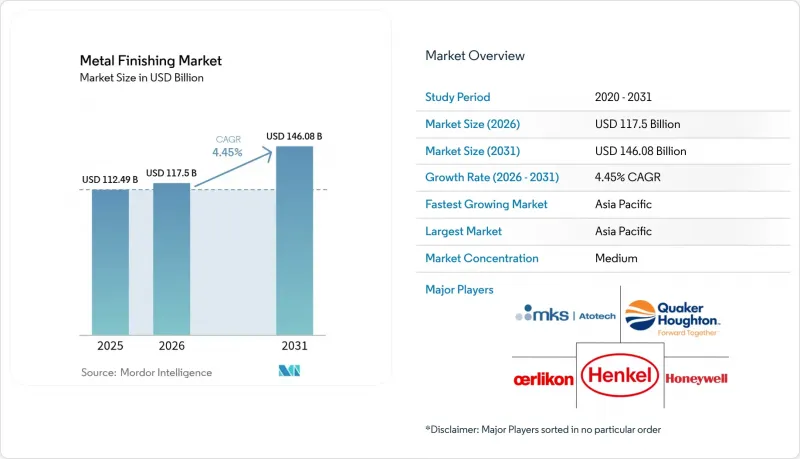
Mordor Intelligence에 따르면 2026년 금속 표면 처리 시장 규모는 1,175억 달러로 추정되며, 2025년 1,124억 9,000만 달러에서 확대되어 2031년에는 1,460억 8,000만 달러에 달할 것으로 예측됩니다.
2026년부터 2031년까지 연평균 성장률(CAGR) 4.45%로 성장할 것으로 전망됩니다.
본 보고서는 유형별(무기 금속 표면 처리, 유기 금속 표면 처리, 하이브리드 금속 표면 처리), 용도별(자동차, 가전제품, 철물, 보석류, 항공우주, 중장비, 의료기기, 전자기기, 건설, 기타 용도), 및 지역별(아시아태평양, 북미, 유럽 등)로 분류되어 있습니다. 시장 예측은 금액(달러) 단위로 표시되어 있습니다.
세계 금속 표면 처리 시장의 동향 및 인사이트
내구성, 내마모성, 장수명 제품에 대한 수요
가혹한 해양 환경이나 풍력발전 환경에서 25년의 내구 연한을 규정하고 있는 업계에서는 장비의 가동 주기를 연장하고 중장비의 유지보수 예산 및 에너지 사용량을 절감하는 첨단 코팅이 채택되고 있습니다. 항공우주 업계의 OEM 기업들은 경량화와 뛰어난 내마모성을 동시에 갖춘 하이브리드 유기·무기 코팅에 높은 가격을 지불하고 있습니다. 재생에너지 부품 제조업체들은 성능을 저하시키지 않으면서 순환 경제 목표를 달성하기 위해 바이오 유래 첨가제를 배합하고 있습니다. 수명주기 배출량에 대한 규제 당국의 감시가 강화되는 가운데, 내구성이 뛰어난 마감재에 대한 수요는 더욱 높아지고 있습니다.
자동차 생산 확대
중국에서는 3,000만 대 이상의 자동차가 생산되고 있으며, 그 생산 대수의 대부분을 배터리식 전기자동차가 차지하고 있어, 이는 알루미늄 표면 처리 및 복합재료 접합 솔루션에 대한 수주를 뒷받침하고 있습니다. 2024년 전 세계 OEM의 표면 처리 라인 개조 투자는 고전압 절연 코팅이 필요한 800V 아키텍처의 통합을 목표로 하고 있습니다. 대형 알루미늄 구조물의 기가 캐스팅에서는 구조 부품의 치수 정밀도와 내식성을 확보하기 위해 더욱 엄격한 표면 처리 공차가 요구됩니다. USMCA 가입국의 국내 조달률에 관한 규제로 인해 북미에서는 단기적인 생산능력 확대가 예상됩니다.
유해 화학제품에 대한 환경 규제
PFAS 및 6가 크롬(Cr(VI))을 대상으로 한 EPA의 규제안으로 인해 규정 준수 비용이 증가하고, 생산능력 확대를 위한 자본이 전용되고 있습니다. REACH 인증을 취득한 크롬 공급업체의 수가 제한적이어서 원자재 공급이 부족해지고, 일시적인 가격 급등이 발생하고 있습니다. 소규모 공장들은 새로운 폐수처리 시스템에 대한 투자를 피하기 위해 시장에서 철수하고 있으며, 그 결과 견고한 환경 인프라를 갖춘 대기업에 수요가 집중되고 있습니다.
부문 분석
2025년, 금속 표면 처리 시장에서 무기 처리 공정의 점유율은 91.12%를 차지하며, 대량 생산되는 자동차, 전자기기, 중장비 제품의 생산 라인 기반으로서 입지를 확고히 하고 있습니다. 펄스 도금 및 합금 아연도금 기술로 인해 피막 품질이 향상되고 자원 사용량이 감소함에 따라, 무기 화학 처리와 관련된 금속 표면 처리 시장 규모는 2031년까지 연평균 성장률(CAGR) 4.74%로 확대될 것으로 예측됩니다. 아연·알루미늄계 코팅은 내석타성(내석타성)이 향상되고 이종 금속 기판과의 궁합도 양호하여, 자동차 언더바디 보호 분야에서 지지를 얻고 있습니다. 변환 피막은 3가 크롬으로 전환되고 있으며, 독자적인 실러가 선박 및 비도로용 기계의 내식 주기를 연장하고 있습니다.
가전 제조업체들은 VOC 규제를 충족하면서 균일한 광택과 색상을 구현하는 박막 분말 코팅을 선호하고 있습니다. 아연·니켈 전기도금 하층과 폴리우레탄 탑코트를 조합한 하이브리드 코팅이 항공우주 분야의 착륙 장치 프로그램에 사용되고 있으며, 타크트 타임을 연장하지 않으면서 기능의 다양성을 높이고 있습니다.
지역별 분석
아시아태평양은 2025년에 금속 표면 처리 시장 규모의 41.05%를 차지했으며, 2031년까지의 지역별 연평균 성장률(CAGR)도 5.18%로 가장 높은 성장률을 기록했습니다. 이는 중국의 자동차 생산 대수와 인도의 전자 분야 PLI(생산 연계형 인센티브) 투자에 힘입은 결과입니다. 이 지역의 공급업체들은 수출 대상 고객의 요구 사항을 충족하기 위해 3가 크롬 및 불소가 포함되지 않은 화학 약품을 채택하고 있습니다. 일본의 각 OEM 기업들은 연안 지역에서 장기간 사용되는 차량을 위해 아연·마그네슘계 코팅을 개선하고 있는 반면, 한국의 제조 공장에서는 5nm 칩 패키징에 대응하기 위해 AI를 활용한 도금 셀을 도입하고 있습니다.
북미 역시 중요한 시장입니다. USMCA 규정에 따라 역내 부품 조달이 진행되고 있으며, 멕시코와 미국 국경 인근의 조립 거점 근처에 집적되는 새로운 마감 공장의 개발이 촉진되고 있습니다. 테슬라의 텍사스주 및 네바다주 사업 확장에 따라, 기가캐스팅 형상에 맞춰 조정된 친환경 알루미늄 코팅이 대량으로 소비되고 있습니다. 항공우주 업계의 주요 기업들은 PFAS 프리 시스템에 대한 공급업체 기준을 상향 조정하고 있으며, 이는 연구개발비 지출과 설비 투자 확대를 뒷받침하고 있습니다.
유럽은 독일의 전기자동차 프로그램, 항공우주 업계의 Tier 1 기업, 그리고 저탄소 공정을 장려하는 엄격한 그린딜 목표를 통해 그 입지를 유지하고 있습니다. 북유럽의 해양 및 오프쇼어 부문에서는 북극권 환경에서 지속적인 내식성을 발휘하는 초두꺼운 아연·알루미늄·마그네슘 도금층이 요구되고 있습니다. EU의 순환 경제 정책은 도금욕 재활용 및 분말 회수 분야의 혁신을 촉진하고 있습니다.
기타 혜택:
- 엑셀 형식의 시장 예측(ME) 시트
- 3개월간의 애널리스트 지원
자주 묻는 질문
목차
제1장 소개
제2장 조사 방법
제3장 주요 요약
제4장 시장 구도
제5장 시장 규모와 성장 예측
제6장 경쟁 구도
제7장 시장 기회와 향후 전망
KSM 26.08.25According to Mordor Intelligence, metal finishing market size in 2026 is estimated at USD 117.5 billion, growing from 2025 value of USD 112.49 billion with 2031 projections showing USD 146.08 billion, growing at 4.45% CAGR over 2026-2031.
This report is Segmented by Type (Inorganic Metal Finishing, Organic Metal Finishing, and Hybrid Metal Finishing), Application (Automotive, Appliances, Hardware, Jewelry, Aerospace, Heavy Equipment, Medical Devices, Electronics, Construction, and Other Applications), and Geography (Asia-Pacific, North America, Europe, and More). The Market Forecasts are Provided in Terms of Value (USD).
Global Metal Finishing Market Trends and Insights
Durable, Wear-Resistant and Long-Life Product Demand
Industries specifying 25-year service lives in harsh marine and wind-energy settings adopt advanced coatings that extend equipment operating cycles, trimming maintenance budgets and energy use in heavy machinery. Aerospace OEMs pay premiums for hybrid organic-inorganic layers that pair weight reduction with superior abrasion resistance. Renewable-energy component manufacturers incorporate bio-based additives to achieve circular economy goals without compromising performance. Regulatory scrutiny of lifecycle emissions further heightens demand for high-durability finishes.
Expanding Automotive Production
China produces more than 30 million vehicles, with battery electric models accounting for a significant portion of output, fueling orders for aluminum finishing and mixed-material joining solutions. Global OEM investments in finishing-line retrofits in 2024 aim to integrate 800 V architectures that require high-voltage insulation coatings. Gigacasting of large aluminum structures requires tighter surface-treatment tolerances to ensure dimensional accuracy and corrosion resistance for structural components. Domestic content rules in the USMCA economies add near-term capacity expansion in North America.
Environmental Curbs on Hazardous Chemistries
EPA proposals targeting PFAS and Cr (VI) drive compliance expenditures, diverting capital from capacity expansion. Limited numbers of REACH-authorized chromium suppliers tighten feedstock availability, leading to temporary price premiums. Smaller shops exit the market rather than investing in new wastewater systems, thereby concentrating demand among larger players with robust environmental infrastructure.
Other drivers and restraints analyzed in the detailed report include:
- Rapid Growth of Electronics and PCB Manufacturing
- OEM Shift to Eco-Chemistries
- Substitution of Metals by Plastics and Composites
For complete list of drivers and restraints, kindly check the Table Of Contents.
Segment Analysis
Inorganic processes accounted for 91.12% of the metal finishing market share in 2025, positioning them as the backbone of high-volume automotive, electronics, and heavy-equipment lines. The metal finishing market size associated with inorganic chemistries is projected to expand at a 4.74% CAGR to 2031, as pulse-plating and alloy-galvanizing technologies improve deposit quality and reduce resource use. Zinc-aluminum coatings are gaining favor in automotive underbody protection due to their enhanced stone-chip resistance and compatibility with mixed-metal substrates. Conversion coatings are shifting toward trivalent chromium, and proprietary sealers are extending corrosion cycles in marine and off-highway machinery.
Appliance producers prefer thin-film powder layers that deliver consistent gloss and color while meeting VOC caps. Hybrid stacks, combining zinc-nickel electroplated bases with polyurethane topcoats, are being used in aerospace landing-gear programs, increasing functional diversity without extending takt time.
Complete Report Scope:
- By Type
- Inorganic Metal Finishing
- Cladding
- Pretreatment/Surface Preparation
- Consumables and Spares
- Electroplating
- Galvanization
- Electroless Plating
- Conversion Coatings
- Thermal Spray and Powder Coating
- Anodizing
- Electropolishing
- Organic Metal Finishing
- Hybrid Metal Finishing
- Inorganic Metal Finishing
- By Application
- Automotive
- Appliances
- Hardware
- Jewelry
- Aerospace
- Heavy Equipment
- Medical Devices
- Electronics
- Construction
- Other Applications
- By Geography
- Asia-Pacific
- China
- India
- Japan
- South Korea
- ASEAN Countries
- Rest of Asia-Pacific
- North America
- United States
- Canada
- Mexico
- Europe
- Germany
- United Kingdom
- France
- Italy
- Spain
- NORDIC Countries
- Rest of Europe
- South America
- Brazil
- Argentina
- Rest of South America
- Middle-East and Africa
- Saudi Arabia
- South Africa
- Rest of Middle-East and Africa
- Asia-Pacific
Geography Analysis
The Asia Pacific controlled 41.05% of the metal finishing market size in 2025 and also recorded the fastest regional CAGR at 5.18% through 2031, buoyed by China's vehicle output and India's electronics PLI investments. Regional suppliers incorporate trivalent and fluorine-free chemistries to meet the requirements of their export customers. Japanese OEMs refine zinc-magnesium coatings for long-service vehicles in coastal regions, while South Korean fabs deploy AI-driven plating cells to serve 5nm chip packaging.
North America is also a significant market. USMCA rules push parts sourcing within the bloc, fueling the development of new finishing plants clustered near Mexico-U.S. border assembly hubs. Tesla's Texas and Nevada expansions consume large volumes of eco-friendly aluminum coatings tuned for gigacasting geometries. Aerospace primes elevate supplier standards around PFAS-free systems, catalyzing research and development spending and capital upgrades.
Europe maintains its heft through German electric-vehicle programs, aerospace tier-one companies, and stringent green-deal objectives that reward low-carbon processes. The Nordic marine and offshore sectors are seeking ultra-thick zinc-aluminum-magnesium layers that provide sustained corrosion resistance in Arctic conditions. EU circular-economy policies spur innovations in bath recycling and powder reclaim.
- A.E. Aubin Company
- ALMCO
- Auromex Co., Ltd.
- BASF SE
- C. Uyemura Co., Ltd.
- Dupont
- Grind Master
- Guyson Corporation
- Henkel AG & Co. KGaA
- Honeywell International Inc.
- Linde p.l.c.
- MacDermid Alpha Electronics Solutions
- MKS | Atotech
- Nordson Corporation
- OC Oerlikon Management AG
- OTEC Precision Finish Inc.
- Pioneer Metal Finishing
- Plating Equipment Ltd.
- POSCO
- Quaker Chemical Corporation d/b/a Quaker Houghton
- Sequa
- TIB Chemicals AG
Additional Benefits:
- The market estimate (ME) sheet in Excel format
- 3 months of analyst support
TABLE OF CONTENTS
1 Introduction
- 1.1 Study Assumptions and Market Definition
- 1.2 Scope of the Study
2 Research Methodology
3 Executive Summary
4 Market Landscape
- 4.1 Market Overview
- 4.2 Market Drivers
- 4.2.1 Durable, wear-resistant and long-life product demand
- 4.2.2 Expanding automotive production
- 4.2.3 Rapid growth of electronics and PCB manufacturing
- 4.2.4 OEM shift to eco-chemistries
- 4.2.5 AI-driven automation boosting plating yields
- 4.3 Market Restraints
- 4.3.1 Environmental curbs on hazardous chemistries
- 4.3.2 Substitution of metals by plastics and composites
- 4.3.3 Supply-chain volatility for Ni and Cr salts
- 4.4 Value Chain Analysis
- 4.5 Porter's Five Forces
- 4.5.1 Bargaining Power of Suppliers
- 4.5.2 Bargaining Power of Buyers
- 4.5.3 Threat of New Entrants
- 4.5.4 Threat of Substitutes
- 4.5.5 Degree of Competition
5 Market Size and Growth Forecasts (Value)
- 5.1 By Type
- 5.1.1 Inorganic Metal Finishing
- 5.1.1.1 Cladding
- 5.1.1.2 Pretreatment/Surface Preparation
- 5.1.1.3 Consumables and Spares
- 5.1.1.4 Electroplating
- 5.1.1.5 Galvanization
- 5.1.1.6 Electroless Plating
- 5.1.1.7 Conversion Coatings
- 5.1.1.8 Thermal Spray and Powder Coating
- 5.1.1.9 Anodizing
- 5.1.1.10 Electropolishing
- 5.1.2 Organic Metal Finishing
- 5.1.3 Hybrid Metal Finishing
- 5.1.1 Inorganic Metal Finishing
- 5.2 By Application
- 5.2.1 Automotive
- 5.2.2 Appliances
- 5.2.3 Hardware
- 5.2.4 Jewelry
- 5.2.5 Aerospace
- 5.2.6 Heavy Equipment
- 5.2.7 Medical Devices
- 5.2.8 Electronics
- 5.2.9 Construction
- 5.2.10 Other Applications
- 5.3 By Geography
- 5.3.1 Asia-Pacific
- 5.3.1.1 China
- 5.3.1.2 India
- 5.3.1.3 Japan
- 5.3.1.4 South Korea
- 5.3.1.5 ASEAN Countries
- 5.3.1.6 Rest of Asia-Pacific
- 5.3.2 North America
- 5.3.2.1 United States
- 5.3.2.2 Canada
- 5.3.2.3 Mexico
- 5.3.3 Europe
- 5.3.3.1 Germany
- 5.3.3.2 United Kingdom
- 5.3.3.3 France
- 5.3.3.4 Italy
- 5.3.3.5 Spain
- 5.3.3.6 NORDIC Countries
- 5.3.3.7 Rest of Europe
- 5.3.4 South America
- 5.3.4.1 Brazil
- 5.3.4.2 Argentina
- 5.3.4.3 Rest of South America
- 5.3.5 Middle-East and Africa
- 5.3.5.1 Saudi Arabia
- 5.3.5.2 South Africa
- 5.3.5.3 Rest of Middle-East and Africa
- 5.3.1 Asia-Pacific
6 Competitive Landscape
- 6.1 Market Concentration
- 6.2 Strategic Moves
- 6.3 Market Share (%)/Ranking Analysis
- 6.4 Company Profiles {(includes Global level Overview, Market level overview, Core Segments, Financials as available, Strategic Information, Market Rank/Share for key companies, Products and Services, and Recent Developments)}
- 6.4.1 A.E. Aubin Company
- 6.4.2 ALMCO
- 6.4.3 Auromex Co., Ltd.
- 6.4.4 BASF SE
- 6.4.5 C. Uyemura Co., Ltd.
- 6.4.6 Dupont
- 6.4.7 Grind Master
- 6.4.8 Guyson Corporation
- 6.4.9 Henkel AG & Co. KGaA
- 6.4.10 Honeywell International Inc.
- 6.4.11 Linde p.l.c.
- 6.4.12 MacDermid Alpha Electronics Solutions
- 6.4.13 MKS | Atotech
- 6.4.14 Nordson Corporation
- 6.4.15 OC Oerlikon Management AG
- 6.4.16 OTEC Precision Finish Inc.
- 6.4.17 Pioneer Metal Finishing
- 6.4.18 Plating Equipment Ltd.
- 6.4.19 POSCO
- 6.4.20 Quaker Chemical Corporation d/b/a Quaker Houghton
- 6.4.21 Sequa
- 6.4.22 TIB Chemicals AG
7 Market Opportunities and Future Outlook
- 7.1 White-space and Unmet-need Assessment


