

|
시장보고서
상품코드
2113479
통신 클라우드 : 시장 점유율 분석, 업계 동향과 통계, 성장 예측(2026-2031년)Telecom Cloud - Market Share Analysis, Industry Trends & Statistics, Growth Forecasts (2026 - 2031) |
||||||
 Mordor Intelligence
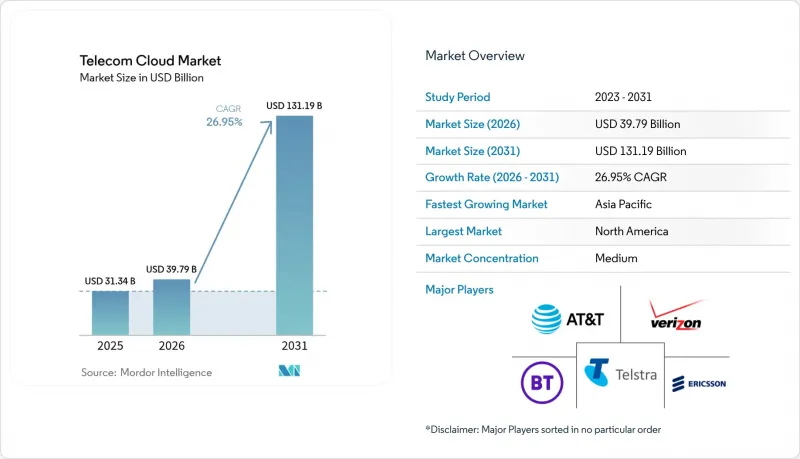
Mordor Intelligence에 따르면 통신 클라우드 시장 규모는 2025년 313억 4,000만 달러에서 2026년에는 397억 9,000만 달러로 확대되고, 2026년부터 2031년까지 CAGR 26.95%를 기록하며 2031년에는 1,311억 9,000만 달러에 달할 것으로 예측됩니다.
본 보고서는 유형별(솔루션, 서비스 등), 용도별(과금·프로비저닝, 트래픽 관리 등), 클라우드 플랫폼별(SaaS, IaaS, PaaS), 최종사용자별(BFSI, 소매, 제조 등), 그리고 지역별로 분류되어 있습니다. 시장 예측은 금액(달러) 기준으로 제시되어 있습니다.
세계 통신 클라우드 시장의 동향 및 인사이트
5G의 급속한 확산이 클라우드 네이티브 코어 네트워크를 요구
스탠드얼론형 5G에서는 클라우드 네이티브 코어가 필수적이며, 모놀리식 아키텍처를 해체하고 네트워크 슬라이싱 자동화 및 실시간 프로비저닝을 가능하게 하는 마이크로서비스로 전환하고 있습니다. 도이치 텔레콤이 Google Cloud와 공동으로 추진하고 있는 AI 기반 RAN 오케스트레이션 이니셔티브는 5G 트래픽의 규모와 복잡성을 관리하기 위해 자동화가 이제 필수적임을 입증하고 있습니다. 텔레포니카 독일은 4,500만 명의 가입자를 에릭슨의 클라우드 네이티브 5G 코어로 전환하여 서비스 출시 시간을 단축하는 동시에 네트워크 민첩성을 강화했습니다. 이러한 변화는 5G 수익이 캐리어급으로 도입된 클라우드 네이티브 기능에 의존하고 있음을 보여줍니다.
통신 사업자의 하이브리드 및 멀티 클라우드 채택 확대
라쿠텐 심포니의 멀티 클라우드 청사진은 주권 관련 의무를 준수하면서도 제공업체 간 워크로드 이식성을 실현하고 있습니다. 하이브리드 아키텍처를 통해 지연에 민감한 네트워크 기능은 온프레미스에 남겨두면서, 확장 가능한 워크로드는 퍼블릭 클라우드로 버스트할 수 있습니다. 시스코의 조사에 따르면, 현재 82%의 기업이 하이브리드 모델을 채택하고 있으며, 이는 복원력과 비용 최적화를 위한 전략의 유효성을 입증합니다. 통신 사업자들이 규정 준수 및 혁신의 속도를 연계함에 따라, 이러한 이중 환경의 도입은 가속화되고 있습니다.
데이터 주권 및 보안 규정 준수의 장벽
Google Cloud의 통신 사업자용 규정 준수 프레임워크는 통신 사업자가 준수해야 하는 지역별 복잡한 개인정보 보호 규제의 미로를 여실히 보여줍니다. 현지화 의무화로 인해 컴퓨팅 비용이 최대 60%까지 증가하여, 통신 클라우드 시장의 비용 절감이라는 매력이 훼손되고 있습니다. VMware의 주권 클라우드 청사진에 따르면, 통신 사업자가 국내 저장이나 저장 데이터의 암호화를 의무화할 경우 아키텍처의 복잡성이 증가하는 것으로 나타났습니다. 법규의 변동은 도입의 유연성을 제약하고 프로젝트 기간을 연장시키고 있습니다.
부문 분석
2025년에는 솔루션 부문이 52.85%의 점유율을 차지했으며, 이는 통신 사업자들이 첫 단계로 기반이 되는 클라우드 스택에 집중했음을 반영합니다. 그러나 ‘서비스’ 부문은 연평균 성장률(CAGR) 27.25%로 급성장하고 있으며, 통신 사업자들이 운영을 전문 파트너에게 위탁함에 따라 그 격차가 좁혀질 것으로 예측됩니다. 통합 커뮤니케이션, CDN, 보안 워크로드는 계속해서 솔루션 매출을 끌어올리고 있지만, 매니지드 호스팅, 전문 서비스 및 네트워크-어-서비스(NaaS) 계약이 더 빠르게 성장하고 있습니다.
통신 사업자들은 변화에 따른 위험을 완화하고, 고객의 혁신을 위해 인력을 재배치하기 위해 매니지드 모델의 도입을 확대하고 있습니다. 코로케이션 거점을 통해 통신 사업자들은 엣지 존과의 근접성을 확보하는 한편, 프로페셔널 서비스를 활용하여 기술 인력 부족 문제를 해소하고 있습니다. 이러한 동향은 통신 클라우드 시장 전체에서 통신 사업자의 지출을 트래픽의 탄력성과 가입자의 계절성에 맞춰 조정하는 운영 비용(OPEX) 기반의 소비 모델로의 구조적 전환을 보여줍니다.
2025년, 통신 클라우드 시장 규모의 45.10%를 차지한 분야는 ‘과금·프로비저닝’ 분야로, 이는 모든 통신 사업자에게 필수적인 수익 보장 활동을 뒷받침하고 있습니다. 한편, ‘트래픽 관리’ 분야는 5G 데이터의 급증으로 네트워크에 부하가 가해지는 가운데 연평균 27.6%의 성장이 예상됩니다. 시스코의 ‘Ultra Traffic Optimization’과 오팡가의 ‘RAIN AI’는 새로운 주파수 대역을 구매하지 않고도 QoE(품질 경험)를 향상시키는, AI를 활용한 혼잡 완화 사례의 좋은 본보기입니다.
혼잡을 예측하고 패킷을 실시간으로 재라우팅하는 AI 탑재 엔진은 필수 기능으로 자리 잡고 있습니다. HCL의 ‘Augmented Network Automation’은 운영 비용(OPEX) 절감에 더해 20%의 용량 향상을 실현하고 있으며, 이는 해당 분야의 눈부신 성장을 뒷받침하고 있습니다. 보안 분석이나 고객 경험 포털과 같은 부수적인 워크로드도 이에 발맞춰 클라우드로 이전되고 있어, 통신 클라우드 시장 내 애플리케이션 계층의 다양화를 더욱 강화하고 있습니다.
지역별 분석
북미는 5G의 조기 도입, 하이퍼스케일러와의 확고한 파트너십, 그리고 우호적인 규제 환경이 맞물려 2025년에는 매출의 34.90%를 차지했습니다. 통신 사업자들은 엣지 서비스와 기업용 연결을 수익화하여 통신 클라우드 시장에서 지역의 리더십을 강화했습니다. 또한, 지방의 5G 구축을 위한 연방 정부의 자금 지원도 투자 모멘텀을 뒷받침하고 있습니다.
아시아태평양은 정부의 디지털화 프로그램과 대규모 데이터센터 투자에 힘입어 2031년까지 연평균 성장률(CAGR) 26.85%로 확대될 것으로 전망됩니다. 일본에서 AWS의 150억 달러 투자 약속과 마이크로소프트의 29억 달러 투자 계획은 자본 집약도가 높음을 보여주는 반면, 화웨이의 2023년 클라우드 서비스 매출이 77% 급증한 것은 국내 수요의 가속화를 시사합니다. 2023년 중국의 클라우드 인프라 지출액 92억 달러는 해당국의 통신 사업자와 현지 공급업체의 성장을 뒷받침하고 있습니다.
유럽은 여전히 대규모 시장이며, 엄격한 주권 요건이 주권형 클라우드 구축을 촉진하고 Open RAN 실험을 뒷받침하고 있습니다. 에너지 효율 목표는 클라우드 통합과 부합하며, 유럽 통신 사업자들에게 네트워크 현대화는 전략적 필수 과제가 되었습니다. 중동 및 아프리카 및 라틴아메리카에서는 스마트 시티 구상, 핀테크의 보급, 모바일 우선 인구 동향에 힘입어 도입 곡선이 상승세를 보이고 있으나, 규제상의 격차와 기술 인력 부족이 단기적인 확장을 저해하고 있습니다.
기타 혜택:
- 엑셀 형식의 시장 예측(ME) 시트
- 3개월간의 애널리스트 지원
자주 묻는 질문
목차
제1장 소개
제2장 조사 방법
제3장 주요 요약
제4장 시장 구도
제5장 시장 규모와 성장 예측
제6장 경쟁 구도
제7장 시장 기회와 향후 전망
KSM 26.08.25According to Mordor Intelligence, the telecom cloud market size is expected to grow from USD 31.34 billion in 2025 to USD 39.79 billion in 2026 and is forecast to reach USD 131.19 billion by 2031 at 26.95% CAGR over 2026-2031.
This report is Segmented by Type (Solution, Services, and More), Application (Billing and Provisioning, Traffic Management, and More), Cloud Platform (SaaS, Iaas, and PaaS), End User (BFSI, Retail, Manufacturing, and More) and by Geography. The Market Forecasts are Provided in Terms of Value (USD).
Global Telecom Cloud Market Trends and Insights
Surge in 5G roll-outs demanding cloud-native core networks
Standalone 5G mandates cloud-native cores, dismantling monolithic architectures in favor of micro-services that enable automated network slicing and real-time provisioning. Deutsche Telekom's work with Google Cloud on AI-driven RAN orchestration proves that automation is now indispensable to manage the scale and complexity of 5G traffic. Telefonica Germany migrated 45 million subscribers to Ericsson's cloud-native 5G core, cutting service-activation times and fortifying network agility.These transformations signal that 5G revenue relies on cloud-native capabilities deployed at carrier grade.
Growing adoption of hybrid and multi-cloud by telecom operators
Rakuten Symphony's multi-cloud blueprint showcases workload portability across providers while guarding sovereignty obligations. Hybrid architectures allow latency-sensitive network functions to remain on-premise while scalable workloads burst to public clouds. Cisco finds 82% of enterprises now run hybrid models, validating the strategy for resilience and cost optimization. This dual-environment adoption is accelerating as operators link compliance with innovation velocity.
Data-sovereignty and security compliance hurdles
Google Cloud's telecom-specific compliance frameworks attest to the maze of regional privacy rules carriers must meet. Localization mandates inflate compute costs by up to 60%, eroding the telecom cloud market's cost-saving allure. VMware sovereign-cloud blueprints show architecture complexity rises when carriers enforce in-country residency and encryption at rest. Evolving statutes constrain deployment flexibility and lengthen project timelines.
Other drivers and restraints analyzed in the detailed report include:
- Edge-cloud federation enabling ultra-low-latency enterprise 4.0
- Convergence of Open RAN accelerating RAN-cloudification
- Integration complexity with legacy BSS/OSS stacks
For complete list of drivers and restraints, kindly check the Table Of Contents.
Segment Analysis
In 2025 solution segment held 52.85% share, reflecting operators' first-wave focus on foundational cloud stacks. Yet Services are accelerating at a 27.25% CAGR, forecast to close the gap as carriers outsource operations to specialist partners. Unified communication, CDN, and security workloads continue to lift Solution revenues, but managed hosting, professional services, and network-as-a-service contracts are growing faster.
Operators increasingly adopt managed models to de-risk transformation and redeploy staff toward customer innovation. Colocation footprints give carriers proximity to edge zones, while professional-service engagements address skills shortages. This trend signals a structural shift toward opex-based consumption, aligning telco spending with traffic elasticity and subscriber seasonality across the telecom cloud market.
Billing and Provisioning retained 45.10% of telecom cloud market size in 2025, underpinning revenue assurance activities critical to every carrier. Traffic Management, however, is projected to grow 27.6% annually as 5G data surges strain networks. Cisco's Ultra Traffic Optimization and Opanga's RAIN AI showcase AI-driven congestion relief that boosts QoE without fresh spectrum buys.
AI-infused engines that predict congestion and reroute packets in real time are becoming must-have capabilities. HCL's Augmented Network Automation illustrates 20% capacity lifts alongside OPEX cuts, explaining the outsized growth. Ancillary workloads such as security analytics and customer-experience portals also migrate to cloud in lockstep, reinforcing application-layer diversification within the telecom cloud market.
Complete Report Scope:
- By Type
- Solution
- Unified Communication and Collaboration
- Content Delivery Network
- Other Solutions
- Service
- Colocation Services
- Network Services
- Professional Services
- Managed Services
- Other Types
- Solution
- By Application
- Billing and Provisioning
- Traffic Management
- Other Applications
- By Cloud Platform
- Software-as-a-Service (SaaS)
- Infrastructure-as-a-Service (IaaS)
- Platform-as-a-Service (PaaS)
- By End User
- BFSI
- Retail
- Manufacturing
- Transportation and Distribution
- Healthcare
- Government
- Media and Entertainment
- Other End Users
- By Geography
- North America
- United States
- Canada
- Mexico
- South America
- Brazil
- Argentina
- Colombia
- Europe
- Germany
- United Kingdom
- France
- Italy
- Spain
- Rest of Europe
- Asia-Pacific
- China
- Japan
- South Korea
- India
- Taiwan
- Rest of Asia-Pacific
- Middle-East and Africa
- Middle-East
- Saudi Arabia
- United Arab Emirates
- Turkey
- Rest of Middle- East
- Africa
- South Africa
- Nigeria
- Egypt
- Rest of Africa
- Middle-East
- North America
Geography Analysis
North America accounted for 34.90% revenue in 2025 as early 5G roll-outs, established hyperscaler partnerships, and favorable regulations aligned. Carriers monetized edge services and enterprise connectivity, strengthening regional leadership in the telecom cloud market. Federal funding streams for rural 5G also bolster investment momentum.
Asia-Pacific is projected to expand at 26.85% CAGR through 2031, supported by government digitalization programs and massive data-center investments. AWS's USD 15 billion commitment and Microsoft's USD 2.9 billion plan in Japan illustrate capital intensity, while Huawei's 77% cloud-service revenue jump in 2023 signals domestic demand acceleration. China's USD 9.2 billion 2023 cloud-infrastructure spend positions its carriers and local providers for growth.
Europe remains a sizeable market, where stringent sovereignty mandates foster sovereign-cloud builds and spark Open RAN experiments. Energy-efficiency goals align with cloud consolidation, giving European carriers strategic imperatives to modernize networks. Middle East and Africa and Latin America show rising adoption curves fueled by smart-city initiatives, fintech penetration, and mobile-first demographics, though regulatory gaps and skills shortages temper near-term scale.
- ATandT Inc.
- Verizon Communications Inc.
- BT Group plc
- Deutsche Telekom AG
- NTT Communications Corp.
- China Telecommunications Corp.
- Telstra Corp. Ltd
- Telefonaktiebolaget LM Ericsson
- CenturyLink (Lumen Technologies)
- Singapore Telecommunications Ltd
- Telus Corp.
- Swisscom AG
- Amazon Web Services
- Microsoft Azure
- Google Cloud
- IBM Cloud
- Oracle Communications Cloud
- Huawei Cloud
- VMware (Telco Cloud Platform)
- Cisco Systems (Telco Cloud)
Additional Benefits:
- The market estimate (ME) sheet in Excel format
- 3 months of analyst support
TABLE OF CONTENTS
1 INTRODUCTION
- 1.1 Study Assumptions and Market Definition
- 1.2 Scope of the Study
2 RESEARCH METHODOLOGY
3 EXECUTIVE SUMMARY
4 MARKET LANDSCAPE
- 4.1 Market Overview
- 4.2 Market Drivers
- 4.2.1 Surge in 5G roll-outs demanding cloud-native core networks
- 4.2.2 Growing adoption of hybrid and multi-cloud by telecom operators
- 4.2.3 Cost efficiency via NFV-enabled OPEX savings
- 4.2.4 Convergence of Open RAN accelerating RAN-cloudification
- 4.2.5 Edge-cloud federation enabling ultra-low-latency enterprise 4.0
- 4.2.6 Sustainability pledges shifting telcos to green public clouds
- 4.3 Market Restraints
- 4.3.1 Data-sovereignty and security compliance hurdles
- 4.3.2 Integration complexity with legacy BSS/OSS stacks
- 4.3.3 Shortage of cloud-native skills in telco ops teams
- 4.3.4 High cross-border cloud exit-cost risk exposures
- 4.4 Supply-Chain Analysis
- 4.5 Regulatory Landscape
- 4.6 Technological Outlook
- 4.7 Porter's Five Force Analysis
- 4.7.1 Bargaining Power of Suppliers
- 4.7.2 Bargaining Power of Buyers
- 4.7.3 Threat of New Entrants
- 4.7.4 Threat of Substitutes
- 4.7.5 Intensity of Competitive Rivalry
- 4.8 Assesment of Macroeconomic Factors on the Market
5 MARKET SIZE AND GROWTH FORECASTS (VALUE)
- 5.1 By Type
- 5.1.1 Solution
- 5.1.1.1 Unified Communication and Collaboration
- 5.1.1.2 Content Delivery Network
- 5.1.1.3 Other Solutions
- 5.1.2 Service
- 5.1.2.1 Colocation Services
- 5.1.2.2 Network Services
- 5.1.2.3 Professional Services
- 5.1.2.4 Managed Services
- 5.1.3 Other Types
- 5.1.1 Solution
- 5.2 By Application
- 5.2.1 Billing and Provisioning
- 5.2.2 Traffic Management
- 5.2.3 Other Applications
- 5.3 By Cloud Platform
- 5.3.1 Software-as-a-Service (SaaS)
- 5.3.2 Infrastructure-as-a-Service (IaaS)
- 5.3.3 Platform-as-a-Service (PaaS)
- 5.4 By End User
- 5.4.1 BFSI
- 5.4.2 Retail
- 5.4.3 Manufacturing
- 5.4.4 Transportation and Distribution
- 5.4.5 Healthcare
- 5.4.6 Government
- 5.4.7 Media and Entertainment
- 5.4.8 Other End Users
- 5.5 By Geography
- 5.5.1 North America
- 5.5.1.1 United States
- 5.5.1.2 Canada
- 5.5.1.3 Mexico
- 5.5.2 South America
- 5.5.2.1 Brazil
- 5.5.2.2 Argentina
- 5.5.2.3 Colombia
- 5.5.3 Europe
- 5.5.3.1 Germany
- 5.5.3.2 United Kingdom
- 5.5.3.3 France
- 5.5.3.4 Italy
- 5.5.3.5 Spain
- 5.5.3.6 Rest of Europe
- 5.5.4 Asia-Pacific
- 5.5.4.1 China
- 5.5.4.2 Japan
- 5.5.4.3 South Korea
- 5.5.4.4 India
- 5.5.4.5 Taiwan
- 5.5.4.6 Rest of Asia-Pacific
- 5.5.5 Middle-East and Africa
- 5.5.5.1 Middle-East
- 5.5.5.1.1 Saudi Arabia
- 5.5.5.1.2 United Arab Emirates
- 5.5.5.1.3 Turkey
- 5.5.5.1.4 Rest of Middle- East
- 5.5.5.2 Africa
- 5.5.5.2.1 South Africa
- 5.5.5.2.2 Nigeria
- 5.5.5.2.3 Egypt
- 5.5.5.2.4 Rest of Africa
- 5.5.5.1 Middle-East
- 5.5.1 North America
6 COMPETITIVE LANDSCAPE
- 6.1 Market Concentration
- 6.2 Strategic Moves
- 6.3 Market Share Analysis
- 6.4 Company Profiles {(includes Global level Overview, Market level overview, Core Segments, Financials as available, Strategic Information, Market Rank/Share for key companies, Products and Services, and Recent Developments)}
- 6.4.1 ATandT Inc.
- 6.4.2 Verizon Communications Inc.
- 6.4.3 BT Group plc
- 6.4.4 Deutsche Telekom AG
- 6.4.5 NTT Communications Corp.
- 6.4.6 China Telecommunications Corp.
- 6.4.7 Telstra Corp. Ltd
- 6.4.8 Telefonaktiebolaget LM Ericsson
- 6.4.9 CenturyLink (Lumen Technologies)
- 6.4.10 Singapore Telecommunications Ltd
- 6.4.11 Telus Corp.
- 6.4.12 Swisscom AG
- 6.4.13 Amazon Web Services
- 6.4.14 Microsoft Azure
- 6.4.15 Google Cloud
- 6.4.16 IBM Cloud
- 6.4.17 Oracle Communications Cloud
- 6.4.18 Huawei Cloud
- 6.4.19 VMware (Telco Cloud Platform)
- 6.4.20 Cisco Systems (Telco Cloud)
7 MARKET OPPORTUNITIES AND FUTURE OUTLOOK
- 7.1 White-Space and Unmet-Need Assessment


