

|
시장보고서
상품코드
2113504
아크릴산 : 시장 점유율 분석, 업계 동향과 통계, 성장 예측(2026-2031년)Acrylic Acid - Market Share Analysis, Industry Trends & Statistics, Growth Forecasts (2026 - 2031) |
||||||
 Mordor Intelligence
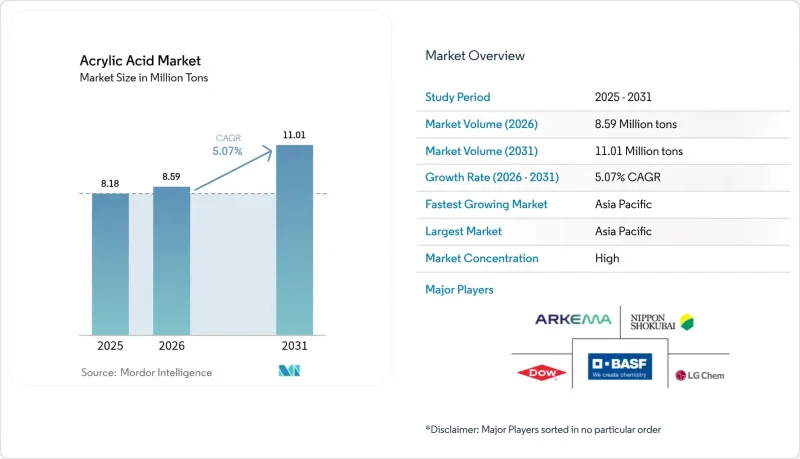
Mordor Intelligence에 따르면 아크릴산 시장 규모는 2025년 818만 톤에서 2026년에는 859만 톤으로 확대되고, 2026년부터 2031년까지 CAGR 5.07%를 기록하며 2031년에는 1,101만 톤에 달할 것으로 예측됩니다.
본 보고서는 유도체별(메틸 아크릴산, 부틸 아크릴산, 에틸 아크릴산 등), 용도별(페인트·코팅, 접착제·실란트 등), 순도 등급별(테크니컬 등급, 빙정 등급, 초고순도), 최종사용자 산업(퍼스널케어·위생, 건축·건설, 자동차·운송 등), 및 지역(아시아태평양, 북미, 유럽 등)별로 분류되어 있습니다.
세계 아크릴산 시장의 동향 및 인사이트
고흡수성 수지의 수요 동향은 상승세를 보이고 있습니다
세계 인구의 고령화와 가처분 소득 증가로 인해 위생 제품의 보급이 확대되면서, 폴리아크릴레이트계 고흡수성 수지의 소비가 증가하고 있습니다. 농업 분야에서의 채택이 확대되고 있으며, 건조 지역에서 농가들이 토양의 보습성을 높이기 위해 이 폴리머를 사용함에 따라 아크릴산 시장이 확대되고 있습니다. 생분해성 가교제에 대한 연구로 인해 흡수 능력을 유지하면서도 사용 후 제품에 대한 우려가 완화되고 있습니다. 판매량 증가가 가장 두드러지는 곳은 아시아태평양이며, 이 지역에서는 영유아 및 성인용 요실금 제품이 급속히 확대되고 있습니다. 주요 수지 공급업체들은 메틸메타크릴레이트의 마이크로파 재활용 기술을 도입하여 주조 아크릴 폐기물의 순환형 처리를 실현하고 있습니다. 또한 각 제조사들은 촉매 공정을 개선하여 에너지 집약도를 낮추고 있으며, 이는 장기적인 비용 경쟁력의 기반이 되고 있습니다.
수성 건축용 도료의 확대
정부의 VOC 규제로 인해 용제형에서 수성형으로의 지속적인 전환이 촉진되고 있으며, 아크릴 분산액이 최적의 바인더로 자리 잡고 있습니다. BASF의 네덜란드 신규 생산 라인은 CO2 배출량을 증가시키지 않으면서 지역 생산능력을 향상시켜, 지속가능한 규모 확대에 대한 노력을 보여주고 있습니다. 걸프협력회의(GCC) 국가들에서는 속건성이 뛰어나고 내식성이 우수한 마감 처리가 요구되는 대규모 인프라 건설에 힘입어, 아크릴 수지가 이미 도료 배합의 40% 이상을 차지하고 있습니다. 수성 도료의 경우, 기존 성능에 필적하기 위해 높은 바인더 고형분이 필요하기 때문에 아크릴산 시장도 혜택을 보고 있으며, 모노머 수요가 크게 증가하고 있습니다. 또한, 포장재가 플라스틱에서 종이 소재로 전환됨에 따라 분산액의 수요는 더욱 확대되고 있습니다.
아크릴산(AA) 증기에 대한 건강 및 독성 우려
규제 당국은 노출 허용 기준을 강화하고 있어, 생산자들은 밀폐형 충전 시스템, 첨단 스크러버 및 개인보호구에 대한 투자를 할 수밖에 없습니다. 유럽연합 집행위원회는 호흡기 자극 위험을 지적하는 한편, NIOSH는 2 ppm의 TWA(시간 가중 평균)를 권장하고 있습니다. 호주의 국가 오염 물질 인벤토리(NPI)는 허가 기준의 지침으로 삼기 위해 각 시설의 배출량을 기록하고 있습니다. WHO 및 EPA의 지침이 다국적 기업의 정책을 형성하고 있으며, 규정 준수 요건이 복잡해짐에 따라 고정비가 증가하고 있습니다. 다운스트림 가공업체, 특히 접착제 공장은 강화된 실내 공기 기준을 충족하기 위해 환기 시스템을 재설계해야만 합니다. 개보수 공사가 진행됨에 따라 단기적인 설비 가동률이 떨어질 가능성이 있으며, 이는 규제가 엄격한 지역의 아크릴산 시장 성장을 둔화시키는 요인이 되고 있습니다.
부문 분석
부틸 아크릴산염은 코팅, 접착제, 실란트 등 폭넓은 용도에 힘입어 2025년 출하량의 46.98%를 차지했습니다. 유연성, 내후성, 비용 효율성의 균형 덕분에 건설 및 포장 업계에서 배합에 대한 채택률이 높아지고 있습니다. 그러나 위생 기준을 높이는 인구통계학적 동향이 초흡수성 폴리머(SAP)의 수요를 자극하고 있어, SAP 유도체는 2031년까지 5.53%라는 가장 높은 연평균 성장률(CAGR)을 기록할 것으로 전망됩니다. SAP 제조업체들은 아크릴산이 자체 무게의 수백 배에 달하는 액체를 흡수하는 고도로 가교된 네트워크를 형성하는 특성을 활용하고 있습니다. 메틸 아크릴레이트와 같은 특수 제품은 속경화형 투과 코팅 시스템을 위한 안정적인 틈새 시장 수요가 있는 반면, 에틸 아크릴레이트는 섬유 및 가죽의 마감 가공에 필요한 깊은 침투를 지원합니다. 디에틸헥실 아크릴레이트는 여전히 감압 접착제용 점착제로 주류를 이루고 있습니다. 빙정 아크릴산은 전자기기 및 의약품 중간체의 기반이 되며, 99% 이상의 고순도로 미량 금속의 혼입을 최소화하고 있습니다.
페인트·코팅 시장은 지속적인 인프라 투자에 힘입어 2025년 시점에서 35.46%의 점유율을 유지한 반면, 접착제·실런트 시장은 연평균 성장률(CAGR) 7.01%를 기록하며 기존 코팅 시장의 성장률을 소폭 상회하고 있습니다. 투명도가 높고 자외선 저항성이 뛰어난 아크릴계 감압 접착제는 전자 디스플레이의 라미네이트 가공 및 자동차 외장 트림에서 주류를 이루며, 모노머 수요 확대를 가속화하고 있습니다. 위생용품 분야에서는 가교 밀도 향상을 활용하여 흡수 성능을 유지하면서도 코어 부분의 두께를 줄임으로써 물류 비용 절감을 도모하고 있습니다. 계면활성제 용도에서는 아크릴산의 양성이온 특성을 활용하여, 농축형 세탁 세제의 세정력을 향상시키는 방향으로 나아가고 있습니다. 섬유 가공 분야에서는 아크릴 유도체가 채택되어, 여러 번의 세탁 주기를 거치더라도 지속되는 내구성이 뛰어난 발수 가공 및 방오 가공이 실현되고 있습니다. 그 결과, 아크릴산 시장은 전자 분야의 소형화 및 자동차 분야의 차량 총중량 넷제로(Net Zero) 목표를 충족하는 고부가가치 접착 솔루션으로 재편되고 있습니다.
지역별 분석
아시아태평양은 2025년에 세계 생산량의 52.10%를 차지했으며, 2031년까지 연평균 성장률(CAGR) 5.36%로 확대될 것으로 전망됩니다. 이 지역의 생산자들은 크래커에서 에스테르 제조에 이르는 효율적인 일괄 생산 체제를 활용하고 있지만, 도시화, 위생 기준 강화, 인프라 정비의 진전에 따라 다운스트림 부문의 소비는 더욱 급속히 증가하고 있습니다. 중국은 화학 산업의 로드맵을 고부가가치 밸류체인로 이끌고 있으며, 정부의 자급자족 추진 정책에 따라 완화(Wanhua) 등의 기업이 아크릴 에스테르 분야로 사업을 확장하도록 장려하고 있습니다.
북미에서는 걸프 코스트의 통합형 복합 시설을 기반으로 공급 전망이 견조하게 유지되고 있습니다. 미국 생산자들은 셰일가스 유래 프로필렌이라는 강점을 활용하고 있지만, 환경 정보 공개 의무에 직면해 있어, 이것이 바이오 루트 및 탄소 회계에 대한 투자를 촉진하고 있습니다. 초순도 아이스급 제품에 대한 전기·전자 분야의 수요가 생산능력의 단계적 확장을 뒷받침하고 있습니다.
유럽에서는 스코프 3 보고 의무화 및 순환 경제 지침을 통해 지속가능성 분야의 리더십을 강화하고 있습니다. 중동 및 아프리카는 기반이 가장 작지만, 석유화학 제조업체들이 파생 제품의 통합을 통해 가치를 창출함에 따라 생산능력 계획에서 현저한 증가가 나타나고 있습니다. 쿠웨이트 석유(Kuwait Petroleum)의 만화(Wanhua)에 대한 출자는 아시아 수요 시장에 진출하려는 걸프 지역 기업들의 전략을 여실히 보여주고 있습니다. 이러한 지역별 동향이 맞물리면서 아크릴산 시장은 경제 상황이 각기 다른 여러 단계에서 핵심 원료로서의 위상을 높이고 있습니다.
기타 혜택:
- 엑셀 형식의 시장 예측(ME) 시트
- 3개월간의 애널리스트 지원
자주 묻는 질문
목차
제1장 소개
제2장 조사 방법
제3장 주요 요약
제4장 시장 구도
제5장 시장 규모와 성장 예측
제6장 경쟁 구도
제7장 시장 기회와 향후 전망
KSM 26.08.25According to Mordor Intelligence, the acrylic acid market size is expected to grow from 8.18 million tons in 2025 to 8.59 million tons in 2026 and is forecast to reach 11.01 million tons by 2031 at 5.07% CAGR over 2026-2031.
This report is Segmented by Derivative (Methyl Acrylate, Butyl Acrylate, Ethyl Acrylate, and More), Application (Paints and Coatings, Adhesives and Sealants, and More), Purity Grade (Technical Grade, Glacial Grade, and Ultra-High Purity), End-User Industry (Personal Care and Hygiene, Building and Construction, Automotive and Transportation, and More), and Geography (Asia-Pacific, North America, Europe, and More).
Global Acrylic Acid Market Trends and Insights
Super-Absorbent Polymer Demand Up-Trend
Global demographic ageing and rising disposable incomes lift hygiene-product penetration, intensifying consumption of polyacrylate-based super-absorbents. Agricultural adoption broadens the acrylic acid market as growers use the polymers to enhance soil water retention in arid regions. Research into biodegradable cross-linkers lessens end-of-life concerns while preserving absorption capacity. Volume growth remains most pronounced in Asia-Pacific, where infant and adult incontinence products scale rapidly. Leading resin suppliers introduce microwave-based recycling for methyl methacrylate, closing the loop for cast-acrylic waste. Manufacturers also refine catalytic processes to cut energy intensity, underpinning long-term cost competitiveness.
Expansion Of Water-Borne Architectural Coatings
Governmental VOC regulations stimulate a lasting shift from solvent-borne to water-borne systems, cementing acrylic dispersions as the binder of choice. BASF's new Dutch production line elevates regional capacity without CO2 increases, signalling a commitment to sustainable scale-up. In the Gulf Co-operation Council states, acrylic resin already commands more than 40% coating formulations, buoyed by large-scale infrastructure builds that require fast-drying, corrosion-resistant finishes. The acrylic acid market benefits as water-borne chemistries need higher binder solids to match legacy performance, materially lifting monomer pull-through. Packaging conversions from plastic to paper substrates further amplify dispersion demand.
Health and Toxicity Concerns of AA Vapours
Regulatory agencies tighten exposure thresholds, compelling producers to invest in closed-loop loading, advanced scrubbers, and personal protective equipment. The European Commission cites respiratory irritation risks, while NIOSH recommends a 2 ppm TWA. Australia's National Pollutant Inventory records site emissions to guide licensing limits. WHO and EPA guidance shape multinational policy, adding layers of compliance that elevate fixed costs. Downstream converters, particularly adhesive plants, must redesign ventilation to meet lowered indoor-air targets. Short-term capacity utilisation can dip as retrofits proceed, tempering acrylic acid market growth in highly regulated regions.
Other drivers and restraints analyzed in the detailed report include:
- Rising Hygiene Mandates in Emerging Asia
- Commercialisation of Bio-Acrylic Acid Routes
- Propylene Price Volatility
For complete list of drivers and restraints, kindly check the Table Of Contents.
Segment Analysis
Butyl acrylate contributed 46.98% of 2025 shipments on the strength of broad coating, adhesive, and sealant usage. Its balance of flexibility, weatherability, and cost efficiency secures formulation loyalty across the construction and packaging industries. However, demographic trends that lift hygiene standards stoke super-absorbent polymer (SAP) demand, giving SAP derivatives the highest 5.53% CAGR through 2031. SAP producers exploit acrylic acid's capacity to form highly cross-linked networks that absorb liquids exceeding several hundred times their own weight. Specialty streams such as methyl acrylate enjoy steady niche orders for rapid-cure transmission-coating systems, whereas ethyl acrylate supports textile and leather finishing requiring deep fibre penetration. Two-ethylhexyl acrylate remains the tackifier of choice for pressure-sensitive adhesive labels. Glacial acrylic acid underpins electronics and pharmaceutical intermediates, where 99%+ purity ensures minimal trace metals.
Paints and coatings retained 35.46% volume in 2025 thanks to ongoing infrastructure spending, yet adhesives and sealants display a 7.01% CAGR that edges out traditional coating increments. High-clarity, UV-resistant acrylic pressure-sensitive adhesives dominate electronic display lamination and exterior automotive trim, accelerating monomer uptake. Sanitary products leverage advances in cross-link density to reduce core thickness while maintaining absorption metrics, thereby lowering logistics costs. Surfactant applications tap acrylic acid's amphiphilic property set to improve detergency across concentrated laundry formats. Textile treatments incorporate acrylic derivatives for durable water repellency and anti-soiling finishes that survive multiple wash cycles. Consequently, the acrylic acid market realigns toward high-value bonding solutions that satisfy miniaturisation in electronics and net-zero body-weight targets in automotive.
Complete Report Scope:
- By Derivative
- Methyl Acrylate
- Butyl Acrylate
- Ethyl Acrylate
- 2-Ethylhexyl Acrylate
- Glacial Acrylic Acid
- Superabsorbent Polymer
- By Application
- Paints and Coatings
- Adhesives and Sealants
- Sanitary Products
- Surfactants
- Textiles
- Other Applications
- By Purity Grade
- Technical Grade (~94 %)
- Glacial Grade (more than or equal to 99%)
- Ultra-high Purity (Electronics)
- By End-user Industry
- Personal Care and Hygiene
- Building and Construction
- Automotive and Transportation
- Electrical and Electronics
- Packaging
- Agriculture and Horticulture
- By Geography
- Asia-Pacific
- China
- India
- Japan
- South Korea
- Australia
- Indonesia
- Malaysia
- Thailand
- Vietnam
- Rest of Asia-Pacific
- North America
- United States
- Canada
- Mexico
- Europe
- Germany
- United Kingdom
- France
- Italy
- Spain
- Nordic Countries
- Turkey
- Russia
- Rest of Europe
- South America
- Brazil
- Argentina
- Colombia
- Rest of South America
- Middle-East and Africa
- Saudi Arabia
- United Arab Emirates
- Qatar
- Egypt
- Nigeria
- South Africa
- Rest of Middle-East and Africa
- Asia-Pacific
Geography Analysis
Asia-Pacific accounted for 52.10% of global volume in 2025 and is projected to expand at a 5.36% CAGR to 2031. Regional producers capitalise on efficient cracker-to-ester integration, yet downstream consumption rises even faster as urbanisation, hygiene mandates, and infrastructure build intensify. China guides its chemical-industry roadmap toward higher-value chains, encouraging firms such as Wanhua to broaden into acrylic esters under governmental self-sufficiency drives.
North America maintains a resilient supply outlook anchored by integrated Gulf Coast complexes. US producers benefit from shale-advantaged propylene yet face environmental disclosure obligations that spur investment in bio-routes and carbon accounting. Electrical and electronics demand for ultra-high-purity glacial grades supports incremental debottlenecking.
Europe advances sustainability leadership through mandatory scope-3 reporting and circular-economy directives. The Middle East and Africa record the smallest base but witness a pronounced uptick in capacity planning as petrochemical producers capture value through derivative integration. Kuwait Petroleum's equity entry into Wanhua underscores Gulf entities' strategy to access Asian demand corridors. Collectively, geographic dynamics elevate the acrylic acid market as a cornerstone feedstock across differentiated economic stages.
- Arkema
- BASF
- China Petroleum & Chemical Corporation (Sinopec)
- Dow
- Evonik Industries AG
- Formosa Plastics Group
- LG Chem
- Mitsubishi Chemical Group Corporation
- NIPPON SHOKUBAI CO., LTD.
- Sasol
- Satellite Chemical Co., Ltd.
- Shanghai Huayi Acrylic Acid Co., Ltd.
- Wanhua
Additional Benefits:
- The market estimate (ME) sheet in Excel format
- 3 months of analyst support
TABLE OF CONTENTS
1 Introduction
- 1.1 Study Assumptions and Market Definition
- 1.2 Scope of the Study
2 Research Methodology
3 Executive Summary
4 Market Landscape
- 4.1 Market Overview
- 4.2 Market Drivers
- 4.2.1 Super-Absorbent Polymer Demand Up-Trend
- 4.2.2 Expansion of Water-Borne Architectural Coatings
- 4.2.3 Rising Hygiene Mandates in Emerging Asia
- 4.2.4 Commercialisation of Bio-Acrylic Acid Routes
- 4.2.5 Surge in Electronics-Grade Pressure-Sensitive Adhesives
- 4.3 Market Restraints
- 4.3.1 Health and Toxicity Concerns of AA Vapours
- 4.3.2 Propylene Price Volatility
- 4.3.3 Supply Risk from Ageing Propylene Oxide Assets
- 4.4 Value Chain Analysis
- 4.5 Porter's Five Forces
- 4.5.1 Bargaining Power of Suppliers
- 4.5.2 Bargaining Power of Buyers
- 4.5.3 Threat of New Entrants
- 4.5.4 Threat of Substitutes
- 4.5.5 Degree of Competition
5 Market Size and Growth Forecasts (Volume)
- 5.1 By Derivative
- 5.1.1 Methyl Acrylate
- 5.1.2 Butyl Acrylate
- 5.1.3 Ethyl Acrylate
- 5.1.4 2-Ethylhexyl Acrylate
- 5.1.5 Glacial Acrylic Acid
- 5.1.6 Superabsorbent Polymer
- 5.2 By Application
- 5.2.1 Paints and Coatings
- 5.2.2 Adhesives and Sealants
- 5.2.3 Sanitary Products
- 5.2.4 Surfactants
- 5.2.5 Textiles
- 5.2.6 Other Applications
- 5.3 By Purity Grade
- 5.3.1 Technical Grade (~94 %)
- 5.3.2 Glacial Grade (more than or equal to 99%)
- 5.3.3 Ultra-high Purity (Electronics)
- 5.4 By End-user Industry
- 5.4.1 Personal Care and Hygiene
- 5.4.2 Building and Construction
- 5.4.3 Automotive and Transportation
- 5.4.4 Electrical and Electronics
- 5.4.5 Packaging
- 5.4.6 Agriculture and Horticulture
- 5.5 By Geography
- 5.5.1 Asia-Pacific
- 5.5.1.1 China
- 5.5.1.2 India
- 5.5.1.3 Japan
- 5.5.1.4 South Korea
- 5.5.1.5 Australia
- 5.5.1.6 Indonesia
- 5.5.1.7 Malaysia
- 5.5.1.8 Thailand
- 5.5.1.9 Vietnam
- 5.5.1.10 Rest of Asia-Pacific
- 5.5.2 North America
- 5.5.2.1 United States
- 5.5.2.2 Canada
- 5.5.2.3 Mexico
- 5.5.3 Europe
- 5.5.3.1 Germany
- 5.5.3.2 United Kingdom
- 5.5.3.3 France
- 5.5.3.4 Italy
- 5.5.3.5 Spain
- 5.5.3.6 Nordic Countries
- 5.5.3.7 Turkey
- 5.5.3.8 Russia
- 5.5.3.9 Rest of Europe
- 5.5.4 South America
- 5.5.4.1 Brazil
- 5.5.4.2 Argentina
- 5.5.4.3 Colombia
- 5.5.4.4 Rest of South America
- 5.5.5 Middle-East and Africa
- 5.5.5.1 Saudi Arabia
- 5.5.5.2 United Arab Emirates
- 5.5.5.3 Qatar
- 5.5.5.4 Egypt
- 5.5.5.5 Nigeria
- 5.5.5.6 South Africa
- 5.5.5.7 Rest of Middle-East and Africa
- 5.5.1 Asia-Pacific
6 Competitive Landscape
- 6.1 Market Concentration
- 6.2 Strategic Moves
- 6.3 Market Share Analysis
- 6.4 Company Profiles (includes Global level Overview, Market level overview, Core Segments, Financials as available, Strategic Information, Market Rank/Share for key companies, Products and Services, and Recent Developments)
- 6.4.1 Arkema
- 6.4.2 BASF
- 6.4.3 China Petroleum & Chemical Corporation (Sinopec)
- 6.4.4 Dow
- 6.4.5 Evonik Industries AG
- 6.4.6 Formosa Plastics Group
- 6.4.7 LG Chem
- 6.4.8 Mitsubishi Chemical Group Corporation
- 6.4.9 NIPPON SHOKUBAI CO., LTD.
- 6.4.10 Sasol
- 6.4.11 Satellite Chemical Co., Ltd.
- 6.4.12 Shanghai Huayi Acrylic Acid Co., Ltd.
- 6.4.13 Wanhua
7 Market Opportunities and Future Outlook
- 7.1 White-space and Unmet-Need Assessment


