|
시장보고서
상품코드
2113517
자동차 스티어링 시스템 : 시장 점유율 분석, 업계 동향과 통계, 성장 예측(2026-2031년)Automotive Steering System - Market Share Analysis, Industry Trends & Statistics, Growth Forecasts (2026 - 2031) |
||||||
 Mordor Intelligence
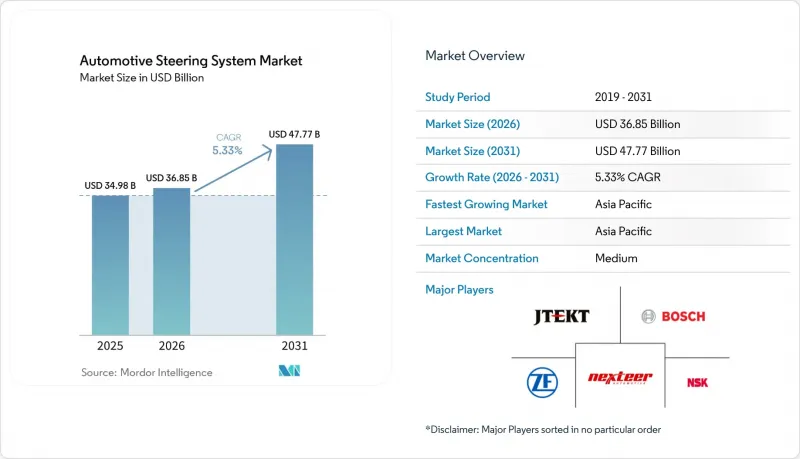
Mordor Intelligence에 따르면 자동차 스티어링 시스템 시장 규모는 2025년에 349억 8,000만 달러로 평가되며, 2026년에는 368억 5,000만 달러로 확대될 것으로 추정되며, 2031년까지 477억 7,000만 달러에 달할 것으로 예측됩니다.
2026년부터 2031년까지 연평균 성장률(CAGR) 5.33%로 성장할 것으로 전망됩니다.
본 보고서는 구성 부품(유압 펌프, 전기 모터 등), 차종(승용차, 상용차), 구조(전동 파워 스티어링(EPS), 유압식 파워 스티어링(HPS) 등), 판매 채널(OEM 및 애프터마켓), 지역(아메리카 등)별로 분류되어 있습니다. 시장 예측은 금액(달러) 기준으로 제시되어 있습니다.
세계 자동차용 스티어링 시스템 시장의 동향 및 인사이트
내연기관(ICE) 및 신에너지차(XEV) 플랫폼에서의 EPS의 급속한 보급
EPS는 전기자동차(EV) 주도 기술로 흔히 설명되지만, 자동차 스티어링 시스템 시장에서 여전히 가장 많은 생산 대수를 차지하는 것은 내연기관(ICE) 및 하이브리드 차량의 생산입니다. 유압 펌프를 제거함으로써 엔진의 부하가 경감되고 연비가 3-5% 향상되므로, 내연기관 플랫폼이 여전히 차량 생산 대수의 대부분을 차지하는 분야에서도 EPS의 중요성은 여전히 남아 있습니다. 또한, EPS는 차선 유지, 자동 주차, 조향 보정에 사용되는 제어 가능한 액추에이터이므로, 보조 운전 기능을 탑재한 차량이 늘어남에 따라 그 역할은 더욱 확대될 것으로 예상됩니다. 저비용의 컬럼 어시스트 방식은 대량 생산 모델에서 여전히 중요하지만, 중량이 큰 SUV나 대형 전동화 차량에는 표준 C-EPS가 일반적으로 제공할 수 있는 토크보다 더 큰 토크가 필요합니다. 넥스테어(Nextair)는 2025년 4월, 일반적인 C-EPS의 범위를 뛰어넘는 크로스오버 차량 및 엔트리급 EV 프로그램을 위해 보조 용량을 110 Nm까지 확장한 ‘고출력 컬럼 어시스트형 EPS’를 발표했습니다. 이를 통해 자동차용 스티어링 시스템 시장은 공급업체들이 단일 EPS 도입의 흐름에 의존하기보다는, 더 큰 차종 클래스 및 고출력 모델로 단계적으로 전환해 나가는 방향을 유지하고 있습니다.
2025년부터 프리미엄 전기자동차에 도입된 스티어 바이 와이어
스티어 바이 와이어는 2025년부터 2026년까지 기술적 가능성 단계에서 양산 단계로 전환되며, 자동차 스티어링 시스템 시장에 새로운 프리미엄 성장층을 가져왔습니다. ZF는 2025년 2월 NIO의 ET9용 양산을 시작했으며, 메르세데스-벤츠는 2026년 4월 ZF의 하드웨어를 채택한 EQS 부분 변경 모델에서 유럽 양산에 스티어 바이 와이어를 도입했습니다. Nexteer 역시 2026년 4월, 중국 NEV 제조사를 대상으로 ASIL-D 인증을 획득한 스티어 바이 와이어 생산을 시작했으며, 이는 해당 아키텍처 분야에서 이 회사의 첫 본격적인 양산 프로그램이 되었습니다. 2026년 7월 1일 시행되는 GB17675-2025에 따라 기계식 스티어링 링크 의무화가 철폐되고 상용화에 명확한 법적 근거가 마련됨에 따라, 중국은 여전히 가장 중요한 추진력으로 남아 있습니다. NIO, XPeng, BYD, Li Auto의 프로그램 존재는 이 기술의 채택이 이미 초고급차 부문을 넘어 더 폭넓은 전기자동차 가격대로 확산되고 있음을 보여줍니다. ZF가 장자강에서 계획하고 있는 연간 38만 세트의 스티어 바이 와이어 생산능력 역시, 각 공급업체들이 자동차용 스티어링 시스템 시장이 시범 생산 규모가 아닌 상당한 생산량을 흡수할 것이라는 전제 하에 현재 자본을 투입하고 있음을 보여줍니다.
희토류 자석의 가격 변동이 EPS의 부품 원가를 끌어올린다
NdFeB 자석은 EPS 모터의 성능을 좌우하는 핵심 요소이므로, 희토류에 대한 의존은 자동차용 스티어링 시스템 시장에서 여전히 가장 명백한 공급 위험 중 하나입니다. 전 세계 희토류 정제량의 91%, 소결 NdFeB 자석 생산량의 94%를 중국이 차지하고 있기 때문에 중국의 정책 변화는 공급망 전체의 비용 곡선을 급격하게 변화시킵니다. 2025년 4월, 중국 상무부(MOFCOM)가 7종류의 중·중희토류 원소에 대해 시행한 수출 허가 조치는, 스티어링 모터에 요구되는 고온 성능에서 디스프로슘과 테르븀이 중요하기 때문에 전망을 더욱 어둡게 만들었습니다. 2026년 초부터 같은 해 후반에 걸쳐 NdPr 산화물의 가격은 대폭 급등한 후 안정세를 보였습니다. 이로 인해 특히 가격 민감도가 가장 높은 차량 부문에서 EPS 프로그램의 부품 원가(BOM)에 대한 압박이 크게 가중되었습니다. 이에 대응하여 각 공급업체는 중국 외 지역에서의 조달 계약을 체결하는 한편, 수요가 낮은 용도에 최적화된 페라이트계 모터 설계에 주력하고 있습니다. 동시에 라이너스(Lynas) 등의 생산업체들은 중국 국경을 넘어 NdPr 생산능력을 확대하고 있습니다. 이러한 조치에도 불구하고, 자동차용 스티어링 시스템 시장은 불균형한 비용 부담에 직면해 있습니다. 즉, 주류인 EPS 어셈블리는 프리미엄급 스티어-바이-와이어 방식의 제품에 비해 가격 면에서 더 엄격한 제약에 놓여 있는 상황입니다.
부문 분석
2025년, 스티어링 컬럼/랙은 자동차용 스티어링 시스템 시장의 38.74%를 차지하며, 모든 스티어링 아키텍처에서 가장 큰 구성품 그룹이 되었습니다. 이러한 우위는 전자기기 및 소프트웨어에 대한 부가가치가 확대되고 있음에도 불구하고, EPS, EHPS 및 기타 유압식 시스템에서도 컬럼,랙, 샤프트, 조인트, 기어 기구가 여전히 필수불가결하다는 사실을 반영합니다. 이 분야의 매출이 견조한 추세를 보이는 이유는 보조 기능이 어떻게 제공되든 간에, 모든 차량에서 조작된 조향 입력을 휠 각도로 변환하는 기계적 경로가 여전히 필요하기 때문입니다. 자동차 스티어링 시스템 시장에서, 이로 인해 컬럼·랙 세트는 기반이 되는 구성요소 계층으로서의 역할을 수행하는 한편, 전자 장치가 제품의 차별화를 점점 더 결정짓게 되고 있습니다. 유압 펌프 하위 부문은 현재 지속적인 압박을 받고 있습니다. 이는 새로운 승용차 플랫폼이 유압식 조향에서 전동 보조 방식으로 계속 전환되고 있기 때문입니다.
이러한 변화로 인해 부품 수요가 사라지는 것은 아니며, 그 가치가 전동 모터, ECU 및 센서 소자로 이동하고 있습니다. ECU 매출이 증가하고 있는 이유는 EPS 컨트롤러가 단순히 보조 로직을 처리하는 데 그치지 않고, 토크 오버레이, 센서 퓨전 입력, 그리고 점점 더 소프트웨어로 정의되는 조향 거동을 관리하게 되었기 때문입니다. 또한, ADAS 지원 시스템에서는 진단 범위 요건을 충족하기 위해 여러 토크, 각도, 위치 측정이 필요하기 때문에 센서 계층도 심화되고 있으며, 그 결과 어셈블리당 부품 수가 증가하고 있습니다. 고출력 EPS 및 페일 오퍼레이셔널(fail-operational) 설계가 더 많은 차종에 보급됨에 따라, 전기 모터는 2026년부터 2031년까지 연평균 성장률(CAGR) 8.53%로 성장할 것으로 예측되며, 자동차 조향 시스템 시장에서 가장 두드러진 성장을 보일 부품이 될 전망입니다. 듀얼 권선 브러시리스 DC 모터는 L2+ 애플리케이션에서 표준 구성으로 자리 잡고 있습니다. 이는 단일 고장이 발생한 후에도 각 권선이 부분적인 조향 제어 능력을 유지해야 하기 때문입니다. 스티어 바이 와이어로의 전환은 랙 액추에이터 모터와 스티어링 휠 피드백 시뮬레이터 모터가 별도로 구성되기 때문에 시스템당 모터 탑재 수를 증가시켜 수요를 더욱 확대하고 있습니다. 넥스테어(Nextair)사의 2025년 수주 구성을 살펴보면, 순수 전기자동차(EV) 및 전기자동차와 내연기관(ICE)의 하이브리드 플랫폼이 큰 비중을 차지하고 있으며, 이러한 구성의 변화가 이미 수주 실적에 명확하게 나타나고 있음을 알 수 있습니다. 그 결과, 자동차 스티어링 시스템 업계에서는 기계식 스티어링 하드웨어의 근본적인 중요성을 훼손하지 않으면서도, 가치의 중심이 전자 통합형 모터 어셈블리로 꾸준히 이동하고 있습니다.
2025년, 승용차는 자동차 스티어링 시스템 시장 점유율의 62.65%를 차지하고 있으며, 이는 생산 대수의 증가와 신형 승용차 모델에 EPS가 거의 완전히 보급된 것을 모두 반영하고 있습니다. SUV는 그 무게와 넓은 타이어 접지면적 덕분에 더 강한 횡방향 토크를 감당할 수 있는 랙 어시스트 방식 및 듀얼 피니언 방식의 EPS 솔루션에 대한 수요를 뒷받침하고 있어, 이 차종 그룹 내에서 여전히 가장 중요한 차체 스타일을 차지하고 있습니다. 해치백은 도시 지역의 운전 패턴이 소형 차체를 계속해서 뒷받침하고 있는 유럽과 남아시아에서 여전히 중요한 위치를 차지하고 있으며, 세단은 중국 내 생산을 통해 안정적인 역할을 유지하고 있습니다. 다목적차(MPV)는 절대적인 규모로는 여전히 작지만, 가족용 차체 형태가 꾸준한 인기를 유지하고 있는 동남아시아에서는 그 중요성을 유지하고 있습니다. 승용차 전체에서 자동차 스티어링 시스템 시장은 이미 유럽과 일본에서 확립된 EPS 기준에 따라 형성되어 있습니다. 동시에, 중국의 NEV 플랫폼에서는 EPS와 스티어 바이 와이어(Steer-by-Wire)를 조기에 도입하는 경향이 강해지고 있습니다.
상용차는 2026년부터 2031년까지 연평균 성장률(CAGR) 7.28%로 성장할 것으로 예측되며, 자동차 조향 시스템 시장에서 가장 빠르게 성장하는 차종 카테고리가 될 전망입니다. 단기적인 성장 동력은 도시 지역 배송 차량의 소형 상용차 전동화이며, 이곳에서는 전기 구동계가 도입됨에 따라 기존 레이아웃에서 유압식 파워 스티어링이 당연시되던 상황이 변화하고 있습니다. 중형 및 대형 상용차의 경우, 앞축 하중이 여전히 매우 높기 때문에 유압식 또는 전기유압식 스티어링에 크게 의존하고 있습니다. 그렇지만 고속도로에서의 자율주행 기능에는 보다 정밀한 차선 중앙 유지 제어가 요구되기 때문에 그 방향성은 변화하고 있습니다. 이러한 수요에 따라 트럭 제조사들은 미래 플랫폼을 위해 이중화된 EPS 설계를 평가하고 있으며, 특히 고속도로에서의 자율주행이나 플래토닝이 제품 로드맵에 포함된 경우에는 그 경향이 두드러집니다. 한 미국 특허 출원에서는 상용차의 모드 전환 시 안전한 컨트롤러 전환이 강조되고 있는데, 이는 고속 주행 중 고장 발생 시의 제어 인계에 대해 현재 기능 안전 관점에서 관심이 집중되고 있음을 반영합니다. 공급업체에게 있어 상용차 분야의 비즈니스 기회는 매력적입니다. 왜냐하면 이러한 전환은 전동 보조의 기본 수준이 비교적 낮은 단계에서 시작되기 때문에 전환의 여지가 더 크기 때문입니다. 또한, 지금까지 승용차가 주류를 이루던 전동화 프로그램에 고토크 스티어링 부품을 도입함으로써, 자동차용 스티어링 시스템 시장의 수익 구조를 다각화하는 데에도 기여할 것입니다. 따라서 자동차용 스티어링 시스템 업계는 전기자동차의 증가뿐만 아니라, 제어 정밀도가 전략적 가치를 지닌 대형 차량 용도에서의 스티어링 전동화에 대한 수요 증가에도 의존하게 될 것입니다.
지역별 분석
아시아태평양은 2025년 자동차 스티어링 시스템 시장 규모의 48.25%를 차지하고 있으며, 2031년까지 연평균 성장률(CAGR) 6.52%로 확대될 것으로 예상됩니다. 이에 따라 이 지역은 최대 시장 규모와 가장 빠른 성장률을 모두 갖추게 될 것입니다. 중국은 세계 최대의 자동차 생산 규모와 단기적으로 가장 탄탄한 스티어 바이 와이어 도입 계획이 결합되어 있어, 자동차 스티어링 시스템 시장에서 여전히 가장 중요한 국가로 남아 있습니다. 2025년까지 중국에서는 신에너지차 생산이 대폭 증가하여, EPS 및 새로운 바이와이어 플랫폼에 대한 수요 증가가 반영될 전망입니다. 2026년에 GB17675-2025에 따라 시행될 예정인 상용 스티어 바이 와이어 도입을 위한 법적 프레임워크의 정비는, 중국의 주요 OEM 업체들이 이미 이 분야의 프로그램을 승인한 점을 고려할 때 중요한 의미를 지닙니다. 한편, 인도는 전기자동차에 대한 강력한 정책 지원과 국내 제조 클러스터에 대한 투자를 통해 지역 전체의 성장세를 뒷받침하고 있습니다. 반면, 일본은 2026년에 ‘렉서스 RZ 550e F SPORT’에 스티어 바이 와이어 시스템이 도입되는 것에서 알 수 있듯이, 정밀 스티어링 공급 및 프리미엄 바이 와이어 개발 분야에서 실력을 입증하고 있습니다.
유럽은 2025년에도 자동차용 스티어링 시스템 시장에서 2위의 규모를 자랑하는 지역으로, 엄격한 안전 및 배기가스 규제에 더해 탄탄한 Tier 1 공급업체 기반의 뒷받침을 받아 지속적인 성장을 이어가고 있습니다. 독일은 ZF와 보쉬 양사가 양산 공급 체제로 전환하고, 메르세데스-벤츠가 2026년 EQS를 통해 유럽 최초로 대규모 양산 도입을 달성함에 따라, 해당 지역에서 스티어 바이 와이어 추진의 중심지가 되고 있습니다. 이 지역의 규제 동향에 따라 EPS 수요는 견조한 추세를 보이고 있습니다. 이는 과거에는 구식 유압식 솔루션으로도 허용되던 상황에서도, 차선 유지 지원 및 안전 기능 측면에서 전자 제어가 가능한 조향 출력의 필요성이 높아지고 있기 때문입니다. 보쉬는 이미 바이 와이어 시스템에 대해 장기적으로 상당한 수익 전망을 제시하고 있으며, 이는 각 공급업체들이 이러한 전환을 얼마나 진지하게 받아들이고 있는지를 보여줍니다. 체코, 슬로바키아, 헝가리 등 동유럽의 생산 거점은 서유럽 OEM 프로그램의 조립 거점 역할을 수행함으로써 계속해서 EPS 수요를 흡수하고 있습니다. 반면, 러시아는 제재와 공급망의 고립으로 인해 첨단 반도체 및 최고 수준의 스티어링 시스템에 대한 접근이 제한되고 있어 전환 속도가 더딘 상황입니다.
북미는 여전히 자동차 스티어링 시스템 시장에서 주요 지역으로 남아 있습니다. 그 이유는 이 지역의 제품 구성에 대형 픽업 트럭과 풀사이즈 SUV가 포함되어 있으며, 이러한 차종은 역사적으로 다른 지역보다 오랫동안 유압식 및 전기유압식 스티어링을 채택해 왔기 때문입니다. 현재, 보조 운전 기능이 대형 차량에도 보급됨에 따라, 이러한 제품 구성이 고출력 EPS 및 향후 스테어 바이 와이어 시스템에 중요한 기회를 창출하고 있습니다. 남미는 계속해서 브라질과 아르헨티나의 조립 주기에 연동되어 있으며, 브라질이 주요 생산·유통 거점 역할을 하는 한편, 기존 차량의 노후화에 따라 EPS 교체 시장이 확대되고 있습니다. 중동 및 아프리카에서는 사우디아라비아와 UAE의 차량 대수 증가, 그리고 유럽의 스티어링 규격을 충족해야 하는 튀르키예의 수출용 생산 거점에 힘입어 규모는 작지만 꾸준한 성장을 보이고 있습니다.
기타 혜택:
- 엑셀 형식의 시장 예측(ME) 시트
- 3개월간의 애널리스트 지원
자주 묻는 질문
목차
제1장 소개
제2장 조사 방법
제3장 주요 요약
제4장 시장 구도
제5장 시장 규모와 성장 예측
제6장 경쟁 구도
제7장 시장 기회와 향후 전망
KSM 26.08.25According to Mordor Intelligence, the automotive steering system market size was valued at USD 34.98 billion in 2025, is estimated to grow to USD 36.85 billion in 2026, and is projected to reach USD 47.77 billion by 2031, growing at a 5.33% CAGR over 2026-2031.
This report is Segmented by Component (Hydraulic Pump, Electric Motor, and More), Vehicle Type (Passenger Cars, Commercial Vehicles), Mechanism (Electronic Power Steering (EPS), Hydraulic Power Steering (HPS), and More), Sales Channel (OEM and Aftermarket), and Geography (North America, South America, and More). The Market Forecasts are Provided in Terms of Value (USD).
Global Automotive Steering System Market Trends and Insights
Rapid EPS Penetration in ICE and XEV Platforms
EPS is often described as an EV-led technology, but the bigger volume engine in the automotive steering system market still comes from ICE and hybrid vehicle production. Removing the hydraulic pump reduces parasitic engine load and improves fuel economy by 3-5%, keeping EPS relevant even where combustion platforms still account for most vehicle output. EPS is also the controllable actuator used for lane keeping, automated parking, and steering correction, so its role is expected to grow as more vehicles add assisted driving features. The lower-cost column-assist format still matters for high-volume programs, yet heavier SUVs and larger electrified vehicles need more torque than standard C-EPS can usually deliver. Nexteer responded in April 2025 with a High-Output Column-Assist EPS that extends assist capacity to 110 Nm for crossover and entry EV programs, which sit above the normal C-EPS range . This keeps the automotive steering system market on a stepwise migration path, where suppliers move through larger vehicle classes and higher-output variants rather than relying on a single wave of EPS adoption.
Steer-By-Wire Deployment in Premium EVs From 2025
Steer-by-wire moved from technical promise to serial production during 2025 and 2026, adding a new premium growth layer to the automotive steering system market. ZF began series production for NIO's ET9 in February 2025, and Mercedes-Benz brought steer-by-wire into European series production in April 2026 on the refreshed EQS using ZF hardware. Nexteer also began ASIL-D-certified steer-by-wire production in April 2026 for a Chinese NEV manufacturer, marking its first full-scale production program in this architecture. China remains the most important catalyst because GB17675-2025, effective July 1, 2026, removes the mandatory mechanical steering link and gives commercial deployment a clear legal basis. The presence of programs from NIO, XPeng, BYD, and Li Auto shows that adoption is already moving below the ultra-luxury tier and into broader EV price bands. ZF's planned capacity of 380,000 steer-by-wire sets a year in Zhangjiagang also shows that suppliers are now committing capital on the assumption that the automotive steering system market will absorb meaningful production volume rather than pilot-scale output .
Rare-Earth Magnet Price Volatility Inflates EPS BOM
Rare-earth exposure remains one of the clearest supply risks in the automotive steering system market because NdFeB magnets are central to EPS motor performance. China accounts for 91% of globally refined rare earth output and 94% of sintered NdFeB magnet manufacturing, so policy changes there move cost curves quickly across the rest of the supply chain. MOFCOM's April 2025 export licensing action on seven medium and heavy rare earth elements tightened the outlook further because dysprosium and terbium are important for the high-temperature performance needed in steering motors. From the start of 2026 to later that year, NdPr oxide prices experienced a significant surge before easing. This substantially increased bill-of-materials pressures for EPS programs, particularly in the most price-sensitive vehicle categories. In response, suppliers are forging non-Chinese sourcing agreements and delving deeper into ferrite-based motor designs tailored for applications with lower demand. Concurrently, producers like Lynas are ramping up NdPr capacity beyond China's borders. Despite these measures, the automotive steering system market grapples with a lopsided cost burden: mainstream EPS assemblies have tighter pricing constraints compared to their premium steer-by-wire counterparts.
Other drivers and restraints analyzed in the detailed report include:
- OEM Demand For ADAS-Ready "Fail-Operational" Architectures
- Cyber-Secure ECU Mandates in UNECE R155 Markets
- Automotive MCU Shortage Through 2026
For complete list of drivers and restraints, kindly check the Table Of Contents.
Segment Analysis
Steering Column/Rack accounted for 38.74% of the automotive steering system market in 2025, making it the largest component group across all steering architectures. That lead reflects the fact that columns, racks, shafts, joints, and gear mechanisms remain present in EPS, EHPS, and the remaining hydraulic programs, even as more value moves into electronics and software. Revenue in this area stays resilient because every vehicle still needs the mechanical path that translates commanded steering input into wheel angle, regardless of how the assist function is delivered. Within the automotive steering system market, this makes the column-and-rack set the anchor content layer, while electronics increasingly determine product differentiation. The hydraulic pump sub-segment is now under sustained pressure because new passenger car platforms continue to move away from hydraulic steering in favor of electric assist.
That shift is shifting value toward electric motors, ECUs, and sensing elements rather than eliminating demand for components. ECU revenue is rising because EPS controllers now manage torque overlay, sensor fusion inputs, and increasingly software-defined steering behavior, rather than handling only assist logic. The sensors layer is also deepening because ADAS-ready systems require multiple torque, angle, and position measurements to meet diagnostic coverage expectations, thereby increasing content per assembly. Electric Motor is projected to grow at 8.53% CAGR from 2026 to 2031, making it the fastest-growing component in the automotive steering system market as higher-output EPS and fail-operational designs spread across more vehicle classes. Dual-winding brushless DC motors are becoming a more common baseline for L2+ applications because each winding must maintain partial steering authority after a single fault. The steer-by-wire transition adds another layer of demand because the rack actuator motor is separate from the steering-wheel feedback simulator motor, which increases motor content per system. Nexteer's 2025 booking mix, with a significant share tied to fully EV and split EV-and-ICE platforms, shows that this content shift is already evident in active business awards. As a result, the automotive steering system industry is seeing the value center steadily shift toward electronically integrated motor assemblies without diminishing the fundamental importance of mechanical steering hardware.
Passenger Cars held 62.65% of the automotive steering system market share in 2025, reflecting both higher unit production and near-complete penetration of EPS in new passenger models. SUVs remain the most important body style within this vehicle group because their weight and wider tire footprints support demand for rack-assist and dual-pinion EPS solutions with stronger lateral torque handling. Hatchbacks still matter in Europe and South Asia, where urban driving patterns continue to support compact formats, and sedans keep a stable role through domestic Chinese production. Multi-purpose vehicles remain smaller in absolute terms, yet they retain relevance in Southeast Asia, where family-oriented vehicle formats continue to have enduring appeal. Across passenger cars, the automotive steering system market is already shaped by an established EPS baseline in Europe and Japan. At the same time, Chinese NEV platforms increasingly pair EPS with early steer-by-wire preparation.
Commercial Vehicles are projected to grow at a 7.28% CAGR from 2026 to 2031, making them the fastest-growing vehicle category in the automotive steering system market. The near-term lift comes from light commercial vehicle electrification in urban delivery fleets, where electric drivetrains remove the natural fit that hydraulic power steering once had in conventional layouts. Medium and heavy commercial vehicles still rely heavily on hydraulic or electro-hydraulic steering because front axle loads remain very high. Still, the direction of travel is changing as automated highway functions require more precise lane-centering control. That need is prompting truck manufacturers to evaluate redundant EPS designs for future platforms, especially where highway automation or platooning is part of the product roadmap. A U.S. patent application highlighted safe controller switching during commercial vehicle mode transitions, which reflects the functional safety attention now being placed on fault handover at highway speeds. For suppliers, the commercial vehicle opportunity is attractive because the shift starts from a lower electric-assist base, offering more room for conversion. It also broadens the revenue mix of the automotive steering system market by bringing higher-torque steering content into electrification programs that were previously dominated by passenger cars. The automotive steering system industry will therefore depend not only on more EVs, but also on the growing need to electrify steering in heavy-duty applications where control precision has strategic value.
Complete Report Scope:
- By Component
- Hydraulic Pump
- Electric Motor
- Steering Column / Rack
- Sensors (Torque, Angle, Position)
- Electronic Control Unit (ECU)
- Other Components
- By Vehicle Type
- Passenger Cars
- Hatchback
- Sedan
- Sport Utility Vehicle
- Multi-Purpose Vehicle
- Commercial Vehicles
- Light Commercial Vehicles
- Medium and Heavy Commercial Vehicles
- Passenger Cars
- By Mechanism
- Electronic Power Steering (EPS)
- Hydraulic Power Steering (HPS)
- Electro-hydraulic Power Steering (EHPS)
- Steer-by-Wire
- By Sales Channel
- Original Equipment Manufacturer (OEM)
- Aftermarket
- By Geography
- North America
- United States
- Canada
- Rest of North America
- South America
- Brazil
- Argentina
- Rest of South America
- Europe
- Germany
- United Kingdom
- France
- Italy
- Russia
- Rest of Europe
- Asia-Pacific
- China
- Japan
- India
- South Korea
- Rest of Asia-Pacific
- Middle East and Africa
- Turkey
- Saudi Arabia
- United Arab Emirates
- South Africa
- Rest of Middle East and Africa
- North America
Geography Analysis
Asia-Pacific accounted for 48.25% of the automotive steering system market size in 2025 and is expected to expand at a 6.52% CAGR through 2031, giving it both the largest base and the fastest growth rate. China remains the most important country within the automotive steering system market because it combines the world's largest vehicle production footprint with the strongest near-term steer-by-wire pipeline. By 2025, China will have experienced significant growth in new energy vehicle production, reflecting rising demand for EPS and new by-wire platforms. The formalization of the legal pathway for commercial steer-by-wire deployment, set to take effect in 2026 under GB17675-2025, holds significance as major Chinese OEMs have already greenlit programs in this domain. Meanwhile, India bolsters regional momentum with robust EV policy support and investments in domestic manufacturing clusters. Japan, on the other hand, showcases its prowess in precision steering supply and premium by-wire development, as evidenced by the launch of the Lexus RZ 550e F SPORT's steer-by-wire system in 2026.
Europe remained the second-largest regional block in the automotive steering system market in 2025 and continues to be driven by strict safety and emissions rules, plus a dense Tier-1 supplier base. Germany is the center of the region's steer-by-wire push because ZF and Bosch have both moved into serial supply positions, and Mercedes-Benz introduced the first large-scale European series application on the EQS in 2026. The region's regulatory path keeps EPS demand firm because assisted-lane and safety features increasingly require electronically controllable steering output, even where older hydraulic solutions were once acceptable. Bosch has already attached major long-range revenue expectations to by-wire systems, which shows how seriously the supplier base views this transition. Eastern European production hubs such as the Czech Republic, Slovakia, and Hungary continue to absorb EPS demand by serving as assembly locations for Western OEM programs. At the same time, Russia faces a slower path due to sanctions and supply-chain isolation, which limit access to advanced semiconductors and top-tier steering systems.
North America remains a major region in the automotive steering system market because its product mix includes large pickups and full-size SUVs that have historically supported hydraulic and electro-hydraulic steering for longer than in other regions. That same mix now creates an important opportunity for higher-output EPS and future steer-by-wire systems as assisted-driving features spread to larger vehicles. South America continues to track the assembly cycles of Brazil and Argentina, with Brazil acting as the main production and distribution base and a growing EPS replacement market emerging as the installed fleet ages. The Middle East and Africa show steadier but smaller gains, supported by fleet growth in Saudi Arabia and the UAE, and by Turkey's export-linked production base, which must meet European steering specifications.
- JTEKT Corporation
- Robert Bosch GmbH
- ZF Friedrichshafen AG
- Nexteer Automotive Corporation
- NSK Ltd.
- HL Mando Corporation
- Astemo Ltd.
- Hyundai Mobis
- thyssenkrupp Presta AG
- Schaeffler Group
- Denso Corporation
- Knorr-Bremse AG
- China Automotive Systems, Inc.
Additional Benefits:
- The market estimate (ME) sheet in Excel format
- 3 months of analyst support
TABLE OF CONTENTS
1 Introduction
- 1.1 Study Assumptions & Market Definition
- 1.2 Scope of the Study
2 Research Methodology
3 Executive Summary
4 Market Landscape
- 4.1 Market Overview
- 4.2 Market Drivers
- 4.2.1 Rapid EPS Penetration in ICE and XEV Platforms
- 4.2.2 Steer-By-Wire Deployment in Premium EVs From 2025
- 4.2.3 OEM Demand For ADAS-Ready "Fail-Operational" Architectures
- 4.2.4 Cyber-Secure ECU Mandates in UNECE R155 Markets
- 4.2.5 Lightweight Steering Columns to Meet Euro 7/CAFE Norms
- 4.2.6 OTA-Upgradable Torque-Overlay Software Revenues
- 4.3 Market Restraints
- 4.3.1 Rare-Earth Magnet Price Volatility Inflates EPS BOM
- 4.3.2 Automotive MCU Shortage Through 2026
- 4.3.3 Steering-Feel Concerns Slowing Steer-By-Wire Rollout
- 4.3.4 Tier-1 Consolidation Limits OEM Bargaining Leverage
- 4.4 Value / Supply-Chain Analysis
- 4.5 Technological Outlook
- 4.6 Regulatory Landscape
- 4.7 Porter's Five Forces
- 4.7.1 Threat of New Entrants
- 4.7.2 Bargaining Power of Buyers
- 4.7.3 Bargaining Power of Suppliers
- 4.7.4 Threat of Substitutes
- 4.7.5 Competitive Rivalry
5 Market Size & Growth Forecasts (Value, USD)
- 5.1 By Component
- 5.1.1 Hydraulic Pump
- 5.1.2 Electric Motor
- 5.1.3 Steering Column / Rack
- 5.1.4 Sensors (Torque, Angle, Position)
- 5.1.5 Electronic Control Unit (ECU)
- 5.1.6 Other Components
- 5.2 By Vehicle Type
- 5.2.1 Passenger Cars
- 5.2.1.1 Hatchback
- 5.2.1.2 Sedan
- 5.2.1.3 Sport Utility Vehicle
- 5.2.1.4 Multi-Purpose Vehicle
- 5.2.2 Commercial Vehicles
- 5.2.2.1 Light Commercial Vehicles
- 5.2.2.2 Medium and Heavy Commercial Vehicles
- 5.2.1 Passenger Cars
- 5.3 By Mechanism
- 5.3.1 Electronic Power Steering (EPS)
- 5.3.2 Hydraulic Power Steering (HPS)
- 5.3.3 Electro-hydraulic Power Steering (EHPS)
- 5.3.4 Steer-by-Wire
- 5.4 By Sales Channel
- 5.4.1 Original Equipment Manufacturer (OEM)
- 5.4.2 Aftermarket
- 5.5 By Geography
- 5.5.1 North America
- 5.5.1.1 United States
- 5.5.1.2 Canada
- 5.5.1.3 Rest of North America
- 5.5.2 South America
- 5.5.2.1 Brazil
- 5.5.2.2 Argentina
- 5.5.2.3 Rest of South America
- 5.5.3 Europe
- 5.5.3.1 Germany
- 5.5.3.2 United Kingdom
- 5.5.3.3 France
- 5.5.3.4 Italy
- 5.5.3.5 Russia
- 5.5.3.6 Rest of Europe
- 5.5.4 Asia-Pacific
- 5.5.4.1 China
- 5.5.4.2 Japan
- 5.5.4.3 India
- 5.5.4.4 South Korea
- 5.5.4.5 Rest of Asia-Pacific
- 5.5.5 Middle East and Africa
- 5.5.5.1 Turkey
- 5.5.5.2 Saudi Arabia
- 5.5.5.3 United Arab Emirates
- 5.5.5.4 South Africa
- 5.5.5.5 Rest of Middle East and Africa
- 5.5.1 North America
6 Competitive Landscape
- 6.1 Market Concentration
- 6.2 Strategic Moves
- 6.3 Market Share Analysis
- 6.4 Company Profiles (Includes Global Level Overview, Market Level Overview, Core Segments, Financials as Available, Strategic Information, Market Rank/Share for Key Companies, Products and Services, SWOT Analysis, and Recent Developments)
- 6.4.1 JTEKT Corporation
- 6.4.2 Robert Bosch GmbH
- 6.4.3 ZF Friedrichshafen AG
- 6.4.4 Nexteer Automotive Corporation
- 6.4.5 NSK Ltd.
- 6.4.6 HL Mando Corporation
- 6.4.7 Astemo Ltd.
- 6.4.8 Hyundai Mobis
- 6.4.9 thyssenkrupp Presta AG
- 6.4.10 Schaeffler Group
- 6.4.11 Denso Corporation
- 6.4.12 Knorr-Bremse AG
- 6.4.13 China Automotive Systems, Inc.