

|
시장보고서
상품코드
2113533
의료용 로봇 시스템 : 시장 점유율 분석, 업계 동향 및 통계, 성장 예측(2026-2031년)Medical Robotic Systems - Market Share Analysis, Industry Trends & Statistics, Growth Forecasts (2026 - 2031) |
||||||
 Mordor Intelligence
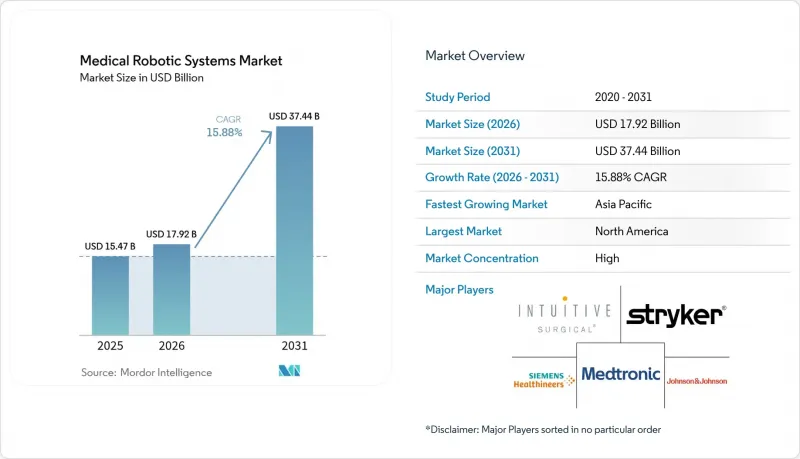
Mordor Intelligence에 의하면, 의료용 로봇 시스템 시장 규모는 2025년 154억 7,000만 달러에서 2026년에는 179억 2,000만 달러에 이르고, 2026-2031년 CAGR15.88%로 성장을 지속하여 2031년까지 374억 4,000만 달러에 달할 것으로 예측됩니다.
본 보고서는 제품 유형(외과용 로봇 시스템 등), 구성 부품(로봇 시스템, 기구·부속품 등), 용도(일반외과, 정형외과 등), 최종 사용자(병원 및 클리닉 등), 자동화 수준(원격 조작 등) 및 지역(북미, 유럽 등)별로 세분화되어 있습니다. 시장 전망은 금액(달러) 기준으로 제시되어 있습니다.
전 세계 의료용 로봇 시스템 시장 동향 및 인사이트
미국 및 유럽에서 외래 로봇 수술센터 도입 가속화
외래 수술 시설은 입원 시설에 비해 수술 비용을 30-40% 절감하면서도 동등한 임상 성과를 달성하고 있으며, 이러한 차이로 인해 보험사는 적절한 증례를 당일 진료 경로로 유도하도록 권장받고 있습니다. 메디케어의 2025년 지급 기준 개정에 따라 ASC(외래수술센터(ASC)) 대상 목록은 계속해서 확대되고 있으며, 민간 보험사들도 수술 건수가 많은 센터에 보상을 제공하는 일괄 지급 제도를 도입하고 있습니다. 유럽의 제도도 이에 발맞추고 있으며, 독일에서는 병원에 대한 자금 지원을 수술 건수 기준치에 연동함으로써, 지역 네트워크가 로봇 자산을 공동으로 활용하여 복잡한 증례를 현지에서 처리할 수 있도록 장려하고 있습니다.
중국 3급 병원에서 종양학에 특화된 로봇 수술의 급증
중국 국가위생건강위원회는 암 치료 프로토콜에서 로봇 보조 절제술에 대한 언급을 늘리고 있으며, 기존에 자본 예산이 부족했던 성급 핵심 병원의 도입을 뒷받침하고 있습니다. 병원들은 로봇 기술을 활용하여 1급 도시에서 최고 수준의 외과의를 초빙하고, 광범위한 네트워크 전반에 걸쳐 치료 성과를 표준화하고 있습니다. 국내 공급업체들이 저가형 시스템으로 시장에 진입하여 도입 비용을 절감하는 한편, 정부의 목표를 상회하는 속도로 보급을 가속화하고 있습니다.
보증 기간 종료 후 미납된 서비스 비용이 증가하여 중소 병원 시장 진입을 저해
보증 기간 이후 서비스 비용이 급증하는 가운데, 의료 로봇 시장은 큰 과제에 직면해 있으며, 특히 중소규모 병원에 미치는 영향이 두드러집니다. 일반적으로 로봇 수술 시스템의 연간 서비스 요금은 시스템 구매 가격의 12%에서 18% 범위 내로 설정되어 있습니다. 이러한 지속적인 재정적 부담은 수술 건수가 중규모에서 소규모인 많은 의료기관에게 지속 불가능한 부담이 되고 있습니다. 그 결과, 지방이나 2차 병원에서는 미뤄진 유지보수 건이 누적되고 있어 가동 중단 시간 증가와 로봇 투자에 대한 수익성 저하를 초래하고 있습니다. 이러한 상황은 경쟁 제3자 업체의 유지보수 서비스 이용이 제한적이라는 점, 생의학 서비스에 대한 인플레이션 압력, 그리고 OEM(원래 장비 제조업체)의 대응 지연 등으로 인해 더욱 악화되고 있습니다. 이러한 과제로 인해 일부 병원에서는 예방적 유지보수가 아닌 사후 대응형 유지보수 방식을 채택할 수밖에 없는 실정입니다. 이러한 유지보수 지연은 구형 소프트웨어에 대한 의존, 운영상의 안전성 저하, 그리고 수술 선택지의 제한으로 이어질 가능성이 있습니다. 병원 내에 생의학 엔지니어를 보유하지 않은 소규모 병원은 대개 고액의 OEM 기술자에 크게 의존할 수밖에 없으며, 이는 재정적 문제를 더욱 심각하게 만들고 있습니다. 이렇게 누적되는 유지보수 지연은 의료법적 위험을 높일 뿐만 아니라, 로봇 수술 중단 가능성을 높이고, AI 가이드 내비게이션과 같은 신기술 도입을 방해하는 요인이 되고 있습니다. 그 영향은 동남아시아, 동유럽, 라틴아메리카 등 지역에서 특히 두드러집니다. 이러한 지역에서는 병원의 이익률이 낮고 수술 건수가 많기 때문에 고액의 서비스 비용을 정당화하기에는 아직 이릅니다.
부문 분석
2025년, 외과 수술 시스템은 확립된 보험 환급 코드와 외과 의사를 위한 충실한 연수 체제에 힘입어 의료용 로봇 시스템 시장에서 26.35%의 점유율을 유지했습니다. 그 이용 범위는 비뇨기과, 산부인과, 일반외과, 정형외과 수술에 이르기까지 다양하며, 다빈치(da Vinci) 시스템의 누적 수술 건수는 전 세계적으로 1,500만 건을 넘어섰습니다. 사이버나이프(CyberKnife) 등의 플랫폼이 주도하는 방사선 외과 분야의 종양학 응용에서는 국소 종양 제어율이 89.3%를 기록하며, 임상적 수용도가 더욱 높아지고 있습니다.
재활 솔루션은 매출 면에서는 뒤처지고 있지만, 공공 자금을 통한 뇌졸중 프로그램을 배경으로 급속히 확대되고 있습니다. 외골격을 활용한 세션은 치료 강도가 높으며, 초기 의료경제학 연구에 따르면 기존 물리치료에 비해 기능 회복 속도가 15% 더 빠른 것으로 나타났습니다. 이러한 요인들이 결합되어 재활용 로봇은 연평균 성장률(CAGR) 18.48%를 달성하고 있으며, 이는 의료용 로봇 시스템 시장 내에서 가장 높은 성장률입니다.
2025년에는 의료용 로봇 시스템 시장의 50.35%를 소모품 및 부속품이 차지했습니다. 이는 모든 시술에서 스테이플러, 트로카, 에너지 칩 등의 일회용 소모품이 필요하기 때문입니다. 처리 능력이 높은 병원에서는 콘솔 1대당 하루 평균 7건의 로봇 수술이 이루어지고 있으며, 이 속도라면 일괄 구매에 따른 가격 할인을 적용한 후에도 공급업체는 두 자릿수의 이익률을 확보할 수 있습니다. 고객 유지를 위해 공급업체는 일회용 소모품을 자동으로 보충하고 비용을 환자의 진료 기록에 직접 청구하는 스마트 재고 캐비닛을 도입하고 있으며, 이를 통해 건당 간호 시간을 12분 단축하고 있습니다.
리스, 보증, 소프트웨어, 교육에 이르는 서비스는 의료 기관이 자본 묶임보다 운영비 모델을 선호하기 때문에 연평균 성장률(CAGR) 18.3%라는 더욱 빠른 속도로 확대되고 있습니다. 다년 계약의 ‘서비스형 소프트웨어(SaaS)’ 패키지에는 현재 무제한 기기 사용, 예측 유지보수, 분기별 소프트웨어 업데이트가 포함되어 있어, 새로운 하드웨어 없이도 AI 안내 기능을 강화하고 있습니다. 캘리포니아 대학교 헬스 네트워크(UC Health Network)와 같은 병원에서는 가상현실(VR)을 활용한 리허설 모듈을 호스팅하는 구독형 포털로 전환한 결과, 가동률이 2% 향상되었고, 신규 외과 의사의 인증 절차가 9% 단축되었다고 보고되었습니다. 각 벤더사는 요금 수준을 수술 건수와 연동하는 추세가 강해지고 있으며, 경제성과 이용 현황을 일치시킴으로써 계약 갱신을 거의 원활하게 진행할 수 있도록 하고 있습니다.
지역별 분석
북미는 2025년 매출의 35.45%를 차지했습니다. 이는 FDA의 명확한 승인 절차, 강력한 벤처 자금, 그리고 보험사의 로봇 수술 코드 수용에 힘입은 결과입니다. 미국의 외래 진료 센터에서는 다학제적 치료를 지원하는 로봇 수술실 도입이 점점 더 확대되고 있습니다. 또한, 캐나다 각 주의 입찰에서는 초기 예산을 관리하기 위해 리스 방식으로의 전환이 진행되고 있습니다. 멕시코의 사립 병원에서는 비용 대비 효과가 높은 비만 치료 및 정형외과 수술을 원하는 해외 의료 관광객을 수용하기 위해 로봇 수술이 적극적으로 도입되고 있습니다.
아시아태평양은 공공 자금, 인구 통계학적 압력, 그리고 피보험자 수 증가에 힘입어 2031년까지 연평균 성장률(CAGR)이 17.6%에 달하며 가장 빠르게 성장하는 지역입니다. 중국에서는 3급 병원의 조달에 힘입어 종양학 분야의 로봇 도입 대수가 가속화되고 있습니다. 한편, 일본에서는 국민건강보험 제도 하에서 뇌졸중 후 재활용 외골격 장치에 대한 지원이 이루어지고 있습니다. 인도의 민간 병원 체인은 의료 서비스의 차별화를 꾀하고 해외에 거주하는 인도인 환자를 유치하기 위해 로봇을 도입하고 있으며, 수술 비용은 서유럽권의 동종 시설에 비해 40-60% 저렴합니다.
유럽에서는 지불 제도의 다양성으로 인해 완만하긴 하지만 착실하게 도입이 진행되고 있습니다. 독일에서는 수술 건수에 기반한 품질 기준에 따라, 특히 내장외과나 심장외과 분야에서 로봇에 대한 투자가 촉진되고 있습니다. 영국의 NICE(국립의료기술평가기구)는 비용 대비 효과의 기준치를 규정하고 있어, 도입까지의 기간은 길어지지만 지속 가능한 활용이 보장되고 있습니다. 프랑스, 이탈리아, 스페인에서는 지역 클러스터 간에 로봇 자산을 공유하고 있으며, 북유럽 국가들에서는 치료 성과 벤치마킹을 위해 로봇 관련 데이터를 국가 등록부에 통합하고 있습니다.
기타 혜택:
- 엑셀 형식 시장 예측(ME) 시트
- 3개월간의 애널리스트 지원
자주 묻는 질문
목차
제1장 서론
제2장 조사 방법
제3장 주요 요약
제4장 시장 구도
제5장 시장 규모와 성장 예측
제6장 경쟁 구도
제7장 시장 기회와 향후 전망
LSH 26.08.25According to Mordor Intelligence, the medical robotic systems market size is expected to grow from USD 15.47 billion in 2025 to USD 17.92 billion in 2026 and is forecast to reach USD 37.44 billion by 2031 at 15.88% CAGR over 2026-2031.
This report is Segmented by Product Type (Surgical Robotic Systems, and More), Component (Robotics Systems, Instruments and Accessories, and More), Application (General Surgery, Orthopedic Surgery, and More), End User (Hospitals and Clinics, and More), Automation Level (Tele-Operated, and More), and Geography (North America, Europe, and More). The Market Forecasts are Provided in Terms of Value (USD).
Global Medical Robotic Systems Market Trends and Insights
Accelerating Adoption of Outpatient Robotic Surgery Centers in the United States & Europe
Ambulatory surgery facilities reduce procedure costs by 30-40% relative to inpatient settings while matching clinical outcomes, a differential that compels payers to steer appropriate cases into same-day pathways. Medicare's payment updates for 2025 continue to expand the ASC-eligible list, and private insurers deploy bundled payments that reward high-throughput centers. European systems follow suit; Germany links hospital funding to procedure-volume thresholds, prompting regional networks to pool robotic assets to keep complex cases local.
Rapid Surge in Oncology-Focused Robotic Procedures within China's Tier-3 Hospitals
China's National Health Commission increasingly references robot-assisted resection in its oncology protocols, spurring procurement among provincial referral centers that traditionally lacked capital budgets. Hospitals leverage robotics to recruit top surgeons from tier-1 cities and to standardize outcomes across sprawling networks. Domestic vendors enter with lower-priced systems, compressing acquisition costs and accelerating penetration beyond state targets.
Rising Back-log of Post-Warranty Service Costs Deterring Smaller Hospitals
As post-warranty service expenses surge, the medical robots market faces a significant challenge, particularly affecting smaller hospitals. Typically, annual service fees for robotic surgical systems range between 12% and 18% of the system's original cost. This recurring financial burden proves unsustainable for many mid- and low-volume facilities. Consequently, rural and Tier-2 hospitals are experiencing a growing backlog of deferred maintenance, resulting in increased downtime and diminished returns on their robotics investments. The situation is exacerbated by limited access to competitive third-party servicing, inflationary pressures on biomedical services, and sluggish response times from original equipment manufacturers (OEMs). These challenges have prompted some hospitals to adopt a reactive maintenance approach rather than a preventive one. Such a backlog can result in reliance on outdated software, compromised operational safety, and limited surgical options. Without in-house biomedical engineers, smaller hospitals often find themselves heavily reliant on costly OEM technicians, which intensifies their financial challenges. This mounting service backlog not only heightens medico-legal risks but also increases the likelihood of cancelled robotic procedures and hinders the adoption of emerging technologies, such as AI-guided navigation. The repercussions are most pronounced in regions such as Southeast Asia, Eastern Europe, and Latin America, where hospitals operate on thin margins and surgical volumes fall short of justifying the steep service costs.
Other drivers and restraints analyzed in the detailed report include:
- Mandatory Minimum-Volume Policies in Germany Pushing Hospitals toward Robotic Systems for Complex Surgeries
- Emergence of Subscription & Leasing Business Models Reducing Up-front CAPEX in Middle-Income Markets
- Data-Protection Regulations (GDPR/HIPAA) Limiting Cloud-Connected Robot Analytics
For complete list of drivers and restraints, kindly check the Table Of Contents.
Segment Analysis
Surgical systems retained a 26.35% share of the medical robotic systems market in 2025, buoyed by mature reimbursement codes and extensive training pipelines among surgeons. Utilization spans urology, gynecology, general, and orthopedic procedures, with cumulative da Vinci case volumes surpassing 15 million globally. Oncology applications in radiosurgery, led by platforms such as CyberKnife, demonstrate a 89.3% local tumor control rate, reinforcing clinical acceptance.
Rehabilitative solutions trail in revenue but are scaling quickly on the back of publicly funded stroke programs. Exoskeleton sessions deliver higher therapy intensity, and early health-economic studies show 15% faster functional recovery versus conventional physiotherapy. Combined, these factors push rehabilitation robotics to an 18.48% CAGR, the fastest within the medical robotic systems market.
Consumable instruments and accessories accounted for 50.35% of the medical robotic systems market share in 2025, as every procedure requires single-use items such as staplers, trocars, and energy tips. High-throughput hospitals average seven robotic cases per console per day, a cadence that secures double-digit margins for vendors even after bulk-pricing concessions. To entrench loyalty, suppliers introduce smart inventory cabinets that automatically replenish disposables and book charges directly to patient dossiers, thereby trimming nursing time by 12 minutes per case.
Services, spanning lease, warranty, software, and training, scale even faster at an 18.3% CAGR, as providers favor operating-expense models over capital lock-in. Multi-year "system-as-a-service" packages now bundle unlimited instruments, predictive maintenance, and quarterly software updates that enhance AI guidance without requiring new hardware. Hospitals, such as the University of California health network, report a 2% higher uptime and 9% quicker credentialing of new surgeons after migrating to subscription portals that host virtual reality (VR) rehearsal modules. Vendors increasingly tie fee levels to case volumes, aligning economics with utilization and making renewals almost frictionless.
Complete Report Scope:
- By Product Type
- Surgical Robotic Systems
- Rehabilitative Robotic Systems
- Non-invasive Radiosurgery Robots
- Hospital and Pharmacy Automation Robots
- Other Product Types
- By Component
- Robotic Systems
- Instruments and Accessories
- Services (Maintenance, Training, Subscription)
- Software and AI Platforms
- By Application
- General Surgery
- Orthopedic Surgery
- Neurosurgery
- Cardiovascular
- Gynecology
- Urology
- Oncology
- Laparoscopy and Thoracoscopy
- Other Applications
- By End User
- Hospitals and Clinics
- Ambulatory Surgery Centers
- Rehabilitation Centers
- Homecare Settings
- By Automation Level
- Tele-operated
- Semi-autonomous
- Autonomous
- Assistive and Collaborative
- By Geography
- North America
- United States
- Canada
- Mexico
- Europe
- United Kingdom
- Germany
- France
- Italy
- Rest of Europe
- Asia-Pacific
- China
- Japan
- India
- South Korea
- Rest of Asia
- Middle East
- Israel
- Saudi Arabia
- United Arab Emirates
- Turkey
- Rest of Middle East
- Africa
- South Africa
- Egypt
- Rest of Africa
- South America
- Brazil
- Argentina
- Rest of South America
- North America
Geography Analysis
North America captured 35.45% revenue in 2025, supported by clear FDA pathways, strong venture funding, and payer acceptance of robotic codes. U.S. ambulatory centers increasingly integrate multi-specialty robotic suites, and Canada's provincial tenders shift toward leasing to manage upfront budgets. Mexico's private hospitals embrace robotics to service inbound medical tourists seeking cost-effective bariatric and orthopedic procedures.
The Asia-Pacific region is the fastest-growing geography, with a 17.6% CAGR to 2031, driven by public funding, demographic pressure, and rising insured populations. China's tier-3 hospital procurements accelerate oncology robot volumes, while Japan subsidizes exoskeletons for post-stroke therapy under its national insurance scheme. India's corporate hospital chains adopt robots to differentiate care and draw diaspora patients, with procedural pricing 40-60% lower than Western counterparts.
Europe shows moderate but steady adoption shaped by heterogeneous payer systems. Germany's volume-based quality rules force robotic investment, especially in visceral and cardiac surgery. The United Kingdom's NICE incorporates cost-effectiveness thresholds, stretching adoption timelines yet ensuring sustainable utilization. France, Italy, and Spain pool robotic assets across regional clusters, while the Nordics integrate robotic data feeds into national registries for outcome benchmarking.
- Intuitive Surgical Inc.
- Stryker Corporation
- Medtronic plc
- Johnson and Johnson (Ethicon/Auris)
- Siemens Healthineers AG (incl. Corindus)
- CMR Surgical Ltd
- Smith and Nephew plc
- Zimmer Biomet Holdings Inc.
- Globus Medical Inc.
- Asensus Surgical Inc.
- Brainlab AG
- Think Surgical Inc.
- PROCEPT BioRobotics Corp.
- Vicarious Surgical Inc.
- Titan Medical Inc.
- Renishaw plc
- MicroPort MedBot
- Accuray Incorporated
- Omnicell Technologies Inc.
- Aethon Inc.
Additional Benefits:
- The market estimate (ME) sheet in Excel format
- 3 months of analyst support
TABLE OF CONTENTS
1 INTRODUCTION
- 1.1 Study Assumptions and Market Definition
- 1.2 Scope of the Study
2 RESEARCH METHODOLOGY
3 EXECUTIVE SUMMARY
4 MARKET LANDSCAPE
- 4.1 Market Overview
- 4.2 Market Drivers
- 4.2.1 Accelerating Adoption of Outpatient Robotic Surgery Centers in the United States and Europe
- 4.2.2 Rapid Surge in Oncology-Focused Robotic Procedures within China's Tier-3 Hospitals
- 4.2.3 Mandatory Minimum-Volume Policies in Germany Pushing Hospitals toward Robotic Systems for Complex Surgeries
- 4.2.4 Emergence of Subscription and Leasing Business Models Reducing Up-front CAPEX in Middle-Income Markets
- 4.2.5 Integration of AI-Powered Intra-operative Imaging Driving Precision Neurosurgery Adoption
- 4.2.6 Government-Sponsored Rehabilitation Robotics Programs Addressing Stroke Burden in Japan and South Korea
- 4.3 Market Restraints
- 4.3.1 Rising Back-log of Post-Warranty Service Costs Deterring Smaller Hospitals
- 4.3.2 Data-Protection Regulations (GDPR/HIPAA) Limiting Cloud-Connected Robot Analytics
- 4.3.3 Shortage of Certified Robotic Surgeons in Latin America Slowing Utilization Rates
- 4.3.4 Stringent FDA Cybersecurity Draft Guidance Elevating Compliance Costs for New Entrants
- 4.4 Industry Value Chain Analysis
- 4.5 Regulatory and Technological Outlook
- 4.6 Porter's Five Forces Analysis
- 4.6.1 Bargaining Power of Suppliers
- 4.6.2 Bargaining Power of Buyers
- 4.6.3 Threat of New Entrants
- 4.6.4 Threat of Substitutes
- 4.6.5 Intensity of Competitive Rivalry
5 MARKET SIZE AND GROWTH FORECASTS (VALUE)
- 5.1 By Product Type
- 5.1.1 Surgical Robotic Systems
- 5.1.2 Rehabilitative Robotic Systems
- 5.1.3 Non-invasive Radiosurgery Robots
- 5.1.4 Hospital and Pharmacy Automation Robots
- 5.1.5 Other Product Types
- 5.2 By Component
- 5.2.1 Robotic Systems
- 5.2.2 Instruments and Accessories
- 5.2.3 Services (Maintenance, Training, Subscription)
- 5.2.4 Software and AI Platforms
- 5.3 By Application
- 5.3.1 General Surgery
- 5.3.2 Orthopedic Surgery
- 5.3.3 Neurosurgery
- 5.3.4 Cardiovascular
- 5.3.5 Gynecology
- 5.3.6 Urology
- 5.3.7 Oncology
- 5.3.8 Laparoscopy and Thoracoscopy
- 5.3.9 Other Applications
- 5.4 By End User
- 5.4.1 Hospitals and Clinics
- 5.4.2 Ambulatory Surgery Centers
- 5.4.3 Rehabilitation Centers
- 5.4.4 Homecare Settings
- 5.5 By Automation Level
- 5.5.1 Tele-operated
- 5.5.2 Semi-autonomous
- 5.5.3 Autonomous
- 5.5.4 Assistive and Collaborative
- 5.6 By Geography
- 5.6.1 North America
- 5.6.1.1 United States
- 5.6.1.2 Canada
- 5.6.1.3 Mexico
- 5.6.2 Europe
- 5.6.2.1 United Kingdom
- 5.6.2.2 Germany
- 5.6.2.3 France
- 5.6.2.4 Italy
- 5.6.2.5 Rest of Europe
- 5.6.3 Asia-Pacific
- 5.6.3.1 China
- 5.6.3.2 Japan
- 5.6.3.3 India
- 5.6.3.4 South Korea
- 5.6.3.5 Rest of Asia
- 5.6.4 Middle East
- 5.6.4.1 Israel
- 5.6.4.2 Saudi Arabia
- 5.6.4.3 United Arab Emirates
- 5.6.4.4 Turkey
- 5.6.4.5 Rest of Middle East
- 5.6.5 Africa
- 5.6.5.1 South Africa
- 5.6.5.2 Egypt
- 5.6.5.3 Rest of Africa
- 5.6.6 South America
- 5.6.6.1 Brazil
- 5.6.6.2 Argentina
- 5.6.6.3 Rest of South America
- 5.6.1 North America
6 COMPETITIVE LANDSCAPE
- 6.1 Market Concentration
- 6.2 Strategic Moves (MandA, Partnerships, Funding)
- 6.3 Market Share Analysis
- 6.4 Company Profiles (includes Global level Overview, Market level overview, Core Segments, Financials as available, Strategic Information, Market Rank/Share for key companies, Products and Services, and Recent Developments)
- 6.4.1 Intuitive Surgical Inc.
- 6.4.2 Stryker Corporation
- 6.4.3 Medtronic plc
- 6.4.4 Johnson and Johnson (Ethicon/Auris)
- 6.4.5 Siemens Healthineers AG (incl. Corindus)
- 6.4.6 CMR Surgical Ltd
- 6.4.7 Smith and Nephew plc
- 6.4.8 Zimmer Biomet Holdings Inc.
- 6.4.9 Globus Medical Inc.
- 6.4.10 Asensus Surgical Inc.
- 6.4.11 Brainlab AG
- 6.4.12 Think Surgical Inc.
- 6.4.13 PROCEPT BioRobotics Corp.
- 6.4.14 Vicarious Surgical Inc.
- 6.4.15 Titan Medical Inc.
- 6.4.16 Renishaw plc
- 6.4.17 MicroPort MedBot
- 6.4.18 Accuray Incorporated
- 6.4.19 Omnicell Technologies Inc.
- 6.4.20 Aethon Inc.
7 MARKET OPPORTUNITIES AND FUTURE OUTLOOK
- 7.1 White-space and Unmet-Need Assessment


