

|
시장보고서
상품코드
2113615
바이오플라스틱 : 시장 점유율 분석, 업계 동향 및 통계, 성장 예측(2026-2031년)Bioplastics - Market Share Analysis, Industry Trends & Statistics, Growth Forecasts (2026 - 2031) |
||||||
 Mordor Intelligence
Mordor Intelligence에 의하면, 바이오플라스틱 시장 규모는 2025년 237만 톤에서 2026년에는 278만 톤으로 확대되어 2031년까지 618만 톤에 이를 것으로 예측되며, 2026-2031년 CAGR 17.33%를 기록할 전망입니다.
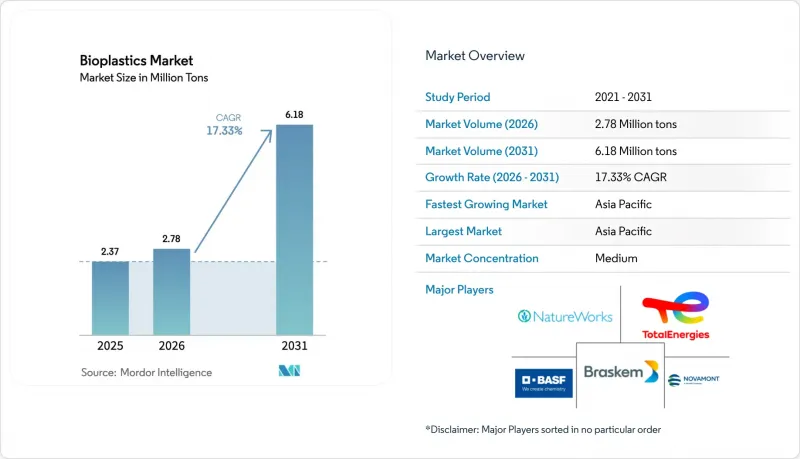
본 보고서는 유형(바이오 생분해성 플라스틱 및 바이오 비생분해성 플라스틱), 원료(사탕수수/사탕무, 옥수수 등), 가공 기술(압출 성형, 사출 성형, 블로우 성형 등),용도(연포장, 경질 포장 등), 지역(아시아태평양, 북미, 유럽 등)별로 분류되어 있습니다. 시장 예측은 수량(톤) 단위로 제시되어 있습니다.
전 세계 바이오플라스틱 시장 동향 및 인사이트
유럽 및 아시아에서의 일회용 플라스틱 사용 금지 의무화
발포 폴리스티렌, 옥소 분해성 봉투 및 폴리에틸렌 빨대에 대한 규제상 금지 조치로 인해, 2021년 이후 석유 유래 플라스틱 수요가 약 120만 톤 감소했으며, 인증된 퇴비화 가능한 대체재에 대한 즉각적인 수요가 발생하고 있습니다. 2024년 7월 유럽집행위원회가 발표한 지침에서는 적용 예외를 EN 13432 표준과 연계함으로써 정의가 더욱 엄격해졌으며, 이로 인해 옥소 첨가제가 포함된 포장재가 배제됨과 동시에 푸드서비스용 용기에 PLA의 보급이 가속화되었습니다. 인도에서는 중앙공해관리위원회가 2024년 한 해 동안 불시 감사를 실시하여 5억 루피 상당의 규제 위반 재고를 압수함에 따라, 가공업체들은 PLA 및 전분 혼합 소재에 대해 다년 계약을 체결하게 되었습니다. 태국의 2025년 1월 로드맵에서는 적용 범위가 호텔 및 패스트푸드점까지 확대되고, 2027년까지 퇴비화 가능한 소재의 비율을 40%로 의무화함에 따라 국내 신규 생산 능력에 대한 위험이 완화되었습니다. 규정 위반 시 벌금 및 브랜드 소유자의 법적 책임이 따르기 때문에 하이난에서 구자라트에 이르기까지 그린필드 공장에 대한 설비 투자 결정은 현재 인수 계약에 의해 뒷받침되고 있습니다.
지속 가능한 포장재 및 친환경 플라스틱에 대한 수요 급증
주요 소비재 기업들은 2030년까지 850만 톤의 버진 플라스틱을 대체하겠다고 공동으로 약속했지만, 2025년 중반 시점에서 그 요건의 82%는 여전히 계약이 체결되지 않은 상태였습니다. 이러한 조달 격차는 드롭인형 바이오 PE 및 차세대 PLA 합금에 대한 제안 요청서(RFP) 증가를 촉진하고 있습니다. 유니레버는 2024년 바이오 PE 조달량을 전년 대비 22% 증가한 4만 7,000톤으로 늘리고, 2027년까지 3배로 확대하는 것을 목표로 하고 있습니다. 네슬레 워터스는 프랑스에서 PLA로만 제작된 병에 대한 실증 실험을 실시하여 rPET에 비해 ‘크래들-투-게이트’ 배출량을 35% 감축했으나, 55℃ 이상에서 열변형이 발생하기 때문에 판매는 냉장 유통 채널로 제한되었습니다. 다논은 2025년 3월, 네이처웍스(NatureWorks)와의 제휴를 통해 PLA의 열변형 온도 상한을 70°C까지 높여, 남유럽에서 상온 보관이 가능한 요거트 컵을 실현하는 것을 목표로 하고 있습니다. 여기서 얻을 수 있는 교훈은 분명합니다. 각 브랜드는 경질 용기의 경우 드롭인 제품을, 유연한 필름의 경우 생분해성 합금을 사용하는 등 조달을 세분화하고 있으며, 이러한 각 접근 방식은 기존 생산 라인에 미치는 영향을 최소화하면서 서로 다른 규제 시험 요건을 충족하고 있습니다.
원유 가격 침체 속 석유계 플라스틱 대비 가격 프리미엄
2024년부터 2025년에 걸쳐 PLA의 거래 가격은 톤당 2,200-3,800달러로推移했으며, 브렌트 원유가 배럴당 평균 75달러였던 시기에는 버진 LDPE의 약 2배 수준이었습니다. 탄소세나 퇴비화 의무화가 없는 상황에서 인도와 동남아시아의 가공업체들은 테이크아웃 용기를 PP에서 PLA로 전환할 때 최대 60%의 비용 증가에 직면하고 있습니다. 2025년 초, 브라질의 가뭄으로 인해 에탄올 가격이 12% 급등함에 따라, 브라스켐(Braskem)사의 바이오 PE 프리미엄은 톤당 300달러에서 450달러로 확대되었습니다. 따라서 원유 가격의 침체가 장기화되면 정책 주도 수요를 제외한 모든 수요가 위협을 받게 되며, 대부분의 생산자는 원유 가격이 아닌 설탕 가격에 연동된 장기 판매 계약을 통해 이익률을 보호할 수밖에 없게 됩니다.
부문별 분석
2025년, 바이오 유래의 비생분해성 플라스틱은 바이오플라스틱 시장에서 56.64%의 점유율을 차지했습니다. 이는 바이오 PET 및 바이오 PE가 기존 설비에서 제조 가능하며, 병 등급의 투명성을 유지하고, 확립된 재활용 루프에 적합하기 때문입니다. 코카콜라는 2024년에 900억 번째 ‘PlantBottle’을 출하하며, PET 베일의 순도를 저해하지 않는 부분적인 바이오 함유로 규모의 경제를 입증했습니다. PLA 및 전분 블렌드가 주도하는 생분해성 플라스틱군은 23.46%의 성장률을 보이고 있으며, 매립 폐기물 감축 규제가 유럽에서 남미로 확대됨에 따라 시장 점유율을 확대해 나갈 전망입니다. PLA는 이미 북미의 청과물용 투명 클램쉘 용기 시장을 휩쓸고 있는 반면, 전분과 PBAT의 조합은 옥수수 유래 마스터배치보다 15% 저렴한 가격의 카사바 유래 마스터배치에 힘입어 동남아시아 전역의 식료품용 봉투 시장을 휩쓸고 있습니다. PHA의 해양 생분해성 특성은 어구 등 쓰레기로 인한 위험이 심각한 이용 사례에 대응하고 있습니다. 바카디사가 병 뚜껑에 PHA를 채택한 사례는 성능이 브랜드의 미학을 충족한다면 틈새 시장에서도 규모 확대가 가능함을 보여줍니다. 바이오 PA는 연료 라인 및 섬유용으로 여전히 고성능 폴리머로서의 위상을 유지하고 있으며, 그 높은 이익률은 생산자를 원유 가격 변동으로부터 보호하고 있습니다. 전반적으로 이 부문의 동향은 드롭인 소재가 대량 생산용 포장 시장을 유지하는 한편, 생분해성 소재가 규제 대상인 틈새 시장에 침투하여 2031년까지 차별화된 생산 능력 확장을 주도할 것임을 시사합니다.
2025년에는 사탕수수와 사탕무 유래 원료가 총 생산량의 42.28%를 차지하며 비용 곡선을 안정시키고 있습니다. 이는 브라질의 제당 공장이 바가스를 이용한 열병합 발전 크레딧과 에탄올 헤지를 결합하여 투입 마진을 안정화하고 있기 때문입니다. 옥수수 유래 덱스트로스는 네브래스카주 블레어에 위치한 네이처웍스의 연산 150 ktpa PLA 공장의 원료로 사용되고 있지만, 가격 변동과 토지 이용에 대한 엄격한 감시로 인해 생산자들은 잔여물 유래 당으로의 전환을 강요받고 있습니다. 셀룰로오스 기반 경로는 연평균 성장률(CAGR) 24.59%로 성장할 전망입니다. 그 선두에 서 있는 것은 리그노셀룰로오스계 시럽을 아반티움(Avantium)사의 폴리에틸렌 프라노에이트(PFA) 파일럿 라인에 판매하는 펄프 공장이며, 해당 라인은 PET에 비해 산소 차단성이 50% 향상되었다고 홍보하고 있습니다. 카사바 전분은 태국의 열가소성 봉투용 등급의 원료로 사용되고 있으며, 현지 농업 기술과 손익분기점을 6년으로 단축시키는 BOI(태국 투자위원회)의 세제 혜택 조치를 활용하고 있습니다. 조류 및 미생물 유래 유지류는 2024년부터 2025년에 걸쳐 1억 8,000만 달러의 벤처 자금을 조달했으며, 현재는 RWDC사의 ‘Solon PHA’를 현행 PHA 지수 가격보다 20% 저렴한 가격에 공급하고 있습니다. 따라서 원료의 다각화는 원자재 가격 변동 위험을 억제할 뿐만 아니라, 대형 소비재(FMCG) 기업들이 내세우는 ‘산림 파괴 제로’ 조달 공약과도 부합합니다.
지역별 분석
아시아태평양은 2025년에 전 세계 총량의 47.75%를 차지할 것으로 보이며, 2031년까지 연평균 성장률(CAGR) 22.51%로 성장할 전망입니다. 이러한 성장의 원동력은 중국의 택배용 생분해성 포장재 30% 의무화, 태국의 PLA 공장에 대한 세제 혜택, 그리고 인도의 일회용 플라스틱 규제로 인해 12,000개 가공 업체가 퇴비화 가능한 수지로 전환을 추진한 데 있습니다. 중국석유화학(Sinopec)은 2024년 9월 하이난성에 연간 60 ktpa 규모의 PBAT 생산 시설을 개장했습니다. 이 시설은 사탕수수 유래 에탄올과 통합되어 있어 원료 비용을 15% 절감하는 동시에 자유무역항의 우대 조치 대상에 포함됩니다. 릴라이언스 인더스트리즈와 다니마는 2026년까지 구자라트주에 연간 30 ktpa 규모의 PHA 공장을 건설할 계획이며, 이는 국내 멀티필름 수요와 유럽의 해양 생분해성 플라스틱 수요를 모두 충족시킬 예정입니다. 2025년 4월 일본이 도입한 보조금 제도는 바이오 수지로 전환하는 중소 성형 제조업체의 설비 투자액의 50%를 보전해 주는 것으로, 공급망의 현지화가 기후 변화 대책 및 안보상의 목표라는 정책적 인식을 보여주고 있습니다.
북미와 유럽은 여전히 세계 표준을 수립하는 혁신의 거점으로 남아 있습니다. 미국의 ‘인플레이션 억제법’은 탄소 네거티브 폴리머에 대해 45Q 세액 공제를 적용하고 있으며, 브렌트 원유 가격이 70달러에 육박하는 상황에서도 네브래스카주의 PLA 생산은 경쟁력을 유지하고 있습니다. 독일은 PLA와 PET의 혼입 문제를 해결하기 위한 효소 재활용 실증 실험에 자금을 지원하고 있으며, EU의 ‘순환 경제 행동 계획’에서 화학적 재활용이 퇴비화와 공존할 수 있음을 시사하고 있습니다. 2024년 1월부터 전면 시행되고 있는 프랑스의 AGEC법은 식당 및 직원 구내식당에 토탈에너지즈 코르비온사의 태국 공장에서 공급하는 퇴비화 가능한 식기 사용을 의무화하고 있으며, 이는 국경을 초월한 공급망이 국내 규제 요건을 어떻게 충족하고 있는지를 보여줍니다. 영국의 플라스틱 포장세는 30% 기준치에 도달하면 재생 가능 탄소 크레딧의 대상이 되는 바이오 PE를 간접적으로 뒷받침하고 있습니다.
남미에서는 브라질의 설탕 플랫폼이 활용되고 있습니다. 브라켐(Braskem)사는 바이오 PE의 60%를 유럽 및 북미로 수출하고 있지만, 국내 보급은 금지 조치의 부재와 지불 의향 저하로 인해 지연되고 있습니다. 아르헨티나에서는 부에노스아이레스에서 분리 수거를 통한 퇴비화 시범 운영이 진행 중이며, 혼입률이 10% 미만으로 억제된다면 전국적인 확대가 검토되고 있습니다. 중동에서는 바이오 나프타의 활용 방안을 모색하고 있으며, SABIC사는 주바이르 공장에서 원료 전환을 검토하여 탄소 국경 조정 대상인 EU 고객사에 공급하는 것을 목표로 하고 있습니다. 남아프리카공화국은 2024년 말에 퇴비화할 수 없는 제품에 대한 생산자 책임 부담금 초안을 마련했으나, 소규모 가공업체들이 면제를 요구하며 로비 활동을 벌이고 있어 시행이 지연되고 있습니다.
기타 혜택:
- 엑셀 형식 시장 예측(ME) 시트
- 3개월간의 애널리스트 지원
자주 묻는 질문
목차
제1장 서론
제2장 조사 방법
제3장 주요 요약
제4장 시장 구도
제5장 시장 규모와 성장 예측
제6장 경쟁 구도
제7장 시장 기회와 향후 전망
LSH 26.08.25According to Mordor Intelligence, the bioplastics market size is expected to increase from 2.37 Million tons in 2025 to 2.78 Million tons in 2026 and reach 6.18 Million tons by 2031, growing at a CAGR of 17.33% over 2026-2031.
This report is Segmented by Type (Bio-Based Biodegradables and Bio-Based Non-Biodegradables), Feedstock (Sugarcane/Sugar Beet, Corn, and More), Processing Technology (Extrusion, Injection Molding, Blow Molding, and More), Application (Flexible Packaging, Rigid Packaging, and More), and Geography (Asia-Pacific, North America, Europe, and More). Market Forecasts are Provided in Terms of Volume (Tons).
Global Bioplastics Market Trends and Insights
Mandate for Single-Use-Plastic Bans in Europe and Asia
Regulatory prohibitions on polystyrene foam, Oxo-degradable bags, and polyethylene straws have removed roughly 1.2 million tons of petro-plastic demand since 2021, creating an immediate pull for certified-compostable alternatives. European Commission guidance issued in July 2024 further tightened definitions by linking exemptions to EN 13432, which sidelined oxo-additive packaging and accelerated PLA penetration into food-service ware. In India, the Central Pollution Control Board used spot audits throughout 2024 to seize non-compliant inventory valued at INR 500 million, prompting converters to lock in multi-year PLA and starch-blend contracts. Thailand's January 2025 roadmap extended the mandate to hotels and quick-service restaurants, requiring 40% compostable share by 2027 and thus derisking new domestic capacity. Because enforcement carries financial penalties and brand-owner liability, offtake contracts now underpin capital spending decisions for greenfield plants from Hainan to Gujarat.
Surging Demand for Sustainable Packaging and Eco-Friendly Plastics
Consumer-packaged-goods leaders collectively pledged to displace 8.5 million tons of virgin plastic by 2030, yet 82% of that requirement remained uncontracted as of mid-2025. This procurement gap has fueled RFPs for both drop-in bio-PE and next-generation PLA alloys. Unilever lifted its bio-PE intake to 47,000 tons in 2024-up 22% year over year-and targets a three-fold increase by 2027. Nestle Waters piloted full-PLA bottles in France that cut cradle-to-gate emissions by 35% versus rPET, though heat-distortion above 55 °C restricted sales to refrigerated channels. Danone's March 2025 collaboration with NatureWorks aims to push PLA's heat-deflection ceiling to 70 °C, unlocking ambient yogurt cups in Southern Europe. The takeaway is clear: brands are segmenting procurement between drop-ins for rigid formats and biodegradable alloys for flexible films, each pathway minimizing disruption to existing lines while meeting diverging regulatory tests.
Price Premium vs. Petro-Plastics Amid Low Oil Prices
PLA traded between USD 2,200 and USD 3,800 per ton in 2024-2025, roughly double virgin LDPE when Brent averaged USD 75 per barrel. Without carbon levies or mandated compostability, converters in India and Southeast Asia confront up to a 60% cost penalty for switching from PP to PLA in takeaway containers. Braskem's bio-PE premium widened from USD 300 to USD 450 per ton in early 2025 as ethanol prices spiked 12% on Brazilian drought. Sustained crude weakness therefore threatens all but policy-driven demand, forcing most producers to hedge margins through long-term offtake deals indexed to sugar rather than oil.
Other drivers and restraints analyzed in the detailed report include:
- Corporate Net-Zero Procurement of Low-Carbon Polymers
- Advanced Mechanical-Recycling Compatibility Incentives
- Heat-Resistance and Barrier-Property Gaps in PLA Grades
For complete list of drivers and restraints, kindly check the Table Of Contents.
Segment Analysis
The bio-based non-biodegradable class held a 56.64% bioplastics market share in 2025 because bio-PET and bio-PE run on legacy facilities, preserve bottle-grade clarity, and fit established recycling loops. Coca-Cola shipped its 90 billionth PlantBottle in 2024, validating the scale advantage of partial bio-content that keeps PET bale purity intact. The biodegradables family, led by PLA and starch blends, is growing at 23.46% and will erode share as landfill-diversion mandates spread from Europe to South America. PLA already dominates transparent clamshells for North American produce, while starch-PBAT combinations own grocery bags across Southeast Asia, aided by cassava-based masterbatches priced 15% below corn counterparts. PHA's marine-biodegradable profile tackles use-cases where litter risk is acute, such as fishing gear; Bacardi's adoption for bottle caps demonstrates how niche applications can scale once performance meets brand aesthetics. Bio-PA remains a performance polymer for fuel-lines and textile fibers, its high margin insulating producers from crude swings. Overall, the segment profile signals that drop-ins will retain large-volume packaging accounts while biodegradables penetrate regulated niches, driving differentiated capacity deployment through 2031.
Sugarcane and sugar-beet streams supplied 42.28% of total volume in 2025, anchoring cost curves because Brazilian mills bundle bagasse cogeneration credits and ethanol hedges to stabilize input margins. Corn-based dextrose feeds NatureWorks' 150 ktpa Blair, Nebraska, PLA unit, yet price volatility and land-use scrutiny are pushing producers toward residue-based sugars. Cellulosic pathways will expand at a 24.59% CAGR, spearheaded by pulp mills that sell lignocellulosic syrup into Avantium's polyethylene furanoate pilot line, which touts a 50% oxygen-barrier gain over PET. Cassava starch underwrites Thailand's thermoplastic bag grades, exploiting local agronomy and BOI tax holidays that cut break-even time to six years. Algae and microbial oils attracted USD 180 million in venture funding during 2024-2025 and now supply RWDC's Solon PHA at 20% below prevailing PHA index prices. Feedstock diversification, therefore, limits commodity risk and aligns with deforestation-free procurement pledges issued by major FMCG companies.
Complete Report Scope:
- By Type
- Bio-based Biodegradables
- Starch-based
- Polylactic Acid (PLA)
- Polyhydroxyalkanoates (PHA)
- Polyesters (PBS, PBAT, PCL)
- Other Bio-based Biodegradables
- Bio-based Non-biodegradables
- Bio Polyethylene Terephthalate (PET)
- Bio Polyethylene
- Bio Polyamides
- Bio Polytrimethylene Terephthalate
- Other Bio-based Non-biodegradables
- Bio-based Biodegradables
- By Feedstock
- Sugarcane / Sugar Beet
- Corn
- Cassava and Potato
- Cellulosic and Wood Waste
- Others (Algae and Microbial Oil)
- By Processing Technology
- Extrusion
- Injection Molding
- Blow Molding
- 3D Printing
- Others (Thermoforming, etc.)
- By Application
- Flexible Packaging
- Rigid Packaging
- Automotive and Assembly Operations
- Agriculture and Horticulture
- Construction
- Textiles
- Electrical and Electronics
- Other Applications
- By Geography
- Asia-Pacific
- China
- India
- Japan
- South Korea
- Indonesia
- Thailand
- Rest of Asia-Pacific
- North America
- United States
- Canada
- Mexico
- Europe
- Germany
- United Kingdom
- Italy
- France
- Netherlands
- Spain
- Rest of Europe
- South America
- Brazil
- Argentina
- Rest of South America
- Middle-East and Africa
- Saudi Arabia
- United Arab Emirates
- South Africa
- Egypt
- Rest of Middle-East and Africa
- Asia-Pacific
Geography Analysis
Asia-Pacific held 47.75% of global volume in 2025 and will grow at a 22.51% CAGR through 2031, driven by China's 30% biodegradable-packaging mandate for express deliveries, Thailand's tax holidays for PLA plants, and India's single-use-plastic enforcement that re-tooled 12,000 converters toward compostable resins. Sinopec opened a 60 ktpa PBAT facility in Hainan in September 2024, integrated with sugarcane ethanol to shave 15% off feedstock costs while qualifying for Free Trade Port incentives. Reliance Industries and Danimer plan a 30 ktpa PHA plant in Gujarat by 2026 to serve both domestic mulch film and European marine-biodegradable demand. Japan's April 2025 subsidy offset 50% of capex for SME molders converting to bio-resins, signaling policy recognition that supply-chain localization is a climate and security objective.
North America and Europe remain innovation hubs that write global specifications. The U.S. Inflation Reduction Act extends 45Q credits to carbon-negative polymers, making Nebraska's PLA output competitive even when Brent flirts with USD 70. Germany funds enzymatic recycling pilots to handle PLA-PET contamination, hinting that chemical recycling could coexist with composting in the EU Circular Economy Action Plan. France's AGEC law, fully in force since January 2024, pushes restaurants and canteens into compostable cutlery supplied by TotalEnergies Corbion's Thai plant, illustrating how cross-border supply networks meet domestic mandates. The United Kingdom's plastic-packaging tax indirectly favors bio-PE that qualifies for renewable-carbon credits once it reaches the 30% threshold.
South America leverages Brazil's sugar platform; Braskem exports 60% of its bio-PE to Europe and North America, but domestic uptake lags due to absent bans and low willingness to pay. Argentina pilots source-separated compost collection in Buenos Aires and may scale nationally if contamination rates stay below 10%. The Middle East explores bio-naphtha; SABIC studies feedstock switching at Jubail to supply EU customers exposed to carbon-border adjustments. South Africa drafted producer-responsibility fees on non-compostables in late 2024 but faces implementation delays as small converters lobby for exemptions.
- Arkema
- Avantium N.V.
- BASF
- BIOTEC Biologische Naturverpackungen GmbH & Co. KG.
- Braskem
- CJ CHEIL JEDANG CORP
- Danimer Scientific
- Eni S.p.A. (Novamont)
- Futerro
- Green Dot Bioplastics
- Indorama Ventures
- Kaneka Corporation
- Minima
- NatureWorks LLC
- Rodenburg Group
- RWDC Industries
- TotalEnergies (Total Corbion)
- Trinseo
Additional Benefits:
- The market estimate (ME) sheet in Excel format
- 3 months of analyst support
TABLE OF CONTENTS
1 Introduction
- 1.1 Study Assumptions and Market Definition
- 1.2 Scope of the Study
2 Research Methodology
3 Executive Summary
4 Market Landscape
- 4.1 Market Overview
- 4.2 Market Drivers
- 4.2.1 Mandate for single-use-plastic bans in Europe and Asia
- 4.2.2 Surging demand for sustainable packaging and eco-friendly plastics
- 4.2.3 Corporate net-zero procurement of low-carbon polymers
- 4.2.4 Advanced mechanical-recycling compatibility incentives
- 4.2.5 Large availability of renewable feedstock
- 4.3 Market Restraints
- 4.3.1 Price premium vs. petro-plastics amid low oil prices
- 4.3.2 Heat-resistance and barrier-property gaps in PLA grades
- 4.3.3 Limited industrial-composting infrastructure penalties
- 4.4 Value Chain Analysis
- 4.5 Porter's Five Forces
- 4.5.1 Bargaining Power of Suppliers
- 4.5.2 Bargaining Power of Buyers
- 4.5.3 Threat of New Entrants
- 4.5.4 Threat of Substitutes
- 4.5.5 Degree of Competition
5 Market Size and Growth Forecasts (Volume)
- 5.1 By Type
- 5.1.1 Bio-based Biodegradables
- 5.1.1.1 Starch-based
- 5.1.1.2 Polylactic Acid (PLA)
- 5.1.1.3 Polyhydroxyalkanoates (PHA)
- 5.1.1.4 Polyesters (PBS, PBAT, PCL)
- 5.1.1.5 Other Bio-based Biodegradables
- 5.1.2 Bio-based Non-biodegradables
- 5.1.2.1 Bio Polyethylene Terephthalate (PET)
- 5.1.2.2 Bio Polyethylene
- 5.1.2.3 Bio Polyamides
- 5.1.2.4 Bio Polytrimethylene Terephthalate
- 5.1.2.5 Other Bio-based Non-biodegradables
- 5.1.1 Bio-based Biodegradables
- 5.2 By Feedstock
- 5.2.1 Sugarcane / Sugar Beet
- 5.2.2 Corn
- 5.2.3 Cassava and Potato
- 5.2.4 Cellulosic and Wood Waste
- 5.2.5 Others (Algae and Microbial Oil)
- 5.3 By Processing Technology
- 5.3.1 Extrusion
- 5.3.2 Injection Molding
- 5.3.3 Blow Molding
- 5.3.4 3D Printing
- 5.3.5 Others (Thermoforming, etc.)
- 5.4 By Application
- 5.4.1 Flexible Packaging
- 5.4.2 Rigid Packaging
- 5.4.3 Automotive and Assembly Operations
- 5.4.4 Agriculture and Horticulture
- 5.4.5 Construction
- 5.4.6 Textiles
- 5.4.7 Electrical and Electronics
- 5.4.8 Other Applications
- 5.5 By Geography
- 5.5.1 Asia-Pacific
- 5.5.1.1 China
- 5.5.1.2 India
- 5.5.1.3 Japan
- 5.5.1.4 South Korea
- 5.5.1.5 Indonesia
- 5.5.1.6 Thailand
- 5.5.1.7 Rest of Asia-Pacific
- 5.5.2 North America
- 5.5.2.1 United States
- 5.5.2.2 Canada
- 5.5.2.3 Mexico
- 5.5.3 Europe
- 5.5.3.1 Germany
- 5.5.3.2 United Kingdom
- 5.5.3.3 Italy
- 5.5.3.4 France
- 5.5.3.5 Netherlands
- 5.5.3.6 Spain
- 5.5.3.7 Rest of Europe
- 5.5.4 South America
- 5.5.4.1 Brazil
- 5.5.4.2 Argentina
- 5.5.4.3 Rest of South America
- 5.5.5 Middle-East and Africa
- 5.5.5.1 Saudi Arabia
- 5.5.5.2 United Arab Emirates
- 5.5.5.3 South Africa
- 5.5.5.4 Egypt
- 5.5.5.5 Rest of Middle-East and Africa
- 5.5.1 Asia-Pacific
6 Competitive Landscape
- 6.1 Market Concentration
- 6.2 Strategic Moves
- 6.3 Market Share(%)/Ranking Analysis
- 6.4 Company Profiles {(includes Global level Overview, Market level overview, Core Segments, Financials as available, Strategic Information, Market Rank / Share for key companies, Products and Services, and Recent Developments)}
- 6.4.1 Arkema
- 6.4.2 Avantium N.V.
- 6.4.3 BASF
- 6.4.4 BIOTEC Biologische Naturverpackungen GmbH & Co. KG.
- 6.4.5 Braskem
- 6.4.6 CJ CHEIL JEDANG CORP
- 6.4.7 Danimer Scientific
- 6.4.8 Eni S.p.A. (Novamont)
- 6.4.9 Futerro
- 6.4.10 Green Dot Bioplastics
- 6.4.11 Indorama Ventures
- 6.4.12 Kaneka Corporation
- 6.4.13 Minima
- 6.4.14 NatureWorks LLC
- 6.4.15 Rodenburg Group
- 6.4.16 RWDC Industries
- 6.4.17 TotalEnergies (Total Corbion)
- 6.4.18 Trinseo
7 Market Opportunities and Future Outlook
- 7.1 Integration of bioplastics into advanced mechanical-recycling streams
- 7.2 High-heat PLA and PHA alloys for durable automotive parts
- 7.3 White-space and unmet-need assessment


