

|
시장보고서
상품코드
2113628
자동 체외식 제세동기(AED) : 시장 점유율 분석, 업계 동향 및 통계, 성장 예측(2026-2031년)Automated External Defibrillator - Market Share Analysis, Industry Trends & Statistics, Growth Forecasts (2026 - 2031) |
||||||
 Mordor Intelligence
자동 체외식 제세동기(AED) 시장 규모는 2025년 16억 5,000만 달러에서 2026년에는 17억 6,000만 달러에 이르고, 2026-2031년 CAGR 7.44%로 성장을 지속하여 2031년에는 25억 2,000만 달러에 달할 것으로 예측됩니다.
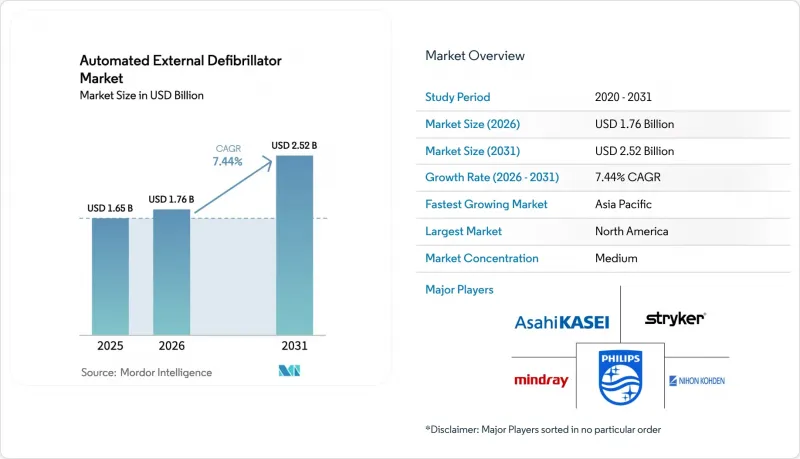
본 보고서는 제품 유형(반자동 AED, 완전 자동 AED), 기술(2상 파형 AED, 단상 파형 AED), 용도(업무용 AED, 공공용 AED), 최종 사용자(병원 및 진료소, 응급 의료 서비스 등), 지역(북미 등)별로 분류되어 있습니다. 시장 예측은 금액(달러) 기준으로 제시되어 있습니다.
전 세계 자동제세동기(AED) 시장 동향 및 인사이트
갑작스러운 심정지(SCA) 발생률 증가
병원 밖에서 발생하는 심정지(SCA)는 미국에서 연간 35만 건에 달하며, 제세동까지의 지연이 1분 늘어날 때마다 생존율은 약 10% 감소합니다. 미국심장협회(AHA)의 2025년판 지침에서는 권장 대응 시간이 단축되고 소아용 프로토콜이 확대됨에 따라 학교 및 스포츠 시설 내 AED 설치 밀도가 높아지고 있습니다. 현재, 지자체 계획 담당자들은 AED 설치를 위해 지도상에 ‘도보 4분 이내’ 구역을 표시하고 있습니다. 또한, 심폐소생술 인식 제고 주간 동안 인도 보건부는 74만 7,000명 이상의 시민을 동원하여 전국적으로 60만 6,374명 이상의 참가자를 대상으로 실기 훈련을 실시했습니다. 일본과 유럽에서는 고령화로 인해 기초 위험이 높아지고 있지만, 아시아태평양의 중소득 국가에서는 생활습관병 증가가 응급 대응 체계의 구축 속도를 앞지르고 있어, 절대적인 성장률이 가장 급격하게 증가하고 있습니다.
정부 자금을 통한 공공용 제세동기(PAD) 프로그램
중국은 2024년에 6만 4,000대 이상의 공공용 AED를 설치할 예정이며, 베이징시는 GPS 원격 측정 기능을 갖춘 네트워크 연결형 캐비닛 2,000대 도입을 약속했습니다. 영국은 2025년에 100만 파운드(127만 달러)를 예산에 편성하여 의료 서비스가 미치지 않는 지역에 2,000대의 AED를 설치할 예정입니다. 뉴욕시나 뉴햄프셔주 등 미국 관할 구역에서는 정책을 대량 구매 계약에 반영하고 있으며, Philips사의 ‘HeartStart OnSite’는 898.79 달러, ZOLL사의 ‘AED Plus’는 1,070 달러에 조달되고 있습니다. 프랑스, 독일, 이탈리아의 유럽 법규 역시 공공시설에 제세동기 설치를 의무화하고 있으며, 예측 가능한 교체 주기가 확립되어 있습니다.
소규모 기관의 높은 도입 및 유지 비용
기본적인 AED 가격은 849-1,795달러이지만, 전극 패드, 배터리, 보관 캐비닛 및 교육 비용을 더하면 5년간의 총 소유 비용은 2배가 됩니다. 소규모 비영리 단체는 대개 기증받은 인터넷 미연결 기기에 의존하고 있어, 필요할 때 5대 중 1대 비율로 사용할 수 없는 상태입니다. 보조금은 존재하지만, 행정적 부담이 가장 소규모인 진료소나 자원봉사 소방대의 도입을 방해하고 있어, 지역 간 격차가 해소되지 않은 채로 남아 있습니다.
부문 분석
2025년 기준, 반자동식 AED는 자동체외제세동기(AED) 시장의 58.24%를 차지했습니다. 이는 구조자가 안전을 확인한 후 버튼을 누르도록 지도해 온 수십 년간의 훈련을 반영한 것입니다. 공공장소에서는 주저 없이 작동하는 기기가 선호되기 때문에 2031년까지 완전 자동식 기기 시장 점유율은 연평균 9.78%의 성장률을 보일 것으로 전망됩니다. ZOLL사의 AED 3 및 Stryker사의 LIFEPAK CR2는 두 모드 모두를 지원하므로, 구매자는 사용자 프로파일에 맞추어 선택할 수 있습니다. 공항이나 경기장에서는 훈련을 받지 않은 일반인을 대상으로 전자동식 기기가 선호되는 반면, 병원에서는 여전히 임상적 감독을 목적으로 반자동식 기기가 선호되고 있습니다. 가격 차이가 거의 없고(모드 전환 비용은 대개 100달러 미만입니다), 비용이 장벽이 되지 않기 때문에 도입 여부를 좌우하는 것은 정책과 신뢰감뿐입니다.
완전 자동 모드의 보급은 조작에 대한 망설임 시간을 단축함으로써 AED 시장을 활성화시키고 있습니다. 연구에 따르면, 이러한 망설임 시간의 단축은 자발적 순환 회복률 향상으로 이어진다고 합니다. 일본과 한국의 규제 체계에서는 두 모드 모두 허용되고 있지만, 교육 커리큘럼은 여전히 반자동 방식의 기준을 따르고 있어 전환이 더딘 실정입니다. 일반인이 이용할 수 있는 네트워크가 더욱 활성화됨에 따라 핸즈프리 조작에 대한 익숙함이 높아지면서, 반자동식 AED 재고 교체 수요가 가속화되고, AED 업계는 단순화되는 방향으로 나아갈 것입니다.
2025년에는 2상식 플랫폼이 AED 시장 규모의 91.11%를 차지하며, 연평균 9.45%의 성장률을 보일 것으로 전망됩니다. 현재 FDA에 등록을 신청하는 업체들은 실질적 동등성을 입증하기 위해 2상식 제품을 비교 대상으로 삼고 있으며, 이로 인해 단상식 제품의 신청은 사실상 불필요해졌습니다. ZOLL사의 직선 파형은 환자의 임피던스에 따라 에너지를 조정하는 반면, Stryker사의 cprINSIGHT는 흉부 압박을 중단하지 않고 심장 리듬을 분석하여 건당 1-2분의 대기 시간을 단축합니다.
단상식 장치는 오래된 병원의 재고나 저소득 시장에서 여전히 남아 있지만, 중국의 수출업체들도 2상식 설계를 채택하고 있어 가격 차이를 좁히고 전 세계적인 단계적 폐지를 가속화하고 있습니다. 이러한 발전은 첫 번째 충격의 유효성이 높고 조직 손상이 적다는 연구 결과와 일치하며, 향후 AED 시장의 갱신 과정에서 2상식 하드웨어로의 전환이 확실시되고 있습니다.
지역별 분석
북미는 미국 50개 주 모두에서 공공 접근에 관한 법적 체계가 성숙해 있으며, ‘농촌 지역 응급 의료기기 접근법(Rural Access to Emergency Devices Act)’에 따른 연방 정부의 보조금 덕분에 2025년 매출의 44.22%를 차지했습니다. 2025년에 발표된 미국심장협회(AHA)의 새로운 지침에서는 학교 및 보육 시설용 기기 사양이 조정되었습니다. 캐나다와 멕시코는 1인당 도입 대수 측면에서 미국에 뒤처져 있지만, 각 주와 민간 기업이 새로운 설치에 자금을 지원하고 있어 따라잡을 기회가 있습니다.
아시아태평양은 2031년까지 9.34%라는 지역별 최고 연평균 성장률(CAGR)을 달성할 전망입니다. 중국 적십자사는 2024년에 6만 4,000대의 장비를 설치했으며, 베이징시는 실시간 GPS 정보를 제공하는 스마트 캐비닛 2,000대를 발주했습니다. 일본 소방청은 공공시설에 AED 도입을 지속적으로 추진하고 있으며, 한국의 응급의료서비스법(EMS법)에서는 학교 및 대규모 상업 건물에 AED 설치를 의무화하고 있습니다. 인도의 ‘심폐소생술(CPR) 인식 제고 주간’에는 60만 6,374명이 교육을 받고 있지만, 연방 정부의 AED 의무화 및 법적 책임 명확화가 아직 결정되지 않아 당장 보급이 진전되지는 않고 있습니다.
유럽에서는 완만한 성장과 엄격한 환경 규제 간의 균형이 이루어지고 있습니다. 영국은 지역사회 내 AED 설치에 100만 파운드를 예산으로 편성했으며, 프랑스, 독일, 이탈리아에서는 지역별 설치 의무가 시행되고 있습니다. EU의 배터리 지침 및 WEEE 지침은 규정 준수 비용을 증가시키지만, 동시에 수명이 긴 배터리로의 교체와 패드 재활용 프로그램 추진으로 이어지고 있습니다. 중동 및 아프리카 및 남미 지역은 여전히 발전 단계에 있지만, GCC 국가들과 브라질의 대도시권 보건국에서는 생존율 향상이 확인되면 확대가 기대되는 공공 접근 프로그램의 시범 운영이 진행되고 있습니다.
기타 혜택:
- 엑셀 형식 시장 예측(ME) 시트
- 3개월간의 애널리스트 지원
자주 묻는 질문
목차
제1장 서론
제2장 조사 방법
제3장 주요 요약
제4장 시장 구도
제5장 시장 규모와 성장 예측
제6장 경쟁 구도
제7장 시장 기회와 향후 전망
LSH 26.08.25According to Mordor Intelligence, the automated external defibrillator market size is expected to grow from USD 1.65 billion in 2025 to USD 1.76 billion in 2026 and is forecast to reach USD 2.52 billion by 2031 at 7.44% CAGR over 2026-2031.
This report is Segmented by Product Type (Semi-Automatic AEDs, Fully-Automatic AEDs), Technology (Biphasic Waveform AEDs, Monophasic Waveform AEDs), Modality (Professional-Use AEDs, Public-Access AEDs), End User (Hospitals & Clinics, Emergency Medical Services, and More), and Geography (North America, and More). The Market Forecasts are Provided in Terms of Value (USD).
Global Automated External Defibrillator Market Trends and Insights
Rising Incidence of Sudden Cardiac Arrest (SCA)
Out-of-hospital SCA reached 350,000 U.S. events annually, and survival drops roughly 10% with every minute's delay to defibrillation. New American Heart Association 2025 guidelines shorten recommended response intervals and broaden pediatric protocols, prompting higher device densities in schools and sports venues. Municipal planners now map four-minute walk radii for AED placement, while during the CPR Awareness Week, India's Ministry of Health engaged over 747,000 citizens, providing physical training to more than 606,374 participants nationwide. Aging populations intensify baseline risk in Japan and Europe, but middle-income Asia-Pacific nations record the steepest absolute growth because lifestyle diseases are outpacing emergency-response build-outs.
Government-Funded Public-Access Defibrillation (PAD) Programs
China installed more than 64,000 public-access units in 2024, and Beijing committed to 2,000 networked cabinets with GPS telemetry. The United Kingdom set aside GBP 1 million (USD 1.27 million) in 2025 to place 2,000 devices in underserved areas. U.S. jurisdictions such as New York City and New Hampshire translate policy into bulk-buy contracts that quote Philips HeartStart OnSite at USD 898.79 and ZOLL AED Plus at USD 1,070. European decrees in France, Germany and Italy similarly mandate defibrillators in public buildings, creating predictable replacement cycles.
High Acquisition & Maintenance Cost for Small Institutions
A basic AED sells for USD 849-1,795, but five-year ownership doubles after pad, battery, cabinet and training expenses. Small nonprofits often depend on donated, non-connected devices, leaving one in five units unusable when needed. Grants exist yet administrative burdens deter the smallest clinics and volunteer fire departments, perpetuating geographic inequity.
Other drivers and restraints analyzed in the detailed report include:
- Technological Shift to Biphasic & Impedance-Compensated Waveforms
- Integration into Smart-City IoT Emergency Networks
- Limited Reimbursement & Liability Concerns in Emerging Markets
For complete list of drivers and restraints, kindly check the Table Of Contents.
Segment Analysis
Semi-automatic units controlled 58.24% automated external defibrillator market share in 2025, reflecting decades of training that tells rescuers to press a button only after confirming safety. Fully-automatic devices will compound at 9.78% through 2031 as public venues prefer hardware that fires without hesitation. ZOLL's AED 3 and Stryker's LIFEPAK CR2 come in both modes, letting buyers match user profiles. Airports and stadiums lean toward full-auto for untrained crowds, whereas hospitals still favor semi-auto for clinical oversight. Pricing parity-it often costs less than USD 100 to switch modes-removes cost as a barrier, leaving policies and confidence to steer adoption.
Fully-automatic gains feed the automated external defibrillator market by shortening pause time, which studies link to higher return-of-spontaneous-circulation rates. Regulatory frameworks in Japan and South Korea allow both modes, though their training curricula still echo semi-auto norms, slowing transition. As more public-access networks go live, familiarity with hands-free operation should accelerate replacement demand for semi-auto stock, nudging the automated external defibrillator industry toward simplicity.
Biphasic platforms captured 91.11% share of automated external defibrillator market size in 2025 and will rise 9.45% annually. FDA registrants now use biphasic comparators for substantial equivalence, effectively making monophasic filings obsolete. ZOLL's rectilinear waveform adjusts energy to patient impedance, while Stryker's cprINSIGHT analyzes rhythm without stopping compressions, removing one to two minutes of idle time per case.
Monophasic devices linger in older hospital inventories and low-income markets, but Chinese exporters are also adopting biphasic designs, cutting price gaps and speeding global phase-out. These advances align with studies showing higher first-shock efficacy and lower tissue damage, guaranteeing that future automated external defibrillator market replacements gravitate to biphasic hardware.
Complete Report Scope:
- By Product Type
- Semi-Automatic AEDs
- Fully-Automatic AEDs
- By Technology
- Biphasic Waveform AEDs
- Monophasic Waveform AEDs
- By Modality
- Professional-Use AEDs
- Public-Access AEDs
- By End User
- Hospitals & Clinics
- Emergency Medical Services (EMS)
- Public Access Locations
- Home Care
- Others (Training Institutions, Corporate Wellness)
- By Geography
- North America
- United States
- Canada
- Mexico
- Europe
- Germany
- France
- United Kingdom
- Italy
- Spain
- Rest of Europe
- Asia-Pacific
- China
- Japan
- India
- South Korea
- Australia
- Rest of Asia-Pacific
- Middle East & Africa
- GCC
- South Africa
- Rest of Middle East & Africa
- South America
- Brazil
- Argentina
- Rest of South America
- North America
Geography Analysis
North America contributed 44.22% of 2025 revenue thanks to mature public-access legislation in all 50 U.S. states and federal grants under the Rural Access to Emergency Devices Act. New American Heart Association guidelines published in 2025 adjust device specs for schools and childcare centers. Canada and Mexico trail the U.S. in per-capita deployment but offer catch-up opportunity as provinces and private employers fund new placements.
Asia-Pacific is on track for the fastest 9.34% regional CAGR through 2031. China's Red Cross installed 64,000 devices in 2024 and Beijing ordered 2,000 smart cabinets with live GPS feeds. Japan's Fire and Disaster Management Agency continues to push devices into public facilities, and South Korea's EMS Act requires units in schools and large commercial buildings. India's CPR Awareness Week trains 606,374, yet federal AED mandates and liability clarity remain pending, limiting immediate conversion.
Europe balances moderate growth with stringent environmental rules. The United Kingdom has earmarked GBP 1 million for community placements, and France, Germany and Italy enforce location-specific mandates. The EU Battery and WEEE Directives raise compliance costs but also motivate upgrades to longer-life batteries and pad recycling programs. Middle East-Africa and South America remain nascent, although GCC nations and Brazil's metro health secretariats are piloting public-access programs that could scale on positive survival data.
- A.M.I. Italia
- Asahi Kasei (ZOLL Medical)
- Avive Solutions
- Beijing M&B Electronic
- BPL
- Cardiac Science (CSI)
- CU Medical Systems
- Defibtech
- Fukuda Denshi
- HeartSine Technologies
- Koninklijke Philips
- Mediana
- Metrax GmbH (Corpuls)
- Nihon Kohden
- Progetti
- Rapid Response Revival
- Schiller
- Shenzhen Mindray Bio-Medical
- Shenzhen XFT
- Stryker (Physio-Control)
Additional Benefits:
- The market estimate (ME) sheet in Excel format
- 3 months of analyst support
TABLE OF CONTENTS
1 Introduction
- 1.1 Study Assumptions & Market Definition
- 1.2 Scope of the Study
2 Research Methodology
3 Executive Summary
4 Market Landscape
- 4.1 Market Overview
- 4.2 Market Drivers
- 4.2.1 Rising Incidence of Sudden Cardiac Arrest (SCA)
- 4.2.2 Government-Funded Public Access Defibrillation (PAD) Programs
- 4.2.3 Technological Shift to Biphasic & Impedance-Compensated Waveforms
- 4.2.4 Integration Of AEDs into Smart-City IoT Emergency Networks
- 4.2.5 Corporate ESG Mandates Adding AED Coverage to Workplace HSE KPIs
- 4.2.6 Subscription-Based "AED-As-A-Service" Lowering CAPEX Barriers
- 4.3 Market Restraints
- 4.3.1 High Acquisition & Maintenance Cost for Small Institutions
- 4.3.2 Limited Reimbursement & Liability Concerns in Emerging Markets
- 4.3.3 Supply-Chain Dependence on Lithium Cells Facing EU/US Sourcing Rules
- 4.3.4 End-Of-Life Environmental Compliance (Battery & Pad Waste)
- 4.4 Value / Supply-Chain Analysis
- 4.5 Regulatory Landscape
- 4.6 Technological Outlook
- 4.7 Porter's Five Forces Analysis
- 4.7.1 Threat of New Entrants
- 4.7.2 Bargaining Power of Suppliers
- 4.7.3 Bargaining Power of Buyers
- 4.7.4 Threat of Substitutes
- 4.7.5 Competitive Rivalry
5 Market Size & Growth Forecasts (Value in USD)
- 5.1 By Product Type
- 5.1.1 Semi-Automatic AEDs
- 5.1.2 Fully-Automatic AEDs
- 5.2 By Technology
- 5.2.1 Biphasic Waveform AEDs
- 5.2.2 Monophasic Waveform AEDs
- 5.3 By Modality
- 5.3.1 Professional-Use AEDs
- 5.3.2 Public-Access AEDs
- 5.4 By End User
- 5.4.1 Hospitals & Clinics
- 5.4.2 Emergency Medical Services (EMS)
- 5.4.3 Public Access Locations
- 5.4.4 Home Care
- 5.4.5 Others (Training Institutions, Corporate Wellness)
- 5.5 By Geography
- 5.5.1 North America
- 5.5.1.1 United States
- 5.5.1.2 Canada
- 5.5.1.3 Mexico
- 5.5.2 Europe
- 5.5.2.1 Germany
- 5.5.2.2 France
- 5.5.2.3 United Kingdom
- 5.5.2.4 Italy
- 5.5.2.5 Spain
- 5.5.2.6 Rest of Europe
- 5.5.3 Asia-Pacific
- 5.5.3.1 China
- 5.5.3.2 Japan
- 5.5.3.3 India
- 5.5.3.4 South Korea
- 5.5.3.5 Australia
- 5.5.3.6 Rest of Asia-Pacific
- 5.5.4 Middle East & Africa
- 5.5.4.1 GCC
- 5.5.4.2 South Africa
- 5.5.4.3 Rest of Middle East & Africa
- 5.5.5 South America
- 5.5.5.1 Brazil
- 5.5.5.2 Argentina
- 5.5.5.3 Rest of South America
- 5.5.1 North America
6 Competitive Landscape
- 6.1 Market Concentration
- 6.2 Market Share Analysis
- 6.3 Company Profiles (includes Global level Overview, Market level overview, Core Segments, Financials as available, Strategic Information, Market Rank/Share for key companies, Products and Services, and Recent Developments)
- 6.3.1 A.M.I. Italia
- 6.3.2 Asahi Kasei (ZOLL Medical)
- 6.3.3 Avive Solutions
- 6.3.4 Beijing M&B Electronic
- 6.3.5 BPL Medical Technologies
- 6.3.6 Cardiac Science (CSI)
- 6.3.7 CU Medical Systems
- 6.3.8 Defibtech LLC
- 6.3.9 Fukuda Denshi
- 6.3.10 HeartSine Technologies
- 6.3.11 Koninklijke Philips N.V.
- 6.3.12 Mediana Co. Ltd.
- 6.3.13 Metrax GmbH (Corpuls)
- 6.3.14 Nihon Kohden Corporation
- 6.3.15 Progetti Srl
- 6.3.16 Rapid Response Revival
- 6.3.17 Schiller AG
- 6.3.18 Shenzhen Mindray Bio-Medical
- 6.3.19 Shenzhen XFT
- 6.3.20 Stryker (Physio-Control)
7 Market Opportunities & Future Outlook
- 7.1 White-space & Unmet-Need Assessment


