

|
시장보고서
상품코드
2113650
간암 : 시장 점유율 분석, 업계 동향 및 통계, 성장 예측(2026-2031년)Liver Cancer - Market Share Analysis, Industry Trends & Statistics, Growth Forecasts (2026 - 2031) |
||||||
 Mordor Intelligence
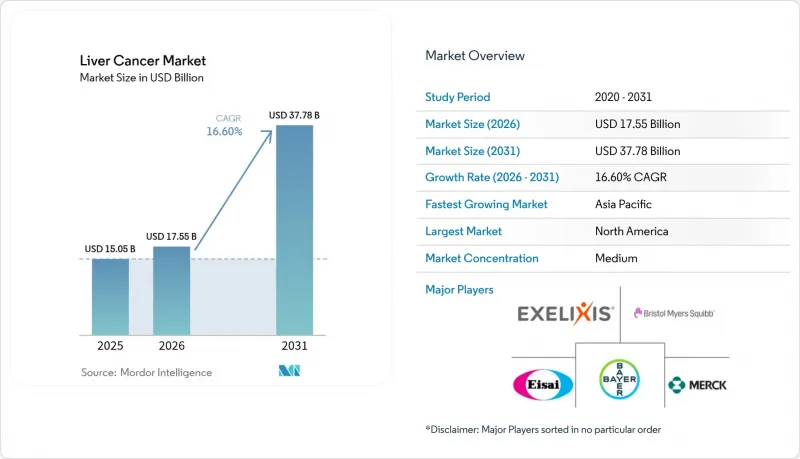
Mordor Intelligence에 의하면, 간암 시장 규모는 2025년에 150억 5,000만 달러로 평가되었습니다. 2026년 175억 5,000만 달러에서 성장하여 2031년까지 377억 8,000만 달러에 이를 것으로 예측됩니다.
예측 기간(2026-2031년) 동안 연평균 성장률(CAGR)은 16.60%를 나타낼 것으로 전망됩니다.
본 보고서는 암의 유형(간세포암, 담관암 등), 치료법(표적 치료, 화학요법 등), 연령대(성인, 고령자, 소아), 유통 채널(병원 약국, 소매 약국 등), 지역(북미, 유럽, 아시아태평양 등)별로 세분화되어 있습니다. 시장 규모 및 전망은 금액(달러) 기준으로 제시되어 있습니다.
세계의 간암 시장 동향 및 인사이트
간세포암(HCC) 발생률의 급증
세계 간세포암(HCC) 환자 수는 2020년 90만 5,347건에서 2040년까지 139만 2,474건으로 53.8% 증가할 것으로 예측되어, 치료 솔루션에 대한 장기적인 수요가 높다는 점이 부각되고 있습니다. 아시아태평양은 만성 B형 간염 감염자의 약 4분의 3을 차지하고 있으며, 몽골은 연령 조정 이환율이 전 세계에서 가장 높습니다. 고소득 국가에서 대사 기능 장애 관련 지방간 질환(MASLD) 증가는 특히 북유럽 및 아시아 일부 지역의 젊은 층을 중심으로 비만과 관련된 HCC 사례가 급증하고 있어 성장의 두 번째 축이 되고 있습니다. 이러한 역학적 변화는 중국, 일본, 서유럽의 인구 고령화 및 평균 수명 연장과 맞물려 간암 시장의 지속적인 확대를 확실하게 하고 있습니다.
병용 요법의 1차 치료제로서의 승인 확대
2025년 4월, FDA가 니볼루맙과 이필리무맙의 병용 요법을 승인함에 따라 전 세계 1차 치료 기준이 재정의되었으며, 전체 생존 기간의 중앙값은 소라페닙 또는 렌바티닙 단일 요법에서 20.6개월이었던 것에 비해 23.7개월로 늘어났습니다. 유럽에서는 그로부터 2개월 후 이 치료법이 승인되어, 각국의 의료 제도에서 가이드라인의 신속한 업데이트가 촉진되었습니다. EMERALD-1 및 LEAP-012 임상시험의 긍정적인 결과로 인해 체크포인트 억제제와 항-VEGF제 또는 국소·영역 치료와의 병용 요법이 더욱 입증되었고, 도입 곡선이 상승하며 보험사의 평가가 가속화되었습니다. 상환 체계가 적용됨에 따라 고가의 병용 요법이 수익 기반을 확대하고 있으며, 연구 개발(R&D) 경쟁을 격화시키고 있습니다.
간경변 환자에서 나타나는 중증 면역 관련 이상반응(irAE)
체크포인트 억제제에 의한 간독성은 간경변 환자의 12.9%에서 확인되었으며, CheckMate-9DW 임상시험의 니볼루맙·이필리무맙 군에서는 18%의 환자가 투여를 중단했습니다. 고령자 코호트에서는 그 위험이 더욱 높기 때문에 치료 지속률을 유지하기 위해서는 irAE 위험을 예측하는 바이오마커가 필요합니다.
부문 분석
2025년, 간세포암은 간암 시장에서 74.88%의 시장 점유율을 확보하며 주요 가치 창출 요인으로서의 역할을 입증했습니다. 이러한 우위는 발병률과 체크포인트 억제제 병용 요법 및 항혈관신생제를 기반으로 한 치료법에 대한 연구 개발 자금 규모를 모두 반영한 것입니다. 2025년 4월 듀얼 체크포인트 억제제의 승인은 경쟁사와의 차별화를 강화하고 1차 치료 옵션을 확대했습니다. 담관암은 규모는 작지만 전략적으로 중요한 틈새 영역으로 남아 있으며, 종양 침윤 림프구 제제에 대한 패스트 트랙 지정은 세포 치료에 기반한 혁신에 대한 규제 당국의 의지를 보여줍니다.
간모세포종은 희귀암이지만, 영상 진단 기술 및 분자 프로파일링의 발전으로 조기 수술 적응증 판정 및 소아 면역요법 임상시험 참여가 가능해지면서 연평균 성장률(CAGR) 19.18%로 확대되고 있습니다. 유전자 발현 연구가 정밀 투여를 촉진하고 있으며, 소아 고형암에 대한 CAR-T 치료 연구로 인해 완치의 가능성을 지닌 치료 옵션이 도입되고 있습니다. 이 틈새 분야의 성장 가속화는 수익원의 다각화를 가져오며, 소아 종양학을 전문으로 하는 학술 기관과의 제휴를 촉진하고 있습니다.
화학요법은 특히 자원이 제한된 지역에서 널리 이용 가능하며 도입 비용이 낮기 때문에 2025년에도 간암 시장 점유율 30.72%를 유지했습니다. 그러나 종양 전문의들이 세포 독성보다 정밀성을 우선시하는 경향이 있어 표적 치료는 연평균 성장률(CAGR) 19.25%로 성장하고 있습니다. 아테졸리주맙·베바시주맙 및 두르발맙·베바시주맙 병용 요법은 지속적인 무재발 효과를 보여주고 있어, 진료 지침상 적응증 확대를 뒷받침하고 있습니다. RayzeBio사의 악티늄-225 제제를 포함한 방사성 의약품은 고도로 국소화된 알파 입자의 치사성으로 인해 표적 범위를 확대되고 있습니다.
면역요법의 부상으로 정위 방사선 치료 및 경동맥 시술을 통합한 다모달 치료로의 전환이 진행되고 있으며, 이를 통해 정상 조직을 보존하면서 더 깊은 치료 효과를 얻을 수 있게 되었습니다. 화학요법은 현재 주로 병용 요법의 일부로, 혹은 면역 표적 요법의 시작을 기다리는 동안의 가교 요법으로 자리 잡고 있습니다.
지역별 분석
북미는 체크포인트 억제제의 조기 도입, 폭넓은 보험 적용, 그리고 높은 임상시험 밀도에 힘입어 2025년에는 전 세계 매출의 39.68%를 차지했습니다. FDA의 ‘프로젝트 오비스(Project Orbis)’는 다국간 동시 심사를 촉진하여 미국 환자와 캐나다, 호주의 파트너 기업들이 ‘퍼스트 인 클래스(first-in-class)’ 치료에 더 빨리 접근할 수 있도록 하고 있습니다. 그러나 ‘인플레이션 억제법’의 가격 협상 관련 규정에 따라 정가 상승이 억제될 가능성이 있어, 기업들은 출시 시기를 최적화해야할 것입니다.
아시아태평양은 2031년까지 연평균 성장률(CAGR) 19.02%를 나타낼 것으로 예측되며, 이는 세계에서 가장 빠른 성장률입니다. 신규 증례의 50% 이상을 차지하는 중국에서는 NRDL(국가기본의약품목록)에 따른 대폭적인 가격 인하와 도시 지역의 보험 가입률 상승이 맞물려, 판매량 확대를 통해 이익률 압박을 상쇄하고 있습니다. 일본과 한국은 탄탄한 임상시험 책임 의사 네트워크를 보유하고 있으며, 전 세계 간세포암(HCC) 임상시험의 약 절반이 아시아태평양 시설에서 수행되고 있어 개발 기간이 단축되고 있습니다.
유럽에서는 통합된 의료 기술 평가 및 승인 절차의 조화를 바탕으로 일관된 도입이 진행되고 있습니다. EMA의 이중 체크포인트 요법 승인은 해당 지역의 보험 환급 절차를 효율화하고 있습니다. 라틴아메리카 및 중동에서는 민관 파트너십을 통한 방사선 치료 역량 확대와 바이러스성 간염 근절을 위한 감시 체계 구축으로 새로운 성장 여지가 생겨나고 있습니다.
기타 혜택 :
- 엑셀 형식 시장 예측(ME) 시트
- 3개월간의 애널리스트 지원
자주 묻는 질문
목차
제1장 서론
제2장 조사 방법
제3장 주요 요약
제4장 시장 구도
제5장 시장 규모 및 성장 예측
제6장 경쟁 구도
제7장 시장 기회 및 향후 전망
KTH 26.08.26According to Mordor Intelligence, the liver cancer market size was valued at USD 15.05 billion in 2025 and estimated to grow from USD 17.55 billion in 2026 to reach USD 37.78 billion by 2031, at a CAGR of 16.60% during the forecast period (2026-2031).
This report is Segmented by Cancer Type (Hepatocellular Carcinoma, Cholangiocarcinoma, and More), Therapy (Targeted Therapy, Chemotherapy, and More), Age Group (Adults, Geriatric, and Pediatric), Distribution Channel (Hospital Pharmacies, Retail Pharmacies, and More), and Geography (North America, Europe, Asia-Pacific and More). The Market and Forecasts are Provided in Terms of Value (USD).
Global Liver Cancer Market Trends and Insights
Surge in Incidence of Hepatocellular Carcinoma (HCC)
Global hepatocellular carcinoma cases are projected to increase by 53.8%, from 905,347 in 2020 to 1,392,474 by 2040, underscoring the long-term demand for treatment solutions . Asia-Pacific shoulders roughly three-quarters of chronic hepatitis B infections, while Mongolia registers the world's highest age-standardized incidence. Rising metabolic dysfunction-associated steatotic liver disease (MASLD) in high-income economies adds a second growth pillar as obesity-linked HCC cases escalate, especially among younger cohorts in Northern Europe and parts of Asia. These epidemiologic shifts ensure durable expansion of the liver cancer market, reinforced by ageing populations and extended life expectancy in China, Japan, and Western Europe
Expanding First-Line Approvals of Drug Combos
The April 2025 FDA approval of nivolumab plus ipilimumab reset global first-line standards, yielding a 23.7-month median overall survival versus 20.6 months for sorafenib or lenvatinib monotherapy. Europe ratified the regimen two months later, triggering rapid guideline updates across national health systems. Positive EMERALD-1 and LEAP-012 readouts further validated integrating checkpoint inhibitors with anti-VEGF or locoregional treatments, lifting adoption curves and accelerating payer assessments. As reimbursement frameworks adapt, premium-priced combinations enlarge revenue pools and intensify R&D competition.
Severe Immune-Related Adverse Events (irAEs) in Cirrhotics
Checkpoint inhibitor hepatotoxicity appears in 12.9% of cirrhotic patients, prompting 18% discontinuation in the nivolumab-ipilimumab arm of CheckMate-9DW. Geriatric cohorts show heightened vulnerability, necessitating biomarkers that predict irAE risk to maintain treatment uptake.
Other drivers and restraints analyzed in the detailed report include:
- Rapid NAFLD and NASH Conversion into HCC in Obese Cohorts
- Wider Reimbursement for Loco-Regional TACE-IO Protocols
- High Attrition in Late-Phase Trials
For complete list of drivers and restraints, kindly check the Table Of Contents.
Segment Analysis
Hepatocellular carcinoma secured a 74.88% market share in the liver cancer market in 2025, validating its role as the primary value driver. This dominance reflects both incidence rates and the weight of R&D capital directed toward checkpoint combinations and anti-angiogenic backbones. The April 2025 dual-checkpoint approval intensified competitive differentiation and expanded frontline choices. Cholangiocarcinoma remains a minor but strategically important niche where fast-track designations for tumor-infiltrating lymphocyte products illustrate regulatory appetite for cell-based innovation.
Hepatoblastoma, though rare, is advancing at a 19.18% CAGR, buoyed by improved imaging and molecular profiling that allow early surgical candidacy and enrollment in pediatric immunotherapy trials. Gene-expression studies are propelling precision dosing, and CAR-T exploration for pediatric solid tumors is introducing potentially curative options. This tail-segment acceleration diversifies revenue sources and spurs partnerships with academic centers specializing in pediatric oncology.
Chemotherapy retained 30.72% of the liver cancer market share in 2025, due to its widespread availability and low acquisition cost, especially in resource-constrained regions. Yet, targeted therapy is growing at a 19.25% CAGR as oncologists prioritize precision over cytotoxicity. Atezolizumab-bevacizumab and durvalumab-bevacizumab combinations demonstrate sustained progression-free benefits, supporting expanded indications in guidelines. Radiopharmaceuticals, including actinium-225 constructs from RayzeBio, broaden the targeted spectrum with highly localized alpha-particle lethality.
Immunotherapy's rise drives the shift toward multimodal regimens that integrate stereotactic radiation and transarterial procedures, enabling deeper responses while sparing healthy parenchyma. Chemotherapy now primarily features in combination schedules or as bridging therapy awaiting the initiation of immuno-targeted therapy.
Complete Report Scope:
- By Cancer Type
- Hepatocellular Carcinoma
- Cholangiocarcinoma
- Hepatoblastoma
- Other Primary Liver Cancers
- By Product Type
- Therapy
- Targeted Therapy
- Immunotherapy
- Chemotherapy
- Radiation Therapy
- Diagnostic
- Ultrasound Scans
- Confirmatory Needle Biopsy
- Endoscopic Ultrasound
- CT Scan
- PET Scan
- Other Diagnostic Types
- Therapy
- By Age Group
- Adults
- Geriatric
- Pediatric
- By Distribution Channel
- Hospital Pharmacies
- Retail Pharmacies
- Online Pharmacies
- By Geography
- North America
- United States
- Canada
- Mexico
- Europe
- Germany
- United Kingdom
- France
- Italy
- Spain
- Rest of Europe
- Asia-Pacific
- China
- Japan
- India
- Australia
- South Korea
- Rest of Asia-Pacific
- Middle East and Africa
- GCC
- South Africa
- Rest of Middle East and Africa
- South America
- Brazil
- Argentina
- Rest of South America
- North America
Geography Analysis
North America commanded 39.68% of global revenue in 2025, buoyed by early checkpoint inhibitor uptake, generous insurance coverage, and leading clinical-trial density. FDA's Project Orbis fosters simultaneous multinational review, accelerating first-in-class access for United States patients and partners in Canada and Australia. Inflation Reduction Act price-negotiation provisions, however, may curb list-price growth, encouraging companies to optimize launch sequencing.
Asia-Pacific is projected to post a 19.02% CAGR through 2031, the fastest worldwide. China, holding more than 50% of incident cases, blends steep NRDL price reductions with rising urban insurance penetration, which expands volume to offset constrained margins. Japan and South Korea supply robust investigator networks, with roughly half of global HCC trials enrolling at Asia-Pacific sites, reducing development timelines.
Europe maintains consistent uptake supported by centralized health-technology assessments and pathway harmonization. EMA's endorsement of dual-checkpoint regimens streamlines regional reimbursement. Latin America and the Middle East deliver emerging upside as public-private partnerships expand radiotherapy capacity and viral-hepatitis elimination drives surveillance.
- Roche
- Bayer
- Bristol-Myers Squibb
- Merck
- Pfizer
- AstraZeneca
- Eli Lilly and Company
- Novartis
- Abbvie
- Amgen
- Johnson & Johnson
- Eisai
- Exelixis
- Celsion (Imunon)
- Sanofi
- Gilead Sciences
- BeiGene
- Innovent Biologics
- Sumitomo Pharma
- Hepion Pharmaceuticals
- Abbott Laboratories
- Boston Scientific
- Siemens Healthineers
Additional Benefits:
- The market estimate (ME) sheet in Excel format
- 3 months of analyst support
TABLE OF CONTENTS
1 Introduction
- 1.1 Study Assumptions & Market Definition
- 1.2 Scope of the Study
2 Research Methodology
3 Executive Summary
4 Market Landscape
- 4.1 Market Overview
- 4.2 Market Drivers
- 4.2.1 Surge In Incidence of Hepatocellular Carcinoma (HCC)
- 4.2.2 Expanding First-Line Approvals of Drug Combos
- 4.2.3 Rapid NAFLD and NASH Conversion into HCC in Obese Cohorts
- 4.2.4 Wider Reimbursement for Loco-Regional TACE-IO Protocols
- 4.2.5 AI-Enhanced Ultrasound & Liquid-Biopsy Screening Uptake
- 4.2.6 VC-Backed Radiopharma Pipelines Targeting Liver Lesions
- 4.3 Market Restraints
- 4.3.1 Severe Immune-Related Adverse Events
- 4.3.2 High Attrition in Late-Phase HCC Drug Trials
- 4.3.3 Sub-Optimal Surveillance in Low-HDI Endemic Countries
- 4.3.4 Price Ceilings in China's NRDL & Similar Tender Schemes
- 4.4 Regulatory Landscape
- 4.5 Technological Outlook
- 4.6 Porters Five Forces Analysis
- 4.6.1 Threat of New Entrants
- 4.6.2 Bargaining Power of Buyers/Consumers
- 4.6.3 Bargaining Power of Suppliers
- 4.6.4 Threat of Substitute Products
- 4.6.5 Intensity of Competitive Rivalry
5 Market Size & Growth Forecasts (Value, USD)
- 5.1 By Cancer Type
- 5.1.1 Hepatocellular Carcinoma
- 5.1.2 Cholangiocarcinoma
- 5.1.3 Hepatoblastoma
- 5.1.4 Other Primary Liver Cancers
- 5.2 By Product Type
- 5.2.1 Therapy
- 5.2.1.1 Targeted Therapy
- 5.2.1.2 Immunotherapy
- 5.2.1.3 Chemotherapy
- 5.2.1.4 Radiation Therapy
- 5.2.2 Diagnostic
- 5.2.2.1 Ultrasound Scans
- 5.2.2.2 Confirmatory Needle Biopsy
- 5.2.2.3 Endoscopic Ultrasound
- 5.2.2.4 CT Scan
- 5.2.2.5 PET Scan
- 5.2.2.6 Other Diagnostic Types
- 5.2.1 Therapy
- 5.3 By Age Group
- 5.3.1 Adults
- 5.3.2 Geriatric
- 5.3.3 Pediatric
- 5.4 By Distribution Channel
- 5.4.1 Hospital Pharmacies
- 5.4.2 Retail Pharmacies
- 5.4.3 Online Pharmacies
- 5.5 By Geography
- 5.5.1 North America
- 5.5.1.1 United States
- 5.5.1.2 Canada
- 5.5.1.3 Mexico
- 5.5.2 Europe
- 5.5.2.1 Germany
- 5.5.2.2 United Kingdom
- 5.5.2.3 France
- 5.5.2.4 Italy
- 5.5.2.5 Spain
- 5.5.2.6 Rest of Europe
- 5.5.3 Asia-Pacific
- 5.5.3.1 China
- 5.5.3.2 Japan
- 5.5.3.3 India
- 5.5.3.4 Australia
- 5.5.3.5 South Korea
- 5.5.3.6 Rest of Asia-Pacific
- 5.5.4 Middle East and Africa
- 5.5.4.1 GCC
- 5.5.4.2 South Africa
- 5.5.4.3 Rest of Middle East and Africa
- 5.5.5 South America
- 5.5.5.1 Brazil
- 5.5.5.2 Argentina
- 5.5.5.3 Rest of South America
- 5.5.1 North America
6 Competitive Landscape
- 6.1 Market Concentration
- 6.2 Market Share Analysis
- 6.3 Company Profiles (includes Global level Overview, Market level overview, Core Segments, Financials as available, Strategic Information, Market Rank/Share for key companies, Products & Services, and Recent Developments)
- 6.3.1 F. Hoffmann-La Roche
- 6.3.2 Bayer AG
- 6.3.3 Bristol Myers Squibb Company
- 6.3.4 Merck & Co. Inc.
- 6.3.5 Pfizer inc.
- 6.3.6 AstraZeneca
- 6.3.7 Eli Lilly and Company
- 6.3.8 Novartis AG
- 6.3.9 AbbVie Inc.
- 6.3.10 Amgen Inc.
- 6.3.11 Johnson & Johnson
- 6.3.12 Eisai Co. Ltd.
- 6.3.13 Exelixis Inc.
- 6.3.14 Celsion (Imunon)
- 6.3.15 Sanofi SA
- 6.3.16 Gilead Sciences
- 6.3.17 BeiGene
- 6.3.18 Innovent Biologics
- 6.3.19 Sumitomo Pharma
- 6.3.20 Hepion Pharmaceuticals
- 6.3.21 Abbott Laboratories
- 6.3.22 Boston Scientific Corporation
- 6.3.23 Siemens Healthcare GmbH
7 Market Opportunities & Future Outlook
- 7.1 White-space & Unmet-Need Assessment


