

|
시장보고서
상품코드
2113717
X선 필름 : 시장 점유율 분석, 업계 동향 및 통계, 성장 예측(2026-2031년)X-ray Films - Market Share Analysis, Industry Trends & Statistics, Growth Forecasts (2026 - 2031) |
||||||
 Mordor Intelligence
Mordor Intelligence에 의하면, X선 필름 시장 규모는 2026년에 20억 4,000만 달러로 평가되고 2031년까지 26억 9,000만 달러에 이를 것으로 예측됩니다.
이는 예측 기간 전체에 걸쳐 연평균 성장률(CAGR)이 5.69%를 나타낼 것임을 시사합니다.
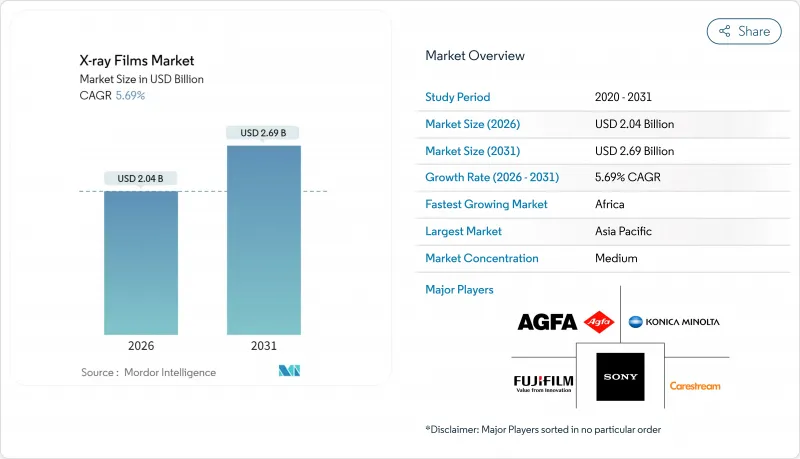
본 보고서는 최종 사용자별(병원, 연구·학술 기관, 동물 병원, 산업 시설 등), 필름 유형별(드라이 필름, 웨트 필름), 필름 감도별(그린 필름,하프 스피드 블루 필름, 풀 스피드 블루 필름, 클리어 필름), 필름 크기(14×17인치, 11×14인치, 10×12인치, 8×10인치, 기타 필름 크기) 및 지역별로 분류되어 있습니다. 시장 예측은 금액(달러) 기준으로 제시되어 있습니다.
세계의 X선 필름 시장 동향 및 인사이트
개발도상국에서의 기존 X선 장비의 지속적인 채택
자금 부족, 잦은 정전, 그리고 미비한 네트워크 인프라로 인해 사하라 이남 아프리카와 남아시아의 농촌 지역에 위치한 많은 병원에서는 아날로그 X선 촬영이 여전히 실용적인 선택지로 남아 있습니다. 세계보건기구(WHO)는 2025년 보고서에서 해당 지역의 의료시설 중 절반 미만이 안정적인 전력 공급을 받고 있어 평판 검출기 도입은 현실적이지 않다고 지적했습니다. 나이지리아 보건 당국은 디지털화 비용이 1실당 8만 달러부터 시작되기 때문에 2024년 기준으로 가동 중인 X선 장비의 82%가 여전히 필름 방식을 유지하고 있다고 지적했습니다. 인도의 ‘아유슈만 바라트’ 이니셔티브에서는 도시 지역의 디지털 영상 연계가 진전되고 있지만, 우타르프라데시 주,비하르주, 자르칸드주의 의료기관에서는 하루 평균 전력 공급 시간이 12시간 미만이기 때문에 필름이 여전히 의료 접근성 격차를 해소하는 역할을 하고 있습니다. 따라서 현지 유통 및 암실용 약품 지원을 유지하고 있는 공급업체들은 X선 필름 시장의 견고한 부문을 계속해서 지켜내고 있습니다. 그 결과, 2031년을 훨씬 넘어서까지 디지털 기술과 아날로그 기술이 공존하는 점진적인 도입 곡선이 형성되고 있습니다.
자원이 부족한 환경에서의 필름의 비용 대비 효과
2024년 IAEA 가이드에 따르면, 3년 치 소모품을 포함한 완전한 필름실의 비용은 2만 5,000-4만 달러로, 컴퓨터화 또는 직접 디지털 X선 촬영에 필요한 8만-35만 달러의 지출보다 훨씬 낮습니다. 화학 약품 및 은 회수에 드는 운영 비용은 예측 가능하지만, 반면 디지털 시스템에서는 연간 소프트웨어 사용료와 하드웨어 교체 주기가 발생하며, 많은 공립 병원에서 이러한 비용이 유지 관리 예산을 초과하고 있습니다. WHO 조사에 따르면, 아프리카 국가 중 영상 진단 기기의 예방 정비 프로그램을 시행하고 있는 곳은 고작 28%에 불과하며, 그 결과 디지털 기기의 가동 중단률은 40-50%에 달하는 반면, 필름 시스템의 경우 카세트의 정기적인 청소만으로 충분합니다. 동물병원이나 개인 치과에서도 유사한 경제적 상황이 관찰되며, 대형 장비 공급업체가 거의 타겟으로 삼지 않는 틈새 서비스 분야에서 X선 필름 시장이 호황을 누리고 있습니다. 국가의 조달 정책이 장기적으로는 디지털화를 추진하고 있음에도 불구하고, 이러한 경제적 격차가 단기적인 수요를 강화하고 있습니다.
디지털 X선 촬영 및 평판 검출기 기술로의 급속한 전환
2025년까지 고소득 지역에서 신규 도입의 70% 이상을 디지털 X선 촬영이 차지하게 되었습니다. 이는 병원들이 워크플로우 가속화, 환자 피폭량 감소, 클라우드 아카이브를 우선시했기 때문입니다. 2025년 11월에 발표된 GE 헬스케어의 인터라드(Interrad) 사에 대한 23억 달러 규모의 인수 계획은 필름을 완전히 배제하는 엔터프라이즈 이미징 플랫폼으로의 업계 전환 노력을 여실히 보여주고 있습니다. 코니카미놀타는 2015년에 필름 생산을 중단했으며, 현재 베트남 국립 혁신 센터와 공동으로 AI 알고리즘을 개발하고 있는데, 이는 소모품에서 데이터 중심 서비스로의 전환을 보여줍니다. 미국의 보험 환급 제도는 디지털 대응 외래 진료 센터를 우대하고 있어 아날로그 촬영실의 폐지를 가속화하고 있습니다. 이러한 동향으로 인해 X선 필름 시장에서 수익성이 높은 구매자들이 배제되면서, 남아 있는 수요 분야에서의 가격 경쟁이 격화되고 있습니다.
부문별 분석
병원은 2025년 매출의 59.23%를 차지했으며, 이는 대규모 아날로그 장비 도입 실적과 많은 관할 구역에서 여전히 종이 매체의 기록을 우선시하는 법적 보존 규정을 반영한 것입니다. 한편, 보험사가 환자를 저비용 외래 영상 진단으로 유도함에 따라 진단센터는 연평균 성장률(CAGR) 6.72%로 확대되고 있습니다. 이러한 외래 진료로의 전환으로 인해 검사 건수가 재분배되면서 X선 필름 수요 구조가 재편되고 있습니다.
독립 진단 검사 시설이 2018년 7,000곳에서 2024년에는 1만 1,000곳 이상으로 증가함에 따라 고객 기반은 확대되었으나, 동시에 디지털화 도입도 가속화되고 있어 필름을 통한 수익 확대 여지는 제한적입니다. 연구 기관이나 교육 병원에서는 특히 저·중소득 국가에서 프로토콜 개발을 위해 암실을 유지하고 있습니다. 한편, 아시아태평양 및 남미의 동물병원에서는 반려동물 주인이 부담하는 비용으로는 디지털 장비로 업그레이드하는 비용을 충당하기 어려운 경우가 대부분이므로 필름이 사용되고 있습니다. 산업 플랜트에서는 ASTM 필름 규격이 준수되고 있어, 비파괴 검사 용도에서 비록 특수하긴 하지만 안정적인 X선 필름 시장 점유율을 확보하고 있습니다.
드라이 필름은 2025년 매출의 57.78%를 차지했으며, 환경 규제에 대응하기 위해 시설에서 암실을 폐지함에 따라 연평균 성장률(CAGR) 5.82%로 성장할 것으로 전망됩니다. 열화상 기술 덕분에 현상액이나 고정액 등의 화학 약품이 필요 없어지고 처리 시간이 단축될 뿐만 아니라, NHS 잉글랜드와 같은 기관이 설정한 병원의 탈탄소화 목표에도 부합합니다.
습식 필름은 1만 5,000-3만 달러에 달하는 건식 프린터를 도입할 자금이 없는 자원이 제한된 진료소나, 습식 처리된 이미지가 약간 더 뛰어난 콘트라스트를 제공하는 산업 분야의 현장 작업에서 여전히 사용되고 있습니다. 그럼에도 불구하고, 드라이 필름은 규제 준수 측면에서 우위를 점하고 있어 규제가 엄격한 시장에서는 선호되는 소모품이 되었으며, 그 채택으로 인해 X선 필름 시장 점유율은 습식 방식에서 건식 방식으로 완만하지만 착실히 이동하고 있습니다.
지역별 분석
아시아태평양은 2025년 매출의 52.39%를 차지했습니다. 이는 중국 지방 병원에 구형 X선 장비가 막대하게 보유되어 있는 점과, 인도에서 전력망이 불안정한 주에서 필름에 대한 의존이 지속되고 있는 점이 요인으로 작용했습니다. 일본에서는 높은 촬영 건수로 인해 수요가 유지되고 있으며, 현지 재활용 업체에 의한 은 회수율이 95%를 초과함에 따라 필름의 경제성이 향상되고 있습니다.
아프리카는 연평균 성장률(CAGR) 6.61%를 기록하며 가장 빠르게 성장하는 지역입니다. 아프리카개발은행은 영상진단 장비 분야에서 연간 30억-40억 달러의 부족이 있다고 지적하고 있으며, WHO 데이터에 따르면 3분의 1의 국가에서 방사선과 의사 밀도가 100만 명당 1명 미만인 것으로 나타나, 이러한 상황이 단순한 아날로그 시스템의 도입을 뒷받침하고 있습니다. 이집트의 경우 2022년 기준 CT 스캐너 보유 대수가 100만 명당 고작 2.5대에 그치는 반면, X선 장비는 100만 명당 21대를 보유하고 있어, X선 필름 시장을 지탱하는 가격 면에서의 우위가 두드러지고 있습니다.
북미 및 유럽에서는 신규 판매에서 디지털화 보급률이 70%를 초과하여 성장이 둔화되고 있지만, 산업용 검사나 수의 진료 현장에서는 여전히 필름이 구매되고 있습니다. 브라질과 아르헨티나를 중심으로 한 남미에서는 예산 제약으로 인해 공립 병원에서 아날로그 장비가 유지되고 있으며, 규제 기준에서도 필름이 법적 증거로 계속 인정받고 있습니다. 이처럼 지역별로 대조적인 상황으로 인해 전 세계 X선 필름 시장을 하나의 도입 곡선으로 정의할 수는 없습니다.
기타 혜택 :
- 엑셀 형식 시장 예측(ME) 시트
- 3개월간의 애널리스트 지원
자주 묻는 질문
목차
제1장 서론
제2장 조사 방법
제3장 주요 요약
제4장 시장 구도
제5장 시장 규모 및 성장 예측
제6장 경쟁 구도
제7장 시장 기회 및 향후 전망
KTH 26.08.26According to Mordor Intelligence, the x-ray films market size is valued at USD 2.04 billion in 2026 and is projected to reach USD 2.69 billion by 2031, reflecting a 5.69% CAGR throughout the forecast period.
This report is Segmented by End User (Hospitals, Research and Academic Institutions, Veterinary Clinics, Industrial Facilities, and More), Film Type (Dry Film, and Wet Film), Film Sensitivity (Green Film, Half-Speed Blue Film, Full-Speed Blue Film, Clear Film), Film Size (14X17 Inch, 11X14 Inch, 10X12 Inch, 8X10 Inch, and More Film Sizes), and Geography. The Market Forecasts are Provided in Terms of Value (USD).
Global X-ray Films Market Trends and Insights
Continued Adoption of Traditional X-ray Equipment in Developing Economies
Limited capital, frequent power outages, and gaps in network infrastructure keep analog radiography viable in many hospitals across sub-Saharan Africa and rural South Asia. The World Health Organization reported in 2025 that fewer than half of facilities in the region had reliable electricity, making flat-panel detectors impractical. Nigeria's health authority noted that 82% of its functional X-ray units remained film-based in 2024 because digital conversion costs start at USD 80,000 per room. India's Ayushman Bharat initiative links digital reports in urban centers, yet facilities in Uttar Pradesh, Bihar, and Jharkhand average under 12 hours of daily electricity, so film continues to bridge access gaps. Vendors that maintain local distribution and darkroom chemistry support, therefore, protect a durable segment of the X-ray films market. The result is a staggered adoption curve in which digital and analog technologies coexist well past 2031.
Cost-Effectiveness of Film in Low-Resource Settings
A complete film room, including a three-year supply of consumables, costs USD 25,000-40,000, far below the USD 80,000-350,000 outlay for computed or direct digital radiography, according to a 2024 IAEA guide. Operating expenses for chemistry and silver recovery remain predictable, whereas digital suites impose annual software fees and hardware refresh cycles that exceed maintenance budgets in many public hospitals. The WHO found that only 28% of African countries run preventive maintenance programs for imaging equipment, resulting in 40-50% downtime on digital units, while film systems require only periodic cassette cleaning. Veterinary clinics and solo dental practices mirror this economics, keeping the X-ray film market active in service niches that large equipment suppliers seldom target. The financial delta strengthens short-term demand even as national procurement policies promote eventual digitization.
Rapid Shift to Digital Radiography and Flat-Panel Detector Technology
Digital radiography accounted for more than 70% of new installations in high-income regions by 2025, as hospitals prioritized faster workflows, lower patient dose, and cloud archiving. GE HealthCare's planned USD 2.3 billion acquisition of Intelerad, announced in November 2025, underscores industry commitment to enterprise imaging platforms that bypass film entirely. Konica Minolta ended film production in 2015 and now codesigns AI algorithms with Vietnam's National Innovation Center, illustrating a pivot from consumables to data-centric services. Reimbursement in the United States favors digital-ready outpatient centers, accelerating the retirement of analog rooms. These dynamics remove the highest-margin buyers from the X-ray films market and intensify price competition in remaining pockets of demand.
Other drivers and restraints analyzed in the detailed report include:
- Expansion of Industrial Non-Destructive Testing Requiring Film Radiography
- Silver Recovery Economics Improving Film Lifecycle Value
- Environmental Regulations on Chemical Processing and Waste Disposal
For complete list of drivers and restraints, kindly check the Table Of Contents.
Segment Analysis
Hospitals commanded 59.23% of 2025 revenue, reflecting large analog installed bases and legal retention rules that still favor hard-copy records in many jurisdictions. Diagnostic centers, however, are advancing at a 6.72% CAGR as payers steer patients toward lower-cost outpatient imaging. This outpatient shift reallocates procedure volume and reshapes the demand profile for X-ray films.
Growth in independent diagnostic testing facilities from 7,000 units in 2018 to more than 11,000 in 2024 broadens the customer pool but also accelerates digital adoption, limiting upside from film. Research institutes and teaching hospitals preserve film rooms for protocol development, especially in low- and middle-income countries, while veterinary clinics in Asia-Pacific and South America use film because pet-owner reimbursements rarely cover digital upgrades. Industrial plants adhere to ASTM film standards, ensuring a stable, if specialized, slice of the X-ray films market for non-destructive testing applications.
Dry film secured 57.78% of 2025 sales and is forecast to climb at a 5.82% CAGR as facilities retire darkrooms to meet environmental mandates. Thermal imaging removes developer and fixer chemicals, shortening turnaround times and aligning with hospital decarbonization targets set by organizations such as NHS England.
Wet film persists in resource-limited clinics that cannot fund USD 15,000-30,000 dry printers, and in industrial fieldwork where wet-processed images deliver marginally better contrast. Even so, dry film's compliance advantages make it the preferred consumable in regulated markets, and its adoption supports a gradual yet steady shift in X-ray films market share from wet to dry modalities.
Complete Report Scope:
- By End User
- Hospitals
- Diagnostic Centers
- Research and Academic Institutions
- Veterinary Clinics
- Industrial Facilities
- By Film Type
- Dry Film
- Wet Film
- By Film Sensitivity
- Green Film
- Half-Speed Blue Film
- Full-Speed Blue Film
- Clear Film
- By Film Size
- 14 X 17 inch
- 11 X 14 inch
- 10 X 12 inch
- 8 X 10 inch
- Other Film Sizes
- By Geography
- North America
- United States
- Canada
- Mexico
- Europe
- Germany
- United Kingdom
- France
- Russia
- Rest of Europe
- Asia-Pacific
- China
- Japan
- India
- South Korea
- Australia
- Rest of Asia-Pacific
- Middle East and Africa
- Middle East
- Saudi Arabia
- United Arab Emirates
- Rest of Middle East
- Africa
- South Africa
- Egypt
- Rest of Africa
- Middle East
- South America
- Brazil
- Argentina
- Rest of South America
- North America
Geography Analysis
Asia-Pacific generated 52.39% of 2025 revenue, driven by China's extensive stock of legacy X-ray units in rural hospitals and India's ongoing reliance on film in states with unstable grids. Japan sustains demand through high imaging volumes, and local recyclers achieve silver recovery rates above 95%, which extends film economics.
Africa is the fastest-growing territory at a 6.61% CAGR. The African Development Bank highlights a USD 3-4 billion annual gap in imaging equipment, and WHO data show radiologist densities below 1 per million in one-third of nations, conditions that favor simple analog systems. Egypt recorded only 2.5 CT scanners per million in 2022, yet possessed 21 X-ray machines per million, underscoring the affordability advantage that supports the X-ray films market.
North America and Europe exhibit slower growth because digital penetration exceeds 70% of new sales, but industrial testing and veterinary practices still purchase film. South America, anchored by Brazil and Argentina, retains analog suites in public hospitals under budget constraints, and regulatory codes continue to recognize film as legal evidence. These regional contrasts ensure that no single adoption curve defines the global X-ray films market.
- Fujifilm Holdings Corporation
- Konica Minolta Inc.
- Agfa-Gevaert NV
- Carestream Health Inc.
- Sony Corporation
- Foma Bohemia Ltd.
- Flow Dental
- Codonics Inc.
- China Lucky Film Corp.
- Tianjin Media Imaging Materials
- Colenta Labortechnik
- Eastman Kodak Company
- Ashland Global Holdings
- Luckyfilm Co., Ltd.
- Skydent AS
- Dentsply Sirona Inc.
- Canon Medical Systems Corporation
- Siemens Healthineers AG
- Hologic Inc.
- Shimadzu Corporation
Additional Benefits:
- The market estimate (ME) sheet in Excel format
- 3 months of analyst support
TABLE OF CONTENTS
1 INTRODUCTION
- 1.1 Study Assumptions and Market Definition
- 1.2 Scope of the Study
2 RESEARCH METHODOLOGY
3 EXECUTIVE SUMMARY
4 MARKET LANDSCAPE
- 4.1 Market Overview
- 4.2 Market Drivers
- 4.2.1 Continued Adoption of Traditional X-Ray Equipment in Developing Economies
- 4.2.2 Cost-Effectiveness of Film in Low-Resource Settings
- 4.2.3 Ongoing Demand for Hard-Copy Imaging Records for Legal and Clinical Documentation
- 4.2.4 Expansion of Industrial Non-Destructive Testing Requiring Film Radiography
- 4.2.5 Silver Recovery Economics Improving Film Lifecycle Value
- 4.2.6 Rising Veterinary Imaging Volumes in Emerging Markets Sustaining Film Demand
- 4.3 Market Restraints
- 4.3.1 Rapid Shift to Digital Radiography and Flat-Panel Detector Technology
- 4.3.2 Environmental Regulations on Chemical Processing and Waste Disposal
- 4.3.3 Shrinking Global Supply Chain for Specialty Film Chemicals Increasing Costs
- 4.3.4 Hospital Decarbonization Targets Reducing Film Printer Purchases
- 4.4 Impact of Macroeconomic Factors on the Market
- 4.5 Industry Value Chain Analysis
- 4.6 Regulatory Landscape
- 4.7 Technological Outlook
- 4.8 Porter's Five Forces Analysis
- 4.8.1 Threat of New Entrants
- 4.8.2 Bargaining Power of Buyers
- 4.8.3 Bargaining Power of Suppliers
- 4.8.4 Threat of Substitutes
- 4.8.5 Intensity of Competitive Rivalry
5 MARKET SIZE AND GROWTH FORECASTS (VALUE)
- 5.1 By End User
- 5.1.1 Hospitals
- 5.1.2 Diagnostic Centers
- 5.1.3 Research and Academic Institutions
- 5.1.4 Veterinary Clinics
- 5.1.5 Industrial Facilities
- 5.2 By Film Type
- 5.2.1 Dry Film
- 5.2.2 Wet Film
- 5.3 By Film Sensitivity
- 5.3.1 Green Film
- 5.3.2 Half-Speed Blue Film
- 5.3.3 Full-Speed Blue Film
- 5.3.4 Clear Film
- 5.4 By Film Size
- 5.4.1 14 X 17 inch
- 5.4.2 11 X 14 inch
- 5.4.3 10 X 12 inch
- 5.4.4 8 X 10 inch
- 5.4.5 Other Film Sizes
- 5.5 By Geography
- 5.5.1 North America
- 5.5.1.1 United States
- 5.5.1.2 Canada
- 5.5.1.3 Mexico
- 5.5.2 Europe
- 5.5.2.1 Germany
- 5.5.2.2 United Kingdom
- 5.5.2.3 France
- 5.5.2.4 Russia
- 5.5.2.5 Rest of Europe
- 5.5.3 Asia-Pacific
- 5.5.3.1 China
- 5.5.3.2 Japan
- 5.5.3.3 India
- 5.5.3.4 South Korea
- 5.5.3.5 Australia
- 5.5.3.6 Rest of Asia-Pacific
- 5.5.4 Middle East and Africa
- 5.5.4.1 Middle East
- 5.5.4.1.1 Saudi Arabia
- 5.5.4.1.2 United Arab Emirates
- 5.5.4.1.3 Rest of Middle East
- 5.5.4.2 Africa
- 5.5.4.2.1 South Africa
- 5.5.4.2.2 Egypt
- 5.5.4.2.3 Rest of Africa
- 5.5.4.1 Middle East
- 5.5.5 South America
- 5.5.5.1 Brazil
- 5.5.5.2 Argentina
- 5.5.5.3 Rest of South America
- 5.5.1 North America
6 COMPETITIVE LANDSCAPE
- 6.1 Market Concentration
- 6.2 Strategic Moves
- 6.3 Market Share Analysis
- 6.4 Company Profiles (includes Global Level Overview, Market Level Overview, Core Segments, Financials as Available, Strategic Information, Market Rank/Share for Key Companies, Products and Services, and Recent Developments)
- 6.4.1 Fujifilm Holdings Corporation
- 6.4.2 Konica Minolta Inc.
- 6.4.3 Agfa-Gevaert NV
- 6.4.4 Carestream Health Inc.
- 6.4.5 Sony Corporation
- 6.4.6 Foma Bohemia Ltd.
- 6.4.7 Flow Dental
- 6.4.8 Codonics Inc.
- 6.4.9 China Lucky Film Corp.
- 6.4.10 Tianjin Media Imaging Materials
- 6.4.11 Colenta Labortechnik
- 6.4.12 Eastman Kodak Company
- 6.4.13 Ashland Global Holdings
- 6.4.14 Luckyfilm Co., Ltd.
- 6.4.15 Skydent AS
- 6.4.16 Dentsply Sirona Inc.
- 6.4.17 Canon Medical Systems Corporation
- 6.4.18 Siemens Healthineers AG
- 6.4.19 Hologic Inc.
- 6.4.20 Shimadzu Corporation
7 MARKET OPPORTUNITIES AND FUTURE OUTLOOK
- 7.1 White-Space and Unmet-Need Assessment


