

|
시장보고서
상품코드
2113736
폴리머 에멀전 : 시장 점유율 분석, 업계 동향 및 통계, 성장 예측(2026-2031년)Polymer Emulsions - Market Share Analysis, Industry Trends & Statistics, Growth Forecasts (2026 - 2031) |
||||||
 Mordor Intelligence
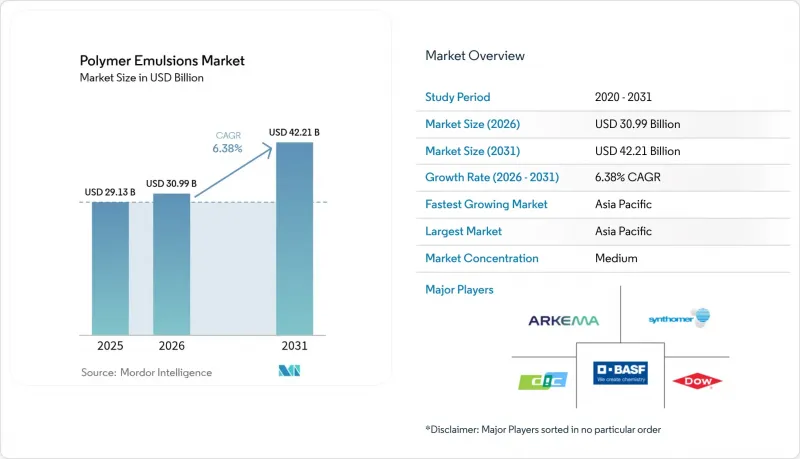
Mordor Intelligence에 의하면, 폴리머 에멀전 시장 규모는 2025년 291억 3,000만 달러로 평가되었습니다. 2026년에는 309억 9,000만 달러로 확대되어 2026년부터 2031년에 걸쳐 CAGR 6.38%로 성장을 지속하여, 2031년에는 422억 1,000만 달러에 이를 것으로 예측됩니다.
본 보고서에서는 업계를 제품 유형(아크릴계, 스티렌·부타디엔(SB) 라텍스 등), 용도(페인트 및 코팅,접착제·카펫 안감 등), 최종 사용자 산업(건축 및 건설, 포장 등), 고형분 함량(고고형분, 중고형분, 저고형분), 지역(아시아태평양, 북미, 유럽, 남미, 중동 및 아프리카)별로 분류하고 있습니다.
세계의 폴리머 에멀전 시장 동향 및 인사이트
아시아의 건설 붐에 힘입어 저VOC 수성 도료로의 전환
아시아의 메가시티에서는 주택 및 인프라 건설이 기록적인 속도로 진행되고 있으며, 엄격한 배출 기준을 준수하는 수성 외장·내장용 도료에 대한 수요가 증가하고 있습니다. 중국의 최신 대기질 계획과 인도의 개정된 국가 건축 기준에서는 VOC 함량이 50 g/l 미만인 도료를 권장하고 있으며, 이에 따라 용제형 알키드 수지 도료로부터의 급속한 대체가 진행되고 있습니다. 이에 대응하여 각 제조업체는 내식성과 저취성을 겸비한 람베르티(Lambert)사의 ‘ESACOTE AC 509’와 같은 아크릴 라텍스 제품으로 대응하고 있습니다. 건강 및 안전상의 이점, 손쉬운 정리, 작업자의 노출 한계치 감소 등이 이러한 시스템에 대한 선호도를 높이고 있으며, 이는 단순한 규제 준수에 그치지 않는 선순환을 만들어내어 폴리머 에멀젼 시장의 장기적인 수요를 확고히 하고 있습니다.
자동차 OEM의 친환경 스크래치 방지 마감재에 대한 수요
현재 북미 및 유럽의 자동차 조립 제조업체들은 용제계와 동등한 내구성을 유지하면서 탄소 발자국을 줄일 수 있는 수성 프라이머·서페이서 및 클리어 코트 패키지를 지정하고 있습니다. 배합 개발자들은 경도와 내스크래치성을 실현하기 위해 자가 가교 블록을 갖춘 하이브리드 폴리우레탄·아크릴 매트릭스를 채택하고 있습니다. Sun Chemical사의 ‘WATERSOL AC’ 시리즈는 VOC를 최대 90%까지 줄이면서 고광택과 미세한 흠집에 대한 내성을 실현하는 코팅제로서 이러한 진보를 구현하고 있습니다. 주요 성능상의 과제가 해결됨에 따라 각 브랜드 소유 기업들은 지속가능성을 강조하며 전 세계 자동차 공장에서의 판매량 증가를 가속화하고 있습니다.
변동이 심한 부타디엔 및 아크릴레이트 단량체 가격
원자재 가격의 급격한 변동으로 인해 라텍스 제조업체의 이익률은 압박을 받고 있습니다. 특히 나프타 가격 변동에 연동되는 스티렌·부타디엔 계열 제품에서 이러한 경향이 두드러집니다. 계약 사양 조정은 분기별로 이루어지는 것이 일반적이며, 가격 급등 시에는 공급업체가 위험에 노출됩니다. 각사는 조달처를 다각화하고, 설탕 유래 아크릴 수지의 도입을 검토함으로써 원자재 비용의 안정화를 도모하고 있지만, 단기적인 가격 변동은 계속해서 수익성을 압박하고 있어 설비 투자의 연기로 이어질 가능성이 있습니다.
부문별 분석
아크릴 수지는 2025년 생산량의 44.40%를 차지했으며, 같은 해 129억 3,000만 달러의 매출을 올렸습니다. 이 부문은 폭넓은 호환성, 뛰어난 내후성, 신속한 규제 승인 등의 장점으로 인해 장식용 도료, 실란트, 점착 라벨 분야에서 표준 플랫폼으로서의 입지를 확고히 하고 있습니다. 세라니즈(Ceranies)사의 EcoVAE 등급은 저취와 A급 내스크럽성을 겸비하여 친환경 건축 요건을 충족합니다. 스티렌-부타디엔 라텍스는 종이 코팅 및 카펫 안감 분야에서 여전히 비용 효율적인 선택지이지만, 재생 섬유의 품질이 향상됨에 따라 그 성장세는 완만하게 유지되고 있습니다. 비닐 아세테이트 폴리머는 유연성이 필수적인 플라스터 및 퍼티 배합 분야에서 안정적인 수요를 유지하고 있습니다. ‘기타’ 범주에는 실리콘 변성 에멀젼 및 바이오 유래 에멀젼이 포함되어 있으며, 의료용 필름과 같은 고수익성 틈새 시장에서 선택적으로 확대되고 있습니다. 한편, 폴리우레탄 분산액은 연평균 성장률(CAGR) 6.78%로 가장 빠르게 성장하고 있으며, 그 원동력은 고급 자동차, 연포장 및 특수 바닥 마감 용도입니다. 이러한 용도에서는 강인성, 투명성, 가수분해 저항성 덕분에 높은 가격이 정당화되고 있습니다. 전반적으로 제품 다각화가 폴리머 에멀젼 시장의 회복력을 뒷받침하고 있습니다.
탄소 배출량 감축을 위한 움직임은 발포를 억제하고 VOC를 줄이는 계면활성제를 포함하지 않는 광중합 공정에 대한 투자를 촉진하고 있습니다. 실험실 연구에 따르면, 기존의 비누계 시스템을 사용하지 않고도 55%의 고형분 함량에서 안정적인 격자 구조를 확보할 수 있었으며, 이를 통해 규제 준수 및 폐수 처리가 간소화될 가능성이 있습니다. 이러한 기법을 도입하는 공급업체는 선구자로서 프리미엄을 확보할 수 있을 것으로 보입니다. 바이오 아크릴 및 당 유래 부타디엔의 생산 규모가 확대됨에 따라, 수명 주기 전반에 걸친 환경 부담 지수는 더욱 낮아져 주요 하류 브랜드의 Scope 3 목표와 부합할 뿐만 아니라, 폴리머 에멀젼 업계를 선도하는 지속가능성 스토리를 강화하게 될 것입니다.
2025년 수요의 45.70%를 도료 및 코팅이 차지했으며, 그 시장 규모는 133억 1,000만 달러에 달했습니다. 엄격한 VOC 규제로 인해 장식용, 보호용, 자동차용 시스템의 수성 플랫폼 전환이 촉진되고 있습니다. 람베르티(Lambert)사의 ‘직접 투 메탈(Direct-to-Metal)’ 아크릴 도료는 건조막 두께 120µm에서 용제계와 동등한 부식 방지 성능을 발휘하고 있으며, 이러한 성능의 동등성이 가혹한 환경에서의 채택을 가능하게 하는 좋은 사례입니다. 접착제 및 카펫 배지는 연포장용 및 건설용 테이프에서 용제계 아크릴이 단계적으로 폐지됨에 따라 6.95%라는 가장 높은 연평균 성장률(CAGR)을 기록하고 있습니다. 수성 감압 접착제는 현재 냉동 보관이나 자외선 조사에도 견딜 수 있게 되어 그 기능 범위가 확대되고 있습니다.
종이 및 판지 분야는 안정적인 추세를 보이고 있지만, 질적인 변화가 진행되고 있습니다. 베르사틱산의 비닐 에스테르를 배합한 수성 배리어 소재는 내습성 및 내유성이 향상되어, 폴리에틸렌 압출 성형 컵이나 트레이를 단일 소재 구조로 대체하는 것이 가능해졌습니다. 섬유, 가죽, 그리고 신흥 분야인 3D 프린팅용 바인더가 다양한 ‘기타’ 카테고리를 차지하고 있습니다. 각 부문에서 디지털 컬러 매칭 및 인라인 점도 제어 시스템을 통해 배치 간 편차가 감소하고, 수성 수지의 사용이 더욱 정착되면서 폴리머 에멀젼 시장의 성장 궤도를 끌어올리고 있습니다.
지역별 분석
아시아태평양은 2025년에 매출의 40.85%(119억 달러 상당)를 차지했으며, 2031년까지 연평균 성장률(CAGR) 7.11%로 성장할 것으로 전망됩니다. 중국, 인도, 인도네시아, 베트남의 건설 붐으로 인해 건축용 라텍스가 대량으로 소비되고 있을 뿐만 아니라, 이 지역의 자동차 제조업체에서는 내스크래치성이 뛰어난 수성 탑코트가 채택되고 있습니다. 중국과 베트남 등 신흥 거점에서 다국적 공급업체들이 생산 능력을 확대함에 따라 리드 타임이 단축되고, 구매자들은 운임 변동으로부터 보호받고 있습니다. 일본과 한국은 광학 필름, 전도성 코팅, 친환경 가죽 마감과 같은 고성능 틈새 시장에 주력하고 있으며, 국내 연구 개발의 깊이가 프리미엄 가격 확보로 이어지고 있습니다.
북미는 규모 면에서 2위를 차지하는 지역입니다. 미국에서는 리모델링, 인프라, 전기차(EV) 제조 분야에서 수성 도료의 도입이 추진되고 있습니다. 저취·속건성 배합에 대한 수요가 높아지는 가운데, 공급업체들은 차세대 아크릴·PU 하이브리드 도료의 출시를 서두르고 있습니다. 캐나다에서는 목재 마감용 및 포장용 등급 수요가 견조한 추세를 보이고 있습니다. 멕시코에서는 급속히 확대되는 가전 및 자동차 조립 공장이 현지 수요를 끌어올리고 있으며, 코팅 공급망을 남쪽으로 끌어당기는 니어쇼어링 동향도 이를 뒷받침하고 있습니다.
유럽은 EU의 적극적인 용제 감축 규제에 의해 형성되는 매우 중요한 시장으로 남아 있습니다. 독일, 프랑스, 영국, 이탈리아에서는 장식용 도료 및 산업용 유지보수 제품의 전환을 가속화하는 국가 차원의 그린 빌딩 기준이 도입되었습니다. EU 역내에서 용제형 라미네이트용 접착제의 사용 금지는 연포장 라인에서 수성 화학제품의 급속한 보급을 뒷받침하고 있습니다. 한편, VAM의 정기적인 생산 중단으로 인한 원료 공급 제약은 공급 안정성에 대한 우려를 부각시키고 있으며, 가공업체들은 동유럽 및 중동에서 이중 조달을 확보해야 하는 상황에 처해 있습니다.
남미, 중동 및 아프리카의 점유율은 작지만 뚜렷한 성장세를 보이고 있습니다. 브라질은 라텍스 모르타르 사용을 확대하는 인프라 및 주택 건설 프로그램의 혜택을 받고 있습니다. 중동은 원료의 우위를 활용하고 있으며, 사우디아라비아와 UAE에 신설된 아크릴 에멀전 공장이 유럽과 아시아로 수출을 진행함에 따라 무역 흐름에 변화가 생기고 있습니다. 남아프리카공화국은 내구성이 뛰어나고 VOC 함량이 낮은 도료를 필요로 하는 정부 주도의 도로 및 주택 프로젝트로 인해 아프리카의 소비를 주도하고 있습니다. 이러한 신흥 지역 전반에 걸쳐 각국 정부는 세계보건기구(WHO)의 실내 공기질 지침을 점점 더 많이 참조하고 있으며, 현지 규제를 국제 기준에 부합하도록 조정함으로써 폴리머 에멀전 시장에 대한 지속적인 수요를 확보하고 있습니다.
기타 혜택 :
- 엑셀 형식 시장 예측(ME) 시트
- 3개월간의 애널리스트 지원
자주 묻는 질문
목차
제1장 서론
제2장 조사의 전제조건과 시장의 정의
제3장 주요 요약
제4장 시장 구도
제5장 시장 규모 및 성장 예측
제6장 경쟁 구도
제7장 시장 기회 및 향후 전망
KTH 26.08.26According to Mordor Intelligence, the polymer emulsions market size is expected to grow from USD 29.13 billion in 2025 to USD 30.99 billion in 2026 and is forecast to reach USD 42.21 billion by 2031 at 6.38% CAGR over 2026-2031.
This report Segments the Industry by Product Type (Acrylics, Styrene Butadiene (SB) Latex, and More), Application (Paints and Coatings, Adhesives and Carpet Backing, and More), End-User Industry (Building and Construction, Packaging, and More), Solid Content (High Solids, Medium Solids, and Low Solids), and Geography (Asia-Pacific, North America, Europe, South America, and Middle-East and Africa).
Global Polymer Emulsions Market Trends and Insights
Shift Toward Low-VOC Water-Borne Coatings Fueled by Asia's Construction Boom
Asian megacities continue to add housing and infrastructure at record pace, raising demand for water-based exterior and interior paints that comply with strict emission targets. China's latest air-quality plan and India's updated National Building Code promote coatings below 50 g VOC l-1, spurring rapid substitution of solvent alkyds. Manufacturers answer with acrylic latexes such as Lamberti's ESACOTE AC 509 that pair corrosion resistance with low odor. Health-and-safety benefits, easier cleanup, and fewer worker exposure limits reinforce preference for these systems, creating positive feedback that extends beyond pure compliance and cements long-term demand in the polymer emulsions market.
OEM Automotive Demand for Eco-Friendly Scratch-Resistant Finishes
Vehicle assemblers in North America and Europe now specify water-borne primer-surfacer and clear-coat packages that match solvent durability while cutting carbon footprints. Formulators employ hybrid polyurethane-acrylic matrices with self-cross-linking blocks to achieve hardness and mar resistance. Sun Chemical's WATERSOL AC line illustrates this progress with coatings that deliver high gloss and low micro-scratch while eliminating up to 90% VOCs. With mainstream performance hurdles removed, brand-owners market sustainability credentials, accelerating volume growth across global auto plants.
Volatile Butadiene and Acrylate Monomer Pricing
Rapid feedstock swings compress latex producer margins, especially for styrene-butadiene grades tied to fluctuating naphtha costs. Contract formulas rarely adjust faster than quarterly, exposing suppliers during spikes. Firms diversify procurement and explore sugar-based acrylics to stabilize input budgets, but near-term volatility continues to weigh on profitability and may delay capital upgrades.
Other drivers and restraints analyzed in the detailed report include:
- EU Bans on Solvent-Borne Adhesives Boosting Packaging Emulsion Uptake
- Increased Textile and Paper Industry Usage
- Performance Gap versus Solvent-Borne Coatings in Heavy-Duty Uses
For complete list of drivers and restraints, kindly check the Table Of Contents.
Segment Analysis
Acrylic resins controlled 44.40% of 2025 volume and generated USD 12.93 billion in 2025. The segment benefits from broad compatibility, solid weatherability, and rapid regulatory approvals, cementing its role as the default platform across decorative paints, sealants, and pressure-sensitive labels. Celanese's EcoVAE grades combine low odor with Class A scrub resistance, satisfying green-building schemes. Styrene-butadiene latex remains a cost-efficient choice for paper coating and carpet backing, though growth is modest as recycled fiber quality improves. Vinyl acetate polymers sustain steady demand in plaster and putty compounds where flexibility is essential. The "Others" cluster, including silicone-modified and bio-derived emulsions, expands selectively in high-margin niches such as medical films. Polyurethane dispersions, however, advance fastest at 6.78% CAGR, fueled by premium automotive, flexible packaging, and specialty floor-finish applications where toughness, clarity, and hydrolysis resistance justify higher prices. Collectively, product diversification anchors resilience in the polymer emulsions market.
The push for lower embodied carbon spurs investment in surfactant-free photoinitiated processes that tame foaming and cut VOCs. Laboratory work shows stable lattices at 55% solid without traditional soap systems, which can simplify compliance and effluent treatment. Suppliers integrating these methods stand to capture early-mover premiums. As bio-acrylic and sugar-route butadiene scale, life-cycle impact scores should fall further, aligning with scope-3 targets of major downstream brands and reinforcing the sustainability narrative driving the polymer emulsions industry.
Paints and coatings consumed 45.70% of 2025 demand, equal to USD 13.31 billion in 2025. Stringent VOC caps encourage conversion of decorative, protective, and automotive systems to water-borne platforms. Lamberti's direct-to-metal acrylic, which matches solvent corrosion protection at 120 µm dry film, exemplifies how performance parity unlocks heavy-duty adoption. Adhesives and carpet backing record the fastest 6.95% CAGR as flexible packaging and construction tapes phase out solvent acrylics. Water-borne pressure-sensitives now withstand freezer storage and UV exposure, broadening their function set.
Paper and paperboard remain steady but are undergoing qualitative change. Water-based barriers incorporating vinyl ester of Versatic acid improve moisture and oil resistance, allowing substitution of polyethylene-extruded cups and trays with single-material structures. Textile, leather, and emerging 3-D printing binders fill the diverse "Others" bucket. Across segments, digital color-matching and inline viscosity control systems reduce batch variability, further normalizing water-borne use and lifting the polymer emulsions market trajectory.
Complete Report Scope:
- By Product Type
- Acrylics
- Styrene-Butadiene (SB) Latex
- Vinyl Acetate Polymers
- PVA Homopolymer
- Other Vinyl Acetates
- Polyurethane (PU) Dispersions
- Others
- By Application
- Paints and Coatings
- Adhesives and Carpet Backing
- Paper and Paperboard
- Others
- By End-User Industry
- Building and Construction
- Automotive and Transportation
- Packaging
- Wood and Furniture
- Textile and Apparel
- Others (Chemicals and General Manufacturing)
- By Solid Content
- High Solids (more than 55 %)
- Medium Solids (45-55 %)
- Low Solids (less than 45 %)
- Geography
- Asia-Pacific
- China
- India
- Japan
- South Korea
- Rest of Asia-Pacific
- North America
- United States
- Canada
- Mexico
- Europe
- Germany
- United Kingdom
- France
- Italy
- Rest of Europe
- South America
- Brazil
- Argentina
- Rest of South America
- Middle East and Africa
- Saudi Arabia
- South Africa
- Rest of Middle East and Africa
- Asia-Pacific
Geography Analysis
Asia-Pacific commanded 40.85% of revenue in 2025, equivalent to USD 11.90 billion, and is projected to grow at 7.11% CAGR through 2031. Building booms in China, India, Indonesia, and Vietnam consume vast volumes of architectural latex, while regional automakers apply scratch-resistant water-borne topcoats. Capacity additions by multinational suppliers in China and emerging hubs such as Vietnam shorten lead times and shield buyers from freight swings. Japan and South Korea concentrate on high-performance niches-optical films, conductive coatings, and eco-friendly leather finishes-where domestic research and development depth secures premium pricing.
North America sits as the second-largest region. The United States drives water-borne adoption in remodeling, infrastructure, and EV manufacturing. Demand for low odor and rapid-dry formulations pushes suppliers to roll out next-generation acrylic-PU hybrids. Canada maintains healthy consumption in wood finishes and packaging grades. Mexico's fast-expanding appliance and automotive assembly plants lift local demand, aided by near-shoring trends that draw coatings supply chains southward.
Europe remains a pivotal market shaped by the EU's aggressive solvent-reduction mandates. Germany, France, the United Kingdom, and Italy implement national green-building codes that accelerate switch-overs in decorative paints and industrial maintenance products. The bloc's ban on solvent-borne laminating adhesives propels swift uptake of water-borne chemistries in flexible packaging lines. Meanwhile, feedstock constraints from periodic VAM outages underscore supply-security concerns, pushing converters to qualifying dual sourcing in Eastern Europe and the Middle East.
South America and the Middle East and Africa hold smaller shares yet exhibit notable momentum. Brazil benefits from infrastructure and housing programs that expand latex mortar use. The Middle East leverages feedstock advantage; new acrylic emulsion plants in Saudi Arabia and the UAE export to Europe and Asia, altering trade flows. South Africa anchors African consumption with government-backed road and housing projects that call for durable low-VOC coatings. Across these emerging regions, governments increasingly reference the World Health Organization indoor air guidelines, aligning local regulations with global norms and ensuring sustained demand for the polymer emulsions market.
- 3M
- Allnex GmbH
- Akzo Nobel N.V.
- Arkema
- Asahi Kasei Corporation
- BASF
- Celanese Corporation
- Clariant
- Covestro AG
- DIC CORPORATION
- Dow
- Eastman Chemical Company
- Eni S.p.A.
- Georgia-Pacific
- JSR Corporation
- Kamsons Polymer Limited
- Lamberti S.p.A.
- Mallard Creek Polymers
- Polynt S.p.A.
- Synthomer plc
- The Lubrizol Corporation
- Wacker Chemie AG
- ZEON CORPORATION
Additional Benefits:
- The market estimate (ME) sheet in Excel format
- 3 months of analyst support
TABLE OF CONTENTS
1 Introduction
2 Study Assumptions and Market Definition
- 2.1 Scope of the Study
- 2.2 Research Methodology
3 Executive Summary
4 Market Landscape
- 4.1 Market Overview
- 4.2 Market Drivers
- 4.2.1 Shift Toward Low-VOC Water-borne Coatings Fueled by Asia's Construction Boom
- 4.2.2 OEM Automotive Demand for Eco-Friendly Scratch-Resistant Finishes in North America and Europe
- 4.2.3 EU Bans on Solvent-Borne Adhesives Boosting Packaging Emulsion Uptake
- 4.2.4 Capacity Expansions of Acrylic Emulsion Plants in GCC Nations
- 4.2.5 Increased Textile and Paper Industry Usage
- 4.3 Market Restraints
- 4.3.1 Volatile Butadiene and Acrylate Monomer Pricing
- 4.3.2 Performance Gap vs. Solvent-borne Coatings in Heavy-Duty Uses
- 4.3.3 VAM Supply Disruptions in Europe
- 4.4 Value Chain Analysis
- 4.5 Porter's Five Forces Analysis
- 4.5.1 Bargaining Power of Suppliers
- 4.5.2 Bargaining Power of Buyers
- 4.5.3 Threat of New Entrants
- 4.5.4 Threat of Substitutes
- 4.5.5 Intensity of Rivalry
- 4.6 Supply and Demand Analysis
- 4.6.1 Major Current and Planned Projects
- 4.6.2 Trade Analysis
- 4.6.3 Current Supply and Demand Scenario
5 Market Size and Growth Forecasts (Value)
- 5.1 By Product Type
- 5.1.1 Acrylics
- 5.1.2 Styrene-Butadiene (SB) Latex
- 5.1.3 Vinyl Acetate Polymers
- 5.1.3.1 PVA Homopolymer
- 5.1.3.2 Other Vinyl Acetates
- 5.1.4 Polyurethane (PU) Dispersions
- 5.1.5 Others
- 5.2 By Application
- 5.2.1 Paints and Coatings
- 5.2.2 Adhesives and Carpet Backing
- 5.2.3 Paper and Paperboard
- 5.2.4 Others
- 5.3 By End-User Industry
- 5.3.1 Building and Construction
- 5.3.2 Automotive and Transportation
- 5.3.3 Packaging
- 5.3.4 Wood and Furniture
- 5.3.5 Textile and Apparel
- 5.3.6 Others (Chemicals and General Manufacturing)
- 5.4 By Solid Content
- 5.4.1 High Solids (more than 55 %)
- 5.4.2 Medium Solids (45-55 %)
- 5.4.3 Low Solids (less than 45 %)
- 5.5 Geography
- 5.5.1 Asia-Pacific
- 5.5.1.1 China
- 5.5.1.2 India
- 5.5.1.3 Japan
- 5.5.1.4 South Korea
- 5.5.1.5 Rest of Asia-Pacific
- 5.5.2 North America
- 5.5.2.1 United States
- 5.5.2.2 Canada
- 5.5.2.3 Mexico
- 5.5.3 Europe
- 5.5.3.1 Germany
- 5.5.3.2 United Kingdom
- 5.5.3.3 France
- 5.5.3.4 Italy
- 5.5.3.5 Rest of Europe
- 5.5.4 South America
- 5.5.4.1 Brazil
- 5.5.4.2 Argentina
- 5.5.4.3 Rest of South America
- 5.5.5 Middle East and Africa
- 5.5.5.1 Saudi Arabia
- 5.5.5.2 South Africa
- 5.5.5.3 Rest of Middle East and Africa
- 5.5.1 Asia-Pacific
6 Competitive Landscape
- 6.1 Market Concentration
- 6.2 Strategic Moves (Mergers and Acquisitions, JVs, Funding)
- 6.3 Market Share Analysis
- 6.4 Company Profiles (includes Global-level Overview, Market-level Overview, Core Segments, Financials, Strategic Information, Market Rank/Share, Products and Services, Recent Developments)
- 6.4.1 3M
- 6.4.2 Allnex GmbH
- 6.4.3 Akzo Nobel N.V.
- 6.4.4 Arkema
- 6.4.5 Asahi Kasei Corporation
- 6.4.6 BASF
- 6.4.7 Celanese Corporation
- 6.4.8 Clariant
- 6.4.9 Covestro AG
- 6.4.10 DIC CORPORATION
- 6.4.11 Dow
- 6.4.12 Eastman Chemical Company
- 6.4.13 Eni S.p.A.
- 6.4.14 Georgia-Pacific
- 6.4.15 JSR Corporation
- 6.4.16 Kamsons Polymer Limited
- 6.4.17 Lamberti S.p.A.
- 6.4.18 Mallard Creek Polymers
- 6.4.19 Polynt S.p.A.
- 6.4.20 Synthomer plc
- 6.4.21 The Lubrizol Corporation
- 6.4.22 Wacker Chemie AG
- 6.4.23 ZEON CORPORATION
7 Market Opportunities and Future Outlook
- 7.1 White-space and Unmet-Need Assessment
- 7.2 Emerging Market for Bio-based Emulsion Polymer


